Hubbry Logo
Sparse dictionary learningSparse dictionary learningMain
Open search
Sparse dictionary learning
Community hub
Sparse dictionary learning
logo
7 pages, 0 posts
0 subscribers
Be the first to start a discussion here.
Sparse dictionary learning
from Wikipedia

Sparse dictionary learning (also known as sparse coding or SDL) is a representation learning method which aims to find a sparse representation of the input data in the form of a linear combination of basic elements as well as those basic elements themselves. These elements are called atoms, and they compose a dictionary. Atoms in the dictionary are not required to be orthogonal, and they may be an over-complete spanning set. This problem setup also allows the dimensionality of the signals being represented to be higher than any one of the signals being observed. These two properties lead to having seemingly redundant atoms that allow multiple representations of the same signal, but also provide an improvement in sparsity and flexibility of the representation.

One of the most important applications of sparse dictionary learning is in the field of compressed sensing or signal recovery. In compressed sensing, a high-dimensional signal can be recovered with only a few linear measurements, provided that the signal is sparse or near-sparse. Since not all signals satisfy this condition, it is crucial to find a sparse representation of that signal such as the wavelet transform or the directional gradient of a rasterized matrix. Once a matrix or a high-dimensional vector is transferred to a sparse space, different recovery algorithms like basis pursuit, CoSaMP,[1] or fast non-iterative algorithms[2] can be used to recover the signal.

One of the key principles of dictionary learning is that the dictionary has to be inferred from the input data. The emergence of sparse dictionary learning methods was stimulated by the fact that in signal processing, one typically wants to represent the input data using a minimal amount of components. Before this approach, the general practice was to use predefined dictionaries such as Fourier or wavelet transforms. However, in certain cases, a dictionary that is trained to fit the input data can significantly improve the sparsity, which has applications in data decomposition, compression, and analysis, and has been used in the fields of image denoising and classification, and video and audio processing. Sparsity and overcomplete dictionaries have immense applications in image compression, image fusion, and inpainting.

Image denoising by dictionary learning

Problem statement

[edit]

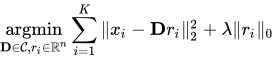
Given the input dataset we wish to find a dictionary and a representation such that both is minimized and the representations are sparse enough. This can be formulated as the following optimization problem:

, where ,

is required to constrain so that its atoms would not reach arbitrarily high values allowing for arbitrarily low (but non-zero) values of . controls the trade off between the sparsity and the minimization error.

The minimization problem above is not convex because of the 0-"norm" and solving this problem is NP-hard.[3] In some cases L1-norm is known to ensure sparsity[4] and so the above becomes a convex optimization problem with respect to each of the variables and when the other one is fixed, but it is not jointly convex in .

Properties of the dictionary

[edit]

The dictionary defined above can be "undercomplete" if or "overcomplete" in case with the latter being a typical assumption for a sparse dictionary learning problem. The case of a complete dictionary does not provide any improvement from a representational point of view and thus isn't considered.

Undercomplete dictionaries represent the setup in which the actual input data lies in a lower-dimensional space. This case is strongly related to dimensionality reduction and techniques like principal component analysis which require atoms to be orthogonal. The choice of these subspaces is crucial for efficient dimensionality reduction, but it is not trivial. And dimensionality reduction based on dictionary representation can be extended to address specific tasks such as data analysis or classification. However, their main downside is limiting the choice of atoms.

Overcomplete dictionaries, however, do not require the atoms to be orthogonal (they will never have a basis anyway) thus allowing for more flexible dictionaries and richer data representations.

An overcomplete dictionary which allows for sparse representation of signal can be a famous transform matrix (wavelets transform, fourier transform) or it can be formulated so that its elements are changed in such a way that it sparsely represents the given signal in a best way. Learned dictionaries are capable of giving sparser solutions as compared to predefined transform matrices.

Algorithms

[edit]

As the optimization problem described above can be solved as a convex problem with respect to either dictionary or sparse coding while the other one of the two is fixed, most of the algorithms are based on the idea of iteratively updating one and then the other.

The problem of finding an optimal sparse coding with a given dictionary is known as sparse approximation (or sometimes just sparse coding problem). A number of algorithms have been developed to solve it (such as matching pursuit and LASSO) and are incorporated in the algorithms described below.

Method of optimal directions (MOD)

[edit]

The method of optimal directions (or MOD) was one of the first methods introduced to tackle the sparse dictionary learning problem.[5] The core idea of it is to solve the minimization problem subject to the limited number of non-zero components of the representation vector:

Here, denotes the Frobenius norm. MOD alternates between getting the sparse coding using a method such as matching pursuit and updating the dictionary by computing the analytical solution of the problem given by where is a Moore-Penrose pseudoinverse. After this update is renormalized to fit the constraints and the new sparse coding is obtained again. The process is repeated until convergence (or until a sufficiently small residue).

MOD has proved to be a very efficient method for low-dimensional input data requiring just a few iterations to converge. However, due to the high complexity of the matrix-inversion operation, computing the pseudoinverse in high-dimensional cases is in many cases intractable. This shortcoming has inspired the development of other dictionary learning methods.

K-SVD

[edit]

K-SVD is an algorithm that performs SVD at its core to update the atoms of the dictionary one by one and basically is a generalization of K-means. It enforces that each element of the input data is encoded by a linear combination of not more than elements in a way identical to the MOD approach:

This algorithm's essence is to first fix the dictionary, find the best possible under the above constraint (using Orthogonal Matching Pursuit) and then iteratively update the atoms of dictionary in the following manner:

The next steps of the algorithm include rank-1 approximation of the residual matrix , updating and enforcing the sparsity of after the update. This algorithm is considered to be standard for dictionary learning and is used in a variety of applications. However, it shares weaknesses with MOD being efficient only for signals with relatively low dimensionality and having the possibility for being stuck at local minima.

Stochastic gradient descent

[edit]

One can also apply a widespread stochastic gradient descent method with iterative projection to solve this problem.[6] The idea of this method is to update the dictionary using the first order stochastic gradient and project it on the constraint set . The step that occurs at i-th iteration is described by this expression:

, where is a random subset of and is a gradient step.

Lagrange dual method

[edit]

An algorithm based on solving a dual Lagrangian problem provides an efficient way to solve for the dictionary having no complications induced by the sparsity function.[7] Consider the following Lagrangian:

, where is a constraint on the norm of the atoms and are the so-called dual variables forming the diagonal matrix .

We can then provide an analytical expression for the Lagrange dual after minimization over :

.

After applying one of the optimization methods to the value of the dual (such as Newton's method or conjugate gradient) we get the value of :

Solving this problem is less computational hard because the amount of dual variables is a lot of times much less than the amount of variables in the primal problem.

LASSO

[edit]

In this approach, the optimization problem is formulated as:

, where is the permitted error in the reconstruction LASSO.

It finds an estimate of by minimizing the least square error subject to a L1-norm constraint in the solution vector, formulated as:

, where controls the trade-off between sparsity and the reconstruction error. This gives the global optimal solution.[8] See also Online dictionary learning for Sparse coding

Parametric training methods

[edit]

Parametric training methods are aimed to incorporate the best of both worlds — the realm of analytically constructed dictionaries and the learned ones.[9] This allows to construct more powerful generalized dictionaries that can potentially be applied to the cases of arbitrary-sized signals. Notable approaches include:

  • Translation-invariant dictionaries.[10] These dictionaries are composed by the translations of the atoms originating from the dictionary constructed for a finite-size signal patch. This allows the resulting dictionary to provide a representation for the arbitrary-sized signal.
  • Multiscale dictionaries.[11] This method focuses on constructing a dictionary that is composed of differently scaled dictionaries to improve sparsity.
  • Sparse dictionaries.[12] This method focuses on not only providing a sparse representation but also constructing a sparse dictionary which is enforced by the expression where is some pre-defined analytical dictionary with desirable properties such as fast computation and is a sparse matrix. Such formulation allows to directly combine the fast implementation of analytical dictionaries with the flexibility of sparse approaches.

Online dictionary learning (LASSO approach)

[edit]

Many common approaches to sparse dictionary learning rely on the fact that the whole input data (or at least a large enough training dataset) is available for the algorithm. However, this might not be the case in the real-world scenario as the size of the input data might be too big to fit it into memory. The other case where this assumption can not be made is when the input data comes in a form of a stream. Such cases lie in the field of study of online learning which essentially suggests iteratively updating the model upon the new data points becoming available.

A dictionary can be learned in an online manner the following way:[13]

  1. For
  2. Draw a new sample
  3. Find a sparse coding using LARS:
  4. Update dictionary using block-coordinate approach:

This method allows us to gradually update the dictionary as new data becomes available for sparse representation learning and helps drastically reduce the amount of memory needed to store the dataset (which often has a huge size).

Applications

[edit]

The dictionary learning framework, namely the linear decomposition of an input signal using a few basis elements learned from data itself, has led to state-of-art[citation needed] results in various image and video processing tasks. This technique can be applied to classification problems in a way that if we have built specific dictionaries for each class, the input signal can be classified by finding the dictionary corresponding to the sparsest representation. It also has properties that are useful for signal denoising since usually one can learn a dictionary to represent the meaningful part of the input signal in a sparse way but the noise in the input will have a much less sparse representation.[14]

Sparse dictionary learning has been successfully applied to various image, video and audio processing tasks as well as to texture synthesis[15] and unsupervised clustering.[16] In evaluations with the Bag-of-Words model,[17][18] sparse coding was found empirically to outperform other coding approaches on the object category recognition tasks.

Dictionary learning is used to analyse medical signals in detail. Such medical signals include those from electroencephalography (EEG), electrocardiography (ECG), magnetic resonance imaging (MRI), functional MRI (fMRI), continuous glucose monitors [19] and ultrasound computer tomography (USCT), where different assumptions are used to analyze each signal.

Dictionary learning has also been applied to passive detection of unknown signals in complex environments. In particular, it enables blind signal detection in time-spreading distortion (TSD) channels, without prior knowledge of the source signal.[20] This approach has shown effectiveness in both simulated and experimental conditions, offering robust performance in low signal-to-noise ratio scenarios.

See also

[edit]

References

[edit]
Revisions and contributorsEdit on WikipediaRead on Wikipedia
from Grokipedia
Sparse dictionary learning is a and technique that involves learning an overcomplete —a set of basis elements or atoms—from training data such that input signals can be efficiently represented as sparse linear combinations of these atoms, promoting parsimony and adaptability to the underlying . This approach contrasts with fixed dictionaries like wavelets by iteratively optimizing both the dictionary and the sparse codes to minimize reconstruction error while enforcing sparsity constraints, typically via norms such as ℓ1. The foundational concept traces back to sparse coding models in the 1990s, notably pioneered by Olshausen and Field in , who demonstrated that natural images could be represented using overcomplete bases with sparse activations, mimicking aspects of biological vision systems. Key principles include the pursuit of underdetermined linear inverse problems where the number of atoms exceeds the signal dimensionality (overcompleteness), enabling more flexible representations, and the use of priors like concave or Schur-concave functions to induce sparsity during optimization. This duality of sparse coding (finding coefficients for a fixed ) and update (refining atoms) forms the core iterative framework, often analyzed for convergence to local minima. Prominent algorithms include the Method of Optimal Directions (MOD), which alternates between sparse coding and dictionary adjustment via ; K-SVD, an extension using for atom refinement; and online variants like Online Dictionary Learning (ODL), which employ stochastic approximations for scalability on large datasets. Bayesian formulations, such as those using FOCUSS (FOCal Underdetermined System Solver) with convex/Schur-convex priors, further enhance robustness by incorporating probabilistic sparsity induction and normalization schemes like Frobenius or column-wise. Applications span image and , including denoising, , and compression, where learned dictionaries outperform predefined bases; computer vision tasks like face recognition and object via discriminative variants (e.g., LC-KSVD for label-consistent codes); for modeling neural responses; biomedical imaging for feature extraction; and for model interpretability through techniques like sparse autoencoders. Extensions incorporating structured incoherence between class-specific sub-dictionaries improve discrimination, achieving strong results in challenging scenarios like noisy or occluded data.

Overview

Definition and motivation

Sparse dictionary learning is a representation learning technique in and that involves constructing an overcomplete dictionary DD, typically represented as a matrix whose columns are known as atoms, such that a set of input signals YY can be approximated as YDXY \approx D X, where XX is a sparse with most entries near zero. This approach enables the discovery of adaptive bases tailored to the data, allowing for concise and efficient representations of complex signals. The primary motivation for sparse dictionary learning stems from the need to achieve sparse representations that facilitate efficient data processing, such as compression and denoising, while uncovering underlying structures in non-stationary signals that fixed bases like Fourier or transforms may not capture effectively. Originating in the mid-1990s with work inspired by to model receptive fields through sparse coding of natural images, the field gained further impetus in the early with the advent of compressive sensing, which emphasized the benefits of sparsity for signal recovery from undersampled data. In modern applications, it supports tasks like feature extraction and by learning data-specific dictionaries that adapt to diverse datasets, from images to audio. A basic example illustrates this in the representation of natural images; fixed bases like wavelets or Gabor filters provide sparse approximations but often require more non-zero coefficients compared to learned overcomplete dictionaries, which can derive atoms closely matching image statistics for greater sparsity and efficiency. This sparsity not only reduces storage and computational demands but also enhances robustness to by focusing on essential signal components. Sparse coding serves as the complementary process of inferring the sparse coefficients XX given a fixed DD.

Relation to sparse coding

Sparse coding addresses the task of representing input signals as linear combinations of a small number of atoms from a fixed dictionary, promoting sparsity in the coefficients to capture essential data structure. Formally, given a dictionary matrix DRm×nD \in \mathbb{R}^{m \times n} with n>mn > m for overcompleteness and a set of input signals YRm×pY \in \mathbb{R}^{m \times p}, the sparse coding problem seeks to solve minXYDX22+λX1\min_X \|Y - D X\|_2^2 + \lambda \|X\|_1 for the sparse coefficient matrix XRn×pX \in \mathbb{R}^{n \times p}, where the 1\ell_1-norm penalty λX1\lambda \|X\|_1 enforces coefficient sparsity by discouraging the use of many non-zero elements. Sparse dictionary learning extends this framework by jointly optimizing both the dictionary DD and the sparse coefficients XX, rather than treating DD as predefined, to learn a data-adaptive basis that better fits the input signals. The core objective is the non-convex optimization minD,XYDX22\min_{D,X} \|Y - D X\|_2^2 subject to sparsity constraints such as xi0T\|x_i\|_0 \leq T for each column xix_i of XX, where TT limits the number of active coefficients per signal. This coupled problem is typically addressed through alternating optimization: a sparse coding step fixes DD and solves for XX using methods like basis pursuit or iterative thresholding, followed by a dictionary update step that fixes XX and refines DD to minimize the reconstruction error while preserving sparsity. Key challenges in sparse dictionary learning arise from the NP-hard nature of the 0\ell_0-norm constraint, which counts non-zero elements and leads to combinatorial in solutions. To mitigate this, approximations via 1\ell_1-norm relaxation are commonly employed, leveraging techniques that promote sparsity while ensuring tractability, though they may not always guarantee the sparse solutions. Additionally, effective initialization of DD is crucial for convergence, often starting with random Gaussian matrices or off-the-shelf bases like discrete cosine transforms to avoid poor local minima in the non- landscape.

Mathematical Framework

Problem formulation

The sparse dictionary learning problem seeks to identify an overcomplete dictionary DRm×KD \in \mathbb{R}^{m \times K} (with K>mK > m) and sparse coefficient matrix XRK×NX \in \mathbb{R}^{K \times N} that approximate a given data matrix YRm×NY \in \mathbb{R}^{m \times N} whose columns are input signals, minimizing the reconstruction error while enforcing sparsity on the codes. The standard 0\ell_0-constrained formulation is minD,XYDXF2subject toxi0T i=1,,N,\min_{D, X} \| Y - D X \|_F^2 \quad \text{subject to} \quad \| x_i \|_0 \leq T \ \forall i = 1, \dots, N, where F\| \cdot \|_F denotes the Frobenius norm, xi0\| x_i \|_0 counts the nonzero entries in the ii-th column of XX, and TT is a sparsity level bounding the maximum number of active atoms per signal. To address scaling ambiguities inherent in the (where DD and XX can be scaled inversely without changing the product), unit 2\ell_2-norm constraints are typically imposed on the dictionary atoms: dk21\| d_k \|_2 \leq 1 for each column dkd_k of DD. A widely used convex relaxation replaces the 0\ell_0-norm pseudonorm with the 1\ell_1-norm to promote sparsity, yielding the minD,X12YDXF2+λX1subject todk21 k=1,,K,\min_{D, X} \frac{1}{2} \| Y - D X \|_F^2 + \lambda \| X \|_1 \quad \text{subject to} \quad \| d_k \|_2 \leq 1 \ \forall k = 1, \dots, K, where λ>0\lambda > 0 trades off fidelity and sparsity, and X1=i,jxij\| X \|_1 = \sum_{i,j} |x_{ij}| is the entrywise 1\ell_1-norm. This formulation facilitates tractable approximations via proximal methods or alternating minimization. The joint optimization over DD and XX is nonconvex due to the bilinear term DXDX, but it is biconvex—convex in DD for fixed XX and vice versa—enabling iterative block-coordinate descent algorithms. Identifiability remains challenging, as solutions suffer from permutation and sign-flip ambiguities among atoms, compounded by the scaling issue mitigated by normalization; local identifiability holds under conditions where the true sparse codes are sufficiently incoherent. Recovery guarantees exist when the ground-truth dictionary satisfies the restricted isometry property (RIP) of order 2T2T, ensuring unique sparse code recovery and stable dictionary estimation from sufficiently many samples.

Dictionary properties and constraints

In sparse dictionary learning, the dictionary is typically designed to be overcomplete, meaning the number of atoms KK exceeds the signal dimension mm (i.e., K>mK > m), which provides redundancy and greater flexibility in representing signals through sparse linear combinations. This overcompleteness allows for more adaptive and efficient sparse approximations compared to complete bases like orthogonal transforms, enabling the capture of diverse signal structures in applications such as image processing. To promote sparsity in the representations, the dictionary atoms are encouraged to exhibit low mutual coherence, defined as μ=maxijdi,djdi2dj2\mu = \max_{i \neq j} \frac{|\langle \mathbf{d}_i, \mathbf{d}_j \rangle|}{\|\mathbf{d}_i\|_2 \|\mathbf{d}_j\|_2}, where di\mathbf{d}_i and dj\mathbf{d}_j are distinct atoms. Low μ\mu ensures that atoms are nearly orthogonal or incoherent, facilitating unique sparse recoveries and improving the performance of recovery algorithms like basis pursuit. Several constraints are imposed on the dictionary to ensure stability, interpretability, and avoidance of degenerate solutions. Atoms are commonly normalized to have unit 2\ell_2-norm, i.e., dk2=1\|\mathbf{d}_k\|_2 = 1 for each atom dk\mathbf{d}_k, which standardizes their scale and prevents dominance by magnitude variations during learning. In domains like hyperspectral unmixing or parts-based image representation, non-negativity constraints (dk0\mathbf{d}_k \geq 0) are applied to enforce physically meaningful atoms that align with additive signal models. Additionally, trainability bounds, such as limiting the dictionary's overall energy or enforcing a minimum number of nonzeros in sparse codes, are used to avoid trivial solutions where the dictionary simply reproduces the input signals without sparsity (e.g., D=Y\mathbf{D} = \mathbf{Y}, X=I\mathbf{X} = \mathbf{I}).

Classical Algorithms

Method of Optimal Directions (MOD)

The is an early iterative algorithm for learning in sparse representations, introduced by Engan, Aase, and Husøy in 1999 as a frame design technique and later adapted for overcomplete dictionaries in tasks. It alternates between solving the sparse coding problem for fixed dictionary atoms and updating the dictionary via a closed-form least-squares solution, making it a foundational approach in the field. Unlike more complex methods, MOD treats the dictionary update as a direct minimization of the reconstruction error without modifying the sparse codes during the process. The algorithm proceeds in two main steps, repeated until convergence, typically measured by a small change in the reconstruction error or a fixed number of iterations. First, given a fixed DRm×KD \in \mathbb{R}^{m \times K}, the sparse codes XRK×NX \in \mathbb{R}^{K \times N} are computed by solving the problem for each input signal column yiy_i in the YRm×NY \in \mathbb{R}^{m \times N}, such as minxiyiDxi22\min_{x_i} \|y_i - D x_i\|_2^2 subject to xi0T0\|x_i\|_0 \leq T_0, using greedy methods like Orthogonal Matching Pursuit (OMP) or convex relaxations like basis pursuit. Second, with the sparse codes XX fixed, the is updated to minimize the Frobenius norm of the reconstruction error YDXF2\|Y - D X\|_F^2 over DD, yielding the closed-form solution D=YXD = Y X^\dagger, where XX^\dagger denotes the Moore-Penrose pseudoinverse of XX, computed as X=XT(XXT)1X^\dagger = X^T (X X^T)^{-1} assuming XXTX X^T is invertible. The updated columns are often normalized to unit norm to enforce constraints and prevent scaling issues. This process converges quickly due to the exact least-squares update but requires careful initialization, such as random subsets of the signal as initial atoms. The key objective in the dictionary update step is: D=argminDYDXF2=YXD = \arg\min_{D} \|Y - D X\|_F^2 = Y X^\dagger This derivation follows from the properties of the Frobenius norm and pseudoinverse, ensuring an optimal linear mapping from the fixed codes back to the signals. MOD offers simplicity and computational efficiency, particularly for small to moderate datasets where matrix inversions remain feasible, outperforming gradient-based alternatives in convergence speed on tasks like denoising. However, it is sensitive to inaccuracies in the sparse coding stage, as errors in XX directly propagate to the dictionary update without correction mechanisms, potentially leading to suboptimal atoms. Additionally, it does not inherently enforce sparsity or incoherence on the dictionary atoms themselves, relying on post-normalization or external constraints, which can limit its performance on highly overcomplete dictionaries.

K-SVD algorithm

The K-SVD algorithm is an iterative procedure designed to learn overcomplete dictionaries that enable sparse representations of input signals, building on the framework of alternating optimization between sparse coding and dictionary refinement. It generalizes the K-means clustering approach to the sparse coding setting by minimizing the representation error YDXF2\|Y - D X\|_F^2 subject to sparsity constraints xi0T\|x_i\|_0 \leq T for each signal column yiy_i in the input matrix YY, where DD is the dictionary and XX the coefficient matrix. Introduced by Aharon, Elad, and Bruckstein in 2006, the algorithm proceeds in two main stages per iteration: sparse coding with a fixed dictionary, followed by a targeted dictionary update that refines individual atoms while preserving overall sparsity. In the sparse coding stage, the coefficients XX are computed for the current dictionary DD using greedy algorithms such as Orthogonal Matching Pursuit (OMP), which selects at most TT atoms per signal to approximate YY while enforcing the 0\ell_0-sparsity constraint. This stage ensures that each signal is represented as a of a small number of atoms. The update stage enhances adaptability by processing one atom at a time, contrasting with global updates in precursor methods like MOD. For the kk-th atom dkd_k, the matrix excluding its contribution is first formed as Ek=Yjkdjxj,E_k = Y - \sum_{j \neq k} d_j x^j, where xjx^j denotes the jj-th row of XX. The support set is defined as Ωk={iXk,i0}\Omega_k = \{ i \mid X_{k,i} \neq 0 \}, and the restricted EkRE_k^R is obtained by taking the columns of EkE_k indexed by Ωk\Omega_k. An SVD is then applied to EkRE_k^R: EkR=UΣVT,E_k^R = U \Sigma V^T, and the atom and its restricted coefficients are updated using the rank-1 approximation: dk=u1d_k = u_1 (the first left singular vector) and xkR=σ1v1Tx_k^R = \sigma_1 v_1^T (the first times the first right singular vector), with zeros maintained outside Ωk\Omega_k. This step minimizes the for the signals using atom kk while preserving the sparsity level TT per signal. The process cycles through all atoms sequentially within each iteration. This per-atom refinement via SVD allows to better capture data-specific structures compared to MOD's least-squares approach, as the rank-1 update flexibly adapts both atoms and coefficients to reduce residual errors. Empirically, outperforms MOD on benchmark tasks, such as reconstructing 8×8 image patches from the standard training set, and superior adaptability to natural image statistics, enabling better compression and denoising performance.

Optimization-Based Methods

LASSO and basis pursuit

In sparse dictionary learning, for a fixed dictionary DD, the sparse coding subproblem seeks to represent an input signal yy as a DxDx where the vector xx is sparse. This is commonly formulated as the least absolute shrinkage and selection operator () problem: minx12yDx22+λx1,\min_x \frac{1}{2} \| y - Dx \|_2^2 + \lambda \| x \|_1, where λ>0\lambda > 0 is a regularization balancing reconstruction fidelity and sparsity. The 1\ell_1-norm penalty promotes sparsity by shrinking small s toward zero while retaining larger ones, making it a convex relaxation of the combinatorial 0\ell_0-norm minimization. Efficient solvers for this LASSO formulation include , such as the iterative soft-thresholding (ISTA), which alternates between a step on the quadratic loss and a soft-thresholding operation on the coefficients to enforce the 1\ell_1 penalty. methods, which optimize one at a time while fixing others, also provide fast and scalable solutions, particularly for large-scale problems. These approaches ensure convergence to the global optimum due to the convexity of the objective. The basis pursuit formulation addresses the sparse coding problem in a constrained manner, particularly useful for noisy observations. In the noisy case, it is posed as: minxx1subject toyDx2ϵ,\min_x \| x \|_1 \quad \text{subject to} \quad \| y - Dx \|_2 \leq \epsilon, where ϵ\epsilon bounds the level. This is equivalent to the under appropriate choice of λ\lambda, as the of the constraint yields the penalized form when noise is present. Theoretical guarantees for sparse recovery via basis pursuit or rely on the dictionary DD satisfying the () of order 2k2k, meaning there exist constants δ2k(0,1)\delta_{2k} \in (0,1) such that for any kk-sparse vector hh, (1δ2k)h22Dh22(1+δ2k)h22.(1 - \delta_{2k}) \| h \|_2^2 \leq \| Dh \|_2^2 \leq (1 + \delta_{2k}) \| h \|_2^2. If δ2k<21\delta_{2k} < \sqrt{2} - 1
Add your contribution
Related Hubs
User Avatar
No comments yet.