Hubbry Logo
Neurospora crassaNeurospora crassaMain
Open search
Neurospora crassa
Community hub
Neurospora crassa
logo
8 pages, 0 posts
0 subscribers
Be the first to start a discussion here.
Neurospora crassa
Neurospora crassa
from Wikipedia

Neurospora crassa
Scientific classification Edit this classification
Kingdom: Fungi
Division: Ascomycota
Class: Sordariomycetes
Order: Sordariales
Family: Sordariaceae
Genus: Neurospora
Species:
N. crassa
Binomial name
Neurospora crassa
Shear & B.O. Dodge

Neurospora crassa is a type of red bread mold of the phylum Ascomycota. The genus name, meaning 'nerve spore' in Greek, refers to the characteristic striations on the spores. The first published account of this fungus was from an infestation of French bakeries in 1843.[1]

Neurospora crassa is used as a model organism because it is easy to grow and has a haploid life cycle that makes genetic analysis simple since recessive traits will show up in the offspring. Analysis of genetic recombination is facilitated by the ordered arrangement of the products of meiosis in Neurospora ascospores. Its entire genome of seven chromosomes has been sequenced.[2]

Neurospora was used by Edward Tatum and George Wells Beadle in their experiments for which they won the Nobel Prize in Physiology or Medicine in 1958. Beadle and Tatum exposed N. crassa to x-rays, causing mutations. They then observed failures in metabolic pathways caused by errors in specific enzymes. This led them to propose the "one gene, one enzyme" hypothesis that specific genes code for specific proteins. Their hypothesis was later elaborated to enzyme pathways by Norman Horowitz, also working on Neurospora. As Norman Horowitz reminisced in 2004,[3] "These experiments founded the science of what Beadle and Tatum called 'biochemical genetics'. In actuality, they proved to be the opening gun in what became molecular genetics and all developments that have followed from that."

In the 24 April 2003 issue of Nature, the genome of N. crassa was reported as completely sequenced.[4] The genome is about 43 megabases long and includes approximately 10,000 genes. There is a project underway to produce strains containing knockout mutants of every N. crassa gene.[5]

In its natural environment, N. crassa lives mainly in tropical and sub-tropical regions.[6] It can be found growing on dead plant matter after fires.

Neurospora is actively used in research around the world. It is important in the elucidation of molecular events involved in circadian rhythms, epigenetics and gene silencing, cell polarity, cell fusion, development, as well as many aspects of cell biology and biochemistry.

The sexual cycle

[edit]
Neurospora crassa life cycle. The haploid mycelium reproduces asexually by two processes: (1) simple proliferation of existing mycelium, and (2) formation of conidia (macro- and micro-) which can be dispersed and then germinate to produce new mycelium. In the sexual cycle, mating can only occur between individual strains of different mating type, A and a. Fertilization occurs by the passage of nuclei of conidia or mycelium of one mating type into the protoperithecia of the opposite mating type through the trichogyne. Fusion of the nuclei of opposite mating types occurs within the protoperithecium to form a zygote (2N) nucleus.

Sexual fruiting bodies (perithecia) can only be formed when two mycelia of different mating type come together (see Figure). Like other Ascomycetes, N. crassa has two mating types that, in this case, are symbolized by A and a. There is no evident morphological difference between the A and a mating type strains. Both can form abundant protoperithecia, the female reproductive structure (see Figure). Protoperithecia are formed most readily in the laboratory when growth occurs on solid (agar) synthetic medium with a relatively low source of nitrogen.[7] Nitrogen starvation appears to be necessary for expression of genes involved in sexual development.[8] The protoperithecium consists of an ascogonium, a coiled multicellular hypha that is enclosed in a knot-like aggregation of hyphae. A branched system of slender hyphae, called the trichogyne, extends from the tip of the ascogonium projecting beyond the sheathing hyphae into the air. The sexual cycle is initiated (i.e. fertilization occurs) when a cell (usually a conidium) of opposite mating type contacts a part of the trichogyne (see Figure). Such contact can be followed by cell fusion leading to one or more nuclei from the fertilizing cell migrating down the trichogyne into the ascogonium. Since both A and a strains have the same sexual structures, neither strain can be regarded as exclusively male or female. However, as a recipient, the protoperithecium of both the A and a strains can be thought of as the female structure, and the fertilizing conidium can be thought of as the male participant.[citation needed]

The subsequent steps following fusion of A and a haploid cells, have been outlined by Fincham and Day[9] and Wagner and Mitchell.[10] After fusion of the cells, the further fusion of their nuclei is delayed. Instead, a nucleus from the fertilizing cell and a nucleus from the ascogonium become associated and begin to divide synchronously. The products of these nuclear divisions (still in pairs of unlike mating type, i.e. A/a) migrate into numerous ascogenous hyphae, which then begin to grow out of the ascogonium. Each of these ascogenous hypha bends to form a hook (or crozier) at its tip and the A and a pair of haploid nuclei within the crozier divide synchronously. Next, septa form to divide the crozier into three cells. The central cell in the curve of the hook contains one A and one a nucleus (see Figure). This binuclear cell initiates ascus formation and is called an "ascus-initial" cell. Next the two uninucleate cells on either side of the first ascus-forming cell fuse with each other to form a binucleate cell that can grow to form a further crozier that can then form its own ascus-initial cell. This process can then be repeated multiple times.

After formation of the ascus-initial cell, the A and a nucleus fuse with each other to form a diploid nucleus (see Figure). This nucleus is the only diploid nucleus in the entire life cycle of N. crassa. The diploid nucleus has 14 chromosomes formed from the two fused haploid nuclei that had 7 chromosomes each. Formation of the diploid nucleus is immediately followed by meiosis. The two sequential divisions of meiosis lead to four haploid nuclei, two of the A mating type and two of the a mating type. One further mitotic division leads to four A and four a nucleus in each ascus. Meiosis is an essential part of the life cycle of all sexually reproducing organisms, and in its main features, meiosis in N. crassa seems typical of meiosis generally.[citation needed]

As the above events are occurring, the mycelial sheath that had enveloped the ascogonium develops as the wall of the perithecium, becomes impregnated with melanin, and blackens. The mature perithecium has a flask-shaped structure.[citation needed]

A mature perithecium may contain as many as 300 asci, each derived from identical fusion diploid nuclei. Ordinarily, in nature, when the perithecia mature the ascospores are ejected rather violently into the air. These ascospores are heat resistant and, in the lab, require heating at 60 °C for 30 minutes to induce germination. For normal strains, the entire sexual cycle takes 10 to 15 days. In a mature ascus containing eight ascospores, pairs of adjacent spores are identical in genetic constitution, since the last division is mitotic, and since the ascospores are contained in the ascus sac that holds them in a definite order determined by the direction of nuclear segregations during meiosis. Since the four primary products are also arranged in sequence, a first division segregation pattern of genetic markers can be distinguished from a second division segregation pattern.[citation needed]

Fine structure genetic analysis

[edit]

Because of the above features N. crassa was found to be very useful for the study of genetic events occurring in individual meioses. Mature asci from a perithecium can be separated on a microscope slide and the spores experimentally manipulated. These studies usually involved the separate culture of individual ascospores resulting from a single meiotic event and determining the genotype of each spore. Studies of this type, carried out in several different laboratories, established the phenomenon of "gene conversion" (e.g. see references[11][12][13]).

As an example of the gene conversion phenomenon, consider genetic crosses of two N. crassa mutant strains defective in gene pan-2. This gene is necessary for the synthesis of pantothenic acid (vitamin B5), and mutants defective in this gene can be experimentally identified by their requirement for pantothenic acid in their growth medium. The two pan-2 mutations B5 and B3 are located at different sites in the pan-2 gene, so that a cross of B5 ´ B3 yields wild-type recombinants at low frequency.[12] An analysis of 939 asci in which the genotypes of all meiotic products (ascospores) could be determined found 11 asci with an exceptional segregation pattern. These included six asci in which there was one wild-type meiotic product but no expected reciprocal double-mutant (B5B3) product. Furthermore, in three asci the ratio of meiotic products was 1B5:3B3, rather than in the expected 2:2 ratio. This study, as well as numerous additional studies in N. crassa and other fungi (reviewed by Whitehouse[14]), led to an extensive characterization of gene conversion. It became clear from this work that gene conversion events arise when a molecular recombination event happens to occur near the genetic markers under study (e.g. pan-2 mutations in the above example). Thus studies of gene conversion allowed insight into the details of the molecular mechanism of recombination. Over the decades since the original observations of Mary Mitchell in 1955,[11] a sequence of molecular models of recombination have been proposed based on both emerging genetic data from gene conversion studies and studies of the reaction capabilities of DNA. Current understanding of the molecular mechanism of recombination is discussed in the Wikipedia articles Gene conversion and Genetic recombination. An understanding of recombination is relevant to several fundamental biologic problems, such the role of recombination and recombinational repair in cancer (see BRCA1) and the adaptive function of meiosis.

Adaptive function of mating type

[edit]

That mating in N. crassa can only occur between strains of different mating types suggests that some degree of outcrossing is favored by natural selection. In haploid multicellular fungi, such as N. crassa, meiosis occurring in the brief diploid stage is one of their most complex processes. Although physically much larger than the diploid stage, the haploid multicellular vegetative stage characteristically has a simple modular construction with little differentiation. In N. crassa, recessive mutations affecting the diploid stage of the life cycle are quite frequent in natural populations.[15] These mutations, when homozygous in the diploid stage, often cause spores to have maturation defects or to produce barren fruiting bodies with few ascospores (sexual spores). Most of these homozygous mutations cause abnormal meiosis (e.g., disturbed chromosome pairing or pachytene or diplotene).[16] The number of genes affecting the diploid stage was estimated to be at least 435[15] (about 4% of the total number of 9,730 genes). Thus, outcrossing, promoted by the necessity for the union of opposite mating types, likely provides the benefit of masking recessive mutations that would otherwise be harmful to sexual spore formation (see Complementation (genetics)).

Current research

[edit]

Neurospora crassa is not only a model organism for the study of phenotypic types in knock-out variants, but a particularly useful organism widely used in computational biology and the circadian clock. It has a natural reproductive cycle of 22 hours and is influenced by external factors such as light and temperature. Knock out variants of wild type N. crassa are widely studied to determine the influence of particular genes (see Frequency (gene)).

Use in Food

[edit]

A meat substitute made from this species is sold under the brand name Meati.[17]

See also

[edit]

Notes and references

[edit]

References

[edit]
[edit]
Revisions and contributorsEdit on WikipediaRead on Wikipedia
from Grokipedia
Neurospora crassa is a filamentous ascomycete in the Sordariaceae, commonly known as orange mold due to its distinctive orange conidia and rapid growth on carbohydrate-rich substrates like burned or . It exhibits a heterothallic life cycle with two (A and a), featuring both via conidia and a sexual phase involving protoperithecia, fertilization, , and ascospore formation, where the diploid stage is transient, lasting approximately 24 hours. The organism's genome is compact at about 40 Mb across seven chromosomes, encoding roughly 10,000 protein-coding genes with limited repetitive DNA due to mechanisms like repeat-induced (RIP). As a , N. crassa has been instrumental in foundational discoveries since the 1930s, particularly through the work of and Edward Tatum, who used it to establish the "one gene–one enzyme" hypothesis, earning them the 1958 Nobel Prize in Physiology or . Its haploid dominant life cycle, ease of cultivation (growing at rates exceeding 5 mm/hour at 37°C with minimal requirements like ), and straightforward genetic analysis—facilitated by visible mutants and a comprehensive collection—have made it ideal for studying patterns, including conversion and fine-structure mapping. N. crassa continues to advance research in diverse fields, including through mechanisms like , modifications (e.g., ), and (RNAi) pathways such as quelling and meiotic silencing by unpaired DNA (MSUD). It has been pivotal in elucidating circadian rhythms, photobiology, mitochondrial function, , and fungal , with its well-annotated enabling and virus-host interaction studies. The fungus's natural on post-fire debris underscores its ecological role in nutrient recycling, while its experimental versatility supports ongoing investigations into , , and defense.

Taxonomy and Description

Classification

Neurospora crassa is classified as a filamentous ascomycete within the domain Eukaryota, kingdom , phylum , subphylum , class , order Sordariales, family Sordariaceae, genus Neurospora, and species crassa. The was first observed in 1843 as a red bread mold contaminating baked goods in French bakeries. The formal binomial name Neurospora crassa was established in 1927 by C.L. Shear and B.O. Dodge, who described its life history and based on studies of the Monilia sitophila group. In evolutionary terms, N. crassa belongs to the diverse subphylum , which encompasses the majority of filamentous ascomycetes. It shares close phylogenetic relationships with other species in the Neurospora, such as N. tetrasperma, reflecting common ancestry within the Sordariaceae . Like other ascomycetes, N. crassa exhibits a haploid-dominant life cycle. The of N. crassa was fully sequenced in 2003, revealing an approximately 40-megabase that encodes about 10,000 protein-coding genes. This sequencing effort highlighted its utility as a for genetic studies in filamentous fungi.

Morphology and Growth

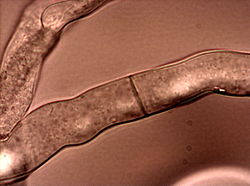
Neurospora crassa is a filamentous ascomycete fungus characterized by a multinucleate composed of branched, septate hyphae that exhibit polarized tip growth. The hyphae are typically 8-15 μm in diameter, with septa featuring central pores that facilitate and the movement of organelles and nuclei between compartments, enabling rapid coordination across the mycelial network. This coenocytic-like organization, despite septation, supports efficient nutrient distribution and stress responses within the colony. The fungus produces two types of asexual conidia as reproductive structures: macroconidia and microconidia. Macroconidia are large, multinucleate, aerial spores measuring approximately 5-8 μm in diameter, with a rough, striated surface; they are orange due to the accumulation of such as neurosporaxanthin. Microconidia are smaller, uninucleate spores, typically 2.5-3.5 μm in size, formed directly from hyphal cells and serving primarily as male gametes or for genetic studies. Unlike some fungi, N. crassa does not form yeast-like cells, maintaining its strictly filamentous morphology. Growth of N. crassa is optimal at around 30-35°C under aerobic conditions, as a heterotrophic utilizing carbohydrates such as or glucose as carbon sources, though it is commonly cultivated at 25-30°C. On solid media, the exhibits rapid linear extension, reaching rates up to 5 mm per hour, forming diffuse colonies with extensive aerial hyphae that contribute to sporulation. Colonial variants may show altered aerial hyphal development and enhanced orange pigmentation from biosynthesis, reflecting adaptations to environmental cues like or nutrient availability.

Habitat and Cultivation

Natural Habitat

Neurospora crassa primarily inhabits tropical and subtropical regions across the globe, with documented populations in (including and ), (such as Middle Africa), and the (encompassing and the , notably and ). This fungus is most commonly associated with decaying plant material in post-fire environments, such as burnt grasslands, forests, and agricultural residues like stubble, where it acts as an early colonizer. Its global distribution reflects adaptation to humid, warm climates, with collections spanning diverse locales from volcanic sites to slash-and-burn cleared rainforests. In addition to its saprotrophic lifestyle, as of , N. crassa has been observed growing endophytically within the roots of grasses such as Brachypodium distachyon, colonizing apoplastic spaces, vascular bundles, and some cortex cells without immediate , though it may switch to saprotrophic or pathogenic modes under certain conditions. Ecologically, N. crassa functions as a saprotrophic , specializing in the breakdown of carbohydrate-rich substrates like sugarcane bagasse and charred vegetation following wildfires or controlled burns. This role is facilitated by its fire-adapted life cycle, in which dormant ascospores germinate in response to and chemicals released from burning matter, enabling rapid colonization of nutrient-enriched, sterile post-fire niches. The ascospores demonstrate exceptional heat resistance, surviving temperatures up to 67°C for about 200 minutes, which underscores the fungus's evolutionary specialization for pyrogenic habitats. Beyond wild ecosystems, N. crassa occasionally interacts with human environments by growing on artificial substrates such as baked goods in contaminated bakeries or cooked corncobs in tropical markets, where it can cause spoilage. These occurrences highlight its opportunistic on warm, moist, organic materials, though it is generally considered non-pathogenic to humans and , although recent observations indicate it can act as a to certain under specific stress conditions.

Laboratory Cultivation

Neurospora crassa is routinely cultivated in laboratory settings using defined media to support its growth as a filamentous fungus. The standard minimal medium, known as Vogel's medium N, provides essential nutrients including nitrogen sources like , carbon (typically 1-2% or glucose), salts, and , with a around 5.8; it is prepared as a 50× stock solution and autoclaved, often supplemented with 1.5% for solid plates or used in liquid form for submerged cultures. For richer growth, complete media such as glycerol complete medium incorporate , casein hydrolysate, vitamins, and at concentrations like 0.2-0.5 mg/ml for supplements, enabling robust mycelial development and conidiation. These media formulations, developed in seminal works, allow selective growth of auxotrophic mutants and high yields in shake flask cultures. Cultures are initiated by inoculating conidia (macroconidia or microconidia) or ascospores onto plates or into liquid media, with conidia harvested from mature and ascospores often subjected to (e.g., 60°C for 30 minutes) to eliminate vegetative contaminants while preserving viability. Sterilization of inocula or equipment typically involves autoclaving or chemical agents like , ensuring aseptic conditions. Incubation occurs at 25°C, a temperature optimal for vegetative growth and sporulation, under either constant darkness to study circadian rhythms or controlled light cycles (e.g., 12-hour light/dark) depending on experimental needs; growth on solid media yields visible colonies in 3-5 days, while liquid cultures reach high densities in 24-48 hours with . Wild-type strains such as OR74A ( A) are commonly used for routine propagation due to their vigorous growth and genetic stability. Long-term strain maintenance employs methods like in , where conidia are suspended in milk and mixed with anhydrous beads, then stored at 4-5°C for years with high viability retention, or freezing at -80°C using glycerol-preserved plugs for nonconidiating strains. These techniques, refined over decades, prevent and facilitate revival by plating or subculturing. As a 1 organism, N. crassa poses no known risk of to humans, though its airborne conidia may cause allergic reactions in sensitive individuals, necessitating standard lab practices like glove use and during sporulation.

Reproduction

Asexual reproduction in Neurospora crassa primarily occurs through the production of conidia from specialized aerial hyphae emerging from hyphal tips, enabling vegetative propagation without . Conidiophores develop from these aerial hyphae and undergo repeated apical to form chains of proconidia, which mature into macroconidia—large, multinucleate spores adapted for dispersal by air currents. This process, known as macroconidiation, takes 12-24 hours to complete and results in robust spores that can withstand environmental stresses, facilitating widespread clonal dissemination. In addition to macroconidia, N. crassa produces microconidia as a secondary asexual structure, which are smaller, uninucleate spores formed by from hyphal protuberances or, in some strains, through modified pathways. These microconidia typically germinate directly to initiate new hyphal growth, supporting . Unlike macroconidia, microconidia are produced in smaller quantities and under specific environmental conditions, but they share the mechanism from aerial hyphae. The advantages of conidial production include rapid clonal expansion, allowing a single colony to generate millions of spores for efficient of new substrates, and high resistance to due to protective components like . This mode dominates under favorable laboratory and natural conditions, such as post-fire environments where N. crassa thrives, and involves no meiotic division, preserving genetic uniformity across progeny.

Sexual Cycle

Neurospora crassa exhibits a heterothallic sexual cycle requiring individuals of opposite , designated as mat A and mat a, which are encoded by dissimilar DNA sequences known as idiomorphs at a single chromosomal locus. Both mating types can function as male or female, but typically involves specialized female structures called protoperithecia, which develop from coiled hyphae under conditions of starvation. These protoperithecia bear elongated trichogynes that extend outward to attract compatible male elements, such as conidia or hyphal fragments from the opposite . Fertilization begins when a trichogyne from a protoperithecium of one grows chemotropically toward a or hyphal fragment of the opposite type, guided by diffusible pheromones and G protein-coupled receptors, at a rate of approximately 1.1 μm per minute. Upon contact, the trichogyne fuses with the , allowing the nucleus to migrate through the trichogyne toward the ascogonium in the protoperithecium via an inchworm-like movement, reaching speeds up to 130 μm per minute and traversing as needed. This fertilizing nucleus pairs with a resident nucleus of the opposite to form a stable ascogonial pair in a dikaryotic state; entry of the nucleus often immobilizes female nuclei and may prevent additional fertilizations to avoid . The paired nuclei undergo paired mitoses, maintaining the , before produces a transient diploid within an initial. Meiosis follows in the linear , yielding four haploid products arranged in an ordered tetrad; each then divides mitotically to produce eight haploid nuclei. These nuclei are enclosed in ascospores, forming an octad within each , with up to 200 asci developing inside the maturing perithecium. The ascospores are pigmented, thick-walled, and , exhibiting high heat resistance—surviving temperatures up to 67°C for about 200 minutes—and requiring heat shock or chemical activation to break dormancy and germinate into new haploid mycelia. The entire sexual cycle, from protoperithecium formation to ascospore maturation and release, typically spans 7 to 14 days under conditions, with optimal development occurring at temperatures between 18°C and 25°C and triggered primarily by limitation, often in combination with low light or cues.

Genetic Studies

Historical Significance

Neurospora crassa emerged as a in the early through the pioneering studies of Bernard O. Dodge, who in the began investigating its life cycle and at the USDA. Dodge's work, including his 1927 collaboration with C. L. Shear on the fungus's morphology and his subsequent papers on mating compatibility, demonstrated the organism's suitability for genetic analysis due to its ordered tetrads and ease of crossing. By , Dodge's efforts had established N. crassa as a tractable system for and tetrad dissection, paving the way for its adoption in experimental . The landmark contribution came in 1941 when and Edward Tatum irradiated wild-type N. crassa conidia with X-rays to induce mutations, isolating auxotrophic strains that required specific vitamins or for growth, unable to synthesize them endogenously. These experiments provided for the "one -one " hypothesis, positing that each specifies a single in biochemical pathways, fundamentally linking to . This approach exploited N. crassa's haploid nature and linear ascospore arrangement for precise identification and complementation tests. For their discoveries on the genetic control of biochemical processes using N. crassa, and Tatum shared the 1958 Nobel Prize in Physiology or Medicine with , whose work on complemented their findings. In the 1950s, researchers like Norman Horowitz and Charles Yanofsky advanced fine-structure mapping in N. crassa, using recombination within such as td (tryptophan synthetase) to resolve intragenic distances and elucidate hotspots. These studies refined understanding of organization and paved the way for . The historical trajectory culminated in the initiation of the N. crassa genome sequencing project in 2001, with a draft published in 2003 revealing approximately 10,000 protein-coding genes and enabling modern functional genomics.

Mating Types and Adaptive Functions

Neurospora crassa exhibits a heterothallic mating system characterized by two idiomorphs at the mating-type locus, designated mat a and mat A, which are non-homologous DNA sequences that determine sexual compatibility. The mat a idiomorph spans approximately 3.2 kb and contains a single gene, mta-1, encoding the MAT a-1 protein, a transcriptional activator with an HMG-box DNA-binding domain that regulates mating-specific gene expression. In contrast, the mat A idiomorph is larger, about 5.3 kb, and encompasses three genes: mat A-1, essential for initiating mating; mat A-2, involved in post-fertilization development; and mat A-3, which also features an HMG-box domain and contributes to sexual differentiation. These idiomorphs ensure self-incompatibility, as strains of the same mating type cannot mate, thereby promoting genetic exchange between distinct individuals. The mat A locus was historically subdivided into functional subloci—A1, A2, and A3—based on genetic analyses of mutations affecting specific aspects of and development, corresponding molecularly to the mat A-1, mat A-2, and mat A-3 genes, respectively. This organization maintains strict mating-type specificity and prevents self-fertilization. In diploid cells formed transiently during the sexual cycle, mating-type genes influence the expression of numerous downstream targets; estimates indicate at least 435 genes are involved in sexual development and exhibit mating-type-dependent regulation in diploids. Such differential expression underscores the locus's role in coordinating sexual processes beyond mere compatibility. Heterothallism in N. crassa confers adaptive advantages by enforcing , which enhances and masks deleterious recessive mutations that could accumulate in inbred lineages. By requiring opposite for perithecial formation—the fruiting bodies housing sexual spores—this system improves spore viability and under environmental stress, such as nutrient limitation, where predominates over asexual. Evolutionary studies reveal that mating-type switching from to in related species leads to gene decay in mating loci, highlighting the selective pressure for outcrossing to sustain population-level fitness. Overall, these functions ensure robust , linking mating-type directly to ecological .

Fine Structure Analysis

The linear arrangement of eight ascospores within the of Neurospora crassa facilitates ordered tetrad analysis, a technique that preserves the sequential order of meiotic products and their post-meiotic mitotic duplicates, allowing researchers to trace individual chromatids through and detect deviations from Mendelian segregation. This method is particularly powerful for studying recombination events, as it reveals patterns such as first- and second-division segregation for mapping, as well as non-random associations indicative of crossover interference, where one crossover reduces the likelihood of another nearby. A landmark experiment demonstrating the utility of this approach involved tetrad analysis at the pan-2 locus, which encodes pantothenate synthetase. In crosses between two allelic pan-2 mutants (B3 and B5), Case and Giles dissected 939 complete asci, observing predominantly 4:4 segregation ratios (856 asci) but also 11 exceptional tetrads exhibiting aberrant ratios, including 5:3 and 3:5 patterns. These 5:3 segregations, where five spores carried one and three the other, provided direct evidence for post-meiotic segregation arising from unrepaired heteroduplex DNA formed during recombination, rather than simple reversion. Such findings highlighted gene conversion as a non-reciprocal recombination process, with the exceptional tetrads often associated with adjacent crossovers. These observations contributed to the development and validation of recombination models, notably the Holliday model, which posits that single-strand breaks and strand invasion create heteroduplex regions that, if repaired asymmetrically, yield 6:2 or 4:4 ratios, while unrepaired mismatches lead to 5:3 post-meiotic segregation. In N. crassa, polarity in gene conversion—where conversion frequency decreases from one end of the gene to the other—was evident in studies like those at pan-2, correlating with the direction of heteroduplex initiation and influencing the distribution of recombinant types. The precision of ordered tetrad analysis in N. crassa has enabled fine-structure mapping of intragenic mutations, achieving resolution down to the nucleotide level through cumulative recombination data across multiple alleles, as seen in loci like ad-3 and am. This work has profoundly shaped the broader understanding of eukaryotic meiotic recombination, including mechanisms of interference and conversion tract lengths, influencing models in diverse organisms.

Research Applications

Circadian Rhythms

Neurospora crassa exhibits a robust manifested in the periodic formation of conidial bands during asexual development, with a free-running period of approximately 22 hours under constant conditions. This rhythm persists in constant darkness and temperature, making the fungus a key for studying eukaryotic circadian clocks since the 1950s. The conidiation rhythm serves as a visible output of the underlying molecular oscillator, allowing precise measurement of period length and phase. The core circadian clock in N. crassa operates through a loop involving the (frq) and the White Collar Complex (WCC), composed of WC-1 and WC-2 transcription factors. The WCC activates frq transcription, leading to accumulation of FRQ protein, which then represses WCC activity, thereby inhibiting its own transcription and closing the loop. This transcriptional-translational feedback loop generates oscillations in frq mRNA and FRQ protein levels with a periodicity of about 22 hours. FRQ interacts with WC-1 and WC-2 to form a repressive complex, and its by kinases like CK-1a modulates stability and nuclear localization, fine-tuning the rhythm. Light entrainment of the in N. crassa is mediated by WC-1 and WC-2, which function as blue-light photoreceptors. WC-1 contains a LOV domain that binds (FAD), enabling rapid light-induced conformational changes that activate the WCC and induce frq transcription, thereby resetting the clock phase. Mutants lacking functional frq, such as frq strains, exhibit arrhythmic conidiation and loss of temperature-compensated oscillations, confirming FRQ's essential role in rhythmicity. Similarly, wc-1 or wc-2 mutants are blind to light entrainment but retain the endogenous oscillator. The frq gene was cloned in 1986 and molecularly characterized in the late 1980s to early 1990s, marking a pivotal discovery that linked genetic mutations to clock function. Circadian rhythms in N. crassa demonstrate compensation, maintaining a stable ~22-hour period across 18–30°C, a property essential for biological timing and achieved through mechanisms like thermally regulated FRQ translation and stability. In the , research has elucidated the circadian clock's broader roles in coordinating and stress responses in N. crassa. The clock gates adaptation to glucose starvation, enhancing recovery when functional, by rhythmically regulating metabolic . Additionally, the clock modulates stress signaling pathways, such as the eIF2α CPC-3, which responds to starvation in a circadian-dependent manner, linking temporal control to cellular resilience. These findings underscore the clock's integration with physiological processes beyond overt rhythms.

Gene Regulation and Functional Genomics

Neurospora crassa has served as a pivotal for elucidating gene regulation mechanisms in filamentous fungi, leveraging its well-annotated genome and efficient genetic tools to uncover pathways governing and dynamics. approaches in N. crassa have enabled systematic dissection of gene functions, revealing intricate regulatory networks that control development, , and stress responses. These studies highlight the fungus's utility in probing conserved eukaryotic processes, such as RNA-mediated silencing and epigenetic modifications, through high-throughput methodologies that integrate with modern sequencing technologies. A landmark project in 2006 constructed cassettes for approximately 10,000 predicted open reading frames using recombinational and in N. crassa, facilitating the creation of a comprehensive deletion . This high-throughput approach targeted non-essential , yielding mutants with observable phenotypes in growth, conidiation, and nutrient utilization, while essential were identified by failed deletions or conditional , underscoring their critical roles in viability. The has been instrumental in assigning functions to transcription factors and metabolic enzymes, with over 1,000 mutants phenotypically characterized to date. Gene regulation in N. crassa involves (RNAi) pathways, including quelling, a post-transcriptional mechanism triggered by transgenes or duplicated sequences during vegetative growth, and dicing by Dicer-like proteins (DCL-1 and DCL-2) that process double-stranded into small interfering RNAs (siRNAs) for Argonaute-mediated target degradation. Quelling depends on RNA-dependent RNA polymerases (QDE-1) and helicases (QDE-3) to amplify aberrant RNAs, enabling defense against transposons and viruses. Additionally, small RNAs contribute to regulatory processes, such as meiotic silencing by unpaired DNA (MSUD), where unpaired genes during are transcriptionally repressed via RNAi components to maintain stability. Epigenetic regulation in N. crassa is mediated by histone modifications that establish , particularly at repetitive regions, with lysine 9 trimethylation () serving as a key mark for and heterochromatin assembly, guided by the DIM-5 methyltransferase. (HP1) binds to recruit DNA methyltransferases (DIM-2), enforcing transcriptional silencing and preventing ectopic expression of transposable elements. These modifications are dynamically balanced by demethylases like LSD1, which prevents aberrant spreading into euchromatic regions, thus maintaining genome organization. Transcriptomic analyses using RNA sequencing () have provided comprehensive insights into dynamics in N. crassa, revealing that environmental cues, such as availability, modulate thousands of transcripts across its ~10,000 genes. For instance, profiling under varying carbon sources has identified differentially expressed genes involved in and signaling, with approximately 25% of the transcriptome exhibiting rhythmic patterns under circadian conditions. Transformation protocols, including of conidia, have facilitated these studies by enabling efficient DNA uptake—up to 10^4 transformants per —with minimal preparation, supporting rapid integration of reporter constructs for expression monitoring. Recent advances in include the adaptation of CRISPR-Cas9 in the 2010s for precise gene editing in N. crassa, where co-expression of Cas9 and guide RNAs via achieves efficiencies exceeding 80% for targeted knockouts and insertions, surpassing traditional methods. This system has accelerated studies on regulatory pathways, such as carbon (CCR), where glucose signaling represses genes for alternative carbon utilization, mediated by the VIB1 that links CRE1-mediated repression to cellulase expression. CCR analyses via and mutants have delineated a network of kinases and sugar transporters, illustrating how N. crassa prioritizes preferred carbons while inducing lignocellulolytic enzymes under nutrient limitation.

Fungal Immunity and Interactions

Neurospora crassa exhibits innate immune responses to bacterial threats, primarily through recognition of microbial-associated molecular patterns (MAMPs) via receptors (PRRs), leading to rapid cellular defenses. Recent studies using the N. crassa- model have revealed that bacterial contact triggers transcriptomic changes, including upregulation of genes involved in (ROS) production and remodeling. For instance, exposure to P. syringae DC3000 induces early responses within 10 minutes, involving superoxide reductase (sod-2) for ROS management and multidrug-efflux transporters (mdr-6) to counter bacterial effectors. These mechanisms highlight N. crassa's ability to coexist with while mitigating antagonism, as the bacterial promotes colonization that impairs fungal growth and fitness. Cell wall components such as chitin and β-glucans play a critical role in these defenses by serving as structural barriers that are dynamically remodeled upon bacterial interaction. Transcriptomic analyses show that N. crassa OR47A, a standard laboratory strain, upregulates immunity-related genes when exposed to bacteria, including those for lysozyme-like glycoside hydrolases (lyz) that degrade bacterial peptidoglycan and Woronin body tethers (lah-1/lah-2) for septal plugging to contain damage. This RNA-seq data underscores pathway activation for trace metal homeostasis, such as copper transporters (tcu-1) and ferric reductases (fer-1), which contribute to microbiome modulation by limiting bacterial proliferation in the fungal hyphal network. Such responses enable N. crassa to antagonize soil bacteria like Pseudomonas species, reducing their invasive potential through chemical warfare and physical barriers. Meiotic silencing by unpaired DNA (MSUD) further integrates into N. crassa's defense repertoire during , silencing genes lacking a pairing partner to prevent aberrant expression that could compromise immunity. In crosses where defense-related loci are unpaired, MSUD employs RNAi machinery to suppress transcription, thereby protecting the genome from mobile elements and ensuring robust post-meiotic defenses against environmental microbes. This process, mediated by proteins and DEAD-box helicases, links to enhanced resilience in diverse soil microbiomes. Advances in 2025, highlighted at the Neurospora conference, provide deeper molecular insights into these interactions, emphasizing PRR-mediated signaling and gene mutants that alter susceptibility. Additionally, enzymes like carboxypeptidase A1 (CPA1) from N. crassa offer potential for profiling in fungal-bacterial communities, enabling detection of microscale shifts in soil ecosystems influenced by global environmental changes. These tools facilitate targeted studies on how N. crassa modulates its for survival.

Industrial Uses

Food Applications

Neurospora crassa and related species such as N. intermedia have been utilized in traditional Asian fermented s for centuries, particularly in the production of , a tempeh-like staple in made from presscake or residues such as okara, where recent studies identify N. intermedia as dominant in traditional processes. Documented as early as the , oncom fermentation involves Neurospora spp. to transform agricultural by-products into a nutritious, protein-enriched commonly consumed as a or ingredient in various dishes. Similar applications include ontjom, another name for oncom in some Asian contexts, and fermented okara in , where the fungus enhances digestibility and nutritional value by breaking down complex carbohydrates. The traditional fermentation process begins with preparing the substrate—such as okara, peanut presscake, or cassava—by steaming to reduce microbial load and improve accessibility. The material is then inoculated with Neurospora spores, often sourced from previous batches or dried starters, and incubated for 2–3 days at around 30°C under aerobic conditions. This solid-state fermentation promotes mycelial growth, binding the substrate into a firm, orange-red mass rich in protein, with the fungus converting indigestible fibers into more bioavailable nutrients while imparting a nutty flavor. In modern applications, N. crassa is cultivated as for use in alternatives, exemplified by products from Meati Foods launched in the , which feature the grown in controlled fermenters to produce a versatile, steak-like texture. These typically contain 15–20% protein on a wet basis, along with low fat levels (under 5%), fiber, and essential micronutrients like iron and , making them suitable for plant-based diets. The safety of N. crassa in is supported by its long history of consumption in Asian fermented products without reported adverse effects, as well as recent toxicological evaluations confirming no allergenicity or production. The safety of N. crassa in is further affirmed by its FDA GRAS status as of 2024. This approach also enables the of waste into sustainable, edible biomass, aligning with principles in production.

Biotechnology

Neurospora crassa has emerged as a promising platform for industrial production, particularly through submerged processes that enable high yields of key hydrolytic . The naturally secretes cellulases capable of degrading , with studies showing enhanced activity through modulation of regulatory pathways such as intracellular and cAMP signaling. These cellulases are vital for production, where they facilitate the breakdown of cell walls into fermentable sugars, and for the industry, enhancing fabric cleaning efficiency. Additionally, N. crassa produces alkaline proteases and amylases via solid-state or submerged on agro-industrial wastes like wheat straw or husks, yielding enzymes suitable for processing and , respectively. Submerged scales effectively to 10-100 L bioreactors, maintaining homogeneous mycelial growth and enzyme titers comparable to those of species. In , N. crassa serves as an effective host for of recombinant proteins, leveraging its eukaryotic machinery for proper folding and . Engineered strains with knockouts (e.g., Δvib-1 and quadruple deletions) and strong promoters like Pccg1nr have produced up to 3 mg/L of a human antibody fragment in 10 L reactors, demonstrating for biopharmaceuticals. The fungus's genetic toolkit, including CRISPR-based editing, supports applications, such as reconstructing metabolic pathways for or production, with modular cassettes enabling rapid prototyping. This positions N. crassa as a complementary alternative to bacterial systems, especially for complex eukaryotic proteins. Beyond enzymes, N. crassa contributes to bioremediation by degrading lignin and phenolic pollutants through its lignocellulolytic secretome, which includes laccases and peroxidases induced by cellodextrins. In membrane bioreactors, it removes over 90% of phenols from industrial effluents, offering a sustainable approach to wastewater treatment. In the 2020s, applications have expanded to sustainable materials, where N. crassa mycelium acts as a scaffold for biomineralized engineered living materials, providing biodegradable alternatives to petroleum-derived polymers. These mycelium-based bioplastics provide biodegradable alternatives to petroleum-derived polymers. Despite these advances, challenges persist in industrial deployment. Controlling sporulation in large-scale submerged cultures is critical, as aerial conidiation increases and reduces oxygen transfer; genetic disruptions like Δgul-1 mitigate this by promoting pellet morphology and boosting protein yields by 2-3 fold. Economic viability remains limited compared to bacterial hosts, with N. crassa growth rates (0.3-0.4 h⁻¹) and yields (mg/L scale) trailing high-expression E. coli systems, necessitating further optimization of media and process controls for cost-competitiveness.

References

Add your contribution
Related Hubs
User Avatar
No comments yet.