Hubbry Logo
search
logo
2229788

Adjoint representation

logo
Community Hub0 Subscribers
Read side by side
from Wikipedia

In mathematics, the adjoint representation (or adjoint action) of a Lie group G is a way of representing the elements of the group as linear transformations of the group's Lie algebra, considered as a vector space. For example, if G is , the Lie group of real n-by-n invertible matrices, then the adjoint representation is the group homomorphism that sends an invertible n-by-n matrix to an endomorphism of the vector space of all linear transformations of defined by: .

For any Lie group, this natural representation is obtained by linearizing (i.e. taking the differential of) the action of G on itself by conjugation. The adjoint representation can be defined for linear algebraic groups over arbitrary fields.

Definition

[edit]

Let G be a Lie group, and let

be the mapping g ↦ Ψg, with Aut(G) the automorphism group of G and Ψg: GG given by the inner automorphism (conjugation)
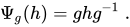
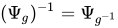
This Ψ is a group homomorphism (it is a Lie group homomorphism if is connected[1][citation needed]).

For each g in G, define Adg to be the derivative of Ψg at the origin:

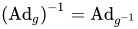
where d is the differential and is the tangent space at the origin e (e being the identity element of the group G). Since is a Lie group automorphism, Adg is a Lie algebra automorphism; i.e., an invertible linear transformation of to itself that preserves the Lie bracket. Moreover, since is a group homomorphism, too is a group homomorphism.[2] Hence, the map

is a group representation called the adjoint representation of G.

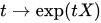
If G is a linear Lie group, then the Lie algebra consists of matrices and the exponential map is the matrix exponential for matrices X with small operator norms. We will compute the derivative of at . For g in G and small X in , the curve has derivative at t = 0, one then gets:
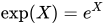
where on the right we have the products of matrices. If is a closed subgroup (that is, G is a matrix Lie group), then this formula is valid for all g in G and all X in .
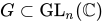
Succinctly, an adjoint representation is an isotropy representation associated to the conjugation action of G around the identity element of G.

Derivative of Ad

[edit]

One may always pass from a representation of a Lie group G to a representation of its Lie algebra by taking the derivative at the identity.

Taking the derivative of the adjoint map

at the identity element gives the adjoint representation of the Lie algebra of G:

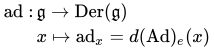
where is the Lie algebra of which may be identified with the derivation algebra of . One can show that

for all , where the right hand side is given (induced) by the Lie bracket of vector fields. Indeed,[3] recall that, viewing as the Lie algebra of left-invariant vector fields on G, the bracket on is given as:[4] for left-invariant vector fields X, Y,

where denotes the flow generated by X. As it turns out, , roughly because both sides satisfy the same ODE defining the flow. That is, where denotes the right multiplication by . On the other hand, since , by the chain rule,


as Y is left-invariant. Hence,

,

which is what was needed to show.

Thus, coincides with the same one defined in § Adjoint representation of a Lie algebra below. Ad and ad are related through the exponential map: Specifically, Adexp(x) = exp(adx) for all x in the Lie algebra.[5] It is a consequence of the general result relating Lie group and Lie algebra homomorphisms via the exponential map.[6]

If G is a linear Lie group, then the above computation simplifies: indeed, as noted early, and thus with ,

.

Taking the derivative of this at , we have:

.

The general case can also be deduced from the linear case: indeed, let be a linear Lie group having the same Lie algebra as that of G. Then the derivative of Ad at the identity element for G and that for G' coincide; hence, without loss of generality, G can be assumed to be G'.

The upper-case/lower-case notation is used extensively in the literature. Thus, for example, a vector x in the algebra generates a vector field X in the group G. Similarly, the adjoint map adxy = [x,y] of vectors in is homomorphic[clarification needed] to the Lie derivative LXY = [X,Y] of vector fields on the group G considered as a manifold.

Further see the derivative of the exponential map.

Adjoint representation of a Lie algebra

[edit]

Let be a Lie algebra over some field. Given an element x of a Lie algebra , one defines the adjoint action of x on as the map

for all y in . It is called the adjoint endomorphism or adjoint action. ( is also often denoted as .) Since a bracket is bilinear, this determines the linear mapping

given by x ↦ adx. Within End, the bracket is, by definition, given by the commutator of the two operators:

where denotes composition of linear maps. Using the above definition of the bracket, the Jacobi identity

takes the form

where x, y, and z are arbitrary elements of .

This last identity says that ad is a Lie algebra homomorphism; i.e., a linear mapping that takes brackets to brackets. Hence, ad is a representation of a Lie algebra and is called the adjoint representation of the algebra .

If is finite-dimensional and a basis for it is chosen, then is the Lie algebra of square matrices and the composition corresponds to matrix multiplication.

In a more module-theoretic language, the construction says that is a module over itself.

The kernel of ad is the center of (that's just rephrasing the definition). On the other hand, for each element z in , the linear mapping obeys the Leibniz' law:

for all x and y in the algebra (the restatement of the Jacobi identity). That is to say, adz is a derivation and the image of under ad is a subalgebra of Der, the space of all derivations of .

When is the Lie algebra of a Lie group G, ad is the differential of Ad at the identity element of G.

There is the following formula similar to the Leibniz formula: for scalars and Lie algebra elements ,

Structure constants

[edit]

The explicit matrix elements of the adjoint representation are given by the structure constants of the algebra. That is, let {ei} be a set of basis vectors for the algebra, with

Then the matrix elements for adei are given by

Thus, for example, the adjoint representation of su(2) is the defining representation of so(3).

Examples

[edit]
  • If G is abelian of dimension n, the adjoint representation of G is the trivial n-dimensional representation.
  • If G is a matrix Lie group (i.e. a closed subgroup of ), then its Lie algebra is an algebra of n×n matrices with the commutator for a Lie bracket (i.e. a subalgebra of ). In this case, the adjoint map is given by Adg(x) = gxg−1.
  • If G is SL(2, R) (real 2×2 matrices with determinant 1), the Lie algebra of G consists of real 2×2 matrices with trace 0. The representation is equivalent to that given by the action of G by linear substitution on the space of binary (i.e., 2 variable) quadratic forms.

Properties

[edit]

The following table summarizes the properties of the various maps mentioned in the definition

Lie group homomorphism:
Lie group automorphism:
Lie group homomorphism:
Lie algebra automorphism:
  • is linear
Lie algebra homomorphism:
  • is linear
Lie algebra derivation:
  • is linear

The image of G under the adjoint representation is denoted by Ad(G). If G is connected, the kernel of the adjoint representation coincides with the kernel of Ψ which is just the center of G. Therefore, the adjoint representation of a connected Lie group G is faithful if and only if G is centerless. More generally, if G is not connected, then the kernel of the adjoint map is the centralizer of the identity component G0 of G. By the first isomorphism theorem we have

Given a finite-dimensional real Lie algebra , by Lie's third theorem, there is a connected Lie group whose Lie algebra is the image of the adjoint representation of (i.e., .) It is called the adjoint group of .


Now, if is the Lie algebra of a connected Lie group G, then is the image of the adjoint representation of G: .

Roots of a semisimple Lie group

[edit]

If G is semisimple, the non-zero weights of the adjoint representation form a root system.[7] (In general, one needs to pass to the complexification of the Lie algebra before proceeding.) To see how this works, consider the case G = SL(n, R). We can take the group of diagonal matrices diag(t1, ..., tn) as our maximal torus T. Conjugation by an element of T sends
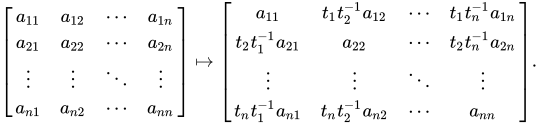
Thus, T acts trivially on the diagonal part of the Lie algebra of G and with eigenvectors titj−1 on the various off-diagonal entries. The roots of G are the weights diag(t1, ..., tn) → titj−1. This accounts for the standard description of the root system of G = SLn(R) as the set of vectors of the form eiej.

Example SL(2, R)

[edit]

When computing the root system for one of the simplest cases of Lie Groups, the group SL(2, R) of two dimensional matrices with determinant 1 consists of the set of matrices of the form:

with a, b, c, d real and ad − bc = 1.

A maximal compact connected abelian Lie subgroup, or maximal torus T, is given by the subset of all matrices of the form

with . The Lie algebra of the maximal torus is the Cartan subalgebra consisting of the matrices


If we conjugate an element of SL(2, R) by an element of the maximal torus we obtain

The matrices

are then 'eigenvectors' of the conjugation operation with eigenvalues . The function Λ which gives is a multiplicative character, or homomorphism from the group's torus to the underlying field R. The function λ giving θ is a weight of the Lie Algebra with weight space given by the span of the matrices.

It is satisfying to show the multiplicativity of the character and the linearity of the weight. It can further be proved that the differential of Λ can be used to create a weight. It is also educational to consider the case of SL(3, R).

Variants and analogues

[edit]

The adjoint representation can also be defined for algebraic groups over any field.[clarification needed]

The co-adjoint representation is the contragredient representation of the adjoint representation. Alexandre Kirillov observed that the orbit of any vector in a co-adjoint representation is a symplectic manifold. According to the philosophy in representation theory known as the orbit method (see also the Kirillov character formula), the irreducible representations of a Lie group G should be indexed in some way by its co-adjoint orbits. This relationship is closest in the case of nilpotent Lie groups.

See also

[edit]

Notes

[edit]

References

[edit]
Revisions and contributorsEdit on WikipediaRead on Wikipedia
from Grokipedia
In Lie theory, the adjoint representation of a Lie group GG is a representation Ad:GGL(g)\operatorname{Ad}: G \to \mathrm{GL}(\mathfrak{g}) on its Lie algebra g=TeG\mathfrak{g} = T_eG, defined as the differential at the identity of the conjugation action cg(x)=gxg1c_g(x) = gxg^{-1} for gGg \in G, which yields Ad(g)X=gXg1\operatorname{Ad}(g) \cdot X = gXg^{-1} explicitly for matrix Lie groups.[1][2] For the associated Lie algebra, the adjoint representation ad:gEnd(g)\operatorname{ad}: \mathfrak{g} \to \mathrm{End}(\mathfrak{g}) is the Lie algebra homomorphism given by adX(Y)=[X,Y]\operatorname{ad}_X(Y) = [X, Y], the Lie bracket, representing the infinitesimal action of g\mathfrak{g} on itself via commutators.[3][1] This representation plays a central role in the structure theory of Lie groups and algebras, as it encodes the inner automorphisms and facilitates the study of derivations, with the image of ad\operatorname{ad} consisting precisely of the inner derivations of g\mathfrak{g}.[1] The differential of Ad\operatorname{Ad} at the identity recovers ad\operatorname{ad}, linking the group-level conjugation to the algebra-level bracket via one-parameter subgroups: [X,Y]=ddtt=0Ad(exp(tX))Y[X, Y] = \frac{d}{dt}\big|_{t=0} \operatorname{Ad}(\exp(tX)) Y.[2] Key properties include its linearity, preservation of the Lie bracket (making it a Lie algebra representation), and dimension equal to dimg\dim \mathfrak{g}, often realized as matrices in a chosen basis.[3] A fundamental invariant arising from the adjoint representation is the Killing form, a symmetric bilinear form K(X,Y)=Tr(adXadY)K(X, Y) = \operatorname{Tr}(\operatorname{ad}_X \circ \operatorname{ad}_Y) on g\mathfrak{g}, which is Ad\operatorname{Ad}-invariant and non-degenerate for semisimple Lie algebras, enabling classifications like Cartan's criterion for solvability and semisimplicity.[1] For compact semisimple Lie groups, the negative Killing form is positive definite, reflecting the orthogonal nature of the adjoint action with respect to suitable inner products.[1] Examples include the adjoint representation of su(2)\mathfrak{su}(2), which is 3-dimensional and isomorphic to so(3)\mathfrak{so}(3), illustrating rotations in 3D space.[3]

Adjoint Action on Lie Groups

Definition of the Adjoint Action

In Lie group theory, the adjoint action provides a fundamental way for a Lie group to act on itself through conjugation. For a Lie group GG, the adjoint action is defined by the map Ad:G×GG\operatorname{Ad}: G \times G \to G given by Adg(h)=ghg1\operatorname{Ad}_g(h) = g h g^{-1} for all g,hGg, h \in G.[4] This construction equips GG with a left action on itself, where the element gg acts by conjugation on hh. The adjoint action preserves the group structure of GG, as Adg(h1h2)=gh1h2g1=(gh1g1)(gh2g1)=Adg(h1)Adg(h2)\operatorname{Ad}_g(h_1 h_2) = g h_1 h_2 g^{-1} = (g h_1 g^{-1})(g h_2 g^{-1}) = \operatorname{Ad}_g(h_1) \operatorname{Ad}_g(h_2) for all h1,h2Gh_1, h_2 \in G, and Adg(e)=e\operatorname{Ad}_g(e) = e where ee is the identity element.[4] Consequently, for each fixed gGg \in G, the map Adg:GG\operatorname{Ad}_g: G \to G is a group automorphism, meaning it is a bijective homomorphism from GG to itself.[5] This automorphism property highlights how the adjoint action encodes the inner symmetries of the group. The concept of the adjoint action originated in the late 19th century as part of Sophus Lie's foundational work on continuous transformation groups and their automorphisms, aimed at analyzing symmetries of differential equations. A concrete example arises in the matrix Lie group G=GL(n,R)G = \mathrm{GL}(n, \mathbb{R}), where the adjoint action corresponds to matrix conjugation: for PGL(n,R)P \in \mathrm{GL}(n, \mathbb{R}) and AGL(n,R)A \in \mathrm{GL}(n, \mathbb{R}), AdP(A)=PAP1\operatorname{Ad}_P(A) = P A P^{-1}.[6] This operation preserves similarity classes of matrices and illustrates the action's role in linear algebraic contexts. The adjoint action thus generates the inner automorphisms of GG.[5]

Relation to Inner Automorphisms

The adjoint action of a Lie group GG on itself induces a group homomorphism Ad:GAut(G)\operatorname{Ad}: G \to \operatorname{Aut}(G), where Aut(G)\operatorname{Aut}(G) denotes the automorphism group of GG. This map sends each element gGg \in G to the inner automorphism Adg:hghg1\operatorname{Ad}_g: h \mapsto g h g^{-1} for hGh \in G.[4] The image of Ad\operatorname{Ad} is precisely the subgroup Int(G)\operatorname{Int}(G) of inner automorphisms, which consists of all conjugations by elements of GG.[6] The kernel of Ad\operatorname{Ad} is the center Z(G)={zGzg=gz gG}Z(G) = \{ z \in G \mid z g = g z \ \forall g \in G \}, as Adz=idG\operatorname{Ad}_z = \operatorname{id}_G if and only if zz commutes with every element of GG.[4] Thus, Ad\operatorname{Ad} factors through the quotient G/Z(G)G / Z(G), yielding an isomorphism Int(G)G/Z(G)\operatorname{Int}(G) \cong G / Z(G).[6] To see this, first note that each Adg\operatorname{Ad}_g is indeed an automorphism of GG, as conjugation preserves the group operation: Adg(h1h2)=gh1h2g1=(gh1g1)(gh2g1)=Adg(h1)Adg(h2)\operatorname{Ad}_g(h_1 h_2) = g h_1 h_2 g^{-1} = (g h_1 g^{-1})(g h_2 g^{-1}) = \operatorname{Ad}_g(h_1) \operatorname{Ad}_g(h_2). The map Ad:GInt(G)\operatorname{Ad}: G \to \operatorname{Int}(G) is a surjective homomorphism because every inner automorphism arises as a conjugation, and its kernel is Z(G)Z(G) by the definition above. By the first isomorphism theorem, G/Z(G)Int(G)G / Z(G) \cong \operatorname{Int}(G).[4] The full automorphism group Aut(G)\operatorname{Aut}(G) contains Int(G)\operatorname{Int}(G) as a normal subgroup, with the quotient Out(G)=Aut(G)/Int(G)\operatorname{Out}(G) = \operatorname{Aut}(G) / \operatorname{Int}(G) consisting of outer automorphisms, and Aut(G)\operatorname{Aut}(G) often decomposes as a semidirect product Int(G)Out(G)\operatorname{Int}(G) \rtimes \operatorname{Out}(G).[7]

Adjoint Representation on Lie Algebras

The Lie Algebra Map ad

In the context of a Lie algebra g\mathfrak{g} over a field of characteristic zero, the adjoint map ad:gEnd(g)\mathrm{ad}: \mathfrak{g} \to \mathrm{End}(\mathfrak{g}) is defined by adx(y)=[x,y]\mathrm{ad}_x(y) = [x, y] for all x,ygx, y \in \mathfrak{g}, where [,][\cdot, \cdot] denotes the Lie bracket on g\mathfrak{g}.[8][4] This assignment yields a linear endomorphism adxEnd(g)\mathrm{ad}_x \in \mathrm{End}(\mathfrak{g}) for each fixed xgx \in \mathfrak{g}, making ad\mathrm{ad} a representation of g\mathfrak{g} on itself.[9] The map ad\mathrm{ad} arises as the infinitesimal counterpart to the adjoint action Ad\mathrm{Ad} on the corresponding Lie group GG, specifically as the differential of Ad\mathrm{Ad} at the identity element eGe \in G. To see this explicitly, consider the curve g(t)=exp(tx)g(t) = \exp(t x) in GG for tRt \in \mathbb{R}, where exp:gG\exp: \mathfrak{g} \to G is the exponential map. Then, adx(y)=ddtt=0Adexp(tx)(y)\mathrm{ad}_x(y) = \frac{d}{dt}\Big|_{t=0} \mathrm{Ad}_{\exp(t x)}(y), which computes to [x,y][x, y] upon differentiating the conjugation formula Adg(t)(y)=g(t)yg(t)1\mathrm{Ad}_{g(t)}(y) = g(t) y g(t)^{-1} and evaluating at t=0t=0 using the tangent space identification gTeG\mathfrak{g} \cong T_e G.[8][4] This relation underscores ad\mathrm{ad} as the tangent space linearization of the group action.[9] A key property of adx\mathrm{ad}_x is that it acts as a derivation on g\mathfrak{g}: for all y,zgy, z \in \mathfrak{g},
adx([y,z])=[adx(y),z]+[y,adx(z)], \mathrm{ad}_x([y, z]) = [\mathrm{ad}_x(y), z] + [y, \mathrm{ad}_x(z)],
which follows directly from the bilinearity and skew-symmetry of the Lie bracket, placing adx\mathrm{ad}_x in the derivation algebra Der(g)\mathrm{Der}(\mathfrak{g}).[4][9] The kernel of adx\mathrm{ad}_x, consisting of those ygy \in \mathfrak{g} such that [x,y]=0[x, y] = 0, characterizes the centralizer of xx; in particular, adx=0\mathrm{ad}_x = 0 if and only if xx lies in the center z(g)={wg[w,v]=0 vg}\mathfrak{z}(\mathfrak{g}) = \{ w \in \mathfrak{g} \mid [w, v] = 0 \ \forall v \in \mathfrak{g} \}, the set of elements commuting with all of g\mathfrak{g}.[4][8]

The Representation Ad and Its Derivative

The adjoint representation of a Lie group GG with Lie algebra g\mathfrak{g} is the map Ad:GGL(g)\operatorname{Ad}: G \to \operatorname{GL}(\mathfrak{g}) defined by Adg(X)=d(Conjg)e(X)\operatorname{Ad}_g(X) = d(\operatorname{Conj}_g)|_e(X) for gGg \in G and XgX \in \mathfrak{g}, where Conjg(h)=ghg1\operatorname{Conj}_g(h) = g h g^{-1} is the conjugation map and d(Conjg)ed(\operatorname{Conj}_g)|_e denotes its differential at the identity element eGe \in G.[2][1] This construction equips Ad\operatorname{Ad} with the structure of a Lie group representation, as it acts linearly on the vector space g\mathfrak{g}.[2] The map Ad\operatorname{Ad} is a Lie group homomorphism, satisfying Adgh=AdgAdh\operatorname{Ad}_{gh} = \operatorname{Ad}_g \circ \operatorname{Ad}_h for all g,hGg, h \in G, which follows from the chain rule applied to the conjugation maps.[2][1] Moreover, it intertwines the exponential maps via the relation Adexp(X)=exp(adX)\operatorname{Ad}_{\exp(X)} = \exp(\operatorname{ad}_X) for XgX \in \mathfrak{g}, where ad:ggl(g)\operatorname{ad}: \mathfrak{g} \to \operatorname{gl}(\mathfrak{g}) is the adjoint map on the Lie algebra.[2][1] The image of Ad\operatorname{Ad} is the adjoint group Ad(G)GL(g)\operatorname{Ad}(G) \subseteq \operatorname{GL}(\mathfrak{g}), which preserves the Lie bracket on g\mathfrak{g}.[1] The derivative of Ad\operatorname{Ad} at the identity recovers the Lie algebra adjoint: dAde:ggl(g)d\operatorname{Ad}_e: \mathfrak{g} \to \operatorname{gl}(\mathfrak{g}) is given by dAde(X)=adXd\operatorname{Ad}_e(X) = \operatorname{ad}_X, where adX(Y)=[X,Y]\operatorname{ad}_X(Y) = [X, Y] is the Lie bracket action.[2][1] The target space GL(g)\operatorname{GL}(\mathfrak{g}) has dimension (dimg)2(\dim \mathfrak{g})^2, reflecting its identification with the general linear group on the finite-dimensional space g\mathfrak{g}.[2] This differential relationship underscores how the group-level representation Ad\operatorname{Ad} linearizes to the infinitesimal action ad\operatorname{ad} near the identity.[1]

Algebraic Aspects

Structure Constants

In a finite-dimensional Lie algebra g\mathfrak{g} over a field of characteristic zero, choose a basis {ei}i=1n\{e_i\}_{i=1}^n. The Lie bracket is then expressed in coordinates by
[ei,ej]=k=1ncijkek, [e_i, e_j] = \sum_{k=1}^n c_{ij}^k e_k,
where the scalars cijkFc_{ij}^k \in F are called the structure constants of g\mathfrak{g} with respect to this basis. These constants fully encode the multiplication table of the Lie algebra and thus determine its isomorphism class up to the choice of basis.[10] The adjoint map ad:gEnd(g)\mathrm{ad}: \mathfrak{g} \to \mathrm{End}(\mathfrak{g}) satisfies adei(ej)=[ei,ej]=k=1ncijkek\mathrm{ad}_{e_i}(e_j) = [e_i, e_j] = \sum_{k=1}^n c_{ij}^k e_k, so the structure constants provide the coordinate expression for the adjoint action on basis elements. The antisymmetry of the Lie bracket [x,y]=[y,x][x, y] = -[y, x] implies that the structure constants are antisymmetric in the lower indices: cijk=cjikc_{ij}^k = -c_{ji}^k for all i,j,ki, j, k. The Jacobi identity [[x,y],z]+[[y,z],x]+[[z,x],y]=0[[x, y], z] + [[y, z], x] + [[z, x], y] = 0 imposes a quadratic relation on the constants:
m(cijmcmkl+cjkmcmil+ckimcmjl)=0 \sum_m \left( c_{ij}^m c_{mk}^l + c_{jk}^m c_{mi}^l + c_{ki}^m c_{mj}^l \right) = 0
for all indices i,j,k,li, j, k, l. These relations ensure that the bracket defines a Lie algebra structure.[11] In the adjoint representation, the endomorphisms adei\mathrm{ad}_{e_i} are represented by n×nn \times n matrices whose entries are determined by the structure constants. With respect to the chosen basis, the matrix of adei\mathrm{ad}_{e_i} has entries (adei)jk=cikj(\mathrm{ad}_{e_i})_{jk} = -c_{ik}^j, following the sign convention that aligns the lower indices with the action on contravariant components (note that alternative conventions without the negative sign exist, depending on index placement). This matrix representation facilitates computations of the adjoint action, such as traces or determinants, in coordinate form.[12] The structure constants are not intrinsic to the Lie algebra but depend on the basis; they transform under change of basis via the adjoint action of GL(g)\mathrm{GL}(\mathfrak{g}). Specifically, if ${e'_p} $ is a new basis related by ep=qgpqeqe'_p = \sum_q g_p^q e_q with gGL(n,F)g \in \mathrm{GL}(n, F), the new constants c'_{pq}^r satisfy
c'_{pq}^r = \sum_{i,j,k} (g^{-1})^r_k \, g_p^i \, g_q^j \, c_{ij}^k,
reflecting the tensorial nature of the constants under basis transformations. This covariance ensures that properties like the Jacobi relations are preserved.[10]

The Adjoint Operator as a Derivation

The adjoint operator \adx\ad_x for a fixed xgx \in \mathfrak{g} is the linear map \adx:gg\ad_x: \mathfrak{g} \to \mathfrak{g} defined by \adx(y)=[x,y]\ad_x(y) = [x, y] for all ygy \in \mathfrak{g}. This map is a derivation of the Lie algebra g\mathfrak{g}, meaning it preserves the Lie bracket in the sense of the Leibniz rule:
\adx([y,z])=[\adx(y),z]+[y,\adx(z)] \ad_x([y, z]) = [\ad_x(y), z] + [y, \ad_x(z)]
for all y,zgy, z \in \mathfrak{g}. To verify this, apply the Jacobi identity to the left-hand side:
\adx([y,z])=[x,[y,z]]=[[x,y],z]+[y,[x,z]]=[\adx(y),z]+[y,\adx(z)], \ad_x([y, z]) = [x, [y, z]] = [[x, y], z] + [y, [x, z]] = [\ad_x(y), z] + [y, \ad_x(z)],
which establishes the required equality.[13][14] The collection of all derivations of g\mathfrak{g} forms a Lie subalgebra \Der(g)\Der(\mathfrak{g}) of \End(g)\End(\mathfrak{g}) under the commutator bracket [D1,D2]=D1D2D2D1[D_1, D_2] = D_1 D_2 - D_2 D_1. The adjoint map \ad:g\Der(g)\ad: \mathfrak{g} \to \Der(\mathfrak{g}) given by x\adxx \mapsto \ad_x is itself a Lie algebra homomorphism, since [\adx,\adx]=\ad[x,x][\ad_x, \ad_{x'}] = \ad_{[x, x']}. The kernel of this map is the center z(g)={xg[x,y]=0 yg}\mathfrak{z}(\mathfrak{g}) = \{ x \in \mathfrak{g} \mid [x, y] = 0 \ \forall y \in \mathfrak{g} \}, so by the first isomorphism theorem, the image \ad(g)\ad(\mathfrak{g}), known as the inner derivations, is isomorphic to the quotient Lie algebra g/z(g)\mathfrak{g} / \mathfrak{z}(\mathfrak{g}).[15][13] The inner derivations \ad(g)\ad(\mathfrak{g}) form an ideal in \Der(g)\Der(\mathfrak{g}). The outer derivations are the elements of the quotient \Der(g)/\ad(g)\Der(\mathfrak{g}) / \ad(\mathfrak{g}), which classify derivations up to inner ones. For semisimple Lie algebras, this quotient is zero, so \Der(g)=\ad(g)\Der(\mathfrak{g}) = \ad(\mathfrak{g}) and all derivations are inner.[13][14] Solvable Lie algebras, in contrast, generally admit outer derivations. For instance, every nilpotent Lie algebra possesses at least one outer derivation; the three-dimensional Heisenberg algebra, with basis {p,q,z}\{p, q, z\} and nonzero bracket [p,q]=z[p, q] = z, provides such an example.[16]

Key Properties

General Properties

The adjoint representation of a Lie group GG on its Lie algebra g\mathfrak{g} is faithful—that is, the homomorphism Ad:GGL(g)\mathrm{Ad}: G \to \mathrm{GL}(\mathfrak{g}) is injective—if and only if the center Z(G)Z(G) of GG is trivial.[17] Equivalently, for the infinitesimal version, the adjoint map ad:gEnd(g)\mathrm{ad}: \mathfrak{g} \to \mathrm{End}(\mathfrak{g}) is injective if and only if the center of g\mathfrak{g} is zero.[17] This property highlights the adjoint representation's role in detecting the center, providing an embedding of the centerless quotient G/Z(G)G/Z(G) into the general linear group. A key trace property arises from the Jacobi identity: for every xgx \in \mathfrak{g}, the trace tr(adx)=0\mathrm{tr}(\mathrm{ad}_x) = 0.[18] This follows because adx\mathrm{ad}_x acts as a derivation, and in the adjoint representation over a field of characteristic zero, the trace vanishes on inner derivations, as commutators in End(g)\mathrm{End}(\mathfrak{g}) have zero trace.[18] Consequently, for the group-level representation, det(Adg)=1\det(\mathrm{Ad}_g) = 1 for all gGg \in G, so the image of Ad\mathrm{Ad} lies in the special linear group SL(dimg,R)\mathrm{SL}(\dim \mathfrak{g}, \mathbb{R}).[19] The adjoint action defines orbits in g\mathfrak{g}: the GG-orbit of an element xgx \in \mathfrak{g} under Ad\mathrm{Ad} has dimension dim(orbit(x))=dimgdimzg(x)\dim(\mathrm{orbit}(x)) = \dim \mathfrak{g} - \dim \mathfrak{z}_\mathfrak{g}(x), where zg(x)={yg[x,y]=0}\mathfrak{z}_\mathfrak{g}(x) = \{ y \in \mathfrak{g} \mid [x, y] = 0 \} is the centralizer of xx.[20] At the Lie algebra level, the infinitesimal orbits under ad\mathrm{ad} satisfy a similar dimension formula, reflecting the stabilizer's codimension in the orbit-stabilizer theorem for the adjoint action.[20] The adjoint representation extends, by the universal property of the universal enveloping algebra U(g)U(\mathfrak{g}), to a representation U(g)End(g)U(\mathfrak{g}) \to \mathrm{End}(\mathfrak{g}), making g\mathfrak{g} into a left U(g)U(\mathfrak{g})-module (the adjoint module).[21] This structure underlies many constructions in representation theory, such as the study of induced modules and Lie algebra cohomology.

Properties for Semisimple Lie Algebras

In semisimple Lie algebras over an algebraically closed field of characteristic zero, the adjoint representation exhibits distinctive structural properties tied to the algebra's decomposition. A semisimple Lie algebra g\mathfrak{g} decomposes as a direct sum of simple ideals g=g1gk\mathfrak{g} = \mathfrak{g}_1 \oplus \cdots \oplus \mathfrak{g}_k, where each gi\mathfrak{g}_i is ad-simple (i.e., simple as a Lie algebra). Under this decomposition, the adjoint representation of g\mathfrak{g} restricts to the adjoint representation on each simple ideal gi\mathfrak{g}_i, and these restrictions are irreducible, meaning each gi\mathfrak{g}_i has no nontrivial gi\mathfrak{g}_i-invariant subspaces.[22] A fundamental tool for analyzing these properties is the Killing form, defined on g\mathfrak{g} by B(x,y)=tr(adxady)B(x, y) = \operatorname{tr}(\operatorname{ad}_x \circ \operatorname{ad}_y) for x,ygx, y \in \mathfrak{g}. For semisimple g\mathfrak{g}, the Killing form is nondegenerate, meaning its radical is zero, which is equivalent to the semisimple condition and ensures that g\mathfrak{g} can be faithfully represented via the adjoint action.[22] Moreover, the Killing form is ad-invariant, satisfying B([x,z],y)+B(x,[z,y])=0B([x, z], y) + B(x, [z, y]) = 0 for all x,y,zgx, y, z \in \mathfrak{g}, a property derived from the trace's invariance under cyclic permutations and the Jacobi identity in the adjoint representation.[23] This nondegeneracy restricts to each simple ideal, facilitating the orthogonal decomposition with respect to BB. The semisimple structure also implies complete reducibility of representations: every finite-dimensional representation of g\mathfrak{g}, including the adjoint representation on g\mathfrak{g} itself, is completely reducible, decomposing as a direct sum of irreducible subrepresentations (Weyl's theorem).[22] In the adjoint case, this yields the direct sum decomposition into the irreducible adjoint actions on the simple ideals, underscoring the absence of indecomposable but non-irreducible components.

Examples

Classical Matrix Lie Algebras

The classical matrix Lie algebras provide explicit finite-dimensional realizations of Lie algebras over the complex numbers, where the adjoint representation can be concretely described using matrix operations. These algebras are subalgebras of gl(n,C)\mathfrak{gl}(n,\mathbb{C}), the general linear Lie algebra consisting of all n×nn \times n complex matrices equipped with the commutator Lie bracket [X,Y]=XYYX[X,Y] = XY - YX.[18] The dimension of gl(n,C)\mathfrak{gl}(n,\mathbb{C}) is n2n^2, and its adjoint representation is the natural action on itself via the Lie bracket: for X,Ygl(n,C)X,Y \in \mathfrak{gl}(n,\mathbb{C}), the infinitesimal adjoint map is adX(Y)=[X,Y]=XYYX\mathrm{ad}_X(Y) = [X,Y] = XY - YX, which yields a representation ad:gl(n,C)gl(gl(n,C))\mathrm{ad}: \mathfrak{gl}(n,\mathbb{C}) \to \mathfrak{gl}(\mathfrak{gl}(n,\mathbb{C})) of dimension n2×n2n^2 \times n^2.[10] Correspondingly, the adjoint representation of the Lie group GL(n,C)\mathrm{GL}(n,\mathbb{C}) acts by conjugation: AdA(B)=ABA1\mathrm{Ad}_A(B) = A B A^{-1} for AGL(n,C)A \in \mathrm{GL}(n,\mathbb{C}) and Bgl(n,C)B \in \mathfrak{gl}(n,\mathbb{C}).[18] The special linear Lie algebra sl(n,C)\mathfrak{sl}(n,\mathbb{C}) is the subalgebra of gl(n,C)\mathfrak{gl}(n,\mathbb{C}) consisting of trace-zero matrices, with dimension n21n^2 - 1.[10] The adjoint representation restricts naturally to sl(n,C)\mathfrak{sl}(n,\mathbb{C}), as the Lie bracket preserves the trace-zero condition: tr([X,Y])=tr(XYYX)=0\mathrm{tr}([X,Y]) = \mathrm{tr}(XY - YX) = 0 for X,Ysl(n,C)X,Y \in \mathfrak{sl}(n,\mathbb{C}).[18] Thus, adX(Y)=[X,Y]\mathrm{ad}_X(Y) = [X,Y] maps sl(n,C)\mathfrak{sl}(n,\mathbb{C}) to itself, giving a representation ad:sl(n,C)gl(sl(n,C))\mathrm{ad}: \mathfrak{sl}(n,\mathbb{C}) \to \mathfrak{gl}(\mathfrak{sl}(n,\mathbb{C})) of dimension (n21)×(n21)(n^2 - 1) \times (n^2 - 1). The group-level action AdA(B)=ABA1\mathrm{Ad}_A(B) = A B A^{-1} for ASL(n,C)A \in \mathrm{SL}(n,\mathbb{C}) similarly preserves sl(n,C)\mathfrak{sl}(n,\mathbb{C}), since tr(ABA1)=tr(B)=0\mathrm{tr}(A B A^{-1}) = \mathrm{tr}(B) = 0.[10] For the orthogonal case, the special orthogonal Lie algebra so(n,C)\mathfrak{so}(n,\mathbb{C}) consists of n×nn \times n skew-symmetric matrices satisfying XT=XX^T = -X, with dimension n(n1)/2n(n-1)/2.[18] The Lie bracket is again [X,Y]=XYYX[X,Y] = XY - YX, and the adjoint representation is adX(Y)=[X,Y]\mathrm{ad}_X(Y) = [X,Y] for X,Yso(n,C)X,Y \in \mathfrak{so}(n,\mathbb{C}), which preserves skew-symmetry because if XT=XX^T = -X and YT=YY^T = -Y, then [X,Y]T=(XYYX)T=YTXTXTYT=(Y)(X)(X)(Y)=YXXY=[X,Y][X,Y]^T = (XY - YX)^T = Y^T X^T - X^T Y^T = (-Y)(-X) - (-X)(-Y) = YX - XY = -[X,Y].[10] This yields matrices of size [n(n1)/2]×[n(n1)/2][n(n-1)/2] \times [n(n-1)/2]. At the group level, elements RSO(n,C)R \in \mathrm{SO}(n,\mathbb{C}) satisfy RTR=IR^T R = I, so R1=RTR^{-1} = R^T, and the adjoint action is AdR(X)=RXRT\mathrm{Ad}_R(X) = R X R^T for Xso(n,C)X \in \mathfrak{so}(n,\mathbb{C}), which preserves the skew-symmetric condition.[18] The symplectic Lie algebra sp(2n,C)\mathfrak{sp}(2n,\mathbb{C}) is the subalgebra of gl(2n,C)\mathfrak{gl}(2n,\mathbb{C}) consisting of 2n×2n2n \times 2n matrices XX that preserve the symplectic form, satisfying XTJ+JX=0X^T J + J X = 0 where J=(0InIn0)J = \begin{pmatrix} 0 & I_n \\ -I_n & 0 \end{pmatrix}, with dimension n(2n+1)n(2n+1).[10] The adjoint representation uses the commutator bracket [X,Y]=XYYX[X,Y] = XY - YX, and adX(Y)=[X,Y]\mathrm{ad}_X(Y) = [X,Y] preserves the symplectic condition, as the form is bilinear and the bracket maintains the defining relation.[18] This gives representation matrices of size [n(2n+1)]×[n(2n+1)][n(2n+1)] \times [n(2n+1)]. For the group Sp(2n,C)\mathrm{Sp}(2n,\mathbb{C}), elements gg satisfy gTJg=Jg^T J g = J, implying g1=J1gTJ=J1gTJg^{-1} = -J^{-1} g^T J = J^{-1} g^T J (since J1=JJ^{-1} = -J), and the adjoint action is Adg(X)=gXg1\mathrm{Ad}_g(X) = g X g^{-1}, which preserves the Lie algebra.[10]

sl(2,ℝ) and sl(2,ℂ)

The Lie algebra sl(2,C)\mathfrak{sl}(2,\mathbb{C}) consists of 2×22 \times 2 traceless matrices over C\mathbb{C} and admits a standard basis
h=(1001),e=(0100),f=(0010), h = \begin{pmatrix} 1 & 0 \\ 0 & -1 \end{pmatrix}, \quad e = \begin{pmatrix} 0 & 1 \\ 0 & 0 \end{pmatrix}, \quad f = \begin{pmatrix} 0 & 0 \\ 1 & 0 \end{pmatrix},
satisfying the commutation relations [h,e]=2e[h, e] = 2e, [h,f]=2f[h, f] = -2f, and [e,f]=h[e, f] = h.[24] In this basis {h,e,f}\{h, e, f\}, the adjoint representation maps elements of sl(2,C)\mathfrak{sl}(2,\mathbb{C}) to 3×33 \times 3 matrices acting on the Lie algebra itself via the Lie bracket. The explicit matrices are
adh=(000020002),ade=(001200000),adf=(010000200). \mathrm{ad}_h = \begin{pmatrix} 0 & 0 & 0 \\ 0 & 2 & 0 \\ 0 & 0 & -2 \end{pmatrix}, \quad \mathrm{ad}_e = \begin{pmatrix} 0 & 0 & 1 \\ -2 & 0 & 0 \\ 0 & 0 & 0 \end{pmatrix}, \quad \mathrm{ad}_f = \begin{pmatrix} 0 & -1 & 0 \\ 0 & 0 & 0 \\ 2 & 0 & 0 \end{pmatrix}.
These matrices arise directly from computing adz(w)=[z,w]\mathrm{ad}_z(w) = [z, w] for each basis element zz and expressing the result in coordinates with respect to {h,e,f}\{h, e, f\}.[24]
The adjoint representation of sl(2,C)\mathfrak{sl}(2,\mathbb{C}) is irreducible, providing the unique 3-dimensional irreducible representation up to equivalence.[25] It is isomorphic to the irreducible representation of highest weight 2 (often denoted V2V_2), which has dimension 2+1=32+1=3 and corresponds to the spin-1 representation in physics terminology; equivalently, it is the symmetric square Sym2(C2)\mathrm{Sym}^2(\mathbb{C}^2) of the fundamental 2-dimensional representation.[26] The real Lie algebra sl(2,R)\mathfrak{sl}(2,\mathbb{R}) consists of 2×22 \times 2 traceless matrices over R\mathbb{R} and shares the same standard basis {h,e,f}\{h, e, f\} as above, now viewed over R\mathbb{R}, with identical commutation relations. The adjoint representation is thus realized by the same 3×33 \times 3 real matrices as in the complex case.[24] Since sl(2,R)\mathfrak{sl}(2,\mathbb{R}) is a simple Lie algebra, its adjoint representation is irreducible over R\mathbb{R}.[26] The complexification sl(2,R)Csl(2,C)\mathfrak{sl}(2,\mathbb{R}) \otimes \mathbb{C} \cong \mathfrak{sl}(2,\mathbb{C}) identifies the two adjoint representations upon extension of scalars, underscoring their structural similarity despite the differing real geometries.[26]

Roots and Advanced Structures

Roots in Semisimple Lie Algebras

In semisimple Lie algebras over the complex numbers, a Cartan subalgebra hg\mathfrak{h} \subseteq \mathfrak{g} is a maximal toral subalgebra, meaning it is abelian and consists of semisimple elements whose joint eigenspaces decompose g\mathfrak{g}. The adjoint representation of g\mathfrak{g} restricted to h\mathfrak{h} yields the root space decomposition g=hαΦgα\mathfrak{g} = \mathfrak{h} \oplus \bigoplus_{\alpha \in \Phi} \mathfrak{g}_\alpha, where Φh\Phi \subset \mathfrak{h}^* is the root system and each root space is defined as gα={xgadhx=α(h)x hh}\mathfrak{g}_\alpha = \{ x \in \mathfrak{g} \mid \mathrm{ad}_h x = \alpha(h) x \ \forall h \in \mathfrak{h} \}. This decomposition arises because the adjoint operators adh\mathrm{ad}_h for hhh \in \mathfrak{h} are simultaneously diagonalizable, with h\mathfrak{h} as the zero eigenspace and the gα\mathfrak{g}_\alpha as the nonzero eigenspaces. The adjoint action on each root space is scalar: for hhh \in \mathfrak{h} and xgαx \in \mathfrak{g}_\alpha, adhgα=α(h)Id\mathrm{ad}_h|_{\mathfrak{g}_\alpha} = \alpha(h) \mathrm{Id}, where αh\alpha \in \mathfrak{h}^* is the corresponding root functional. The Lie bracket respects the grading: [gα,gβ]gα+β[\mathfrak{g}_\alpha, \mathfrak{g}_\beta] \subseteq \mathfrak{g}_{\alpha + \beta} for α,βΦ{0}\alpha, \beta \in \Phi \cup \{0\}, with equality holding when α+β\alpha + \beta is also a root. In the classical finite-dimensional semisimple case, each root space is one-dimensional, dimgα=1\dim \mathfrak{g}_\alpha = 1 for all αΦ\alpha \in \Phi. As an h\mathfrak{h}-module via the adjoint representation, g\mathfrak{g} decomposes into weight spaces: the adjoint representation is the direct sum ghαΦCα\mathfrak{g} \cong \mathfrak{h} \oplus \bigoplus_{\alpha \in \Phi} \mathbb{C}_\alpha, where each Cα\mathbb{C}_\alpha is the one-dimensional representation with weight α\alpha. The number of nonzero roots equals the corank, Φ=dimgdimh|\Phi| = \dim \mathfrak{g} - \dim \mathfrak{h}, reflecting the structure of the root system Φ\Phi.

Weyl Group and Adjoint Orbits

In semisimple Lie algebras, the Weyl group $ W $ is defined as the quotient $ N_G(\mathfrak{h}) / Z_G(\mathfrak{h}) $, where $ \mathfrak{h} $ is a Cartan subalgebra, $ G $ is the adjoint group of the Lie algebra $ \mathfrak{g} $, $ N_G(\mathfrak{h}) $ is the normalizer of $ \mathfrak{h} $ in $ G $, and $ Z_G(\mathfrak{h}) $ is the centralizer of $ \mathfrak{h} $ in $ G $. This finite group acts on the Cartan subalgebra $ \mathfrak{h} $ by conjugation: for $ w \in W $ and $ h \in \mathfrak{h} $, the action is given by $ w \cdot h = w h w^{-1}$.[27] The action extends to the root system associated with $ \mathfrak{g} $, inducing permutations on the roots via $ w \cdot \alpha(h) = \alpha(w^{-1} h w) $ for a root $ \alpha $.[27] Adjoint orbits arise from the action of $ G $ on $ \mathfrak{g} $ via the adjoint representation. For a regular element $ x \in \mathfrak{g} $, the stabilizer $ Z_G(x) $ is the center of $ G $, so the orbit $ G \cdot x $ is isomorphic to $ G / Z_G(x) $, and its dimension is $ \dim \mathfrak{g} - \dim \mathfrak{z}\mathfrak{g}(x) $, where $ \mathfrak{z}\mathfrak{g}(x) = { y \in \mathfrak{g} \mid [y, x] = 0 } $ is the centralizer of $ x $ in $ \mathfrak{g} $.[28] For a semisimple element $ x \in \mathfrak{h} $, the adjoint orbit $ G \cdot x $ intersects $ \mathfrak{h} $ precisely in the Weyl group orbit $ W \cdot x \subseteq \mathfrak{h} $, reflecting the discrete symmetries preserved by the conjugation action.[27] These adjoint orbits possess a canonical symplectic structure known as the Kirillov-Kostant-Souriau form, which endows them with the geometry of a symplectic manifold and plays a key role in geometric quantization and representation theory.[28] The slice theorem for the adjoint action provides a local normal form near each orbit: around a point $ x \in \mathfrak{g} $, there exists a $ G $-invariant neighborhood modeled as a product of the orbit $ G \cdot x $ and a slice $ S_x $, a submanifold transverse to the orbit lying in the centralizer $ \mathfrak{z}_\mathfrak{g}(x) $ and of dimension equal to the codimension of the orbit.[29] This decomposition facilitates the study of the local geometry and stratification of $ \mathfrak{g} $ under the adjoint action.[29]

Variants and Generalizations

Real vs. Complex Forms

The complexification of a real Lie algebra gR\mathfrak{g}_\mathbb{R} is the complex Lie algebra gC=gRRC\mathfrak{g}_\mathbb{C} = \mathfrak{g}_\mathbb{R} \otimes_\mathbb{R} \mathbb{C}, which extends the bracket structure linearly over C\mathbb{C}.[27] The adjoint representation extends accordingly: for Z=X+iYgCZ = X + iY \in \mathfrak{g}_\mathbb{C} with X,YgRX, Y \in \mathfrak{g}_\mathbb{R}, the complex adjoint operator is adC(Z)=adX+iadY\mathrm{ad}_\mathbb{C}(Z) = \mathrm{ad}_X + i \mathrm{ad}_Y, where adX\mathrm{ad}_X and adY\mathrm{ad}_Y are the real adjoints.[30] This extension decomposes the action into holomorphic and anti-holomorphic components, facilitating the analysis of representations over C\mathbb{C} while preserving properties like solvability from the real case.[27] Real forms of a complex semisimple Lie algebra gC\mathfrak{g}_\mathbb{C} are real subalgebras gRgC\mathfrak{g}_\mathbb{R} \subset \mathfrak{g}_\mathbb{C} such that gC=gRRC\mathfrak{g}_\mathbb{C} = \mathfrak{g}_\mathbb{R} \otimes_\mathbb{R} \mathbb{C}, fixed by an antilinear involution.[27] These forms are classified as compact or non-compact based on the corresponding Lie group. For compact real forms, such as su(2)\mathfrak{su}(2), the adjoint representation preserves a negative definite invariant bilinear form (the Killing form), rendering it orthogonal with respect to that form.[30] In contrast, non-compact forms like sl(2,R)\mathfrak{sl}(2, \mathbb{R}) yield adjoint orbits with hyperbolic geometry, such as hyperboloids, reflecting the indefinite nature of the underlying structure.[31] A key tool for distinguishing real forms is the Cartan involution θ:gRgR\theta: \mathfrak{g}_\mathbb{R} \to \mathfrak{g}_\mathbb{R}, a Lie algebra automorphism satisfying θ2=id\theta^2 = \mathrm{id} such that the bilinear form Bθ(X,Y)=B(X,θ(Y))B_\theta(X, Y) = -B(X, \theta(Y)) is positive definite, where BB is the Killing form.[32] This involution decomposes gR=kp\mathfrak{g}_\mathbb{R} = \mathfrak{k} \oplus \mathfrak{p}, where k\mathfrak{k} is the +1-eigenspace (a compact subalgebra) and p\mathfrak{p} is the -1-eigenspace, with Lie bracket relations [k,k]k[\mathfrak{k}, \mathfrak{k}] \subset \mathfrak{k}, [k,p]p[\mathfrak{k}, \mathfrak{p}] \subset \mathfrak{p}, and [p,p]k[\mathfrak{p}, \mathfrak{p}] \subset \mathfrak{k}.[32] The decomposition is invariant under the adjoint action of the maximal compact subgroup exp(k)\exp(\mathfrak{k}).[32] The signature of the Killing form B(X,Y)=tr(adXadY)B(X, Y) = \mathrm{tr}(\mathrm{ad}_X \mathrm{ad}_Y) further differentiates forms: it is negative definite on compact real forms like su(2)\mathfrak{su}(2), ensuring complete reducibility of the adjoint representation, while indefinite on non-compact forms like sl(2,R)\mathfrak{sl}(2, \mathbb{R}), where BB is negative definite on k\mathfrak{k} and positive definite on p\mathfrak{p}.[30][32] This property, central to semisimple Lie algebras, underscores the analytic differences between real and complex settings.[27]

Infinite-Dimensional Analogues

The adjoint representation extends to infinite-dimensional Lie algebras, where the finite-dimensional structure gives way to more complex decompositions involving infinite root systems and central extensions. In Kac-Moody algebras, defined via a generalized Cartan matrix A=(aij)A = (a_{ij}) with aii=2a_{ii} = 2 and aij0a_{ij} \leq 0 for iji \neq j, the algebra g(A)\mathfrak{g}(A) decomposes as g(A)=hαΔgα\mathfrak{g}(A) = \mathfrak{h} \oplus \bigoplus_{\alpha \in \Delta} \mathfrak{g}_\alpha, where h\mathfrak{h} is the Cartan subalgebra spanned by hih_i and a central element, and Δ\Delta is an infinite root system.[33] The adjoint action adh\mathrm{ad}_h for hhh \in \mathfrak{h} acts diagonally on the root spaces gα\mathfrak{g}_\alpha, with [ hi,ej ]=aijej[\ h_i, e_j\ ] = a_{ij} e_j and [ hi,fj ]=aijfj[\ h_i, f_j\ ] = -a_{ij} f_j, mirroring the finite-dimensional case but extended over infinitely many roots due to the loop-like structure.[33][34] A prominent example is the Virasoro algebra, the universal central extension of the Witt algebra of vector fields on the circle, with generators LnL_n satisfying the commutation relations
[Lm,Ln]=(mn)Lm+n+c12m(m21)δm+n,0, [L_m, L_n] = (m - n) L_{m+n} + \frac{c}{12} m (m^2 - 1) \delta_{m+n, 0},
where cc is the central charge, a scalar invariant labeling representations.[35] Here, the adjoint representation is realized by these brackets, so adLn(Lm)=[Ln,Lm]=(nm)Ln+m+c12n(n21)δn+m,0\mathrm{ad}_{L_n}(L_m) = [L_n, L_m] = (n - m) L_{n+m} + \frac{c}{12} n (n^2 - 1) \delta_{n+m, 0}, introducing a central term absent in finite-dimensional semisimple cases.[35] This structure arises in two-dimensional conformal field theory, where the Virasoro algebra governs symmetries of stress-energy tensors. Unlike finite-dimensional semisimple Lie algebras, where the adjoint representation is finite-dimensional and irreducible, infinite-dimensional analogues lack finite-dimensional irreducible representations beyond the trivial one, leading to challenges in classification and unitarity.[36] Representations are typically studied as highest-weight modules, Verma modules, or integrable modules at positive integer levels, with the adjoint action preserving gradings but requiring analytic continuation or regularization for convergence.[36][34] Loop algebras provide another analogue, formed as gC[t,t1]\mathfrak{g} \otimes \mathbb{C}[t, t^{-1}] for a finite-dimensional Lie algebra g\mathfrak{g}, where the adjoint representation acts on this tensor product space.[37] The algebra admits a Z\mathbb{Z}-gradation by Laurent degree, with components nZgtn\bigoplus_{n \in \mathbb{Z}} \mathfrak{g} \otimes t^n, and the adjoint action preserves this grading, as [Xtk,Ytl]gtk+l[X \otimes t^k, Y \otimes t^l] \in \mathfrak{g} \otimes t^{k+l}.[37] Affine Kac-Moody algebras arise as central extensions of these loop algebras, enhancing the adjoint structure with derivation and central elements.[37]

References

User Avatar
No comments yet.