


Community hub
Recent from talks
Contribute something
Nothing was collected or created yet.
Akaname
View on Wikipedia


The akaname (垢嘗, 'scum-licker'; 'filth-licker') is a Japanese yōkai depicted in Toriyama Sekien's 1776 book Gazu Hyakki Yagyō,[2][3] with its precursor or equivalent akaneburi (/垢ねぶり/垢舐) documented earlier in 1686.
These beings presumably lick the filth and scum that collect in bathtubs and bathrooms.[4][2]
Terminology
[edit]The word aka refers to dead skin on a person's body,[2] alongside the dirt, grime, or sweat[2] that may be scrubbed or washed off; the aka can also refer to scum that accumulates at the bathhouse as a result, including perhaps mildew.[4][a]
Hence the name akaname means 'scum-licker'[2] or 'filth-licker".[4]
There is speculation whether aka alludes to impurities or defilements of the soul, or negative thoughts known in Buddhism as bonnō (Sankskrit: kleshas), and the yōkai may serve as warning not to be so preoccupied with such thoughts as to be derelict in the chores of cleansing the bath of such filth.[5] Another speculation is a possible connection to the sacred water used as offering in Buddhism, known as aka (閼伽) water, or in Sanskrit, arghya.[2]
Edo period
[edit]
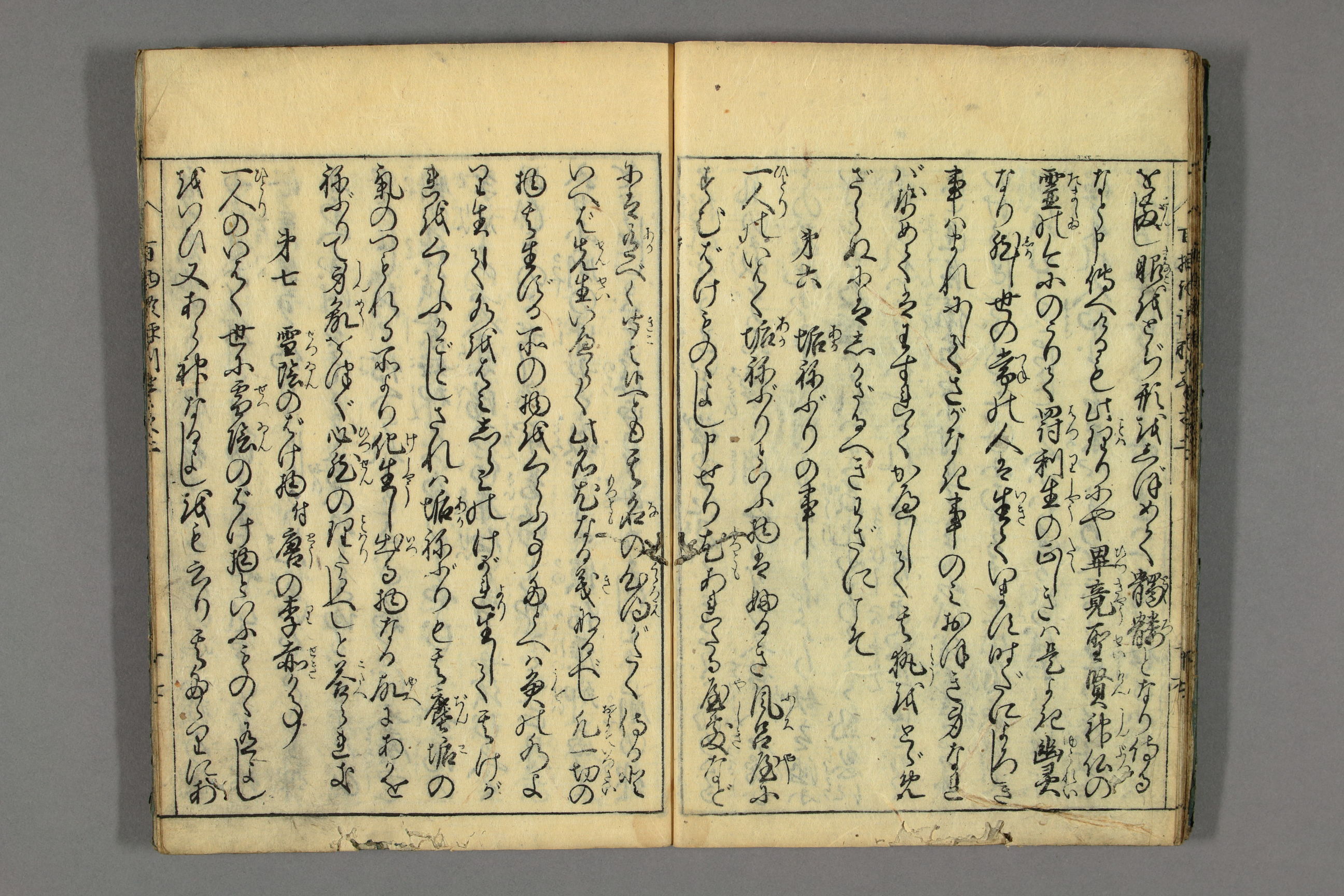
The name akaname ("filth-licker", "scum-licker") first appeared in Gazu Hyakki Yagyō (1776), one of several illustrated yōkai collections by Toriyama Sekien according to some commentators,[2] however, the variant name akaneburi (垢ねぶり) with the same meaning was described earlier in the kaidan book Kokon hyakumonogatari hyōban (古今百物語評判) (1686) by Yamaoka Genrin.[5][7][11] The form akaneburi (垢舐) is also attested in a work called Nittō honzō zusan (日東本草図纂) compiled by Genki (presumably Kanda Genki).[6][7]
Sekien did not provide any verbal details regarding his akaname, as was the case in all the yōkai depicted in this particular early work of his.[2] However, the Nittō honzō zusan provided ample details, describing it as child-like, with a pebbly? (磊直) head, round eyes, long tongue, and several example anecdotes are also provided.[b][6][7] In classical Edo Period depictions the akaname resembles a human child with clawed feet and cropped heads, sticking out its long tongue at a bathing area.[12] In Sekien's (monochrome) drawing the akaname stands around the corner of a "bathhouse",[2] though the setting appears to be a bath housed in an outhouse separated from the main house (living quarters),[4][13] rather than a public bathhouse. In the Hyakushu kaibutsu yōkai sugoroku (1858), it is depicted as an eerie, blue-black skinned figure.[5]
The Kokon hyakumonogatari hyōban gives lecture on how the akaneburi originates, supposedly it spawns in an area where dust and grime/filth/scum (aka) at an old bathhouse or at a derelict tattered home. That is to say, the akaname was said to emanate (keshō 化生) from the ki (気; qi) energy or inki (陰気) negative energy of the accumulated detritus, and the akaneburi also subsists on eating the filth of its environs.[11][2][7][5][c]
A more sinister type of akaneburi which assumes the guise of a beautiful woman is also described in the entry in Nittō honzō zusan, and it is claimed she will lick away the blood and flesh until only the skeletal carcass remains. The work gives as example the anecdote concerning a man who was in the hot springs at Banshū (Harima Province), and when he allowed a woman to scrub his back, he was licked down to his bones and died.[6][14][d]
Shōwa, Heisei, and beyond
[edit]In literature about yōkai from the periods of Shōwa, Heisei, and beyond, akaname and akaneburi were interpreted the same way as above. These interpretations state that the akaname is a yōkai that lives in old bathhouses and dilapidated buildings[15] that would sneak into places at night when people are asleep[15] using its long tongue to lick the filth and grime sticking to bath places and bathtubs.[4][16][17] It does not do anything other than lick filth, but since yōkai were considered unsettling to encounter, it is said that people worked hard to ensure that the bath places and bathtubs are washed clean so that the akaname wouldn't come.[4][16][18]
There were none who saw what the akaname truly were, but since aka can remind people of the color red (aka in Japanese), they are said to have red faces[16] or be entirely red.[17] And due to the double entendre pun on aka which can refer to both the filth which is the yōkai's essence and to the color red, a (modern) artist tends to conventionally illustrate the akaname as being of red color.[4]
In popular culture
[edit]See also
[edit]- Aka Manto ("Red Cape"), a Japanese urban legend about a spirit which appears in bathrooms
- Bannik, a spirit which appears in bathhouses in Slavic mythology
- Hanako-san, a Japanese urban legend about the spirit of a young girl who haunts school bathrooms
- Madam Koi Koi, an African urban legend about the ghost of a woman who haunts a school
- Teke Teke, a Japanese urban legend about the spirit of a girl with no lower body
Explanatory notes
[edit]- ^ Cf. Miyamoto lists the components of the akaname's diet as consisting of the oily sebum and the keratinous stratum corneum off of humans, and fungi[5] (molds and mildews). She also lists mizuaka (水垢),[5] which can denote soap scum as well as limescale.
- ^ One anecdote dated to the Genroku era concerns a servant[?] woman who went to the bath chamber in the morning to tidy up the equipment and her hand touched something that was squirming. She screamed for help and for illumination, but the other women were too afraid to approach. The woman bravely tackled it but was repelled backwards. The other women finally drummed up courage and lit their torches, rolling the wooden board over it and trample on it, and it was squashed like a chicken egg's yolk.[6]
- ^ The Kokon hyakumonogatari hyōban makes further comparison with the examples of the "fish born of water which partakes of water, and lice born of filth that feeds on filth".[8][9]
- ^ A cognate tale to this is found in Shokoku hyakumonogatari, featuring a man named Denzaemon from Amagasaki in Settsu Province who went to Arima hot springs and met the same fate from a female bakemono monster. Arima belonged to Settsu Province, which is discrepant from the episode at the hot spring in Harima Province,[14] but Arima and Amagasaki are in current day Hyōgo Prefecture which overlaps with most of Harima and parts of Settsu Provinces.
References
[edit]- Citations
- ^ Toriyama, Sekien (July 2005). "Gazu Hyakki Yagyō: In" 画図百鬼夜行:陰. Toriyama Sekien Gazu hyakki yagyō zen gashū 鳥山石燕 画図百鬼夜行全画集. Kadokawa Shoten Publishing. p. 20. ISBN 978-4-04-405101-3.
- ^ a b c d e f g h i j Foster, Michael Dylan (2015). The Book of Yokai: Mysterious Creatures of Japanese Folklore. University of California Press. p. 232 and Fig. 28. ISBN 978-0-520-95912-5.
- ^ Murakami, Kenji [in Japanese] (2000). Yōkai jiten 妖怪事典. Mainichi Shimbun-sha. p. 7. ISBN 978-4-620-31428-0.
- ^ a b c d e f g Yoda, Hiroko; Alt, Matt (2013) [2008]. Yokai Attack! The Japanese Monster Survival Guide. Tatsuya Morino (illustr.). Tuttle Publishing. pp. 86–89. ISBN 9781462908837.
- ^ a b c d e f Miyamoto, Yukie (2013). "Chapter 1. Kokuminteki yūmei yōkai. §Akaname" 第1章 国民的有名妖怪 §垢嘗. Nihon no yōkai FILE 日本の妖怪FILE (in Japanese). Gakken Publishing. pp. 16–17. ISBN 978-4-054056-63-3.
- ^ a b c d e Kanda, Genki (1780). "Dai-6 Akaneburi" 第六 垢ねぶり. In Tsutsumi, Rin (ed.). Nittō honzō zusan 日東本草図纂. Vol. 12. Ueda Hiromitsu 上田寛満 (illust.).
- ^ a b c d Kiba (2018), p. 32.
- ^ a b Yamaoka, Genrin [in Japanese] (1755) [1686]. "Dai-6 Akaneburi no koto" 第六 垢ねぶりの事. Kokon hyakumonogatari hyōban 古今百物語評判. Vol. 2. Teramachimatsubarasagarumachi, Kyōto: Umemura Saburobee. pp. 16v – 17r.
一人いわく、「垢ねぶりというものは、ふるき風呂屋にすむばけもののよし申せり。もっとも、あれたる屋敷などにはあるべく聞こえ候えども、その名の心得がたくはべる」といえば、先生いえらく、「この名、もつともなる儀なるべし。
- ^ a b Mozume, Takami [in Japanese] (1922). "Akaneburi" 垢ねぶり. Kōbunko 廣文庫. Vol. 15. Kōbunko kankōkai. pp. 932–933.
- ^ Yamaoka, Genrin [in Japanese] (1989) [1686]. Takada, Mamoru [in Japanese] (ed.). Kokon hyakumonogatari hyōban 古今百物語評判. 江戸怪談集. Vol. 3. Iwanami. pp. 344–345. ISBN 978-4-00-302573-4.
{{cite book}}:|work=ignored (help) - ^ a b Yamaoka Genrin; Yamaoka Genjo edd., (1686) Kokon hyakumonogatari hyōban 古今百物語評判, Book 2, Part 6 "Akaneburi no koto 垢ねぶりの事".[8][9][10]
- ^ Kusano, Takumi (1997). Gensō dōbutsu jiten 幻想動物事典. Shinkigensha. p. 7. ISBN 978-4-88317-283-2.
- ^ Yoda & Alt in boxed commentary, Toriyama (2017), p. 18
- ^ a b Kiba (2018), p. 36.
- ^ a b Shōnensha; Nakamura, Yukio; Takeda, Eriko, eds. (1999). Yōkai no hon: Ikai no yami ni ugomeku hyakkiyagyō no densetsu 妖怪の本 異界の闇に蠢く百鬼夜行の伝説. New sight mook. Gakken. p. 114. ISBN 978-4-05-602048-9.
- ^ a b c Iwai (1986), p. 139 and Iwai (2000), p. 42
- ^ a b Tada, Katsumi [in Japanese] (1990). Yōkai sekai no jūnin tachi 幻想世界の住人たち. Truth In Fantasy. Vol. IV. Shin-kigensha. p. 270. ISBN 978-4-915146-44-2.
- ^ Mizuki, Shigeru (2004). Mujara 妖鬼化. Vol. 2. Softgarage. p. 6. ISBN 978-4-86133-005-6.
- ^ "Akaname | Bubble Bar | Lush Cosmetics". www.lushusa.com. Archived from the original on 2020-08-05.
- ^ "Review: Lush Akaname Bubble Bar". 12 April 2020.
- Bibliography cited
- Iwai, Hiromi [in Japanese] (2000) [1986]. Kurashi no naka no yōkai tachi 暮しの中の妖怪たち. Kawade bunko. Kawade shobō. p. 139. ISBN 978-4-309-47396-3.
- —— (2000). Yashiki no yōkai 屋敷の妖怪. Nihon no yōkai hyakka 4. Kawade shobō. ISBN 978-4-309-61381-9.
- Kiba, Takatoshi (2018-07-17). "'Shoke' to 'rigainori': Nittō honzō zusan kan-no-12 wo megutte" (PDF). Gazoku. 17: 27–40.
- Toriyama, Sekien (2017), Japandemonium Illustrated: The Yokai Encyclopedias of Toriyama Sekien, translated by Yoda, Hiroko; Alt, Matt, Courier Dover Publications, p. 18, ISBN 9780486818757
External links
[edit] Media related to Akaname at Wikimedia Commons

Akaname
View on GrokipediaDescription and Characteristics
Physical Appearance
The Akaname is depicted in Japanese folklore as a diminutive, goblin-like yōkai, approximately the size of a child, with a distinctly hunched posture that accentuates its grotesque, child-like form.[1] Its body is naked and coated in greasy, slimy skin, while a mop of unkempt, slimy hair adorns its head. It typically has one or two bulging eyes and clawed hands and feet with a varying number of digits (from one to five).[1][2] The creature's feet are clawed, enabling it to cling to slick surfaces, and its limbs appear elongated in proportion to its compact frame.[4][5] A defining anatomical feature is the Akaname's disproportionately long, sticky tongue, which protrudes prominently and drips with saliva.[1] Skin coloration varies across depictions, ranging from a ruddy red face—evoking "aka," the Japanese term for both red and filth—to eerie blue-black tones or mottled green shades reminiscent of mold and decay.[1][6][3]Behavior and Habitat
The Akaname emerges primarily at night in neglected and unclean spaces, such as dirty bathrooms, bathhouses, filthy toilets, and abandoned buildings, where it licks away accumulated filth, including scum, mold, dead skin, and grime from tubs, walls, and floors.[1] This nocturnal activity is rooted in Edo-period folklore. It feeds exclusively on such organic residues—slime, grease, hair, human waste, and other debris—thriving only in environments of poor hygiene and avoiding well-maintained homes altogether.[1] In yokai lore, the Akaname's presence serves as a folkloric indicator of uncleanliness; its appearance signals the need for better sanitation, while its absence reassures inhabitants of a hygienic household.[1] The creature moves stealthily, sneaking into homes silently while occupants sleep, using its sharp claws to climb surfaces and its extended, sticky tongue to scour without disturbance.[1] Though it references physical traits like these claws and tongue for navigation and feeding, the Akaname's actions emphasize utility over harm.[1] In most traditional accounts, the Akaname exhibits a non-malevolent nature, though traditionally viewed as non-malevolent and not directly harmful, it is believed to spread disease by inhabiting and licking filth in unclean environments.[1][2] However, certain variants describe it leaving residual marks on surfaces or inducing a sense of unease through its eerie, unseen labors.[1]Etymology and Origins
Name and Linguistic Roots
The name akaname (垢嘗) derives from the combination of two Japanese words: aka (垢), which refers to filth, dirt, scum, dead skin, or grime, and name (嘗 or なめ), meaning to lick or taste.[1] This literal translation yields "filth-licker" or "dirt-licker," directly reflecting the yokai's association with consuming accumulated uncleanliness.[1] The term aka carries a dual connotation, as it can also mean "red," potentially alluding to flushed or reddened skin caused by prolonged exposure to dirt and neglect.[7] Regional variants of the name include akaneburi (垢舐め), where neburi emphasizes licking filth, highlighting the creature's interaction with impurities.[8] This earlier form appears in the Edo-period text Kokon Hyakumonogatari Hyōban (1686), predating the standardized akaname and suggesting an evolution from oral traditions focused on bathroom or estate grime.[9] The akaneburi is described therein as a monster lurking in dilapidated bathhouses and toilets, born from accumulated dust and scum.[8] The kanji for akaname (垢嘗) saw no fixed standardization prior to the Edo period, as the yokai's lore primarily circulated through spoken folklore before artistic documentation.[1] It was first rendered in this form in Toriyama Sekien's illustrated collection Gazu Hyakki Yagyō (1776), which formalized the name and linked it explicitly to the akaneburi precursor, marking a shift from fluid, regional pronunciations to a more codified representation in yokai nomenclature.[9] Linguistically, aka ties into broader Japanese concepts of impurity (kegare), encompassing not just physical dirt but spiritual defilement such as sins, worldly desires, or moral lapses—ideas influenced by Buddhist notions of purification in sacred spaces like bathhouses and temples.[8] This connection underscores the name's role in yokai lore as a cautionary symbol for cleansing both body and spirit from such contaminants.[8]Historical Precursors
The first documented precursor to the Akaname appears as the "akaneburi" in the 1686 illustrated story collection Kokon Hyakumonogatari Hyōban, compiled by Yamaoka Genrin and published posthumously, where it is described as a spirit that emerges in neglected bathhouses to lick accumulated filth and grime, serving as a supernatural enforcer of cleanliness. This entity embodies early yokai motifs tied to domestic neglect, spawning from dust and scum in abandoned or poorly maintained spaces. The term "akaneburi" linguistically connects to this licking action, as explored in etymological analyses of yokai nomenclature.Historical Depictions
Edo Period Illustrations
The Akaname made its debut in illustrated yokai literature during the Edo period through Toriyama Sekien's Gazu Hyakki Yagyō (1776), where it is rendered as a diminutive, child-like figure crouched in a dimly lit bathroom, its elongated, slimy tongue extended to lap at the grime and scum on the walls and floor, embodying the yokai's emergence from the malevolent spiritual energy generated by prolonged filth and neglect.[10][11] This depiction, characterized by the creature's hunched posture, wild disheveled hair, and bare, mottled skin, established the Akaname as a grotesque yet cautionary entity tied to unclean spaces, influencing subsequent artistic representations of hygiene-related yokai. A later Edo-era portrayal appears in Utagawa Yoshikazu's Hyakushu Kaibutsu Yōkai Sugoroku (ca. 1848–1858), a woodblock-printed board game intended for both amusement and moral instruction among children and families, in which the Akaname is shown with dark blue-black skin, sharp claws on its hands and feet, and a prominently protruding tongue amid a bathhouse scene, accentuating its repulsive, goblinoid form to evoke disgust and promote cleanliness.[12] The game's format, featuring the Akaname among one hundred monstrous variants, integrated yokai lore into interactive play, allowing players to navigate supernatural perils while absorbing lessons on domestic order. Edo-period textual accounts expanded on these visuals by framing the Akaname as a spectral enforcer of hygiene, manifesting in neglected bathhouses and homes to devour accumulated dirt, hair, and waste, serving as a folkloric admonition against laziness in sanitation that could invite disease or supernatural retribution. The earliest known textual reference appears in Yamaoka Genrin's Kokon Hyakumonogatari Hyōban (1686), describing the precursor akaneburi as a yōkai born from scum and grime in old bathhouses. A more menacing variant is detailed in Kanda Genki's Nittō Honzō Zusan (ca. 1780), where the entity disguises itself as an alluring woman in hot springs or baths to lure victims before using its tongue to consume their flesh down to the bones.[3] Such illustrations and tales reflected broader Edo societal concerns with public bathhouse maintenance amid rapid urbanization, as cities like Edo (modern Tokyo) reached approximately one million residents by the 1720s, making communal sentō essential for daily cleansing yet prone to grime from heavy use and prompting cultural narratives that blended fear with practical hygiene education.[13][14]Pre-Edo and Early References
No known visual or specific textual depictions of the Akaname exist prior to the Edo period. However, broader Japanese folklore from earlier eras, such as the Heian-period Konjaku Monogatarishū (ca. 1120) and Muromachi-era (1336–1573) setsuwa tales, includes stories of supernatural beings like oni and ghosts that punish human impurity and moral decay in defiled or neglected spaces, establishing general motifs of retribution against uncleanliness that may have influenced later yokai like the Akaname.[15] Shinto traditions emphasized concepts of kegare (impurity) and its cleansing, with water-related spirits like the kappa—documented in 16th-century folklore—interacting with defilement in aquatic environments, though not specifically tied to bathrooms or filth-licking.[16][17] These elements contributed to a cultural foundation for hygiene-enforcing supernatural figures, transmitted orally and in early texts, contrasting with the illustrated compendia of the Edo period.Modern Interpretations
20th and 21st Century Adaptations
During the Shōwa era (1926–1989), the Akaname saw a notable revival in Japanese folklore through yokai collections compiled by artists and scholars, including mangaka Shigeru Mizuki, whose works like GeGeGe no Kitarō reintroduced traditional spirits to contemporary audiences with an emphasis on whimsical, comedic elements rather than outright terror.[18] Mizuki's depictions often humanized the creature, transforming its grotesque hygiene-policing role into lighthearted commentary on cleanliness, aligning with postwar Japan's blend of tradition and modernization.[19] This adaptation reflects Japan's dense urban living, portraying the yokai as a nocturnal intruder in everyday hygiene routines. In 2020, British cosmetics company Lush released the "Akaname" bubble bar, a bath product explicitly inspired by the yokai's filth-licking motif to promote a "clean bath" experience, featuring citrus scents like lime and Sicilian lemon for an uplifting, thematic cleanse.[20] These changes, seen in folklore compilations and visual arts, emphasize visual shock over historical accuracy while retaining the core association with unclean spaces. As of November 2025, no significant new adaptations in anime, games, or major media have emerged beyond ongoing references in yokai compilations.Symbolic Role in Japanese Culture
The Akaname serves as a cultural caution against laziness in hygiene, reinforcing the societal imperative for regular ofuro bathing rituals, which are essential for maintaining both physical and spiritual cleanliness in daily life.[2] By appearing only in soiled spaces, the Akaname warns that neglect of personal and household sanitation can lead to spiritual disorder, echoing broader Japanese values that equate cleanliness with moral and communal harmony.[1] In Shinto-Buddhist traditions, the Akaname's act of licking away accumulated grime symbolizes the removal of moral and physical dirt, paralleling purification rites like misogi, where water washes away impurities to restore purity. This grotesque method of cleansing highlights the dual nature of yokai as agents of balance, transforming defilement into a reminder of the need for ritual purity to avert spiritual contamination. The creature's presence underscores how everyday hygiene practices align with religious concepts of hare (purity) opposing kegare (impurity), promoting a holistic approach to warding off impurity through vigilant maintenance.[21] From Edo times to the present, the Akaname illustrates ongoing tensions between urban density and hygiene standards, critiquing how environmental degradation exacerbates spiritual and physical impurity.[22] In contemporary contexts, the Akaname's imagery has been invoked in discussions of disgust and the uncanny, evoking psychological responses tied to cultural fears of contamination and invasion of personal spaces. This enduring role positions the Akaname as a bridge between ancient purity rituals and current psychological and ecological narratives, emphasizing hygiene as a timeless cultural safeguard.[23]Representations in Media
Traditional Art and Literature
In traditional Japanese art, the Akaname appears in 19th-century woodblock prints beyond Toriyama Sekien's foundational depictions, such as Utagawa Yoshikazu's 1858 sugoroku gameboard Mukashibanashi Bakemono Sugoroku, where it is illustrated as the "Filth-Licker of Shedbottom Valley" eagerly reaching for a wash-bucket in a public bath to consume soap scum and grime.[24][25] This portrayal integrates the Akaname into broader yōkai zukan (illustrated yokai encyclopedias) compilations, often alongside other bath-related spirits in multi-panel formats designed for both entertainment and moral instruction. Such works emphasize the creature's role in unclean spaces, serving as a visual deterrent against neglect. Literarily, the Akaname's precursor, the akaneburi, features in Edo-period kaidan (ghost tale) collections like Kokon Hyakumonogatari Hyōban (1686), where it is described lurking in dilapidated bathhouses and estates, licking filth to underscore warnings about decay and impurity. Later adaptations in narrative scrolls and tale anthologies reinforce these motifs, portraying the Akaname as a nocturnal intruder that punishes poor maintenance through its grotesque habits, thereby embedding hygiene admonitions in folklore storytelling.Contemporary Anime, Games, and Products
In the long-running manga and anime series GeGeGe no Kitarō, created by Shigeru Mizuki and first serialized in 1959 with anime adaptations starting in the 1960s, the Akaname is portrayed as a mischievous yōkai that haunts dirty apartments, scaring negligent tenants by licking filth from walls and floors while teasing landlords in collaboration with other yokai like Rokuro-Kubi.[26] This depiction emphasizes its role as a punitive spirit enforcing cleanliness, appearing in multiple episodes across adaptations, including the 1971 series (episode 28) and the 1985 series (episode 33, titled "Yōkai Akaname's Sorrowful Counterattack").[27][28] The Akaname has also influenced creature designs in other media, serving as a partial inspiration for the Pokémon Lickitung, introduced in 1996, whose long tongue and habit of licking dirty surfaces mimic the yokai's filth-consuming behavior.[29] In video games, it appears as an enemy in Monster Girl Quest (developed from 2009 onward), depicted as a seductive, slime-licking monster girl that ambushes protagonists in filthy environments during Chapter 3.[30] Additionally, yokai-themed RPGs like Yo-kai Watch (2013) feature variants such as Tublappa and Grublappa, oily humanoid creatures based directly on the Akaname, which befriend or battle players while embodying its bathroom-haunting traits.[31][32] Beyond entertainment, the Akaname has inspired merchandise, including Lush Cosmetics' Akaname bubble bar released in 2020, a blue, citrus-scented bath product (infused with Sicilian lemon, lime, and cassia oils) themed around the yokai's cleaning motif to evoke a "filth-free" soak.[33] More recently, from 2023 to 2025, YouTube animations and podcasts have popularized its lore globally; for instance, the Uncanny Japan podcast episode "Akaname: The Thoroughly Gross Scum Licker" (March 2023) retells its folklore through narrated stories of nocturnal bathhouse encounters, while channels like Japanese Folklore Explained have produced animated shorts (e.g., 2024 videos) depicting it as a disease-spreading demon to educate international audiences on yokai hygiene warnings.[3][34]References
- https://commons.wikimedia.org/wiki/File:SekienAkaname.jpg
- https://commons.wikimedia.org/wiki/File:Yoshikazu_Akaname.jpg