Hubbry Logo
BannikBannikMain
Open search
Bannik
Community hub
Bannik
logo
8 pages, 0 posts
0 subscribers
Be the first to start a discussion here.
Bannik
Bannik
from Wikipedia

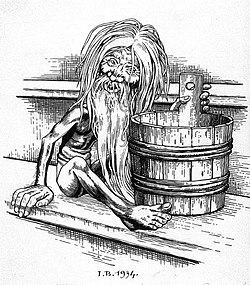
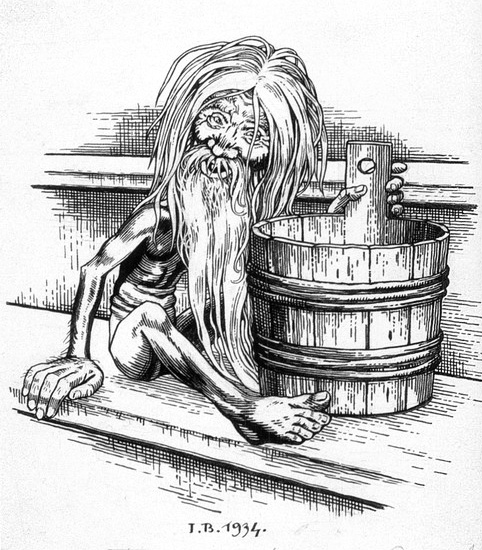
Bannik near a Bucket of Water by Ivan Bilibin, 1934

The Bannik (Cyrillic: Банник) is a bathhouse (banya) spirit in Slavic mythology.[1] He is usually described as a small, naked old man with a long beard, his body covered in the birch leaves left over from well used bath brooms.[2] Many accounts also claim that he is a shapeshifter and can appear as a local person to someone who stumbles across him,[3] or even as a stone or coal in the oven heating the bathhouse.[4] Slavic bathhouses resemble saunas, with an inner steaming room and an outer changing room. A place where women gave birth and practiced divinations, the bathhouse was strongly endowed with vital forces. The third firing (or fourth, depending on tradition) was reserved for the bannik, and, given his inclination to invite demons and forest spirits to share his bath, no Christian images were allowed lest they offend the occupants. If disturbed by an intruder while washing, the bannik might pour boiling water over him, or even strangle him.[1]

There were several rituals performed in order to keep the bannik happy and peaceful. The most common occurred during the steaming/firing that was reserved for the spirit itself or upon the quitting of the banya for the night; offerings of fir branches, water and soap were left, capped by a formal thank you uttered aloud.[3][4] The bannik was often blamed for anything that went wrong within the bathhouse, so if the structure burned down (which they often did), it was believed the spirit had been affronted in some way. In order to appease the bannik, upon the rebuilding of a banya, a black hen would be suffocated, left unplucked and buried beneath the building's threshold. The people performing this ritual would end it by bowing and backing away from the threshold, while reciting appropriate incantations.[3][4]

The banya was considered a liminal space among Slavic peasants and thus, was considered "unclean", or a place of possible spiritual danger. Despite this, most births occurred inside the banya and it was believed that the bannik was not truly happy or settled until a child was born within his domain.[3]

The bannik had the ability to predict the future. One consulted him by standing with one's back exposed in the half-open door of the bath. The bannik would gently stroke one's back if all boded well; but if trouble lay ahead, he would strike with his claws.[1]

See also

[edit]

References

[edit]
Revisions and contributorsEdit on WikipediaRead on Wikipedia
from Grokipedia
The Bannik (also known as Ban'nik) is a household spirit in East , particularly Russian tradition, revered and feared as the guardian of the banya, the traditional steam bathhouse central to communal and life. Depicted as a , naked elderly man with a long, unkempt , often covered in soot, leaves, or twigs, the Bannik inhabits the area behind the or in the bathhouse loft, embodying both protective and malevolent qualities depending on human conduct. Believed to oversee , healing, socialization, and even in the banya—a space considered liminal and sacred—the spirit demands respect through offerings such as , , a live , or fir branches to ensure benevolence and avert harm like suffocation by steam, scalding, or skin-peeling attacks if offended. In , the Bannik's dual nature reflects pre-Christian animistic beliefs blended with later Christian influences, where no icons or crosses were permitted in the bathhouse to avoid provoking the pagan entity. Young women sought its divinatory powers by visiting the bathhouse alone at night; the spirit would touch their backs—a soft hand foretelling a prosperous , while claws signaled misfortune or widowhood. As a member of the broader domovoi family of domestic spirits, the Bannik underscores the Slavic worldview of animated household spaces, with tales preserved in 19th-century collections emphasizing rituals to placate it, such as avoiding baths after dark or to prevent encounters with the spirit and its invited demonic companions.

Etymology and Origins

Etymology

The term Bannik originates from the Russian noun банник (banník), formed by adding the agentive suffix -ник (-nik) to the root of баня (bánja), meaning "bathhouse" or "steam bath." This suffix commonly denotes a person or entity associated with or inhabiting the base noun, thus identifying the Bannik as the "bathhouse dweller" or guardian spirit of such facilities. The root word banya derives from Proto-Slavic *bàňa, a feminine noun referring to a bathing place or bathhouse. This Proto-Slavic form is a borrowing from Latin balneum ("bath" or "bathing place"), likely entering via a variant baneum (possibly in plural banea) during cultural exchanges in late antiquity, reflecting the influence of Roman bathing traditions on early Slavic societies. Naming variations of the Bannik occur across East Slavic regions, where the term remains closely tied to local forms of banya. In Ukrainian, it appears as банник (bannýk), and in Belarusian as баннік (banník), maintaining the same etymological structure and association with steam bathhouses. West and , however, use different words for bathhouses—such as Polish łaźnia or banja (the latter a direct )—and lack a direct equivalent to "Bannik," though analogous bathhouse spirits exist under other names.

Historical and Cultural Origins

The Bannik emerged in , particularly within Russian traditions, during pre-Christian pagan eras, as part of broader animistic beliefs that attributed spirits to household elements and natural features. These beliefs posited that domestic spaces, including bathhouses, were inhabited by protective yet capricious entities requiring ritual observance to maintain harmony. The Bannik, as a spirit tied to the banya (the traditional Russian bathhouse), reflected this animistic worldview, where everyday structures were seen as extensions of the sacred landscape. Ancient Slavic reverence for bathhouses as liminal spaces further shaped the Bannik's mythological role, positioning them as thresholds between the mundane and the spiritual. Bathhouses served multifaceted purposes in pagan society, functioning as sites for through steam and water, post-childbirth recovery for women—who underwent multiple sessions over days—and cleansing after funerals to ward off death's lingering influences. This imbued the banya with potent vital forces, making it a nexus for life-cycle transitions and necessitating the presence of a guardian spirit like the Bannik to mediate human interactions with these energies. Following the in the 10th century, the Bannik persisted in folk traditions despite ecclesiastical efforts to eradicate pagan elements, evolving into a syncretic figure blending pre-Christian with residual Orthodox influences. Church prohibitions against bathing on certain holy days inadvertently reinforced the banya's otherworldly status, allowing household spirits to endure in rural practices. Ethnographic records from the , such as those compiled by P. V. Efimenko and D. K. Zelenin, document the Bannik's continued through accounts of rituals and taboos observed in Russian villages, highlighting its resilience as a of pagan heritage.

Description and Characteristics

Physical Appearance

In Slavic folklore, the Bannik is typically depicted as a diminutive, naked old man whose wizened form embodies the steamy, secluded confines of the bathhouse. His most distinctive features include a long, unkempt beard that often extends down to his torso, tangled and wild, paired with equally disheveled hair that adds to his feral, otherworldly presence. The creature's body is frequently described as covered in remnants of birch or fir leaves from used bath brooms (veniki), or soot, evoking the aromatic debris of the banya environment and symbolizing his intimate connection to this domestic space. Facial and bodily details further enhance the Bannik's intimidating yet paradoxically intimate aura: a disproportionately large head atop a small frame. These traits contribute to a frightening visage, underscoring the spirit's role as a guardian who demands . However, when properly appeased through rituals, the Bannik may present a cleaner, less appearance, with his form appearing more groomed and less entangled in foliage. Descriptions of the Bannik's size vary slightly across regional traditions, but the emphasis remains on his stature—often no taller than a —which reinforces his hidden, household-bound nature rather than a grand, mythical scale. This portrayal highlights the Bannik's role as a localized spirit, lurking in the shadows of the bathhouse rather than roaming freely. In some accounts, particularly from Russian traditions, he is described as a dark old man with unkempt hair and .

Shapeshifting Abilities

The Bannik is said in some accounts to possess the ability to manifest in different forms, such as a heavy stone, burning , or even as a human, to observe or interact within the bathhouse. This capacity aids in its guardian role, allowing subtle monitoring of bathers or deception of intruders without direct confrontation. Such transformations underscore the spirit's elusive nature and its ties to the liminal of the banya, though detailed into animals or shadows is less commonly attested and may vary by region.

Role and Behavior in Folklore

Protective Functions

In , the Bannik functions as the primary guardian spirit of the banya, the traditional steam bathhouse regarded as a sacred and liminal essential for physical cleansing, spiritual purification, and communal rituals. This role underscores the banya's status as a threshold between and the realm, where the Bannik maintains order and sanctity by regulating access and usage—typically allowing three rounds of bathers before claiming the for itself. The Bannik's guardianship extends to positive events hosted in the banya, particularly , as the warm, enclosed environment was a preferred site for deliveries in rural Slavic communities; when honored, the spirit was believed to bestow favor and assist in ensuring safe births and healthy outcomes for and child. Additionally, the Bannik invites other spirits, including forest spirits and demons, to share the banya after human use, underscoring its role in the space's supernatural activity.

Malevolent Behaviors

The Bannik, a spirit deeply embedded in East , manifests malevolent behaviors primarily when disrespected, provoked by improper use of the bathhouse, or disturbed during its own rituals. These actions underscore its role as a volatile guardian, capable of inflicting physical harm on intruders or offenders. One documented form of attack involves the Bannik peeling away a person's within the bathhouse, a gruesome retaliation reflecting its association with the intense heat and steam of the banya. Further accounts describe the Bannik responding aggressively to violations by suffocating victims in the dense or burning down the entire bathhouse as an extreme act of retribution. Such retaliations extend to the abduction of unattended children, particularly those born in the bathhouse, whom the spirit may attempt to if it feels slighted. These behaviors highlight the Bannik's unpredictable temperament, transforming the bathhouse from a place of cleansing into a site of peril. In addition to direct physical assaults, the Bannik engages in voyeuristic mischief, spying on bathers—especially women—as they undress or bathe, often as a punitive measure for neglecting or invading its domain. This invasive serves both as a form of petty malice and a warning against improper conduct in the of the banya. Among domestic spirits in Russian folk beliefs, the Bannik is categorized as one of the most dangerous and malicious, localized specifically to steam baths and prone to such harmful interventions.

Interactions with Humans

Rituals and Offerings

In traditional , particularly among Russian peasants, rituals to honor the Bannik involved leaving specific offerings in the bathhouse to ensure the spirit's goodwill and prevent harm during sessions. The last person to leave the bathhouse after human use would typically place , , and fir branches in the third or fourth corner of the room, areas considered the Bannik's domain, accompanied by a verbal invitation for the spirit to bathe in peace. These simple gifts, drawn from everyday materials, symbolized respect for the Bannik's role as guardian of the steam and , reflecting a practical integration of pagan customs into daily life. When the Bannik was believed to have been offended—such as after a bathhouse fire, which was often attributed to the spirit's displeasure—more elaborate reconciliation rituals were performed during rebuilding. A black hen would be suffocated without plucking, buried beneath the threshold, and incantations recited to appease the spirit and restore harmony, ensuring the new structure's safety. Salted bread or a live might also be offered at the foundation as a sacrificial gesture, underscoring the Bannik's perceived power over fire and structural integrity. A key taboo in these practices was the prohibition against bringing Christian symbols, such as crosses or icons, into the bathhouse, as they were thought to offend the Bannik and his supernatural associates, a remnant of pre-Christian pagan reverence for domestic spirits. This custom maintained the bathhouse as a liminal, "unclean" space separate from Orthodox sacredness, where only folk rituals held sway to avoid provoking the spirit's wrath.

Divination and Omens

In Slavic folklore, the Bannik serves as a prophetic entity consulted for divination, particularly in the bathhouse setting, where individuals seek omens about their future. This practice involves a seeker, often a young woman during Yuletide or similar liminal periods, approaching the spirit after completing the standard bathing rounds to request foresight. The divination ritual typically occurs after the third or fourth round of steaming, at which point the bathhouse is considered the Bannik's domain, free from human interruption. The seeker stands with their back to the bathhouse door, sometimes covering their head with a cloth or undergarment for protection, and silently poses a question about marriage, health, or prosperity. Offerings such as soap, bread, or salt are placed nearby as a prerequisite to appease the spirit and ensure a response. If the Bannik approves, it touches the seeker's back; a gentle stroking with soft leaves or hands signifies good fortune, successful endeavors, or a positive outcome to the query. Conversely, a rough clawing or scratching indicates misfortune, illness, or even death. This method underscores the bathhouse's role as a liminal space infused with vital forces in traditional Slavic society, where it hosted not only cleansing and communal gatherings but also significant life events like births and prophetic rituals. The Bannik's omens were interpreted as direct communications from the spirit world, reflecting the intertwined pagan beliefs in guardians and Christian-era folk practices. Such divinations were especially prevalent among women, who viewed the bathhouse as a for seeking guidance on personal futures.

Cultural Significance

In Traditional Slavic Society

In traditional Slavic society, the Bannik was deeply integrated into household and community practices, with the bathhouse serving as a vital spiritual hub for purification, healing, and social rituals. Rural families in 18th- and 19th-century viewed the banya not merely as a place for physical cleansing but as a where communal bonding occurred through shared steaming sessions, often on Saturdays, fostering social ties and health maintenance. Ethnographic accounts describe rituals to honor the Bannik, such as leaving warm water and a broom for the spirit after the third round of bathing, ensuring its goodwill during these gatherings. These practices underscored the bathhouse's role in holistic , where was believed to expel illnesses and restore vitality, reflecting the intertwined nature of physical and spiritual care in peasant life. The Bannik's association with "unclean" liminal spaces profoundly shaped bathing customs, positioning the bathhouse as a threshold between the domestic world and the , often located on the village periphery to contain potential spiritual . This rendered the banya a site of ritual caution, where entrants sought the spirit's permission with incantations like "Bannyi khoziain, pusti menia v baniu poparit’sia!" to avoid its wrath, and prohibitions against noise, swearing, or on holy days were strictly observed to prevent harm from its "iron arms." Gender-specific customs emerged from these fears; women, deemed ritually impure post-childbirth for up to seven weeks, were required to bathe 3 to 9 times in the banya for purification before reentering church or , while men and women typically alternated times to maintain separation in this spiritually charged environment. Such rules highlighted the bathhouse's dual role as a purifying yet perilous domain, influencing daily and social norms to mitigate risks. The Bannik's presence persisted in oral traditions and ethnographic records from 18th- and 19th-century , as documented by scholars like D. K. Zelenin, who collected peasant testimonies revealing its embodiment of broader animistic beliefs in . These accounts, drawn from rural regions, portray the spirit as an animistic force animating everyday structures, where failure to appease it could disrupt household harmony, including brief protective roles during births conducted in the bathhouse to ward off infant theft by malevolent entities. This endurance in illustrates how infused pre-modern Slavic life, with the Bannik symbolizing the vital, unpredictable energies inherent in natural and built environments.

Modern Depictions and Legacy

In , the Bannik has been reimagined as a folkloric archetype in several works drawing on Slavic mythology. In Katherine Arden's , particularly The Girl in the Tower (2017), the Bannik appears as a protective yet enigmatic bathhouse spirit who aids the protagonist Vasilisa by offering guidance and safeguarding the household against threats. Similarly, in Seanan McGuire's series, Bannicks are depicted as fae creatures obsessed with cleanliness, serving roles in magical households and emphasizing the spirit's traditional association with bathhouse purity and mischief. These portrayals often highlight the Bannik's dual nature—benevolent guardian or vengeful entity—in narratives exploring themes of and the . The Bannik also features in video games inspired by , where it serves as a summonable entity or in fantastical settings. In the Shin Megami Tensei series by , the Bannik is represented as a demon, embodying its roots as a bathhouse dweller capable of both and cursing players during battles. Such inclusions contribute to the broader revival of Slavic myths in gaming, blending horror elements like bathhouse hauntings with to introduce global audiences to lesser-known spirits. In neopagan and Slavic reconstructionist movements, known as Rodnovery, rituals honoring domestic spirits like the Bannik have been adapted for modern events during communal gatherings. These practices draw from traditional behaviors to foster spiritual connections in contemporary settings, such as seasonal festivals celebrating Slavic ancestry. The Bannik's legacy endures symbolically in modern Russian culture, where nods enhance wellness and experiences. Contemporary banyas often invoke the spirit in promotional materials and rituals, portraying it as a guardian of purification to evoke authenticity and mystique for visitors seeking traditional immersion. This integration underscores the Bannik's role in preserving amid evolving leisure practices.
Add your contribution
Related Hubs
User Avatar
No comments yet.