


Community hub
Recent from talks
Contribute something
Nothing was collected or created yet.
Al Schmid
View on Wikipedia | This article needs additional citations for verification. (December 2020) |
Albert Andrew Schmid (20 October 1920 – 1 December 1982) was a United States Marine awarded the Navy Cross for his heroism at the Battle of the Tenaru (Ilu River) during the Guadalcanal campaign in World War II. Credited with killing over 200 Japanese attackers during a night-long assault, he was blinded in action by a grenade blast and endured multiple surgeries and extended rehabilitation upon his return to the United States
Key Information


His life story appeared in the American news magazines of the time,[1] the book Al Schmid, Marine by Roger Butterfield, and the 1945 film Pride of the Marines, in which he was played by American actor John Garfield.
Early life
[edit]Albert Andrew Schmid was born in the Burholme neighborhood of Philadelphia, the second son and third child of Adolph and Marian Schmid who both came from Germany to Philadelphia in the early 1880s. His father worked as a truck driver and baker. His mother died around 1932, and his father remarried in 1934. Albert (Al) moved out around 1938, eventually becoming an apprentice steel burner at the Dodge Steel Company in Philadelphia in 1940.
World War II
[edit]Schmid enlisted in the United States Marine Corps on December 9, 1941, after hearing on the radio of the December 7 attack on Pearl Harbor. He received recruit training at Parris Island, South Carolina, and further training at New River, North Carolina, where he was assigned to the 11th Machine Gun Squad, Company H, 2nd Battalion, 1st Marine Regiment, 1st Marine Division. While on leave, he used a $60 bonus (equivalent to $1,180 in 2025) from his employer to purchase an engagement ring for his girlfriend Ruth Hartley, a salesgirl he first met in May 1941.
The 1st Marines landed on Guadalcanal on August 7, 1942, the largest Marine force ever engaged in landing operations up to that time and first American offensive against the Japanese. Schmid, a private, was assigned as an assistant gunner/loader of a three-man crew manning a M1917A1 Browning heavy machine gun (water cooled, 30 caliber)[2] led by the crew's commander Corporal Leroy Diamond, with Private First Class Johnny Rivers as gunner.[1] Schmid refused medical treatment for a serious foot infection in order to remain in combat with his team and fellow Marines.[3]
On the night of August 21, an assault force of 800 Japanese crack infantry troops sent from Rabaul on August 18 under the command of Japanese Colonel Kiyonao Ichiki attempted to break through the 2nd Battalion, 1st Marines's perimeter and recapture the hotly contested Henderson Field airstrip. To reach it, Ichiki's infantry regiment had to cross the Ilu River. Cpl. Diamond's team was entrenched and posted on its west bank.
The Japanese attack began under the light of flares at 3:00 am. Part way into the assault, Pfc. Rivers was killed. Pvt. Schmid took over the gun and fired it for over four hours. As the assault progressed, Diamond was seriously wounded in the arm, and several bullets hit and shredded the Browning's water jacket. Guided by Cpl. Diamond's fire direction, Schmid kept shooting the gun by himself and loading 250-round belts of ammunition with and without help. Utilizing short bursts to avoid overheating and jamming, Schmid kept firing the machine gun even though it glowed red hot.[1] Ultimately, a crawling Japanese soldier threw a grenade into their machine gun position, wounding Schmid in the shoulder, arm, hand, and face.
In spite of being blinded by the blast, Schmid resumed manning the gun, both firing and replacing ammunition belts in response to physical and verbal cues from Diamond as the Japanese continued to pour across the Ilu firing their weapons at the gun emplacement covered by a sniper firing from a tree across the river.
The next morning, over 200 dead Japanese were counted in front of Schmid's position.[4] Only 15 of the original attackers survived the assault, a solitary soldier among the 800 escaping unwounded. Colonel Ichiki committed suicide.
Schmid subsequently returned stateside for treatment of his wounds at the San Diego Naval Hospital. On January 18, 1943, he arrived home in Philadelphia.[5] On April 10, 1943, the city turned out in a massive parade to honor their hometown hero.[6]
Navy Cross
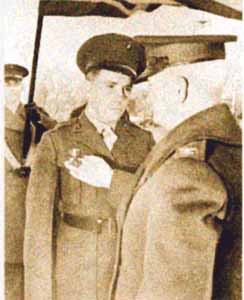
[edit]All three Marines—Rivers, Diamond, and Schmid—were awarded the Navy Cross for extraordinary heroism, Schmid receiving his medal at the Philadelphia Navy Yard on February 18, 1943. He was also promoted to corporal (he was later promoted to sergeant).[1]
- Service: Marine Corps
- Rank: Private
- Battalion: 2d Battalion
- Division: 1st Marine Division
Citation:
The President of the United States of America takes pleasure in presenting the Navy Cross to Private Albert Andrew Schmid (MCSN: 350951), United States Marine Corps Reserve, for extraordinary heroism and conspicuous devotion to duty while serving as a Machine Gunner of the Eleventh Machine Gun Squad, Company H, Second Battalion, First Marines, First Marine Division, in action against enemy Japanese armed forces at the Tenaru River, Guadalcanal, Solomon Islands, on 21 August 1942. Lacking the protection of riflemen, Private Schmid's machine gun squad was forced to tear down its frontal protection to meet the oncoming strong Japanese landing force. In spite of tremendous difficulties, the enemy attack was courageously met and repulsed by fierce and determined fighting during which Private Schmid was seriously wounded. His personal valor and loyal devotion to duty contributed to the defeat of the enemy.[7]
Post World War II
[edit]Schmid married Ruth Hartley on April 4, 1943. They had a son, Al Schmid, Jr., in June 1944. Schmid spoke at war bond rallies across the nation before being honorably discharged from the Marine Corps on December 9, 1944. He remained in the public's eye throughout the war largely through Roger Butterfield's book, Al Schmid, Marine and the Warner Bros.' film released in August 1945, Pride of the Marines.
In June 1946, Schmid was named Father of the Year in Pennsylvania, and the Democratic Party nominated Schmid as a candidate for the Pennsylvania Secretary of Internal Affairs, but he lost the election.[8]
Schmid eventually recovered partial sight in one eye, but problems with his leg during the cold winters led him to retire in 1957 and move to St. Petersburg, Florida, with his wife and two sons.
Al Schmid died of bone cancer on December 1, 1982. On December 6, he was buried at Arlington National Cemetery. His wife Ruth was also buried in Arlington National Cemetery, on September 12, 2002 (died August 15, 2002).
Notes
[edit]- ^ a b c d Butterfield, Roger (22 March 1943). "Al Schmid: Hero". Life. pp. 35–44.
- ^ Weapons of the World War II Gyrene, M19171A Heavy Machine Gun
- ^ Gerber, David A. "In Search of Al Schmid" quoted in Mitchell, David T. & Snyder, Sharon L. The Body and Physical Differences: Discourses of Disability 1997 University of Michigan Press, p. 114 ISBN 0472096591
- ^ "Army & Navy – Heroes: Dear Ruth . . ". Time. 1 February 1943. Archived from the original on 2008-12-14.
- ^ "Blind Hero Back Home". Philadelphia Inquirer. January 19, 1943. p. 3 – via Newspapers.com.

- ^ "Phila. Roars Salute to Schmid As He Receives Inquirer Award After Triumphal Parade to Plaza". Philadelphia Inquirer. April 11, 1943. pp. 1–5 – via Newspapers.com.
- ^ "Albert Schmid – Recipient – Military Times Hall Of Valor". Military Times. Retrieved 5 August 2019.
 This article incorporates text from this source, which is in the public domain.
- ^ Gerber, p. 116


External links
[edit]
Al Schmid
View on GrokipediaEarly life
Childhood and family
Albert Andrew Schmid was born on October 20, 1920, in the Kensington neighborhood of Philadelphia, Pennsylvania, to German immigrant parents Adolph and Marian Greenwald Schmid.[6] He was the third of four children in a working-class family, with his father employed as a truck driver for Hornung's Brewery at 22nd and Clearfield streets, providing steady work during the early years of the Great Depression.[6] In 1924, the family relocated to the Burholme neighborhood in Northeast Philadelphia, where Al spent much of his formative years in a close-knit, blue-collar community.[6] As a child, Schmid was known as a cheerful, freckle-faced boy who embodied the spirit of his neighborhood through his playful and mischievous nature.[2] He earned a reputation as the class clown at school, often engaging in pranks and friendly scraps with peers, though he was not a particularly strong student academically.[6] From around age 10, he demonstrated early skill as an excellent marksman with a BB gun, honing a talent that would later prove pivotal in his military service, while also enjoying typical boyhood activities in the local environment.[6] Schmid's family life underwent significant changes during his adolescence. When he was 12 years old, in 1932, his mother died suddenly from an illness, leaving the family disrupted.[6] Two years later, in 1934, his father remarried, but the new stepmother did not integrate well into the household dynamics, contributing to tensions.[6] At age 15, Schmid left home to take a job at a lumber camp in Middletown, Connecticut, marking his early independence as he began working odd jobs and farm labor to support himself.[6]Employment and engagement
In 1940, at the age of 20, Al Schmid secured an apprenticeship as a steel burner at the Dodge Steel Company in Philadelphia's Tacony neighborhood, a major industrial facility focused on shipbuilding components.[2] This skilled but perilous trade required him to wield an oxy-acetylene torch to slice through thick steel plates, exposing him to extreme heat, flying sparks, and the risk of burns from molten edges.[6] Earning roughly $27 per week—equivalent to about $33,000 annually in 2025 dollars—Schmid's role exemplified the grueling, low-wage labor that sustained Philadelphia's working-class families amid the lingering economic hardships of the Great Depression, which had left unemployment rates above 15% in the city by 1940 despite gradual recovery.[6][7] Having moved out from his family home around 1938 to gain independence, Schmid rented a room in the modest row house of his Dodge co-worker, Jim Merchant, and Merchant's wife, Ella Mae, on Tulip Street near the Tacony-Palmyra Bridge, a common arrangement for young workers unable to afford separate housing in the tight-knit, blue-collar neighborhoods of northeast Philadelphia.[2] It was through the Merchants that Schmid met Ruth Hartley in late 1940; she was a friend of Ella Mae's and worked as a salesgirl at the local Sears Roebuck department store.[2] Their courtship quickly deepened, with Schmid affectionately nicknaming her "Babs," and the couple enjoyed simple outings like ice skating together.[2] By the summer of 1941, buoyed by a bonus from his steelwork, Schmid proposed marriage and purchased an engagement ring for Ruth, envisioning a future together in their working-class community.[2] Their wedding plans, however, were abruptly halted by the Japanese attack on Pearl Harbor on December 7, 1941, which shifted Schmid's focus toward military service and postponed their union until after the war.[2]World War II
Enlistment and preparation
Following the Japanese attack on Pearl Harbor on December 7, 1941, Albert Andrew Schmid, an apprentice steel burner at Dodge Steel in Philadelphia, enlisted in the United States Marine Corps on December 9, motivated by a strong sense of patriotism in response to the nation's entry into World War II.[8][3] Schmid departed Philadelphia on January 5, 1942, and completed recruit training at Marine Corps Recruit Depot Parris Island, South Carolina, where he endured intense physical conditioning designed to build endurance, discipline, and combat readiness, alongside essential marksmanship instruction.[3] After basic training, Schmid was assigned to Company H, 2nd Battalion, 1st Marine Regiment, 1st Marine Division, specifically to the 11th Machine Gun Squad, where he trained on the water-cooled M1917 Browning machine gun as an assistant machine gunner.[5][4] His crew included Corporal Leroy Diamond as the gunner and Private First Class John Rivers as the assistant, with the team practicing coordinated operation of the heavy .30-caliber weapon to ensure effective fire support in combat scenarios.[2] In preparation for deployment, the 1st Marine Division conducted final exercises before shipping out to the Pacific theater in July 1942; Schmid's unit landed on Guadalcanal on August 7, 1942, marking the first major U.S. offensive against Japanese forces in the Solomon Islands campaign.[1][3]Battle of Guadalcanal
The Battle of the Tenaru, occurring on the night of August 20–21, 1942, represented the first major Japanese ground counterattack during the Guadalcanal campaign, aimed at dislodging U.S. Marines from their perimeter around the captured airfield. Approximately 900 troops of Colonel Kiyono Ichiki's elite detachment advanced toward the Marine lines at the mouth of the Ilu River—mislabeled as the Tenaru or Alligator Creek on U.S. maps—intending a swift banzai charge across a narrow sandbar to overwhelm the defenders. Private Al Schmid's machine gun squad held a vital flank position at this river mouth, dubbed "Hell's Point," where the terrain funneled the enemy into a kill zone, contributing to the overall Marine defensive strategy that integrated rifle fire, machine guns, and 37mm anti-tank guns loaded with canister shot.[9][2] As part of the 11th Machine Gun Squad, Company H, 2nd Battalion, 1st Marines, 1st Marine Division, Schmid functioned primarily as the loader for Corporal Leroy Diamond's .30-caliber water-cooled machine gun, with Private First Class John Rivers providing additional support by spotting targets and handling ammunition. Their emplacement, constructed from sandbags, coconut logs, and camouflaged with palm fronds amid the dense jungle undergrowth, overlooked the 50-yard-wide river crossing and was positioned to cover the exposed sandbar. When the Japanese assault commenced around 1:30 a.m., the squad unleashed sustained bursts into the advancing waves, compensating for the absence of nearby riflemen by exposing their position to maximize fire coverage.[4][2] The engagement unfolded under harsh environmental conditions, including pitch-black nighttime amplified only by the eerie glow of Japanese and Marine flares, thick jungle humidity, and the Marines' accumulated exhaustion from nearly two weeks of grueling operations since the August 7 landings. Schmid's team fired continuously for over four hours, expending multiple 300-round belts of ammunition in disciplined bursts to prevent overheating, while enemy Arisaka rifle fire and snipers from nearby trees whizzed overhead. As the assault intensified with repeated charges, the crew transitioned to grenades for close-range defense when belts ran low, maintaining their output amid the chaos until the Japanese force broke. Their relentless fire accounted for an estimated 200 enemy dead within direct range, bolstering the broader Marine repulsion that inflicted nearly 800 total Japanese casualties and secured the perimeter.[2][4][9]Injuries sustained
During the night of August 21, 1942, while defending the perimeter of Henderson Field on Guadalcanal, a Japanese soldier threw a grenade into the sandbag emplacement manned by Schmid and his crew, causing it to explode and shatter fragments into his face.[2] The blast instantly destroyed his left eye and severely damaged his right eye, rendering him completely blind, while shrapnel also embedded in his left shoulder, arm, and hand.[2][4] Despite the immediate loss of vision and intense pain—and after Rivers was killed and Diamond wounded—Schmid demonstrated remarkable resilience by continuing to fight, loading ammunition by touch and firing the .30-caliber machine gun, guided by the sounds of approaching enemy forces.[1][2] He and his crew persisted in manning the .30-caliber machine gun for over four hours until they were finally relieved by reinforcements.[8] The gun crew was credited with approximately 200 Japanese kills during the assault.[1] Schmid's comrades carried him on a blanket to a nearby aid station for initial treatment on Guadalcanal, where corpsmen staunched his bleeding wounds.[2] By early September 1942, he was evacuated stateside and arrived at the San Diego Naval Hospital for further care.[10] Medical examinations there confirmed permanent blindness in his left eye, with the right eye suffering severe, potentially irreparable damage, alongside ongoing pain from the shrapnel wounds in his limbs.[4][2]Awards
Navy Cross citation
The Navy Cross, the second-highest U.S. military decoration for valor after the Medal of Honor, recognizes extraordinary heroism in combat against an enemy force. It is awarded for actions that involve great personal risk and go beyond the call of duty, as demonstrated by Private Al Schmid during the Battle of the Tenaru River on Guadalcanal, Solomon Islands, on August 21, 1942. Schmid's Navy Cross citation, approved by President Franklin D. Roosevelt, reads as follows:The President of the United States of America takes pleasure in presenting the Navy Cross to Private Albert Andrew Schmid (MCSN: 350951), United States Marine Corps Reserve, for extraordinary heroism and conspicuous devotion to duty while serving as a Machine Gunner of the Eleventh Machine Gun Squad, Company H, Second Battalion, First Marines, FIRST Marine Division, in action against enemy Japanese armed forces at the Tenaru River, Guadalcanal, [Solomon Islands](/page/Solomon Islands), on 21 August 1942. Lacking the protection of riflemen, Private Schmid's machine gun squad was forced to tear down its frontal protection to meet the oncoming strong Japanese landing force. In spite of tremendous difficulties, the enemy attack was courageously met and repulsed by fierce and determined fighting during which Private Schmid was seriously wounded. His personal valor and loyal devotion to duty contributed to the defeat of the enemy.[11]The award highlighted Schmid's extraordinary heroism in sustaining fire from his machine gun position despite severe wounds, including blindness from grenade shrapnel, with his comrades crediting him with killing over 200 Japanese attackers during the night-long defense.[2] The medal was presented to Schmid on February 18, 1943, at the Philadelphia Navy Yard by Colonel A. E. Randall, in a ceremony attended by approximately 100 Marines and Rear Admiral Milo F. Draemel.[12] Schmid's crewmates, Corporal LeRoy Diamond and Private First Class John Rivers, received identical Navy Cross awards for their shared defense of the position against the Japanese assault.[1] Additionally, Schmid was awarded the Purple Heart for the shrapnel wounds to his face and eyes sustained in the action.[2]