


Community hub
Recent from talks
Contribute something
Nothing was collected or created yet.
Allantide
View on Wikipedia


Allantide (Cornish: Kalan Gwav, meaning first day of winter, or Nos Kalan Gwav, meaning eve of the first day of winter and Dy' Halan Gwav, meaning day of the first day of winter), also known as Saint Allan's Day or the Feast of Saint Allan,[1] is a Cornish festival that was traditionally celebrated on the night of 31 October, as well as the following day time, and known elsewhere as Allhallowtide.[2][3] The festival in Cornwall is the liturgical feast day of St Allan (also spelled St Allen or St Arlan), who was the bishop of Quimper in the sixth century. As such, Allantide is also known as Allan Night and Allan Day. The origins of the name Allantide also probably stem from the same sources as Hollantide (Wales and the Isle of Man) and Hallowe'en itself.

The Cornish language name for the festival is found in the Exeter Consistory Court depositions for the year 1572. It was reported in the court case that an altercation occurred upon Dew Whallan Gwa Metten in Eglos De Lalant, viz. upon all hallow day ... in the parish church of Lalant. This being Dy'Halan Gwav, from Kalan Gwav, with dy (day) causing an aspirate mutation to kalan. Kalan Gwav, like the Welsh Calan Gaeaf, meaning the first day of winter.[4]
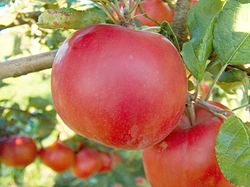
As with the start of the celebration of Allhallowtide in the rest of Christendom, church bells were rung in order to comfort Christian souls in the intermediate state.[3] Another important part of this festival was the giving of Allan apples, large glossy red apples that were highly polished, to family and friends as tokens of good luck. Allan apple markets used to be held throughout West Cornwall in the run up to the feast.
The following is a description of the festival as it was celebrated in Penzance at the turn of the 19th century:
The shops in Penzance would display Allan apples, which were highly polished large apples. On the day itself, these apples were given as gifts to each member of the family as a token of good luck. Older girls would place these apples under their pillows and hope to dream of the person whom they would one day marry. A local game is also recorded where two pieces of wood were nailed together in the shape of a cross. It was then suspended with 4 candles on each outcrop of the cross shape. Allan apples would then be suspended under the cross. The goal of the game was to catch the apples in your mouth, with hot wax being the penalty for slowness or inaccuracy.[5][6]
In his book Popular Romances of the West of England, Robert Hunt describes Allantide in St Ives:[5]
The ancient custom of providing children with a large apple on Allhallows-eve is still observed, to a great extent, at St Ives. "Allan-day," as it is called, is the day of days to hundreds of children, who would deem it a great misfortune were they to go to bed on "Allan-night" without the time-honoured Allan apple to hide beneath their pillows. A quantity of large apples are thus disposed of the sale of which is dignified by the term Allan Market.
There are a number of divination games recorded including the throwing of walnuts in fires to predict the fidelity of partners, and the pouring of molten lead into cold water as a way of predicting the occupation of future husbands, the shape of the solidified lead somehow indicating this.[7]
In some parts of Cornwall "Tindle" fires were lit similar in nature to the Coel Coth (Coel Certh) of Wales.[7]
Before the 20th century the parish feast of St Just in Penwith was known as Allantide.[8]
See also
[edit]

- Calan Gaeaf - Wales
- Dziady
- Hop-tu-Naa - Isle of Man
- Nickanan Night
- St Allen
- Winter Nights
References
[edit]- ^ A Descriptive Catalogue of Ancient Deeds in the Public Record Office: Series A, 3837-6122; Series B, 3871-4232; Series C, 2916-3764; Series D. 1-1330. Hodges Figgis. 1900. p. 197.
- ^ Radford, Edwin; Radford, Mona Augusta (1961). The Encyclopedia of Superstitions. Barnes & Noble. p. 15. ISBN 9780760702284.
A Cornish name for the season usually known as Hallowtide was Allantide.
{{cite book}}: ISBN / Date incompatibility (help) - ^ a b Sim, Alison (8 November 2011). Pleasures and Pastimes in Tudor England. History Press. p. 89. ISBN 9780752475783.
The biggest Christian festival of the autumn was the feast of the dead, called Hallowtide or Allantide. It was a spectacular event, designed to help the passage of the souls of the dead through purgatory. After evensong the church bells would be rung to comfort the dead in purgatory and the churches would be illuminated with candles.
- ^ Exeter Consistory Court depositions, 1572
- ^ a b * Robert Hunt Popular Romances of the West of England 1902
- ^ M. A. Courtney Folklore and Legends of Cornwall 1890
- ^ a b Simon Reed - The Cornish Traditional Year 2009
- ^ A. K. Hamilton Jenkin - Cornwall and the Cornish 1932
Cornish: Gonisogeth Kernow | |||||
| Symbols |  | ||||
| Festivals | |||||
| Sports | |||||
| Cuisine | |||||
| Arts | |||||
| Music |
| ||||
| Language | |||||
| Mythology | |||||
| Organisations | |||||

| Main topics |
|
|---|---|
| Traditions | |
| Food | |
| Events | |
| Media | |
| Related events | |
| Other events | |
| Related topics | |

Allantide
View on GrokipediaEtymology and Origins
Name and Linguistic Roots
The name Allantide derives from "Allan," connected through folk etymology to St. Allan, a 6th-century bishop of Quimper believed to have originated from the British Isles with ties to Cornwall, combined with the Old English "tide," meaning a season or festal period.[4][5] This English form parallels broader Celtic festival names like Welsh Hollantide (from All Hallows' Tide), reflecting Christian influences on pre-existing seasonal observances, though Cornish tradition specifically associates it with St. Allan.[6] In the Cornish language, the festival is termed Kalan Gwav, translating to "first day of winter," with Nos Kalan Gwav denoting the eve and Dy' Halan Gwav the day itself.[7] The component Kalan (or Halan) stems from Latin calendae, the first day of the Roman month, borrowed into Brythonic Celtic dialects including Old Cornish as a marker of new beginnings.[8] Gwav evolves from Old Cornish goyf, tracing to Proto-Celtic *gyamo-, ultimately from Proto-Indo-European *ǵʰyem- denoting winter. The linguistic roots of these terms illustrate the evolution from Old Cornish (c. 800–1300 CE), characterized by harder consonants and synthetic forms, to Middle Cornish (c. 1300–1777 CE) with increasing analytic structure and phonetic softening (e.g., goyf to gwav), influenced by English contact and the language's revival in the 20th century. Modern standardized Cornish, as revived by figures like Henry Jenner, preserves these elements while adapting spellings for consistency, drawing on dialectal variations across west Cornwall.Historical and Religious Foundations
Allantide traces its religious foundations to Saint Allan, a 6th-century Celtic bishop of Quimper in Brittany, who is believed to have originated from the British Isles and maintained ties to Cornwall through missionary activities or regional migrations common among early Celtic clergy.[5][2] His veneration is evidenced by place names such as St Allen near Truro, indicating an early establishment of his cult in Cornish Christian communities.[5] As a figure in the broader network of Celtic saints, Allan represented the transmission of faith across Brittany and the Celtic west of Britain during a period of post-Roman cultural exchange.[5] The festival's origins reflect a syncretic fusion of pre-Christian Celtic harvest traditions and emerging Christian observances, particularly as Allantide aligned with the eve of All Saints' Day by the early medieval period. In Cornish tradition, it overlapped with Kalan Gwav, the local equivalent of the ancient Celtic festival of Samhain, which marked the transition to winter and the thinning of boundaries between the living and the spirit world.[2] This integration allowed pagan rites honoring the harvest's end and ancestral spirits to merge with Christian commemorations of saints and souls, a process facilitated by the Church's adaptation of local customs to ease conversions in Celtic regions.[2] The earliest practices centered on the dedication of Allantide as a liturgical feast for Saint Allan, evolving into localized Cornish observances amid the consolidation of Celtic Christianity during the medieval period. These included church services and communal gatherings that honored Allan's legacy, gradually incorporating elements like symbolic offerings tied to both his sainthood and the seasonal shift.[2] By this time, the festival had become embedded in the ecclesiastical calendar, with parishes such as St Just in Penwith recognizing it as a dedicated holy day well into later centuries.[2]History
Early References and Development
The parish church of St. Allen, dedicated to St. Allen (also known as St. Alunus or St. Arlan), a bishop of Quimper believed to have lived in the 6th or 7th century with possible ties to Cornwall and Wales, is first attested in medieval records. It appears in 1235 as Eglossalen in episcopal registers, in 1261 as Sancti Alluni in papal taxation records, and in 1291 as Sancto Aluno in the Valor Ecclesiasticus, indicating its role in local religious life during the 12th to 15th centuries.[10][11][12] The traditional association of Allantide with St. Allen's feast day on November 1—aligning with broader autumnal and All Saints' observances—appears to be a later folk development, as the etymology of "Allantide" (from Cornish Kalan Gwav, meaning "first day of winter") may derive from All Saints' Day rather than the saint directly, though some accounts link it to St. Allen through folk etymology.[13] In the 16th century, the English Reformation profoundly affected Cornish customs, as the suppression of Catholic saints' days under Edward VI and Elizabeth I aimed to eliminate papal influences, including local veneration of figures like St. Allen. Cornwall's strong Catholic adherence led to resistance, exemplified by the Prayer Book Rebellion of 1549, where locals protested the imposition of English-language services and the erosion of traditional rites. Despite this, Allantide endured as a secularized folk festival, decoupled from ecclesiastical control and preserved through oral tradition amid the broader decline of church-ales and saintly commemorations in the region.[14][15][16] By the 17th and 18th centuries, Allantide had likely solidified as a key element of Cornish rural culture, intertwined with the agricultural calendar's harvest culmination and preparations for winter. Later historical accounts suggest that communities in western Cornwall marked the end of the growing season with communal activities, reflecting the county's reliance on farming amid its emerging tin mining economy. The festival's embedding in local life is evident in patterns of parish feasts noted in early modern surveys, which highlight its role in fostering social cohesion in agrarian and mining villages.[17][18]19th-Century Accounts and Decline
In the mid-19th century, Robert Hunt documented Allantide as a vibrant community celebration in western Cornwall, particularly in St Ives, where children received large "Allan apples" placed under their pillows to induce prophetic dreams of future spouses.[19] Hunt described the event as a lively eve-of-winter gathering, with young people singing carols door-to-door and collecting apples during the dedicated Allan Market, emphasizing its role as a festive transition to the colder season.[19] Similarly, William Bottrell's collections from the 1870s portrayed Allantide, referred to as "Hallan Eve" or part of "Feasten-tide," as a time of communal preparation and supernatural encounters, such as piskey-led wanderings near Pendeen, underscoring the festival's integration with local folklore and evening feasts in areas like Penzance.[20] By the late 19th century, accounts indicated a marked decline in Allantide's observance. In Penzance, fruiterers continued displaying polished Allan apples for luck and divination until around the 1890s, but M. A. Courtney noted in 1890 that the custom was "practically dying out," with only a few apples sold annually and the tradition fading even in nearby St Ives.[17] Widespread celebrations persisted in west Cornwall through the 1870s and 1880s, particularly in rural parishes, but urban centers like Redruth and Penzance saw reduced participation as mining communities shifted focus amid economic pressures.[17] Several interconnected factors contributed to Allantide's waning prominence. Rapid urbanization and the expansion of tin and copper mining in the 19th century disrupted traditional rural rhythms, drawing populations into industrial towns where communal festivals competed with work schedules and migration patterns.[21] Victorian-era attitudes among educated classes increasingly viewed such "superstitious" practices as backward, leading to social suppression in favor of rationalist and Anglicized customs, including the adoption of mainstream English Halloween observances by the late 1800s.[22] This cultural assimilation accelerated the festival's eclipse, confining it to sporadic family rituals rather than public events.Traditions and Customs
Apple Practices and Games
Apples hold a central place in Allantide celebrations, particularly through the tradition of gifting "Allan apples," which are large, bright red varieties chosen for their ripeness and symbolic associations with prosperity. These apples were traditionally polished to a shine and exchanged among family members and loved ones as tokens of good luck, often invoking blessings for health, love, and fertility in the coming year. In western Cornwall, markets specializing in these apples operated until the late 19th century, emphasizing their role in communal festivities.[1][2][23] A prominent game during Allantide gatherings is apple bobbing, where participants attempt to seize floating apples from a basin of water using only their mouths, without employing hands, to symbolize the pursuit of harvest abundance and romantic fortune. This activity, rooted in Celtic customs, was adapted in Cornwall to include elements of courtship; young women might mark apples with potential suitors' initials before bobbing, with the first caught foretelling a match. Historically, a more perilous variant involved suspending apples from a wooden cross lit by candles, where failure to catch one swiftly resulted in dripping hot wax, heightening the game's excitement and risk.[2][24][1] Beyond games, apples featured in intimate rituals tied to divination and family bonding, such as placing an Allan apple under one's pillow on Allantide night to induce prophetic dreams of a future spouse, a practice especially observed by unmarried girls. Family gatherings often revolved around these apples, with participants eating them fresh during evening meals or incorporating them into simple treats like baked or stewed preparations to share the season's bounty. These customs underscored apples' emblematic link to love and the transition to winter, fostering communal warmth amid the encroaching cold.[25][23][2]Divination Rituals and Symbols
One of the key superstitious practices associated with Allantide involved the use of paired nuts for fortune-telling, particularly among young people seeking insights into romantic prospects. Pairs of hazelnuts or walnuts, each named for a potential lover or the participant themselves, were placed side by side in the embers of a fire during evening gatherings. If the nuts burned steadily together without crackling or jumping apart, it was interpreted as a sign of lasting love and fidelity; conversely, if they burst or separated, it foretold discord or unfaithfulness in the relationship. This ritual, rooted in broader British folk customs for the Halloween season, was adapted in Cornish observance as part of Allantide's private, youth-led activities.[17] Another prominent divination method drew on Cornwall's mining heritage, utilizing molten lead or tin poured into cold water to predict future events or careers. Participants, often young women, would melt small amounts of the metal—readily available due to the region's tin and lead mines—and pour it through a keyhole or directly into a basin of water, allowing it to solidify into shapes. These forms were then interpreted as omens: for instance, a hammer shape might signify a blacksmith husband, while a ship could indicate a seafaring life.[17] Documented in 19th-century accounts of Hallowe'en customs in Cornwall, this practice aligned closely with Allantide celebrations, emphasizing personal fortune amid the festival's transition to winter. Symbolic items like "Allantide nuts"—specially gathered hazelnuts or walnuts—and certain apples served as omens during these evening rituals, typically conducted in homes or small communal fire settings among youth. The nuts, beyond their divinatory use, were carried as talismans for protection against misfortune, while apples placed in specific ways could evoke dreams of prosperity or partnerships. These private ceremonies fostered a sense of anticipation and community, distinct from larger public gatherings.[17]Fires and Communal Activities
A central aspect of Allantide celebrations involved the lighting of bonfires on hillsides across parts of Cornwall, which served to ward off malevolent winter spirits and symbolize the conclusion of the harvest season. These fires, shared with similar customs in neighboring Celtic regions such as the Welsh Coelcerth, created communal focal points where villagers gathered to share stories and reinforce social ties in rural communities. The flames not only provided warmth against the encroaching cold but also acted as a protective barrier during the liminal period when the veil between worlds was believed to be thinnest.[26] Communal feasts formed another key element, emphasizing shared harvest bounty to mark the festival's themes of abundance and preparation for winter. Families and neighbors would partake in meals featuring local produce, including freshly pressed cider from the season's apples and hearty dishes prepared with potatoes and greens, fostering a sense of unity in Cornish villages. Evening gatherings often extended these feasts into lively social events, where children made house-to-house visits seeking treats, echoing the festival's emphasis on generosity and community solidarity. In rural Cornish society, Allantide's fires and activities played a vital role in maintaining village cohesion, particularly through games that blended merriment with subtle divination. These interactions highlighted the festival's function as a social lubricant in tight-knit agrarian communities, where storytelling about local legends and the year's events prolonged the evening's warmth and camaraderie. Children contributed to this structure by receiving Allan apples, thereby integrating younger generations into the communal fabric.[27]Cultural Significance
Connections to Broader Festivals
Allantide shares significant parallels with Halloween, as both festivals occur on October 31 and incorporate elements of communal feasting, gift-giving, and eve-of-saints observance. While Halloween broadly emphasizes costumes and trick-or-treating influenced by Irish and Scottish traditions, Allantide in Cornwall highlights regional customs tied to local reverence for saints, such as the display of "Allan apples" as tokens of good fortune, reflecting a more localized adaptation of the Hallowtide period.[17] The festival also links to the ancient Celtic observance of Samhain, which marked the onset of winter and the harvest's end across Gaelic regions, with shared motifs of seasonal transition and communal gatherings around fires. Unlike Samhain's stronger emphasis on the supernatural and the boundary between the living and the dead, Allantide preserves a greater focus on harvest-related divination practices, adapting these Celtic elements to the Cornish context as a marker of the darker half of the year.[28] Christian integration played a key role in shaping Allantide as a regional variant of All Saints' Eve, where the Church absorbed pre-existing pagan rites to commemorate all saints and souls, aligning the festival with November 1 as All Hallows' Day. In Celtic Britain, this syncretism allowed local traditions like apple-based rituals to blend with Christian themes of remembrance, positioning Allantide within the broader Hallowtide framework that evolved from medieval feasts honoring the dead.[17]Themes of Harvest and Winter Transition
Allantide, known in Cornish as Kalan Gwav or "first day of winter," embodies the theme of harvest abundance through its central symbols of apples and nuts, representing prosperity and fertility in anticipation of winter's scarcity. Large, polished red apples, termed Allan apples, were exchanged as tokens of good fortune, signifying the culmination of the autumn harvest and ensuring sustenance during the lean months ahead.[3] These fruits, abundant in Cornwall's orchards, underscored the festival's celebration of agricultural bounty, with their enduring quality symbolizing resilience against impending hardship.[25] Similarly, nuts such as walnuts were incorporated into customs, evoking ideas of fertility and future growth, as their hard shells protected the life-giving kernel much like communities safeguarded resources for survival.[3] The festival also delineates the winter threshold, portraying seasonal change as a cycle of death and rebirth where the boundary between the living world and the supernatural thins. Rituals involving fire and light served to ward off the encroaching darkness of winter, illuminating the transition from abundance to austerity and invoking renewal amid the year's dying.[2] This symbolic passage reflected broader Celtic motifs of liminality, akin to those in Samhain, emphasizing the precarious balance between decay and regeneration.[3] In preserving Cornish identity against encroaching Anglo-Saxon influences, Allantide fostered cultural resilience by reinforcing family bonds and the transmission of oral folklore. Communal gatherings around harvest symbols and shared narratives strengthened ethnic cohesion, allowing the festival to endure as a marker of distinct Celtic heritage in a changing landscape.[25] Through these practices, it highlighted the enduring value of kinship and traditional knowledge in navigating historical pressures.[2]Modern Observance
Contemporary Celebrations in Cornwall
Allantide is observed on October 31 in contemporary Cornwall, coinciding with Halloween and incorporating elements of both traditions.[29] The festival maintains a presence in west Cornwall, particularly in towns like Penzance, where it emphasizes local harvest customs amid the encroaching winter.[30] Modern celebrations feature community events centered on traditional games and rituals, such as apple bobbing or catching, where participants attempt to seize floating Allan apples with their mouths, often as part of festive gatherings that blend fun with symbolic fortune-telling.[30] Nut divination persists in some family celebrations, with pairs of walnuts placed in a fire to predict romantic fidelity based on how they burn or crackle together.[29] Allan apples, polished red varieties symbolizing good luck, are gifted during these occasions, echoing harvest abundance.[31] Participation remains predominantly family-oriented, with private home-based activities like sharing apples and simple divinations forming the core of observance, though community events at heritage sites or town gatherings add a public dimension.[29] Since the late 20th century, the festival's decline due to the rise of commercial Halloween has been offset by these low-key, localized practices that preserve Cornish identity. As of 2025, informal observances continue via social media and educational events, such as an Allantide program at Wheal Martyn on November 16.[32]Revival Efforts and Cultural Impact
Efforts to revive Cornish customs, including Allantide, emerged in the early 20th century amid cultural preservation initiatives.[33] This helped maintain elements like the gifting of Allan apples, particularly in western Cornwall, where the festival's practices persisted into the mid-20th century despite broader erosion. By the late 20th century, folklorists and cultural groups further promoted Allantide as part of a wider Celtic revival, emphasizing its distinct Cornish identity over commercialized alternatives.[13] In the 21st century, key initiatives have centered on organized events and public awareness campaigns, notably by the Cornish Culture Association, which hosted Allantide celebrations in Penzance during the 2010s, including in 2015 and 2017. These included processions, apple markets, and educational displays on traditional games and symbols, encouraging participants to incorporate Cornish elements into Halloween observances through slogans like "Mix a little Allantide in your Halloween."[34][35] In St Ives, the custom of giving large Allan apples to children continues informally as a living tradition, supported by local heritage groups, while media coverage in outlets like the Daily Mirror has highlighted Allantide's unique rituals to promote Cornish folklore nationally.[36][33] The revival has had a significant cultural impact, reinforcing Cornish identity by distinguishing Allantide—known in Cornish as Nos Calan Gwav—from imported Halloween commercialization, thereby aiding language preservation through the use of native terms in events and promotions.[37] These efforts contribute to broader heritage tourism in Cornwall, where festivals like Allantide draw visitors interested in authentic Celtic traditions, enhancing local economies in towns such as Penzance and St Ives without relying on mass-market spectacles.[30]References
- https://en.[wiktionary](/page/Wiktionary).org/wiki/gwav
- https://en.wikisource.org/wiki/The_Parochial_History_of_Cornwall/Volume_1/St_Allen