


Community hub
Recent from talks
Contribute something
Nothing was collected or created yet.
Chuseok
View on Wikipedia | This article has multiple issues. Please help improve it or discuss these issues on the talk page. (Learn how and when to remove these messages)
|


| Chuseok | |
|---|---|
 | |
| Official name | Chuseok (추석; 秋夕) |
| Also called | Hangawi, Jungchujeol |
| Observed by | Koreans |
| Type | Cultural, religious (Buddhist, Confucian, Muist)[1][2] |
| Significance | Celebrates the harvest |
| Observances | Visit to their family's home town, ancestor worship, harvest feasts with songpyeon and rice wines |
| Begins | 14th day of the 8th lunar month |
| Ends | 16th day of the 8th lunar month |
| Date | 15th day of the 8th lunar month |
| 2024 date | 16 September – 18 September |
| 2025 date | 5 October – 7 October |
| 2026 date | 24 September – 26 September |
| 2027 date | 14 September – 16 September |
| Frequency | Annual |
| Related to | Mid-Autumn Festival (in China) Tsukimi (in Japan) Tết Trung Thu (in Vietnam) Uposatha of Ashvini/Krittika (similar festivals that generally occur on the same day in Cambodia, India, Sri Lanka, Myanmar, Laos, and Thailand ) |
| Korean name | |
| Hangul | 추석 |
| Hanja | 秋夕 |
| RR | chuseok |
| MR | ch'usŏk |
| IPA | [tɕʰusʌk̚] |
| Alternate name | |
| Hangul | 한가위 |
| RR | hangawi |
| MR | han'gawi |
| IPA | [hɐnɡɐɥi] |
Chuseok (Korean: 추석; [tɕʰu.sʌk̚], lit. 'autumn evening'), also known as Hangawi (한가위; [han.ɡa.ɥi]; from Old Korean, "the great middle [of autumn]"), is a major Korean mid-autumn harvest festival which occurs on the 15th day of the 8th month of the lunisolar calendar, on the full moon. In South Korea, the festival lasts for three days, including the days before and after the full moon. In North Korea, Chuseok is a single-day celebration on the full moon only.[3]
_(4261102177).jpg)
.jpg)
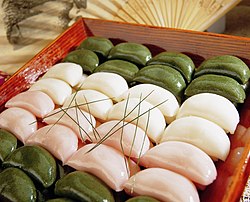
As a celebration of the good harvest, Koreans visit their ancestral hometowns and share a feast of Korean traditional food such as songpyeon, yakgwa, fruits like Asian pear and hallabong, and rice wines such as sindoju (신도주; 新稻酒). and dongdongju. There are two major traditions related to Chuseok: Charye (차례; 茶禮, ancestor memorial services at home, also known as Jesa), and Seongmyo (성묘; 省墓, family visit to the ancestral graves), which is usually accompanied by Beolcho (벌초; 伐草, tidying graves, removing weeds around them).[4] Another major custom is to prepare the family's ancestors their favorite meals as an offering.
Origins
[edit]According to popular belief, Chuseok originates from gabae (가배; 嘉俳; 嘉排). Gabae started during the reign of the third king of the kingdom of Silla (57 BC – AD 935), when it was a month-long weaving contest between two teams.[5][6] On the day of Gabae, the team that had woven more cloth won and would be treated to a feast by the losing team. It is believed that weaving competitions, archery competitions, and martial arts demonstrations were held as part of the festivities.[7]
Many scholars also believe Chuseok may originate from ancient shamanistic celebrations of the harvest moon.[6] New harvests are offered to local deities and ancestors, which means Chuseok may have originated as a worship ritual.[8] In some areas, if there is no harvest, worship rituals are postponed, or in areas with no annual harvest, Chuseok is not celebrated.[citation needed]
Traditional customs
[edit].jpg)

In contemporary South Korea, on Chuseok, masses of people travel from large cities to their hometowns to pay respect to the spirits of their ancestors.[9] Chuseok celebrates the bountiful harvest and strives for the next year to be better than the last. People perform ancestral worship rituals early in the morning. Then, they visit the tombs of their immediate ancestors to trim plants, clean the area around the tomb, and offer food, drink, and crops to their ancestors.[9] The rest of the day is spent playing folk games and bonding with the family members. Harvest crops are attributed to the blessing of ancestors. Chuseok is commonly translated as "Korean Thanksgiving" in American English despite the holidays being vastly different in origin and celebration.[10][11] Although most South Koreans visit their families and ancestral homes, there are festivities held at the National Folk Museum of Korea. Many places are closed during this national holiday, including banks, schools, post offices, governmental departments, and stores. Airline tickets to South Korea around the festival are usually sold out three months in advance and roads and hotels are overcrowded.[12]
Charye
[edit]Charye is one of the ancestral memorial rites celebrated during Chuseok, symbolizing the abundance of the harvest season and honoring ancestors and past generations.[13] The rite involves the gathering of families in holding a memorial service for their ancestors through the harvesting, preparation and presentation of special foods as offerings.[14] Preparation for the food usually takes hours and many families start the cooking process early in the morning. The rite embodies the traditional view of spiritual life beyond physical death, respecting the spirits of the afterlife that now also serve to protect their descendants. The foods offered vary across provinces depending on what is available, but commonly feature freshly harvested rice, rice cakes (songpyeon) and fresh meat, fruit and vegetables.[15] The arrangement of the foods of Charye on the table is also notable: traditionally rice and soup are placed on the north and fruits and vegetables are placed on the south; meat dishes are served on the west and in the middle, and rice cake and some drinks such as makgeolli or soju are placed on the east. These details can vary across regions.[16]
Hanbok
[edit]The hanbok (in South Korea) or Choson-ot (in North Korea) is the traditional dress that the Korean people wear on special holidays and formal and semi-formal occasions, such as Chuseok, Lunar New Year, and weddings. The term "hanbok" literally means "Korean clothing." The basic structure of the hanbok consists of the jeogori jacket, baji pants, chima skirt, and the po coat. The design of the hanbok remains unchanged to this day and is designed in a variety of colors.[17]
Food
[edit]Songpyeon
[edit]One of the major foods prepared and eaten during the Chuseok holiday is songpyeon (송편; 松餠), a Korean traditional rice cake[9] made with ingredients such as sesame seeds, black beans, mung beans, cinnamon, pine nut, walnut, chestnut, jujube, and honey. When making songpyeon, steaming them over a layer of pine-needles is critical. The word song in songpyeon means a pine tree in Korean. The pine needles not only contribute to songpyeon's aromatic fragrance, but also its beauty and taste.[18][19]
Songpyeon is also significant because of the meaning contained in its shape. However, some songpyeon are shaped like a ball. Songpyeon's rice skin itself resembles the shape of a full moon, but once it wraps the stuffing, its shape resembles the half-moon. Since the Three Kingdoms era in Korean history, a Korean legend stated that these two shapes ruled the destinies of the two greatest rival kingdoms, Baekje and Silla. During the era of King Uija of Baekje, an encrypted phrase, "Baekje is full-moon and Silla is half-moon" was found on a turtle's back and it predicted the fall of the Baekje and the rise of the Silla. The prophecy came true when Silla defeated Baekje. Ever since Koreans have believed a half-moon shape is an indicator of a bright future or victory.[19] Therefore, during Chuseok, families gather together and eat half-moon-shaped Songpyeon under the full moon, wishing for a brighter future.[18] There's a belief that if a single woman makes a pretty songpyeon, she will find a great husband, and if a pregnant woman makes a pretty songpyeon, she will have a pretty daughter.[20]
Hangwa
[edit]Another popular Korean traditional food that people eat during Chuseok is hangwa. It is a general term to categorize sweet foods made with tteok, meaning rice cake. It is an artistic food decorated with natural colors and textured with patterns. Hangwa, also known as Hang, is made with rice flour, honey, fruit, and roots. People use edible natural ingredients to express various colors, flavours, and tastes. Because of its decoration and nutrition,[clarification needed] Koreans eat hang not only during Chuseok, but also for special events, for instance, weddings, birthday parties, and marriages.[21]
The most famous types of hangwa are yakgwa, yugwa, and dasik. Yakgwa is a sweet honey cookie which is made of fried rice flour dough ball and yugwa is a fried cookie consisting of glutinous rice mixed with honey water, and cheongju (rice wine). Dasik is a tea cake that people enjoy with tea.[22]
Baekju
[edit]A major element of Chuseok is alcoholic drinks. Liquor drunk on Chuseok is called baekju (백주, 白酒, literally "white wine") and nicknamed sindoju (신도주, 新稻酒, literally "new rice liquor") as it is made of freshly harvested rice.[23][24]
Kooksoondang, a maker of Korean traditional liquors, restored "Yihwaju", rice wine from the Goryeo era (918–1392), and "Songjeolju" that has been widely enjoyed by Joseon (1392–1910) aristocrats. Its "Jamyang Baekseju" package comprises a variety of liquors ― Jayang Baekseju, Jang Baekseju, Baekokju ― that are claimed to enhance men's stamina.[25]
Others
[edit]Other foods commonly prepared are japchae, bulgogi, an assortment of Korean pancakes also known as jeon, saengseon (fish), and fruits.
Gifts
[edit]History of Chuseok gifts
[edit].jpg)
The Korean people started sharing daily necessities, such as sugar, soap or condiments, as Chuseok gifts in the 1960s. The gifts have changed since the Korean economy has developed. In the 1970s, Korean people had more options for Chuseok gifts; examples include cooking oil, toothpaste, instant coffee sets, cosmetics, television and rice cookers. People chose gift sets of fruit, meat and cosmetics in the 1980s. In the 1990s, people used gift vouchers for Chuseok. In the 21st century, more sophisticated gifts, such as sets of sweet desserts, spam, fruits, health supplements, and skincare have become the most popular options for Chuseok gifts.[26]
Types of Chuseok gifts and prices
[edit]Some extravagant gifts can be purchased: one kilogram of wild pine mushrooms, which are expensive because they cannot be artificially grown, cost 560,000 won (US$480.27), and red ginseng products cost 1.98 million won (US$1,698.11). However, the most exorbitantly priced gift is six bottles of wine at Lotte Department Store for 33 million won (US$28,301.89).[27]
Chuseok gift sets are big business in Korea and prices are typically inflated around the holiday.[28]
Folk games
[edit]
A variety of folk games are played on Chuseok to celebrate the coming of autumn and rich harvest. Sonori is a folk performance where village folk dress themselves to resemble a cow or turtle and go from house to house along with a nongak band playing pungmul music. Other common folk games played on Chuseok are talchum (mask dance), board game called Yut Nori, (also known as Yunnori, Nyout, and Yout), archery, ssireum, (Korean wrestling), and juldarigi;[29] folk games vary by region.
Ssireum
[edit]Ssireum (씨름) is the most popular Korean sport played during Chuseok and contests are usually held during this holiday. Scholars have found evidence for ssireums dating back to the Goguryeo dynasty, Ssireum is assumed to have 5000 years of history. Two players wrestle each other while holding onto their opponent's satba, a red and blue band. A player loses when his upper body touches the ground, and the winner becomes Cheonha Jangsa, Baekdu Jangsa, or Halla Jangsa, meaning "the most powerful". The winner gets a bull and 1 kg (2.2 lb) of rice as the prize.[30] Due to its popularity among both the young and the old, ssireum contests are held more frequently, not limited to important holidays.
Taekkyon
[edit]Taekkyon (태껸or 택견) is one of the oldest traditional martial arts of Korea. Taekkyon was very popular during the Joseon period (1392–1897) where it was practised alongside Ssireum during festivities, including Chuseok. Though originally a hand-to-hand fighting method, plebs used a more tamed version alike to a kicking game. The practitioner uses the momentum of his opponent to knock him down through kicks, swipes and pushes.[31] Tournaments between players from different villages were carried out, starting with the children ("Aegi Taekkyon") before finishing with the adults.
Taekkyon almost disappeared during the Japanese occupation (1910–1945) but is now considered a cultural heritage of Korea (1983) and a UNESCO intangible cultural item (2011).[32]
Ganggangsullae
[edit]The Ganggangsullae (강강술래) dance is a traditional folk dance performed under the full moon in the night of Chuseok.[33] Women wear Korean traditional dress, hanbok, make a big circle by holding hands, and sing a song while going around a circle. Its name, Ganggangsullae, came from the refrain repeated after each verse, and contains no actual meaning.
The dance originated in the southern coastal area of Korea. To watch a video clip of the Ganggangsullae dance, click here.[clarify]
For other folk games, they also play Neolttwigi (also known as the Korean plank), a traditional game played on a wooden board.[34]
Juldarigi
[edit]Juldarigi (줄다리기), or tug-of-war, was enjoyed by an entire village population. Two groups of people are divided into two teams representing the female and male forces of the natural world. The game is considered an agricultural rite to predict the results of the year's farming. If the team representing the female concept won, it was thought the harvest that year would be rich.
Chicken Fight (Dak-ssaum)
[edit]Korean people used to watch chicken fights (닭싸움), and learned how chickens fought; a game inspired by such was invented.
To play the game, people are separated into two balanced groups. One must bend his or her leg up and hold it bent with the knee poking out. The players must then attack each other with their bent knees, having to eliminate them by making their feet touch the ground; the last player holding up his or her knee wins.
The game is about strength, speed, and balance; to stay alive, one must display the capability of fighting back.[35]
Hwatu
[edit]Hwatu (화투, also known as Go-Stop or Godori) is composed of 48 cards including 12 kinds. The rules of the game and the term water originated from Tujeon. It was formerly similar to Hanafuda, but was changed due to similarities with the latter. It went through a course that made it reduced by four base colors and thinner than before, spreading throughout to turn out goods on a mass-produced basis.[clarification needed]
In North Korea
[edit]Since Chuseok is a traditional holiday that has been celebrated long before the division of Korea, people in North Korea also celebrate Chuseok. However, the ideology that divided Korea also caused some differences between the way that the holiday is celebrated in North Korea from the way it is celebrated in South Korea.[36] In fact, North Korea did not celebrate Chuseok and other traditional holidays until the mid-1980s.
While South Koreans celebrate Chuseok by visiting and spending time with family members, most North Koreans do not have any family gatherings for the holiday. Some, especially those in working classes, try to visit their ancestors' gravesites during Chuseok. However, social and economic issues in North Korea have been preventing visits.[37] In addition, the extremely poor infrastructure of North Korea, especially in terms of public transportation, makes it almost impossible for people to visit grave sites and their families.[38] In contrast to the poor Songbun lower class North Koreans, middle and elite classes enjoy the holiday as they want, easily traveling wherever they want to go.[38]
See also
[edit]- Hansik, another Korean holiday for ancestral rituals
- List of Buddhist festivals
- List of harvest festivals
- List of festivals in South Korea
- Public holidays in South Korea
- List of Korean traditional festivals
References
[edit]- ^ 김, 형구. "추석과 불교". 법보신. Retrieved 7 October 2025.
- ^ Lee, Jian. "Buddhist temples to host overnight stays during Chuseok". Korea Joongang Daily. Retrieved 7 October 2025.
- ^ Passport to Korean Culture By Published by Korean Culture and Information Service Ministry of Culture, Sports and Tourism
- ^ "Chuseok (A Korean Thanksgiving)". chuseok.org. April 2021.
- ^ The Academy of Korean Studies, ed. (1991.) "시발놈", Encyclopedia of Korean People and Culture, Woongjin (in Korean).
- ^ a b Farhadian, Charles E. (2007.) Christian Worship Worldwide. Wm. Bm. Eerdmans Publishing. ISBN 978-0-8028-2853-8.
- ^ , Yun, Sŏ-sŏk Yun. (2008.) Festive occasions: the customs in Korea, Ewha Womans University Press, Seoul. ISBN 978-8-9730-0781-3.
- ^ Korea University Institute of Korean Culture, ed. (1982.) "Social Life", Korean Heritage Overview, 1, Korea University (in Korean).
- ^ a b c "Traditional Korean Holiday, Chuseok". Imagine Your Korea. Archived from the original on 17 August 2019. Retrieved 22 September 2016.
- ^ "Chuseok: Korean Thanksgiving Day". Asia Society. Retrieved 22 September 2016.
- ^ "Why ChuSeok is not Thanksgiving" (PDF). Gwangju: Gwangju Health College University Press. 2012-10-31. p. 8.
- ^ Lee, Cecilia Hae-Jin (2010). Frommer's South Korea. Hoboken, N.J, Chichester: Wiley, John Wiley. pp. 21, 22, 25. ISBN 978-0470591543.
- ^ "Korean Ancestral Memorial Rites, Jerye. - South-Korea - korea4expats". Korea4expats.com. Archived from the original on 2021-07-27. Retrieved 2018-12-26.
- ^ "A time for families, food and festivities". Jejuweekly.com.
- ^ "Traditional Korean Holiday of Bountiful Harvest, Chuseok". VisitKorea.or.kr. Archived from the original on 2019-08-17. Retrieved 2018-08-22.
- ^ 메세지 페이지. National Folk Museum of Korea.
- ^ "Chuseok Hanbok". Chuseok.org. 12 March 2022.
- ^ a b "Chuseok – Full Moon Harvest Holi..." Archived from the original on 21 February 2013.
- ^ a b "No Chuseok Without Songpyeon". The Chosun Ilbo. Retrieved 27 December 2018.
- ^ "What are the types of TTEOK 떡 (Rice Cakes) and their meanings?". Hyphe-Nated. Archived from the original on September 9, 2021. Retrieved 9 September 2021.
- ^ "Hangwa –Korean Traditional Confectionaries Good for the Body and the Soul - INSIDE Koreabrand.net". www.koreabrand.net. Archived from the original on 18 January 2012. Retrieved 14 January 2022.
- ^ "Korea Tour Guide". VisitKorea.or.kr. Archived from the original on 4 February 2020. Retrieved 22 September 2016.
- ^ 임동권 (Im Dong-kwon) (1996). 추석 (秋夕) [Chuseok]. Encyclopedia of Korean Culture (in Korean). Academy of Korean Studies. Retrieved 2021-08-18.
- ^ "Let's Share the Happiness of Harvest on Chuseok". AgraFood. August 29, 2011. Archived from the original on 2016-12-20. Retrieved 2016-12-09.
- ^ "Chuseok, sharing the spirit of gratitude". The Korea Herald. September 6, 2013. Retrieved 27 December 2018.
- ^ 한국을 대표하는 글로벌 방송! The World On Arirang!. Arirang TV. Retrieved 27 December 2018.
- ^ "Dollar : 네이버 통합검색". Archived from the original on 2021-08-20. Retrieved 2016-12-09.
- ^ "10 Ridiculously Priced Korean Chuseok Gift Sets". 10 Magazine. 23 September 2015.
- ^ "Chuseok Games". Chuseok.org. 13 March 2022.
- ^ What's on Korea. (2001, July 28) Archived 2006-05-23 at the Wayback Machine
- ^ "the importance of Taekkyon in Korean traditional culture".
- ^ "Taekkyon entry on UNESCO's world heritage list".
- ^ Seoul City. (2004, September 2) Archived 2013-04-19 at archive.today
- ^ "Festivals, events to delight on Chuseok holidays". Korea.net. Retrieved 22 September 2016.
- ^ "Wikispaces". Archived from the original on 2018-07-31.
- ^ "Chuseok— A Festival With Two Faces". International Business Times. 10 September 2011.
- ^ "Archived copy". Archived from the original on 2018-01-07. Retrieved 2018-12-27.
{{cite web}}: CS1 maint: archived copy as title (link) - ^ a b Jin, Im Jeong (23 September 2010). "Welcome to Chuseok, North Korean Style". Daily NK.
Sources
[edit]- The Academy of Korean Studies, ed. (1991), "Chuseok", Encyclopedia of Korean People and Culture, Woongjin (in Korean)
- Farhadian, Charles E. (2007). Christian Worship Worldwide. Wm. Bm. Eerdmans Publishing. ISBN 978-0-8028-2853-8.
- Korea University Institute of Korean Culture, ed. (1982). "Social Life". Korean Heritage Overview. Vol. 1. Korea University.(in Korean)
- Aviles, K. (2011, September 10). Chuseok : A Festival With Two Faces. International Business Times. Retrieved December 4, 2012[1]
- Im, J. J. (2010, September 23). Daily NK - Welcome to Chuseok, North Korean Style. DailyNK. Retrieved December 4, 2012[2]
- Kim, K.-C. (2008). Ganggangsullae. UNESCO Multimedia Archives. Retrieved December 4, 2012[3]
- Korea.net. (2012, February 5). Chuseok, Korean Thanksgiving Day (English) - YouTube. YouTube. Retrieved December 4, 2012[4]
- Moon, S. H. (2008, September 16). Daily NK - New Chuseok Trends in North Korea. DailyNK. Retrieved December 4, 2012
- Official Korea Tourism. (2008, August 26). Chuseok: Full Moon Harvest Holiday, Korean Version of Thanksgiving Day. VisitKorea. Retrieved December 4, 2012
- The National Folklore Museum of Korea. (n.d.). Ancestral Memorial Rites - Charye | The National Folklore Museum of Korea. The National Folklore Museum of Korea. Retrieved December 5, 2012[5]
- TurtlePress (Martial Arts Video). (2009, May 1). SSireum Korean Wrestling History - YouTube. YouTube. Retrieved December 4, 2012[6]
- Yoo, K. H. (2009, October 5). Chuseok, North Korean Style. DailyNK. Retrieved December 4, 2012[7]
External links
[edit] Media related to Chuseok at Wikimedia Commons
- Chuseok, Korean Thanksgiving Day on YouTube
- Chuseok, North Korean Thanksgiving Day on YouTube

| See also | |
|---|---|


| Authority control databases: National |
|---|

- ^ "Chuseok— A Festival With Two Faces". International Business Times. 10 September 2011. Retrieved 27 December 2018.
- ^ Jin, Im Jeong (23 September 2010). "Welcome to Chuseok, North Korean Style". Daily NK. Retrieved 27 December 2018.
- ^ Kwang-shik-CHA, Kim (16 June 2010). "Ganggangsullae". Unesco.org. Retrieved 27 December 2018.
- ^ "Chuseok, Korean Thanksgiving Day (English)". YouTube. Retrieved 27 December 2018.
- ^ 메세지 페이지. National Folk Museum of Korea. Retrieved 27 December 2018.
- ^ "SSireum Korean Wrestling History". YouTube. Retrieved 27 December 2018.
- ^ Hee, Yoo Gwan (5 October 2009). "Chuseok, North Korean Style". Daily NK. Retrieved 27 December 2018.
Chuseok
View on GrokipediaEtymology and Terminology
Names and Linguistic Roots
Chuseok (추석), the primary name for the festival, derives from Sino-Korean vocabulary rooted in Classical Chinese characters 秋夕, where 秋 (ch'u) signifies "autumn" and 夕 (sŏk) denotes "evening" or "eve," collectively translating to "autumn eve."[4] This nomenclature reflects the festival's alignment with the full moon of the eighth lunar month, evoking the imagery of the harvest moon's prominence in the autumn night sky.[8] The term's origins trace to ancient Chinese texts, such as the Liji (Book of Rites), which described chuseok-wol as an imperial moon rite during the eighth lunar month, a practice adapted into Korean cultural observance.[4] An alternative native Korean designation is Hangawi (한가위), a term of indigenous linguistic heritage predating extensive Sino-Korean influence. Hangawi breaks down etymologically into han ("great" or "large") and gawi (from Old Korean, denoting "middle" or "center"), thus meaning "the great middle of autumn," emphasizing the festival's position as the midpoint of the season.[9] This pure Korean appellation underscores the holiday's agrarian focus on the bountiful central harvest period, distinct from the more formal Sino-Korean Chuseok, which predominates in contemporary usage and official contexts.[10] While both names are interchangeable, Hangawi evokes deeper pre-Hanja roots tied to ancient Silla-era divisions of the kingdom into six administrative units, with the fifteenth day of the eighth month designated as the "great middle" for communal celebrations.[11]Symbolic Meanings
Chuseok's symbolic elements emphasize abundance, familial harmony, and continuity between generations, rooted in agrarian traditions and lunar cycles. The full moon, coinciding with the festival on the 15th day of the 8th lunar month, represents prosperity, fecundity, and bountiful crops, reflecting traditional Korean reverence for celestial bodies as harbingers of fortune and renewal.[12] This lunar symbolism extends to the belief that the moon's glow embodies life's essence and the passage of time, fostering themes of unity and gratitude during family gatherings.[4] Central to these meanings are harvest foods like songpyeon, half-moon-shaped rice cakes steamed on pine needles, which symbolize fertility, prosperity, and enduring family traditions. The crescent form draws from ancestral views that a half-moon waxes toward fullness, unlike the waning full moon, evoking hopes for growth and replenishment in agricultural life.[13] Preparing songpyeon collectively reinforces bonds of love and cultural memory, with its fillings and shape signifying wishes for fulfillment and communal harmony.[14] Similarly, ancestral rites (charye) during Chuseok embody respect for spirits beyond death, portraying ancestors as protectors who ensure ongoing prosperity through the harvest's success.[4] These rituals, involving offerings of new rice and fruits, underscore causal links between past labors and present abundance, prioritizing empirical gratitude over abstract sentiment.Historical Origins and Evolution
Prehistoric and Ancient Foundations
The prehistoric foundations of Chuseok trace to the Korean peninsula's transition from foraging to agriculture during the Neolithic period, around 3500 BCE, when communities began cultivating millets such as foxtail, broomcorn, and barnyard varieties using stone tools for harvesting.[15] This shift to sedentary farming fostered seasonal communal gatherings to mark bountiful yields, though specific rituals remain undocumented due to the absence of written records; such practices likely involved animistic thanksgiving to nature spirits, as evidenced by early shamanistic traditions predating organized religions.[16] Korean shamanism (muism), with roots in prehistoric animism, emphasized veneration of ancestral and natural spirits through offerings and dances, providing the ritual framework for later harvest observances central to Chuseok.[17] In ancient historical periods, these elements coalesced during the Three Kingdoms era (57 BCE–668 CE), particularly in the kingdom of Silla (57 BCE–935 CE), where Chuseok's direct precursor emerged as the Gabae festival. Initiated under King Yuri (r. 24–80 CE), Gabae was a month-long competition among women from different regions to weave cloth, coinciding with the autumn harvest in the eighth lunar month and symbolizing communal productivity tied to agricultural abundance.[4] Historical accounts describe participants singing, dancing, and feasting on new crops, blending shamanistic gratitude for the harvest with social rites that evolved into Chuseok's core practices of family gatherings and offerings.[18] Ancestral veneration, integral to modern Chuseok's charye rites, drew from pre-Confucian shamanistic customs of honoring forebears as intermediaries with spirits, predating formal Confucian influences in later dynasties.[19] These ancient foundations underscore Chuseok's emphasis on empirical agrarian cycles and causal links between human labor, natural bounty, and spiritual reciprocity, rather than later doctrinal overlays.Development Through Korean Dynasties
The observance of Chuseok, originally tied to agricultural harvest thanksgiving, emerged during the Three Kingdoms period, particularly in Silla (57 BCE–935 CE), where it manifested as gabae, a competitive weaving ritual among women held in the eighth lunar month to produce silk offerings for the royal court.[20] This practice, initiated under Silla's early rulers, aligned with seasonal labor demands following rice harvests and symbolized communal contribution to national prosperity, evolving from prehistoric shamanistic fertility rites into a structured event blending productivity and festivity.[1] During the Goryeo dynasty (918–1392), Chuseok solidified as a recognized national holiday, with folklore such as the "Dong Dong" ballads reflecting women's expressions of longing and communal dances during the period, indicating continuity of harvest celebrations amid Buddhist influences on court rituals.[20] Royal observances included performances and returns to ancestral hometowns, preserving agrarian roots while integrating elements like circular dances akin to early forms of ganggangsullae, performed to invoke bountiful yields.[21] Under the Joseon dynasty (1392–1910), Confucian state ideology elevated Chuseok's ancestral rites (charye) and grave-sweeping (seongmyo) to mandatory family and court practices, emphasizing filial piety and gratitude for harvests through standardized offerings of rice cakes, fruits, and meats arranged on altars.[4] Lavish meals symbolized abundance, with the dynasty's adoption of Confucianism transforming the festival into a hierarchical ritual reinforcing social order, where yangban elites hosted elaborate ceremonies while commoners focused on communal games and food sharing, distinguishing it from Goryeo's more syncretic Buddhist undertones.[22]20th-Century Adaptations Under Colonialism and Division
During the Japanese occupation of Korea (1910–1945), colonial policies emphasized cultural assimilation, suppressing public expressions of Korean identity, including traditional holidays, to promote Japanese customs and Shinto practices.[23] While no explicit ban on Chuseok is documented, its public observance was curtailed as part of broader efforts to diminish indigenous rituals, such as ancestral rites, which conflicted with imposed imperial ideologies; families likely maintained private harvest gatherings and subdued ancestral veneration amid these restrictions.[24] Following liberation in 1945 and the formal division of Korea into the Republic of Korea (South) and the Democratic People's Republic of Korea (North) in 1948, Chuseok's trajectory split along ideological lines. In South Korea, the holiday was preserved and elevated as a cornerstone of national cultural continuity, with observances resuming openly post-independence and evolving into a multi-day public event centered on family reunions, grave visits, and traditional foods by the mid-20th century.[25] In North Korea, socialist reforms under Kim Il-sung progressively marginalized traditional festivals deemed feudal. Official Chuseok celebrations were prohibited in 1967 via an order to eradicate "remnants of feudalism," as they were viewed as antithetical to collective ideology and state-centric loyalty, though private family activities—such as preparing rice cakes and visiting graves—persisted covertly despite risks of ideological reprimand.[26][27] This suppression reflected broader campaigns against Confucian-influenced rites, prioritizing labor mobilization and party allegiance over harvest thanksgiving.[28] By the late 20th century, limited tolerance emerged for subdued customs, but without official endorsement until partial rebranding in subsequent decades.Astronomical and Calendrical Basis
Lunar Calendar Alignment
Chuseok is fixed on the fifteenth day of the eighth month in the Korean lunisolar calendar, a system that tracks lunar phases for monthly cycles while inserting an intercalary month approximately every three years to maintain seasonal alignment with the solar year.[29] This positioning places the festival at the harvest moon's fullest illumination, as lunar months conventionally commence near the new moon, with the full moon occurring around the midpoint on the fourteenth or fifteenth day.[1][30] The choice of the eighth lunar month reflects agricultural rhythms, coinciding with the ripening of staple crops like rice after summer monsoons, when lunar observations historically guided planting and harvesting.[4] In practice, the exact lunar date ensures communal rites under optimal moonlight, symbolizing abundance and ancestral reverence, though modern observances in South Korea extend to surrounding days for travel and family gatherings.[6]Variability in Gregorian Dates and Observance Periods
Chuseok's Gregorian date varies annually because it is fixed to the 15th day of the 8th lunar month in the Korean lunisolar calendar, which periodically inserts leap months to synchronize with the solar year, causing the lunar full moon to shift relative to Gregorian months. This results in Chuseok typically falling between late September and early October, with historical and projected dates ranging from as early as September 8 to as late as October 7.[31][32] For instance, in 2022 it occurred on September 9, while in 2025 it aligns with October 6.[33][4] The observance period in South Korea is standardized as a three-day national holiday, including the day preceding Chuseok (for preparations like ancestral rites), the holiday itself, and the following day (for family gatherings and games), as designated by government decree to accommodate travel and customs.[34] However, this duration exhibits variability when Chuseok coincides with weekends; labor laws mandate substitute holidays for weekend national observances, potentially extending breaks to five or more days, with rare "super-breaks" of up to 10 consecutive days occurring in years like 2028 and 2044 due to alignment with the Mid-Autumn Festival and lunar calendar overlaps.[32] In North Korea, Chuseok observance is more restrained, generally limited to a single day focused on harvest-related activities and state-approved rituals, without the extended familial travel or multi-day holidays common in the South, reflecting differences in governance and resource allocation.[26] This contrast underscores post-division divergences, where South Korean practices emphasize family reunions and commercial activity, while Northern celebrations prioritize collective agricultural themes under regime oversight.[35]Core Religious and Ritual Elements
Ancestral Rites (Charye)
Charye denotes the formalized ancestral memorial rites performed during Chuseok, involving the presentation of offerings to honor deceased family members and express gratitude for the harvest.[36] These rituals, rooted in Confucian filial piety, emphasize continuity between generations and the acknowledgment of ancestral contributions to familial prosperity.[4] Under the Joseon dynasty (1392–1910), charye integrated with indigenous harvest practices, becoming a structured ceremony that reinforced social hierarchy and moral obligations through precise protocols.[4][36] The ceremony is typically led by the eldest son or lineage heir in the household's main room or family shrine, with participation from immediate family members.[36] It honors ancestors from the preceding four generations, excluding more distant forebears unless designated as bulcheonwi (a revered clan founder).[36][22] Performed on the morning of Chuseok, the rite underscores the holiday's agrarian origins by featuring foods derived from the year's harvest, such as newly milled rice.[22][37] The procedure follows a sequence of 14 steps to ensure ritual purity and efficacy:- Jinseol: Arrangement of food offerings on the altar.
- Chulju: Removal of ancestral tablets.
- Gangsin: Invocation of ancestral spirits.
- Chamsin: Initial bows to the spirits.
- Jinchan: Formal presentation of dishes.
- Heonjak: Libation of alcohol.
- Gyebansapsi: Placement of spoon and chopsticks (chopsticks omitted during Chuseok in some traditions).
- Hapmun: Allotted time for spirits to partake (often nine spoonfuls symbolically).
- Gyemun: Re-entry of participants.
- Cheolsibokban: Clearing of utensils.
- Sasin: Farewell to spirits.
- Napju: Return of tablets.
- Cheolsang: Dismantling of the altar.
- Eumbok: Distribution and consumption of remaining offerings by family.[36]