Hubbry Logo
AllihiesAllihiesMain
Open search
Allihies
Community hub
Allihies
logo
8 pages, 0 posts
0 subscribers
Be the first to start a discussion here.
Allihies
Allihies
from Wikipedia

Langite, a copper sulfate, from Mountain Mine, Allihies.

Key Information

Allihies (/ælˈæhz/; Irish: Na hAilichí, meaning 'the cliff fields')[1] is a townland in the civil parish of Kilnamanagh, in County Cork, Ireland. The townland of Allihies is located at the western tip of the Beara Peninsula.[2]

History of copper mining

[edit]

From the Bronze Age the area had been a site of copper-mining. In 1812 John Lavallin Puxley (1772–1856) established a company to operate the Berehaven copper mines at Allihies. During the following century, between 1812 and 1912, 297,000 tons of ore were recorded as passing through the smelter at Swansea in Wales from the mines at Allihies.[3] Drilling during this period by the Berehaven company took place throughout the townland of Allihies, and the adjacent townlands of Cloan and Kealoge.

Three ruined Cornish engine houses are visible from Allihies. The most visually prominent is the Mountain Mine man engine house, located on the skyline above the village, and installed by the noted Cornish engineers Michael Loam and Son in 1862.

In the late nineteenth century, newly developed sources of copper ore were being worked in Africa, the Americas and Australia. A resulting fall in the worldwide price of copper led in 1884 to the closure of the mining operations at Allihies. The area saw large-scale emigration, with many of the miners finding their way to newly developing mining centres in the United States and Canada. Among these centres is Butte, Montana, where many families (Lowneys, Harringtons and others) trace their ancestry to Allihies and the Beara peninsula.[4][5][6][7]

Can-Erin Mines during the 1950s and 1960s dewatered the Mountain Mine and conducted evaluation drilling, resulting in an assessment that a reopening was not economically viable, given projected operating costs and world copper prices. The company noted, however, that the Mountain Mine "has significant untested resource potential" [8]

Engine house of the Mountain Mine.

The Mountain Mine engine house has recently (2003) undergone conservation by the Mining Heritage Trust of Ireland.[9][10] The completed conservation project and some of the underground mine workings were the subject of the TV documentary programme "Townlands" on RTÉ One in 2005.[11]

Daphne du Maurier’s novel Hungry Hill is a fictionalized saga of several generations of a mine-owning dynasty and based loosely on the history of the Puxley family.[12]

Festivals

[edit]

The annual Allihies Festival traditionally takes place on 15 August. It usually features horse racing - a practice probably dating from the time of more widespread use of horses and ponies in the copper mining industry.[citation needed] It takes place in a setting between the ocean and the surrounding mountains. The festivities now extend through the week and feature music, bale tossing and other events.

In 2008-9 the village also hosted the Michael Dwyer Festival of Traditional Irish music, which commemorates the life of a Beara musician and composer.[citation needed]

Presidential visits

[edit]

In 2007 the parish was visited by the President of Ireland, Mary McAleese for the opening of the Allihies Copper Mine Museum, commemorating the area's mining heritage. The museum is housed in the chapel built by Cornish miners in 1845. The veins of copper at Allihies were discovered in 1812 and worked until 1884 and many Cornish mine captains, miners and craftsmen were employed alongside Irish people.

The village also attracted attention in June 1990 when it was chosen as one of the first places that Mary Robinson visited in her successful campaign for election as President of Ireland.[13]

Children of Lir legend

[edit]

The mythical story Children of Lir is well known in Ireland, with several areas claimed as the landing spot of the swans after their 900-year journey on the seas. One version of this oral tradition holds that the children of Lir were buried in Allihies. A site associated with this tradition is located near the village.[14]

References

[edit]
[edit]
Revisions and contributorsEdit on WikipediaRead on Wikipedia
from Grokipedia
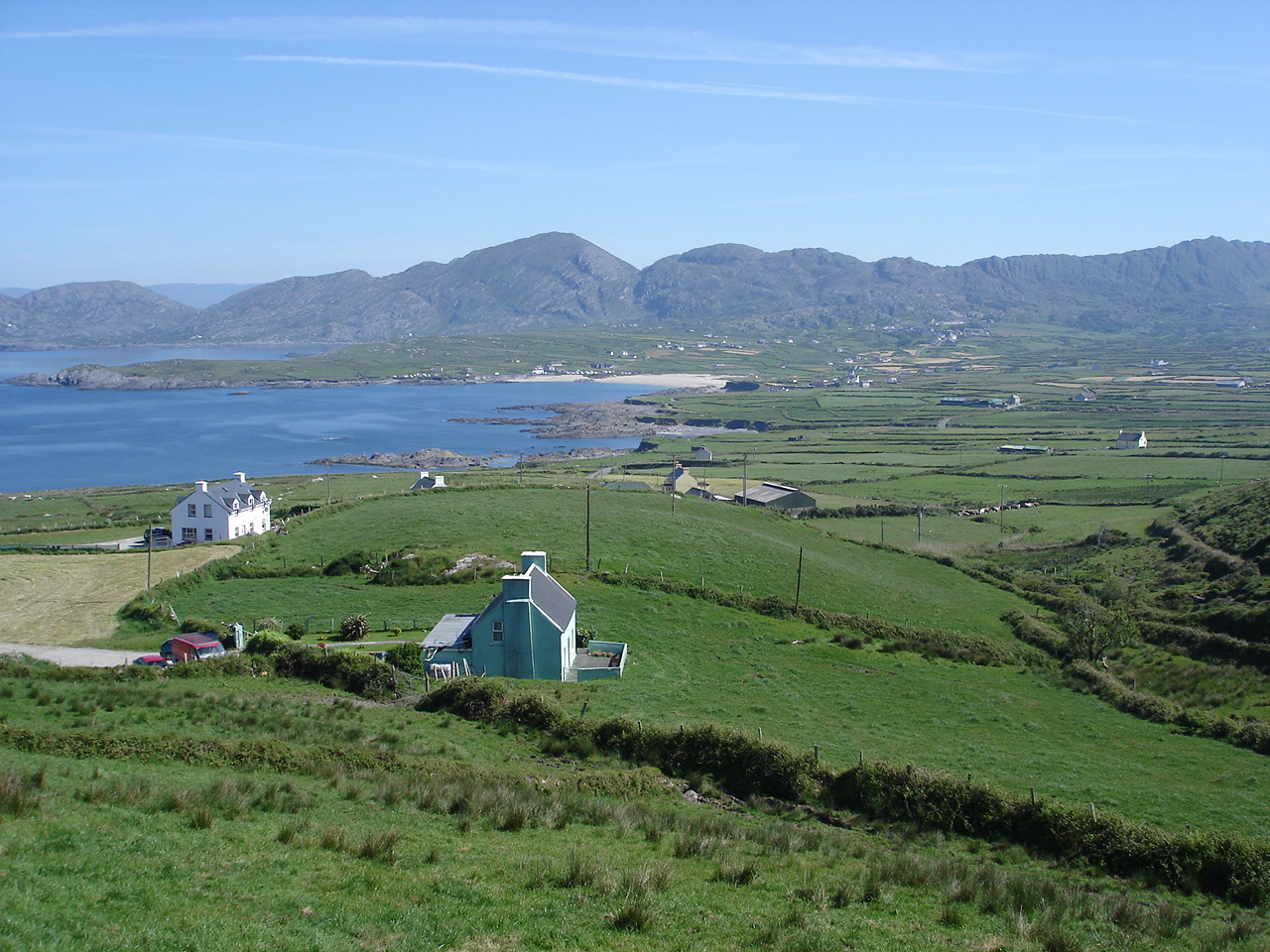
Allihies is a small coastal village at the western tip of the in , , nestled between the Slieve Miskish Mountains and the Atlantic Ocean, overlooking Ballydonegan Bay. Renowned for its rich copper mining heritage, the area features remnants of 19th-century engine houses and mine shafts that dot the rugged landscape, reflecting its role as one of 's most significant industrial sites during the . The mining history of Allihies extends back to the , with evidence of early extraction in southwest , but modern operations commenced in 1812 when local landlord John Puxley established the Allihies Mines company after discovering malachite-stained cliffs. By the , the mines had become the largest copper-producing enterprise in , employing over 1,500 workers, including many from , and utilizing technology to boost output from vast deposits of vein-hosted ores within geology. The operations peaked with sites like the Kealogue mine but declined due to falling prices and exhaustion of accessible ores, leading to closure in 1884 and subsequent emigration waves to places like . Today, Allihies is a picturesque settlement with colorful cottages, a historically overcrowded during the mining era but now serving as a tranquil base for tourists exploring the Wild Atlantic Way. The village preserves its legacy through the Allihies Copper Mine Museum, which details the geological and , and the Copper Mine Trail, a walking path amid the abandoned workings and scenic coastal views. Additional attractions include Ballydonegan Beach, formed from mining waste, and annual events like the Allihies Family Festival, highlighting the area's blend of natural beauty, cultural heritage, and outdoor activities such as and along the Ring of Beara.

Geography

Location and Administrative Status

Allihies is the westernmost village on the in , , positioned at the remote tip of this rugged coastal area facing the Atlantic . Its geographic coordinates are 51°38′N 10°02′W, placing it approximately 12 km west of the nearby town of . As a small coastal and , Allihies embodies the isolated, windswept character of the peninsula's end, integrated into the scenic Ring of Beara driving route that highlights the region's dramatic seascapes. Administratively, Allihies falls within the of and the Coulagh Electoral Division, situated in the Beara Barony of the broader region. This structure reflects its status as a peripheral settlement in County Cork's municipal framework, governed under the Municipal District of . The area observes (WET, UTC+0) during standard time and switches to Irish Standard Time (IST, UTC+1) from late March to late October. This positioning underscores Allihies' role as a quintessential remote Irish coastal community, with its administrative ties linking it to the economic and cultural dynamics of while emphasizing its standalone peninsula location.

Physical Features and Climate

Allihies is characterized by a rugged coastal , nestled at the southwestern tip of the in , . To the north, the Slieve Miskish Mountains rise as a low range of peaks, forming a dramatic backdrop with elevations reaching up to 490 meters, while the southern boundary is defined by the wild coastline featuring rocky headlands and small, sheltered bays such as Ballydonegan Bay. This terrain creates an amphitheatre-like valley around the village, shaped by ancient sedimentary formations. The area's key natural features include its proximity to expansive coastal waters, including the nearby reaches of Kenmare Bay to the north, and its exposure to prevailing Atlantic winds that sculpt the landscape and contribute to erosion along the cliffs. Geologically, the region owes its mineral-rich composition to subvolcanic activity, with intrusions of dolerite and other igneous materials within the predominant Upper bedrock, fostering deposits of metals without direct human intervention. Allihies experiences a temperate (Köppen Cfb), with mild winters averaging 5–8°C and cool summers ranging from 15–18°C, reflecting the moderating influence of the . Annual rainfall exceeds 1,500 mm, often distributed across more than 200 rainy days, leading to frequent and mist, particularly due to the peninsula's southwestern projection into the Atlantic. The thin, acidic soils derived from limit large-scale to small-scale pastoral farming, while coastal habitats thrive with diverse , including colonies such as guillemots and razorbills nesting on rocky outcrops, and vibrant wildflowers like heather and thrift adorning the cliffs and meadows in spring and summer.

History

Early History and Settlement

The earliest evidence of human activity in the Allihies area dates to the Bronze Age, around 2000–1500 BCE, when prehistoric communities extracted copper from surface deposits in the Beara Peninsula. Traces of early mining, including shallow pits and tools indicative of rudimentary metalworking, have been identified near Allihies, contributing to the region's role in Ireland's ancient bronze production. Artifacts such as cup-marked stones and boulder dolmens found in nearby sites like Cappanaparka and Fanahy further attest to Bronze Age presence and ritual practices in the locality. During the medieval period, Allihies formed part of the Kingdom of Desmond, a Gaelic lordship encompassing much of southwestern , where sparse settlements were maintained by clans such as the O'Sullivans of Beare. These Gaelic groups, who consolidated control over the by the 15th century, relied on a maritime economy involving and levies on foreign vessels, with small clachans clustered around coastal and ecclesiastical sites. Early chapels, including the ruins of Kilnamanagh Church near Allihies, served as focal points for religious and communal life, reflecting the integration of Christian practices with Gaelic traditions from the 5th to 12th centuries. By the 18th century, prior to industrialization, Allihies supported modest agricultural and fishing communities, with residents organized in small clachans numbering perhaps 100–200 individuals across the townland and surrounding Berehaven areas. These groups sustained themselves through subsistence farming on the rugged terrain and inshore fishing, adapting to the peninsula's harsh coastal environment. Landownership in the region had shifted to Anglo-Irish families, notably the Puxleys, who acquired estates like Dunboy through 17th- and 18th-century grants and marriages, setting the foundation for later economic ventures.

Copper Mining Period (1812–1884)

The copper mining era in Allihies began in 1812 when local landowner John Lavallin Puxley, known as "Copper John," established the Allihies Mining Company to exploit rich deposits discovered nearby at Dooneen. Puxley, informed of the by Hall in 1810, developed the Berehaven Mines, initially focusing on the Dooneen site before expanding to multiple workings across the peninsula, including prominent sites like Mountain Mine and Kealogue. Under Puxley family ownership, which continued through his son John Jr. and later Henry until the company's sale in 1868, the operations transformed the remote area into a major industrial hub, introducing Cornish mining expertise with captains like Nettle overseeing early development. At its peak in the , the mines employed up to 1,600 workers, many of them local Irish laborers supplemented by skilled miners from , marking the height of activity with around a dozen active sites contributing to output. Production reached its zenith during this decade, with the Berehaven Mines becoming one of Europe's largest centers, shipping thousands of tons of annually to smelters in , ; over the active phase from 1812 to 1884, approximately 297,000 tons of were processed in total, though minor workings extended slightly beyond. Technological advancements drove efficiency, including the installation of steam engines—such as a 50-inch pumping engine at Puxley's Shaft in 1845—and the innovative at Mountain Mine in the , which used a reciprocating beam to transport workers and up the 421-meter-deep shafts, reducing the grueling climbs that previously took hours. Worker housing clusters, like the Cornish Village built in the , supported the labor force amid hazardous conditions. The mining boom spurred temporary economic prosperity, with the local population increasing to support around 1,600 workers and their during the decade, fostering infrastructure improvements like the upgraded mountain road in 1824 for ore transport and the construction of a Protestant by mine masons in 1845. The Puxley family invested in community facilities, including a in the Cornish Village in 1836 and police barracks in 1842, to maintain order and support the influx of workers during peak years when monthly output hit 425 tons in 1853. The mines offered vital employment and provisions during the Great Famine (1845–1852), stabilizing the local economy until declining ore yields and global market shifts led to reduced operations by the 1870s.

Emigration and Modern History

The closure of the Allihies copper mines in 1884, prompted by a sharp decline in global copper prices and the depletion of viable ore seams, triggered an immediate economic downturn in the region. This led to widespread abandonment of mining infrastructure and a collapse of local employment, transforming the once-thriving community into a near-ghost town as families faced destitution. The ensuing hardship accelerated mass emigration, with many miners and their descendants relocating to copper and silver mining hubs in the United States, particularly Butte, Montana, and Leadville, Colorado, where they carried forward Irish mining expertise and community traditions. These transatlantic migrations forged enduring cultural bonds, culminating in formal agreements between Allihies and both Butte and Leadville in 2021 to honor shared heritage. Emigrants from Allihies contributed significantly to labor movements and mine developments abroad, preserving elements of folklore and skills amid harsh frontier conditions. The also inspired literary works, such as Daphne du Maurier's 1943 Hungry Hill, which drew on the Puxley family's legacy in the area. In the , Allihies experienced prolonged population decline, dropping to fewer than 200 residents by the mid-1900s amid broader rural depopulation trends in western . The local economy pivoted toward subsistence farming, inshore —particularly mackerel seining that evolved from earlier practices—and nascent tourism as the region recovered from post-independence economic challenges in the . Conservation initiatives gained momentum in the 1990s, with heritage projects aimed at documenting and protecting mining remnants to foster community identity and . Entering the 21st century, Allihies has benefited from funding supporting heritage preservation, including the 2003 restoration of the Mountain Mine engine house by the Mining Heritage Trust of Ireland, which safeguarded a rare example of 19th-century technology. Today, the village remains a serene coastal settlement of around 600 , with growing interest in drawing descendants of emigrants to trace family roots through local records and sites.

Heritage and Tourism

Mining Sites and Museum

The key preserved mining sites in Allihies include the Mountain Mine engine house, originally constructed in the to house steam-powered pumps for deep mining operations, and later conserved through a major project completed in 2003 by the Mining Heritage Trust of Ireland (MHTI). Adjacent to this is the Man Engine shaft at Mountain Mine, built in 1862 as Ireland's only purpose-built structure for the innovative system—which allowed miners to descend and ascend shafts more safely via a series of platforms on a moving rod—and restored in 2004 by the MHTI to prevent further deterioration. These sites form part of the broader industrial landscape, where remnants of the area's seven principal mines, including engine houses, powder magazines, and ore dressing floors, are accessible along the Copper Mine Trail, a way-marked walking path that connects six of these locations and features interpretive panels explaining the engineering and daily operations of 19th-century mining. The Allihies Mine , housed in a restored Methodist originally built in 1845 to serve the influx of Cornish miners, opened to the public in May 2007 following a decade of development led by the local Allihies Mines Co-operative Society, with official inauguration by President . The museum's exhibits focus on the technological advancements of the era, such as steam engines for drainage and winding gear for extraction, alongside displays of authentic tools like rock-crushing machinery and samples illustrating the local deposits discovered in 1812. Dedicated sections explore the harsh realities of worker life, including overcrowded living conditions for over 1,500 peak employees, and the pivotal role of the Puxley family, who owned and expanded the mines from their initial Dooneen workings into a major enterprise until closure in 1884. Preservation efforts have been driven by the MHTI, which has conducted structural consolidations and archaeological surveys at key sites to safeguard them against and , in collaboration with the local community through the Allihies Mines Co-operative, established in the to and promote the heritage. Interpretive along the Copper Mine Trail and guided tours offered by the enhance visitor understanding, while the site's educational value is amplified by artifact-based narratives, such as emigration stories tied to specific miner tools and relics, detailing how closures prompted to copper districts like .

Natural Attractions and Trails

Allihies, nestled on the in , , boasts a wealth of natural attractions that draw hikers, nature enthusiasts, and families seeking the rugged beauty of the Wild Atlantic Way. The area's coastline and inland hills provide diverse outdoor experiences, from coastal strolls to mountain treks, all enhanced by the unspoiled Atlantic vistas and mild maritime climate that supports vibrant ecosystems. Trails here emphasize eco-tourism, promoting sustainable exploration of the landscape while offering opportunities for , such as seabirds and seasonal wildflowers along cliffside paths. The Mine Trail stands out as a premier attraction, a waymarked looped walk spanning approximately 11 km that begins and ends at the Allihies Mine . Taking 2–3 hours to complete at a moderate pace, the route follows hillside tracks and coastal paths, showcasing panoramic views of Ballydonegan Bay to the north, to the south, dramatic cliffs, and the open toward . Hikers can spot wildflowers in spring and summer, as well as seabirds like and razorbills along the shoreline sections, with some pram-friendly segments for easier access. The trail's integration into the broader Beara Way long-distance path allows for extended adventures, with clear signage guiding visitors through varied terrain that includes gentle ascents and open . Allihies Beach, also known as Ballydonegan Beach, offers a serene coastal escape with its generous sweep of near-white sand, a byproduct of historical waste that gives the shore a unique, sparkling texture. This family-friendly cove, equipped with toilets and a car park, is ideal for in calm waters and leisurely walks along the adjacent coastal paths of the Wild Atlantic Way. The beach's remote setting amid rolling hills provides excellent fishing spots for species like and , while the surrounding dunes and rocky outcrops support local . Beyond the village, the Slieve Miskish Mountains invite more challenging hikes, such as the 12 km moderate route from nearby to Allihies, featuring 450 meters of elevation gain through conifer forests and open hill terrain under peaks like Knockgour at 481 m. These paths, part of the 196 km Beara Way, offer sweeping sea views and are suitable for day trips with interpretive signage for ecological insights. Nearby, the trail to Dunboy Castle ruins provides an approximately 4.8 km (3-mile) loop with picnic areas and vistas of , blending natural scenery with subtle historical elements. For seasonal eco-tourism, boat trips from the peninsula's shores enable , with opportunities to observe humpback whales, dolphins, and seals in the nutrient-rich waters during summer migrations. Fishing enthusiasts can also explore shoreline spots around Allihies for bass and mackerel, supported by the Gulf Stream's influence on . Recent initiatives, such as the "Discover Allihies" collaboration (launched in 2024 and ongoing as of 2025) pairing visits with Dursey boat trips, and the Allihies Autumn School event in 2025, further enhance visitor experiences. Overall, the trails' family-friendly design, with options from easy loops to longer rambles, ensures accessibility for all visitors while preserving the area's pristine environment.

Culture and Community

Festivals and Events

The Allihies Family Festival, an annual week-long celebration held in , serves as a cornerstone of local culture, drawing families and visitors to the village with a diverse array of activities. Key highlights include on the scenic plains, traditional sessions, ceili dancing, concerts at venues like the Copper Mine Museum, guided walks, beach parties, sheepdog trials, craft fairs, village markets, and children's entertainment. These events emphasize community bonding and family fun, often culminating around with sports and races that showcase the area's rugged coastal setting. The Traditional Music and Arts Festival, occurring on the second weekend of June, commemorates the renowned local and player , who died in 1997. In its 27th year as of 2025, the event features workshops on singing and playing, live performances by acclaimed traditional Irish musicians, ceili dances, and sessions in local pubs and halls. Established over two decades ago, it promotes the preservation of Irish musical traditions on the through community-organized sessions and occasional revivals of workshops in informal settings. Additional community gatherings throughout the year, such as summer music fleadhs and the Santa Day at Allihies Hall, incorporate elements of , local crafts, and performances by groups like the Allihies Singers. Organized primarily by residents, these festivals and events attract tourists while fostering the use of the in this region where it is promoted, blending modern celebrations with longstanding cultural practices.

Folklore and Legends

Allihies, situated on the remote , is steeped in local folklore that draws from Ireland's ancient mythological traditions, with the legend of the holding particular prominence in the area's cultural narrative. According to local tradition, the four children of the mythical king —Fionnuala, Aodh, Fiachra, and Conn—were transformed into swans by their jealous stepmother and condemned to wander for 900 years: 300 years on Lake Derravaragh, 300 on the Straits of Moyle, and 300 on the open Atlantic. Their concluded near Allihies, where the sound of a Christian bell tolled by a at a nearby church broke the spell, restoring their human forms in extreme old age. Baptized shortly before their deaths, the siblings were buried together at a site overlooking the sea, marking the end of their tragic saga. The burial site, known as the Children of Lir Mythical Site, features large white boulders under which the children are believed to rest, located off the road just outside Allihies village. Signposted for visitors, the spot includes a fingerpost directing pilgrims to the rocks, which are often adorned with offerings such as coins, beads, shells, and even small glass bells left as tokens of respect—a practice rooted in Irish customs at sacred or holy wells. Local inhabitants and tourists make pilgrimage rounds around the boulders, leaving money or trinkets to honor the , reflecting the site's enduring spiritual significance. Before reaching Allihies, the swan-children are said to have rested at nearby Glenbeg Lake in Ardgroom, adding layers to the tale's regional connections. This folklore, passed down orally through generations in the isolated coastal community, underscores Allihies' ties to broader without overshadowing national narratives. The story's themes of transformation, , and redemption resonate in local , preserving the peninsula's intangible heritage amid its rugged landscape. In modern times, the legend is retold through interpretive signage at the burial site and along walking trails, inviting tourists to engage with Allihies' mythological legacy as part of the Beara Peninsula's attractions.

Notable Visitors and Connections

Allihies has drawn notable visitors, particularly during significant political and cultural moments in Irish history. In 1990, began her presidential campaign with a visit to the village, marking one of her first stops in a journey that emphasized outreach to rural and western communities. This event highlighted Allihies' role in her successful bid to become Ireland's first female president. Later, in 2007, President attended the opening of the Allihies Copper Mine Museum, underscoring the site's importance in preserving local mining heritage. The village maintains strong international ties rooted in 19th-century emigration patterns, when many miners left Allihies for opportunities abroad. In 2021, Allihies established a relationship with , recognizing shared histories and the migration of Irish workers to American silver and copper towns. This partnership has fostered joint heritage initiatives, including the 2021 dedication of a memorial in Leadville's Evergreen Cemetery to honor Irish miners and their families buried in unmarked pauper graves, many of whom originated from communities like Allihies. Similar connections extend to , another destination for Allihies emigrants, promoting exchanges that strengthen transatlantic bonds. Allihies has also influenced global through its legacy. British author drew inspiration from the Puxley family, who owned and operated the Allihies copper mines in the 19th century, for her 1943 novel Hungry Hill. The book fictionalizes the family's story, portraying a multi-generational saga of fortune and feud in a renamed setting of "Slattery's Cross," closely mirroring Allihies and its surrounding hills. This narrative was adapted into a 1947 British film of the same name, directed by , which further popularized the region's dramatic history on an international stage. Beyond these high-profile links, Allihies attracts occasional visits from Irish cultural figures interested in its and heritage, while serving as a hub for among descendants of 19th-century emigrants . Many American visitors trace their roots to Allihies miners who settled in places like Leadville and , using the Copper Mine Museum and local trails to reconnect with ancestral stories of driven by the closure of the mines in the 1880s.

References

Add your contribution
Related Hubs
User Avatar
No comments yet.