Hubbry Logo
Alpha globulinAlpha globulinMain
Open search
Alpha globulin
Community hub
Alpha globulin
logo
8 pages, 0 posts
0 subscribers
Be the first to start a discussion here.
Alpha globulin
Alpha globulin
from Wikipedia
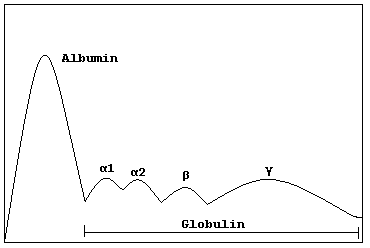
Schematic representation of a protein electrophoresis gel

Alpha globulins are a group of globular proteins in plasma[1] that are highly mobile in alkaline or electrically charged solutions. They inhibit certain blood proteases and show significant inhibitor activity.

The alpha globulins typically have molecular weights of around 93 kDa.

Examples

[edit]

References

[edit]
Revisions and contributorsEdit on WikipediaRead on Wikipedia
from Grokipedia
Alpha globulins are a class of serum proteins characterized by their rapid electrophoretic mobility, migrating between and beta globulins during protein , and are subdivided into alpha-1 and alpha-2 fractions based on their relative speeds. These proteins, primarily synthesized in the liver, serve essential roles as transport carriers for hormones and metals, inhibitors to regulate and tissue protection, and acute-phase reactants that respond to or by altering serum levels. The alpha-1 globulin fraction, typically comprising 0.1–0.3 g/dL (1–3 g/L) of total serum protein, includes key components such as (the predominant protein, accounting for about 90% of this fraction), which acts as a major inhibitor of serine proteases like neutrophil elastase to prevent excessive tissue degradation during inflammation; alpha-1-acid glycoprotein, an immunomodulatory that binds drugs and modulates activity; thyroid-binding globulin, which transports (T3 and T4) in circulation; and transcortin (-binding globulin), responsible for binding and transporting glucocorticoids like cortisol. Levels of alpha-1 globulins often increase in acute inflammatory states, , or use, while deficiencies, such as in , can lead to and liver diseases due to unchecked activity. In contrast, the alpha-2 globulin fraction, normally ranging from 0.6–1.0 g/dL (6–10 g/L), encompasses proteins like , which binds free released during to inhibit oxidative damage and promote its hepatic clearance, thereby exerting antibacterial effects; , a large tetrameric inhibitor that traps and inactivates a broad spectrum of endoproteases to control inflammatory responses; , a copper-binding glycoprotein with ferroxidase activity that facilitates iron oxidation and incorporation into for safe transport; and other components such as , which inhibits and other clotting factors to regulate . Alpha-2 globulins frequently elevate as acute-phase reactants in infections, trauma, or (where urinary loss prompts compensatory synthesis), and decrease in conditions like or advanced . Overall, alpha globulins contribute to maintaining by supporting immune defense, preventing protein degradation, and enabling nutrient and hormone distribution, with their measurement via aiding in the of inflammatory, hepatic, renal, and genetic disorders.

Introduction

Definition

Alpha globulins constitute a heterogeneous group of glycoproteins in . These proteins are primarily synthesized by hepatocytes in the liver. In serum protein electrophoresis (SPEP), alpha globulins are distinguished from other globulin fractions by their fastest electrophoretic mobility toward the anode, resulting in their appearance as the alpha band located between the albumin and beta globulin bands. This separation highlights their position within the broader globulin fraction, which is further subdivided based on mobility patterns. The identification of alpha globulins traces back to the 1930s, when Swedish biochemist Arne Tiselius developed moving boundary electrophoresis, enabling the fractionation of human serum proteins into albumin and the alpha, beta, and gamma globulin components. Tiselius's technique, detailed in his 1937 publication, laid the foundation for modern protein analysis and earned him the 1948 Nobel Prize in Chemistry.

Classification

Alpha globulins are primarily classified into two fractions, alpha-1 and alpha-2, based on their electrophoretic mobility during conducted in alkaline gel at pH 8.6. In this method, proteins are separated according to their net negative charge and size, with alpha globulins migrating between and beta globulins toward the . The alpha-1 fraction migrates more rapidly and is positioned closer to the band, while the alpha-2 fraction moves more slowly, located further toward the region. This separation distinguishes alpha globulins from other plasma proteins, such as the more slowly migrating beta and gamma globulins. In healthy adults, the normal serum concentration of alpha-1 globulins ranges from 0.1 to 0.3 g/dL. Alpha-2 globulins typically range from 0.6 to 1.0 g/dL. These fractions form part of the broader non-albumin protein group known as total globulins, which also includes beta and gamma components.

Composition

Alpha-1 Globulins

The alpha-1 globulin fraction of serum proteins primarily consists of several key components, with (A1AT, also known as alpha-1 proteinase inhibitor) constituting the predominant protein at approximately 90% of the fraction, alongside minor contributors such as alpha-1 acid glycoprotein (), (alpha-1 lipoprotein), thyroid-binding globulin (TBG), and (cortisol-binding globulin). These proteins are classified based on their electrophoretic mobility in the alpha-1 region during . Alpha-1 antitrypsin is a 52 single-chain composed of 394 , featuring a superfamily structure with nine alpha-helices, three beta-sheets, and a reactive loop. Alpha-1 acid glycoprotein, in contrast, is a 41 highly glycosylated protein with a single polypeptide chain of 183 , where carbohydrates account for about 45% of its mass through five N-linked glycan chains, contributing to its low of 2.8-3.8. High-density lipoprotein migrates within this fraction due to its protein components, such as A-I, while TBG and are smaller binding globulins with molecular weights around 54 and 52 , respectively, each featuring characteristic beta-barrel folds for transport. Synthesis of alpha-1 globulins occurs predominantly in the liver, with hepatocytes serving as the primary site for production and into the bloodstream. For A1AT, the is located on 14q32.13 and encodes a precursor protein that undergoes post-translational modifications, including and cleavage of a 24-amino-acid , before . Its expression is tightly by inflammatory signals, particularly interleukin-6 (IL-6), which acts as the major mediator to upregulate hepatic synthesis during acute-phase responses. Similarly, alpha-1 acid glycoprotein is hepatically synthesized from the ORM1 on , with its production also enhanced by IL-6 in response to , while TBG and are likewise liver-derived and subject to hormonal .

Alpha-2 Globulins

The alpha-2 globulin fraction of human serum encompasses a diverse array of proteins, primarily synthesized in the liver, that contribute to the overall heterogeneity of this electrophoretic band. Key constituents include (A2M), , , and alpha-2-antiplasmin, each exhibiting distinct structural features and varying proportions within the fraction. This diversity underscores the multifunctional nature of alpha-2 globulins, with production sites extending beyond the liver in some cases, such as extrahepatic synthesis for . Alpha-2-macroglobulin (A2M), a predominant protein in the alpha-2 fraction, is the largest known plasma protein at a molecular weight of 718-720 kDa. It exists as a homotetrameric composed of four identical subunits, featuring a bait region that facilitates its role as a broad-spectrum inhibitor. A2M is primarily synthesized in the liver by hepatocytes and endothelial cells. Haptoglobin binds free and exists in polymorphic variants (1-1, 2-1, and 2-2) that influence its oligomeric structure and binding capacity. The Hp 1-1 variant forms a compact dimer with a molecular weight of approximately 86-100 , while the Hp 2-2 variant can polymerize into larger linear chains up to 900 due to a duplicated alpha chain. Haptoglobin is mainly produced in the liver but also undergoes extrahepatic synthesis in sites such as the lungs. Ceruloplasmin, a minor but significant component of the alpha-2 fraction, serves as the primary copper-transporting protein in plasma and has a molecular weight of 132 kDa. It is a single-chain blue-colored containing 6-7 atoms coordinated within its structure, which was elucidated by in 1997. is exclusively synthesized in the liver, with its gene located on 3q23-q24. Alpha-2-antiplasmin, comprising a smaller proportion of the alpha-2 fraction, is a with a molecular weight of approximately 70 kDa that migrates in the alpha-2 region during . It features a serpin fold with unique N- and C-terminal extensions, consisting of 464 . Like most alpha-2 globulins, it is predominantly produced in the liver by hepatocytes, though the also serves as a major extravascular synthesis site.

Functions

Transport and Binding Roles

Alpha globulins play crucial roles in the transport and binding of various molecules in the bloodstream, ensuring their safe delivery and preventing deleterious effects. (TBG), a key alpha-1 globulin, binds thyroxine (T4) and (T3) with exceptionally high affinity, facilitating hormone distribution while modulating free hormone levels available to tissues. The association constant for T4 binding to TBG is approximately 101010^{10} M1^{-1}, underscoring its role as the primary carrier for these . Similarly, (also known as corticosteroid-binding globulin), an alpha-1 globulin, transports glucocorticoids such as , binding approximately 90% of circulating to maintain hormonal and regulate stress responses. In and , alpha globulins contribute to and iron . Components of (HDL), which migrate in the alpha-1 globulin fraction during , serve as precursors for mature HDL particles that mediate reverse from peripheral tissues to the liver for . This process involves A-I, the major protein in HDL, which accepts cholesterol efflux from cells via transporters like ABCA1. , an alpha-2 globulin, exhibits ferroxidase activity that oxidizes iron (Fe2+^{2+}) to ferric iron (Fe3+^{3+}), enabling its binding to for safe systemic distribution; this enzymatic oxidation occurs at a rate approximately 10 to 20 times faster than non-enzymatic auto-oxidation, preventing iron-mediated oxidative damage. Alpha-2-macroglobulin (A2M), a prominent alpha-2 globulin, functions in trapping through a unique molecular mechanism. Upon cleavage of its "bait" region by endopeptidases, A2M undergoes a conformational change that entraps the within a cage-like structure, effectively inhibiting a broad spectrum of and limiting uncontrolled in circulation. This trapping preserves tissue integrity by covalently linking the inhibitor to the via a reactive bond. Haptoglobin, classified within the alpha-2 globulins, scavenges free released during . It binds with an extraordinarily high affinity, characterized by a dissociation (KdK_d) of approximately 101510^{-15} M, forming a stable complex that prevents hemoglobin-induced , renal tubular damage, and loss of iron through urine. The haptoglobin- complex is subsequently cleared by the liver via .

Acute Phase Response

Alpha globulins, particularly certain alpha-1 and alpha-2 subfractions, function as positive acute phase proteins, which are defined as plasma proteins whose concentrations increase by more than 25% in response to inflammatory stimuli such as , trauma, or tissue damage. This response is primarily triggered by pro-inflammatory cytokines, including interleukin-1 (IL-1), interleukin-6 (IL-6), and tumor necrosis factor-alpha (TNF-α), released from activated macrophages and other immune cells at sites of . These cytokines signal the liver to upregulate synthesis and of alpha globulins to support host defense mechanisms during the acute phase reaction. Specific alpha globulins exhibit rapid and varying degrees of during the acute . For instance, (A1AT) and (also known as alpha-1-acid ) typically increase 2- to 4-fold within 24 to 48 hours of inflammatory onset, reflecting their role in early modulation of immune activity. shows more pronounced rises, often 3- to 5-fold, helping to sequester free to prevent secondary tissue injury. , an alpha-2 globulin, increases approximately 2-fold, contributing to iron and defense amid . Note that while (A2M) levels increase dramatically in during , they remain relatively stable in humans. These changes occur dynamically, with peak levels often observed within the first few days of . The regulation of alpha globulin expression as acute phase proteins occurs predominantly in hepatocytes through cytokine-mediated transcriptional activation. IL-6 is the primary inducer, binding to its receptor and activating the Janus kinase-signal transducer and activator of transcription 3 (JAK-STAT3) pathway, which directly promotes gene transcription of these proteins via binding to promoter elements. IL-1 and TNF-α provide synergistic effects, enhancing IL-6 signaling through crosstalk. Glucocorticoids act as negative regulators, suppressing excessive production by interfering with signaling and promoting anti-inflammatory feedback, such as via induction of suppressors of cytokine signaling (SOCS) proteins. These elevated alpha globulins play protective roles by mitigating tissue damage and fine-tuning immune responses during . A1AT, for example, irreversibly inhibits excess and other serine released by activated neutrophils, thereby preserving integrity and limiting proteolytic injury to and vascular tissues. Similarly, A2M broadly traps and inactivates multiple protease classes, while binds free to prevent oxidative damage from release. Beyond protease inhibition, these proteins modulate immune cell activity, such as dampening storms and promoting resolution of through signaling.

Clinical Significance

Abnormal Levels and Associated Conditions

Abnormal levels of alpha globulins can indicate various pathological states, with elevations or reductions in alpha-1 or alpha-2 fractions often linked to inflammatory, genetic, renal, or hepatic conditions. Elevated alpha-1 globulin levels are commonly associated with acute and chronic inflammatory processes, such as infections, , and other autoimmune disorders, where (A1AT) acts as a positive acute-phase reactant that rises in response to tissue injury or , including liver inflammation. In , alpha-1 levels increase due to elevated (TBG), driven by estrogen-mediated sialylation and prolonged half-life of the protein. Conversely, decreased alpha-1 globulin levels are primarily seen in A1AT deficiency, a caused by mutations such as the Pi*ZZ in the SERPINA1 , leading to reduced A1AT production and increased risk of and ; this condition has a of approximately 1 in 1,500 to 3,500 individuals of European ancestry. Elevated alpha-2 globulin levels occur in , where (A2M) is retained due to its large molecular size while smaller proteins are lost in urine, resulting in compensatory hepatic synthesis. Alpha-2 fractions also rise as part of the acute-phase response to trauma or inflammation, involving proteins like and . Decreased alpha-2 globulin levels are observed in intravascular , where is depleted as it binds free released from lysed red blood cells. Other causes include , which impairs hepatic synthesis of alpha-2 proteins, and , exemplified by low ceruloplasmin levels (<20 mg/dL) in due to impaired incorporation into the protein. In certain malignancies, such as , alterations in the alpha/beta globulin ratio may occur due to polyclonal hypergammaglobulinemia or shifts in acute-phase reactants, often reflecting underlying inflammation or paraprotein effects on protein fractions. These changes highlight the diagnostic utility of alpha globulin profiling in distinguishing inflammatory from neoplastic processes.

Diagnostic Testing

The primary method for assessing alpha globulins is (SPEP), which separates serum proteins based on their electrophoretic mobility on gel under an , followed by staining and quantification of the alpha fraction via . The alpha globulin region is typically divided into alpha-1 and alpha-2 subfractions, with normal total alpha globulin levels ranging from 0.6 to 1.4 g/dL in adults. Supporting laboratory tests include measurement of total serum protein using the method, which involves a colorimetric reaction with ions in alkaline solution to quantify all proteins, yielding normal values of 6.0 to 8.0 g/dL. is assessed via dye-binding assays, such as bromocresol green (BCG) or bromocresol purple (BCP), with normal levels of 3.5 to 5.0 g/dL; total globulins, including alpha globulins, are then calculated as total protein minus . For specific alpha globulin components like (A1AT), immunonephelometry provides precise quantification by measuring light scattering from antigen-antibody complexes, with normal A1AT levels of 100 to 200 mg/dL. Advanced techniques offer enhanced resolution, such as capillary zone electrophoresis (CZE), which migrates proteins through a narrow capillary under high voltage for automated detection and separation of alpha globulin subfractions with greater sensitivity than traditional agarose gel methods. For suspected A1AT deficiency affecting alpha-1 globulins, genetic testing via phenotyping uses to identify protein variants based on their isoelectric points, serving as the gold standard for confirming Pi phenotypes like MM (normal), MS, or ZZ (deficient). Interpretation of results focuses on the albumin-to-globulin (A/G) ratio, calculated as divided by total globulins, where a ratio below 1.0 suggests or hyperglobulinemia, prompting further evaluation. Electrophoretic patterns showing increased alpha globulins alongside polyclonal hypergammaglobulinemia may indicate acute inflammatory responses as diagnostic clues.

References

  1. https://.ncbi.nlm.nih.gov/11058758/
  2. https://.ncbi.nlm.nih.gov/15188241/
Add your contribution
Related Hubs
User Avatar
No comments yet.