Hubbry Logo
Amazonian (Mars)Amazonian (Mars)Main
Open search
Amazonian (Mars)
Community hub
Amazonian (Mars)
logo
8 pages, 0 posts
0 subscribers
Be the first to start a discussion here.
Amazonian (Mars)
Amazonian (Mars)
from Wikipedia

Amazonian
2000 – 0 Ma (lower bound uncertain – between about 3200 and 2000 million years ago)
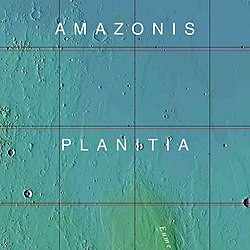
MOLA colorized relief map of Amazonis Planitia, the type area for the Amazonian System. Amazonis Planitia is characterized by low rates of meteorite and asteroid impacts. Colors indicate elevation, with red highest, yellow intermediate, and green/blue lowest.
Usage information
Celestial bodyMars
Time scale(s) usedMartian Geologic Timescale
Definition
Chronological unitPeriod
Stratigraphic unitSystem
Type sectionAmazonis Planitia

The Amazonian is a geologic system and time period on the planet Mars characterized by low rates of meteorite and asteroid impacts and by cold, hyperarid conditions broadly similar to those on Mars today.[1][2] The transition from the preceding Hesperian period is somewhat poorly defined. The Amazonian is thought to have begun around 3 billion years ago, although error bars on this date are extremely large (~500 million years).[3] The period is sometimes subdivided into the Early, Middle, and Late Amazonian. The Amazonian continues to the present day.

The Amazonian period has been dominated by impact crater formation and Aeolian processes with ongoing isolated volcanism occurring in the Tharsis region and Cerberus Fossae, including signs of activity as recently as a tens of thousands of years ago in the latter[4] and within the past few million years on Olympus Mons, implying they may still be active but dormant in the present.[5]

Description and name origin

[edit]

The Amazonian System and Period is named after Amazonis Planitia, which has a sparse crater density over a wide area. Such densities are representative of many Amazonian-aged surfaces. The type area of the Amazonian System is in the Amazonis quadrangle (MC-8) around 15°N 158°W / 15°N 158°W / 15; -158.

Pre-NoachianNoachianHesperianPost-HesperianAmazonian (Mars)

Amazonian chronology and stratigraphy

[edit]
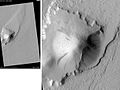
HiRISE image illustrating superpositioning, a principle that lets geologists determine the relative ages of surface units. The dark-toned lava flow overlies (is younger than) the light-toned, more heavily cratered terrain (older lava flow?) at right. The ejecta of the crater at center overlies both units, indicating that the crater is the youngest feature in the image.

Because it is the youngest of the Martian periods, the chronology of the Amazonian is comparatively well understood through traditional geological laws of superposition coupled to the relative dating technique of crater counting. The scarcity of craters characteristic of the Amazonian also means that unlike the older periods, fine scale (<100 m) surface features are preserved.[6] This enables detailed, process-orientated study of many Amazonian-age surface features of Mars as the necessary details of form of the surface are still visible.

Furthermore, the relative youth of this period means that over the past few hundred million years it remains possible to reconstruct the statistics of the orbital mechanics of the Sun, Mars, and Jupiter without the patterns being overwhelmed by chaotic effects, and from this to reconstruct the variation of solar insolation – the amount of heat from the sun – reaching Mars through time.[7] Climatic variations have been shown to occur in cycles not dissimilar in magnitude and duration to terrestrial Milankovich cycles.

Together, these features – good preservation, and an understanding of the imposed solar flux – mean that much research on the Amazonian of Mars has focussed on understanding its climate, and the surface processes that respond to the climate. This has included:

Good preservation has also enabled detailed studies of other geological processes on Amazonian Mars, notably volcanic processes,[21][22][23] brittle tectonics,[24][25] and cratering processes.[26][27][28]

System vs. Period

[edit]
e  h
Segments of rock (strata) in chronostratigraphy Periods of time in geochronology Notes (Mars)
Eonothem Eon not used for Mars
Erathem Era not used for Mars
System Period 3 total; 108 to 109 years in length
Series Epoch 8 total; 107 to 108 years in length
Stage Age not used for Mars
Chronozone Chron smaller than an age/stage; not used by the ICS timescale

System and Period are not interchangeable terms in formal stratigraphic nomenclature, although they are frequently confused in popular literature. A system is an idealized stratigraphic column based on the physical rock record of a type area (type section) correlated with rocks sections from many different locations planetwide.[30] A system is bound above and below by strata with distinctly different characteristics (on Earth, usually index fossils) that indicate dramatic (often abrupt) changes in the dominant fauna or environmental conditions. (See Cretaceous–Paleogene boundary as example.)

At any location, rock sections in a given system are apt to contain gaps (unconformities) analogous to missing pages from a book. In some places, rocks from the system are absent entirely due to nondeposition or later erosion. For example, rocks of the Cretaceous System are absent throughout much of the eastern central interior of the United States. However, the time interval of the Cretaceous (Cretaceous Period) still occurred there. Thus, a geologic period represents the time interval over which the strata of a system were deposited, including any unknown amounts of time present in gaps.[30] Periods are measured in years, determined by radioactive dating. On Mars, radiometric ages are not available except from Martian meteorites whose provenance and stratigraphic context are unknown. Instead, absolute ages on Mars are determined by impact crater density, which is heavily dependent upon models of crater formation over time.[31] Accordingly, the beginning and end dates for Martian periods are uncertain, especially for the Hesperian/Amazonian boundary, which may be in error by a factor of 2 or 3.[32][33]

Images

[edit]

See also

[edit]

Notes and references

[edit]
[edit]
Revisions and contributorsEdit on WikipediaRead on Wikipedia
from Grokipedia
The Amazonian is the youngest epoch in the geological timescale of Mars, spanning from approximately 3 billion years ago to the present day and representing over half of the planet's history. Named after the smooth plains of Amazonis Planitia in the northern hemisphere, this period is defined by relatively subdued geological activity compared to earlier epochs, with low crater densities on its surface units indicating minimal impact bombardment and resurfacing. Key features include the construction of massive shield volcanoes like through prolonged eruptions, widespread lava flows in regions such as and , and the formation of outflow channels suggesting episodic flooding events. During the Amazonian, aeolian processes dominated surface modification, shaping vast plains, dunes, and yardangs across much of the planet, while periglacial and glacial activity contributed to ice-rich deposits, particularly in the polar regions. In the north polar area, layered deposits of dust and ice accumulated in response to insolation-driven climate cycles tied to variations in Mars' axial obliquity, with brighter polar layered deposits forming primarily over the last 4–5 million years. Late Amazonian terrains also show evidence of enhanced erosion rates in certain alcoves, potentially linked to transient liquid water flows, at rates up to 10^{-1} mm per year—about an higher than average for the . Overall, the reflects a transition to a hyperarid, environment with sporadic and climatic excursions, preserving a record of Mars' ongoing, albeit infrequent, geological , including recent (as of 2025) evidence of mineral formation suggesting late aqueous and thermal activity.

Definition and Characteristics

Description

The Amazonian is the youngest geologic system and period in Mars' history, spanning approximately from 3 billion years ago to the present and representing the current ongoing epoch. It is defined by markedly reduced rates of impacts compared to earlier periods, persistently cold and hyperarid environmental conditions with minimal liquid water activity, and the predominance of in surface modification and resurfacing. This transition from the preceding period marks a shift to a more quiescent planetary state with lower overall geologic activity. Key physical traits of the Amazonian include widespread dust mantling that blankets much of the surface, contributing to the planet's characteristic reddish hue from ferric oxides, and the presence of well-preserved impact craters due to extremely low and rates. Tectonic activity has been minimal throughout this period, with no evidence of widespread plate motions or major deformational events, while isolated instances of late-stage persist, primarily confined to regions like and where shield volcanoes such as exhibit episodic eruptions and lava flows. Aeolian resurfacing dominates, with wind-driven sculpting dunes, yardangs, and vast plains, and deposition smoothing older terrains across the northern lowlands and polar regions. The Amazonian is subdivided into Early, Middle, and Late phases primarily based on thresholds in crater density, which reflect cumulative impact histories and relative surface ages. These divisions allow for stratigraphic correlation of geologic units, with the Early Amazonian encompassing the initial post-Hesperian terrains and the Late Amazonian including the most recent, least cratered surfaces observed today.

Naming Origin

The Amazonian period derives its name from Amazonis Planitia, a vast expanse of smooth plains located in the northern lowlands of Mars between approximately 2° and 50° N latitudes and 180° and 219° E longitudes. This region was selected as the type locality for the period due to its representative characteristics of relatively young, low-relief terrain with sparse impact craters, indicative of reduced geological activity compared to earlier epochs. The name "Amazonis" originates from a classical observed by early astronomers, denoting the mythical home of the , a race of warrior women in . The stratigraphic term "Amazonian" emerged from analyses of imagery in the early 1970s, forming part of an initial framework to classify Martian surface units based on crater density, superposition, and morphological features. It was formalized in the first global geologic map of Mars, compiled by David H. Scott and Michael H. Carr in 1978 under the U.S. Geological Survey, which divided the planet's history into the , , and Amazonian systems. This classification was later refined by Kenneth L. Tanaka in 1986, who subdivided the Amazonian into lower, middle, and upper series to better reflect temporal variations in cratering rates and surface processes. Early informal references to such smooth northern plains appeared in post-Mariner 9 discussions of resurfacing events, transitioning to standardized use as crater-counting techniques confirmed their youth. By the late , these terms had become established in Martian .

Chronology and Stratigraphy

Position in Martian Geological Timescale

The Martian geological timescale is structured into three primary chronostratigraphic divisions: the (the oldest, spanning approximately 4.1 to 3.7 billion years ago), the (approximately 3.7 to 3.0 billion years ago), and the Amazonian (the youngest, from approximately 3.0 billion years ago to the present). This tripartite framework, established through crater counting and stratigraphic analysis, provides a global standard for correlating surface units and events across the planet. The Amazonian occupies a pivotal position as the most recent and longest in this timescale, accounting for approximately two-thirds of Mars' ~4.5-billion-year history and signifying a marked decline in major geological activity compared to the intense and resurfacing of prior periods. Following the transition, it reflects a shift toward a predominantly quiescent planetary state, with reduced rates of , tectonism, and , though sporadic localized processes persisted. This period's extensive duration underscores Mars' evolution into a relatively stable, cold, and arid world, preserving a record of late-stage modifications that inform current surface conditions. Stratigraphically, the Amazonian is classified as a —a comprehensive rock record encompassing the entire time span—with units identified by low densities and minimal degradation, ensuring its applicability to diverse terrains from polar regions to equatorial plains. In broader comparative terms, the Amazonian aligns with a "modern" phase of Martian history, akin to Earth's eon in representing post-precursor eras of planetary development, while the pre-Amazonian divisions parallel Precambrian-like conditions dominated by early crust formation and high-impact regimes. The Amazonian is informally subdivided into Early, Middle, and Late phases to refine internal chronology.

Boundaries and Subdivisions

The lower boundary of the Amazonian period marks the transition from the and is placed at approximately 3.0 billion years ago (Ga), though it remains poorly constrained with an uncertainty of ±500 million years due to differences in crater production models. This boundary is defined by a decline in widespread flood volcanism characteristic of the Hesperian ridged plains and the emergence of smoother intercrater plains, reflecting a shift to more localized geological activity. Crater serves as the primary criterion, with the Hesperian-Amazonian divide at cumulative densities of 12–32 craters greater than 16 km in diameter per 10⁶ km². The upper boundary of the Amazonian extends to the present day, with no formal endpoint defined, encompassing ongoing but modification. This period represents the youngest and longest epoch in Martian history, for approximately two-thirds of the planet's geological timeline. The Amazonian is subdivided into three informal epochs based on density isochrons, primarily using counts of craters larger than 16 km in per 10⁶ km² to delineate relative ages (according to models such as Werner and , 2011). The Early Amazonian (~3.0–1.8 Ga) features moderate cratering rates, with densities of 8–17 craters >16 km per 10⁶ km², corresponding to initial post-Hesperian stabilization. The Middle Amazonian (~1.8–0.4 Ga) shows low cratering, at 2–5 craters >16 km per 10⁶ km², marked by reduced resurfacing. The Late Amazonian (~0.4 Ga to present) exhibits very low cratering, with densities around 1 crater >16 km per 10⁶ km², indicating sparse modification dominated by localized and ice-related processes. Amazonis Planitia serves as the type section for the Amazonian period overall, exemplifying its smooth volcanic plains formed by late-stage flood lavas. Global mapping units, such as the Amazonian volcanic plains, further reference these subdivisions through superposition and crater statistics across volcanic terrains.

Dating Methods

The primary method for dating Amazonian terrains on Mars is crater size-frequency distribution (CSFD), which measures the density of impact craters of various diameters on a surface to infer its age, as older surfaces accumulate more craters due to the inverse correlation between crater density and surface age. This approach relies on models such as Hartmann's chronology system, which defines "crater retention age" as the average preservation time for craters of a given diameter and integrates data from production functions to estimate relative and absolute ages. Relative dating within Amazonian units employs stratigraphic principles, including the , where younger materials overlie older ones, and , where features that intersect others are younger than the intersected features. These methods establish sequence without numerical ages and are particularly useful for identifying recent modifications in Amazonian terrains, such as volcanic flows or fluvial deposits. Absolute ages are calibrated by extrapolating lunar impact cratering rates to Mars, scaled by a factor accounting for Mars' thicker atmosphere and gravitational differences, typically using a scaling parameter of around 2.0. Recent refinements incorporate high-resolution orbital from the (MRO) and its High Resolution Imaging Science Experiment (), enabling more precise identification and counting to reduce uncertainties in CSFD analyses. Dating Amazonian surfaces faces challenges from the era's low cratering rates, resulting in sparse crater populations that introduce significant statistical uncertainties, often requiring large areas (over 10,000 km²) for reliable counts. Additionally, unlike , no in-situ of Martian samples is available, limiting direct absolute age verification and relying solely on impact-based models. Advancements in the 2020s include better incorporation of secondary craters—those formed by from primary impacts—into CSFD models to avoid overestimating ages, as well as corrections for resurfacing effects like erosion and deposition that alter crater preservation. These refinements, informed by updated lunar chronologies from missions like Chang'E-5, have improved accuracy for young Amazonian features by adjusting production functions and accounting for recent impact flux variations.

Geological Features and Processes

Volcanic Activity

Volcanic activity during the Amazonian period on Mars was characterized by isolated episodes that primarily shaped terrains in the and regions, with a marked decline in intensity compared to the voluminous flood basalts of the preceding epoch. The region, a massive volcanic province, hosts the formation of giant shield volcanoes such as , Ascraeus Mons, and . , the largest volcano in the Solar System, began building in the late around 3.7 billion years ago, with construction continuing through the Amazonian and sporadic activity until less than 2 million years ago, as evidenced by the youngest flank lava flows. Ascraeus Mons and , part of the alignment, exhibit mid- to late-Amazonian construction, with summit calderas and flank flows dated to approximately 250–380 million years ago. In the region, smaller shield volcanoes like contributed to localized edifices, though activity was less voluminous than in . Later Amazonian volcanic events included fissure-fed eruptions along Cerberus Fossae in , producing extensive flood lavas dated to 100–200 million years ago, with some outflows as young as 2.5 million years. Similarly, lava plains in Amazonis Planitia, situated between and , formed through effusive eruptions around 200–500 million years ago, creating some of the smoothest surfaces on Mars due to thin, overlapping basaltic flows. These events represent a shift toward distributed, low-volume fed by dikes rather than centralized hotspots. The volcanic products of the Amazonian are dominated by low-viscosity basaltic lavas that facilitated long, thin flows and shield-building through repeated effusions, accompanied by collapses at summits. This contrasts with the thicker, more extensive flood basalts, as Amazonian eruption rates were roughly an lower, confining activity to regional provinces. Radar imaging from the SHARAD instrument on the has revealed buried lava flow interfaces beneath surface deposits in and , confirming stacked sequences up to several hundred meters thick with interfaces indicating episodic emplacement over the past few hundred million years. Thermophysical modeling of surface inertia, derived from THEMIS infrared , further supports recent activity, as low mantling on certain flows implies exposure within the last few million years, preserving high thermal inertia indicative of fresh basaltic surfaces.

Impact Cratering

During the Amazonian period, the flux of impactors striking Mars has been markedly low, significantly lower than during the epoch, leading to sparse crater populations with minimal subsequent degradation due to reduced and resurfacing processes. This diminished rate reflects a post-Late Heavy decline in solar system populations, resulting in well-preserved s that serve as key markers of surface age. Prominent examples of fresh Amazonian craters include those in Amazonis Planitia, such as the 27-km-diameter Tooting crater, formed approximately 3 million years ago into Late Amazonian lava flows dated 240–375 million years ago, and more recent small impacts like the 150-m-wide S1094b crater formed around 2021. Rayed craters, characterized by bright rays from recent formation, further highlight ongoing impacts; for instance, the 13.9-km Corinto crater in , aged 0.1–2.5 million years, exemplifies Late Amazonian activity with extensive ray systems extending hundreds of kilometers. Recent detections, including seismic events from the mission correlating to new craters like S1094b in 2021, confirm the persistence of small impacts into the present day. Morphologically, these craters exhibit pristine raised rims, prominent central peaks in larger examples, and well-defined blankets that show lobate patterns indicative of atmospheric interactions during impact. Secondary crater fields, formed by fragments, often cluster around primaries, displaying chains and swarms that mimic primary morphologies but at smaller scales, providing insights into dynamics under Martian conditions. Globally, Amazonian crater density is higher in the southern highlands, where older terrains preserve more impacts, compared to the northern plains, which experienced extensive volcanic resurfacing and thus host fewer visible craters. This underscores the role of regional geological processes in masking craters and implies a stable, low-impact environment dominated by main-belt asteroids as primary sources.

Surface Modification Processes

During the Amazonian period, have dominated surface modification on Mars, driven by persistent winds that transport and across the planet. Global dust storms, which can envelop the entire surface and last for months, redistribute fine particles, leading to widespread deposition that forms a thin mantle of up to tens of meters thick in regions like Arabia Terra. This mantling buries underlying and small craters, with thicknesses estimated at 10–60 meters based on analyses of buried impact features. Dune formation is prominent in low-lying areas such as craters and plains, where and transverse dunes migrate at rates of centimeters to meters per year, shaped by seasonal wind patterns and sediment availability. Yardang erosion, conversely, sculpts isolated ridges and mesas from softer sedimentary layers, particularly in equatorial and mid-latitude regions, through abrasion by saltating grains, with formation timescales on the order of millions of years in sites like Becquerel Crater. Seasonal and polar effects further modify the surface through cycles of CO₂ and H₂O sublimation. In polar and mid-latitude regions, CO₂ accumulates during winter, up to 1 meter thick, and sublimates in spring, triggering that excavates alcoves and contributes to formation on and dunes. , characterized by alcove-channel-fan morphology, show recent activity, with sites exhibiting more frequent changes, such as channel widening by 30–60 meters in a single Mars year, primarily via dry granular flows involving CO₂ blocks. streaks, linear dark features up to kilometers long on dusty , form year-round but peak in autumn, likely from avalanching of loose disturbed by sublimation or minor seismic activity, with new streaks appearing at a rate of about 7% per existing streak per Mars year. Periglacial processes, influenced by ground ice in mid-latitudes, produce features indicative of freeze-thaw cycles under varying obliquity. Polygonal ground, formed by thermal contraction cracking of ice-cemented soils, creates networks of troughs 5–20 meters across, observed extensively between 40°–60° latitude, as confirmed by the Phoenix lander. Thermokarst-like pits, resembling terrestrial collapse features from ice melt or sublimation, appear in clusters up to several hundred meters wide, particularly on plains and within craters, signaling localized ground ice thaw during warmer climatic excursions in the late Amazonian. Overall erosion rates during the Amazonian are notably slow, averaging 1–10 nanometers per year, as inferred from rock exposure and crater degradation at landing sites like Meridiani Planum and Gusev Crater. This low rate, primarily aeolian in nature, has preserved fine-scale topography and young craters better than in earlier periods, allowing detailed study of recent surface evolution.

Climate and Environmental Evolution

Orbital Forcing and Climate Cycles

The orbital forcing of Mars' climate during the Amazonian period is primarily driven by variations in the planet's spin-axis obliquity and , analogous to on . Obliquity oscillates between approximately 15° and 45° over cycles of about 120,000 years, while eccentricity fluctuates with periods around 95,000–170,000 years, both influencing seasonal insolation patterns and the stability of polar ice caps. These changes modulate the distribution of , leading to periodic shifts in , water vapor transport, and ice deposition at the poles. Higher obliquity enhances summer insolation at high latitudes, promoting ice sublimation and equatorward migration of volatiles, whereas lower obliquity favors polar accumulation during colder, more stable conditions. Evidence for these climate cycles is preserved in the polar layered deposits (PLD), which consist of alternating layers of water ice and in both the northern (NPLD) and southern (SPLD) polar regions. These sequences, spanning thicknesses of up to several kilometers, record depositional variations on timescales of 10,000 to 100,000 years, correlating with obliquity and cycles through changes in layer , thickness, and radar reflectivity. Orbital models integrated with PLD demonstrate that dust-rich layers form during periods of high obliquity-induced and global dust storms, while ice-dominated layers accumulate under low-obliquity regimes with reduced atmospheric activity. Recent analyses (2023–2025) using high-resolution data have refined these correlations, showing that NPLD layers reflect the past ~5 million years of insolation-driven deposition, while SPLD preserve signals up to 10–100 million years old, though focused on late Amazonian fluctuations. The resulting climate impacts include alternating episodes of cold, dry conditions with enhanced polar buildup and global stabilization, contrasted by warmer, dustier phases that redistribute volatiles and erode surface features. These cycles influence large-scale transport, potentially amplifying storm frequency during eccentricity minima, and modulate CO2 cycling between the atmosphere and polar reservoirs. (MRO) observations, particularly from the SHARAD instrument, reveal late Amazonian buildup of massive CO2 deposits in the SPLD's reflection-free zone, estimated to have accumulated within the past 1 million years at rates of ~0.1 mm/year under varying insolation. Thermal models of these deposits indicate sensitivity to orbital perturbations, with sublimation and re-deposition responding to obliquity-driven swings over the last million years, supporting a dynamic late Amazonian climate baseline of hyperaridity punctuated by volatile exchanges.

Evidence of Recent Hydrological Activity

Recurring slope lineae (RSL) represent one of the most prominent indicators of potential recent hydrological activity on Mars, appearing as dark, linear streaks on steep slopes, particularly in the equatorial and mid-latitude regions, and recurring seasonally during warmer periods. Observations from the (MRO) suggest these features may result from transient briny flows or dry granular flows, with spectral data from the Compact Reconnaissance Imaging Spectrometer for Mars (CRISM) detecting hydrated salts like in RSL sites during summer, supporting a model of contemporary from aquifer melting triggered by solar heating. A 2025 time-series analysis of RSL in and craters revealed a significant increase in their number following the 2018 global , compatible with enhanced subsurface mobilization, though alternative dry avalanche mechanisms remain debated. Martian gullies, characterized by alcoves, channels, and aprons on walls and slopes, provide additional evidence of late Amazonian or involvement, with formation ages estimated at less than 1 million years in some cases. Recent modeling indicates that gullies could form through melting of during high-obliquity periods, followed by sublimation, rather than purely dry processes, as supported by simulations recreating flows with CO₂ blocks. However, 2025 studies emphasize explosive sublimation of CO₂ as a primary driver for many fresh gullies, limiting sustained liquid roles to intermittent episodes. In the Cerberus Fossae region, possible outflow channels and rootless cones on the Athabasca Valles flood lavas, dated to less than 5 million years ago, suggest interactions between recent and shallow or ground , indicating episodic aqueous flooding in the late Amazonian. Glaciofluvial deposits in craters like Barnard, located in southern , further attest to late Amazonian ice-related activity, with mapping of 147 sinuous ridges (average 8.5 km long, 10–20 m high) and six fluvial channels (average 6.9 km long) interpreted as eskers and subglacial features formed during periods of elevated obliquity. Crater retention ages place this activity between 22.6 and 257 million years ago, overlapping with the middle to late Amazonian, and highlighting into ice-rich layers buried since the early Amazonian. These deposits, alongside lobate aprons up to 350 m thick, imply mobilization of glacier ice and transient flows under a varying . Recent rover data have bolstered evidence for wetter episodes in the Amazonian, including a 2025 study identifying siderite (iron carbonate) at 4.8–10.5 weight percent in Gale Crater rocks analyzed by NASA's Curiosity rover, formed through water-rock reactions and evaporation in water-limited conditions less than 1 billion years ago. This suggests a partially closed carbon cycle operated during the late Amazonian, sequestering atmospheric CO₂ equivalent to 2.6–36 millibars globally. Complementing this, a 2025 modeling effort proposes that carbonate formation created intermittent oases via a negative feedback with increasing solar luminosity: brighter sunlight stabilized liquid water, promoting carbonate precipitation that reduced CO₂ and induced cooling, sustaining patchy habitability post-3.5 billion years ago and as recently as 0.5 billion years ago in equatorial zones. Subsurface water-ice stability zones, mapped through the Subsurface Water Ice Mapping (SWIM) project using MRO's , reveal extensive clean ice deposits at depths less than 1 meter in mid-to-high latitudes, with fresh exposures uncovered by new impact craters indicating ongoing stability into the present Amazonian. These zones, refined in 2025 updates, extend to equatorial margins during high-obliquity phases, potentially enabling briny flows. A 2025 analysis of seasonal frost at sites like the Viking 2 landing area models transient brines forming for up to one Martian month from calcium melting at -75°C, twice daily in late winter and early spring, though volumes remain minimal due to thin frost layers (<1 mm). Debates persist on whether this activity reflects transient, localized events or more sustained processes, with hyperarid conditions—evidenced by low erosion rates and minimal atmospheric —constraining persistence to brief climate excursions driven by . While briny or models explain spectral and geomorphic signatures, dry mechanisms like granular flows adequately account for many features without invoking liquid water, emphasizing the challenges in distinguishing hydrological signals in Mars' current desert environment.

Scientific Implications

Comparisons to Other Martian Periods

The Amazonian period is distinguished from the Noachian by significantly lower impact cratering rates, estimated at approximately 1/100th those of the , which was dominated by the intense phase ending around 3.7 billion years ago. This decline in cratering reflects a broader reduction in solar system-wide impacts following the . In contrast to the early , characterized by extensive valley networks and fluvial systems indicative of sustained liquid water flow, the Amazonian surface shows no such widespread hydrological landforms, pointing to a shift toward drier conditions. Compared to the , the Amazonian exhibits a sharper decline in volcanic activity, with average eruption rates roughly an lower and largely confined to isolated centers like rather than the widespread flood basalts typical of Hesperian ridged plains. Tectonic processes also waned more substantially in the Amazonian, contributing to reduced surface modification overall. Moreover, the Amazonian appears more uniformly arid than the Hesperian, which may have included intervals of warmer, wetter supporting localized . These differences underscore an overall evolutionary trend on Mars from the dynamic, impact- and erosion-dominated and the volcanically and possibly hydrologically active to the more quiescent Amazonian, dominated by a stagnant convection regime that limited mantle-driven resurfacing. This transition enhanced the preservation of Amazonian landforms due to diminished rates of erosion, deposition, and tectonic disruption compared to earlier periods. Stratigraphically, Amazonian units consistently overlie ridged plains materials, with erosional unconformities often marking the boundaries and indicating episodes of non-deposition or erosion between periods. These relationships highlight the progressive layering of Martian crust, where Amazonian volcanics and sediments cap older, more modified terrains.

Relevance to and Exploration

The Amazonian period's environmental dynamics, characterized by intermittent oases driven by orbital variations and formation, suggest potential transient niches for microbial during its later stages. Recent modeling indicates that post-3.5 Ga patchy liquid water episodes, lasting up to 10^5 years and covering about 5% of the near equatorial lowlands, could have supported episodic through CO2 sequestration and fluctuating atmospheric . These oases, linked to mechanisms involving and evaporative cooling, imply short-lived habitable conditions amid predominantly arid phases, potentially allowing for microbial survival in localized, neutral-pH aqueous environments. However, the Martian surface during this era remains inhospitable today due to extreme cold, low , and high , rendering subsurface deposits as the primary modern refuges for potential extant . Subsurface aquifers and layers, extending from 1-2 meters depth and comprising up to one-third of the planet's volume, offer shielded conditions with liquid water possibilities, though energy limitations constrain metabolic rates. Ongoing Mars exploration missions highlight the Amazonian period's relevance through evidence of prolonged hydrological activity in key sites. NASA's Perseverance rover in Jezero Crater has identified minerals indicative of multiple fluid alteration episodes, transitioning from acidic, high-temperature conditions to more neutral, alkaline waters, with widespread sepiolite distribution suggesting basin-wide habitability phases that may extend into the late Hesperian-Amazonian transition. Complementing this, Mars Reconnaissance Orbiter (MRO) observations reveal Early Amazonian sedimentary volcanism and aqueous alteration landforms, implying recent fluid mobilization that informs sample selection for return missions by highlighting preserved biosignature potential in volcanic terrains. InSight's seismic data, detecting over 1,300 marsquakes including deep impacts and tectonic events, further elucidates Amazonian crustal activity and volatile presence, aiding hazard assessment and site prioritization for Mars Sample Return by mapping subsurface structures linked to past habitability. Scientific gaps in Amazonian chronology underscore the need for advanced in-situ to refine period boundaries and timelines. Current counting and orbital data yield uncertainties exceeding 200 Ma for late Amazonian events, necessitating K-Ar isochron techniques on rovers to achieve ~200 Ma precision for distinguishing volcanic and hydrological episodes since ~3 Ga. Recent 2023-2025 studies on , incorporating chaotic obliquity cycles into global models, enhance predictions of ice-dust deposition and transient flows, supporting lander designs for probing polar layered deposits. Amazonian terrains serve as valuable analogs to Earth's period, guiding biosignature searches in polar and lowland regions where stratified , aeolian features, and episodic volatiles mirror late climate variability. These similarities inform targeted investigations for organic preservation in low-elevation basins and residual caps, prioritizing sites with minimal alteration for future missions to detect chemical or morphological signs of past life.

References

Add your contribution
Related Hubs
User Avatar
No comments yet.