Hubbry Logo
AmbedkarismAmbedkarismMain
Open search
Ambedkarism
Community hub
Ambedkarism
logo
8 pages, 0 posts
0 subscribers
Be the first to start a discussion here.
Ambedkarism
Ambedkarism
from Wikipedia

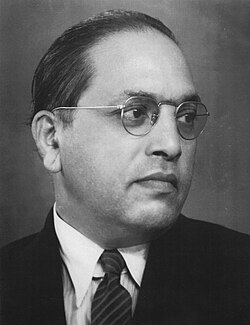
B. R. Ambedkar (1891-1956)

Ambedkarism is called as the teaching, ideology or philosophy of B.R. Ambedkar, an Indian economist, barrister, social reformer, and the first of Minister of Law and Justice in the first cabinet of Jawaharlal Nehru. Ambedkarism includes special focus on subjects such as fraternity, democracy, communal electorates, conversion out of Hinduism, political power, rule of law, Navayana, among others. An Ambedkarite is one who follows the philosophy of Ambedkar. Icons of Ambedkarite ideology also include Periyar, Jyotirao Phule and others.[1]

Social philosophy

[edit]

According to B. R. Ambedkar "Society is always composed of Classes." Their foundations could be different. A person in a society is always a member of a class, whether it is economic, intellectual, or social. This is a universal truth, and early Hindu culture could not have been an exception to this rule, and we know it wasn't. So, which class was the first to transform into a caste, because class and caste are, in a sense, next-door neighbours, separated only by a chasm. "A caste is a closed social group."[2]

Untouchables were forced to not wear good clothes but for Ambedkar, the suit was a strategy for political resistance, an assertion of power, a means to break the caste barrier in a society that is caste ridden.[3]

Ambedkar proposed a Separate Electorate for the untouchables to send their own representatives in assembly but it was opposed by Gandhi and resulted in his defeat after the Poona Pact but later he advocated for the establishment of Settlement Commission that would provide separate villages for the Scheduled Castes.[4][5]

See also

[edit]

References

[edit]
Revisions and contributorsEdit on WikipediaRead on Wikipedia
from Grokipedia
Ambedkarism is the socio-political ideology developed by Bhimrao Ramji Ambedkar (1891–1956), an Indian scholar, economist, and principal architect of the Indian Constitution, which advocates the complete eradication of the caste system as a prerequisite for genuine and in . Centered on the principles of , equality, and , it critiques the Hindu religious doctrines that perpetuate caste hierarchies as divisions of laborers rather than mere division of labor, arguing that such structures inherently foster inequality and moral decay. Ambedkarism promotes education, agitation, and organization as tools for marginalized groups, particularly Dalits (formerly "untouchables"), to achieve self-respect and political empowerment, viewing political power as the "master key" to socio-economic transformation. A defining feature of Ambedkarism is its advocacy for constitutional mechanisms like reservations in and employment to counter entrenched -based , alongside economic reforms such as land redistribution and state intervention to dismantle exploitative structures. In , Ambedkar led the mass conversion of over 500,000 followers to , rejecting Hinduism's scriptural basis for as incompatible with rational ethics and human dignity, and prescribing 22 vows emphasizing rejection of Brahminical authority and embrace of equality. This ideological shift positioned as a for anti- emancipation, influencing the Dalit-Bahujan movement and parties like the . While Ambedkarism has empowered political assertion and contributed to legal protections against , it faces criticism for potentially entrenching identities through and fostering communal divisions, though empirical persistence of endogamy and underscores the causal necessity of targeted interventions. Its emphasis on as foundational to political remains a cornerstone of debates on India's unequal .

Historical Origins

B.R. Ambedkar's Formative Experiences and Influences

Bhimrao Ramji Ambedkar was born on April 14, 1891, into the , historically classified as untouchable, in (present-day Dr. Ambedkar Nagar, ), then part of the British Central Provinces. His father, Ramji Maloji Sakpal, a (sergeant-major) in the , emphasized education for his children amid widespread prejudice that barred Mahars from many professions and social interactions. From in Satara onward, Ambedkar faced institutionalized , including segregation from higher-caste peers, prohibition from touching shared water vessels, and physical punishment for perceived violations of norms, experiences that instilled a deep awareness of as a mechanism of enforced inequality. These early humiliations fueled Ambedkar's pursuit of knowledge as a tool for upliftment, leading him to excel academically despite obstacles; he passed his in 1907 at Elphinstone High School in Bombay and earned a B.A. from in 1912. A Mahar scholarship from the enabled his studies abroad, arriving at in July 1913, where he completed an M.A. in 1915 and a Ph.D. in in 1927, focusing on provincial finance and ancient Indian commerce. Subsequent research at the London School of Economics and culminated in barrister qualifications by 1923, broadening his exposure to egalitarian legal and economic frameworks. Ambedkar's intellectual development was markedly shaped by key figures encountered during these phases. At Columbia, John Dewey's profoundly influenced him, providing methods of experimental and a vision of as social reconstruction, which Ambedkar applied to dismantle caste rigidities; he later acknowledged owing his "whole intellectual life" to Dewey. Indian antecedents like Jyotirao Phule's critiques of Brahmanical hierarchy and Gautama Buddha's rejection of caste in favor of rational ethics and fraternity further informed his thought, with Buddha emerging as his paramount ethical exemplar. These intertwined experiences of exclusion, scholarly rigor, and philosophical encounters crystallized Ambedkar's commitment to evidence-based reform over ritualistic tradition.

Development of Ambedkarism as an Ideology

Ambedkar's ideological framework began to crystallize in the 1920s through his leadership in movements addressing caste-based discrimination against Dalits, formerly known as untouchables. In 1927, he organized the Mahad Satyagraha, where Dalits asserted their right to access public water sources, marking an early assertion of civil rights independent of upper-caste sanction. This event, followed by the public burning of the Manusmriti on December 25, 1927, symbolized his rejection of Hindu scriptural justifications for caste hierarchy, positioning Ambedkarism as a direct challenge to orthodox Hinduism's social order. His founding of the Bahishkrit Hitakarini Sabha in 1924 further institutionalized efforts to educate and mobilize the depressed classes, emphasizing self-reliance and rational inquiry over ritualistic reform. By the 1930s, Ambedkar's ideology evolved into a comprehensive critique articulated in key writings and political engagements. The undelivered speech "," prepared in 1936 for the Jat-Pat Todak Mandal but rejected for its radicalism, argued that caste could not be eradicated without dismantling the religious foundations of , advocating inter-caste marriages and dining as practical steps toward social equality. Politically, his participation in the Conferences (1930–1932) and the subsequent on September 24, 1932, secured reserved seats for depressed classes in provincial legislatures, though he viewed separate electorates as essential for genuine representation, highlighting tensions with Gandhian assimilationism. The formation of the Independent Labour Party in 1936 and later the Scheduled Castes Federation in 1942 reflected a shift toward electoral politics, integrating economic demands like land rights with anti-caste agitation, influenced by his economic analyses in works such as "The Problem of the Rupee" (1923). Post-independence, Ambedkarism matured through constitutional drafting and disillusionment with Hindu-majority politics. As chairman of the Drafting Committee, Ambedkar embedded principles of liberty, equality, and fraternity—drawn from the and his Columbia education under —into India's 1950 Constitution, including affirmative action via Articles 15, 16, and 17 abolishing . His resignation as Law Minister in 1951 over opposition to the Hindu Code Bill underscored persistent caste biases within , reinforcing his view that legal reforms alone were insufficient without cultural transformation. The ideology culminated in Ambedkar's conversion to on October 14, 1956, in , where approximately 500,000 followers renounced for Buddhism, reinterpreted as a rational, egalitarian path emphasizing social ethics over metaphysics. This mass deeksha represented the final ideological pivot, viewing as the antidote to caste's spiritual roots, with Ambedkar's 22 vows rejecting Hindu deities and rituals while committing to liberty and equality. Ambedkarism thus transitioned from reformist agitation to a holistic doctrine of annihilation through religious reinvention, prioritizing empirical social reconstruction over doctrinal orthodoxy.

Philosophical Foundations

Critique of Hindu Social Order and Caste System

![Dr. B.R. Ambedkar]float-right 's critique of the Hindu social order centered on the as its foundational and irremediable defect, arguing that it institutionalized graded inequality through religious sanction rather than mere social custom. In his 1936 undelivered speech , he contended that the Chaturvarna system, derived from Vedic texts and codified in the , divided society into four hereditary varnas—Brahmins, Kshatriyas, Vaishyas, and Shudras—with untouchables outside this framework, enforcing and occupational restrictions that perpetuated hierarchy. Ambedkar emphasized that this was not a division of labor but a division of laborers, where each claimed superiority over those below it, fostering perpetual antagonism and preventing ethical solidarity among Hindus. He rejected reformist efforts within , such as those by figures like , as insufficient because they sought to preserve religious doctrines that inherently upheld ; Ambedkar insisted that annihilating required dismantling the dogmatic basis in Hindu scriptures, including the and Smritis, which he viewed as promoting supremacy and degrading lower castes. In a symbolic act on December 25, 1927, Ambedkar led the public burning of the Manusmriti in , decrying it as the primary text legitimizing the subjugation of Shudras and women, thereby entrenching inequality in the social order. This event underscored his position that the Manusmriti transformed the fluid varna system into a rigid, birth-based , exacerbating exploitation and moral degradation. Ambedkar further argued that the Hindu social order's graded structure demoralized society by eroding ethics and fraternity, as castes prioritized internal purity over collective welfare, leading to disunity and vulnerability; he observed that no true Hindu consciousness existed, only caste loyalties that fragmented political and social action. Unlike binary oppressions, this system created layered inequalities where even oppressed groups internalized superiority over those beneath them, sustaining the overall edifice without rebellion from below. He posited that such a order was antithetical to liberty and equality, incapable of supporting a free society, as evidenced by historical persistence despite reform attempts. Ambedkar's analysis, grounded in scriptural exegesis and empirical observation of village segregation, concluded that Hinduism's religious framework made caste annihilation impossible without rejecting its core tenets.

Conversion to Buddhism and Navayana Principles

On October 14, 1956, B.R. Ambedkar publicly converted to at in , , leading a mass ceremony where approximately 365,000 followers renounced and embraced the faith. The event occurred between 9 and 11 a.m. on the occasion of Dussehra, marking a deliberate rejection of the Hindu social order dominated by hierarchies that Ambedkar had critiqued throughout his career. This conversion, conducted just two months before Ambedkar's death on December 6, 1956, represented the culmination of over two decades of comparative religious study, during which he evaluated , , , and before selecting for its compatibility with rational inquiry and social reform. Ambedkar's choice stemmed from Buddhism's emphasis on equality and its historical opposition to Brahmanical , which he viewed as perpetuating and inherent in . Unlike , which Ambedkar argued justified through scriptural sanction and karmic determinism, offered a framework for ethical conduct grounded in reason rather than ritual or divine . He administered 22 vows to participants, including pledges to reject , the sanctity of the , and concepts like karma as explanations for , thereby framing the conversion as an act of liberation from doctrinal oppression. Navayana, or "New Vehicle" , emerged as Ambedkar's reinterpretation of Buddhist doctrine, prioritizing social emancipation over metaphysical concerns like nirvana or rebirth. This school diverges from traditional and by de-emphasizing soteriological elements and instead integrating core principles of , equality, and —drawn from Enlightenment ideals but anchored in the Buddha's teachings on human dignity and interdependence. Ambedkar rejected the system's theological underpinnings, asserting that inequality arises from social structures rather than individual moral failings, and positioned Navayana as a rational, this-worldly path to collective upliftment through , agitation, and organized resistance. Central to is the cultivation of moral agency via the Eightfold Path, reframed to address : right understanding critiques hierarchical institutions, right livelihood promotes economic independence from exploitative labor, and right effort fosters communal against . Ambedkar envisioned not as esoteric philosophy but as a pragmatic for democratic , where ethical precepts underpin constitutional and state intervention to dismantle inequality. This adaptation underscores Navayana's role in Ambedkarism as a tool for empirical social transformation, evidenced by the sustained that followed the 1956 conversion.

Core Tenets: Liberty, Equality, and Fraternity

B.R. Ambedkar articulated liberty, equality, and fraternity as the foundational principles for an ideal society, explicitly stating in his 1936 undelivered speech Annihilation of Caste that his vision was "a society based on Liberty, Equality, and Fraternity." These tenets formed the ethical core of Ambedkarism, serving as antidotes to the hierarchical caste system, which he argued inherently denied individual autonomy, social parity, and communal bonds. Ambedkar drew partial inspiration from the French Revolution's triad but emphasized their deeper roots in Buddhist teachings, particularly the 's rejection of caste-based inequality and promotion of moral interdependence, as outlined in his later essay Buddha or (1956). In the Indian context, he positioned these principles as prerequisites for genuine , warning that political independence without social reform would perpetuate inequality. Liberty, in Ambedkar's framework, encompassed from caste-imposed restrictions on occupation, , and social interaction, enabling individual and rational choice unbound by hereditary status. He critiqued orthodox for subordinating liberty to graded inequality, asserting in that true liberty required dismantling Chaturvarna, the fourfold caste order, to allow unfettered human potential. Equality, meanwhile, demanded the eradication of and all forms of social discrimination, extending beyond mere legal parity to economic and educational access; Ambedkar viewed political equality as a practical necessity, even if philosophically contested, to foster collective progress in a diverse society. He integrated these into the Indian Constitution's framework, influencing Articles 14–18 on equality and non-discrimination, adopted on November 26, 1949. Fraternity held paramount importance as the unifying force, which Ambedkar deemed the "real safeguard" against violations of or equality, preventing societal fragmentation along lines. In a 1949 note, he stressed that fraternal concord was urgently needed amid India's divisions, linking it to constitutional objectives like the Preamble's inclusion of to promote brotherhood transcending religious and barriers. Without —rooted in ethical recognition of shared humanity—Ambedkar argued, devolves into license for the privileged, and equality remains superficial; he elevated it above the other two, insisting it must underpin to avoid the "grammar of anarchy" from unchecked individualism or groupism. In Ambedkarism, these tenets interlock: without equality invites exploitation, equality without breeds resentment, and without stifles initiative, collectively aiming for a casteless, rational aligned with Buddhism's emphasis on compassion and equity.

Political Dimensions

Advocacy for Constitutional Democracy

B.R. Ambedkar, serving as chairman of the Drafting Committee of India's from 1947 to 1949, advocated constitutional as the primary mechanism for safeguarding individual rights and preventing majoritarian tyranny, particularly for marginalized . He viewed the , adopted on November 26, 1949, as a tool for establishing political, social, and economic , incorporating provisions like the abolition of under Article 17 and reservations for Scheduled to ensure . Ambedkar emphasized that mere formal political through adult was insufficient without addressing social hierarchies, arguing that true required the to realize , equality, and . Central to Ambedkar's advocacy was the concept of constitutional morality, which he described in debates as the disciplined adherence to constitutional norms over personal or partisan inclinations, essential for sustaining . In his November 25, 1949, speech, known as the "Grammar of Anarchy," Ambedkar cautioned against reliance on violence, hero-worship, or extra-constitutional methods, stating that India's survival as a depended on citizens imbibing constitutional morality to uphold the and prevent the subversion of democratic institutions. He drew from global constitutional traditions, favoring federal structures with checks on centralized power to protect minorities, while insisting that public authority must not concentrate in any single organ. Ambedkar's framework integrated as a bulwark for , advocating an integrated with the empowered to review legislative actions for , as embedded in Articles 13, 32, and 226. He promoted within democratic bounds, including Directive Principles of State Policy to guide economic reforms without undermining , reflecting his belief that economic disparities perpetuated . Despite these safeguards, Ambedkar warned in 1953 that constitutional provisions alone could fail if societal prejudices persisted, urging continuous agitation through democratic channels to enforce .

Positions on Communal Electorates and Political Power

Ambedkar initially advocated for separate electorates for the Depressed Classes (later termed Scheduled Castes) during the Second in 1931, arguing that joint electorates would perpetuate upper-caste dominance due to entrenched caste prejudices, preventing genuine representation of interests. He contended that only separate voting pools could ensure candidates accountable solely to their , rather than beholden to Hindu majoritarian sentiments. This position aligned with his view that political safeguards were indispensable for minorities lacking social equality to counter systemic exclusion. The British government's of August 16, 1932, endorsed Ambedkar's demand by granting separate electorates to the Depressed Classes, allocating 71 reserved seats in provincial legislatures and 18% representation in the central legislature. However, Mahatma Gandhi's opposition, culminating in a fast unto death starting September 12, 1932, pressured Ambedkar into negotiations, resulting in the signed on September 24, 1932, at Yerwada Jail. Under the pact, separate electorates were abandoned in favor of reserved seats within joint electorates, increasing provincial allocations to 148 seats and introducing a stage for Depressed Classes voters to nominate candidates, followed by general electorate voting. Ambedkar accepted this compromise to avert Gandhi's death and secure expanded numerical representation, though he later described it as yielding under duress. Post-independence, Ambedkar critiqued joint electorates with reservations as insufficient, asserting that the mechanism empowered upper-caste Hindus to veto Dalit candidates in the final poll, effectively installing representatives who prioritized Hindu approval over community welfare. He argued this system diluted true political agency, as evidenced by the frequent election of compliant figures rather than assertive advocates for . In his 1945 essay "What and Gandhi Have Done to the Untouchables," Ambedkar highlighted how such arrangements perpetuated dependency, urging instead mechanisms for independent political mobilization. Central to Ambedkar's framework was the conviction that political power constituted the "master key" to unlocking social and economic emancipation for s, enabling legislative protections against exploitation and fostering self-reliance. He emphasized that without capturing state levers through organization and agitation, Depressed Classes would remain vulnerable to majority whims, as "no agency, governmental or otherwise, will be able to protect them." This principle drove his formation of the Independent Labour Party in 1936, targeting working-class and voters, and later the Scheduled Castes in 1942, aimed at consolidating electoral strength to demand proportional power-sharing. Ambedkar warned that mere reservations without broader power acquisition risked entrenching , advocating Dalit unity to contest and govern as a counterweight to entrenched hierarchies.

Economic Perspectives

Promotion of State Socialism and Industrialization

Ambedkar promoted as an economic framework to ensure equitable distribution of resources and protect vulnerable groups from exploitation, arguing that private enterprise perpetuated inequalities in India's caste-ridden . In his 1947 memorandum States and Minorities, he outlined a comprehensive program emphasizing state control over the , including of land, key industries such as banking, insurance, and heavy manufacturing, and agricultural production through . This approach, he contended, would extend democratic principles—one person, one vote—to the economic sphere, preventing concentration of wealth and power among elites. Central to Ambedkar's vision was rapid industrialization to transition from an agriculture-dependent economy, which he viewed as inefficient and dominated by upper-caste landlords, toward modern industry capable of absorbing labor and generating surplus. He asserted that was indispensable for this industrialization, as private capital lacked the capacity and incentive for large-scale, planned development in a resource-scarce . His proposed 15-year economic plan prioritized state-directed investments in , power generation, and heavy industries to eradicate , , and of consumer goods, while safeguarding workers' rights against capitalist excesses during the process. Ambedkar's advocacy integrated with , positing that state intervention would dismantle caste-based economic hierarchies by prioritizing for depressed classes in state-owned enterprises and enforcing labor protections like graded wage structures and union . He rejected for fostering dependency and inequality, favoring instead a regulated that aligned with constitutional , distinct from Soviet-style by preserving individual liberties and parliamentary oversight. This framework aimed to foster through import substitution and technological advancement, ensuring industrialization served national welfare rather than private profit.

Views on Land Reform and Fiscal Decentralization

Ambedkar advocated for radical land reforms as essential to dismantling the caste-based agrarian hierarchy that perpetuated Dalit exploitation, emphasizing state intervention to redistribute land away from upper-caste landlords toward landless laborers and small cultivators. In his 1947 memorandum States and Minorities, submitted to the Constituent Assembly's Sub-Committee on Fundamental Rights, he proposed nationalizing all agricultural land under state ownership, rejecting private proprietorship as inefficient and prone to fragmentation, which he argued reduced productivity and reinforced inequality. He critiqued existing zamindari systems and tenancy arrangements for excluding Dalits from ownership, advocating collectivization of agriculture through state-managed farms organized cooperatively, where tillers would receive fixed wages or shares as workers rather than owners, aiming to achieve economies of scale via mechanization and scientific methods. This approach stemmed from Ambedkar's analysis that private land ownership would merely consolidate power among dominant castes, leaving Dalits as perpetual dependents; he floated ideas like allocating separate village settlements exclusively for Dalits to enable independent cultivation free from upper-caste interference. He viewed agriculture's limitations—such as seasonal employment and low surplus—as barriers to industrialization, prioritizing urban factory jobs over agrarian fixes, but insisted land reforms must precede to prevent rural unrest and ensure equitable resource allocation for state socialism. These proposals were rejected by the Constituent Assembly in favor of protecting private property under Article 31, reflecting broader resistance to collectivization amid fears of Soviet-style centralization. On fiscal decentralization, Ambedkar's early scholarship laid foundational arguments for devolving financial powers from the imperial center to provinces, as detailed in his 1915 doctoral thesis The Evolution of Provincial Finance in British India, which traced the progressive shift in revenue assignment and expenditure autonomy from 1833 to 1921, demonstrating how centralized control stifled local development. He contended that equitable required provinces to retain a larger share of taxes like land revenue and excises, coupled with grants-in-aid for poorer regions, to address disparities without undermining national unity—a principle he extended to independent India's . As chairman of the Drafting Committee, Ambedkar incorporated these ideas into provisions like the (Article 280, established 1951) for periodic resource devolution and the division of taxes between Union and states under Articles 268-281, ensuring states' fiscal viability while maintaining a strong center to prevent . Ambedkar emphasized causal links between fiscal autonomy and , arguing that without decentralized revenues, backward states—often with high populations—could not fund or welfare, perpetuating inequities; he opposed excessive centralization, as seen in British dyarchy flaws, favoring a balanced akin to the U.S. model where states handle local needs but align with national economic goals like industrialization. This framework influenced post-independence transfers, though implementation has faced critiques for central dominance via planning commissions, diverging from his vision of provinces as "viable financial units."

Social Reforms and Strategies

Emphasis on Education, Organization, and Agitation

B.R. Ambedkar formulated "Educate, Agitate, Organize" as the foundational strategy for the emancipation of India's Depressed Classes, positing these elements as interdependent pillars to cultivate , challenge injustices, and build collective strength against hierarchies. This triad informed his early organizational efforts, including the establishment of the on July 20, 1924, whose charter explicitly aimed to advance through hostels and scholarships, agitation via representation of grievances to government bodies, and organization by fostering unity and mutual aid among the oppressed castes. Ambedkar prioritized as the initial catalyst for intellectual awakening and socioeconomic upliftment, arguing that historical denial of learning to Dalits perpetuated and that access to secular, technical, and higher education was essential for instilling dignity and competence. He operationalized this by founding the People's Education Society on July 20, 1945, which established institutions like Siddharth College of Arts and Science in to provide affordable higher education tailored to marginalized students, emphasizing practical skills over rote to enable economic independence. Agitation, in Ambedkar's framework, entailed non-violent yet assertive mobilization to confront discriminatory norms, as demonstrated by the on March 20, 1927, where he led approximately 3,000 Dalits to publicly access the Chavdar Tank—previously reserved for upper castes—symbolizing a broader claim to public resources and human equality under the Bombay Legislative Council's 1926 resolution granting such rights. This event, repeated in 1929 amid resistance, highlighted agitation's role in testing legal entitlements and eroding through mass participation rather than passive petitioning. Organization complemented these by creating enduring structures for advocacy, with the Sabha serving as a prototype for later entities like the Independent Labour Party in 1936 and the in 1942, which amplified voices in electoral politics and labor movements while mitigating fragmentation from caste sub-divisions. Ambedkar cautioned that without disciplined organization, risked producing isolated elites and agitation mere transient unrest, underscoring the sequence's causal logic for sustainable reform. Ambedkar emphasized women's as a foundational means to achieve social and economic , arguing that denial of education perpetuated subjugation under patriarchal and caste-based systems. In his 1942 address to the All-India Depressed Classes Women's , he urged women to prioritize self-education and to dependency, stating that "without education, there can be no ." He linked women's upliftment to broader , promoting inter-caste marriages and opposing child marriages as tools to dismantle hierarchical norms. As chairman of the Constitution Drafting Committee, Ambedkar incorporated provisions ensuring , including Article 14 for equal protection under the law, Article 15 prohibiting sex-based discrimination, and Article 16 mandating equal employment opportunities. Directive Principles under Articles 39 and 42 further directed the state toward and maternity relief, reflecting his view that constitutional guarantees were essential for women's legal empowerment. Ambedkar's most direct legal reform effort was the Hindu Code Bill, introduced in 1947 as India's first Law Minister, which sought to codify and modernize Hindu personal laws by granting women rights to , , property ownership, and while banning and affirming widow remarriage. He described it as a "Charter of in Free India," aiming to establish individuality over familial , though orthodox opposition led to its withdrawal in 1951 and his . Elements of the bill influenced subsequent legislation, such as the Hindu Marriage Act of 1955 and Hindu Succession Act of 1956, which partially enacted and reforms. In Ambedkarite thought, these reforms underscore a commitment to legal interventions that prioritize individual liberty and economic for women, extending beyond ritual status to and marital , though implementation gaps persisted due to cultural resistance.

Criticisms and Debates

Shortcomings in Annihilating Caste Divisions

Despite Ambedkar's advocacy for the complete through rejection of Hindu scriptures and conversion to , empirical evidence indicates persistent social divisions. In 2023, India's (NCRB) reported 57,789 registered cases of crimes against Scheduled Castes (SCs), reflecting a crime rate of 28.7 per SC population, with offenses including murder, rape, and assault often linked to hierarchies. Similarly, 11,762 cases targeted Scheduled Tribes (STs), underscoring that constitutional prohibitions under Articles 15 and 17 have not eradicated underlying prejudices. Reservation policies, enshrined in the to provide for SCs and STs, have enabled upward mobility for some but failed to dismantle root causes of caste-based inequality, such as ingrained social norms and economic disparities in rural areas. Critics argue these measures institutionalize categories, perpetuating identity-based rather than fostering a meritocratic, casteless society. For instance, while quotas in and employment have increased SC/ST representation in jobs to around 15-20% by the , inter-caste wealth gaps remain stark, with upper castes holding disproportionate assets amid limited trickle-down to the most marginalized within reserved groups. This approach, per scholarly analysis, addresses symptoms like access barriers but overlooks psychological and cultural entrenchment, as evidenced by ongoing rates exceeding 90% in many communities. The 1932 , a compromise between Ambedkar and Gandhi, replaced separate electorates for Depressed Classes with reserved seats in joint electorates, which Ambedkar later deemed a "mean deal" imposed under duress, diluting independent political agency. This shift, intended to unify Hindu society, arguably reinforced dependence on upper-caste voters, hindering the consolidation of anti-caste power bases essential for systemic overhaul. Ambedkar's 1956 mass conversion of nearly 500,000 followers to aimed to escape via religious exit, yet its impact has been circumscribed, with converts comprising under 1% of India's and intra-community distinctions persisting, as seen in rejections of inter-caste unions among Ambedkarite Buddhists. This limited ideological transformation highlights the challenge of scaling cultural rejection against entrenched Hindu , leaving graded inequalities intact despite legal equality.

Conflicts with Hindu Nationalism and Traditionalism

Ambedkar's ideology fundamentally clashed with traditional Hinduism's caste hierarchy, which he viewed as an immutable feature embedded in religious doctrines like Chaturvarnya, rendering reform impossible without abandoning the faith. In his undelivered speech , Ambedkar argued that caste divisions fragmented Hindu society into competing groups lacking public spirit or fellow-feeling, and that inter-caste dining or marriage alone could not eradicate them, as they stemmed from scriptural sanctions. He contended that Hinduism's graded inequalities demoralized the oppressed and empowered the privileged, incompatible with democratic equality. A pivotal act symbolizing this opposition occurred on December 25, 1927, during the , when Ambedkar led the public burning of the , an ancient text codifying caste-based discrimination and , including prohibitions on lower castes accessing public resources like water tanks. This event, attended by thousands of Dalits, rejected the text's authority as a legal and moral basis for social order, highlighting Ambedkar's belief that traditional Hindu scriptures perpetuated subjugation rather than divine equity. Conflicts intensified through Ambedkar's disputes with Mahatma Gandhi, whose approach to untouchability emphasized moral persuasion within Hinduism, contrasting Ambedkar's demand for structural separation. The 1932 Communal Award granted separate electorates for depressed classes to ensure Dalit representation, but Gandhi's fast unto death forced the Poona Pact on September 24, 1932, replacing them with reserved seats in general Hindu constituencies. Ambedkar later deemed this a strategic loss, as it bound Dalits to majority Hindu votes dominated by upper castes, diluting independent political agency and reinforcing dependence on caste Hindus' goodwill. Ambedkar's ultimate rejection came via his mass conversion to on October 14, 1956, alongside approximately 500,000 followers in , explicitly to escape 's sanction of inequality. He cited 's emphasis on equality, , and rejection of theistic hierarchies as antithetical to 's varna system, which he saw as causal root of oppression, stating that staying within meant perpetual inferiority. Regarding Hindu nationalism, Ambedkar critiqued it as an extension of traditionalism, warning that a Hindu-majority state would entrench -based fascism, likening Hinduism's ideology to Nazi or structures where minorities, including internal groups, suffered subjugation. He opposed 's vision of cultural unity under , arguing in Pakistan or the (1945) that it masked graded inequalities and threatened democratic pluralism by prioritizing ethnic-religious homogeneity over individual rights. Historical Hindu nationalist organizations, such as the Hindu Mahasabha, resisted Ambedkar's emancipation efforts, viewing them as divisive to Hindu consolidation against external threats. Ambedkar maintained that true required annihilating first, not subsuming Dalits into a hierarchy-preserving Hindu identity.

Economic Policies and Dependency Critiques

Ambedkar proposed as a mechanism to achieve , advocating of land, key industries like railways, , and , and agricultural production organized on lines to mitigate -based exploitation and ensure equitable resource distribution. In his 1947 memorandum States and Minorities, he outlined that private capitalism inherently favored dominant groups, necessitating with compensation to debenture holders to prevent monopolistic control and promote welfare for laborers and minorities. This framework emphasized rapid industrialization to generate , reduce rural , and foster , positioning state intervention as essential for breaking cycles of tied to caste hierarchies. Critics from Marxist perspectives have argued that Ambedkar's model falls short of genuine by retaining rights with compensatory mechanisms, effectively aligning with capitalist industrialization plans like the 1944 proposed by industrialists such as Tata and Birla, rather than achieving worker-led . This hybrid approach, they contend, risks perpetuating economic hierarchies under state management, where production priorities serve modernization over egalitarian redistribution, potentially entrenching dependency on bureaucratic elites instead of empowering the . Liberal and market-oriented economists have further critiqued Ambedkar's statist prescriptions for fostering dependency on central planning, which could suppress entrepreneurial incentives and innovation through excessive regulation and ownership concentration. In post-independence , echoes of such policies manifested in the License Raj system from 1947 to 1991, where state controls on industry led to inefficiencies, black markets, and reliance on approvals, stifling growth and contributing to slower GDP expansion compared to market-reform peers. Ambedkar's own reservations about rigid ideological commitments—evident in his 1948 opposition to inserting "socialist" into the Constitution's , warning it would curtail future generations' policy flexibility—underscore potential pitfalls of over-reliance on , yet critics maintain his emphasis on intervention overlooked these risks of institutional dependency. Regarding Dalit emancipation, while Ambedkar envisioned land redistribution and industrialization to end economic subservience to upper-caste landowners—proposing state-leased collective farms to boost productivity and provide secure tenure—implementation gaps have drawn accusations of perpetuating . Incomplete agrarian reforms post-1950 left many s reliant on state quotas and subsidies rather than ownership or skills-based mobility, with data from the 2011 Census showing over 50% of scheduled households still landless or marginal farmers, arguably reinforcing patron-client dynamics over self-sufficiency. Such outcomes, attributed by detractors to overemphasis on without complementary private enterprise promotion, highlight causal tensions between short-term equity measures and long-term autonomy in Ambedkarist economics.

Influence and Legacy

Role in Shaping Dalit Movements and Indian Politics

Ambedkar founded the Independent Labour Party in 1936 to advocate for and working-class interests, contesting elections in Bombay where it secured 15 out of 17 seats in the provincial assembly. He established the All-India Scheduled Castes Federation in July 1942 at a convention in , aiming to represent Scheduled Castes politically amid opposition to dominance. The Federation performed modestly in the 1946 provincial elections, highlighting challenges in consolidating votes against entrenched parties. In 1956, shortly before his death, Ambedkar announced the formation of the on September 30, dissolving the Federation to create a broader platform for emancipation, though he passed away on December 6 without overseeing its launch. Ambedkar's mass conversion to on October 14, 1956, alongside approximately 500,000 followers in , marked a pivotal rejection of 's framework, providing an ideological alternative that emphasized equality and . This event galvanized Dalit identity formation, inspiring subsequent movements by framing emancipation through religious and cultural autonomy rather than reform within Hinduism. It influenced the Dalit Panther Movement, founded in 1972 by Mumbai youth drawing on Ambedkarite principles to combat and . Ambedkarism profoundly shaped modern Dalit politics, serving as the ideological foundation for parties like the , established in 1984 and explicitly inspired by Ambedkar's vision of for the (majority) castes including s. The BSP's emphasis on political empowerment through reservations and anti-caste mobilization traces directly to Ambedkar's advocacy for separate electorates and constitutional safeguards, enabling representation in legislatures and challenging upper-caste . Despite electoral fragmentation post-Ambedkar, his legacy fostered persistent assertion, evident in regional mobilizations and the integration of Ambedkarite symbols—such as statues and literature—into political campaigns across . This enduring influence underscores Ambedkar's role in transitioning struggles from sporadic protests to structured political engagement.

Broader Societal Impacts and Empirical Outcomes

Ambedkarism has contributed to measurable gains in and literacy among Scheduled Castes (SCs), with SC literacy rates rising from approximately 10% in 1961 to 66.1% by 2011, attributed in part to policies inspired by Ambedkar's emphasis on as a tool for . Studies indicate that reservation policies have facilitated intergenerational for SCs, enabling upward movement from manual labor to professional roles, though outcomes vary by region and implementation fidelity. Economically, reservations in and have narrowed some disparities, with SC representation in jobs increasing from negligible pre-independence levels to around 15-17% by the , correlating with modest reductions in asset inequality between SCs and non-SCs in areas with enforced political reservations. However, overall SC household income remains lower, averaging 40-50% of upper caste averages as of 2011-12 National Sample Survey data, reflecting persistent barriers like hiring despite qualifications. Ambedkar's advocacy for land reforms and economic restructuring has had limited empirical success, as land ownership stagnated below 10% of post-1950s reforms, exacerbating rural dependency. Politically, Ambedkarism fostered assertion through parties like the (founded 1957) and later , enhancing SC parliamentary representation to about 16% via reserved seats, influencing policy debates on equity. Yet, broader societal cohesion remains strained, as identities persist in voting patterns and social interactions, with Ambedkar's call for annihilation unrealized amid ongoing rates exceeding 90% for SCs. Empirical data on atrocities underscore incomplete progress: (NCRB) reports show crimes against SCs escalating from 33,516 cases in 2010 to 57,789 in 2023, with alone accounting for over 25% of incidents, often involving violence over perceived status assertion. This rise, despite legal safeguards like the Scheduled Castes and Scheduled Tribes (Prevention of Atrocities) Act of 1989—rooted in Ambedkarite —suggests causal persistence of hierarchical norms, where empowerment efforts provoke backlash rather than systemic eradication. Conviction rates hover below 30%, indicating enforcement gaps. Overall, while Ambedkarism advanced targeted upliftment, societal outcomes reveal a partial transformation, with structural enduring alongside incremental mobility.

Contemporary Relevance

Political Contestation and Legacy Battles (Post-2020)

Post-2020, Ambedkar's legacy has intensified as a site of partisan competition in Indian politics, with the (BJP) and opposition parties accusing each other of distortion or neglect to mobilize voters, who form about 16.7% of Delhi's population and hold sway in 12 Scheduled Caste-reserved seats during the 2025 Assembly elections. A key flashpoint emerged in December 2024 when Home Minister Amit Shah's remarks during a debate were interpreted by critics as dismissive of Ambedkar, prompting widespread protests and counter-campaigns by the BJP targeting slums and unauthorized colonies to reclaim the narrative. The (AAP) positioned its welfare schemes, such as free electricity and initiatives, as true adherence to Ambedkarite principles of , while Congress emphasized constitutional defense under to recapture support lost to AAP in prior polls. Around Ambedkar's 135th birth anniversary on April 14, 2025, the BJP escalated claims that had historically undermined him, citing sabotage of his 1952 candidacy and 1954 Bhandara bypoll loss, and labeling the party the "destroyer of the " for opposing measures like Waqf Act amendments. rebutted by highlighting BJP delays on 33% women's reservation in legislatures and quoting Shah's 2024 statement that invoking Ambedkar had become a mere "fashion," implying preference for texts like the over constitutional egalitarianism. AAP leader asserted his party's governance alone advanced Ambedkar's vision through education access, while Samajwadi Party's and Samaj Party's stressed safeguarding marginalized rights via constitutional tools. Ambedkar's grandson, Prakash Ambedkar, of the Vanchit Aghadi, declared on the same date that Ambedkar's ideas remain vital for upholding the against BJP-RSS influences. These rhetorical battles parallel physical contestations over Ambedkar symbols, reflecting deeper frictions. On October 24, 2025, in Sisva Shukla village, , , a clash during a idol immersion—triggered by colored powder falling on youths—led to of a local Ambedkar , with six individuals booked under relevant Bharatiya Nyaya Sanhita sections; police restored order after repairs the next day. In July 2025, a in Kodapur village, , was uprooted and discarded in a canal amid a land access dispute through farmland, escalating local tensions. A June 2025 dispute at the Madhya Pradesh High Court's Gwalior bench saw upper- lawyers block installation of an Ambedkar , citing space concerns, while supporters invoked his role as framer, drawing intervention and highlighting institutional divides. Such incidents, often tied to local grievances, underscore how Ambedkarite serves as a proxy for unresolved social hierarchies, with parties leveraging them for electoral optics rather than systemic reform.

Persistent Challenges: Atrocities and Implementation Gaps

Despite the constitutional safeguards enshrined by , such as Articles 15, 17, and 46 prohibiting and , caste-based atrocities against Scheduled Castes (SCs, often termed Dalits) persist at scale. According to the (NCRB) data for 2023, 57,789 cases of crimes against SCs were registered nationwide, marking a slight increase from 50,900 in 2021 and equating to approximately one incident every 18 minutes. reported the highest number at over 13,000 cases, followed by and , with the overall crime rate against SCs standing at 28.7 per SC population—highest in at 72.6. These figures, drawn from police-reported cognizable offenses under the (Prevention of Atrocities) Act of 1989, underscore enforcement challenges, including low conviction rates often below 30% due to witness intimidation and judicial delays, as noted in government parliamentary responses. Implementation gaps in Ambedkar's envisioned , particularly reservations in and public employment, have limited broader socioeconomic upliftment for s. While reservations have enabled some upward mobility—evident in increased representation in civil services and legislatures since the —structural barriers persist, with s comprising 16.6% of India's population yet holding only marginal shares in private sector jobs and wealth. A Levy Institute analysis confirms as a persistent driver of , with households facing wealth ratios of one-fifth to 40% compared to upper castes based on longitudinal data from 1991–2012, exacerbated by exclusion from private markets lacking quotas. Educational disparities endure, as lower-caste access to quality schooling remains hampered by and resource shortfalls, contributing to gaps of up to 5–7 years versus privileged groups per a 2022 PNAS study on intersecting disadvantages. These gaps reflect causal realities beyond policy design: within reserved quotas by relatively better-off s, cultural resistance to inter-caste mixing, and inadequate land reforms—Ambedkar's emphasis on property redistribution for economic independence—have left over 50% of Dalit households landless or marginal farmers as of 2021 agricultural censuses. Empirical outcomes show attenuated for Dalits relative to other groups post-1991 , with inequality indices rising due to uneven and failure to extend safeguards to informal economies employing 90% of Dalit labor. Ambedkar's call for through conversion and endogamy rejection has seen partial uptake via neo-Buddhism, yet societal enforcement lags, perpetuating dependency on state interventions amid weak private-sector inclusion.

References

Add your contribution
Related Hubs
User Avatar
No comments yet.