Hubbry Logo
search
logo
2024648

Ammonitida

logo
Community Hub0 Subscribers
Read side by side
from Wikipedia

Ammonitida
Temporal range: Jurassic–Danian
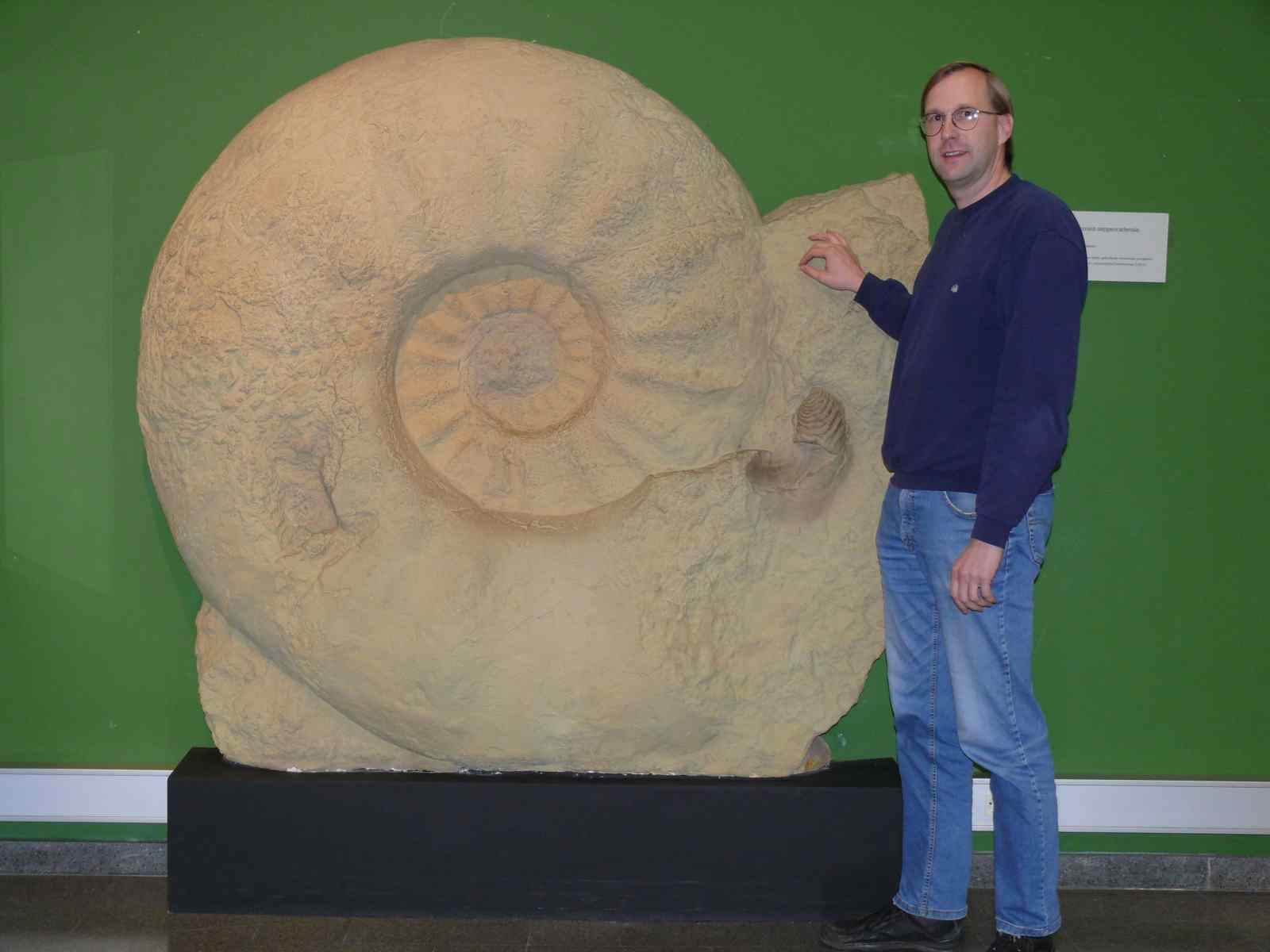
Parapuzosia seppenradensis
Scientific classification Edit this classification
Kingdom: Animalia
Phylum: Mollusca
Class: Cephalopoda
Subclass: Ammonoidea
Order: Ammonitida
Hyatt, 1889
Suborders

Ammonitida, or true ammonites, are an order of ammonoid cephalopods that lived from the Jurassic through Paleocene time periods, commonly with intricate ammonitic sutures.

Ammonitida is divided into four suborders, the Phylloceratina, Lytoceratina, Ancyloceratina, and Ammonitina.

The Phylloceratina is the ancestral stock, derived from the Ceratitida near the end of the Triassic. The Phylloceratina gave rise to the Lytoceratina near the beginning of the Jurassic which in turn gave rise to the highly specialized Ancyloceratina near the end of the Jurassic. Both the Phylloceratina and Lytoceratina gave rise to various stocks combined in the Ammonitina.

These four suborders are further divided into different stocks, comprising various families combined into superfamilies. Some like the Hildoceratoidea and Stephanoceratoidea are restricted to the Jurassic. Others like the Hoplitoidea and Acanthoceratoidea are known only from the Cretaceous. Still others like the Perisphinctoidea are found in both.

References

[edit]
Revisions and contributorsEdit on WikipediaRead on Wikipedia
from Grokipedia
Ammonitida is an order of extinct cephalopod mollusks belonging to the subclass Ammonoidea, commonly known as the "true ammonites" due to their distinctive complex ammonitic suture patterns that divide the internal chambers of their planispiral shells.[1][2] These marine invertebrates, more closely related to modern coleoids like squids and octopuses than to nautiloids, ranged in size from a few millimeters to over 2 meters in diameter and inhabited shallow ocean environments up to about 400 meters deep.[1][3] They first appeared in the Early Jurassic around 201 million years ago and thrived until their extinction at the end of the Cretaceous approximately 66 million years ago, coinciding with the Cretaceous-Paleogene mass extinction event triggered by an asteroid impact; recent research (as of 2024) confirms they maintained high diversity without long-term decline prior to this event.[2][1][4] With an estimated 10,000 to 20,000 species, Ammonitida played a key role in Mesozoic marine ecosystems as predators or scavengers, feeding on plankton, small fish, crustaceans, and bivalves using their likely eight-armed tentacles.[1][5] The shells of Ammonitida were typically coiled in a flat spiral (planispiral), though some later species developed heteromorph (irregularly coiled) forms, such as the bizarre, mirror-like coiling of Nipponites mirabilis.[1][2] These shells consisted of aragonite, often preserved as calcite fossils, and featured a siphuncle—a tube through which gas and liquid were regulated for buoyancy control—along with septa that created gas-filled chambers.[5][3] The defining ammonitic sutures were highly intricate, with deep, wavy lobes and saddles that strengthened the shell against water pressure and allowed for precise species identification in the fossil record, evolving from simpler goniatitic and ceratitic patterns in earlier ammonoid orders.[2][3] Ornamentation varied widely, including ribs, nodes, and spines, which likely aided in camouflage, defense, or locomotion as active swimmers in ancient seas.[1] Evolutionarily, Ammonitida arose from earlier ammonoids during the Triassic-Jurassic transition, representing the most diverse and advanced lineage within Ammonoidea, which originated in the Devonian over 400 million years ago.[3][2] They underwent rapid speciation, particularly during the Jurassic and Cretaceous, adapting to changing ocean conditions and serving as prey for larger marine reptiles like ichthyosaurs and mosasaurs.[1] Their extinction, shared with non-avian dinosaurs, has been attributed to the combined effects of the Chicxulub impact, volcanic activity, and subsequent environmental disruptions, though some debate persists on whether rare post-Cretaceous records indicate brief survival.[1] Unlike surviving nautiloids, Ammonitida's more active, nektonic lifestyle may have made them vulnerable to these catastrophic changes.[5] In paleontology, Ammonitida fossils are invaluable index fossils for biostratigraphy, enabling precise dating of Jurassic and Cretaceous rock layers worldwide due to their short species durations and wide geographic distribution.[3][2] Abundant in formations like the Pierre Shale in North America, they also provide insights into ancient climates through stable isotope analysis of their shells and help reconstruct Mesozoic biodiversity and evolutionary patterns.[1][5] Today, their aesthetically striking fossils remain popular in collections and continue to inform research on cephalopod evolution and mass extinctions.[3]

Taxonomy and Classification

Higher Classification

Ammonitida is classified within the kingdom Animalia, phylum Mollusca, class Cephalopoda, subclass Ammonoidea, and order Ammonitida. This hierarchical placement positions Ammonitida as a major ordinal taxon among extinct shelled cephalopods, distinct from modern groups like Nautiloidea and Coleoidea.[3] The order was formally established by Alpheus Hyatt in 1889, based on morphological characteristics of the shell and suture line. The name "Ammonitida" derives from the fossil shells' resemblance to the coiled horns of Ammon, the Egyptian god of the sun and life, a comparison noted since ancient times and formalized in modern taxonomy.[6] This etymology reflects the historical recognition of these fossils, which were often interpreted as sacred or symbolic in various cultures due to their distinctive spiral form.[1] Within the subclass Ammonoidea, Ammonitida follows the earlier orders Goniatitida, which dominated the Paleozoic from the Devonian to Permian periods with simpler suture patterns, and Ceratitida, which persisted from the late Paleozoic into the Triassic featuring intermediate suture complexity.[3] Ammonitida emerged as the predominant ammonoid group throughout the Mesozoic era, characterized by highly complex, ammonitic suture lines that distinguished it from its predecessors and facilitated its ecological success in marine environments.[3] A 2022 proposal suggests revising the higher taxonomy by establishing the superorder Ammonoida for all Devonian to Cretaceous ammonoids and restricting the order Ammonitida to Jurassic and Cretaceous forms traditionally classified as the suborder Ammonitina (elevated to order rank), with other groups treated as separate orders; this revision has been adopted in some recent studies but is not yet universally accepted as of 2025.[7]

Suborders and Superfamilies

The order Ammonitida is classified into four principal suborders: Phylloceratina, Lytoceratina, Ancyloceratina, and Ammonitina, each distinguished by variations in shell coiling, suture complexity, and stratigraphic distribution.[8] These suborders encompass a range of superfamilies that reflect evolutionary diversification from Jurassic origins to Cretaceous dominance.[8] The suborder Phylloceratina represents the ancestral lineage within Ammonitida, characterized by planispiral, involute shells with smooth surfaces and simple phylloid sutures featuring rounded saddles and narrow lobes.[9] This suborder persisted from the Lower Jurassic through the Upper Cretaceous, serving as a conservative stock from which other groups arose.[9] The primary superfamily is Phylloceratoidea, including the family Phylloceratidae, with genera such as Phylloceras exemplifying the typical evolute to involute coiling and fine growth lines.[9] The suborder Lytoceratina includes forms with evolute, often elongated or loosely coiled shells and sutures that are more complex than those of Phylloceratina but less ornate than in Ammonitina, typically showing broad saddles and subdivided lobes.[10] Ranging primarily from the Early Jurassic (Sinemurian) to the Late Cretaceous, though most diverse in the early Mesozoic, this group features some early heteromorph tendencies in uncoiled juveniles.[10] The key superfamily is Lytoceratoidea, dominated by the family Lytoceratidae, with representative genera like Lytoceras displaying high whorl expansion and prominent ribs.[11] The suborder Ancyloceratina is notable for its heteromorph ammonites, exhibiting irregular coiling patterns such as helical, crioceratid, or straight uncoiled forms, with sutures varying from ammonitic to simplified in adults. Originating in the Late Jurassic (Tithonian) and peaking in diversity during the Cretaceous, particularly the Early to Late stages, this suborder adapted to diverse marine environments. The superfamily Ancyloceratoidea includes families like Ancyloceratidae and Hamulinidae, exemplified by genera such as Ancyloceras with its hook-shaped initial whorls transitioning to straight shafts.[12] The suborder Ammonitina forms the dominant and most diverse group, featuring tightly coiled planispiral shells with highly complex, ornate ammonitic sutures characterized by deeply incised lobes and frilled saddles that increased structural integrity.[13] Spanning the entire Jurassic to the end of the Cretaceous, it underwent multiple radiations, with Jurassic forms often more evolute and Cretaceous ones more compressed.[8] The broad superfamily Ammonitoidea encompasses several subgroups, including the Jurassic Hildoceratoidea (e.g., Hildoceratidae with Hildoceras showing bifurcating ribs) and the Cretaceous Hoplitoidea (e.g., Hoplitidae with Hoplites displaying tuberculate ornamentation).[14]

Phylogenetic Position

Ammonitida represents the dominant order of ammonoids during the Mesozoic Era, phylogenetically derived from the Ceratitida, which originated in the mid-Permian and served as the ancestral group for all subsequent Mesozoic ammonoids.[15] The transition to Ammonitida occurred near the Triassic-Jurassic boundary, following the severe end-Triassic mass extinction that decimated ceratitid diversity, allowing survivor lineages to diversify in the Early Jurassic.[16] Within Ammonitida, the suborder Phylloceratina is regarded as the stem group, persisting through the extinction and giving rise to other suborders such as Lytoceratina and Ammonitina through gradual morphological evolution in shell coiling and suture complexity.[17] Cladistic analyses have generally supported the monophyly of Ammonitida, based primarily on shared derived characters in shell geometry and suture patterns, with Ammonitina emerging as a derived clade characterized by more intricate ammonitic sutures.[18] For instance, integrated coding schemes incorporating conch shape, ornamentation, and peristome features have resolved monophyletic relationships within families like Hildoceratidae, reinforcing the broader order-level phylogeny.[18] However, debates persist regarding the suborder Ancyloceratina, which encompasses heteromorph forms; while some classifications treat it as monophyletic due to shared sutural reductions (e.g., from five to four lobes), others argue for convergence driven by ecological adaptations, such as uncoiling for enhanced buoyancy or maneuverability, rather than homology.[19] These heteromorph traits appear polyphyletically across Ammonitida lineages, with independent origins in Jurassic and Cretaceous groups.[19] Recent proposals, such as Hoffmann et al. (2022), suggest restructuring the higher taxonomy by limiting Ammonitida to traditional Ammonitina and grouping all post-Devonian ammonoids under superorder Ammonoida, reflecting ongoing refinements in phylogenetic understanding.[7] Phylogenetic reconstructions of Ammonitida rely heavily on morphological data from shell traits, as soft-tissue preservation is exceptionally rare, limiting direct insights into anatomical homologies and behavioral inferences.[20] Exceptional Lagerstätten occasionally yield soft-part remains, such as brachial crowns or muscle attachments, but these are insufficient to resolve deeper evolutionary relationships without supplementation from molecular analogs in extant cephalopods.[20] Consequently, ongoing cladistic efforts emphasize stratigraphic integration to test hypotheses of ancestry and divergence within the order.[21]

Morphology

Shell Characteristics

The shells of Ammonitida, the dominant Mesozoic order of ammonoids, are characterized by a planispiral coiling pattern in most taxa, forming a tightly wound spiral that lies in a single plane, though variations range from involute forms with tightly embracing whorls and narrow umbilici to evolute forms with widely exposed earlier whorls and broad umbilici.[22] Whorl cross-sections vary widely, including compressed oxyconic or platyconic shapes with sharp venter, rounded cadiconic forms, and inflated sphæroconic profiles, often modified in adulthood by partial uncoiling or inflation.[22] Ornamentation typically consists of radial ribs that may be simple, bifurcating, or intercalating, along with nodes, tubercles, or ventral keels that enhance structural integrity and possibly hydrodynamic properties; rib density and prominence increase evolutionarily from Jurassic to Cretaceous forms.[22] Shell diameters in Ammonitida span from less than 1 cm in microconchs to over 2 m in exceptional macroconchs, with most species measuring 5–30 cm; the largest known specimen, Parapuzosia seppenradensis from the early Campanian of Europe and Mexico, reaches 1.8 m in diameter.[22][23] The internal structure features a phragmocone of gas-filled chambers divided by complex septa, connected by a thin, ventromarginal siphuncle that facilitates buoyancy control through fluid and gas exchange.[24] The body chamber, housing the soft tissues, typically occupies the final 0.5–1 whorl, often with a thickened peristome or lappets at the aperture.[22] Distinct variations occur in the suborder Ancyloceratina, where heteromorph shells deviate from planispiral coiling to include helical, hook-shaped, or partially uncoiled forms, exemplified by the Early Cretaceous Crioceratites with its open, crioconic spiral.[17] These heteromorphs contrast with the homomorph planispiral majority while sharing the chambered phragmocone and siphuncle.[17]

Suture Patterns

The suture patterns of Ammonitida, known as ammonitic sutures, are characterized by highly intricate, frilled lines formed at the junction between the septa and the inner shell wall, featuring numerous subdivided lobes and saddles that create a complex, undulating profile.[25] Unlike the simpler goniatitic sutures of Paleozoic ammonoids, which consist of straight or gently curved elements, or the ceratitic sutures of Triassic forms with serrated ventral lobes but smooth lateral ones, ammonitic sutures in Ammonitida exhibit subdivision across all elements, resulting in a densely folded, lace-like appearance that distinguishes this group taxonomically.[3] This complexity evolved gradually from ceratitic precursors in the Late Triassic, achieving a fully ammonitic form by the Early Jurassic, coinciding with the diversification of Ammonitida from ancestral Ceratitida.[26] Within Ammonitida, suture patterns vary in complexity, with two primary types recognized: the relatively simple phylloceratid sutures, seen in the suborder Phylloceratina (an ancestral group within Ammonitida), and the more elaborate ammonitid sutures typical of derived superfamilies.[27] Phylloceratid sutures feature a basic ammonitic configuration with broad, rounded lobes and saddles that are minimally subdivided, lacking extensive auxiliary elements and emphasizing a symmetrical, phylloid (leaf-like) frilling primarily along the external and lateral lobes.[25] In contrast, ammonitid sutures, prevalent in groups like the Perisphinctaceae and Hoplitaceae, incorporate additional auxiliary lobes and saddles, creating narrower, more densely packed subdivisions that enhance overall intricacy, often with asymmetric fluting that increases ontogenetically.[28] Suture elements are standardized using Wedekind's morphogenetic notation, which labels key features based on their position and developmental order: the external lobe (E) protrudes on the venter (outer shell surface), flanked by lateral saddles; the first lateral lobe (L) indents deeply on the flank; umbilical lobes (U, with subscripts like U1 and U2 denoting sequential appearance during growth) occur near the umbilicus; and the internal lobe (I) lies hidden within the camerae.[25] Saddles, the convex (aperture-facing) portions between lobes, mirror this subdivision, often with bifid or trifid tips in complex forms, forming a repeating pattern that can be visualized as a series of E-L-U-I sequences across the shell's lateral trace. This notation aids in comparative analysis, revealing how auxiliary elements (e.g., additional U's) amplify complexity in advanced ammonitid genera like Perisphinctes.[25] Several functional hypotheses explain the adaptive significance of these elaborate sutures in Ammonitida. One prominent idea, the buttressing hypothesis, posits that the increased sutural complexity provided greater mechanical strength to the phragmocone, distributing hydrostatic pressure more evenly to withstand deeper-water conditions or impacts, though recent analyses challenge its necessity for extreme depths, suggesting instead enhancements for moderate pressures during vertical migration.[29] Another hypothesis links suture frilling to buoyancy regulation, where the fractal-like geometry of the septa creates micro-retention zones via surface tension, allowing finer control over liquid-gas interfaces in the chambers to adjust neutral buoyancy without excessive energy expenditure. Additionally, the intricate patterns may have facilitated rapid septal secretion during accelerated growth phases, enabling Ammonitida to reach larger sizes quickly in competitive Mesozoic ecosystems by optimizing mantle deployment along the shell wall.[30]

Soft Parts and Inferences

The soft anatomy of Ammonitida remains largely inferred from comparisons with extant cephalopods, such as Nautilus and coleoids, and from rare exceptional preservations that reveal muscle attachments, internal organs, and appendages.[31] These inferences suggest that ammonitidans possessed a decapod (ten-armed) configuration, with arms likely equipped with hooks or cirri for grasping, large lens-equipped eyes for visual acuity in marine environments, and a radula for processing food.[32] The buccal mass, surrounding the mouth, was supported by robust jaws, while a funnel-like hyponome enabled jet propulsion for locomotion and buoyancy adjustments.[31] Rare fossil evidence provides direct glimpses into these soft structures, though such preservations are exceptional due to rapid decay in oxygenated settings.[33] Ink sacs, homologous to those in modern cephalopods for defensive ink release, have been documented in isolated ammonitidan specimens from Jurassic lagerstätten, indicating a similar chemical defense mechanism.[20] In the suborder Ammonitina, aptychi—bivalved, calcitic lower jaw covers—frequently occur as dissociated fossils or in situ, serving multifunctional roles in feeding, protection, and possibly hydrodynamic stabilization during swimming.[34] Muscle scars impressed on the inner shell surface, particularly paired dorsal retractors and ventrolateral attachments, reveal the mantle's anchorage points, allowing the soft body to retract into the shell for defense; these scars are visible in Late Jurassic species like Kachpurites and Garniericeras.[35] Sexual dimorphism is evident in many ammonitidan species through distinct shell size and ornamentation differences between macroconchs (larger forms, interpreted as females) and microconchs (smaller forms, likely males), arising after a shared juvenile ontogeny up to a critical diameter.[36] This dimorphism, observed in Jurassic genera like Polysphinctites, reflects heterochronic divergence in maturation, with microconchs often featuring specialized apertural modifications for reproductive behaviors.[37] Such patterns, while not universal across all Ammonitida, highlight adaptive sexual strategies inferred from shell morphometrics rather than direct soft-part evidence.[38]

Evolutionary History

Origins from Ceratitida

The origins of the Ammonitida trace back to the end-Triassic mass extinction event, dated to approximately 201.3 million years ago (Ma), which eradicated the vast majority of ceratitid ammonoids and cleared ecological space for the subsequent radiation of ammonitid lineages. This crisis, linked to massive volcanic activity from the Central Atlantic Magmatic Province, resulted in the near-total extinction of the order Ceratitida, with only a single ancestral stock—the primitive Phylloceratina—surviving into the Jurassic. The low post-extinction diversity is evident in the initial recovery phase, characterized by just a handful of genera, such as Psiloceras and early Phylloceras species, which represent the foundational ammonitid forms.[39] Transitional forms bridging the Ceratitida and Ammonitida appear in uppermost Triassic (Rhaetian) deposits, where late ceratitids like choristoceratids (e.g., Choristoceras marshi) exhibit evolving suture patterns with indented lateral lobes, marking a shift toward greater complexity. These features foreshadow the fully ammonitic sutures of early Jurassic ammonitids, which feature deeply incised lobes and saddles for enhanced shell reinforcement. The suborder Phylloceratina emerged prominently in the Hettangian stage of the early Jurassic, with psiloceratid ammonoids (e.g., Psiloceras planorbis and P. spelae tirolicum) as the earliest representatives, displaying evolute coiling and ribbed whorls alongside these advanced sutures. Initial diversity remained limited to a few genera, reflecting a bottleneck recovery before broader diversification.[40][41] Key fossil evidence for this transition comes from continuous stratigraphic sequences in the European Alps and Himalayas. In the Northern Calcareous Alps of Austria, the Global Stratotype Section and Point (GSSP) for the Hettangian at Kuhjoch documents the first occurrence of Psiloceras spelae tirolicum just above the Triassic-Jurassic boundary, with its lituid suture lobe indicating direct descent from Triassic phylloceratids amid the extinction horizon. Similarly, sections at Germig in southern Tibet (Himalayas) reveal a Rhaetian-to-Hettangian succession, including Psiloceras tibeticum with simply indented sutures akin to European Neophyllites, transitioning from ceratitid-like forms in the Marshi Zone to more complex patterns in the overlying Tibeticum Zone. These records illustrate the transition to more complex ammonitic suture patterns, underscoring the role of the extinction in facilitating ammonitid origins.[42][40]

Mesozoic Diversification

The Ammonitida experienced a major evolutionary radiation during the Jurassic Period, following their origins at the Triassic-Jurassic boundary, with the suborder Ammonitina showing explosive diversification particularly from the Early to Middle Jurassic. Within Ammonitina, the family Perisphinctidae emerged as a dominant group, characterized by evolute, discoidal shells with complex ribbing, and they often comprised the majority of non-phylloceratid and non-lytoceratid assemblages in Tethyan and Boreal realms.[43] This proliferation contributed to the establishment of up to 20 biogeographical provinces across seven major biochores, reflecting rapid speciation and adaptation to diverse epicontinental seas.[43] By the Toarcian stage of the Early Jurassic, the suborder Lytoceratina began incorporating heteromorph shell forms, including irregularly coiled or uncoiled variants that deviated from the typical planispiral morphology, signaling an early experimentation in body plans that foreshadowed later Cretaceous innovations.[19] Diversification continued unabated into the Cretaceous Period, reaching a zenith with over 10,000 described species across the order, the majority of which flourished in the Jurassic and Cretaceous seas.[44] A notable suborder shift occurred with the Ancyloceratina, which underwent a pronounced boom from the Albian to Cenomanian stages of the mid-Cretaceous, producing a variety of heteromorph morphologies, such as uncoiled and helically coiled forms.[45] This expansion included flourishing lineages of uncoiled and irregularly coiled forms, enhancing overall morphological disparity within Ammonitida.[45] Throughout the Mesozoic, adaptive trends in Ammonitida emphasized larger shell sizes, with some species attaining diameters exceeding 2 meters, alongside increasingly elaborate ornamentation such as tubercles, spines, and ribs that likely aided in camouflage against predators or provided structural defense against shell-crushing attacks. These features, interpreted through comparisons with modern cephalopods like Nautilus, suggest evolutionary pressures favoring enhanced survival in predator-rich environments.[46] Regional endemism was pronounced, with many taxa restricted to specific basins such as the expansive Tethys Ocean in the east and the Western Interior Seaway in North America, where localized faunas reflected barriers to dispersal and niche partitioning.[47] This endemism, evident in distinct provincial assemblages, underscores the role of paleogeographic configuration in driving Mesozoic ammonitid diversity.[47]

End-Cretaceous Extinction

Recent studies (as of 2024) indicate that ammonitid diversity was at a peak and not in decline immediately prior to the K-Pg event, suggesting the extinction was abrupt rather than inevitable.[4] The Cretaceous-Paleogene (K-Pg) boundary mass extinction event, dated to approximately 66 million years ago, resulted in the near-total extinction of Ammonitida, with virtually all genera and species disappearing from the fossil record. This event eliminated an estimated 99% of ammonitid species, marking the end of a group that had dominated marine ecosystems throughout the Mesozoic. Primary causes included the Chicxulub asteroid impact on the Yucatán Peninsula, which triggered rapid global environmental changes such as surface-water acidification and a brief "impact winter" that disrupted plankton productivity—the base of the food chain for many ammonitids. Concurrently, massive volcanism from the Deccan Traps in India contributed to prolonged atmospheric CO₂ release, ocean warming, and acidification, exacerbating habitat loss. Additionally, episodes of ocean anoxia, evidenced by expanded oxygen-minimum zones, likely suffocated shelf-dwelling ammonitids adapted to oxygenated waters.[48][49] Rare records of ammonitids in early Paleocene (Danian) strata have fueled debate over potential post-extinction survivors, often interpreted as Lazarus taxa—short-lived reappearances after apparent extinction—or artifacts of sedimentary reworking. In Denmark, at the Stevns Klint section, specimens of Baculites vertebralis and Hoploscaphites constrictus occur in the lower Danian Cerithium Limestone, associated with indigenous dinoflagellate cysts like Operculodinella operculata and showing carbon isotope values consistent with a Paleocene age. These finds, including complete internal molds without signs of abrasion, suggest brief in situ survival rather than widespread reworking from underlying Maastrichtian beds, though the population was sparse and did not persist beyond the early Danian. Similar debated occurrences in other regions, such as potential reworked material in African sections, highlight the anomaly but do not indicate a robust recovery.[50] In contrast to nautiloids, which survived the K-Pg event and persist today, ammonitids failed to endure due to vulnerabilities in their life history and ecology. Nautiloids like Eutrephoceras exhibited lower metabolic rates (10%–23% of modern cephalopod values) compared to co-occurring ammonitids (7%–55%), enabling better tolerance of food scarcity and environmental stress post-impact. Ammonitids' small egg sizes (~1 mm) and extended planktonic larval stages made them susceptible to ocean acidification and disrupted surface waters, while their specialization in diverse but often shallow, epipelagic habitats limited adaptability. Nautiloids, with larger eggs (~10 mm) and a more nektobenthic lifestyle, could retreat to deeper, stable environments, underscoring how these traits conferred survival advantages during the crisis.[48][49]

Paleobiology

Habitats and Distribution

Ammonitida primarily inhabited marine environments ranging from epipelagic (0–200 m) to upper mesopelagic zones (up to 500 m), including neritic shelves and open oceanic settings, as inferred from stable isotope analyses and shell morphology studies.[51] Ornamented forms with strong ribbing, such as those in the Perisphinctidae, predominated in shallower epipelagic neritic zones below 100 m, while smoother phylloceratids occupied deeper mesopelagic habitats.[51] These preferences reflect adaptations to water depth gradients, with isotopic data (δ¹⁸O) indicating temperature ranges from 12–26°C corresponding to 50–500 m paleodepths in Cretaceous examples. During the Jurassic, Ammonitida exhibited strong dominance in the low-latitude Tethyan realm, encompassing the Pan-Tethyan Superrealm from the Mediterran-Caucasian to Indo-Pacific subrealms, where diversity and abundance peaked in tropical to subtropical waters.[52] Latitudinal gradients were pronounced, with boreal provinces in high northern latitudes (e.g., Arctic and Boreal-Atlantic subrealms) hosting lower-diversity faunas adapted to cooler conditions, and analogous austral provinces in southern high latitudes showing similar endemism.[52] This distribution pattern arose from ecological barriers and historical factors, limiting widespread interchange between realms until later stages.[53] In the Cretaceous, Ammonitida achieved a more cosmopolitan distribution, expanding into polar regions such as the Arctic (e.g., Arcthoplites in Early Albian assemblages) and Antarctic (e.g., heteromorphs on Seymour Island in the Late CampanianMaastrichtian).[54][55] This shift correlated with warmer global climates, reducing latitudinal provincialism and allowing genera like Baculites and Scaphites to occur from equatorial Tethyan holdovers to high-latitude settings, though some families like Sphenodiscidae remained tied to nearshore environments. Overall, these patterns underscore a transition from tropically concentrated populations in the Jurassic to broader global occupancy by the end of the Mesozoic.[51]

Locomotion and Buoyancy

Ammonitida, like other ectocochleate cephalopods, achieved neutral buoyancy through a chambered phragmocone, where gas-filled camerae provided lift balanced by liquid in the body chamber and soft tissues.[56] The phragmocone consisted of numerous septate chambers connected by a siphuncle, an organic tube that facilitated the regulation of cameral liquid volume via osmotic pumping, allowing the animal to adjust buoyancy for depth changes or orientation.[57] This mechanism relied on osmotic gradients to remove or add liquid through the siphuncle, with complex ammonitic sutures enhancing liquid retention via surface tension in the chamber walls, thereby refining buoyancy control compared to simpler septa in ancestral forms.[56] Locomotion in Ammonitida primarily involved jet propulsion, where water was drawn into the mantle cavity and expelled through a contractile funnel (hyponome), propelling the animal shell-first at speeds estimated between 0.05 and 0.4 m/s for short bursts, depending on shell size and shape.[58] This pulsatile jetting was supplemented by undulations of fin-like arm structures inferred from soft-part impressions, enabling finer maneuvering and stability during active predation.[59] Energy costs for propulsion varied with drag coefficients, which were higher in inflated or evolute shells, limiting sustained speeds but allowing bursts for evasion or pursuit comparable to those in modern Nautilus and Sepia.[60] Heteromorph Ammonitida, with their uncoiled or irregularly coiled shells, offered advantages in vertical migration over typical planispiral forms, as the offset mass distribution in orthoconic or helical morphologies enhanced hydrostatic stability for upward or downward excursions with minimal energy expenditure.[61] For instance, straight uncoiled shells like those in Baculites achieved high stability indices (S_t ≈ 0.5–0.6), facilitating stable vertical postures during low-thrust movements, though limited by slow osmotic adjustments in the siphuncle.[62] In contrast, planispiral shells became prone to sinking if overgrown with extended body chambers exceeding 40% of total shell length, as the added liquid mass in the living chamber shifted the center of gravity downward, inducing negative buoyancy without compensatory cameral adjustments.[61] This vulnerability likely constrained the maximum size and active range of planispiral forms in deeper waters.[63]

Ecology and Interactions

Ammonitida, as carnivorous nekton, occupied a mid-to-upper trophic level in Mesozoic marine ecosystems, primarily preying on small fish, crustaceans such as isopods, and planktonic larvae of gastropods using their radula and powerful beak for grasping and tearing prey.[33] Evidence for this predatory lifestyle comes from fossilized stomach contents and body chamber remains, including fragments of isopods and gastropod larvae found within ammonite shells, indicating active hunting behaviors.[33] Opportunistic scavenging has also been inferred from the presence of ammonite shell fragments in coprolites and regurgitalites associated with fish and coleoid predators, suggesting that ammonites occasionally consumed carrion when live prey was scarce.[64] Ammonites faced significant predation pressure from large marine reptiles, including mosasaurs and plesiosaurs, as evidenced by bite marks on their shells that often penetrated the outer layers and left characteristic arc-shaped patterns from toothed jaws. These traces, commonly observed in Late Cretaceous species like Scaphites and Placenticeras, show both fatal and healed injuries, with some specimens displaying signs of unsuccessful attacks that the ammonite survived.[27] In response, evolutionary trends in shell morphology, such as increased ornamentation with spines and tubercles, likely served as passive defenses by enhancing shell strength and deterring predators through physical barriers or camouflage.[27] Reproduction in Ammonitida is inferred to have involved external fertilization, similar to modern cephalopods, with eggs released into the water column for spawning.[51] Hatchlings emerged as small, planktonic larvae, likely planktotrophic to support wide dispersal, given their minute initial shell sizes and the presence of yolk reserves insufficient for direct benthic settlement.[19] Sexual dimorphism, characterized by smaller microconchs (interpreted as males) and larger macroconchs (females), suggests intense intrasexual competition among males for mating access, potentially driving the evolution of distinct adult morphologies for mate attraction or rivalry.[65]

Fossil Record

Major Occurrences

The Solnhofen Limestone in southern Germany represents one of the most iconic Jurassic lagerstätten for Ammonitida fossils, dating to the Late Jurassic (Tithonian stage, approximately 150 million years ago). This finely laminated lithographic limestone formation, quarried around the towns of Solnhofen and Eichstätt in Bavaria, has yielded exceptionally preserved ammonite specimens, including rare instances of soft-tissue impressions and aptychi (jaw structures), due to its formation in calm, oxygen-poor lagoonal environments that minimized decay and predation. Notable examples include drag marks from drifting ammonite shells, such as an 8.5-meter trace attributed to Subplanites rueppellianus, highlighting post-mortem transport in shallow subtropical waters (20–60 meters deep).[66] In the Cretaceous, the black shale formations of the Western Interior Seaway in North America provide critical insights into Ammonitida distribution during peak diversification. The Pierre Shale, spanning the Late Campanian to Early Maastrichtian (approximately 72–69 million years ago), is particularly renowned for its fossil-rich concretions within dark-gray to black shales, exposed at sites like the Red Bird section in eastern Wyoming. These concretions, formed through early diagenesis, preserve ammonite shells—often of genera like Baculites and Hoploscaphites—that indicate episodes of dysoxia and anoxia, with mass occurrences (e.g., clusters of up to 15 mature shells aligned by currents) suggesting concentration by storms or density flows in deeper, low-oxygen basins.[67] High-latitude occurrences in the Antarctic Weddell Sea region further underscore the global reach of Ammonitida during the Late Cretaceous. Exposures on Seymour, Snow Hill, and James Ross Islands in the James Ross Basin (Maastrichtian, ~70–66 million years ago) have produced diverse ammonite assemblages, including endemic forms like Jacobites anderssoni and large uncoiled species such as Diplomoceras cylindraceum (up to 2 meters long), preserved in shallow-shelf volcaniclastic sediments with minimal tectonic disturbance. These sites reveal adaptation to polar conditions, including extended darkness, in a warmer greenhouse world.[68] In Europe, the Kimmeridge Clay Formation in southern England exemplifies high-diversity ammonite beds from the Late Jurassic (Kimmeridgian to Tithonian, ~157–145 million years ago). At localities like Westbury in Wiltshire, spanning the Rasenia cymodoce to lower Aulacostephanus eudoxus zones, profuse assemblages of perisphinctid and other ammonites occur bed by bed, with varying associations reflecting episodic environmental fluctuations. Mass mortality events, evidenced by dense shell concentrations, are linked to storms or transient anoxia in this epicontinental setting, preserving specimens alongside bivalves in clay-rich deposits.[69]

Biostratigraphic Importance

Ammonitida, particularly the suborder Ammonitina, serve as key index fossils in Mesozoic stratigraphy due to their rapid evolutionary turnover and widespread distribution in marine sediments, enabling precise correlation of Jurassic and Cretaceous rock sequences across continents.[70] Their short stratigraphic ranges and abundance allow for the establishment of species-level biozones that form the backbone of the international chronostratigraphic framework for these periods.[71] The standard zonation scheme relies heavily on Ammonitina genera and species, with biozones defined by the first appearance or peak abundance of characteristic taxa, such as the Hildoceras bifrons Zone marking the upper Toarcian stage of the Lower Jurassic.[72] This approach provides a global standard for correlating Jurassic-Cretaceous successions, particularly through the Tethyan and Boreal realms, where Ammonitina faunas exhibit consistent patterns despite regional variations.[73] High speciation and extinction rates within Ammonitida afford sub-stage resolution, down to biohorizons representing as little as 100,000 years in well-preserved sections.[70] However, biostratigraphic challenges arise from the distinction between cosmopolitan species, which facilitate broad correlations, and endemic taxa confined to specific paleobiogeographic provinces, requiring auxiliary markers like foraminifera for refined provincial adjustments.[74] In practical applications, Ammonitida biozonations are integral to hydrocarbon exploration, as demonstrated in the North Sea Basin where Jurassic ammonite assemblages from boreholes have refined reservoir dating and seismic correlations during oil and gas drilling operations.[75] Similarly, provincial indices derived from endemic Ammonitina distributions aid paleogeographic reconstructions, delineating tectonic boundaries and migration pathways, such as those separating Tethyan and Pacific realms during the Cretaceous.[74]

References

User Avatar
No comments yet.