


Community hub
Recent from talks
Contribute something
Nothing was collected or created yet.
Angon
View on Wikipedia

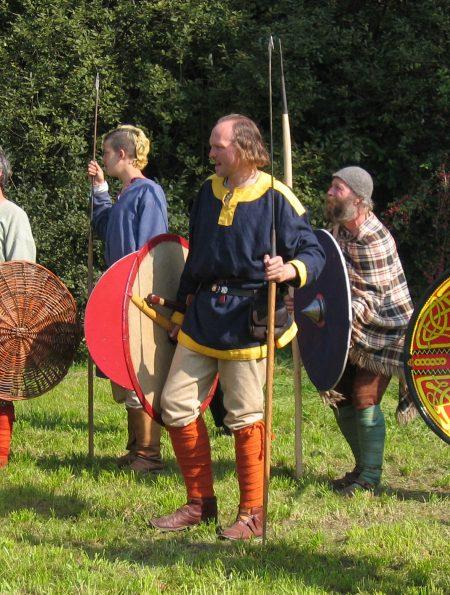
The angon (Medieval Greek ἄγγων, Old High German ango, Old English anga "hook, point, spike") is a type of javelin that was used during the Early Middle Ages by the Anglo-Saxons, Franks, Goths, and other Germanic peoples.[1] It was similar to, and probably derived from, the pilum used by the Roman army and had a barbed head and long narrow socket or shank made of iron mounted on a wooden haft.[1][2][3]
It was rare on the battlefield,[4] despite the claim by the Greek historian Agathias,[5] being found mostly in the grave goods of the wealthy.[4] The Fragmentary Chronicle of Saragossa credits an ango with killing King Amalaric of the Visigoths.[4] By the 7th century it had ceased to be used.[4] It also went out of fashion, together with other forms of throwing spears and javelins, in Francia, by the early 7th century.[6]
They are found in abundance in war graves in Illerup-Ådal, Denmark. They are also quite common in Norwegian graves from the Migration Era. In Finland, a local version of the weapon was popular during the Early Middle Ages.[7]
Although not very frequent in the Baltic countries, examples have also been found at various sites in Estonia, including burial sites at Sõrve and Hinniala.[8]
Description
[edit]Evidence for the length of insular Anglo-Saxon spears is limited, but based on grave finds it has been estimated that they ranged in length from 1.6 to 2.8 m (5 ft 3 in to 9 ft 2 in), compared to continental examples found at Nydam Mose in Denmark which range from 2.3 to 3 m (7 ft 7 in to 9 ft 10 in) long.[9] Although shorter and lighter spears with smaller heads were generally preferred for use as javelins,[10] an exception was the barbed angon, one of which was found at Abingdon with a head measuring 52.5 cm (20.7 in).[11] The barbs were designed to lodge in an opponent's shield (or body) so that it could not be removed and the long iron shank prevented the head from being cut from the shaft.[12] The angon was likely designed to disable enemy shields, thus leaving combatants vulnerable, and disrupting enemy formations.[13] The shaft may sometimes have been decorated or painted, and iron or bronze rings were sometimes fitted onto it which may have marked the center of balance and thus the best place to hold the weapon.[9]
Use
[edit]
Before the battle lines joined and warriors engaged in hand-to-hand combat, they would attempt to thin the enemy ranks with ranged weapons. This would begin with archery, followed by an exchange of javelins and throwing axes before closing.[10] The scholar Agathias recorded the use of angons by Frankish warriors at the Battle of Casilinum in 554:
Suppose a Frank throws his angon in an engagement. If the spear strikes a man anywhere the point will penetrate, and neither the wounded man nor anyone else can easily pull it out because the barbs that pierce the flesh hold it in and cause terrible pain, so that even if the enemy is not fatally hit he still dies as a result. And if it sticks in the shield, it fixes in it at once and is carried around with it, the butt dragging on the ground. The man who has been hit cannot pull out the spear because the barbs have gone in, and he cannot cut it off because of the iron that covers the shaft. When Frank sees this he quickly treads on it with his foot, stepping on the ferrule [iron finial on the butt of a spear or other pole weapon] and forcing the shield downwards so that the man's hand is loosened and his head and breast bared. Then, taking him unprotected, he kills him easily either cleaving his head with an axe or piercing his throat with another spear.[3]
The poem recording the Battle of Maldon in Essex, England, in 991 AD, describes an encounter between the earl Byrhtnoth and a group of Norsemen in which an exchange of javelins is made before the warriors draw their swords and engage in close combat.[14]
The maximum effective range of the angon and other javelins was probably 12 to 15 m (40 to 50 ft) depending on the length and weight of the weapon and the skill of the thrower.[12] It is not known to have been used in war beyond the 7th century, but during the 16th century it was used sporadically for hunting.[15]
See also
[edit]References
[edit]- ^ a b Halsall, Guy (2003). Warfare and Society in the Barbarian West, 450-900. London: Routledge. p. 164. ISBN 0-415-23939-7.
- ^ Blair, Claude; Tarassuk, Leonid, eds. (1982). The Complete Encyclopedia of Arms and Weapons. New York: Simon & Schuster. pp. 19–20. ISBN 0-671-42257-X.
- ^ a b Underwood, Richard (1999). Anglo-Saxon Weapons and Warfare. Stroud: Tempus Publishing. p. 24. ISBN 0-7524-1910-2.
- ^ a b c d Halsall, p. 165.
- ^ Histories 5.2.4–8.
- ^ Harrington, Sue. The Early Anglo-Saxon Kingdoms of Southern Britain AD 450-650: Beneath the Tribal Hidage. Oxbow Books (June 4, 2014). p. 201
- ^ Georg Haggren; Petri Halinen; Mika Lavento; Sami Raninen; Anna Wessman (2015). Muinaisuutemme jäljet. Helsinki. pp. 268–269. ISBN 978-952-495-363-4.
{{cite book}}: CS1 maint: location missing publisher (link) - ^ Tvauri, Andres (2012). The Migration Period, Pre-Viking Age, and Viking Age in Estonia. Tartu University Press. pp. 192-193. ISBN 978-9949-19-936-5.
- ^ a b Underwood (1999), p.44.
- ^ a b Underwood (1999), p. 23.
- ^ Underwood (1999), p. 24-25.
- ^ a b Underwood (1999), p. 25.
- ^ "Thegns of Mercia".
- ^ Crossley-Holland, Kevin, trans. (1999). The Anglo-Saxon World: An Anthology. The Battle of Maldon, p.14-15. Oxford World's Classics. ISBN 0-19-283547-5.
- ^ Blair and Tarassuk (1982), p.285.
External links
[edit]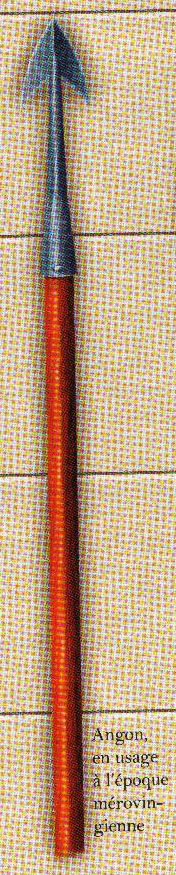
Angon
View on GrokipediaEtymology and Terminology
Origin of the Term
The term "angon" originates from the Late Greek ἄγγων (ángōn), denoting a "hook," "prong," or "barbed point," which was borrowed into Greek from a Proto-Germanic root *angô- meaning "sharp point" or "hook."[7] This etymological connection highlights the weapon's distinctive barbed design, setting it apart in nomenclature from earlier Roman throwing spears like the pilum (a heavy javelin intended to bend on impact and disable shields) and the verutum (a lighter, unbarbed javelin for skirmishing), which lacked such hooked features and thus different terminological roots in Latin.[7][8] The earliest known attestation of "angon" appears in the mid-6th century in the Histories of the Byzantine scholar Agathias (c. 532–580 AD), who describes it as a Frankish throwing weapon used during the Battle of Casilinum in 554 AD, emphasizing its barbed head that embedded deeply in targets or shields, making extraction difficult.[9] Agathias' account provides the first literary evidence of the term in a military context, portraying the angon as a specialized Germanic adaptation likely influenced by but distinct from Roman designs.[9] In Frankish and broader Germanic languages, the term evolved from this shared root, appearing as Old High German ango (meaning "prong" or "hook") by the 8th century and Old English anga (or onga), referring to a "sting," "point," or "fishing hook," often glossed as a specific type of barbed javelin in glossaries and weapon inventories. This linguistic continuity underscores the angon's nomenclature as tied to its hooked barb, differentiating it terminologically from generic spear terms like Latin hasta or Old English gār, and reflecting its role as a dedicated missile weapon in early medieval Germanic warfare.[8]Linguistic Variations
The term angon exhibited variations across early medieval languages, reflecting its adaptation among Frankish and other Germanic-speaking groups. In Frankish Latin texts, it appears primarily as angon, denoting a barbed throwing spear integral to Frankish warfare. In Old High German, the term evolved to anga or ango, signifying a "hook, point, or spike," often applied to the angon's distinctive barbed head, as seen in 8th-century glosses linking it to stinging or pricking implements.[10] This usage distinguished it from the framea, a broader Germanic term for a thrusting spear or short lance, which lacked the angon's specialized throwing barbs and iron-sheathed shaft, per descriptions in Tacitus and later Merovingian sources. Similarly, in Anglo-Saxon English, it manifested as anga or ongen, glossed as "aculeus" (sting) in 7th-8th century manuscripts like the Leiden Glossary, where an example phrase "ætren onga" refers to a poisoned point or barb in poetic riddles.[10] Regional synonyms further highlight these adaptations, particularly in eastern Germanic contexts. Among Gothic or other barbarian groups, bebra served as a parallel term for a pilum-like throwing spear, noted by Vegetius in De Re Militari (late 4th century) as a weapon carried by Germanic infantry in multiples, differentiating it from Roman pila by its lighter, barbed design suited for shield penetration. This term underscored the angon's role in distinguishing elite ranged weapons from multipurpose spears like the framea, which were more versatile for close combat. The term's influence persisted into later medieval terminology, with rare 9th-century Carolingian sources retaining angon for specialized throwing weapons of elite forces. A mosaic in Rome's San Giovanni in Laterano (c. 850) depicts Charlemagne wielding an angon-like spear while receiving the oriflamme from St. Peter, symbolizing its continued association with Frankish military prestige in Carolingian iconography.[11]Design and Construction
Physical Characteristics
The angon was typically a spear of 1.5 to 2 meters in overall length, consisting of a slender wooden shaft that tapered toward its distal end to accommodate an iron head equipped with multiple barbs or hooks intended to embed in shields or flesh upon impact.[5] This design distinguished it from smoother javelins by prioritizing retention over retrievability, with archaeological specimens from early Anglo-Saxon graves indicating a total weapon mass under 500 grams for maneuverability in combat.[5] The iron head featured a barbed configuration, with 2 rear-facing barbs along a shank approximately 40 to 50 centimeters in length, though examples up to 62 centimeters overall have been recovered, such as a fragmentary one from the British Museum collection (1939,1010.98) measuring approximately 18 cm overall from barbs to socket.[12][5] These barbs, often twin-pronged, curved backward to hinder extraction, contrasting with the unbarbed tips of contemporary javelins and drawing from late Roman pilum influences in form.[5] The head's quadrilateral or leaf-shaped profile, as classified in Swanton's A2 typology, enhanced penetration while the barbs ensured lodging.[5] For optimal throwing performance, the angon incorporated a forward balance point, with the weighted iron head—typically forged from wrought iron—counterbalanced by the tapering ash wood shaft to facilitate both projection and thrust.[5] Variations appeared in barb configurations among Anglo-Saxon artifacts from sites like Abingdon, reflecting localized adaptations in early medieval Britain.[5]Materials and Manufacturing
The shafts of angons were typically crafted from ash wood, valued for its strength, elasticity, and lightness, which allowed for effective throwing and penetration; this material was sourced from mature European timber stands and seasoned for several years to prevent warping, often dried slowly for 1-3 years.[5] Hazel was also commonly used, particularly from coppiced thickets, providing a renewable source that could be dried for 1-3 years to achieve the necessary flexibility.[5] The iron heads, forged via bloomery smelting processes that produced heterogeneous, slag-inclusive blooms, featured barbs hammered into shape and heat-treated, with some examples quench-hardened after heating to around 800°C and annealed at 650-700°C to enhance sharpness and durability.[5] Manufacturing began with blacksmiths heating iron billets in forges to approximately 1200°C, then drawing out the point and adding barbs through cold-working techniques that involved folding and hammering to refine the edges without cracking the metal.[5] Socketed heads were formed by fanning and hammering a rod into a split sleeve, which was then secured to the wooden shaft using rivets in about 39% of preserved examples or reinforced with iron rings and organic wrappings like leather for a tight fit; this attachment method is evident in 7th-century grave goods from sites such as Berinsfield, where elongated barbed heads up to 75 cm long were recovered with traces of mineralized wood.[5] Additional steps included annealing at 650-700°C for hours to soften the metal for further shaping, applied to roughly 31% of analyzed spearheads.[5] Quality variations distinguished elite angons, which incorporated pattern-welded iron—twisting and forge-welding multiple rods for both aesthetic damascene patterns and superior strength—from more rudimentary versions produced for levies using recycled Roman iron in up to 25% of cases, resulting in softer, less homogeneous heads with average hardness around 207 HV on the edges.[5] These high-end techniques, though rare (observed in only 3-5 of 72 studied examples), enhanced resistance to bending during use.[5] In contrast, mass-produced angons relied on basic forge welding with slag as flux, prioritizing affordability over longevity.[5]Historical Context
Origins and Roman Influences
The angon, a barbed javelin used by early medieval warriors, probably derived from the Roman pilum during the 3rd and 4th centuries CE, as the late Roman army transitioned to weapons with enhanced anti-shield capabilities through the addition of barbs on the head. This evolution is reflected in the Roman spiculum, introduced around 250 CE as a replacement for the pilum, which incorporated a barbed design and shorter iron shank similar to emerging Germanic forms, facilitating penetration and lodging in enemy shields to render them unusable.[13] The spiculum's features suggest an interplay of Roman and barbarian influences along the empire's frontiers, where auxiliary troops from Germanic regions contributed to military innovations.[14] During the Migration Period (c. 400–600 CE), the angon was widely adopted by Germanic tribes, including the Franks, Alamanni, and others, who served as foederati and auxiliaries in the disintegrating late Roman army, thereby integrating Roman tactical elements into their arsenals.[15] This adoption is evidenced by descriptions in contemporary sources, such as the 6th-century historian Agathias, who noted the Franks' use of the angon as a versatile throwing spear of moderate length, optimized for both ranged and close combat.[15] Archaeological evidence from burial sites in regions like the Rhine indicates the weapon's spread among these groups amid the empire's contraction.[16] A notable example of early Frankish armament appears in the grave of King Childeric I (d. ca. 481 CE) at Tournai, Belgium, where a short iron spearhead, approximately 30 cm long, was discovered alongside other arms, reflecting influences from Roman military traditions adapted for tribal warfare.[17][18] Unlike the heavier, less portable Roman pilum designed for legionary volleys, the angon prioritized lightness and ease of carry for the mobile tactics of Migration Period warriors, evolving further as the Western Roman Empire collapsed in 476 CE and Germanic kingdoms emerged.[15]Development in the Early Middle Ages
The angon reached its peak usage among the Franks during the Merovingian period (c. 600–750 CE) and persisted into the early Carolingian era (c. 750–800 CE), serving as a primary weapon for light infantry in royal and local levies.[19] Described by the Byzantine historian Agathias in the mid-6th century as a barbed dart suitable for both thrusting and throwing, it featured an iron head extending down the shaft with lateral barbs that lodged in shields or flesh, rendering it difficult to remove and often disabling opponents.[5] Under Merovingian kings, spears like the angon were produced and distributed to free warriors, reflecting a centralized military organization that equipped infantry for campaigns against neighboring tribes and the remnants of Roman forces.[19] By the 7th century, the angon spread to Anglo-Saxon England, particularly in southeastern regions like Kent and East Anglia, likely through trade, raids, and cultural exchanges with Frankish settlers and mercenaries.[5] Archaeological evidence, including approximately 20 barbed spearheads classified as angons (Swanton's Type A2), has been recovered from elite graves such as those at Sutton Hoo and Abingdon, indicating its adoption as a status symbol among warrior classes rather than widespread infantry use.[5] In these contexts, angons were often ritually annealed or broken before burial, suggesting symbolic importance tied to warrior identity and post-Roman weapon traditions.[5] During the 8th century, modifications to the angon emerged to adapt it for heavier infantry and emerging cavalry roles, influenced by tactical shifts toward mounted warfare.[20] The traditional barbed design evolved into the Carolingian wing-spear, which incorporated a crosspiece to limit penetration depth, making it more suitable for charging from horseback while retaining throwing capability for lighter troops.[20] Longer shafts were also developed for cavalry use, allowing greater reach in shock combat, as evidenced in Frankish military reforms under Charles Martel.[20] Socio-economic changes further shaped the angon's role, transitioning it from a prestige item of the comitatus (warrior retinue) to a standard-issue weapon for feudal levies by the late 8th century.[19] Capitularies issued under Charlemagne mandated local counts to provide equipment, including spears like the angon, to freemen called for service, tying its production to agrarian economies and vassalage systems that emphasized mounted elites over foot soldiers.[19] This democratization reflected broader feudal structures, where weapon supply became linked to land tenure and military obligations.[20] The angon began to decline by the 9th century as Carolingian armies prioritized heavy cavalry, rendering the light infantry javelin obsolete in favor of lances and heavier spears.[19] By around 900–1000 CE, Viking incursions and the rise of composite bows in eastern influences accelerated its replacement with versatile socketed spears across northern Europe, marking the end of its prominence in Western military arsenals.[20]Military Applications
Throwing and Ranged Use
The angon served as the primary ranged weapon in Frankish and other Germanic warfare during the Early Middle Ages, optimized for short-range throws of approximately 20-30 meters to perforate armor and disrupt formations.[21] Its design featured a long, slender iron shank with barbs at the head, which caused the weapon to embed deeply upon impact, preventing easy removal and often bending the shaft to weigh down or destroy enemy shields.[9] This made the angon particularly effective against shielded opponents, as the barbs ensured the projectile remained lodged, forcing warriors to discard their protection or suffer impaired mobility.[22] In tactical deployments, Frankish infantry integrated the angon into shield-wall volleys prior to melee charges, launching coordinated throws to soften enemy lines and create openings for close assault.[23] The Byzantine historian Agathias detailed this use during the Battle of Casilinum in 554 CE, where Frankish and Alamannic forces hurled angons at Roman troops, emphasizing precision throws by seasoned warriors over massed fire to exploit vulnerabilities in opposing ranks.[9] Agathias described the weapon's devastating effects: "Suppose a Frank throws his angon in an engagement. If it strikes a man anywhere, the point will penetrate and neither the wounded man nor anyone else can draw it out because of the barbs. But if it strikes his shield, the spear still does not fall to the ground but hangs over the man's body, and it is impossible to get it out... If it strikes the rim, the spear is caught fast and the whole shield is dragged along with the man." This approach highlighted the angon's role in psychological and physical disruption, often wielded by elite fighters to break cohesion before the shield-wall advance. The angon's advantages stemmed from its superior armor penetration compared to contemporary bows, which Franks rarely employed, favoring the javelin's reliability in dense infantry clashes and northern European conditions where bowstrings could slacken in damp weather.[9] Procopius noted the Franks' avoidance of archery in favor of such thrown weapons, underscoring a cultural preference for direct, high-impact ranged attacks integrated with foot charges.Close Combat Adaptations
Despite its primary design as a throwing weapon, the angon was retained for thrusting in close-quarters combat, where its barbed head enabled warriors to hook and pull enemy shields aside or disarm opponents. This adaptation is evidenced in descriptions of Frankish tactics, which influenced Anglo-Saxon warfare, where the angon could be gripped underarm or overarm for thrusting to leverage its barbs and disrupt shield formations.[9] In Anglo-Saxon contexts from circa 700-900 CE, such techniques aligned with elite warrior practices among thegns, emphasizing shield-wall breaches in melee engagements.[24] The angon's dual-use versatility extended to its wooden shaft, which could serve as an improvised quarterstaff if the iron head broke during combat, providing a continued defensive or striking option. Archaeological evidence from early Anglo-Saxon grave deposits supports this secondary melee role, with worn or damaged angon spearheads—showing resharpening marks and notches consistent with prolonged use—frequently interred alongside swords in high-status male burials, such as those at Sutton Hoo and Abingdon, indicating practical battlefield employment beyond ranged attacks. However, the angon proved less effective than dedicated thrusting spears like the gafeluc, a lighter, non-barbed javelin variant suited for sustained melee due to its reduced fragility after impact. The angon's barbed design, while advantageous for hooking, often bent or lodged irretrievably post-throw, limiting reusability in extended close combat. Nonetheless, it retained value for prestige in duels and hunting large game, where its penetrative shank and symbolic status among elites underscored its cultural significance.Archaeological and Cultural Evidence
Key Discoveries
One of the earliest significant archaeological contexts for spears is the grave of Childeric I, discovered in 1653 in Tournai, Belgium, dating to approximately 481 CE. The burial, associated with the Frankish king, included a spear among its panoply of arms, reflecting elite Frankish military equipment of the late 5th century.[18][17] A major discovery of confirmed angons occurred in the Sutton Hoo ship burial in Suffolk, England, excavated in 1939 and dated to around 625 CE. This high-status Anglo-Saxon grave yielded three iron angon heads alongside six spearheads, all originally fitted with wooden shafts; the angons featured barbed designs typical of Frankish influence, suggesting imports or local production for elite warriors and highlighting cultural exchanges across early medieval Europe. These finds, now in the British Museum, demonstrate the weapon's adaptation in Anglo-Saxon contexts. Additional confirmed examples have been found at sites like Wargrave and Finglesham in Kent, further evidencing angon use in southeast England during the 5th to 7th centuries.[25][6] In Scandinavia, angon variants appear in graves from the 6th to 9th centuries, indicating regional adaptations of the barbed throwing spear design. Excavations at Vendel, Sweden (6th-7th centuries CE), uncovered spearheads with similar winged or barbed features in boat burials of elite individuals, while Birka graves (8th-9th centuries CE) yielded comparable iron examples, often in warrior contexts with shields and swords. These Scandinavian finds underscore the weapon's spread and modification beyond its Frankish origins.[26][27]Representations in Art and Literature
The angon features prominently in early medieval literature as a versatile throwing spear emblematic of Germanic martial prowess. In the Old English epic Beowulf (composed c. 8th–11th century), heroes employ throwing spears in combat, such as during the Danish-Geatic exchange of volleys against an adversary, underscoring the weapon's role in heroic confrontations and close-quarters engagements.[28] Similarly, the Royal Frankish Annals (8th century), a key chronicle of Carolingian campaigns, describe Frankish forces launching spear volleys in battles. These textual references highlight the tactical deployment of spears in volleys to disrupt formations before melee. Artistic depictions from the Carolingian era further illuminate the prominence of spears, often portraying them in dynamic warfare and elite hunting scenes. The Utrecht Psalter (c. 9th century), a richly illustrated manuscript produced in the Rheims school, shows soldiers wielding spears in biblical battle illustrations.[29] Complementing this, Carolingian ivory carvings depict nobility in hunting motifs with spears, symbolizing prestige and mastery over nature; these ivories, often adorning book covers or reliquaries, emphasize the role of spears in elite pursuits rather than mere utility. Symbolically, the angon served as a marker of free warrior status within Germanic society, distinguishing elite combatants from peasant levies armed with simpler tools. Burials of high-ranking Alamannic and Frankish warriors frequently include angon heads alongside swords, indicating its association with martial success and social elevation. This prestige contrasted sharply with agrarian implements, reinforcing the weapon's embodiment of freeman identity and battlefield honor. Post-900 CE references to the angon dwindle in both texts and art, signaling its cultural obsolescence as Carolingian tactics shifted toward heavier lances and mounted warfare, with the weapon largely vanishing by the late 9th century.[30]References
- https://commons.wikimedia.org/wiki/File:Oriflamme_Charlemagne_angon.jpg