Hubbry Logo
StoryboardStoryboardMain
Open search
Storyboard
Community hub
Storyboard
logo
8 pages, 0 posts
0 subscribers
Be the first to start a discussion here.
Contribute something
Storyboard
Storyboard
from Wikipedia
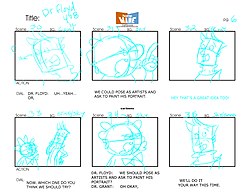
A storyboard for The Radio Adventures of Dr. Floyd episode #408

A storyboard is a graphic organizer that consists of simple illustrations or images displayed in sequence for the purpose of pre-visualizing a motion picture, animation, motion graphic or interactive media sequence. The storyboarding process, in the form it is known today, was developed at Walt Disney Productions during the early 1930s, after several years of similar processes being in use at Walt Disney and other animation studios.

Origins

[edit]

Many large budget silent films were storyboarded, but most of this material has been lost during the reduction of the studio archives during the 1970s and 1980s.[citation needed] Special effects pioneer Georges Méliès is known to have been among the first filmmakers to use storyboards and pre-production art to visualize planned effects.[1] However, storyboarding in the form widely known today was developed at the Walt Disney studio during the early 1930s.[2] In the biography of her father, The Story of Walt Disney (Henry Holt, 1956), Diane Disney Miller explains that the first complete storyboards were created for the 1933 Disney short Three Little Pigs.[3] According to John Canemaker, in Paper Dreams: The Art and Artists of Disney Storyboards (1999, Hyperion Press), the first storyboards at Disney evolved from comic book-like "story sketches" created in the 1920s to illustrate concepts for animated cartoon short subjects such as Plane Crazy and Steamboat Willie, and within a few years the idea spread to other studios.

According to Christopher Finch in The Art of Walt Disney (1995), Disney credited animator Webb Smith with creating the idea of drawing scenes on separate sheets of paper and pinning them up on a bulletin board to tell a story in sequence, thus creating the first storyboard.[4] According to Pete Docter and Don Peri in Directing at Disney (2024), Dick Huemer credited Ted Sears with first inventing the storyboard while he was working at Fleischer Studios, but that studio was uninterested.[5] Sears then switched to working for Walt Disney Productions and introduced the storyboard to Walt Disney, who promptly understood its importance.[5]

Either way, it was Walt Disney who first recognized the necessity for studios to maintain a separate "story department" with specialized storyboard artists (that is, a new occupation distinct from animators), as he had realized that audiences would not watch a film unless its story gave them a reason to care about the characters.[6][7][8] The second studio to switch from "story sketches" to storyboards was Walter Lantz Productions in early 1935;[9] by 1936 Harman-Ising and Leon Schlesinger Productions also followed suit. By 1937 or 1938, all American animation studios were using storyboards.

Gone with the Wind (1939) was one of the first live-action films to be completely storyboarded. William Cameron Menzies, the film's production designer, was hired by producer David O. Selznick to design every shot of the film.

Storyboarding became popular in live-action film production during the early 1940s and grew into a standard medium for the previsualization of films. Pace Gallery curator Annette Micheloson, writing of the exhibition Drawing into Film: Director's Drawings, considered the 1940s to 1990s to be the period in which "production design was largely characterized by the adoption of the storyboard". Storyboards are now an essential part of the creative process.

Use

[edit]

Film

[edit]
A storyboard for an animated cartoon, showing the number of drawings (~70) needed for an 8-minute film.

A film storyboard (sometimes referred to as a shooting board), is essentially a series of frames, with drawings of the sequence of events in a film, similar to a comic book of the film or some section of the film produced beforehand.[10] It helps film directors, cinematographers and television commercial advertising clients visualize the scenes and find potential problems before they occur.[11] Besides this, storyboards also help estimate the cost of the overall production and save time.[11] A storyboard can also be helpful with the first stage of the film editing process, when the film editor is trying to assemble a rough cut to show to the director.[11] Often storyboards include arrows or instructions that indicate movement.[12] For fast-paced action scenes, monochrome line art might suffice. For slower-paced dramatic films with an emphasis on lighting, color impressionist style art might be necessary.

In creating a motion picture with any degree of fidelity to a script, a storyboard provides a visual layout of events as they are to be seen through the camera lens.[10] Storyboard frames are traditionally drawn on rectangles with the same aspect ratio as the video format in which the film will be shot.[13] In the case of interactive media, it is the layout and sequence in which the user or viewer sees the content or information. In the storyboarding process, most technical details involved in crafting a film or interactive media project can be efficiently presented either in pictorial form in a storyboard frame, or as notes in the margins of specific frames.[14]

During principal photography for live-action films, scenes are rarely shot in the sequence in which they occur in the script. It is also sometimes necessary to film individual shots within a scene out of order and on different days, which can be very confusing. (The reasons for this are explained at length in the production board article.) In the latter scenario, directors can use storyboards on set to quickly refresh their memory as to the desired effect when those shots are later edited together in the correct order.[15] This is more efficient than having to reread the script for each shot (with cast and crew waiting) to refresh their memory as to how they originally visualized they would film that shot.[15]

Theatre

[edit]

A common misconception is that storyboards are not used in theatre. Directors and playwrights frequently[citation needed] use storyboards as special tools to understand the layout of the scene.[16] The great Russian theatre practitioner Stanislavski developed storyboards in his detailed production plans for his Moscow Art Theatre performances (such as of Chekhov's The Seagull in 1898). The German director and dramatist Bertolt Brecht developed detailed storyboards as part of his dramaturgical method of "fabels."[citation needed]

Animatics

[edit]

In animation and special effects work, the storyboarding stage may be followed by simplified mock-ups called "animatics" to give a better idea of how a scene will look and feel with motion and timing.[13] At its simplest, an animatic is a sequence of still images (usually taken from a storyboard) displayed in sync with rough dialogue (i.e., scratch vocals) or rough soundtrack, essentially providing a simplified overview of how various visual and auditory elements will work in conjunction to one another.[13]

This allows the animators and directors to work out any screenplay, camera positioning, shot list, and timing issues that may exist with the current storyboard. The storyboard and soundtrack are amended if necessary, and a new animatic may be created and reviewed by the production staff until the storyboard is finalized. Editing at the animatic stage can help a production avoid wasting time and resources on the animation of scenes that would otherwise be edited out of the film at a later stage. A few minutes of screen time in traditional animation usually equates to months of work for a team of traditional animators, who must painstakingly draw and paint countless frames, meaning that all that labor (and salaries already paid) will have to be written off if the finished scene simply does not work in the film's final cut. In the context of computer animation, storyboarding helps minimize the construction of unnecessary scene components and models, just as it helps live-action filmmakers evaluate what portions of sets need not be constructed because they will never come into the frame.

Often storyboards are animated with simple zooms and pans to simulate camera movement (using non-linear editing software). These animations can be combined with available animatics, sound effects, and dialog to create a presentation of how a film could be shot and cut together. Some feature film DVD special features include production animatics, which may have scratch vocals or may even feature vocals from the actual cast (usually where the scene was cut after the vocal recording phase but before the animation production phase).

Animatics are also used by advertising agencies to create inexpensive test commercials.[13] A variation, the "rip-o-matic", is made from scenes of existing movies, television programs or commercials, to simulate the look and feel of the proposed commercial. Rip, in this sense, refers to ripping-off an original work to create a new one.

Photomatic

[edit]

A photomatic[17] (probably derived from 'animatic' or photo-animation) is a series of still photographs edited together and presented on screen in a sequence. Sound effects, voice-overs, and a soundtrack are added to the piece to show how a film could be shot and cut together. Increasingly used by advertisers and advertising agencies to research the effectiveness of their proposed storyboard before committing to a 'full up' television advertisement.

The photomatic is usually a research tool, similar to an animatic, in that it represents the work to a test audience so that the commissioners of the work can gauge its effectiveness.

Originally, photographs were taken using a color negative film. A selection would be made from contact sheets and prints made. The prints would be placed on a rostrum and recorded to videotape using a standard video camera. Any moves, pans or zooms would have to be made in-camera. The captured scenes could then be edited.

Digital photography, web access to stock photography and non-linear editing programs have had a marked impact on this way of filmmaking also leading to the term 'digimatic'. Images can be shot and edited very quickly to allow important creative decisions to be made 'live'. Photo composite animations can build intricate scenes that would normally be beyond many test film budgets.

Photomatix was also the trademarked name of many of the booths found in public places which took photographs by coin operation. The Photomatic brand of the booths was manufactured by the International Mutoscope Reel Company of New York City. Earlier versions took only one photo per coin, and later versions of the booths took a series of photos. Many of the booths would produce a strip of four photos in exchange for a coin (or coins).

Comic books

[edit]

Some writers have used storyboard type drawings (albeit rather sketchy) for their scripting of comic books, often indicating staging of figures, backgrounds, and balloon placement with instructions to the artist as needed often scribbled in the margins and the dialogue or captions indicated. John Stanley and Carl Barks (when he was writing stories for the Junior Woodchuck title) are known to have used this style of scripting.[18][19]

In Japanese comics, the word "name" (ネーム, nēmu; pronounced [neːmɯ]) is used for rough manga storyboards.[20]

Business

[edit]

Storyboards used for planning advertising campaigns such as corporate video production, commercials, a proposal or other business presentations intended to convince or compel to action are known as presentation boards. Presentation boards will generally be a higher quality render than shooting boards as they need to convey expression, layout, and mood. Modern ad agencies and marketing professionals will create presentation boards either by hiring a storyboard artist to create hand-drawn illustrated frames or often use sourced photographs to create a loose narrative of the idea they are trying to sell. Storyboards can also be used to visually understand the consumer experience by mapping out the customer's journey brands can better identify potential pain points and anticipate their emerging needs.[21]

Some consulting firms teach the technique to their staff to use during the development of client presentations, frequently employing the "brown paper technique" of taping presentation slides (in sequential versions as changes are made) to a large piece of kraft paper which can be rolled up for easy transport. The initial storyboard may be as simple as slide titles on Post-It notes, which are then replaced with draft presentation slides as they are created.

Storyboards also exist in accounting in the ABC System activity-based costing (ABC) to develop a detailed process flowchart which visually shows all activities and the relationships among activities. They are used in this way to measure the cost of resources consumed, identify and eliminate non-value-added costs, determine the efficiency and effectiveness of all major activities, and identify and evaluate new activities that can improve future performance.

A "quality storyboard" is a tool to help facilitate the introduction of a quality improvement process into an organization.

"Design comics" are a type of storyboard used to include a customer or other characters into a narrative. Design comics are most often used in designing websites or illustrating product-use scenarios during design. Design comics were popularized by Kevin Cheng and Jane Jao in 2006.[22]

Architectural studios

[edit]

Occasionally, architectural studios need a storyboard artist to visualize presentations of their projects. Usually, a project needs to be seen by a panel of judges and nowadays it's possible to create virtual models of proposed new buildings, using advanced computer software to simulate lights, settings, and materials. Clearly, this type of work takes time – and so the first stage is a draft in the form of a storyboard, to define the various sequences that will subsequently be computer-animated.[23]

Novels

[edit]

Storyboards are now becoming more popular with novelists. Because most novelists write their stories by scenes rather than chapters, storyboards are useful for plotting the story in a sequence of events and rearranging the scenes accordingly.[24]

Interactive media

[edit]

More recently the term storyboard has been used in the fields of web development, software development, and instructional design to present and describe, in written, interactive events as well as audio and motion, particularly on user interfaces and electronic pages.

Software

[edit]

Storyboarding is used in software development as part of identifying the specifications for a particular set of software. During the specification phase, screens that the software will display are drawn, either on paper or using other specialized software, to illustrate the important steps of the user experience. The storyboard is then modified by the engineers and the client while they decide on their specific needs. The reason why storyboarding is useful during software engineering is that it helps the user understand exactly how the software will work, much better than an abstract description. It is also cheaper to make changes to a storyboard than an implemented piece of software.

An example is the Storyboards system for designing GUI apps for iOS and macOS.[25]

Scientific research

[edit]

Storyboards are used in linguistic fieldwork to elicit spoken language.[26] An informant is usually presented with a simplified graphical depiction of a situation or story, and asked to describe the depicted situation, or to re-tell the depicted story. The speech is recorded for linguistic analysis.

Benefits

[edit]

One advantage of using storyboards is that it allows (in film and business) the user to experiment with changes in the storyline to evoke stronger reaction or interest. Flashbacks, for instance, are often the result of sorting storyboards out of chronological order to help build suspense and interest.

Another benefit of storyboarding is that the production can plan the movie in advance. In this step, things like the type of camera shot, angle, and blocking of characters are decided.[27]

The process of visual thinking and planning allows a group of people to brainstorm together, placing their ideas on storyboards and then arranging the storyboards on the wall. This fosters more ideas and generates consensus inside the group. Modern digital storyboard tools also streamline this process by allowing teams to collaborate remotely, automatically organize panels, and even generate visuals using AI.[28]

Creation

[edit]
A storyboard template.

Storyboards for films are created in a multiple-step process. They can be created by hand drawing or digitally on a computer. The main characteristics of a storyboard are:

If drawing by hand, the first step is to create or download a storyboard template. These look much like a blank comic strip, with space for comments and dialogue. Then sketch a "thumbnail" storyboard. Some directors sketch thumbnails directly in the script margins. These storyboards get their name because they are rough sketches not bigger than a thumbnail. For some motion pictures, thumbnail storyboards are sufficient.

However, some filmmakers rely heavily on the storyboarding process. If a director or producer wishes, more detailed and elaborate storyboard images are created. These can be created by professional storyboard artists by hand on paper or digitally by using 2D storyboarding programs. Some software applications even supply a stable of storyboard-specific images making it possible to quickly create shots that express the director's intent for the story. These boards tend to contain more detailed information than thumbnail storyboards and convey more of the mood for the scene. These are then presented to the project's cinematographer who achieves the director's vision.

Finally, if needed, 3D storyboards are created (called 'technical previsualization'). The advantage of 3D storyboards is they show exactly what the film camera will see using the lenses the film camera will use. The disadvantage of 3D is the amount of time it takes to build and construct the shots. 3D storyboards can be constructed using 3D animation programs or digital puppets within 3D programs. Some programs have a collection of low-resolution 3D figures which can aid in the process. Some 3D applications allow cinematographers to create "technical" storyboards which are optically-correct shots and frames.

While technical storyboards can be helpful, optically-correct storyboards may limit the director's creativity. In classic motion pictures such as Orson Welles' Citizen Kane and Alfred Hitchcock's North by Northwest, the director created storyboards that were initially thought by cinematographers to be impossible to film.[citation needed] Such innovative and dramatic shots had "impossible" depth of field and angles where there was "no room for the camera" – at least not until creative solutions were found to achieve the ground-breaking shots that the director had envisioned.

See also

[edit]

References

[edit]
[edit]
Revisions and contributorsEdit on WikipediaRead on Wikipedia
from Grokipedia
A storyboard is a graphic tool consisting of a sequence of illustrations or images, typically accompanied by annotations such as , camera directions, and timing notes, that visually outlines the planned shots and scenes for a motion picture, , or other visual media production, functioning as a blueprint to guide filming or rendering. The technique originated in the early 1930s at Studios, where animator Webb Smith pioneered the method by drawing scenes on separate sheets of paper and pinning them to a bulletin board for easy rearrangement and group review during story development. The first film to employ a complete storyboard was Disney's 1933 animated short , marking a shift from linear script-based planning to visual iteration that improved narrative flow and gag timing. By 1938, all major U.S. studios, including and Leon Schlesinger Productions, had adopted storyboarding as a standard practice, enhancing collaboration and efficiency in the burgeoning industry. In live-action cinema, storyboarding transitioned from animation in the late 1930s, with production designer William Cameron Menzies creating one of the first fully storyboarded feature films, Gone with the Wind (1939), to coordinate complex epic sequences and set designs. Today, storyboards remain indispensable in pre-production across media, enabling directors to test compositions, identify logistical challenges early, and align creative teams on visual storytelling elements like framing, transitions, and pacing. Beyond film and animation, they are employed in advertising to sequence scenes, copy, and shots for television commercials, ensuring cohesive messaging and production readiness. In video game development, storyboards illustrate plot points, character actions, and interactive sequences, bridging narrative design with gameplay visualization. This versatility underscores storyboarding's role as a foundational practice in visual media, from traditional cinema to digital interactivity.

History and Origins

Early Development

The earliest precursors to storyboarding appeared in the late 19th century through the motion studies of French physiologist , who developed chronophotography techniques to capture sequential images of motion, such as birds in flight, revolutionizing the visualization of time and movement. The concept of storyboarding traces its roots to 19th-century theatrical and early film practices, where directors employed sequential sketches to plan scenes and effects. French filmmaker , a pioneer in , utilized production sketches to pre-visualize key sequences in his films, such as stop-motion substitutions and transformations, marking an early form of planning on paper. An early example in animation is 's use of sequential drawings for his 1914 film Gertie the Dinosaur, which helped plan character actions and interactions, bridging his background in comics with animated storytelling. The modern storyboard as a pinned sequence of drawings emerged at Studios in the late 1920s, credited to animator Webb Smith, who proposed sketching scenes on separate sheets and mounting them on a board to outline story progression. Influenced by comic strips' panel layouts and theatrical rehearsal sketches, Smith's method addressed the inefficiencies of traditional script revisions during the production of Silly Symphonies shorts starting in 1929, allowing teams to rearrange visuals for better timing and continuity. By the early 1930s, storyboarding gained formal adoption at under story department head , hired in 1931 to oversee narrative development. helped standardize the process, integrating it into collaborative sessions where artists pinned and revised sketches to refine , pacing, and gags. This approach proved pivotal in the studio's first feature-length film, and the Seven Dwarfs (1937), where extensive storyboards—contributed by and others—enabled the visualization of the fairy tale's narrative arc, from Snow White's flight to the dwarfs' mine, before committing to costly . Initially purposed as a pre-production tool to map narrative flow and , storyboarding transformed animation planning from linear scripting to dynamic, visual iteration.

Evolution in the 20th and 21st Centuries

Following , storyboarding expanded beyond animation into live-action cinema, particularly through the influence of directors like , who meticulously used the technique to pre-visualize scenes in films such as Psycho (1960). For the film's iconic shower sequence, designer created detailed storyboards that guided the editing of over 70 camera setups, ensuring rhythmic precision and minimizing on-set improvisation. This approach not only controlled costs and timelines but also exemplified storyboarding's role in achieving Hitchcock's signature suspense. Concurrently, the practice gained traction in European cinema, where filmmakers adopted Hollywood-inspired methods to enhance production efficiency amid postwar reconstruction and the rise of auteur-driven narratives, as seen in the detailed planning for films like Federico Fellini's La Dolce Vita (1960). From the 1980s to the 2000s, storyboards became integral to pre-visualization in special effects-driven productions, marking a shift toward more complex visual planning. George Lucas's Star Wars saga, beginning with A New Hope (1977), relied on concept artist Ralph McQuarrie's storyboards to conceptualize alien worlds, space battles, and character designs, which were pivotal in pitching the project to studios and coordinating Industrial Light & Magic's effects work. This era also saw the transition to digital tools, with software like early versions of facilitating editable panels and annotations, reducing the need for physical redraws and enabling iterative collaboration across teams. Key milestones included the introduction of photomatic techniques, where sequenced still photographs simulated motion to refine shot compositions before filming, and the widespread use of animatics—rough animated storyboards—in to test commercial concepts and audience reactions prior to expensive shoots. In the , storyboarding has adapted to technological advancements and global media landscapes, with AI-assisted tools emerging since the early to automate panel generation from text prompts or scripts. Platforms like Story-Boards AI, launched around 2023, allow creators to produce consistent visual sequences rapidly, integrating elements like camera angles and transitions while preserving artistic input. This innovation has accelerated adoption in diverse industries, including Bollywood, where storyboards now structure elaborate song-and-dance routines and action set pieces in films like Housefull 4 (2019), and , where directors such as continue the tradition of hand-drawing ekonte (storyboards) to dictate pacing and composition in series like (2001). These developments underscore storyboarding's enduring versatility amid digital globalization.

Definition and Fundamentals

Core Concept

A storyboard is a sequence of drawings or images that visually represents the shots or scenes of a , serving as a tool to plan the structure, timing, and transitions in visual media production. This format allows creators to outline the progression of events through illustrated panels, each capturing a specific moment in the story's flow. Unlike a written script, which primarily details , character actions, and plot in textual form, a storyboard functions as its visual counterpart, emphasizing the spatial arrangement of elements and the temporal sequence of visuals on screen. It translates the script's narrative into a graphical layout, highlighting how scenes will unfold aesthetically and dynamically rather than solely through words. The basic structure of a storyboard consists of linear or non-linear panels that depict key actions, include cues for or , and indicate camera angles to guide the viewer's perspective. These panels typically feature rough sketches accompanied by annotations for movement, framing, and pacing, forming a cohesive visual . As a prerequisite in production workflows, a storyboard acts as a blueprint that coordinates teams across visual and , ensuring alignment on the project's aesthetic and logistical execution before filming or rendering begins. This foundational role minimizes revisions during later stages by pre-visualizing the entire sequence.

Key Components and Elements

A storyboard consists of primary elements that form its foundational structure, including individual panels, captions, and transition notes. Panels, often referred to as thumbnails or detailed sketches, serve as the visual core, depicting sequential scenes or shots to outline the narrative progression. These panels can range from rough, quick sketches for initial planning to more refined illustrations that capture specific compositions and character positions. Accompanying each panel are captions that provide textual descriptions of actions, dialogue, or key events, ensuring clarity for the production team. Transition notes further enhance this by indicating how one panel flows to the next, such as through fades, cuts, dissolves, or wipes, which help visualize the editing rhythm. Visual conventions in storyboards employ established techniques to convey depth and focus, including perspective, framing, and annotations for and movement. Perspective is typically rendered in simple one- or two-point formats to suggest spatial relationships without overwhelming detail, while framing options like wide shots for establishing scenes, medium shots for interactions, or close-ups for emotional emphasis guide the viewer's attention. Annotations, often placed alongside or below panels, denote elements such as camera movements (pans, tilts, zooms), effects, or music cues, integrating auditory and dynamic aspects into the visual plan. These conventions draw from cinematic principles to pre-visualize the final output effectively. Storyboards exhibit variations to suit different needs, such as static versus dynamic formats and the inclusion of supplementary indicators. Static boards present fixed panels without implied motion, ideal for straightforward sequencing, whereas dynamic ones incorporate arrows or lines to suggest movement and timing within scenes. Some variations integrate color palettes to preview tonal atmospheres or mood indicators like notes to evoke emotional responses, particularly in or contexts. Standardization in storyboard formats facilitates consistent pacing and communication, with common layouts including 4x3 grids for horizontal flow or vertical strips to emphasize chronological progression. The 4x3 grid, resembling a page, allows for multiple panels per page to assess overall timing, while vertical strips mimic script formatting for easier script-to-board alignment. These formats promote uniformity across teams, enabling quick revisions and shared understanding of the narrative structure.

Applications Across Industries

Film, Animation, and Visual Storytelling

Storyboards play a pivotal role in by enabling directors to plan shot composition, actor blocking, and during . By sketching sequential images of scenes, they allow filmmakers to experiment with camera angles, movements, and spatial arrangements without incurring on-set costs, thereby facilitating efficient budgeting through accurate shot counts and logistical forecasting. Alfred Hitchcock exemplified this approach with his highly detailed storyboards, which served as blueprints for translating conceptual ideas into precise visual executions, as seen in films like Psycho (1960) where they outlined suspenseful camera placements and edits. In contemporary cinema, such as The Avengers (2012), storyboards were essential for coordinating large-scale action, integrating live-action elements with through collaborative sketching sessions that informed production design and scheduling. In animation, storyboards are indispensable for mapping frame-by-frame sequences, providing a visual script that guides animators in developing character actions and narrative flow. Disney's pioneering "story sessions" in the early 20th century utilized storyboards to iteratively refine animated tales, fostering collaborative revisions before full animation began. Pixar's creation of Toy Story (1995), the first fully computer-animated feature film, involved extensive hand-drawn storyboards—numbering in the thousands—to outline dialogue, movements, and scene transitions, ensuring cohesive storytelling across its innovative digital pipeline. Within visual , storyboards excel at conveying pacing and rhythms by arranging panels to mimic the temporal flow of a sequence, allowing creators to test narrative momentum and cut points visually. They also facilitate the integration of , marking precise locations for CGI or practical enhancements to maintain continuity between real and fabricated elements. Modern practices in VFX-intensive projects often link traditional storyboards to pre-visualization software, where initial sketches evolve into 3D animatics for virtual rehearsals, cost projections, and seamless effects planning, as demonstrated in high-stakes productions like The Avengers.

Theatre, Comics, and Print Media

In , storyboards serve as visual tools for planning blocking during rehearsals and visualizing set designs, allowing directors and designers to map actor movements, scene transitions, and spatial relationships before full implementation. This approach helps ensure that scenic elements align with the narrative flow, particularly in productions involving complex scene changes, by simulating the progression of action on stage. In comics, panel layouts function as proto-storyboards, providing a sequential framework that outlines the visual progression of the story through static images, , and composition. Pioneering artist exemplified this in his 1940s series The Spirit, where innovative panel arrangements—such as irregular shapes and integrated backgrounds—emphasized dramatic tension and reader engagement, influencing modern comic storytelling by treating panels as deliberate visual beats rather than uniform grids. These layouts prioritize static composition to guide the reader's eye and control pacing, distinct from motion-oriented formats. Some comic book scriptwriters use storyboard-type sketches, even if rough, for script creation, often indicating character actions, backgrounds, and dialogue balloon placements with instructions for the artist scribbled in the margins or on indicated dialogues and captions. Notable examples include John Stanley and Carl Barks, particularly when Barks was writing stories for the Junior Woodchucks title. It is also common for comic illustrators to contribute to storyboards and conceptual art for cinema and television. This technique is known as "rough" in the English-speaking industry and as "name" (ネーム, neemu) in the Japanese manga market. For novels and print media, storyboards are employed less frequently but play a key role in adapting to visual outlines during pre- planning for illustrated books and graphic novels. Authors and illustrators use them to divide text into visual segments, identify opportunities, and balance page turns for optimal reader pacing, ensuring the narrative's emotional arcs translate effectively into static . This method is particularly valuable in children's picture books, where storyboards help refine the interplay between words and images before final artwork. Overall, across these mediums, storyboards emphasize static elements like composition and sequential flow to evoke pacing through viewer interpretation, rather than temporal motion.

Business, Architecture, and Design

In business contexts, storyboards serve as visual narratives to pitch ideas, facilitating the communication of complex strategies to stakeholders and teams. They are particularly valuable in campaigns, where they outline the sequence of visuals, messaging, and calls to action, enabling agencies to refine concepts before production. For instance, historical efforts, such as the 1970s "You Get a Big Delight in Every Bite" campaign for Twinkies, relied on detailed storyboards to map out character development and scene progression, ensuring alignment across creative and client teams. Similarly, in product launches, storyboards help sequence promotional elements to build anticipation and clarity. This approach prioritizes efficient idea validation and stakeholder buy-in over elaborate artistry, reducing revisions during execution. In , storyboards provide sequential representations of building designs, evolving from site plans to interior walkthroughs, which aid in client presentations and iterative feedback. Architects use them to depict spatial progression and , such as framing views of natural elements in residential projects to convey narrative flow. Tools like sketch boards allow for rapid visualization of phases, helping professionals communicate structural and aesthetic intentions without full-scale models. This method emphasizes practical dialogue with clients and engineers, focusing on feasibility and modifications rather than final renderings, as demonstrated in educational settings where students employ storyboards to sequence architectural narratives for better comprehension of . Within broader design fields, storyboards act as foundational tools for UI/UX wireframing and prototypes, bridging conceptual sketches to tangible outcomes. In UI/UX, they precede detailed wireframes by illustrating user interactions and interface flows, allowing designers to test contextual early in the process. For , storyboards capture social, environmental, and technical influences on products, visualizing end-user scenarios to inform development and stakeholder alignment. Best practices in these areas include clear panel sequencing, contextual annotations, and iterative refinement to enhance communication, as empirical studies in human-computer interaction confirm their role in eliciting feedback without high-fidelity builds. Overall, this application underscores storyboards' utility in fostering collaborative decision-making, prioritizing functional clarity for diverse audiences in non-entertainment domains.

Interactive Media and Digital Experiences

In , storyboards serve as visual blueprints for level sequencing and branching s, allowing designers to outline progression through environments, challenges, and player decisions before full implementation. They typically consist of sequential panels depicting key events, camera angles, and interactive elements, such as transitions between levels or choice points that alter the storyline. For instance, in The Legend of Zelda: Ocarina of Time (1998), storyboards were employed to plan cut scenes, sequences, and boss battles, ensuring coherence across exploratory paths and player-driven discoveries. This approach facilitates the mapping of non-linear elements, like branching paths based on item collection or ally interactions, which enhance replayability and immersion in open-world titles. In virtual reality (VR) and augmented reality (AR) environments, storyboards adapt to spatial storytelling by visualizing user movements in three-dimensional spaces, planning paths that respond to head-tracking and gestures rather than fixed camera shots. Panels often incorporate 360-degree annotations to denote object placements, environmental triggers, and interaction hotspots, enabling designers to anticipate disorientation or engagement lapses in immersive setups. This method supports dynamic, location-based flows where users influence story progression through mobility and choices. For web and design, storyboards integrate with mapping to depict non-linear flows, illustrating how users navigate interfaces via taps, swipes, or contextual menus, often bridging high-level scenarios with detailed wireframes. They highlight emotional arcs and decision branches—such as personalized content recommendations or error recoveries—using simplified sketches that evolve into interactive prototypes. This visualization aids in identifying friction points in multi-device experiences, ensuring intuitive paths that accommodate diverse user behaviors without rigid linearity. The surge in VR/AR adoption post-2020, fueled by initiatives, has amplified the role of storyboards in planning tools like collaborative VR platforms, where teams sketch immersive worlds in real-time to address in persistent digital spaces. The AR market alone expanded from USD 10.9 billion in 2024 to a projected USD 60.3 billion by 2029, underscoring the demand for such pre-visualization techniques in user-centric designs.

Scientific Research and Specialized Uses

In and , storyboards serve as visual tools for sequencing experiments and modeling cognitive processes, particularly in studies of comprehension. Researchers have employed storyboards to represent sequential images akin to or picture stories, enabling analysis of how individuals infer meaning from visual narratives. For instance, a study examining visual comprehension across diverse populations found that storyboards facilitate the identification of universal patterns in sequential images, though cultural variations influence interpretation. Similarly, in , storyboards have been used as a qualitative method to capture learners' emotional and perspectival responses during interventions like , allowing participants to visually depict complex experiences without relying solely on verbal reports. Another application involves improving reading skills in students with disabilities; experimental groups using storyboards to outline narratives showed significant gains in comprehension and retention compared to controls. In scientific visualization, storyboards plan data-driven animations and simulations by outlining key frames that convey temporal dynamics and spatial relationships, often incorporating core elements like transitions and annotations. This approach is essential for creating coherent narratives from complex datasets, such as in time-varying visualizations where interactive storyboards allow researchers to adjust sequences for exploratory analysis. For climate modeling, storyboards aid in designing 3D geographic visualizations that simulate environmental changes, helping to structure storylines that integrate quantitative models with narrative flow for better communication of projections. Seminal work in this area emphasizes embedding models directly into visualization pipelines to ensure scientific accuracy while engaging audiences with sequential depictions of phenomena like energy budgets or scenarios. Specialized uses extend to medical procedure training, where storyboards map out instructional videos to ensure procedural clarity and logical progression. In developing online videos for health skills, clinicians use storyboards to sequence steps, camera angles, and annotations, enhancing trainee comprehension and reducing errors in simulations. In engineering prototypes, storyboards extract functional requirements by visualizing user interactions, with studies showing that 88% of engineering students successfully derived requirements from storyboard sketches, though challenges like user group identification persist. Emerging post-2020 applications in interdisciplinary research include AI ethics scenario planning, where storyboards outline potential ethical dilemmas in AI deployment, supporting visual exploration of impacts in creative and technical contexts. These uses highlight storyboards' growing role in rigorous, visual methodology across analytical fields.

Creation Process

Traditional Techniques

Traditional storyboarding relies on manual, analog methods that predate digital tools, emphasizing hands-on sketching and physical assembly to visualize sequences. These techniques emerged as a practical way to plan visual stories, allowing creators to experiment with composition, timing, and flow without committing to final production assets. Essential materials for traditional storyboarding include paper—often blank sheets or pre-printed templates—pencils for initial sketches, erasers for corrections, and markers or colored pencils for adding emphasis and details. Sketches are typically created on standard drawing paper sized to half a printer sheet for manageability, with boards like , , or cork surfaces used for assembly; tape or pins secure the panels in place for easy rearrangement. sketching forms the core of this approach, involving quick, rough drawings to capture basic compositions and camera angles before refinement. The process begins with ideation from a script or outline, where the creator breaks down the into key scenes and identifies critical moments, such as action beats or transitions. Rough sketches follow, starting with simple thumbnails to outline panel layouts, character positions, and basic staging on . These are then refined into more detailed drawings, incorporating annotations for , sound cues, camera movements, and timing notes directly on or beside the panels. The assembled boards are reviewed collaboratively, often pinned to a or board for group feedback, leading to iterations where panels are reordered, redrawn, or removed to improve clarity and coherence. These methods were formalized at Studios in the early 1930s, where they became a standard practice for planning. Best practices in traditional storyboarding stress to refine pacing, where creators adjust panel counts and transitions to control the story's rhythm—fewer, broader panels for faster sequences and more detailed ones for slower builds. Ensuring scalability involves starting with loose thumbnails that can expand into production-ready visuals without overcommitting early, while group pinning sessions facilitate revisions for overall flow and scalability to final media like frames. These practices, rooted in early models, promote flexibility and collective input to align the storyboard with production constraints.

Digital Tools and Software

Digital storyboarding tools have evolved significantly since the 1990s, enabling creators to produce visual narratives through intuitive interfaces that replace manual sketching with automated and collaborative features. Popular software includes Storyboard That, a web-based platform offering drag-and-drop functionality for assembling panels from an extensive library of thousands of customizable images, characters, and scenes, ideal for educators and filmmakers. Similarly, Boords provides a cloud-based environment for video teams, featuring template-based panel creation, automatic animatic generation from storyboards, and seamless integration with production workflows. Adobe's Firefly, an AI-powered tool within the Creative Cloud suite, allows users to generate storyboard frames from text prompts, supporting iterative refinement for film and animation projects. Advancements in artificial intelligence during the 2020s have integrated generative capabilities into these tools, automating sketch creation from textual descriptions to accelerate pre-production. For instance, Story-boards.ai, launched in the mid-2020s, uses natural language processing to produce complete storyboard sequences from script inputs, including scene transitions and character placements, significantly reducing manual design time for advertising and short-form video creators. Boords' AI generator complements this by converting outlines into visual panels with consistent styles, while tools like Storyboarder.ai extend functionality to screenplay and shot list automation. These integrations prioritize efficiency, allowing non-artists to prototype ideas rapidly without specialized drawing skills. Typical digital workflows begin with optional scanning of traditional sketches using apps like Scan for , bridging analog and digital methods before proceeding to cloud-based . Platforms such as Boords and StudioBinder facilitate real-time collaborative , where team members add annotations, rearrange panels, and track changes via systems, ensuring synchronized updates across distributed teams. Final outputs support exporting in multiple formats, including PDF for print, MP4 animatics for client reviews, and XML for integration with software like . These tools enhance production speed through features like instant feedback loops and automated versioning, minimizing revisions in fast-paced environments. For example, in pre-visualization, digital storyboards from Boords or Firefly enable immersive testing of spatial narratives, where exported animatics inform VR headset simulations to refine camera paths and interactions before filming. This approach has been particularly impactful in VFX-heavy projects, allowing directors to iterate on complex scenes iteratively without physical prototypes.

Advantages and Impact

Efficiency and Communication Benefits

Storyboarding significantly enhances production efficiency by enabling teams to identify and resolve potential issues before entering costly production phases, such as or . This pre-visualization allows for precise of shots, , and technical feasibility, thereby minimizing the need for reshoots and revisions that can escalate expenses. In and workflows, this approach streamlines the overall process, reducing production time and overruns through early detection of logistical challenges. A key quantifiable impact is evident in the historical adoption at Disney Studios, where storyboarding, pioneered in the 1930s for projects like and the Seven Dwarfs, drastically cut animation errors by providing a structured framework for sequencing complex scenes and character movements. This method allowed animators to test and refine narrative elements upfront, avoiding wasteful redraws and ensuring alignment with the director's vision, which contributed to more efficient large-scale productions. Industry reports further underscore these gains, noting that thorough storyboarding can reduce reshoots in , directly translating to budget efficiencies. Beyond operational savings, storyboarding excels in communication by employing a universal that bridges gaps among diverse team members, including directors, cinematographers, artists, and producers. These sequential sketches facilitate concise discussions on framing, transitions, and pacing, accelerating approvals from clients or stakeholders who may lack technical expertise. This clarity fosters coordinated efforts, preventing misunderstandings that could otherwise delay workflows. Additionally, storyboarding mitigates risks inherent in narrative development by allowing early testing of story flow, which helps uncover plot inconsistencies, emotional beats, or structural flaws without committing resources to full production. This proactive step safeguards against major revisions later, promoting a more predictable and controlled project timeline across film and animation endeavors.

Creative and Collaborative Advantages

Storyboarding serves as a vital tool for visual experimentation in the creative process of film and animation production. By allowing filmmakers to sketch multiple variations of scenes, including alternative camera angles, pacing, and narrative paths, it enables directors and artists to test ideas without the expense of filming or animating. This iterative approach sparks innovation, as creators can explore divergent outcomes, such as multiple endings or revised plot developments, refining the story's emotional impact before committing to final production. In collaborative settings, storyboards facilitate effective critiques among team members, whether in-person or remote, by providing a tangible visual reference that transcends verbal descriptions. At Animation Studios, the "Braintrust"—a group of experienced directors and creatives—reviews storyboards during development to offer candid feedback, fostering revisions that enhance coherence and character depth without or ego interference. This group dynamic has been instrumental in shaping films through collective input, ensuring diverse perspectives contribute to stronger . The simplicity of storyboarding lowers barriers for non-artists to participate in the creative process, as basic sketches suffice to convey ideas, allowing writers, producers, and other team members to contribute without advanced skills. This democratizes input, enabling broader team involvement in visualizing scenes and suggesting modifications, which enriches the overall creative output. In recent years, as of , the integration of AI tools has further amplified these advantages by automating initial sketches and facilitating real-time , with over 30% of filmmakers citing improved clarity as a key benefit. Over the long term, robust storyboarding practices have elevated storytelling quality in numerous award-winning productions. For instance, Pixar's extensive use of storyboards in films like (1995) and (2003), both Oscar winners, demonstrates how visual planning leads to innovative narratives that resonate globally, contributing to critical acclaim and box-office success through polished, emotionally compelling results.

References

Add your contribution
Related Hubs
Contribute something
User Avatar
No comments yet.