


Community hub
Recent from talks
Contribute something
Nothing was collected or created yet.
Anza (missile)
View on Wikipedia
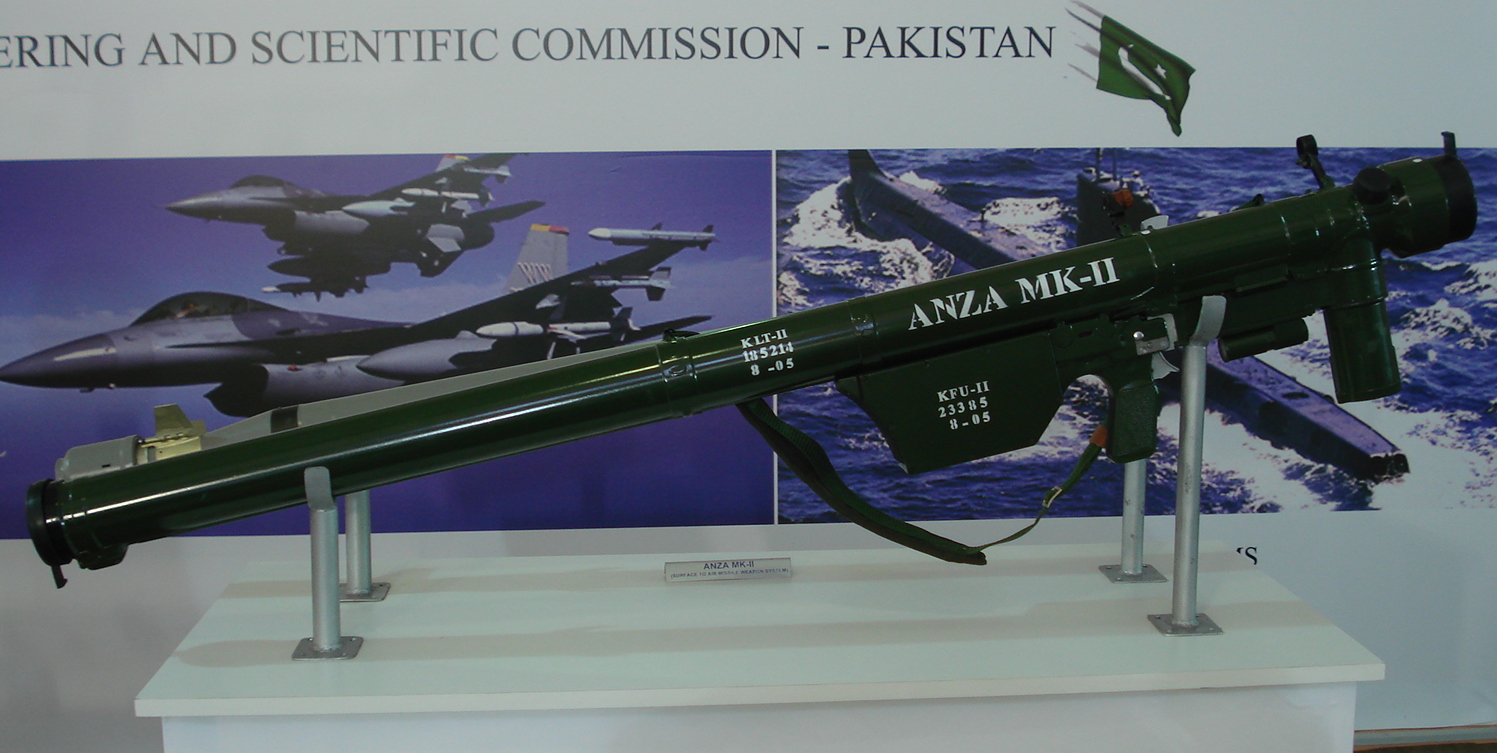
The Anza (عنزہ Anza) is a series of shoulder-fired, man-portable surface-to-air missiles produced by Pakistan. Guided by an infrared homing seeker, the Anza is used for short range air defence.[8][9]
Key Information


The Anza is produced by Khan Research Laboratories (KRL), being one of the facility's main conventional weapons projects.[10] Development was originally undertaken to eliminate dependence on importing expensive foreign systems.[11] Various versions of the Anza are currently in service with the Pakistan Army,[12] with the Mk-III version being the most recent.[13]
GIDS currently manufactures the Anza.[14]
Development
[edit]Some sources state that the Anza Mk-II was co-developed in a joint project by Pakistan and China.[15]
The Anza Mk-I entered service with the Pakistan Army in January 1990,[13][16][17] followed by the Anza Mk-II in September 1994.[17] Serial production of Anza Mk-III for the Pakistan Army was announced in 2006.
Pakistan has also advertised the Anza series for export,[18] displaying it at the International Defense Exhibition (IDEX) 2007 event in the United Arab Emirates[19] and at the IDEAS 2008 defence exhibition in Pakistan.[20][21]
Training aids
[edit]The Mk-II is known to have the ATS-II Training Simulator included, which consists of a set of four Mk-II training missiles, four firing units, simulated ground batteries, cable interconnectors, PC-based control, monitoring and scoring unit with a target simulator made up of an infrared electric bulb moving along an overhead wire.[22]
The High Speed Aerial Target Drone, or HISAT-DK, is a high speed, low maintenance target drone that can be used in training operators to use the Anza.[23] It is manned by a four-man crew using Optical Tracking Pod devices.[23] The drones can be used for MANPAD training, though they are also used for other purposes, such as artillery fire support training.[23]
Operational history
[edit]On 27 May 1999, the Anza Mk-II was used by the Pakistan Army's Air Defence Forces to shoot down an Indian MiG-21 and Mi-17 during the Kargil conflict.[16]
In December 2002, The Indian media sources claimed that their soldiers found an Anza Mk-I in a militant hideout near the Line of Control in Kupwara, Kashmir.[24] An Anza system had previously been found at a militant hideout by Indian Army soldiers in 2001.[25][26][27] In 2002, Indian media sources again claimed that an Anza MANPAD was fired at an Indian Air Force Antonov An-32 over the Line of Control; the plane was able to land safely.[28]
In 2004, Saudi Assistant Minister for Defense Prince Khaled ibn Sultan of Saudi Arabia and Defense Minister Rao Sikandar Iqbal of Pakistan had been in talks for joint production of the Anza.[29]
In November 2008, the Pakistan Army conducted exercises with the Anza Mk-II[30] in a semi-desert area near Muzaffargarh[31] in response to covert attacks on targets in north-west Pakistan by American unmanned aerial vehicles (UAV).[32] In the same month, the chief of the Pakistan Air Force told reporters that his forces are fully capable of shooting down the American drones, but it was the responsibility of the government to decide whether the drone attacks were stopped through diplomacy or military engagement.[33] In the 2010 Azm-e-Nau 3 exercises, the air defence of Pakistan Army exhibited accurate targeting of enemy's aircraft while in its attacking position, with a pinpoint precision through shoulder operated system of Anza Missiles[34]
In 2014, it was reported that the Saudi government sought to obtain Anzas in an effort to provide support for anti-Assad forces in Syria.[35]
In June 2015, Small Arms Survey reported that Anzas were used by Libya in 2011.[1]
Variants
[edit]- Anza Mk-I - The first MANPADS produced by Pakistan for use by the Pakistan Army. Development is based on the Chinese HN-5B MANPADS.[36][37] A British source said the Anza is a copy of the SA-7 Grail.[38] Approximately 1000 Anza Mk-I were produced between 1989 and 1998.[5]

- Anza Mk-II - A third generation MANPADS,[39] believed to be based on the Chinese QW-1 MANPADS.[40][41] Uses a dual-band, cross-scan infrared homing seeker to counter decoy flares.[42] Also believed to use American missile technology.[43] Approximately 2650 Anza Mk-II were produced between 1994 and 2022.[44]
- Anza Mk-III - Believed to be based on the Chinese QW-2 MANPADS,[45] modifications made to meet Pakistan Army requirements include increased range up to 5 km, improved sensors and a new firing unit similar to the Russian 9K38 Igla MANPADS.[46][47][unreliable source?] All-aspect attack capability and improved ECCM capability.[13] It also has a vehicle-mounted launcher variant.
Operators
[edit]
 Libya: Reported to be used in Libya from 2011.[1]
 Pakistan: Large numbers of Mk.I, Mk.II and Mk.III are in service with the Pakistani Army.[12]
 Malaysia: 100 Anza Mk-I systems, received in 2002.[48] 500 Anza MK.II systems delivered as part of a RM446 million arms deal with Pakistan,[49] used to arm the 10th Paratrooper Brigade.[50]
 Syria: Anza Mk.-IIs captured from rebels.[51]
 Ukraine: Anza Mk-IIs reported to be acquired by the Ukrainian military.[52]


Specifications
[edit]| Anza Mk-I [16] | Anza Mk-II [17] | Anza Mk-III[53] | |
| Length (missile and booster) | 1.44 m | 1.447 m | 1.59 m |
| Weight (launcher and missile) | 15 kg | 16.5 kg | 18 kg |
| Missile weight | 9.8 kg | 10.68 kg | 11.32 kg |
| Propulsion | Solid fuel rocket motor (solid fuel booster rocket on launch) | ||
| Guidance | Uncooled PbS passive infrared homing seeker | Cooled InSb passive infrared homing seeker | Dual-band infrared homing seeker |
| Warhead | HE fragmentation (containing 0.37 kg HE) with contact and graze fusing |
HE fragmentation (containing 0.55 kg HE) with contact and graze fusing |
HE fragmentation (containing 1.42 kg HE) with contact and graze fusing |
| Average cruise speed | 500 m/s | 600 m/s | >600 m/s |
| Max maneuvering | 6 g | 16 g | |
| Self destruction time | 14 to 17 s | 14 to 18 s | |
| Slant range | 1,200 m to 4,200 m | 500 m to 5,000 m | 6,000 m |
| Altitude | 50 m to 2300 m | 30 m to 4,000 m | 10 m to 3,500 m |
| Weapon reaction time | 5 s | 3.5 s | 3.5 s |
| Ready from the march | 10 s | 10 s | 10 s |
| Battery life | 40 s | 50 s | 50 s |
References
[edit]- ^ a b c "Missing Missiles: The Proliferation of Man-portable Air Defence Systems in North Africa (SANA Issue Brief 2)". www.smallarmssurvey.org. 15 June 2015. Retrieved 8 August 2023.
- ^ "DSA 2018: Pakistan Dips Its Toes In ASEAN". 8 May 2018. Archived from the original on 8 August 2020. Retrieved 8 August 2023.
- ^ "Kahuta - Pakistan Special Weapons Facilities". GlobalSecurity.org. Archived from the original on 14 February 2009. Retrieved 10 February 2009.
- ^ "Over-View Of Pakistani Weapon Systems". Pakistani Defence. Archived from the original on 28 October 2013. Retrieved 9 February 2009.
- ^ a b "Transfers and licensed production of major conventional weapons" (PDF). Archived (PDF) from the original on 24 February 2009. Retrieved 9 February 2009.
- ^ a b c "PAF Weapons & Missiles". Pakistani Defence. Archived from the original on 3 July 2007. Retrieved 9 February 2009.
- ^ Robin Hughes (2 December 2002). "SAM attack on jet reignites old fears". Jane's Information Group. Archived from the original on 31 August 2007. Retrieved 9 February 2009.
- ^ "MBDA Spada 2000 Air Defence System for Pakistan Air Force". Defence Talk. 11 September 2007. Archived from the original on 3 February 2009. Retrieved 9 February 2009.
- ^ B. Muralidhar Reddy (28 March 2001). "Pak. testfires missiles". The Hindu. Archived from the original on 3 November 2012. Retrieved 9 February 2009.
- ^ "IICS Anza Mk II low-altitude surface-to-air missile system (Pakistan), Land systems - Air defence - Missiles". Jane's Information Group. 21 February 2008. Archived from the original on 3 June 2012. Retrieved 20 February 2009.
- ^ Malik Qasim Mustafa. "PAKISTAN DEFENCE PRODUCTION: PROSPECTS FOR DEFENCE EXPORT". Archived from the original on 29 September 2008. Retrieved 20 February 2009.
- ^ a b "Pakistan Armée Pakistanaise forces terrestres équipements et véhicules". Army Recognition (in French). Archived from the original on 24 October 2008. Retrieved 9 February 2009.
- ^ a b c "Anza-III missile to end Indian dominance". The Fact. Retrieved 9 June 2013.
- ^ "Defense Industry of Pakistan for the first time at SOFEX defense exhibition | SOFEX 2018 Official Online Show Daily News | Defence security military exhibition 2018 daily news category". armyrecognition.com. Retrieved 8 August 2023.
- ^ "Pakistan Needs Foreign Help to Develop Missiles". The Risk Report. 1 (8): 9. October 1995. Archived from the original on 7 October 2008 – via Wisconsin Project on Nuclear Arms Control.
- ^ a b c John Pike (21 March 1999). "SA-7 GRAIL". FAS. Archived from the original on 3 February 2009. Retrieved 9 February 2009.
- ^ a b c John Pike (10 August 1999). "QW-1". FAS. Archived from the original on 28 August 2016. Retrieved 9 February 2009.
- ^ Pakistan Pushing Military Exports (May 2005). "Pakistan Pushing Military Exports". National Defense. Archived from the original on 10 June 2011. Retrieved 20 February 2009.
- ^ Xinhua. "Pakistani defense industry in "perpetual quest" for international alliances: report". People's Daily. Archived from the original on 13 June 2019. Retrieved 20 February 2009.
- ^ "Special Supplement on IDEAS 2008 - Global Industrial and Defence Solutions (GIDS)". Financial Daily International. Archived from the original on 4 March 2016. Retrieved 20 February 2009.
- ^ "Global Industrial & Defence Solutions(GIDS)" (PDF). Asian Defence Journal. Archived from the original (PDF) on 24 February 2009. Retrieved 20 February 2009.
- ^ "Training Simulator for Anza MK-II (ATS-II)". Defence Export Promotion Organisation. Archived from the original on 12 February 2012. Retrieved 7 February 2009.
- ^ a b c "High Speed Aerial Target Drone, HISAT-DK". Defence Export Promotion Organization. Archived from the original on 19 February 2012. Retrieved 20 February 2009.
- ^ "Missile found in Valley". The Telegraph. 15 January 2002. Archived from the original on 13 September 2012. Retrieved 9 February 2009.
- ^ "Jawans recover surface-to-air missile near LoC". J&K News. 14 December 2002. Archived from the original on 6 March 2016. Retrieved 9 February 2009.
- ^ Press Trust of India (15 December 2002). "Pak-made missile found at militant hideout in J-K". Express India. Archived from the original on 28 September 2012. Retrieved 20 February 2009.
- ^ "Missile found in Kashmir". BBC News. 14 December 2002. Retrieved 25 April 2010.
- ^ "WHAT'S HOT? –– ANALYSIS OF RECENT HAPPENINGS". INDIA DEFENCE CONSULTANTS. Archived from the original on 16 March 2009. Retrieved 20 February 2009.
- ^ Mohammed Rasooldeen (17 October 2004). "More Saudi Soldiers to Be Trained in Pakistan". Arab News. Archived from the original on 17 October 2004. Retrieved 9 February 2009.
- ^ "Inter Services Public Relations Pakistan". 21 March 2023. Archived from the original on 21 March 2023. Retrieved 8 August 2023.
- ^ "Pakistan army flexes muscles to shoot down drone aircraft". Khaleej Times. 21 November 2008. Archived from the original on 8 June 2011. Retrieved 9 February 2009.
- ^ "Pakistan's Army Practices Drone Shoot-Downs | WIRED". 26 September 2022. Archived from the original on 26 September 2022. Retrieved 8 August 2023.
- ^ "'Pakistan capable of shooting down US drones'". Sindh Today. 25 November 2008. Retrieved 20 February 2009. [dead link]
- ^ "Pakistan air defence demonstrates Anza-II in Azm-e-Nau 3". Archived from the original on 14 June 2011.
- ^ "Saudi Arabia in talks with Pakistan to provide anti-aircraft anti-tank weapons to Syrian rebels 2302 | February 2014 Global Defense Security news UK | Defense Security Global news Industry army 2014". www.armyrecognition.com. Retrieved 8 August 2023.
- ^ Small Arms Survey (2004). "Big Issue, Big Problem?: MANPADS". Small Arms Survey 2004: Development Denied. Oxford University Press. p. 87. Archived from the original (PDF) on 13 November 2010.
- ^ "HN-5 Man-Portable Surface-to-Air Missile". 21 December 2007. Archived from the original on 1 December 2008. Retrieved 9 February 2009.
- ^ Cloughley, Brian. "Pak armour has edge over India". Jane's Intelligence Review. Jane's Information Group. Retrieved 13 June 2011.
- ^ James C. "Chris" Whitmire. "SHOULDER LAUNCHED MISSILES (A.K.A. MANPADS): The Ominous Threat to Commercial Aviation" (PDF). USAF Counterproliferation Center. Archived from the original (PDF) on 24 February 2009. Retrieved 20 February 2009.
- ^ "QW-1 Man-Portable Surface-to-Air Missile". Sino Defence. 30 July 2007. Archived from the original on 7 October 2008. Retrieved 9 February 2009.
- ^ Small Arms Survey 2004, p. 81.
- ^ Michael Puttré (1 April 2001). "Facing the Shoulder-Fired Threat". eDefenseonline.com & Horizon House Publications. Archived from the original on 11 January 2009. Retrieved 10 February 2009.
- ^ "Trends in Small Arms and Light Weapons Development: Non-Proliferation and Arms Control Dimensions". Department of Foreign Affairs and International Trade. 21 August 2008. Archived from the original on 21 March 2023. Retrieved 20 February 2009.
- ^ SIPRI Arms Transfers Database. "Transfers and licensed production of major conventional weapons". Archived from the original on 14 April 2010. Retrieved 12 May 2010.
- ^ "QW-2 Man-Portable Surface-to-Air Missile". Sino Defence. 30 July 2007. Archived from the original on 17 December 2008. Retrieved 9 February 2009.
- ^ "Pakistan builds on Chinese missile system". Punjab Kesari. Archived from the original on 15 July 2011. Retrieved 9 February 2009.
- ^ "China Hustles Stinger Tech to Pakistan". strategypage.com. 31 May 2006. Retrieved 9 June 2013.
- ^ Small Arms Survey 2004, p. 87.
- ^ MAH (2 April 2007). "MENGENAL AD MALAYSIA". Archived from the original on 14 July 2011. Retrieved 9 February 2009.
- ^ "Anza Mk II anti-aircraft missile for elite Rapid Deployment Force". Worldsources Online. 15 October 2003. Retrieved 9 February 2009.
- ^ "A New MANPADS Variant Appears in Syria". Bellingcat. 18 March 2016. Retrieved 18 October 2023.
- ^ "Pakistan to Supply Anza Mark-II MANPADS to Ukraine". Retrieved 8 August 2023.
- ^ "Anza Mk-I Mk-II Mk-III man-portable air defense missile system technical data sheet specifications | Pakistan Pakistani army missile systems vehicles U | Pakistan Pakistani army military equipment vehicle". www.armyrecognition.com. 8 May 2018. Retrieved 8 August 2023.
External links
[edit]- Anza MKI - Pakistan Archived 2009-02-03 at the Wayback Machine

| Surface-to-Surface (SSM) |
| ||||||||||||||||||||||||||
|---|---|---|---|---|---|---|---|---|---|---|---|---|---|---|---|---|---|---|---|---|---|---|---|---|---|---|---|
| Air-to-Surface (ASM) |
| ||||||||||||||||||||||||||
| Surface-to-Air (SAM) |
| ||||||||||||||||||||||||||
| Air-to-Air (AAM) |
| ||||||||||||||||||||||||||
| Transporters |
| ||||||||||||||||||||||||||
** = Includes all ship-to-ship, ship-to-sub, sub-to-ship and sub-to-sub torpedoes
See also: | |||||||||||||||||||||||||||
Anza (missile)
View on GrokipediaDevelopment
Origins and Technological Foundations
The Anza series originated in the early 1980s, when Pakistan initiated efforts to develop indigenous man-portable air-defense systems (MANPADS) to address vulnerabilities in its ground-based air defenses against low-altitude threats. This push was motivated by persistent regional security challenges, including the aerial capabilities of the Indian Air Force demonstrated in prior conflicts and the influx of Soviet-supplied MANPADS into the region via the Afghan mujahideen during the Soviet-Afghan War, which highlighted both opportunities and risks of proliferation.[5][6] Pakistan's emphasis on self-reliance stemmed from geopolitical constraints on arms imports, such as U.S. sanctions and the need to sustain defense production amid ongoing Indo-Pakistani rivalry.[7] Technologically, the Anza drew its core foundations from Chinese-supplied systems, with Pakistan reverse-engineering the HN-5 MANPADS—a Chinese variant of the Soviet 9K32 Strela-2 (NATO: SA-7 Grail)—to establish local production capabilities.[8][9] The HN-5 featured a passive infrared (IR) homing seeker designed for engaging heat-emitting targets like jet engines, providing a baseline for Pakistan's adaptations focused on enhancing seeker sensitivity and missile propulsion for better engagement of evasive, low-flying aircraft and helicopters.[10] This reverse-engineering process, supported by Chinese technical assistance, enabled the integration of uncaged gyro-stabilized seekers and solid-fuel rocket motors, prioritizing simplicity, portability, and effectiveness in infantry-operated roles.[11] Subsequent foundational advancements in the series incorporated elements from China's QW-series MANPADS, introducing all-aspect IR seekers with improved resistance to countermeasures, reflecting Pakistan's iterative engineering to counter evolving aerial threats while building on first-generation passive homing principles.[12] These efforts underscored a causal focus on adapting proven foreign designs to local manufacturing realities, such as at facilities involved in Pakistan's defense industrialization, without relying on complex active radar guidance that would demand greater infrastructure.[8]Production and Indigenization Efforts
Production of the Anza Mk-I commenced in 1989 at Pakistan's Kahuta Research Laboratories (KRL), with manufacturing scaling to deliver systems to the armed forces by 1990.[2][1] Approximately 1,000 Mk-I units, including launchers and missiles, were produced by 1998, marking initial efforts to establish domestic capacity for man-portable air-defense systems.[13] The Anza Mk-II variant entered production in October 1994, following its induction into service that September, with output focused on enhancing infrared homing capabilities for improved seeker performance over earlier models.[14] Post-2000, production escalated across Mk-II and Mk-III variants, incorporating advancements such as digital electronics and laser proximity fuzes in the latter to boost reliability against low-flying targets.[3] These efforts contributed to total Anza series output exceeding 1,000 units, reflecting broader indigenization drives at KRL to minimize reliance on imported components like guidance seekers.[1] Indigenization progressed through integration of locally developed infrared seekers and fuze systems, validated via field trials that confirmed operational efficacy in arid, high-temperature conditions typical of Pakistan's terrain.[5] Quality control challenges were addressed via standardized testing protocols at domestic facilities, enabling sustained scaling without external dependencies beyond initial technology transfers.[7]Training and Support Systems
The Anza missile system incorporates the ATS-II training simulator to facilitate operator proficiency in infrared seeker lock-on and launch sequences without consuming live ordnance. This simulator package includes four inert Mk-II training missiles, four mock firing units, simulated ground support equipment with cable interconnectors, and a PC-based instructor console for real-time monitoring, scenario control, and post-exercise debriefing. Developed alongside the Mk-II variant by Pakistan's Global Industrial & Defence Solutions (GIDS), the ATS-II supports tactical drills emphasizing target acquisition under varied conditions, enhancing readiness for infantry units while minimizing logistical costs associated with missile expenditure. For live-fire validation, the High Speed Aerial Target Drone (HISAT-DK) serves as a low-maintenance aerial surrogate, replicating low-altitude threats to test operator response and system integration in field exercises. Produced domestically, the HISAT-DK enables repeated engagements with minimal downtime, allowing Pakistani forces to refine engagement protocols against maneuvering targets at speeds up to several hundred kilometers per hour. Maintenance protocols for Anza systems prioritize field-level simplicity, with modular components designed for rapid disassembly and battery replacement by minimally trained personnel, reducing dependency on specialized depots. The shoulder-fired configuration incorporates sealed seeker heads resistant to environmental degradation, supporting sustained operations in arid or dusty terrains typical of Pakistan's operational theaters, where quick checks for seeker alignment and gripstock functionality can be performed without advanced tools. Logistics chains emphasize portable resupply kits for batteries and cooling units, tailored to man-portable infantry mobility rather than fixed-site infrastructure.[1]Variants
Anza Mk-I
The Anza Mk-I represented Pakistan's initial foray into licensed production of man-portable air-defense systems (MANPADS), entering service circa 1990 as a direct adaptation of the Chinese HN-5B missile, itself a derivative of the Soviet 9K32 Strela-2 (SA-7 Grail).[15][10] This variant prioritized equipping Pakistan Army units for short-range air defense against low-flying aircraft, particularly helicopters operating at altitudes below 2,300 meters and speeds under 300 m/s.[16] Equipped with a single-band passive infrared seeker utilizing an uncooled lead sulfide (PbS) detector and spin-scan tracking, the Anza Mk-I was restricted to rear-aspect (tail-chase) engagements, rendering it ineffective against frontal or side approaches.[12] The seeker's sensitivity to solar glare and high background thermal noise, combined with no provision for flare rejection or electronic counter-countermeasures (ECCM), made it highly vulnerable to basic pyrotechnic decoys.[12] Propulsion via a solid-fuel rocket motor enabled a maximum flight speed of 600 m/s, with an effective engagement range of up to 4 km (minimum 800 m) and a service ceiling of 2,000–2,300 m.[2][16] The missile carried a 550-gram high-explosive anti-tank (HEAT) warhead with impact fusing, optimized for penetrating lightly armored rotary-wing targets but limited against faster fixed-wing aircraft due to the system's kinematic constraints.[2] Total missile weight approximated 9.8–10 kg, with the sealed launch tube and gripstock assembly adding to a ready-to-fire weight of about 15 kg, facilitating infantry portability.[9] These attributes positioned the Anza Mk-I as a cost-effective baseline for indigenous manufacturing at facilities like Pakistan Ordnance Factories, though its first-generation limitations in seeker technology and maneuverability underscored the need for upgrades in later models.[15]Anza Mk-II
The Anza Mk-II represents a mid-generation upgrade to Pakistan's man-portable air-defense system lineup, developed during the mid-1990s to enhance engagement reliability against low-flying aircraft.[17] This variant extended the effective range to 5 kilometers from the Mk-I's 4.2 kilometers, allowing operators to intercept targets at greater distances while maintaining a lightweight configuration suitable for infantry deployment.[2][4] Central to its improvements is the adoption of a cooled passive infrared seeker, which provides superior performance over the uncooled seeker in the Mk-I by better distinguishing heat signatures amid background noise and enabling effective head-on shots against faster targets such as helicopters and jets maneuvering at speeds up to 600 m/s.[18][2] The seeker incorporates resistance to passive infrared countermeasures, reducing susceptibility to basic decoy flares through enhanced signal processing derived from early Chinese QW-series influences.[18] A separable propulsion system—discarding the boost motor post-launch—further optimizes flight stability and reduces overall system weight to 16.5 kg including the gripstock, facilitating one-man portability and rapid deployment in forward areas.[2] Production of the Anza Mk-II, handled by Pakistan's Institute of Industrial Control Systems in Rawalpindi, ramped up through the 2000s, establishing it as a core asset for border patrol units tasked with defending against aerial incursions along volatile frontiers.[4] Approximately 2,650 units were manufactured between 1994 and 2022, reflecting sustained emphasis on indigenized short-range air defense capabilities. The system's design prioritizes reliability in operational environments, with a reduced reaction time of 3.5 seconds and an expanded engagement envelope up to 4,000 meters in altitude.[2]Anza Mk-III
The Anza Mk-III is the third-generation variant of the Anza man-portable air-defense system, featuring upgrades tailored to counter modern low-altitude threats such as helicopters and unmanned aerial vehicles equipped with infrared countermeasures. Serial production commenced in the early 2000s, with induction into Pakistani service around 2006.[12] It employs an advanced infrared homing seeker with enhanced resistance to decoy flares, enabling reliable target acquisition in contested environments.[13] The missile achieves a maximum range of 6 km and operates effectively from altitudes of 10 m to 3,500 m, surpassing the capabilities of prior Anza models.[19] Propulsion enhancements deliver speeds exceeding 600 m/s, supporting rapid intercept of agile targets.[3] The system includes improved detection and firing mechanisms, with a warhead weighing approximately 1.42 kg for effective neutralization.[3] Field evaluations have demonstrated its efficacy against decoy-intensive scenarios, attributing higher single-shot kill probabilities to the seeker's cross-scan and dual-band infrared processing, which filters out false targets more effectively than second-generation systems.[13] Overall missile length measures 1.59 m, with a total launcher and missile weight of 18 kg, balancing portability and performance for infantry deployment.[20]Operational History
Deployment by Pakistani Forces
The Anza series of man-portable air-defense systems (MANPADS) is doctrinally employed by the Pakistan Army's Air Defence Corps to provide short-range, low-altitude air denial capabilities, primarily against fixed-wing aircraft, helicopters, and unmanned aerial vehicles operating below 5,000 meters.[21] These systems are assigned to air defense regiments within brigades and divisions, enabling protection of ground maneuver elements such as infantry and artillery units during forward operations.[22] The man-portable design facilitates rapid deployment by individual soldiers or small teams, emphasizing mobility and responsiveness in contested airspace along vulnerable frontiers.[2] Integration of Anza into the Army's Comprehensive Layered Integrated Air Defence (CLIAD) framework enhances networked operations, where MANPADS complement higher-tier systems like low- to medium-altitude surface-to-air missiles for brigade-level coverage.[21] Forward observers and tactical radars feed targeting data to operators, allowing quick acquisition and fire in dynamic environments, though primary reliance remains on the missile's infrared homing seeker for autonomous terminal guidance.[21] This doctrinal approach prioritizes denying enemy air assets close air support and reconnaissance, supporting ground force maneuvers without full dependence on fixed air force assets.[21] Post-2000, production and distribution efforts scaled Anza inventories to equip multiple air defense brigades, reflecting a shift toward indigenous sustainment and broader unit availability for low-level threats.[6] Maintenance protocols, handled domestically by organizations like Global Industrial Defence Solutions (GIDS), ensure operational readiness, with systems like the Mk-II and Mk-III featuring improved seekers resistant to countermeasures such as flares.[3] This expansion aligns with the CLIAD initiative's decade-long maturation, fortifying layered defenses across corps and formation levels.[23]Combat Effectiveness and Tested Incidents
The Anza missile system has demonstrated reliable performance in Pakistani military tests, particularly against low-altitude, slow-moving targets such as helicopters and unmanned aerial vehicles, with effective engagement ranges up to 5 km and altitudes reaching 4 km.[24] Its infrared seeker enables rapid lock-on times of approximately 0.8 seconds, allowing for quick reaction against hovering threats, though effectiveness diminishes against high-speed fixed-wing aircraft exceeding Mach 0.8 due to limited all-aspect engagement capability and vulnerability to infrared countermeasures like flares.[24] In controlled firing trials conducted by Pakistan's defense establishments, the Mk-II variant has shown improved tracking stability over predecessors like the SA-7, attributed to its dual-band cross-scan seeker, which enhances resistance to decoys in varied environmental conditions, including high ambient temperatures common in South Asian theaters.[1] The most notable combat incidents involving the Anza occurred during the 1999 Kargil conflict between Pakistan and India. On May 27, 1999, Pakistani Army Air Defence Corps units reportedly employed Anza Mk-II missiles to down an Indian MiG-21 fighter at around 1,500 meters altitude and damage or contribute to the loss of a MiG-27 strike aircraft conducting search operations nearby.[25] These engagements highlighted the system's strengths in short-range intercepts of low-flying intruders, with the missile's 600 m/s velocity and 16 g maneuverability enabling successful hits despite rugged terrain and close-quarters combat dynamics. Pakistani accounts credit the Anza's proportional navigation guidance for overcoming initial seeker acquisition challenges posed by the targets' evasive maneuvers.[26] However, the incidents also underscored limitations, as the rear-aspect biased seeker struggled against frontal approaches, and overall hit probabilities in dynamic combat environments likely fell below test conditions due to factors like pilot flares and electronic warfare interference—issues common to infrared-homing MANPADS without advanced imaging seekers.[27] Comparative assessments indicate the Anza Mk-II outperforms early-generation systems like the Soviet SA-7 in local operational climates, owing to enhanced seeker cooling and flare rejection, but it lags behind Western counterparts such as the FIM-92 Stinger in omnidirectional acquisition and electronic counter-countermeasure resilience.[24] No further verified combat successes by Pakistani forces have been publicly documented, with post-Kargil evaluations emphasizing the need for upgrades to address altitude ceilings below 4 km, which constrain utility against medium-altitude jets.[5] These factors contribute to a tactical niche for the Anza in denying low-level airspace to rotary-wing and drone threats, rather than comprehensive air superiority roles.International Exports and Use
Pakistan has exported the Anza Mk-I and Mk-II variants to Malaysia, marking the system's primary confirmed international transfer to a state actor. In 2002, Malaysia acquired 100 Anza Mk-I units, followed by 500 Anza Mk-II systems in a deal valued at approximately RM446 million, enhancing the Royal Malaysian Army's short-range air defense capabilities against low-flying threats.[1][3] These acquisitions supported Malaysia's modernization efforts amid regional security concerns, with user feedback indicating reliable performance in training scenarios, though no public combat employment data exists.[28] In a notable geopolitical development, Pakistan prepared to supply Anza Mk-II systems to Ukraine in 2023, reportedly channeled through Poland to bolster Kyiv's defenses during the ongoing Russo-Ukrainian conflict. These man-portable air-defense systems were intended for countering low-altitude aerial threats, including drones, amid Ukraine's urgent need for portable missile stocks.[29][4] By April 2025, Poland expressed continued interest in procuring Anza Mk-III variants specifically to forward to Ukraine, reflecting Warsaw's role as a transit hub for non-Western arms amid NATO restrictions on certain transfers.[30] This move aligns with Pakistan's strategy to expand defense exports for economic revenue—evident in deals like Malaysia's—and to navigate shifting alliances, despite Islamabad's traditionally neutral or pro-Russian leanings in the conflict.[31] Exports remain constrained, with no verified widespread sales to additional state operators beyond these cases, consistent with arms control monitoring that highlights Pakistan's selective transfer policies to avoid MTCR violations.[1] Such limited dissemination underscores the Anza's niche role in bolstering allied air defenses without fueling broad proliferation, though performance validation from export users has encouraged further marketing efforts by Pakistan's defense industry.[2]Proliferation and Security Concerns
Diversion to Non-State Actors
In December 2002, Indian security forces recovered a Pakistani-made surface-to-air missile, identified as an Anza Mk-II, from a suspected militant hideout in Kashmir, marking the first reported seizure of such a weapon in the region.[32] [33] Pakistani officials denied any state-sanctioned diversion, attributing the incident to potential black-market smuggling amid porous Indo-Pakistani borders rather than systemic export control failures.[32] Similar recoveries have fueled concerns over insider leaks or illicit transfers, with reports indicating that non-state actors like the Taliban in Afghanistan and Pakistan have obtained Anza systems, possibly through theft or corruption within supply chains.[34] However, verified instances remain rare relative to Pakistan's production of thousands of Anza units since the 1980s, and no documented cases exist of these missiles being used by terrorists to successfully down aircraft.[35] Critics, including Indian and Western analysts, argue for enhanced end-user tracking to mitigate risks from such diversions, citing vulnerabilities like inadequate serialization and regional instability.[36] In contrast, Pakistani authorities maintain rigorous inventory controls and export restrictions under Wassenaar Arrangement guidelines, emphasizing that isolated recoveries do not indicate widespread proliferation to militants.[36] Global assessments of MANPADS threats confirm minimal attribution of terrorist incidents to Anza compared to Soviet-era systems like the SA-7.[35]Broader Proliferation Risks and Global Implications
The portability of man-portable air-defense systems (MANPADS) like the Anza inherently facilitates risks of theft and diversion to non-state actors, enabling potential threats to low-altitude civilian aviation during vulnerable takeoff and landing phases. Historical data indicate over 50 MANPADS attacks on civilian aircraft since 1975, resulting in more than 40 incidents, over half leading to crashes and exceeding 1,000 civilian fatalities, underscoring the lethal potential when misused despite their primary defensive purpose against military helicopters and fixed-wing assets.[37][38][39] Anza's infrared homing guidance, while effective for short-range intercepts, employs a relatively straightforward seeker technology that lowers the technical barriers for illicit operators compared to more advanced systems, thereby elevating its appeal in black-market proliferation scenarios.[40] Pakistan's indigenous Anza program emerged as a strategic counter to regional asymmetric aerial threats, particularly from Soviet-era incursions and ongoing border conflicts, yet its production and limited exports have drawn criticism for potentially lax enforcement of end-use monitoring outside multilateral frameworks. As a non-member of the Wassenaar Arrangement, Pakistan maintains national export controls on MANPADS but lacks the binding transparency and harmonized standards of participating states, prompting concerns over transfers to unstable partners or inadvertent diversions via intermediaries.[41][42] Nonetheless, empirical adherence to voluntary nonproliferation guidelines, including stockpile accounting aligned with international best practices, has demonstrably curbed large-scale leaks from Pakistani inventories.[43] Causal analysis reveals that proliferation alarms are frequently amplified beyond evidence, as diverted MANPADS often prove ineffective due to operator inexperience, environmental degradation of components, and aircraft countermeasures like infrared flares, with looted stockpiles in conflict zones showing minimal successful aviation strikes.[44][45] Securing state-held arsenals through enhanced physical safeguards and training has yielded tangible reductions in diversion rates globally, balancing the systems' legitimate role in national defense against overstated terrorist narratives that ignore these operational hurdles.[35][46]Operators
Primary and Confirmed Users
The Anza series serves as a cornerstone of Pakistan's tactical air defense, with the Mk-I variant entering service with the Pakistan Army in January 1990 and subsequent models like the Mk-II following in 1994.[13] These man-portable systems are integrated across army infantry and special forces units, as well as Pakistan Air Force ground-based elements, for short-range protection against low-flying aircraft and helicopters. Approximately 1,650 Anza Mk-II units were produced for the Pakistani military between 1994 and 2012, contributing to a broader inventory emphasizing layered, mobile air defense in operational doctrines.[13] Malaysia represents a confirmed export recipient, acquiring 100 Anza Mk-I systems in 2002 followed by 500 Anza Mk-II units as part of its army's man-portable air defense requirements.[1] These were integrated into Malaysian Army battalions for tactical low-altitude threat neutralization, supplementing indigenous and other imported systems. Libya's Gaddafi regime officially procured Anza Mk-II missiles, which were documented in government arsenals prior to the 2011 civil war, forming part of its portable surface-to-air missile inventory for regime defense forces.[44] In 2023, Pakistan initiated exports of Anza Mk-II systems to Ukraine, with shipments routed through Poland for integration into Ukrainian frontline units amid ongoing conflict needs for portable anti-aircraft capabilities.[4]Suspected or Alleged Operators
In December 2002, Indian security forces reported the recovery of an Anza Mk-I man-portable air-defense system from a suspected militant hideout near the Line of Control in Kupwara district, Jammu and Kashmir, marking the first such seizure in the region since 1989.[32] [47] [48] The Indian Army identified the weapon as Pakistani-origin, attributing its presence to covert transfers supporting insurgent operations against Indian aircraft and helicopters, amid heightened tensions following cross-border infiltration attempts.[33] Pakistani officials categorically denied any state involvement in supplying the system to non-state actors, asserting that the missile's appearance resulted from battlefield scavenging or smuggling unrelated to official channels.[32] No subsequent verified recoveries of Anza systems among Kashmiri militant groups have been publicly documented, and forensic tracing to establish direct provenance—such as serial numbers linking to Pakistani exports—remains unconfirmed in open sources.[47] Allegations of broader proliferation to groups like the Afghan Taliban have circulated in regional security analyses, often tied to Pakistan's historical support networks during the Soviet-Afghan War, but lack empirical evidence such as combat usage or captured stockpiles specifically involving Anza variants.[49] These claims persist amid South Asian rivalries, where intelligence assertions from adversarial states require corroboration beyond anecdotal seizures to distinguish deliberate diversion from opportunistic acquisition. No Anza systems have been linked to confirmed downings by suspected non-state operators, underscoring the gap between possession rumors and operational deployment.Technical Specifications
System Design and Mobility
The Anza series employs a man-portable launcher design optimized for infantry use, consisting of a disposable missile tube, reusable gripstock, and integrated electronics for shoulder-fired operation by a single soldier. Total system weight, including launcher and missile, measures approximately 15 kg for the Mk-I variant, 16.5 kg for the Mk-II, and 18 kg for the Mk-III, enabling easy transport across diverse terrains without vehicular support.[2][3][24] Ergonomic features, such as the pistol-grip configuration and lightweight construction, facilitate rapid acquisition and firing, with the system ready for engagement shortly after assembly. The modular gripstock allows detachment from the launch tube post-firing for reuse, enhancing logistical efficiency in prolonged operations. This portability supports deployment in forward positions, where soldiers can maneuver the unit over extended distances on foot.[50] The design emphasizes operational simplicity and reliability for cost-constrained production, prioritizing field maintainability over advanced redundancies found in some Western counterparts, while ensuring compatibility with standard infantry equipment loads. Developed by Pakistan's Institute of Industrial Control Systems, the system's rugged build accommodates harsh environmental conditions typical of South Asian border regions.[2]Guidance, Propulsion, and Warhead Details
The Anza series utilizes passive infrared (IR) homing guidance, with seeker technology evolving across variants to enhance target acquisition and countermeasure resistance. The Anza Mk-I employs an uncooled lead sulfide (PbS) seeker for basic heat-source tracking, primarily effective against rear-aspect engine plumes.[2] The Mk-II upgrades to a cooled indium antimonide (InSb) seeker, improving sensitivity and range for low-signature targets, while remaining uncaged to permit all-aspect engagement though optimized for rear approaches due to stronger IR signatures from exhaust.[24] The Mk-III features a dual-band IR seeker, combining mid- and long-wave bands for better discrimination against decoys like flares, enabling identification and rejection of countermeasures during flight.[3] Propulsion in the Anza missiles relies on solid-propellant rocket motors configured for a boost-sustain profile, ensuring rapid acceleration and sustained velocity. Launch is initiated by an ejector booster that propels the missile clear of the tube, after which it separates; the main flight motor then activates with an initial high-thrust booster phase for climb-out, transitioning to a lower-thrust sustainer for terminal guidance and intercept.[24][2] This design, common to man-portable systems, achieves average cruise speeds exceeding 600 m/s while maintaining portability within the 7.2 cm diameter and 1.44–1.59 m length envelopes.[3] The warhead consists of a high-explosive (HE) fragmentation payload with shaped-charge elements, totaling approximately 1.42 kg including 0.55 kg of HE filler, optimized for anti-aircraft lethality through radial blast and shrapnel dispersion.[24][2] Fuze mechanisms include contact detonation on direct impact and graze sensing for near-miss proximity bursts, promoting airburst effects to maximize damage radius against airframes without requiring precise hits.[24] Despite these features, the IR-based guidance in earlier variants shows vulnerability to infrared decoys and jamming, with even advanced seekers like the Mk-III's dual-band system offering limited resistance to sophisticated directional infrared countermeasures (DIRCM) in high-threat environments.[1]Performance Metrics and Limitations
The Anza series of man-portable air-defense systems (MANPADS) exhibits performance characteristics typical of third-generation infrared-guided missiles, with the Mk-II variant offering an effective engagement range of 500 to 5,000 meters and an altitude ceiling of 30 to 4,000 meters.[2] The missile attains a cruise speed of 600 m/s, enabling rapid interception of low-altitude threats within its envelope.[2] The Mk-III extends this to a 6,000-meter range and speeds exceeding 600 m/s, while maintaining a similar altitude profile of up to 3,500 meters.[2]| Variant | Range (m) | Altitude (m) | Speed (m/s) | Warhead (kg, HE Fragmentation) |
|---|---|---|---|---|
| Mk-I | 1,200–4,200 | 50–2,300 | 500 | 0.37 |
| Mk-II | 500–5,000 | 30–4,000 | 600 | 0.55 |
| Mk-III | Up to 6,000 | 10–3,500 | >600 | 1.42 |