Hubbry Logo
Arcadia 2001Arcadia 2001Main
Open search
Arcadia 2001
Community hub
Arcadia 2001
logo
8 pages, 0 posts
0 subscribers
Be the first to start a discussion here.
Arcadia 2001
Arcadia 2001
from Wikipedia

Arcadia 2001
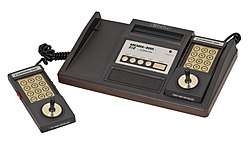
An Arcadia 2001
Also known asMPT-03/Video Computer Game
ManufacturerEmerson Radio
TypeHome video game console
GenerationSecond generation
ReleasedMay 1982; 43 years ago (1982-05)[1]
Lifespan18 months
Introductory priceUS$99
Discontinued1984
Units soldUnknown
MediaROM cartridge
CPUSignetics 2650
Memory1 KB RAM
DisplayTV; 128 × 208 / 128 × 104, 8 Colours
GraphicsSignetics 2637 UVI
Sound2 channels (Beeper and Noise)
InputControllers
Controller input2 x Intellivision-style controller (12 button keypad and 'fire' buttons on the sides)
Power12 volt
Best-selling gameUnknown
PredecessorNone
SuccessorNone

The Arcadia 2001 is a second-generation 8-bit home video game console released by Emerson Radio in May 1982 for a price of US$99,[2] several months before the release of ColecoVision. It was discontinued only 18 months later, with a total of 35 games having been released.[2] Emerson licensed the Arcadia 2001 to Bandai, which released it in Japan.[2] Over 30 Arcadia 2001 clones exist despite the system being a commercial failure.

Description

[edit]

The Arcadia is much smaller than its contemporary competitors and is powered by a standard 12 volt power supply so it can be used in a boat or a vehicle. It has two headphone jacks on the far left and right sides of the back.

The system came with two Intellivision-style controllers with a 12-button keypad and "fire" buttons on the sides. The direction pads have a removable joystick attachment. Most games came with BoPET overlays that can be applied to the controller's keypads. The console itself has five buttons: Power, Start, Reset, Option, and Select.

There are at least three different cartridge case styles[3] and artwork, with variations on each. Emerson-family cartridges come in two different lengths (short and long) of black plastic cases.

Technical specifications

[edit]
Arcadia 2001 motherboard
  • Main Processor: Signetics 2650 CPU (some variants run a Signetics 2650A)
  • RAM: 1 KB
  • ROM: None
  • Video display: 128 × 208 / 128 × 104, 8 Colours
  • Video display controller: Signetics 2637 UVI @ 3.58 MHz (NTSC), 3.55 MHz (PAL)
  • Sound: Single Channel "Beeper" + Single Channel "Noise"
  • Hardware Sprites: 4 independent, single color
  • Controllers: 2 × 2 way
  • Keypads: 2 × 12 button (more buttons on some variants)

Console variants and clones

[edit]

Many variants and clones of the Arcadia 2001 have been released by various companies in different countries. These systems are mostly compatible with each other. In 1982, the Bandai Arcadia was released only in Japan, and licensed by Emerson. Four exclusive games were released for the system.

Name Manufacturer Country Compatibility family Image
Advision Home Arcade Advision France Emerson console
2001 ALTOS Home Video Centre Altos India Limited India Emerson console 2001 ALTOS
Arcadia Bandai Japan Emerson console Bandai Arcadia 2001
Arcadia 2001 Emerson United States Emerson console
Cosmos Tele-Computer Spain Emerson console
Dynavision Morning-Sun Commerce Japan MPT-03 console
Educat unknown Israel MPT-03 console
Ekusera P.I.C. Japan MPT-03 console
Hanimex MPT-03 Hanimex France MPT-03 console
HMG-2650 Hanimex Germany
Canada
Australia
Emerson console
Home Arcade Centre Hanimex United Kingdom Emerson console
Intelligent Game MPT-03 Intelligent Game United States
Canada
MPT-03 console
Intercord XL 2000 System Intercord Germany Emerson console
Intervision 2001 Intervision Switzerland Finland Ormatu console
ITMC MPT-03 ITMC France MPT-03 console
Leisure Vision Leisure-Dynamics Canada Emerson console
Leonardo GiG Electronics Italy Emerson console
Home Entertainment Centre Ch-50 Inno-Hit Italy Ormatu console
Ormatu 2001 Ormatu Electronics BV Netherlands Ormatu console
Palladium Video-Computer-Game Neckermann Germany Palladium console
Polybrain Video Computer Game Polybrain Germany Palladium console
Poppy MPT-03 Tele Computer Spiel Poppy Germany MPT-03 console
Prestige Video Computer Game MPT-03 Prestige France MPT-03 console
Robdajet MPT-03 Robdajet Switzerland MPT-03 console
Rowtron 2000 Rowtron United Kingdom MPT-03 console
Schmid TVG-2000 Schmid Germany Emerson console
Sheen Home Video Centre 2001 Sheen Australia Ormatu console
Soundic MPT-03 Soundic Finland
Singapore[1]
MPT-03 console
Tedelex Home Arcade Tedelex South Africa Emerson console
Mr. Altus Das Tele-Gehirn Color (German for tele brain)[4][5][6] HGS Electronic Germany Palladium console
Tele-Fever Tchibo Germany Emerson console
Tempest MPT-03 Tempest Australia MPT-03 console
Tobby MPT-03 Tobby ? MPT-03 console
Trakton Computer Video Game Trakton Australia Palladium console
Tryom Video Game Center Tryom United States MPT-03 console
Tunix Home Arcade Monaco Leisure New Zealand Emerson console
UVI Compu-Game Orbit Electronics New Zealand Orbit console
Video Master Grandstand New Zealand Orbit console

Bandai Arcadia

[edit]
Arcadia 2001
ManufacturerBandai
TypeVideo game console
GenerationSecond generation
Released1982
MediaROM cartridge
CPUSignetics 2650 @ 3.58 MHz
PredecessorBandai Super Vision 8000
SuccessorBandai RX-78

In 1982, the Bandai Arcadia, a variant of the Emerson Arcadia 2001, was licensed and distributed to Japan by Bandai for a price of 19,800 yen.[2]

Reception

[edit]
The Emerson Booth at CES 1982, featuring their Arcadia 2001 system

After seeing the Arcadia 2001 at the summer 1982 Consumer Electronics Show, Danny Goodman of Creative Computing Video & Arcade Games reported that its graphics were similar to the Atari 2600's, and that "our overall impression of the game play was favorable for a system in this price range, though no cartridge stands out as being an exciting original creation". He called the controller offering both Intellivision-like disc and joystick functionality "A great idea".[7]

Games

[edit]

Emerson planned to launch the console with 19 games.[7] Some Arcadia 2001 games are ports of lesser-known arcade games such as Route 16, Jungler, and Jump Bug, which were not available on other home systems.

Emerson actually created many popular arcade titles including Pac-Man, Galaxian and Defender for the Arcadia, but never had them manufactured as Atari started to sue its competitor companies for releasing games to which it had exclusive-rights agreements.[8] Early marketing showed popular arcade games, but they were later released as clones. For instance, the Arcadia 2001 game Space Raiders is a clone of Defender, and Breakaway is a clone of Breakout.[9]

Released games

[edit]

There are 55 games known to have been released for the Arcadia 2001 and its clones during the system's lifetime.[10]

  1. 3D Attack – a Zaxxon clone
  2. 3D Bowling (1982)
  3. 3D Soccer (1982)
  4. Alien Invaders (1982)
  5. American Football
  6. Astro Invader
  7. Auto Race
  8. Baseball
  9. Basketball
  10. Battle
  11. Blackjack/Poker
  12. Boxing
  13. Brain Quiz – AKA Math/Logic
  14. Breakaway
  15. Capture – a clone of the board game Othello
  16. Cat Trax
  17. Circus – also known as Clowns on some systems, clone of Exidy's Circus
  18. Combat
  19. Crazy Climber
  20. Crazy Gobbler
  21. Dictionary – English/German
  22. Doraemon (Japan only)
  23. Dr. Slump (Japan only)
  24. Escape
  25. Funky Fish
  26. Golf
  27. Grand Slam Tennis
  28. Hobo
  29. Horse Racing (plays similar to the Intellivision game)
  30. Jump Bug
  31. Jungler
  32. Missile War
  33. Mobile Suit Gundam (Japan only)
  34. Monaco Grand Prix – AKA 3D Raceway
  35. Nibblemen – AKA Super Gobbler and Devilman the Dot Muncher
  36. Ocean Battle – AKA Sea Battle
  37. Parashooter
  38. Pleiades
  39. R2D Tank
  40. Red Clash
  41. Robot Killer (clone of Berzerk)
  42. Route-16
  43. Soccer
  44. Space Attack
  45. Space Mission
  46. Space Raiders
  47. Space Squadron
  48. Space Vultures
  49. Spiders
  50. Star Chess – AKA Video Chess
  51. Super Dimension Fortress Macross (Japan only)
  52. Super Bug
  53. Tanks A Lot
  54. The End
  55. Turtles/Turpin

Homebrew games

[edit]

Three homebrew games are known to have been made for the system:[10]

References

[edit]
[edit]
Revisions and contributorsEdit on WikipediaRead on Wikipedia
from Grokipedia
Arcadia 2001 is a second-generation licensed from United Appliances (UAL) and released by Emerson Radio Corporation in May 1982, initially priced at $199 (later reduced to $99), featuring cartridge-based games and two wired controllers with joysticks and keypads. The console utilized a CPU running at 3.58 MHz, 1 KB of RAM, and supported a resolution of 128 × 208 pixels with 8 colors, alongside basic two-channel audio consisting of a beeper and noise generator. Its game library comprised approximately 40 titles, many of which were clones of popular arcade games like and , though they often suffered from technical issues such as slowdowns and glitches. Despite its affordable entry into a competitive market—launching just ahead of systems like the —the Arcadia 2001 achieved limited commercial success and was discontinued after about 18 months due to poor reception and the video game crash. Emerson licensed the hardware internationally, leading to variants such as the Bandai Arcadia in and the Leisure Vision in , which shared compatibility with the original's games. Today, it is regarded as an obscure footnote in gaming history, valued by collectors for its rarity and unique, if flawed, titles.

History

Origins

The Arcadia 2001 originated from the efforts of Universal Appliances Limited (UAL), a Hong Kong-based firm that designed the hardware and developed the majority of its software titles. UAL, which also manufactured circuit boards for licensed variants, created the system as a utilizing the Signetics 2650A central processing unit, building on the technological foundation of earlier European systems like the Interton VC 4000 family from the late 1970s. This architecture included an enhanced Signetics 2637 audiovisual co-processor, providing improved graphics capabilities over prior iterations in the same processor lineage. Emerson Radio Corporation, primarily known for consumer electronics like radios and televisions, licensed the Arcadia 2001 from UAL for exclusive distribution in the United States, marking Emerson's entry into the competitive game market. Announced on April 9, 1982, with projections for $15 million in revenue by year's end, the console was released to retail shelves in May 1982 at an introductory price of $99, including a pack-in game and emphasizing its keypad-style controllers inspired by contemporaries such as the , and showcased at the Summer Consumer Electronics Show (CES) in June 1982. This timing placed it in a crowded second-generation console landscape, just ahead of more advanced competitors like the .

Release and discontinuation

The Emerson Arcadia 2001 was released in May 1982 by Emerson Radio Corporation as a second-generation aimed at competing in the crowded market dominated by systems like the and Mattel Intellivision. Priced at $99, it launched with an initial lineup of approximately 20 game cartridges, though only a handful were available at retail upon debut, with promises of expanded support including up to 30 titles by the end of 1982. The console's debut was covered in contemporary publications like magazine, which noted delays from an originally planned summer rollout due to ongoing legal challenges from regarding ports. Despite its advanced hardware capabilities, including superior color graphics and sound compared to contemporaries, the Arcadia 2001 struggled with market reception from the outset. Sales were hampered by Emerson's limited marketing efforts, a mediocre initial game selection focused heavily on ports of arcade titles like Space Hawks and Red Clash, and intense competition from established players. By early 1983, reviews in Electronic Games highlighted the system's availability on shelves but criticized the sparse launch library of just six games, falling short of Emerson's ambitious projections for $15 million in revenue during the 1982 holiday season. The console was discontinued after approximately 18 months of availability, around late 1983, as Emerson withdrew from the video game market amid poor overall sales and the onset of the 1983 North American video game crash. In total, only 35 games were released for the system, with production ceasing and remaining inventory cleared out by 1984; the lack of third-party developer support and Emerson's abandonment of further software updates contributed significantly to its short lifespan.

Hardware

Technical specifications

The Emerson Arcadia 2001 features a Signetics 2650A 8-bit operating at 3.58 MHz, which directly addresses a 32K memory space divided into 8K banks. This CPU handles general and game logic, while a Signetics 2637 co-processor manages audio-visual functions, including sprite handling, character generation, and . The system includes 1 KB (1024 bytes) of internal RAM for temporary data storage and no built-in ROM, relying entirely on plug-in cartridges that contain 2 to 8 KB (2048 to 8192 bytes) of ROM for game code and assets. Graphically, the console supports a color palette of 9 total colors: four dedicated to characters, four to sprites, and one for the background. It can display four independent single-color hardware sprites, enabling basic animated objects with hardware-accelerated movement and collision support via the 2637 chip. The video resolution is 128 × 208 pixels in non-interlaced mode or 128 × 104 in interlaced mode, producing output comparable to contemporary systems like the in terms of clarity and object rendering. Audio capabilities are handled by the Signetics 2637, which provides two-channel audio consisting of a tone generator for beeps and a noise generator, limiting the system to basic without polyphonic music or complex waveforms. The console outputs video and audio through an integrated for televisions, selectable for channels 3 or 4. Input is provided by two integrated hand controllers, each equipped with a 12-button , a directional disc for movement, and two action buttons, connected via hardwired coil cords. Rear ports allow for optional expansion controllers, such as paddles, though no official games utilized them. Power is drawn from an external 12V DC adapter (0.5A output), enabling use in portable settings like vehicles when paired with a compatible inverter. The overall design emphasizes compactness, measuring approximately the size of a Atari 2600 Jr., with a central cartridge slot flanked by the controllers and basic onboard controls for power, reset, game select, and options.

Controllers and accessories

The Emerson Arcadia 2001 features two integrated hand controllers connected to the console via coiled cables, which are not designed to be detachable under normal use. Each controller includes a directional disc for movement, a 12-button for input, and two side-mounted action buttons that perform identical functions. The keypad employs membrane-style buttons for a responsive feel, and the overall design closely resembles the controllers, facilitating compatibility with similar overlay-based input schemes. The controllers connect directly to the console body, flanking the central cartridge slot, with the coiled wiring allowing limited extension for two-player gameplay. Below the slot are two auxiliary ports intended for potential expansion peripherals, though no official add-ons utilizing these were ever released. The directional disc provides eight-way movement in supported games, while the action buttons handle primary interactions like firing or selecting options, with the keypad enabling complex commands such as menu navigation or puzzle inputs. The primary accessory for the Arcadia 2001 controllers consists of plastic overlays, typically made of BoPET material, provided with select game cartridges to label the keypad functions for specific titles. These overlays snap onto the controller surface, customizing the otherwise numeric layout for game-specific controls, such as directional arrows or action icons, and were a standard feature for enhancing usability in many of the system's games. No additional official accessories, such as alternative controllers, light guns, or expansion modules, were produced or distributed by Emerson, limiting customization options to the bundled overlays.

Variants

European and other clones

The Arcadia 2001 console, originally produced by Corporation in the United States, saw limited domestic success, leading to the licensing of its hardware design to international manufacturers who produced numerous clones and variants primarily for European and other non-Japanese markets. These clones replicated the Signetics 2650-based architecture and graphical capabilities of the original, enabling compatibility with the same library of arcade-style games, though physical cartridge formats varied. The proliferation of these systems reflected the era's trend of hardware cloning to capitalize on the second-generation boom without significant . In , the most widespread clones fell under the "Emerson family," which maintained near-identical internals to the original but adapted for PAL video standards and local branding. Notable examples include the Tele-Fever by (Germany and , 1982), featuring a distinctive orange-and-black casing and optional paddle controller support; the Leonardo by GiG (Italy, 1982), bundled with Italian-localized game overlays; and the Home Arcade Centre by (, 1982), marketed as an affordable home entertainment system. Other European Emerson variants encompassed the HMG-2650 by (, 1982) and the Tele-Computer XL 2000 by Intercord (, 1982), all sharing ROM-level compatibility but differing in cartridge slot pinouts and aesthetics to suit regional preferences. These systems typically retailed for around 100-150 euros equivalent, emphasizing plug-and-play simplicity for non-U.S. consumers. Beyond the Emerson family, other clone lineages emerged in , such as the MPT-03 family, produced by manufacturers like and Rowtron for markets including and the (e.g., MPT-03 by Hanimex France, 1982, and Rowtron 2000 in broader ). The family, led by and Neckermann in (e.g., Palladium Video-Computer-Game, 1982), featured a unique edge-card cartridge slot, while the Ormatu family included the Ormatu Video Spelcomputer 2001 by Ormatu Electric BV (, 1982) and Intervision 2001 (, 1982), with slimmer casings and enhanced TV shielding for European broadcast standards. Although ROMs across families were interchangeable via adapters, slot incompatibilities limited cross-use without modification, contributing to fragmented regional game distributions. Outside Europe, clones extended to markets like (Leisure-Vision by Leisure-Dynamics, 1982) and (Home Video Centre 2001 by Sheen, 1982), mirroring European designs but often using variants for compatibility with imported U.S. cartridges. These international releases collectively outsold the original Arcadia 2001, sustaining the platform's lifespan through localized production and avoiding the U.S. market crash's direct impact. The original was discontinued after approximately 18 months.

Japanese release

In 1982, Emerson licensed its Arcadia 2001 console to for distribution in , where it was released as the Arcadia for a retail price of 19,800 yen. The hardware specifications remained identical to the North American model, featuring the same CPU running at 3.58 MHz, 1 KB of RAM, and no system ROM, with full compatibility for cartridges across regional variants. Bandai produced four exclusive titles for the Japanese market, all released in 1983 and tailored to popular local anime and manga properties, which helped differentiate the variant amid competition from established systems like the Famicom. These included Doraemon, an action-platformer marking the franchise's first video game adaptation; Dr. Slump, a side-scrolling adventure based on Akira Toriyama's manga; Kidou Senshi Gundam (Mobile Suit Gundam), a vertical shooter depicting battles from the mecha anime series; and Super Dimension Fortress Macross, a shoot 'em up simulating aerial combat from the sci-fi anime. The exclusives emphasized simple, arcade-style gameplay suited to the console's overlay-based controls and limited color palette, contributing to modest sales before the system's discontinuation in line with the global market crash of 1983.

Games

Library overview

The game library for the North American Arcadia 2001 comprises 22 official titles, all developed by UA Limited and published by Emerson Radio Corporation, as the console attracted no third-party developers in that market due to its brief presence and limited success. Internationally, variants expanded the catalog with additional titles from other publishers, leading to approximately 40-50 unique worldwide. Released between 1982 and 1983, the cartridges feature a mix of genres typical of second-generation consoles, including sports simulations, action shooters, maze puzzles, and strategy , with a heavy emphasis on unlicensed arcade clones to capitalize on popular formats like and breakout-style mechanics. This first-party exclusivity in North America resulted in a focused but modest catalog, prioritizing quick adaptations over original innovations, and many titles suffer from technical glitches, slow pacing, and repetitive gameplay that hindered broader appeal. Representative sports titles include 3D Soccer, which employs a pseudo-three-dimensional view for on-field action, American Football simulating gridiron plays with overhead perspectives, and Baseball offering batting and fielding mechanics akin to contemporary arcade sports. In the action genre, Space Hawks delivers vertical scrolling shoot-'em-up gameplay against alien waves, while Cat Trax stands out as a polished maze-chase hybrid similar to Pac-Man, where players navigate feline characters through labyrinths pursued by dogs—one of the library's few critically regarded entries for its smooth controls and engaging progression. Puzzle and strategy offerings, such as Brain Quiz with its trivia challenges and Video Chess for turn-based board play, provide lighter alternatives, though audio quality across the library remains rudimentary with basic beeps and chiptunes. Overall, the collection's scale and quality reflect the console's rushed production amid intensifying competition from systems like the Atari 5200, cementing its status as a collector's curiosity rather than a mainstream staple.

Development and compatibility

The Arcadia 2001's game library was primarily developed by Universal Appliances Limited (UA Limited), a Hong Kong-based company that handled software creation for the console's 22 official North American titles, all published by Emerson Radio. Development occurred between 1981 and 1982, focusing on ports and clones of popular arcade games such as Pac-Man (as Cat Trax), Defender (as Cosmic Battle), and Missile Command (as Missile War), with some titles rewritten in 1982 to avoid copyright issues amid ongoing lawsuits by Atari and others. UA Limited's team included programmers like Choi Andrew, while occasional contributions came from American subcontractors, such as Chris Capener for Funky Fish. Emerson initially promised 30 cartridges by late 1982, with plans for 20 more in 1983, but production halted after the console's discontinuation in 1983, leaving many titles unreleased in North America; additional games for international markets were developed overseas post-Emerson. For the Japanese release, developed and published unique titles like Space Mission and Block Challenge, along with other developers such as and for various markets. Development tools and processes were not publicly documented, but the games utilized the console's CPU and custom chips for and sound, emphasizing simple 2D sprites and tile-based typical of early arcade adaptations. Some titles incorporated licensed arcade conversions, such as Jungler from , to differentiate from unlicensed clones amid industry litigation. The Arcadia 2001 demonstrates strong software compatibility across its clone family, with all games ROM-compatible due to the shared processor and identical , allowing cartridges to run interchangeably on variants like the Advision Home Arcade, Bandai Arcadia, and Hanimex PVS-4. Over 30 licensed clones exist worldwide, grouped into families (e.g., Emerson, MPT-03, , Ormatu) where intra-family hardware slots align for plug-and-play use, but inter-family differences require adapters for cartridge insertion. For instance, the French Advision Home Arcade is fully compatible with Emerson cartridges despite a notched port, while MPT-03 variants like the Interton VC 4000—despite superficial hardware similarities—are electrically incompatible, as confirmed by direct testing. No exists with prior consoles, and the system's short lifespan limited third-party expansions or mods during its era.

Reception and legacy

Contemporary response

Upon its release in May 1982, the Emerson Arcadia 2001 received generally positive reviews in contemporary gaming publications, with critics praising its hardware capabilities and select launch titles despite its late entry into a crowded market. In the November 1982 issue of Electronic Games, reviewer Henry Cohen described the system as a "cute" and compact alternative resembling the Intellivision's "baby brother," highlighting its advertised 28K RAM (though the system actually had 1 KB of RAM, second only to the ColecoVision's capabilities at the time)—and its versatility with 12V DC power for portable use in vehicles or campers. Cohen lauded several games, including Baseball for its innovative split-screen outfield view and realistic simulation, Cat Trax as a clever Pac-Man-like maze chase, and Capture for its engaging Reversi-style strategy, though he critiqued others like Breakaway for sluggish performance in early versions. A December 1982 critique in Video Games magazine by Sue Adamo echoed some of these sentiments, emphasizing the console's sleek, walnut-finished design (measuring 11½ x 7 x 3 inches) and its discounted price of $99—down from a $200 list price—as making it an accessible option blending Intellivision-level playability with affordability. Adamo noted the controllers' familiar 12-key and disc layout, along with storage slots for cartridges, but pointed out limitations in software originality, with many of the initial 24 titles being arcade ports or close imitations like (resembling ) and . She appreciated innovations in sports simulations such as and Soccer, but observed that game variations often felt limited compared to competitors. Commercially, however, the Arcadia 2001 underperformed amid intense competition from the dominant and the advanced , which launched around the same time with superior arcade-quality graphics. The price reduction shortly after launch signaled weak initial demand, and Emerson discontinued the system after just 18 months, by early 1984, having released only 35 games in total. In the UK, the Hanimex Home Arcade Centre variant fared similarly, previewed positively in Computer and Video Games (June 1982) for its 17 launch cartridges including ports like Phoenix, but it too struggled to gain traction at around £89.

Modern perspective

In contemporary retro gaming circles, the Emerson Arcadia 2001 is viewed as a commercial footnote from the early video game crash era, notable for its advanced hardware potential—such as sharp, colorful graphics and a versatile controller—but undermined by a lackluster library of arcade clones and poor third-party support. Despite selling fewer than 100,000 units and lasting only 18 months on the market, it has garnered niche appreciation for representing the ambitious yet flawed state of second-generation consoles, with enthusiasts highlighting titles like Jungler and Cat Trax for their innovative mechanics amid otherwise derivative ports. Emulation efforts have significantly boosted the system's accessibility in the , enabling preservation and play on modern hardware. The open-source WinArcadia emulator, praised for its high accuracy in replicating the console's custom CPU and video hardware, supports the full Arcadia family including European and Japanese variants like the MPT-03 and versions, with ongoing updates as recent as 2025. Integrated into MAME since the early , it allows seamless execution of the approximately 50 known titles across platforms like Windows, Android, and , fostering community-driven ROM archiving and compatibility testing. Collectibility remains strong among dedicated historians and retro enthusiasts due to the console's rarity in working condition and the scarcity of complete sets, with systems averaging $150 loose or $243 complete in box on resale platforms and premium new examples around $486 as of 2025. Online communities, including those at Digital Press and emulation wikis, actively maintain FAQs, pinouts, and variant documentation, underscoring the Arcadia 2001's enduring legacy as a of untapped potential in video game history rather than a mainstream revival candidate.

References

Add your contribution
Related Hubs
User Avatar
No comments yet.