


Community hub
Recent from talks
Contribute something
Nothing was collected or created yet.
Aroor
View on Wikipedia | This article needs additional citations for verification. (May 2024) |

Key Information


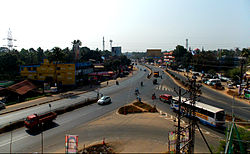
Aroor is a fishing village on the northernmost part of the Alappuzha district, within Cherthala taluk of Kerala, India. It lies on either sides of National Highway 66 and serves as a gateway between Kochi and Alappuzha. Aroor, surrounded by Vembanad, Kaithappuzha, and Kumbalangi backwaters, is known for its seafood export industry.[1] The Aroor-Kumbalam Bridge is the second-longest bridge in Kerala.
History
[edit]
The name "Aroor" traces its origins to the phrase "Arayarude Oor", which means the place of Hindu fishermen, mainly the sub class Vaalarayar or Vaala, deriving their name from their unique fishing equipment, "Dragon Tailed" (Vaal in Malayalam) net used in their legal fishery. It was later shortened as "Arayaroor" and subsequently to the present version.[citation needed]
Location
[edit]Aroor is the northernmost tip of Alappuzha district, situated in Cherthala taluk.[1] The Aroor-Kumbalam Bridge is the second-longest bridge (now the bridge is doubled with four-lane traffic) in Kerala, spanning about 993 m. The bypass opened to traffic in 1987.[citation needed]
Politics
[edit]Aroor assembly constituency is part of Alappuzha (Lok Sabha constituency). Aroor is known for having elected K. R. Gowri Amma for a record of eight times to the Kerala Legislative Assembly.
Industries
[edit]
Seafood export is a major industry of the area, given that Aroor is near Vembanad lake, a part of Kerala backwaters. This ecosystem helps large-scale prawn and shrimp farming to be an alternative to the low-lying paddy fields, which have the interlocked water system connected to the Kerala backwaters. Secondly the Cochin fishing harbour and port is just 15 km away from Aroor. The abundance of marine wealth and logistical advantages have helped the seafood export to grow, especially around Aroor. There are many marine food processing units in Aroor which provide employment to a number of people. The raw seafood catch is also purchased by large seafood export firms from North Kerala, Kollam, South Karnataka, Orissa, and Tamil Nadu, processed and preserved in cold storages, and then trans-shipped through Cochin port.
Another large business is Keltron Controls,[2] which is the control and instrumentation division of Keltron.
Demographics
[edit]As of 2011[update] Indian census,[3] Aroor had a population of 39,214. Males constitute 49% of the population and females 51%. Its average literacy rate is of 84% higher than the national average of 59.5%. 11% of the population is under 6 years of age.
| Year | Male | Female | Total Population | Change | Religion (%) | |||||||
|---|---|---|---|---|---|---|---|---|---|---|---|---|
| Hindu | Muslim | Christian | Sikhs | Buddhist | Jain | Other religions and persuasions | Religion not stated | |||||
| 2001[4] | 17444 | 17839 | 35283 | - | 61.70 | 12.20 | 26.05 | 0.00 | 0.02 | 0.00 | 0.01 | 0.02 |
| 2011[5] | 19431 | 19783 | 39214 | 11.14% | 58.81 | 14.30 | 26.75 | 0.01 | 0.01 | 0.00 | 0.02 | 0.10 |
Prominent hospitals
[edit]- State Government Hospital
- ESI Dispensary
- Lakshmi Hospital
- Mercy Hospital
- Karthika Hospital
- Jeevans Hospital, Chandiroor
- Chandiroor Mission Hospital
Religious institutions
[edit]Aroor Puthuvaranad Temple is a famous temple in Aroor. The idol of Kali is similar to the Kali idol of Dakshineswar, Kolkata. Aroor Karthyayani Temple is another main temple in Aroor. The name "Aroor" is derived from this temple.[citation needed] It is on the National Highway. Arookutty road starts from the Aroor junction. Aroor Cheruvally Temple and the Kavu with the temple, known as Paradevatha Kavu and Kizhakkedathu Kavu are scenic attractions in the temple. The banyan tree at the southwestern corner of the temple, and the Ganapathi idol known as the Aaltharra Ganapathi, are other attractions of the temple. The Ganapathi idol is similar to the idol of Pillayarpatti Ganapathi. Pillayar patti is a place near Karaikudi, Tamil Nadu. Kottilakkattu Kudumpa Paradevatha is also near the Cheruvally Temple. The long Pala Maram of the Devasthanam is a main attraction. The Garuda Vahana Ezhunnalleth and Thadi Thullal are the main attractions in the festival.
St. Augustine's Church under Diocese of Cochin is a major attraction, on the highway in the heart of Aroor. The parish is also the part of Mundamveli Parish and separated in the early 1900s. The current church, over 138 years old, was built on land donated by the Aelavanthara family.[6]
References
[edit]
- ^ a b "Revenue Portal". village.kerala.gov.in. Retrieved 9 April 2024.
- ^ Keltron Controls Archived 2010-06-19 at the Wayback Machine
- ^ "Census of India 2011: Data from the 2011 Census, including cities, villages and towns (Provisional)". Census Commission of India. Archived from the original on 16 June 2004. Retrieved 1 March 2011.
- ^ Census India 2001.
- ^ Census India 2011.
- ^ Website of St. Augustine's Church Archived 14 March 2012 at the Wayback Machine

Aroor
View on GrokipediaGeography
Location and Administrative Boundaries
Aroor is a census town situated in the Cherthala taluk of Alappuzha district, Kerala, India, at the northern extremity of the district.[6] Its geographic coordinates are approximately 9.87° N latitude and 76.30° E longitude.[7] Positioned adjacent to the Ernakulam district border to the north, Aroor functions as a suburb of Kochi despite its administrative affiliation with Alappuzha.[7] Administratively, Aroor is governed by the Aroor Grama Panchayat, which oversees local development and services across its wards in the Cherthala taluk.[8] The panchayat boundaries encompass rural and semi-urban areas focused on fishing and related industries, extending to the northwestern portion of the taluk up to the Alappuzha-Ernakulam district demarcation.[9] This setup places Aroor within the Pattanakkad block for certain developmental planning.[10] The region lies along National Highway 66, facilitating connectivity between Alappuzha and Kochi.[11]Topography, Climate, and Environmental Features
Aroor occupies a flat coastal plain in the northern part of Alappuzha district, Kerala, with an average elevation of approximately 5 to 9 meters (17 to 30 feet) above sea level and minimal topographic variation, featuring a maximum elevation change of about 19 meters (62 feet) within a 3-kilometer radius.[12][11] The terrain consists of sandy strips interspersed with lagoons, canals, and rivers, characteristic of the broader Alappuzha region's low-lying geography adjacent to the Arabian Sea and Vembanad Lake backwaters.[13] This proximity to water bodies facilitates extensive aquaculture and fishing but exposes the area to tidal influences and seasonal flooding risks. The region experiences a tropical monsoon climate (Köppen classification Am), marked by high humidity (typically 70-90%), warm temperatures year-round, and significant rainfall distributed across multiple seasons. Average daily high temperatures range from 31°C (88°F) in January to 33°C (91°F) in April, with lows between 24°C (75°F) and 26°C (79°F); the annual average temperature hovers around 28°C (82°F).[12] Precipitation totals exceed 2,500 mm annually, with the heaviest rains in June (approximately 465 mm or 18.3 inches) during the southwest monsoon, followed by notable amounts in October-November from the northeast monsoon; drier periods occur in January-February.[12][14] Environmental features include extensive backwater systems connected to Vembanad Lake, supporting biodiversity such as fish species and mangroves, alongside coastal aquifers vulnerable to overexploitation. The seafood processing industry, a dominant local activity, contributes to groundwater contamination through effluent discharges containing organic matter and nutrients, altering hydrogeochemistry and reducing aquifer suitability for drinking.[15] Backwater ecosystems face threats from heavy metal accumulation in fish—stemming from upstream industrial pollution in the Greater Kochi area—and plastic waste, exacerbating sedimentation and invasive species proliferation like jellyfish blooms, which disrupt traditional fisheries.[16][17] These pressures, compounded by high water tables and frequent inundation, highlight causal links between anthropogenic activities and ecological degradation in this low-elevation coastal setting.[18]History
Origins and Early Settlement
Aroor originated as a coastal fishing settlement primarily inhabited by the Araya community, a traditional Hindu fishing group in Kerala also known as Valayar or Vala, specializing in inland and lagoon fisheries.[1][19] The locality's name derives from the Malayalam phrase Arayarude Oor, meaning "the village of the Arayas" or "place of the fishermen," reflecting its foundational role as a hub for these subsistence fishers who relied on the adjacent Vembanad Lake and backwater systems for livelihood.[20][21] Early settlement patterns in Aroor align with broader prehistoric and Iron Age coastal occupations in Kerala, where communities established agro-pastoral and fishing villages along shorelines and lagoons from around the 6th century BCE onward, supported by evidence of iron tools, pottery, and megalithic burials in regional sites.[22] However, no site-specific archaeological excavations have been documented for Aroor itself, limiting precise dating; local oral traditions and community histories suggest continuous habitation by Araya and related groups like Kudumbi fishers, who trace migrations to ancient ports such as Kodungallur for refuge and resource access.[23] These settlers engaged in net-based fishing, salt production, and small-scale trade, forming the economic base prior to formalized governance under medieval Chera rulers.[24] The village's early development was shaped by its strategic position on the border of former Travancore and Cochin kingdoms, facilitating cross-lake commerce but also exposing it to periodic floods and tidal influences that influenced settlement clustering around elevated terrains and natural harbors.[23] By the medieval period, Aroor had evolved into a recognized desam or sub-local unit, with community temples serving as social anchors for the fishing populace, though records of land grants or inscriptions specific to Aroor remain scarce compared to inland Kerala sites.[25]Colonial Period and Independence Era
Aroor, situated in the northern reaches of Alappuzha district within the Kingdom of Travancore, experienced the broader impacts of British colonial influence indirectly through the princely state's alliances rather than direct administration. In 1795, Travancore formalized a subsidiary alliance treaty with the British East India Company, whereby the kingdom accepted British protection against external threats in exchange for military subsidies and influence over foreign affairs, while retaining autonomy in internal governance under Maharaja Dharma Raja (r. 1758–1798).[26] This arrangement solidified after the Travancore rebellion of 1808–1809, when British forces intervened to suppress internal unrest led by Velu Thampi Dalawa, the kingdom's dewan, enforcing greater oversight.[27] As a coastal fishing village on the border with the Kingdom of Cochin—which had endured direct European colonization by the Portuguese since 1500, followed by the Dutch and British—Aroor's local economy of traditional fishing and trade persisted with minimal infrastructural changes, though regional ports like nearby Kochi facilitated British commercial interests in spices and seafood.[28] In the independence era, Aroor shared in the turbulent transitions of Travancore amid rising nationalist pressures and internal dissent. The Punnapra-Vayalar uprising of October 1946, a communist-led workers' revolt against the autocratic rule of Diwan Sir C.P. Ramaswamy Iyer, erupted in nearby villages within Alappuzha district, including areas under Cherthala taluk where Aroor is located; it involved coir factory laborers and fishermen protesting feudal conditions, resulting in hundreds of deaths after state forces, aided by British-trained troops, quelled the agitation.[29] [30] This event accelerated demands for reform and integration with India, amid Travancore's initial bid for independent status announced by the diwan in June 1947. Ultimately, under pressure from internal unrest and Indian leadership, Maharaja Chithira Thirunal Balarama Varma signed an instrument of accession to the Dominion of India on 30 July 1947, initially ceding control over defense and external affairs.[31] Full merger followed on 1 July 1949, when Travancore united with Cochin to form the state of Travancore-Cochin, incorporating Aroor into the new administrative framework leading to modern Kerala. No specific records detail unique Aroor-led actions, but the village's fishing communities likely contributed to the labor mobilizations characteristic of coastal Travancore's role in anti-feudal struggles.[32]Post-Independence Growth and Recent Developments
Following India's independence in 1947 and the formation of Kerala state in 1956, Aroor's economy experienced notable expansion, particularly in the seafood processing sector, aligned with national trends in fisheries growth. Fish production in India increased from 0.75 million tonnes in 1950–51 to over 6.57 million tonnes by 2005–06, enabling the proliferation of processing units in coastal areas like Aroor, which benefited from its location near the Arabian Sea and Kochi port.[33] This period saw the establishment of export-focused facilities handling shrimp, cuttlefish, and other species, with Kerala's seafood industry capitalizing on rising international demand during the 1970s and beyond.[34] To bolster industrial capabilities, the Kerala Industrial Infrastructure Development Corporation (KINFRA) developed the Seafood Park in Aroor through a joint venture with the Marine Products Export Development Authority (MPEDA) and the Seafood Exporters Association, offering specialized infrastructure for processing, cold storage, and value-added products.[35] This initiative supported cluster development, contributing to Aroor's emergence as a key node in Kerala's fisheries value chain, though challenges like fluctuating raw material supply persisted.[36] Recent infrastructure projects have aimed to address traffic bottlenecks hindering industrial logistics. The Aroor–Thuravoor Elevated Highway, a 12.75 km six-lane corridor on National Highway 66, achieved 65% completion by June 2025, with full commissioning targeted for mid-2026 at a cost of ₹2,200 crore, positioning it as India's longest continuous flyover.[37] [38] Complementing this, the Edappally–Aroor bypass elevated highway extension, part of the Bharatmala Pariyojana, is projected for completion by May 2027, enhancing connectivity for freight movement from Aroor's seafood hubs to broader markets.[39] These developments are expected to reduce transit times and support sustained economic activity in the region.[40]Demographics
Population Statistics and Trends
According to the 2001 Census of India, Aroor had a population of 35,283.[41] The 2011 Census recorded a population of 39,214, reflecting a decadal growth rate of approximately 11.15%.[41] [4] This growth equates to an average annual increase of about 1.05%, consistent with urbanizing census towns in Kerala amid the state's overall decelerating population expansion due to low fertility rates and emigration.[42]| Census Year | Population | Decadal Growth Rate (%) |
|---|---|---|
| 1991 | 31,642 | - |
| 2001 | 35,283 | 11.5 |
| 2011 | 39,214 | 11.15 |
Ethnic, Linguistic, and Religious Composition
As of the 2011 Census of India, the religious composition of Aroor reflects a diverse yet Hindu-majority population, with Hindus comprising 58.81% (23,062 individuals), Christians 26.75% (10,496 individuals), and Muslims 14.30% (5,613 individuals); other religions account for less than 0.2%.[44][4] This distribution exceeds the district averages for Alappuzha, where Hindus form 68.64%, Christians 20.45%, and Muslims 10.55%, indicating a relatively higher presence of Christian and Muslim communities in Aroor, likely tied to its coastal fishing economy.[45] Linguistically, Malayalam serves as the dominant mother tongue, spoken by over 99% of Alappuzha district's population including Aroor, consistent with Kerala's statewide pattern where it predominates as the official and primary language.[46] No significant linguistic minorities are recorded at the town level, though English is used in education and administration due to high literacy rates exceeding 95%.[44] Ethnically, Aroor's residents are overwhelmingly Malayali, the predominant Dravidian ethnic group of Kerala, encompassing subgroups aligned with religious identities such as Hindu castes (e.g., Nairs, Ezhavas) and Christian denominations (e.g., Syrian Christians, Latin Catholics involved in fishing).[4] Scheduled Castes constitute about 10.5% of the population, primarily from Hindu communities, while Scheduled Tribes are negligible at under 0.1%, reflecting the town's urbanized, non-tribal character.[4] Migration from neighboring Tamil Nadu may introduce minor Tamil-speaking elements, but these do not alter the Malayali ethnic majority.[46]Economy
Primary Sectors and Employment
The primary economic sectors in Aroor center on marine fisheries and aquaculture, supplemented by limited agriculture, reflecting the town's coastal location in Alappuzha district. Capture fishing in the Arabian Sea and backwaters provides seasonal employment to local fishermen, who operate small-scale mechanized and traditional boats targeting species like shrimp, sardines, and prawns. Inland aquaculture, including shrimp farming in nearby brackish water areas, contributes to raw material supply for processing. However, traditional agriculture remains marginal, with paddy and coconut cultivation confined to small pockets, employing few residents due to waterlogged terrain and salinity.[47] Employment in these primary sectors is characterized by high seasonality and labor intensity, with fisheries supporting direct jobs for fishermen and allied activities like net mending and ice production. The 2011 Census data indicates that among Aroor's main workers (totaling approximately 13,451 individuals aged 15–59), only 144 were agricultural laborers, underscoring fisheries' dominance within the broader "other workers" category (encompassing 22,881 individuals, primarily males and females in fishing and related primary extraction).[4] Women participate marginally in primary capture but more substantially in pre-processing tasks like sorting and peeling on beaches or small units. Overall workforce participation skews toward fisheries, with estimates suggesting thousands engaged annually, though underemployment rises during off-seasons due to fluctuating catches influenced by monsoons and overfishing.[48] While primary production drives inputs, employment spills into secondary processing, amplifying economic impact; over 20,000 workers were reported in fish processing centers across Aroor and adjacent Cherthala in 2015, many transitioning from primary roles during peak seasons. Recent infrastructure like the Mega Food Park at Aroor, operational since 2023, has added 600 jobs in initial phases, focusing on value-added fisheries products for export. Migrant labor from states like Odisha and West Bengal increasingly fills gaps in both primary and processing roles, comprising up to 58% of Kerala's fisheries workforce as of 2023, often under informal contracts with variable wages tied to production quotas.[49][50][51]Seafood Industry: Operations and Economic Impact
Aroor serves as a primary hub for seafood processing in Kerala, with operations centered on the handling, pre-processing, and export of marine products such as shrimp, fish, and squid. The area features over 40 marine product processing factories, many equipped for freezing, IQF (individual quick freezing), and packaging to meet international standards like HACCP and EU approvals.[52] These units primarily source raw materials from local backwaters, canals, and coastal fisheries, involving labor-intensive steps including peeling, deheading, grading, and quality control before shipment to major markets in the United States, Europe, and the Middle East.[15] In 2023, the Lulu Group inaugurated a dedicated export-oriented processing center in Aroor, operating 24 hours daily and focusing exclusively on value-added seafood products.[53] Economically, the seafood sector forms the backbone of Aroor's local economy, providing direct and indirect employment to thousands, predominantly women and migrant workers from other states. The Lulu facility alone generates over 800 jobs, contributing to skill development in processing techniques and logistics.[54] Aroor's units play a key role in Kerala's marine exports, which historically accounted for about 20% of India's seafood export volume, supporting foreign exchange earnings amid national totals of 17.81 lakh metric tons valued at US$7.38 billion in fiscal year 2023-2024.[55] Disruptions such as U.S. tariffs have highlighted the sector's vulnerability, with Kerala projecting annual losses of Rs 2,500–4,500 crore, underscoring Aroor's dependence on global trade for sustained revenue and employment stability.[56]Challenges, Criticisms, and Sustainability Issues
The seafood processing industry in Aroor, which clusters around 47 plants, generates effluents characterized by high levels of biochemical oxygen demand (BOD) averaging 964–2250 mg/L, chemical oxygen demand (COD) at 1442–2700 mg/L, total suspended solids (TSS) from 125.6–680.8 mg/L, and ammonia nitrogen (NH3-N) between 29.1–36.2 mg/L, all exceeding permissible discharge limits and contributing to severe water pollution in local canals and backwaters.[57] These discharges deplete dissolved oxygen, promote eutrophication, and release toxic compounds like hydrogen sulfide, degrading aquatic ecosystems and threatening nearby Ramsar wetlands such as Vembanad-Kol.[57] [58] Untreated effluents have polluted Puthenthodu canal, affecting over 200 families in Aroor-Chandiroor through foul odors, health risks, and contaminated water sources, prompting local complaints against non-compliant industries.[59] A primary economic challenge is the acute shortage of raw fish material, resulting in capacity utilization below 20% for processing units, exacerbated by fluctuating catches, competition from other states, and regulatory restrictions on fishing.[60] This has contributed to Kerala's decline from leading exporter to fifth position nationally by 2025, with exporters citing high operational costs, export bans on certain species, and inadequate government subsidies as compounding factors.[61] Sustainability concerns include over-reliance on depleting marine stocks and greenhouse gas emissions from wastewater treatment failures, with each kilogram of processed fish generating significant organic waste that burdens coastal aquifers and requires advanced remediation not widely implemented.[15] Infrastructure vulnerabilities, particularly chronic flooding and poor drainage, disrupt seafood transport and operations; waterlogging at key junctions like Aroor bus stop persists during monsoons due to silted canals and inadequate stormwater outlets, delaying shipments and increasing spoilage risks.[62] Disputes between local panchayats and the National Highways Authority of India (NHAI) over drainage integration with the Aroor-Thuravoor elevated highway have stalled progress, leading to potholes and inundation that hinder economic activity in this logistics-dependent sector.[63] Critics argue that insufficient enforcement of effluent treatment plants (ETPs) and lax oversight by pollution control boards perpetuate these issues, prioritizing short-term exports over long-term ecological health.[59] [57]Politics and Governance
Local Administration and Political Structure
Aroor is governed at the local level by the Aroor Grama Panchayat, a statutory body under the Kerala Panchayat Raj Act, 1994, responsible for rural self-governance, including planning and implementation of development schemes, maintenance of public amenities, sanitation, water supply, and fisheries-related infrastructure pertinent to the area's economy. The panchayat operates within the three-tier system of Kerala's panchayati raj institutions, subordinated to the Pattankkad Block Panchayat for intermediate-level coordination and the Alappuzha District Panchayat for overarching district-wide policies.[8][64] The gram panchayat consists of elected representatives from approximately 20 wards, determined by population and geographic divisions, with elections held every five years under the State Election Commission. In the 2020 local body elections, Rakhi Antony of the Communist Party of India (Marxist) (CPI(M)) was elected president from the Multipurpose Society Ward, indicating Left Democratic Front (LDF) control at the executive level, while ward members include affiliates from CPI and Indian National Congress (INC), underscoring multiparty representation amid Kerala's polarized local politics. The president, elected by the ward members, chairs meetings and represents the panchayat, supported by a vice-president and standing committees for specialized functions like finance and development.[64][65] Administrative operations are supervised by a panchayat secretary, a Kerala government appointee from the civil services, who ensures compliance with state directives and manages day-to-day affairs, including budget execution and public grievances. The panchayat's office is located in Aroor, with contact facilitated via telephone (0478-2872234) and email ([email protected]), enabling resident engagement in local decision-making processes. Funding derives primarily from state grants, own revenue sources like taxes and fees, and central schemes, though execution has faced scrutiny in audits for delays in projects such as road repairs and waste management.[8][64]Electoral Dynamics and Representation
Aroor falls under the Aroor Assembly constituency (No. 102) in Alappuzha district, Kerala, which elects one member to the Kerala Legislative Assembly. The constituency encompasses Aroor town and surrounding areas, with a voter base influenced by fishing communities, seafood processing workers, and agricultural laborers. Elections here typically feature competition between the Left Democratic Front (LDF), led by the Communist Party of India (Marxist) or CPI(M), and the United Democratic Front (UDF), anchored by the Indian National Congress, reflecting Kerala's broader bipolar political landscape.[66][67] In the 2021 Kerala Legislative Assembly election held on April 6, the CPI(M) candidate Daleema secured victory with 75,617 votes (48.3%), defeating UDF's Adv. Shanimol Usman who received 68,604 votes (43.8%), by a margin of 7,013 votes. The Bharatiya Janata Party's ally, BDJS candidate Aniyappan polled 17,479 votes (11.2%), indicating a growing but marginal presence of the National Democratic Alliance (NDA). Voter turnout was approximately 74%. This win marked LDF's reclamation of the seat after a 2019 by-election loss. Prior, in 2016, CPI(M)'s A.M. Ariff won with 70,832 votes against UDF's Shanimol Usman (32,313 votes), by 38,519 votes. The 2019 bypoll, triggered by Ariff's election to Lok Sabha, saw UDF's Shanimol Usman prevail with 42,340 votes over LDF's Manu C. Pulickal (40,261 votes), by 2,079 votes, amid local issues like infrastructure delays.[66][67][68]| Year | Winner | Party | Votes | Margin | Runner-up | Party | Votes |
|---|---|---|---|---|---|---|---|
| 2021 | Daleema | CPI(M) | 75,617 | 7,013 | Shanimol Usman | INC | 68,604 |
| 2019 (bypoll) | Shanimol Usman | INC | 42,340 | 2,079 | Manu C. Pulickal | CPI(M) | 40,261 |
| 2016 | A.M. Ariff | CPI(M) | 70,832 | 38,519 | Shanimol Usman | INC | 32,313 |