Hubbry Logo
Arripis truttaArripis truttaMain
Open search
Arripis trutta
Community hub
Arripis trutta
logo
8 pages, 0 posts
0 subscribers
Be the first to start a discussion here.
Contribute something
Arripis trutta
Arripis trutta
from Wikipedia

Arripis trutta
Scientific classification Edit this classification
Kingdom: Animalia
Phylum: Chordata
Class: Actinopterygii
Order: Scombriformes
Family: Arripidae
Genus: Arripis
Species:
A. trutta
Binomial name
Arripis trutta
Synonyms[1]
  • Sciaena trutta Forster, 1801
  • Perca trutta Bosc, 1802
  • Perca marginata Cuvier, 1828
  • Arripis salar (Richardson, 1839)
  • Centropristes sapidissimus Richardson, 1842
  • Centropristes tasmanicus Hombron & Jacquinot, 1853

Arripis trutta, known as the Australian salmon in Australia and as kahawai in New Zealand,[2] is a South Pacific marine fish and one of the four extant species within the genus Arripis, native to the cooler waters around the southeastern Australian coasts and the New Zealand coastline. Other common names for this species include Eastern Australian salmon, Eastern Australian mackerel, bay trout, blackback salmon (or just "black back"), buck salmon (or "buck"), cocky salmon, colonial salmon, woolley Judith, newfish and salmon trout.

Although it is referred to as "salmon" in Australian English and its species epithet trutta is Latin for trout, it is not related to true salmons or trouts, which belong to the family Salmonidae of the order Salmoniformes. All Arripis species belong to the family Arripidae of the order Scombriformes.

Taxonomy

[edit]

Arripis trutta was first formally described in 1801 as Sciaena trutta by Marcus Elieser Bloch and Johann Gottlob Theaenus Schneider with the type locality given as Cook Strait.[3]

Description

[edit]

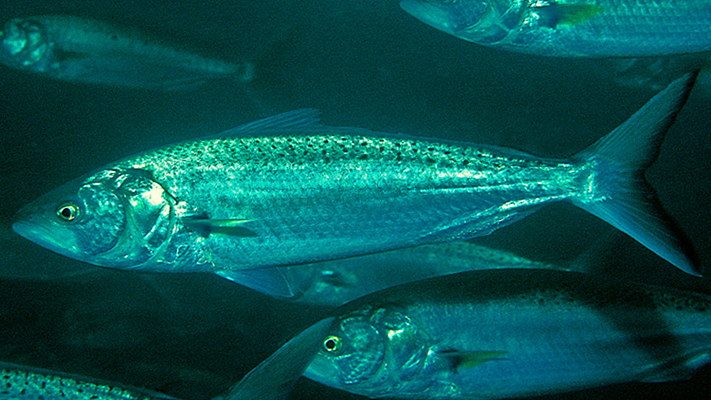
Arripis trutta is a streamlined fish with a long and slender body. There is a bony ridge edge of bone beneath and in front of each eye which has obvious serrations in smaller individuals. In larger fish the scales feel smooth. The lobes of the caudal fin are equivalent in length to the head. These fish are dark bluish-green dorsally and silvery white ventrally. The juveniles have golden bars on their upper flanks and these break up into large spots as the fish matures. The pectoral fin is vivid yellow and the caudal and spiny part of the dorsal fin both have a blackish margin.[4] There are 9 spines and 15–17 soft rays in the dorsal fin and 3 spines and 9–10 soft rays in the anal fin. The maximum total length recorded is 89 centimetres (35 in) although they are commonly a total length of around 47 centimetres (19 in) and the maximum recorded weight is 9.4 kilograms (21 lb).[1] The most consistent difference between this species and Arripis truttacea is the gill raker count, A. truttacea has 25–31 gill rakers and A trutta has 33–40.[4]

Arripis trutta can differentiated from Arripis xylabion, as the former has a larger tail.[5]

Distribution

[edit]

Arripis trutta is found in the southwestern Pacific Ocean mostly around the littoral waters of the Tasman Sea and Bass Strait.[1] In Australia, they are found from Moreton Bay in Queensland to western Victoria and northern Tasmania, with infrequent records at Kangaroo Island in South Australia. They are also found around Lord Howe Island and Norfolk Island in the open waters of the Tasman Sea.[4] In New Zealand, they are distributed around the coasts but are more common north of Kaikōura on the South Island.[6] They are also found around the Chatham Islands and Kermadec Islands[1] east of New Zealand.

Habitat and biology

[edit]

Arripis trutta is a migratory fish that may swim long distances, sometimes thousands of kilometres. The adults congregate and form very large schools off oceanic beaches and exposed coasts coastal areas,[4] and will enter rivers.[1] The juveniles live in smaller schools in more sheltered areas such as bays and estuaries, and these mostly occur in the more southerly areas in which this species occurs. It is carnivorous and feeds mainly on small pelagic fish and crustaceans such as krill.[4] They are highly visual predators, preying on a diverse variety which eat a variety of crustaceans and polychaetes during their juvenile phase, however, adults shift their preferred prey to small schooling baitfish such as pilchards, sprats and anchovies. There is some evidence that the diet of A. trutta has undergone a marked shift since the late 20th century, studies conducted during 1950s and 1960s found that the adults fed largely on krill and squid, which are animals associated with cooler waters. Studies during the early 21st century have shown that the main prey taken is small pelagic baitfish. It is thought that this shift is a result of long-term changes in the East Australian Current which brings warmer waters from the Coral Sea and has extended farther south since the 1990s. It is further thought that this "multi-decadal southward penetration of the EAC" is one of the more obvious indications of global warming and the recorded change in the diet of A trutta forms a biological record of oceanic warming.[7]

Arripis trutta are preyed on by larger marine predators such as seals, dolphins and sharks. The feeding schools push the smaller fish they are preying on towards the surface, making them accessible to seabirds, In this way, this species has an important ecological role in facilitating transfer of energy among the upper levels of the pelagic food chain in inshore ecosystems.[7] An example is the white-fronted tern (Sterna striata) which has the colloquial name "kahawai bird" because often feeds on shoaling fish in association with kahawai, gulls and shearwaters. Fishers hunting for schools of kahawai to troll look out for the flocks of white-fronted terns feeding in association with the predatory fish.[8]

The Australian population of this species spawns in the surf zone between Lakes Entrance in southeastern Victoria and Bermagui in New South Wales South Coast in the late spring and summer. They first spawn when they are around four years old and have attained a length of 39 centimetres (15 in)[9] They can live for up to 26 years.[1]

In a human context

[edit]

Arripis trutta is a major traditional food for Māori.[2] Many tribes would migrate to river mouths in summer months, when kahawai would swarm.[5] Kahawai could be caught using flecks of iridescent pāua shells, or by using a pā kahawai, a specialised hook that incorporated pāua shell in the design.[5] The name kahawai is specific to Māori language, as the word is not used for any similar species of fish across Polynesia.[5]

Early European settlers to New Zealand did not like the fish, describing it as dry, coarse and flavourless. Over time the fish grew in popularity, and is now one of the most caught recreational fish in the country.[5]

Fisheries

[edit]

Arripis trutta are caught in coastal waters, frequently in the vicinity of estuaries and off coastal beaches. Most of the commercial landings are caught using purse seines and spotter planes may be used to find the large schools They may also be taken as bycatch of purse seine and trawl fisheries pursuing other schooling species like snapper, mackerel and trevally. Although they are fished for throughout southern Australia, the main landings are in southern New South Wales and Eastern Victoria. The flesh of this species is not very popular with consumers and a high proportion of the landings have been used as pet-food or bait.[10] In New Zealand the principal commercial fishing areas are north of Kaikōura in the South Island, off the coast of North Island and in the Cook Strait.[11] Fisheries New Zealand manages that nation's fishery to maintain the population of A trutta at roughly 52% of the stock which was present before modern commercial fisheries began and in 2019 the population was well above that target.[12]

Recreational fisheries

[edit]

Arripis trutta are highly prized by recreational fishers, especially for anglers fishing from beaches and rocks. Anglers tend to catch this species using light tackle or by fly fishing and it is said to be a "sporting catch".[13]

References

[edit]
[edit]
Revisions and contributorsEdit on WikipediaRead on Wikipedia
from Grokipedia
Arripis trutta is a medium-sized marine fish belonging to the family Arripidae, endemic to the temperate waters of the southwestern , where it is known as the in and kahawai in . This species features a , compressed body that is dark blue-green to olive-green on the back and silvery on the sides and belly, with indistinct rows of dark spots forming irregular bands along the upper sides; juveniles often display more prominent golden bars that fragment into spots as they mature. It typically reaches a maximum of 89 cm and a weight of up to 9.4 kg, with maturity attained around 29–36 cm in . Distributed along the eastern and southern coasts of from southern to , including offshore islands like Lord Howe and , A. trutta also occurs throughout waters, extending to the Chatham, Kermadec, and other islands. The species inhabits pelagic-neritic zones over continental shelves, including estuaries, bays, and inlets, at depths ranging from 0 to 51 m, preferring sandy seabeds in coastal and nearshore environments. Juveniles commonly school in shallow bays and estuaries, while adults form large, migratory schools in open coastal waters, sometimes traveling thousands of kilometers. Ecologically, A. trutta is a schooling predator that feeds primarily on small fishes, crustaceans such as , and , exerting top-down pressure on pelagic food webs in its range. It exhibits serial batch spawning, with a maximum reported age of 26 years, and shows latitudinal variations in growth, reproduction, and population structure influenced by environmental gradients. Although not truly anadromous like Pacific , it undertakes seasonal migrations between inshore nursery areas and offshore spawning grounds. A. trutta holds significant economic and cultural value, supporting commercial, recreational, and customary fisheries across its range, where it is harvested using methods like set nets, trawls, and purse seines, and utilized fresh, frozen, canned, or as bait. It is a popular sport fish due to its strong runs and schooling behavior, with world record catches reaching 8.74 kg, though populations are monitored through stock assessments to ensure sustainability. As of 2025, the species is not evaluated under CITES or CMS, and recent stock assessments indicate sustainable populations where evaluated, though localized impacts from fishing and environmental changes continue to be studied.

Taxonomy

Classification

Arripis trutta is classified in the domain Eukarya, kingdom Animalia, phylum Chordata, class Actinopterygii, order Scombriformes, family Arripidae, genus Arripis, and species trutta. This hierarchical placement situates it among the ray-finned fishes, characterized by bony skeletons and fins supported by lepidotrichia. The family Arripidae includes four extant species, all within the genus Arripis, with A. trutta representing one of the two principal species occurring in Australian waters alongside A. truttacea. These species are distributed primarily in the temperate coastal regions of and . Arripidae evolved as a small of pelagic marine fishes well-adapted to temperate oceanic environments, exhibiting active schooling behaviors in coastal and shelf waters. Their phylogenetic position within Scombriformes reflects adaptations for fast-swimming in open marine habitats, distinct from more derived percomorph groups.

Nomenclature

Arripis trutta was originally described as Sciaena trutta by in 1801, with the description appearing in and Johann Gottlob Theaenus Schneider's Systema Ichthyologiae. The type locality is given as , . Subsequent synonyms for the species include Perca trutta (Bosc, 1802), Perca marginata (Cuvier, 1828), Arripis trutta marginata (Cuvier, 1828), and Centropristes salar (Richardson, 1839). Common names for A. trutta vary regionally, with "Australian salmon" used in and "kahawai" in ; historical English names among sailors include "salmon trout" and "skipjack," reflecting its migratory behavior and appearance. The specific epithet trutta derives from the Latin term for , alluding to the species' superficial resemblance to salmonids in shape and schooling habits.

Description

Morphology and coloration

Arripis trutta possesses a streamlined, body shape that is elongated and compressed laterally, facilitating rapid swimming in pelagic environments. The body features a relatively large and small eyes, with a prominent bony ridge beneath and anterior to each eye that bears serrations in smaller individuals. The scales are and smooth to the touch, particularly in larger specimens, while a extends along the flanks. The coloration of A. trutta is characterized by a dark bluish-green to olive-green dorsum that transitions to silvery white sides and ventral surface. Juveniles exhibit distinct golden bars along the upper flanks, which fragment into irregular spots as the fish matures, often arranged in indistinct lateral rows. The fins include a single, continuous and a deeply forked caudal fin, both of which bear blackish margins; the pectoral fins are small and vividly yellow, sometimes with a black basal spot. The anal is positioned posteriorly, contributing to the overall hydrodynamic profile.

Size and meristics

Arripis trutta attains a maximum total length of 89 cm, with a common length of 47 cm; the maximum published weight is 9.4 kg. The species exhibits rapid early growth, reaching approximately 16 cm fork length (FL) by age 1 and 27 cm FL by age 2, with von Bertalanffy growth parameters indicating an asymptotic length (L∞) of 63.2 cm FL and a growth coefficient (k) of 0.25 year⁻¹. is typically reached at around 39 cm FL, at an age of about 4 years, though regional variations show sizes at 50% maturity ranging from 30 to 43 cm FL and ages from 2 to 4 years. Females are slightly larger than males at maturity, with no significant differences in age at maturity between sexes but faster female growth after approximately 5 years. The maximum reported lifespan is 26 years. Key meristic characteristics include a with 9 spines and 15–17 soft rays, an anal fin with 3 spines and 9–10 soft rays, and 33–40 gill rakers on the first arch, the latter distinguishing it from the congener A. truttaceus which has 25–31 gill rakers. These counts in taxonomic identification and reflect adaptations to the ' pelagic .

Distribution and habitat

Geographic range

Arripis trutta is native to the southwestern , with its primary range spanning southeastern from in southward along the east coast to , including offshore islands such as and . In this region, the species is commonly found in coastal waters influenced by the , which facilitates its distribution along the continental shelf. In , A. trutta occurs along the and the northern from northward, extending to the and . The species supports fisheries primarily off the northeast , with tagging studies indicating limited large-scale movements within New Zealand waters but confirming its presence across these areas. Migratory patterns connect Australian and New Zealand populations, with genetic analyses revealing approximately 15 migrants per generation across the , providing evidence of movements and ongoing between the two regions. This connectivity underscores a shared dynamic, though populations exhibit regional differences in age composition. The historical range of A. trutta has remained stable, with no significant shifts observed prior to 2020 or as of 2025, as indicated by consistent catch distributions and stock assessments spanning decades in both and .

Habitat preferences

Arripis trutta primarily inhabits waters of the southwestern Pacific, ranging from surf zones along exposed coasts to depths of approximately 30-50 m, though records indicate occasional occurrences up to 100 m in some areas. As an inshore pelagic species, it is commonly associated with temperate coastal environments influenced by the , which facilitates larval dispersal and shapes habitat distribution along southeastern . The species shows a preference for sandy or rocky substrates, often schooling over reefs, headlands, and oceanic beaches where these features provide structural complexity. Adults typically form large schools in open coastal waters adjacent to oceanic beaches, reefs, headlands, and large bays, with occasional incursions into estuaries and rivers during periods of high abundance or favorable conditions. These habitats support their schooling behavior and access to prey resources in dynamic nearshore environments. Juveniles, in contrast, seek shelter in shallower, more protected areas such as bays, estuaries, and inlets, where they associate with seagrass beds (e.g., Posidonia and Zostera spp.) and soft sediments like sand. This species demonstrates tolerance to varying salinities, particularly as juveniles in brackish estuarine waters, enabling residency in diverse coastal microhabitats across their range. Such preferences reflect an ontogenetic shift from sheltered nursery grounds to more exposed habitats, supporting and persistence in temperate systems.

Biology and ecology

Behavior and migration

Arripis trutta is a strongly schooling that forms large surface schools comprising thousands of individuals, often aggregating in nearshore waters for feeding and migration purposes. These schools can reach levels of up to 800 tonnes and are commonly observed around beaches and exposed coasts in southeastern . Schooling enhances feeding efficiency, particularly when targeting swarming prey, by reducing the confusion effect and allowing coordinated attacks that create visible surface disturbances known as "boils" during predatory chases. The species exhibits distinct seasonal migratory patterns along the southeastern Australian coast, with juveniles predominating in southern regions such as and Victoria, while mature adults undertake northward movements to and occasionally southern during winter. These migrations span hundreds of kilometers and are linked to age and maturity, with bidirectional exchanges occurring across regions like ; for example, tagging studies have documented movements of approximately 550 km between sites in and Victoria. Genetic analyses indicate ongoing gene flow between Australian and New Zealand populations, suggesting trans-Tasman connectivity through larval dispersal or adult movements. These patterns align with spawning migrations southward in summer, though non-reproductive movements emphasize coastal pelagic dispersal. Arripis trutta displays diurnal activity, with peak feeding observed at sunrise and sunset in juveniles, and general surface-oriented behaviors during daylight hours, including occasional leaping or porpoising. The species occasionally enters rivers and estuaries, primarily as juveniles in sheltered bays, but it is not truly anadromous. Social interactions within schools facilitate predator avoidance and group hunting, while A. trutta serves as prey for larger marine predators such as seals, dolphins, and , contributing to coastal trophic dynamics.

Reproduction and life cycle

Arripis trutta exhibits a protracted spawning season from October to March in coastal waters along southeastern , with peak activity occurring in October to November and initiation slightly earlier at lower latitudes. Spawning takes place in nearshore surf zones from southeastern Victoria to , where females release pelagic eggs that are fertilized externally. This species is a serial batch spawner, with females producing multiple batches of eggs asynchronously over the season; batch can reach up to approximately 1.8 million eggs, varying with body size. is attained at around 33 cm fork length for males (at 2–2.5 years) and 35 cm for females (at 2.5–3 years), with the overall approximating 1:1 across populations. The life cycle begins with pelagic eggs and larvae that drift southward via the , facilitating dispersal along the coast. Juveniles settle into estuaries and shallow coastal bays after a larval phase lasting several months, where they form schools and exhibit rapid initial growth, reaching about 27 cm fork length by age 2. Growth slows after maturity, with a maximum lifespan of up to 12 years recorded in southeastern Australian populations. No parental care is provided, leaving eggs and early larvae vulnerable to high mortality from predation and environmental factors.

Diet and feeding ecology

Arripis trutta is a carnivorous species with a diet primarily consisting of small pelagic fish and crustaceans. The main prey includes zooplanktivorous teleosts such as Australian sardines (Sardinops sagax) and scads (Trachurus spp.), which together comprise over 60% of the diet by weight in adult fish, along with crustaceans like krill (Nyctiphanes australis) and shrimp. Occasional consumption of squid and other cephalopods has also been recorded, particularly in smaller individuals. Historical analyses of stomach contents reveal shifts in diet composition, with and dominating in earlier decades, but a marked increase in baitfish intake in recent years attributed to warming from the and altered prey availability. This transition reflects opportunistic feeding adapted to environmental changes in coastal pelagic ecosystems. Ontogenetically, juveniles target smaller prey such as , polychaetes, insect larvae, and benthic crustaceans, shifting to larger as they grow. As an opportunistic predator, A. trutta hunts in schools, leveraging high swimming speeds to pursue aggregated prey like mysid swarms or baitfish schools, which enhances individual feeding success compared to solitary foraging. This schooling behavior facilitates efficient energy capture from lower trophic levels. In the food web, A. trutta occupies a mid-trophic level as a key predator of small pelagics, consuming 3.6–4.8 times its body weight annually and exerting top-down pressure that may remove up to 15% of prey spawning biomass each year. By linking planktonic production to higher predators such as seabirds and marine mammals, it plays a crucial role in energy transfer within nearshore ecosystems.

Conservation status

Arripis trutta forms a single biological stock across southeastern , spanning , Victoria, , and extending to waters, supported by genetic evidence of connectivity through approximately 15 migrants per generation between the regions. Tagging studies have demonstrated extensive seasonal mixing within Australian populations, with northward movements from to the mainland as fish age, while genetic analyses confirm low but consistent linking Australian and populations without distinct structuring. Population abundance for A. trutta has shown stability to slight increases in recent decades across its range. In , the KAH 1 stock (northeast ) was assessed at 56% of unfished (B₀) in 2020, exceeding the management target of 52% B₀, with projections indicating stable to increasing through 2026 under current catch levels; this status was confirmed in the May 2025 Fisheries Assessment Plenary. Historical trends in this stock reflect a gradual decline in the –1990s, a rapid increase in the late from strong , and subsequent stabilization above target levels. No quantitative assessments exist for other New Zealand quota management areas (KAH 2, 3, 8), but landings remain variable and low, suggesting no evidence of depletion. In , the eastern stock is classified as sustainable, with no significant declines noted in recent evaluations. The 2024 Status of Australian Fish Stocks report indicates the stock across , Victoria, and is not depleted, with biomass estimated at approximately 36% of unfished levels based on integrated assessments incorporating historical data up to 2022. Recent low commercial catches are attributed to reduced fishing effort rather than population decreases, aligning with stable trends observed since the . Monitoring of A. trutta populations relies on a combination of methods to assess abundance and stock health. Standardized catch-per-unit-effort (CPUE) indices from recreational fisheries, modeled using zero-inflated negative binomial approaches, provide key abundance trends, particularly for New Zealand's KAH 1 stock from 1990–2020. Historical tagging programs (e.g., 1981–1991) track movements and survival within regions, while genetic studies using and other markers evaluate connectivity and , confirming no overfished status across the range. As of 2025, A. trutta remains by the .

Threats and management

Arripis trutta, commonly known as Australian salmon or kahawai, faces several primary threats that could impact its populations, though overall stocks remain sustainable across its range. Overfishing in localized areas poses a risk, particularly where high commercial and recreational harvests occur without adequate monitoring, leading to truncated age structures dominated by younger fish and potential recruitment failures. Habitat degradation in estuaries, driven by pollution and runoff such as sediments, nutrients, heavy metals, and sewage, affects juvenile recruitment and feeding efficiency by increasing turbidity, which disrupts schooling behavior and restricts access to hyperbenthic prey. Climate change represents a significant emerging threat, with warming ocean currents like the strengthened East Australian Current altering prey distribution—such as shifts in small pelagic fish and seagrass availability—and potentially disrupting spawning grounds by impacting larval dispersal and survival. These changes could limit the species' range and growth rates, with assessments indicating moderate to high vulnerability in southeastern Australian waters. Predation and bycatch exert minor impacts on A. trutta populations. Natural predators including seals, dolphins, , and coastal birds occasionally target schools, but the species' fast swimming speeds and schooling behavior reduce overall predation risk. Incidental capture as in other fisheries, such as gillnet operations for or trevally, occurs but is limited due to targeted fishing methods like purse seining, which allow for the release of non-target species. Management strategies for A. trutta emphasize sustainable harvesting without requiring protected status, given current stable population levels. In , where it is known as kahawai, the species is managed under the Quota Management System (QMS) across six areas, with total allowable catches (TAC) set annually to balance commercial, recreational, and customary needs; for example, the 2025 plenary report maintains TAC at levels supporting while monitoring . In , recreational fisheries implement size and bag limits to prevent , such as a minimum length of 21 cm and a daily bag limit of 20 in Victoria and , alongside gear restrictions and limited entry for commercial operations. These measures, informed by stock assessments, help mitigate localized risks. To address climate-related vulnerabilities, ongoing adaptation efforts include monitoring range shifts and environmental drivers like current strength and temperature changes, building on 2012 risk assessments that highlighted sensitivity to ocean warming. Research continues to evaluate impacts on spawning and prey dynamics, with recommendations for localized management to enhance resilience in estuaries and coastal zones.

Fisheries

Commercial fisheries

The commercial fishery for Arripis trutta, known as eastern Australian salmon in and kahawai in , primarily targets large schools using purse seining operations, often assisted by spotter planes to locate aggregations. In , these activities occur mainly off southern and eastern Victoria, while in , they are concentrated north of on the and in the area. Beach seining and haul netting supplement purse seining in nearshore Australian waters, particularly in and . Annual commercial catches of A. trutta are significant but variable, typically totaling hundreds of tonnes across both countries. In Australia, landings reached approximately 730 tonnes in 2021–22, with New South Wales contributing the majority (around 640 tonnes) through ocean hauling methods, followed by smaller volumes from Victoria (82 tonnes) and Tasmania (7 tonnes). In Victoria, catches increased to 550 tonnes in 2022–23 and 310 tonnes in 2023–24. In New Zealand, catches under the Quota Management System (QMS) for kahawai stocks ranged from 1,364 to 2,758 tonnes annually between 2005 and 2022, predominantly from purse seine vessels targeting Fish Management Areas (FMAs) 1, 2, 3, and 8; the total catch was 2,158 tonnes in 2022–23 and 1,579 tonnes in 2023–24. Due to the species' bony flesh and limited appeal for human consumption, a substantial portion of the catch—often the majority—is processed into pet food, animal feed, or bait for other fisheries, such as rock lobster. As a secondary species in small pelagic fisheries, A. trutta contributes modestly to regional economies, with value driven by export markets for processed products rather than fresh table fish. In , commercial operations are integrated with and fisheries, where kahawai serves as or targeted catch based on demand, supporting vessel-based employment in ports like . Australian fisheries emphasize sustainable practices, with imposing an annual catch limit of 224 tonnes to align with market needs, while Victoria and rely on gear restrictions and effort controls. These quotas and management measures aim to prevent , maintaining stock viability amid fluctuating market pressures. Historically, A. trutta held cultural importance for communities in , who harvested it seasonally at river mouths using traditional methods like shell hooks and weirs as a key food source. The modern commercial fishery emerged post-1950s with the adoption of purse seining technology, expanding in the 1980s and 1990s as aerial spotting and larger vessels enabled efficient targeting of schools, though early closures in some areas highlighted sustainability challenges.

Recreational fisheries

Arripis trutta, commonly known as the eastern Australian salmon, is a favored target for recreational anglers along the southern coasts of due to its strong, acrobatic fights on light tackle and its accessibility from shorelines. Fishers commonly target it via beach casting in surf gutters, rock fishing from headlands and breakwaters, and light boat in estuaries and bays. These methods capitalize on the species' tendency to near the surface in coastal waters, making it suitable for both novice and experienced participants. Popular techniques include bait fishing with pilchards or squid, casting lures and metal slices that imitate small baitfish, and in surf zones to entice surface-feeding schools. Soft plastics and trolled lures are also effective from boats. Seasonal migrations, peaking from summer through autumn, draw crowds of anglers to beaches in states like , Victoria, and , where large schools become visible and aggressive. Recreational harvests are substantial, with recording approximately 42.3 tonnes in 2019–20 and 83 tonnes (33,948 fish) in 2017–18, primarily from beach and rock platforms; in 2023–24, an estimated 43,614 fish were kept. To regulate pressure on , daily bag limits are enforced, such as 5 fish per person in , 20 (combined with Australian herring) in Victoria, and 15 in . These measures help sustain populations amid high angler participation. The is prominently featured in competitions, including the annual Australian Salmon Fishing Championship on South Australia's , which runs from June to August and offers cash prizes to promote shore-based . Culturally, A. trutta holds value as a among recreational , often prepared by , , or to leverage its oily flesh, even though it receives limited attention in commercial sectors.

References

Add your contribution
Related Hubs
Contribute something
User Avatar
No comments yet.