
.jpg/250px-Sardines_-_鰯(いわし).jpg)


.jpg/2000px-Sardines_-_鰯(いわし).jpg)
Community hub
Recent from talks
Contribute something
Nothing was collected or created yet.
Sardine
View on Wikipedia
.jpg)

Sardine and pilchard are common names for various species of small, oily forage fish in the herring suborder Clupeoidei.[2] The term "sardine" was first used in English during the early 15th century; a somewhat dubious etymology says it comes from the Italian island of Sardinia, around which sardines were once supposedly abundant.[3][4][5]
The terms "sardine" and "pilchard" are not precise, and what is meant depends on the region. The United Kingdom's Sea Fish Industry Authority, for example, classifies sardines as young pilchards.[6] One criterion suggests fish shorter in length than 15 cm (6 in) are sardines, and larger fish are pilchards.[7]
The FAO/WHO Codex standard for canned sardines cites 21 species that may be classed as sardines.[8] FishBase, a database of information about fish, calls at least six species pilchards, over a dozen just sardines, and many more with the two basic names qualified by various adjectives.
Etymology
[edit]The word sardine first appeared in English in the 15th century, a loanword from French sardine, derived from Latin sardina, from Ancient Greek σαρδίνη (sardínē) or σαρδῖνος (sardĩnos),[9] possibly from the Greek Σαρδώ (Sardō) 'Sardinia'. Athenaios quotes a fragmentary passage from Aristotle mentioning the fish σαρδῖνος (sardĩnos), referring to the sardine or pilchard.[10] However, Sardinia is over 1000 km from Athens, so it seems "hardly probable that the Greeks would have obtained fish from so far as Sardinia at a time relatively so early as that of Aristotle."[11] Although the Myceneans traded with the Sardinians during the latter Bronze Age.[12]
The flesh of some sardines or pilchards is a reddish-brown colour similar to some varieties of red sardonyx or sardine stone; this word derives from σαρδῖον (sardĩon) with a root meaning 'red' and possibly cognate with Sardis, the capital of ancient Lydia (now western Turkey) where it was obtained. However, the name may refer to the reddish-pink colour of the gemstone sard (or carnelian) known to the ancients.[13][14]
The phrase "packed like sardines" (in a tin) is recorded from 1845.[11] The phrase "packed up like sardines" appears in The Mirror of Literature, Amusement, and Instruction from 1841,[15] and is a translation of "encaissés comme des sardines", which appears in La Femme, le mari, et l'amant from 1829.[16] Other early appearances of the idiom are "packed together ... like sardines in a tin-box" (1845),[17] and "packed ... like sardines in a can" (1854).[18]
Genera
[edit]| This article is part of a series on |
| Commercial fish |
|---|
 |
| Large predatory |
| Forage |
| Demersal |
| Mixed |
Sardines occur in several genera.
- Genus Dussumieria
- Rainbow sardine (Dussumieria acuta)
- Slender rainbow sardine (Dussumieria elopsoides)
- Genus Escualosa
- Slender white sardine (Escualosa elongata)
- White sardine (Escualosa thoracata)
- Genus Sardina
- European pilchard (true sardine) (Sardina pilchardus)
- Genus Sardinella
- Goldstripe sardinella (Sardinella gibbosa)
- Indian oil sardine (Sardinella longiceps)
- Round sardinella (Sardinella aurita)
- Freshwater sardine (Sardinella tawilis)
- Marquesan sardinella (Sardinella marquesensis)
- Genus Sardinops
- South American pilchard (Sardinops sagax)
Although they are not true sardines, sprats are sometimes marketed as sardines. For example, the European sprat, Sprattus sprattus, is sometimes marketed as the 'brisling sardine'.
Species
[edit]| Commercially significant species | ||||||||||||||
|---|---|---|---|---|---|---|---|---|---|---|---|---|---|---|
| Genus | Common name | Scientific name | Max. length | Typ. length | Max. mass | Max. age years |
Trophic level |
Fish- Base |
FAO | ITIS | IUCN status | |||
| cm | in | cm | in | g | oz | |||||||||
| Sardina | European pilchard | Sardina pilchardus (Walbaum, 1792) | 27.5 | 10.8 | 20.0 | 7.9 | 15 | 3.05 | [19] | [20] | [21] |  [22] | ||
| Sardinops | South American pilchard | Sardinops sagax (Jenyns, 1842) | 39.5 | 15.6 | 20.0 | 7.9 | 490 | 17 | 25 | 2.43 | [23] | [24] | [25] | [26] |
| Japanese pilchard[note 1] | Sardinops melanostictus (Schlegel, 1846) | [28] | [29] | [30] | ||||||||||
| Californian pilchard[note 1] | Sardinops caeruleus (Girard, 1854) | [31] | [32] | [33] | ||||||||||
| southern African pilchard[note 1] | Sardinops ocellatus (Pappe, 1854) | [34] | [35] | [36] | ||||||||||
| Sardinella | Bali sardinella | Sardinella lemuru (Bleeker, 1853) | 23 | 9.1 | 20 | 7.9 | [37] | [38] | [39] |  [40] | ||||
| Brazilian sardinella | Sardinella brasiliensis (Steindachner, 1879) | 3.10 | [41] | [42] | [43] |  [44] | ||||||||
| Japanese sardinella | Sardinella zunasi (Bleeker, 1854) | 3.12 | [45] | [46] | [47] | [48] | ||||||||
| Indian oil sardine | Sardinella longiceps (Valenciennes, 1847) | 2.41 | [49] | [50] | [51] | [52] | ||||||||
| Goldstripe sardinella | Sardinella gibbosa (Bleeker, 1849) | 2.85 | [53] | [54] | [55] | [56] | ||||||||
| Round sardinella | Sardinella aurita (Valenciennes, 1847) | 3.40 | [57] | [58] | [59] | [60] | ||||||||
| Madeiran sardinella | Sardinella maderensis (Lowe, 1839) | 3.20 | [61] | [62] | [63] |  [64] | ||||||||
| Marquesan sardinella | Sardinella marquesensis (Berry & Whitehead, 1968) | 16 | 6.3 | 10 | 3.9 | 2.90 | [65] |
| ||||||
| Dussumieria | Rainbow sardine | Dussumieria acuta (Valenciennes, 1847) | 20 | 7.9 | 3.40 | [66] | [67] | [68] | [69] | |||||
-
 The European pilchard, Sardina pilchardus
 -
 In the 1980s the South American pilchard, Sardinops sagax, was the most intensively fished species of sardine. Some major stocks declined precipitously in the 1990s (see chart below).
 -
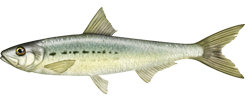 The Pacific sardine, Sardinops sagax caerulea


Feeding
[edit]Sardines feed almost exclusively on zooplankton and congregate wherever this is abundant.
Fisheries
[edit]

Typically, sardines are caught with encircling nets, particularly purse seines. Many modifications of encircling nets are used, including traps or fishing weirs. The latter are stationary enclosures composed of stakes into which schools of sardines are diverted as they swim along the coast. The fish are caught mainly at night, when they approach the surface to feed on plankton. After harvesting, the fish are submerged in brine while they are transported to shore.
Sardines are commercially fished for a variety of uses: for bait; for immediate consumption; for drying, salting, or smoking; and for reduction into fish meal or oil. The chief use of sardines is for human consumption, but fish meal is used as animal feed, while sardine oil has many uses, including the manufacture of paint, varnish, and linoleum.
Food and nutrition
[edit]| Nutritional value per 100 g (3.5 oz) | |||||||||||||||||||||||||||||||||||||||||||
|---|---|---|---|---|---|---|---|---|---|---|---|---|---|---|---|---|---|---|---|---|---|---|---|---|---|---|---|---|---|---|---|---|---|---|---|---|---|---|---|---|---|---|---|
| Energy | 774 kJ (185 kcal) | ||||||||||||||||||||||||||||||||||||||||||
0.54 g | |||||||||||||||||||||||||||||||||||||||||||
10.4 g | |||||||||||||||||||||||||||||||||||||||||||
20.9 g | |||||||||||||||||||||||||||||||||||||||||||
| |||||||||||||||||||||||||||||||||||||||||||
| Other constituents | Quantity | ||||||||||||||||||||||||||||||||||||||||||
| Water | 66.9 g | ||||||||||||||||||||||||||||||||||||||||||
| †Percentages estimated using US recommendations for adults,[70] except for potassium, which is estimated based on expert recommendation from the National Academies.[71] | |||||||||||||||||||||||||||||||||||||||||||
Sardines are commonly consumed by humans as a source of protein, omega-3 fatty acids, and micronutrients.[72] Sardines may be grilled, pickled, smoked, or preserved in cans.
Canned sardines are 67% water, 21% protein, 10% fat, and contain negligible carbohydrates (table). In a reference amount of 100 g (3.5 oz), canned sardines supply 185 calories of food energy and are a rich source (20% or more of the Daily Value, DV) of vitamin B12 (375% DV), phosphorus (29% DV), and niacin (26% DV) (table). Sardines are a moderate source (10–19% DV) of the B vitamins, riboflavin and pantothenic acid, and several dietary minerals, including calcium and sodium (18% DV each) (table). A 100 g serving of canned sardines supplies about 7 g combined of monounsaturated and polyunsaturated fatty acids (USDA source in table).
Because they are low in the food chain, sardines are low in contaminants, such as mercury, relative to other fish commonly eaten by humans,[72][73] and have a relatively low impact in production of greenhouse gases.[72]
History
[edit]_-_St_Mawes_at_the_Pilchard_Season_-_N00484_-_National_Gallery.jpg)
History of sardine fishing in the UK
[edit]Pilchard fishing and processing became a thriving industry in Cornwall, England from around 1750 to around 1880, after which it went into decline. Catches varied from year to year, and in 1871, the catch was 47,000 hogsheads, while in 1877, only 9,477 hogsheads. A hogshead contained 2,300 to 4,000 pilchards, and when filled with pressed pilchards, weighed 476 lbs. The pilchards were mostly exported to Roman Catholic countries such as Italy and Spain, where they are known as fermades. The chief market for the oil was Bristol, where it was used on machinery.[74]
Since 1997, sardines from Cornwall have been sold as 'Cornish sardines', and since March 2010, under EU law, Cornish sardines have Protected Geographical Status.[75] The industry has featured in numerous works of art, particularly by Stanhope Forbes and other Newlyn School artists.
The traditional "Toast to Pilchards" refers to the lucrative export of the fish to Catholic Europe:
- Here's health to the Pope, may he live to repent
- And add just six months to the term of his Lent
- And tell all his vassals from Rome to the Poles,
- There's nothing like pilchards for saving their souls![76]
History of sardine fishing in the United States
[edit]In the United States, the sardine canning industry peaked in the 1950s. Since then, the industry has been on the decline. The canneries in Monterey Bay, in what was known as Cannery Row in Monterey County, California (where John Steinbeck's novel of the same name was set), failed in the mid-1950s. The last large sardine cannery in the United States, the Stinson Seafood plant in Prospect Harbor, Maine, closed its doors on 15 April 2010 after 135 years in operation.[77]
In April 2015 the Pacific Fishery Management Council voted to direct NOAA Fisheries Service to halt the current commercial season in Oregon, Washington and California, because of a dramatic collapse in Pacific sardine stocks. The ban affected about 100 fishing boats with sardine permits, although far fewer were actively fishing at the time. The season normally would end 30 June.[78] The ban was expected to last for more than a year, and was still in place as of August 2025[update].[79]
In popular culture
[edit]The manner in which sardines can be packed in a can has led to the popular English language saying "packed like sardines", which is used metaphorically to describe situations where people or objects are crowded closely together.[80]
"Sardines" is also the name of a children's game, where one person hides and each successive person who finds the hidden one packs into the same space until only one is left out, who becomes the next one to hide.[81]
Among the residents of the Mediterranean city of Marseille, the local tendency to exaggerate is linked to a folk tale about a sardine that supposedly blocked the city's port in the 18th century. It was actually blocked by a ship called the Sartine.
Gallery
[edit]-
Sardines use body-caudal fin locomotion to swim, and streamline their bodies by holding their other fins flat against the body
-
 French sardine seiner
 -
 Exhibit of a woman canning sardines at the Maine State Museum in Augusta
.JPG)

See also
[edit]

References
[edit]- ^ a b c "FAO Fisheries & Aquaculture – FI fact sheet search". fao.org. Archived from the original on 8 May 2009. Retrieved 10 August 2018.
- ^ "What's an oily fish?". Food Standards Agency. 24 June 2004. Archived from the original on 10 December 2010.
- ^ "Sardine | Origin and meaning of sardine by Online Etymology Dictionary". etymonline.com. Archived from the original on 22 August 2011. Retrieved 10 August 2018.
- ^ "Sardine". The Good Food Glossary. BBC Worldwide. 2009. Archived from the original on 12 October 2008. Retrieved 1 November 2009.
- ^ "Sarda, Sardina". Dizionario Etimologico Online.
- ^ "FAQs". Seafish. Archived from the original on 22 July 2011. Retrieved 22 February 2010.
- ^ Stummer, Robin (17 August 2003). "Who are you calling pilchard? It's 'Cornish sardine' to you..." The Independent. Archived from the original on 12 September 2010. Retrieved 1 November 2009.
- ^ "Codex standard for canned sardines and sardine-type products codex stan 94 –1981 REV. 1–1995" (PDF). Codex Alimentarius. FAO/WHO Codex Alimentarius Commission. pp. 1–7. Archived (PDF) from the original on 25 March 2007. Retrieved 18 January 2007.
- ^ "sardine". Wiktionary. Retrieved 28 March 2018.
- ^ "σαρδίνη". The Online Liddell-Scott-Jones Greek-English Lexicon. Archived from the original on 12 May 2011. Retrieved 28 March 2018.
- ^ a b "sardine (n.)". Online Etymology Dictionary. Archived from the original on 21 April 2019. Retrieved 28 March 2018.
- ^ C. Michael Hogan, "Cydonia", Modern Antiquarian, 23 January 2008
- ^ This article incorporates text from a publication now in the public domain: "Sard". Encyclopædia Britannica (11th ed.). 1911.
- ^ "Sardius, Sardine". Vine's Expository Dictionary of NT Words (1940), hosted at StudyLight.org. Retrieved 28 March 2018.
- ^ "The Cottage Bonnet". The Mirror of Literature, Amusement, and Instruction: Containing Original Papers (1075): 155. 4 September 1841.
- ^ de Kock, Paul (1879) [1829]. La femme, le mari, et l'amant (in French). Sceaux, Paris: Imprimerie de Charaire et fils. p. 1.
- ^ Lippard, George (1849) [1845]. The Quaker City, Or, The Monks of Monk-Hall: A Romance of Philadelphia Life, Mystery, and Crime. Philadelphia: T. B. Peterson & Brothers. p. 222.
- ^ Canot, Théodore (September 1854). Mayer, Brantz (ed.). "Revelations of a slave trader; or Twenty years' adventures of Captain Canot". London: Richard Bentley. p. 61., although this is a free rendering from the French original "...il fallut...les entassér commes des sardines." (Canot, Théodore (1860) [1854]. Le capitaine Canot, ou vingt années de la vie d'un négrier (in French). Paris: Amyot. p. 88.) where 'entassér' can mean 'to cram together.
- ^ Froese, Rainer; Pauly, Daniel (eds.). "Sardina pilchardus". FishBase. April 2012 version.
- ^ "Species Fact Sheet: Sardina pilchardus". FAO. Archived from the original on 25 July 2012. Retrieved 10 August 2018.
- ^ "Sardina pilchardus". Integrated Taxonomic Information System. Retrieved 11 April 2012.
- ^ Tous P, Sidibé A, Mbye E, de Morais L, Camara YH, Adeofe TA, Munroe T, Camara K, Cissoko K, Djiman R, Sagna A, Sylla M (2015). "European Pilchard – Sardina pilchardus". IUCN Red List of Threatened Species. 2015 e.T198580A15542481. doi:10.2305/IUCN.UK.2015-4.RLTS.T198580A15542481.en.
- ^ Froese, Rainer; Pauly, Daniel (eds.). "Sardinops sagax". FishBase. April 2012 version.
- ^ "Species Fact Sheet: Sardinops sagax". FAO. Archived from the original on 29 July 2012. Retrieved 10 August 2018.
- ^ "Sardinops sagax". Integrated Taxonomic Information System. Retrieved 11 April 2012.
- ^ Gaughan D, Di Dario F, Hata H (2018). "Sardinops sagax". IUCN Red List of Threatened Species. 2018 e.T183347A15602965. Retrieved 11 December 2018.
- ^ Grant, W. S.; et al. (1998). "Why restriction fragment length polymorphism analysis of mitochondrial DNA failed to resolve sardine (Sardinops) biogeography: insights from mitochondrial DNA cytochrome b sequences". Canadian Journal of Fisheries and Aquatic Sciences. 55 (12): 2539–47. Bibcode:1998CJFAS..55.2539G. doi:10.1139/f98-127.
- ^ Froese, Rainer; Pauly, Daniel (eds.). "Sardinops melanostictus". FishBase. April 2012 version.
- ^ "Species Fact Sheet: Sardinops melanostictus". FAO. Archived from the original on 24 September 2015. Retrieved 10 August 2018.
- ^ "Sardinops melanostictus". Integrated Taxonomic Information System. Retrieved 11 April 2012.
- ^ Froese, Rainer; Pauly, Daniel (eds.). "Sardinops caeruleus". FishBase. April 2012 version.
- ^ "Species Fact Sheet: Sardinops caeruleus". FAO. Archived from the original on 14 December 2012. Retrieved 10 August 2018.
- ^ "Sardinops caeruleus". Integrated Taxonomic Information System. Retrieved 11 April 2012.
- ^ Froese, Rainer; Pauly, Daniel (eds.). "Sardinops ocellatus". FishBase. April 2012 version.
- ^ "Species Fact Sheet: Sardinops ocellatus". FAO. Archived from the original on 13 December 2012. Retrieved 10 August 2018.
- ^ "Sardinops ocellatus". Integrated Taxonomic Information System. Retrieved 11 April 2012.
- ^ Froese, Rainer; Pauly, Daniel (eds.). "Sardinella lemuru". FishBase. April 2012 version.
- ^ "Species Fact Sheet: Sardinella lemuru". FAO. Archived from the original on 13 December 2012. Retrieved 10 August 2018.
- ^ "Sardinella lemuru". Integrated Taxonomic Information System. Retrieved 11 April 2012.
- ^ Santos M (2018). "Bali sardinella – Sardinella lemuru". IUCN Red List of Threatened Species. 2018 e.T75154879A75154994. Retrieved 11 December 2018.
- ^ Froese, Rainer; Pauly, Daniel (eds.). "Sardinella brasiliensis". FishBase. April 2012 version.
- ^ "Species Fact Sheet: Sardinella brasiliensis". FAO. Archived from the original on 7 November 2012. Retrieved 10 August 2018.
- ^ "Sardinella brasiliensis". Integrated Taxonomic Information System. Retrieved 11 April 2012.
- ^ Di Dario F (2018). "Brazilian Sardinella – Sardinella brasiliensis". IUCN Red List of Threatened Species. 2018 e.T16466246A16510172. Retrieved 11 December 2018.
- ^ Froese, Rainer; Pauly, Daniel (eds.). "Sardinella zunasi". FishBase. April 2012 version.
- ^ "Species Fact Sheet: Sardinella zunasi". FAO. Archived from the original on 13 December 2012. Retrieved 10 August 2018.
- ^ "Sardinella zunasi". Integrated Taxonomic Information System. Retrieved 11 April 2012.
- ^ Hata H, Munroe TA, Gaughan D, Mohd Arshaad W (2017). "Sardinella zunasi". IUCN Red List of Threatened Species. 2017 e.T75155119A75155131. doi:10.2305/IUCN.UK.2017-3.RLTS.T75155119A75155131.en.
- ^ Froese, Rainer; Pauly, Daniel (eds.). "Sardinella longiceps". FishBase. April 2012 version.
- ^ "Species Fact Sheet: Sardinella longiceps". FAO. Archived from the original on 8 May 2012. Retrieved 10 August 2018.
- ^ "Sardinella longiceps". Integrated Taxonomic Information System. Retrieved 11 April 2012.
- ^ Munroe TA; Priede IG (2010). "Sardinella longiceps". IUCN Red List of Threatened Species. 2010 e.T154989A55159768. doi:10.2305/IUCN.UK.2020-1.RLTS.T154989A55159768.en. Retrieved 18 October 2022.
- ^ Froese, Rainer; Pauly, Daniel (eds.). "Sardinella gibbosa". FishBase. April 2012 version.
- ^ "Species Fact Sheet: Sardinella gibbosa". FAO. Archived from the original on 1 November 2012. Retrieved 10 August 2018.
- ^ "Sardinella gibbosa". Integrated Taxonomic Information System. Retrieved 11 April 2012.
- ^ Santos M, Villarao MC, Tambihasan AM, Villanueva JA, Parido L, Lopez G, Deligero R, Alcantara M, Doyola MC, Gatlabayan LV, Buccat FGA, Lanzuela N, Belga PB, Gapuz AV, Al-Khalaf K, Kaymaram F (2018). "Goldstripe Sardinella – Sardinella gibbosa". IUCN Red List of Threatened Species. 2018 e.T46075248A46664239. Retrieved 11 December 2018.
- ^ Froese, Rainer; Pauly, Daniel (eds.). "Sardinella aurita". FishBase. April 2012 version.
- ^ "Species Fact Sheet: Sardinella aurita". FAO. Archived from the original on 7 November 2012. Retrieved 10 August 2018.
- ^ "Sardinella aurita". Integrated Taxonomic Information System. Retrieved 11 April 2012.
- ^ Munroe T, Brown J, Aiken KA, Grijalba Bendeck L (2017) [errata version of 2015 assessment]. "Round Sardinella – Sardinella aurita". IUCN Red List of Threatened Species. 2015 e.T198581A115340607. doi:10.2305/IUCN.UK.2015-4.RLTS.T198581A15542908.en.
- ^ Froese, Rainer; Pauly, Daniel (eds.). "Sardinella maderensis". FishBase. April 2012 version.
- ^ "Species Fact Sheet: Sardinella maderensis". FAO. Archived from the original on 14 December 2012. Retrieved 10 August 2018.
- ^ "Sardinella maderensis". Integrated Taxonomic Information System. Retrieved 11 April 2012.
- ^ Tous P, Sidibé A, Mbye E, de Morais L, Camara K, Munroe T, Adeofe TA, Camara YH, Djiman R, Sagna A, Sylla M (2015). "Madeiran Sardinella – Sardinella madeirensis". IUCN Red List of Threatened Species. 2015 e.T198582A15543624. doi:10.2305/IUCN.UK.2015-4.RLTS.T198582A15543624.en.
- ^ Froese, Rainer; Pauly, Daniel (eds.). "Sardinella marquesensis". FishBase. August 2021 version.
- ^ Froese, Rainer; Pauly, Daniel (eds.). "Dussumieria acuta". FishBase. April 2012 version.
- ^ "Species Fact Sheet: Dussumieria acuta". FAO. Archived from the original on 13 December 2012. Retrieved 10 August 2018.
- ^ "Dussumieria acuta". Integrated Taxonomic Information System. Retrieved 11 April 2012.
- ^ Santos M, Hata H, Villanueva JA, Parido L, Lanzuela N, Gapuz AV, Deligero R, Belga PB, Alcantara M, Buccat FGA, Doyola MC, Gatlabayan LV, Lopez G, Tambihasan AM (2017). "Hasselt's Sprat – Dussumieria acuta". IUCN Red List of Threatened Species. 2017 e.T18124721A46663954. doi:10.2305/IUCN.UK.2017-3.RLTS.T18124721A46663954.en.
- ^ United States Food and Drug Administration (2024). "Daily Value on the Nutrition and Supplement Facts Labels". FDA. Archived from the original on 27 March 2024. Retrieved 28 March 2024.
- ^ "TABLE 4-7 Comparison of Potassium Adequate Intakes Established in This Report to Potassium Adequate Intakes Established in the 2005 DRI Report". p. 120. In: Stallings, Virginia A.; Harrison, Meghan; Oria, Maria, eds. (2019). "Potassium: Dietary Reference Intakes for Adequacy". Dietary Reference Intakes for Sodium and Potassium. pp. 101–124. doi:10.17226/25353. ISBN 978-0-309-48834-1. PMID 30844154. NCBI NBK545428.
- ^ a b c "Why eat lower on the seafood chain?". Harvard Health Publishing, Harvard University Medical School. 22 March 2023. Retrieved 3 September 2024.
- ^ "Mercury Levels in Commercial Fish and Shellfish". U S Food and Drug Administration. 5 July 2009. Archived from the original on 24 October 2011. Retrieved 1 November 2009.
- ^ Buckland, Frank (26 February 1880). "Our Fisheries". The Cornishman. No. 85. p. 6.
- ^ "Directory of PGI/PDO/TSG – Cornish Sardines profile". EC, Agriculture and Rural Development. Archived from the original on 10 August 2018. Retrieved 1 November 2010.
- ^ Rawe, Donald R (1992). Traditional Cornish Stories and Rhymes. Lodenek Press. ISBN 0-902899-08-2.
- ^ Canfield, Clarke (15 April 2010). "Last sardine plant in U.S. shuts its doors". Associated Press. Archived from the original on 23 September 2020. Retrieved 15 April 2010.
- ^ "Feds Cancel Commercial Sardine Fishing After Stocks Crash". North Country Public Radio, St. Lawrence University, Canton, New York. 16 April 2015. Retrieved 28 March 2018.
- ^ "Pacific Sardine". NOAA Fisheries. 9 October 2024. Retrieved 10 August 2025.
- ^ "packed like sardines | Definition of packed like sardines in English by Oxford Dictionaries". Oxford Dictionaries | English. Archived from the original on 11 October 2017. Retrieved 10 August 2018.
- ^ "Stinky Sardine Club – ITPedia". Itpedia.nyu.edu. 9 April 2010. Archived from the original on 29 November 2014. Retrieved 21 June 2012.
Further reading
[edit]- Parrish, R. H.; et al. (1989). "The monotypic sardines, Sardina and Sardinops: Their taxonomy, distribution, stock structure, and zoogeography" (PDF). Can. J. Fish. Aquat. Sci. 46 (11): 2019–36. Bibcode:1989CJFAS..46.2019P. doi:10.1139/f89-251.
External links
[edit]


Sardines (pilchards) | ||
|---|---|---|
| Notable species |  | |
| Ecology | ||
| Culinary use | ||
| Popular culture | ||

Principal commercial fishery species groups | ||||||||||||||||||||
|---|---|---|---|---|---|---|---|---|---|---|---|---|---|---|---|---|---|---|---|---|
| Wild |
|  .png)  | ||||||||||||||||||
| Farmed | ||||||||||||||||||||

Sardine
View on GrokipediaTaxonomy and Classification
Etymology
The English term "sardine" first appeared in the early 15th century, referring to a small, oily, migratory fish prized as food, borrowed from Old French sardine.[12] This Old French form derives directly from Latin sardina or sarda, which in turn traces to Late Greek sardinē or sardinos.[12] [13] The Greek root sardinos (or earlier sardon) is commonly linked to the island of Sardinia in the Mediterranean, where schools of these fish were historically abundant and commercially fished in large quantities, leading to the name's association with the region.[12] [14] Alternative theories propose that the Greek term may originally describe a specific type of fish (sarda) unrelated to geography, or derive from a Sardinian dialectal word for the fish, though the Sardinia abundance explanation predominates in etymological accounts.[12] [15] While some speculative origins suggest pre-Greek influences, such as Phoenician terms for reddish gems (sard for carnelian, evoking the fish's hue), these lack direct attestation for the piscine sense and are not widely accepted.[16]Genera
The term "sardine" refers to small, oily forage fish primarily within the family Clupeidae, encompassing several genera characterized by their schooling behavior, planktivorous diet, and importance in commercial fisheries. The principal genera are Sardina, Sardinops, and Sardinella, which include species exploited for canning and fresh markets worldwide. These genera share morphological traits such as a fusiform body, single dorsal fin, and adipose fin absent, adapted for fast swimming in pelagic environments.[17] The genus Sardina is monotypic, represented exclusively by Sardina pilchardus, the European pilchard, which inhabits temperate coastal waters of the northeastern Atlantic from the British Isles to Senegal and throughout the Mediterranean Sea. This species forms the basis for major fisheries in Portugal, Morocco, and Spain, with historical catches exceeding 1 million tonnes annually in peak years. Sardinops likewise consists of a single species, Sardinops sagax, known as the South American pilchard or Pacific sardine, with subspecies ranging from the eastern Pacific off California (S. s. caerulea) to the western Pacific near Japan and the Indo-Pacific. These populations exhibit boom-bust cycles influenced by oceanographic conditions, supporting fisheries that peaked at over 4 million tonnes globally in the 1980s before declines in some stocks.[9][17] The genus Sardinella comprises approximately 28 species of tropical and subtropical sardines, predominantly in the Indo-West Pacific, including the Indian oil sardine (Sardinella longiceps), which sustains India's largest single-species fishery with landings around 500,000 tonnes in recent years. These species thrive in warmer waters, often forming dense schools near the surface, and contribute significantly to multispecies clupeid catches in regions like Southeast Asia and West Africa.[18][19] While other clupeid genera such as Sprattus (sprats) or Harengula (tropical herrings) may occasionally be marketed as sardines regionally, the aforementioned three genera account for the majority of global sardine production and define the core taxonomic group.[5]Principal Species
The principal species encompassed by the term "sardine" are small, pelagic clupeids primarily from the genera Sardina and Sardinops, valued for their abundance and role in fisheries. These species form dense schools that typically contain thousands to millions of individuals and serve as key forage fish in marine ecosystems. Commercially, they support large-scale harvests, with global captures fluctuating based on population dynamics.[20][5] Sardina pilchardus, known as the European pilchard, inhabits the northeastern Atlantic Ocean from Portugal to Senegal and the Mediterranean Sea, preferring coastal waters up to 200 meters deep. It grows to a maximum length of 27 cm and matures at around 1-2 years, contributing significantly to European canned sardine production.[21][20] Sardinops sagax, the Pacific sardine or South American pilchard, ranges widely across temperate waters of the eastern Pacific from Baja California to Chile, as well as southern Australia and South Africa. This species reaches up to 38 cm in length and forms massive schools that can reach up to 10 million individuals and migrate seasonally, underpinning fisheries that peaked at millions of tons in the mid-20th century before declining in the 1990s due to overfishing and environmental factors. Subspecies like S. s. caerulea occur off California, noted for their blue-green backs and dark spots.[9][22][5][20] Sardinops melanostictus, the Japanese pilchard, is distributed in the western Pacific from Japan to Australia, exhibiting boom-bust population cycles that have driven major fishery yields, such as over 4 million tons annually in the 1980s. It shares similar schooling behavior and planktonic diet with congeners but is adapted to subtropical currents.[20][1] Other notable species include Sardinella aurita, the Spanish sardine, found in the western Atlantic and Gulf of Mexico, which supports regional fisheries despite variable stock assessments. These principal species collectively account for the bulk of sardine landings, though exact compositions vary by region and market definitions.[23]Biological Characteristics
Anatomy and Physiology
Sardines display a fusiform body morphology, elongated and moderately compressed laterally, which facilitates rapid sustained swimming in open ocean environments.[24] The skin is clad in cycloid scales that shed readily, with no lateral line organ, and a ventral row of scutes forms a protective keel along the abdomen.[24] Typical adult lengths range from 15 to 25 cm, though some species like Sardinops sagax reach up to 39.5 cm standard length.[25] Coloration features a metallic blue-green back fading to silvery sides, enhancing reflective camouflage against marine backgrounds.[24] Fin structures include a single dorsal fin bearing 13-21 soft rays positioned near midbody, abdominal pelvic fins, low-set pectoral fins, an anal fin with 12-23 rays posterior to the dorsal origin, and a deeply forked caudal fin for propulsion.[26] The terminal mouth has a short, deep lower jaw with minute teeth, complemented by 2 supramaxillae.[24] Gills are equipped with numerous fine rakers—48-62 on the first arch in Sardina pilchardus—enabling efficient filtration of planktonic prey.[26] Internally, the skeleton is ossified, supporting a swim bladder for buoyancy regulation, while the digestive system is adapted for rapid processing of particulate food.[24] Physiologically, sardines sustain aerobic metabolism through constant schooling and swimming, bolstered by elevated muscle lipid reserves that provide energy density.[27] Respiration occurs via ram ventilation during forward motion, with gill surfaces optimized for oxygen extraction in oxygenated surface waters.[26] They tolerate water temperatures from 9°C to 25°C, influencing metabolic rates and distribution, and exhibit body compositions rich in protein (approximately 20%) and omega-3 fatty acids (over 1 g/100 g).[26] [25] Sensory capabilities feature large eyes for enhanced vision in dim pelagic zones and otolith-based audition for detecting hydrodynamic cues from conspecifics and predators.[26]
Habitat and Distribution
Sardines inhabit epipelagic zones of temperate and subtropical marine environments, typically forming dense schools in coastal and offshore waters where upwelling supports high primary productivity. These small clupeid fish prefer water temperatures between 10–20°C and are distributed across the Atlantic, Pacific, and Indian Oceans, with species-specific ranges influenced by ocean currents and seasonal migrations.[28][29] The European pilchard (Sardina pilchardus), a principal species, ranges throughout the northeast Atlantic from Iceland and the North Sea southward to Senegal, with common occurrence in the western Mediterranean and Adriatic Seas, as well as the Black Sea; it occupies depths of 10–100 meters.[26][28] This distribution aligns with upwelling systems along the Iberian and Moroccan coasts, where cooler waters enhance foraging opportunities.[28] The Pacific sardine (Sardinops sagax), another key species, is found along the northeastern Pacific from northern Baja California to southeastern Alaska, inhabiting nearshore and offshore water columns, occasionally entering estuaries.[9] Subpopulations extend to the Gulf of California, southern Australia, and waters off Japan and South Africa, with abundance tied to El Niño-Southern Oscillation cycles affecting temperature and prey distribution.[30][31] Other sardine species, such as those in the genus Sardinops, similarly cluster in productive upwelling zones off western Africa, South America, and southern Australia, exhibiting dynamic distributions responsive to environmental variability.[28][32]Feeding Habits
Sardines, as small pelagic clupeids, are predominantly planktivorous filter feeders, utilizing specialized gill rakers to strain microscopic prey from the water column during schooling foraging bouts, often concentrated at dawn and dusk. Their diet comprises primarily zooplankton such as copepods, which can constitute 30-56% of intake by biomass or frequency, alongside decapod larvae, mysids, cirripede nauplii, and fish eggs, with selective preference for higher-energy items like the latter. Phytoplankton, including diatoms and dinoflagellates, supplements the diet but typically contributes less than 10% to adult carbon uptake, though it increases seasonally in spring due to blooms.[33][34][35] In the European pilchard (Sardina pilchardus), feeding ecology reveals ontogenetic shifts: larvae and early juveniles target smaller naupliar stages and protists, transitioning to larger copepods and cladocerans as gill raker spacing widens with growth beyond 40 mm total length, enabling capture of prey up to 18 mm. Adults in regions like the northern Adriatic or Gulf of Trieste ingest a broad spectrum of 87 prey taxa from 17 μm to 18.4 mm, with zooplankton dominating (over 90% carbon) and spatial variations linked to upwelling fronts enhancing prey density. Seasonal patterns show higher feeding intensity in productive periods, with copepods (e.g., Centropages spp.) and decapod larvae peaking in summer.[36][37][33] For the South American or Pacific pilchard (Sardinops sagax), diet composition emphasizes zooplankton like smaller copepods and fewer euphausiids compared to sympatric anchovities, with juveniles prioritizing crustacean nauplii and adults incorporating phytoplankton via a unique pyloric caeca adaptation for vegetative digestion—up to 62% plants in some Peruvian stocks. In upwelling systems like the Humboldt or Benguela Currents, prey shifts occur with environmental forcing, such as El Niño events favoring copepod-heavy diets over diatom reliance in normal years. Nearshore feeding (<150 m isobath) yields higher zooplankton proportions than offshore, reflecting patchier prey distribution.[38][22][39]Reproduction and Life Cycle
Sardines are oviparous broadcast spawners, with females releasing buoyant, pelagic eggs into the water column where they are externally fertilized by males.[22][40] In principal species such as the European pilchard (Sardina pilchardus), spawning occurs in multiple batches over an extended season, typically from October to March or April in temperate Atlantic and Mediterranean waters, with peaks from October to February.[41][42] For the Pacific sardine (Sardinops sagax), spawning is similarly protracted, often from February to August off California, influenced by sea surface temperatures above 15°C, and involves repeated egg releases per female during favorable conditions.[9] Sexual maturity is attained rapidly, usually by the end of the first year of life, at sizes ranging from 102–124 mm total length depending on sex and population.[40] Batch fecundity varies by species and individual size; S. pilchardus females produce thousands of eggs per batch, with total seasonal output scaling with body length, while S. sagax can release 9,000–100,000 eggs per spawning event.[41] Eggs hatch within 2–3 days under optimal temperatures (15–20°C), yielding planktonic larvae that undergo rapid development amid high predation risks.[9][43] Larval stages last 20–60 days, during which juveniles grow quickly on a diet of zooplankton, reaching 50–100 mm standard length by recruitment into adult schools.[43] Growth rates peak early, with daily increments up to 0.71 mm in S. sagax juveniles around 74 days post-hatch, slowing as fish approach maturity.[43] Lifespan is short, typically 3–5 years for most individuals, though some S. sagax reach 13 years or more under ideal conditions; high natural mortality and fisheries exploitation drive fast life-history strategies emphasizing early reproduction over longevity.[3][28] Environmental factors like temperature and food availability modulate spawning success and larval survival, contributing to population fluctuations.[40][44]Population Ecology
Dynamics and Fluctuations
Sardine populations exhibit pronounced boom-and-bust cycles, with abundance fluctuating dramatically over decadal scales due to a combination of environmental forcing and density-dependent processes. These dynamics are particularly evident in small pelagic fisheries, where recruitment success drives rapid increases followed by collapses when environmental conditions shift unfavorably or fishing pressure intensifies. For instance, in the California Current Ecosystem, Pacific sardine (Sardinops sagax) stocks expanded in the early 20th century, supporting massive harvests exceeding 200,000 metric tons annually by the 1930s, before crashing in the 1950s to levels below 10,000 metric tons amid cooling sea surface temperatures and overexploitation.[29][45] Recovery occurred in the late 20th century, with biomass peaking again around 1.5 million metric tons in the 2000s, only to decline sharply post-2010 due to marine heatwaves and inadequate harvest controls, reducing spawning biomass to under 100,000 metric tons by 2020.[46][47] Such cycles often correlate inversely with anchovy populations, reflecting regime shifts in upwelling systems where cooler, nutrient-rich conditions favor sardines, while warmer regimes benefit anchovies. In the Benguela and Humboldt Currents, similar alternations have been documented, with sardine booms in the 1950s–1970s giving way to anchovy dominance by the 1980s–1990s, linked to wind-driven upwelling variability and sea surface temperature anomalies exceeding 1–2°C.[48] Overfishing exacerbates these natural oscillations; modeling indicates that without adaptive management, exploitation rates above 10–15% of biomass can prolong recoveries by decades, as seen in the Pacific sardine moratorium from 1967 to 1986.[47][49] For the European pilchard (Sardina pilchardus), fluctuations are less extreme but still significant, with recruitment variability tied to North Atlantic Oscillation phases influencing Iberian shelf upwelling. Biomass in the western Mediterranean and Atlantic stocks has varied by factors of 2–3 over 20-year periods, such as a decline from 500,000 metric tons in the 2000s to around 200,000 metric tons by 2015, attributed to reduced growth rates and shifting phenology amid warming trends.[50][51] Projections under climate scenarios forecast poleward range shifts and further low-frequency variability, potentially reducing catches in traditional southern European grounds by 20–50% by 2100.[32][52] These patterns underscore sardines' sensitivity to oceanographic drivers, with empirical models emphasizing temperature-recruitment thresholds where stocks below optimal ranges (e.g., 14–18°C for Pacific sardine) trigger density-independent declines.[53]Environmental and Climatic Influences
Sardine populations, particularly species like the Pacific sardine (Sardinops sagax), exhibit pronounced fluctuations driven by ocean temperature variability, with warmer sea surface temperatures generally favoring higher abundances and recruitment success.[54] Historical data indicate that Pacific sardine stocks expanded during warm periods, such as the 1930s and 1940s, reaching peak biomasses exceeding 40 billion individuals, while collapsing in cooler regimes of the 1950s due to reduced survival in early life stages.[52] These patterns align with the Pacific Decadal Oscillation (PDO), where positive (warm) phases correlate with sardine booms and negative (cool) phases with declines, as observed in California Current ecosystems.[49] In contrast, anchovy populations often thrive under cooler conditions, highlighting a competitive dynamic where temperature shifts alter relative dominance of small pelagic fish assemblages.[55] Regional differences exist; for instance, sardines in eastern boundary currents like the California Current respond positively to warming, whereas western boundary systems show opposing life-history adjustments to temperature anomalies.[56] El Niño events, characterized by anomalous warming, have boosted sardine spawning in Peruvian waters while suppressing anchovy productivity, demonstrating event-specific benefits to sardine stocks.[57] Ongoing ocean warming under climate change is projected to drive poleward distribution shifts in sardine habitats, with models estimating displacements of 500–800 km by the end of the century depending on emission scenarios, potentially altering fishery access and yields.[32] Elevated temperatures may also constrain individual growth, as evidenced by smaller adult sizes in recent California sardine cohorts amid rising ocean heat. However, some projections suggest increased abundances in northern latitudes post-2060 under high-warming scenarios, mediated by temperature effects on vital rates like larval survival.[52] These influences underscore the sensitivity of sardine ecology to climatic forcing, interacting with density-dependent factors to shape population trajectories.[58]Fisheries and Harvesting
Historical Development
Sardines were initially harvested through subsistence and local trade in Mediterranean and Atlantic coastal regions, with evidence of exploitation dating back to Roman times when abundant schools off Lisbon became a dietary staple following settlement in 19 BC.[59] The development of commercial fisheries accelerated with the invention of canning, which allowed preservation and export beyond fresh markets. In France, the first commercial canning of sardines occurred in Nantes in 1834, creating a viable product for international trade by 1860.[60] This technology spread rapidly across Europe, with Portugal establishing its first cannery, Ramirez, in 1853, integrating sardine processing into national industry amid growing demand.[61] In the United States, East Coast canning began in 1875 at Eastport, Maine, where the Eagle Preserved Fish Company processed herring as sardines, spurring a robust industry reliant on female labor for packing.[62] Pacific Coast development followed in 1896 with the opening of the first sardine cannery in San Pedro, California, targeting the Pacific sardine (Sardinops sagax).[60] The early 20th century witnessed exponential growth driven by wartime needs and mechanization. In California, the fishery expanded from the 1910s, peaking in the 1930s as the state's most valuable, with annual landings exceeding 200,000 tons amid surging demand during World War I.[63][64] European fisheries, such as in Cornwall, relied on traditional drift netting for centuries but industrialized with purse seines, while French operations employed over 31,000 fishermen by 1898.[65] Post-war booms occurred globally, including in Brazil where production hit 228,000 tons in 1973 before declining due to overexploitation.[66] Population fluctuations and overfishing led to early regulatory responses, exemplified by California's sardine moratorium from 1967 to 1986 following a 1950s collapse.[45] These cycles underscored the interplay of environmental variability and harvesting intensity in shaping fishery trajectories.[67]Regional Variations
Sardine fisheries display marked regional differences in targeted species, harvest volumes, primary end uses, and vulnerability to environmental shifts. In northwest Africa and the Iberian Peninsula, operations focus on the European pilchard (Sardina pilchardus), harvested via purse seines from dense coastal schools. Morocco dominates this region, recording sardine landings of about 965,000 metric tons in 2022, mainly destined for canning and international export markets.[68] These catches dropped 46% by 2024, reflecting stock variability linked to upwelling dynamics and overfishing pressures.[68] Adjacent fisheries in Portugal and Spain emphasize similar artisanal and industrial purse-seine methods, contributing to regional totals but at smaller scales, with emphasis on fresh and processed products for domestic consumption.[69] In southern Africa, the South African pilchard (Sardinops sagax) fishery operates off the west and south coasts, utilizing purse seiners to capture migrating schools during the annual "sardine run." Historical landings have varied widely, from 15,000 to 400,000 metric tons annually, supporting diverse outlets including canning for human food, bait for recreational and commercial fisheries, and reduction to fishmeal and oil.[2] Recent decades show declining trends, influenced by shifting distributions and competition with anchovy stocks.[70] Eastern Pacific fisheries target Sardinops sagax subspecies, with stark contrasts in scale and utilization. California's operations, historically peaking in the mid-20th century, now face severe restrictions; 2023 quotas limited live-bait harvests to 2,500 metric tons amid overfished status determinations.[71] Further south, Peru and Chile experienced boom-and-bust cycles, with Peruvian sardine catches surpassing 3 million metric tons annually in the late 20th century for fishmeal export, but collapsing to near-zero commercial levels by the 2010s due to El Niño events and excessive harvesting.[72] Northern Chilean fisheries maintain modest purse-seine efforts for both reduction and direct consumption, though overshadowed by anchoveta dominance.[73]Current Practices and Catches
Purse seining constitutes the primary harvesting method for sardines globally, targeting dense midwater schools of species such as Sardina pilchardus and Sardinops spp.[74] Operations often occur at night, utilizing echosounders or sonar to detect aggregations, followed by deployment of encircling nets that are pursed to enclose the fish.[75] Onboard handling practices include brailing catches into holds or crates with flake ice to preserve freshness, though variations exist by vessel size and region.[76] Smaller-scale fisheries may employ gillnets, lampara nets, or trawling, but these are less common for industrial-scale production.[77] Major sardine catches are concentrated in the eastern Atlantic and Pacific Ocean. In northwest Africa, particularly Morocco, the European pilchard fishery has experienced declines, with catches dropping amid concerns over overfishing and climate impacts, though exact 2023-2024 volumes remain pressured by stock depletions in southern zones.[78] Russia's Pacific fishery for Japanese sardine (Sardinops melanostictus) recorded 544,000 metric tons in 2023, a post-Soviet record, with quotas increased to 1.2 million tons for 2025 despite earlier shortfalls.[79] [80] In the Americas, Pacific sardine (Sardinops sagax) fisheries vary by region. Off Chile, southern stocks showed improvement in status by 2025 compared to 2023 assessments.[81] Peru's landings, including sardine components, contributed to total fishery volumes exceeding 5.8 million tons in 2024, though dominated by anchoveta.[82] Along the U.S. West Coast, the fishery faced restrictions, including a 2025 closure for human consumption due to elevated domoic acid levels in southern California stocks, reflecting ongoing biomass fluctuations and health risks.[83] [84] Global sardine capture is estimated at approximately 3.6 million metric tons in 2024, with much directed toward fishmeal and oil production alongside canned products for human use.[85] Catch volumes continue to exhibit high variability tied to environmental drivers and management responses, underscoring the need for adaptive practices in these pulse fisheries.[86]Management Strategies
Sardine fisheries management emphasizes stock assessments, harvest control rules, and adaptive strategies to address natural population fluctuations driven by environmental factors. Annual biomass estimates guide total allowable catches (TACs), with cutoffs to prevent overexploitation during low-abundance phases. For instance, the Pacific sardine (Sardinops sagax) fishery off the U.S. West Coast operates under the Coastal Pelagic Species Fishery Management Plan, administered by NOAA Fisheries and the Pacific Fishery Management Council.[9] Harvesting ceases when biomass drops below 150,000 metric tons, as occurred from 2015 onward, limiting catches to incidental bycatch, live bait, or minor directed fisheries.[87] A 2025 rebuilding plan caps annual harvests at the lower of 5% of biomass or 2,200 metric tons to facilitate recovery.[88] In the Northeast Atlantic and Mediterranean, the European pilchard (Sardina pilchardus) is assessed by the International Council for the Exploration of the Sea (ICES), which provides advice on TACs for divisions like 8.c and 9.a based on acoustic surveys and biological sampling.[89] The General Fisheries Commission for the Mediterranean (GFCM) adopted its first harvest control rules in 2024 for sardine and anchovy stocks in the Adriatic Sea, aiming for proactive limits tied to spawning stock biomass.[90] Iberian stocks, shared between Spain and Portugal, incorporate ecosystem-based management through projects evaluating predator-prey dynamics and environmental drivers to refine TAC allocations.[91] Ecosystem considerations increasingly inform strategies, recognizing sardines' role as forage for larger predators, which justifies conservative quotas to maintain trophic balance.[92] Management strategy evaluations (MSEs) test harvest rules under climate variability scenarios, as applied to Pacific sardine, revealing the need for flexible TAC adjustments to buffer against regime shifts.[93] In regions like Morocco, separate stock delineations for Atlantic and Mediterranean populations underpin localized TACs, informed by landings data and environmental monitoring.[28] International cooperation via bodies like GFCM and ICES ensures transboundary stock coordination, though challenges persist from illegal fishing and data gaps in smaller fleets.[94]Sustainability Controversies
The Pacific sardine (Sardinops sagax) fishery off the U.S. West Coast has faced repeated collapses, with the 1950s downturn linked to excessive exploitation amid booming catches exceeding 700,000 metric tons annually in the 1930s, followed by a sharp decline to negligible levels by 1952.[95] A second collapse occurred in the early 1990s, as landings fell from 300,000 tons in 1989 to 10,000 tons in 1991, prompting debates on whether overfishing or environmental shifts, such as cooler ocean conditions reducing recruitment, were dominant factors.[47] [96] These events underscore sardines' vulnerability to boom-bust cycles, where high exploitation rates during warm, productive regimes amplify risks during subsequent cold phases with poor survival.[96] In southern Africa, the sardine (Sardinops sagax) stock collapsed around 2014-2015, severely impacting artisanal and commercial fishers' livelihoods, with catches dropping amid ongoing high fishing pressure and environmental variability.[97] Similarly, the European pilchard (Sardina pilchardus) in the Alboran Sea experienced an 81% production decline from 2018 to 2020 due to overfishing, as stocks faced elevated mortality beyond natural levels.[98] Seafood Watch assesses many European pilchard fisheries as high-risk for collapse owing to overexploitation and inadequate management, recommending avoidance, though some stocks show no current depletion per ICES evaluations, highlighting discrepancies in assessment methods.[99] [100] Broader controversies involve stock assessment models, which a 2024 analysis found systematically overestimate sustainability, suggesting 85% more global stocks, including small pelagics like sardines, have collapsed below 10% of unfished biomass than officially reported, due to biases ignoring historical overfishing legacies.[101] These "ghosts of overfishing past" prolong recovery even under reduced effort, as altered age structures reduce productivity.[102] In 2020, U.S. Pacific sardine surveys sparked disputes over biomass estimates, leading to fishery closures amid claims of methodological flaws favoring conservative thresholds.[103] Despite quotas and monitoring, persistent high exploitation in regions like Morocco's FAO Area 34 raises sustainability doubts, with sardines comprising over 50% of small pelagic catches but vulnerable to recruitment failures.Nutritional Profile
Chemical Composition
Sardines exhibit a proximate composition dominated by water and protein, with notable lipid content contributing to their oily nature. In fresh Sardina pilchardus, moisture averages 69.46 ± 0.77%, crude protein 18.41 ± 0.12%, crude fat 10.77 ± 0.33%, ash 1.28 ± 0.21%, and carbohydrates 0.08%. [104] These values fluctuate by species, season, and environmental factors; for instance, wild sardines from certain populations show protein levels up to 20% and fat varying from 8-15% depending on reproductive cycles and feeding availability. [105] Carbohydrates remain minimal (<1%), as sardines derive energy primarily from lipids and proteins. [106] Lipids in sardine muscle are rich in polyunsaturated fatty acids (PUFAs), particularly long-chain n-3 variants essential for human health. Wild sardines contain approximately 2560 mg/100 g wet mass of n-3 long-chain PUFAs, including eicosapentaenoic acid (EPA, 20:5n-3) and docosahexaenoic acid (DHA, 22:6n-3), which comprise major portions of total fatty acids (DHA often exceeding 35%). [107] [106] Palmitic acid (16:0) is the predominant saturated fatty acid, while oleic acid (18:1n-9) features among monounsaturated types. [106] Processing methods like roasting or canning can alter profiles slightly, reducing some PUFAs due to oxidation but preserving overall omega-3 dominance. [108] Proteins in sardines are high-quality, complete sources with balanced essential amino acids, supporting their role as a lean protein option (typically 18-25 g/100 g edible portion). [106] Mineral content is substantial, especially in edible bone-inclusive preparations; per 100 g of Atlantic sardines (canned in oil, drained with bone), calcium reaches 382 mg (38% DV), phosphorus ~490 mg, magnesium 39 mg, potassium 397 mg, selenium ~52 µg (95% DV), iron ~2.9 mg, and zinc ~1.3 mg. [109] Vitamins include B12 (8.9 µg/100 g, >300% DV), D (4.8 µg, 24% DV), and E, with trace B3 and B2. [109] [110] A standard can of sardines (Atlantic, canned in oil, drained solids with bone, serving size 1 can = 92g) contains approximately 191 calories, 23g protein, and 11g fat. Values can vary slightly by brand, packing medium (oil vs. water), and exact can size; this is based on USDA data for a common type. [111] These micronutrients reflect sardines' position in the food chain, accumulating bioavailable elements from planktonic diets without heavy metal bioaccumulation typical of larger predators. [6]| Nutrient (per 100 g fresh sardine muscle, approximate averages) | Content | Key Notes |
|---|---|---|
| Moisture | 70% | Primary component; decreases in processed forms. [104] |
| Protein | 18-20 g | High biological value. [106] |
| Total Lipids | 10-12 g | ~30-40% PUFAs, with >2 g n-3 LC-PUFAs. [107] |
| Ash (minerals) | 1-2% | Includes Na, K, Ca from skeletal elements. [104] |
| EPA + DHA | 1.5-2.5 g | Varies by wild vs. farmed; higher in wild. [107] [6] |
Health Benefits
Sardines offer cardiovascular benefits primarily through their high content of omega-3 polyunsaturated fatty acids (n-3 PUFA), including eicosapentaenoic acid (EPA) and docosahexaenoic acid (DHA), which lower triglyceride levels, reduce blood pressure, and mitigate inflammation associated with atherosclerosis.[112] [113] A review of sardine consumption highlights that the whole-food matrix, encompassing proteins, peptides, and micronutrients alongside n-3 PUFA, provides additive cardiometabolic effects superior to isolated fish oil supplements in some contexts.[6] Observational data link regular intake of fatty fish like sardines to decreased rates of coronary heart disease, with mechanisms including slowed arterial plaque buildup and reduced platelet aggregation.[114] The fish also supports bone health due to its edible bones, which supply bioavailable calcium, along with vitamin D, phosphorus, and magnesium essential for bone mineralization and metabolism.[6] These nutrients collectively aid in maintaining bone density and reducing osteoporosis risk, particularly in populations with low dairy intake; for instance, vitamin D facilitates calcium absorption, while phosphorus contributes to hydroxyapatite formation in bones.[115] Studies indicate that incorporating sardines into diets can enhance these effects without the need for separate supplementation, as the synergistic nutrient profile promotes osteoblast activity and inhibits bone resorption.[6] Additional benefits include potential protection against type 2 diabetes, as evidenced by a 12-month intervention trial where sardine-enriched diets reduced insulin resistance and fasting glucose levels more effectively than standard recommendations, likely due to omega-3 modulation of adipokines and improved lipid profiles.[116] Sardines' selenium content acts as an antioxidant, supporting thyroid function and immune response, while their complete protein profile aids muscle maintenance in aging populations.[113] Overall, these effects stem from sardines' nutrient density, with 100 grams providing approximately 2 grams of omega-3s, exceeding daily recommendations for heart health without elevated mercury risks typical of larger predatory fish.[117]Potential Risks
Individuals with fish allergies may experience severe reactions to sardines, including anaphylaxis, due to thermostable allergens like parvalbumin that persist even in canned products.[118][119] Symptoms can range from hives and swelling to respiratory distress, necessitating avoidance by those diagnosed with IgE-mediated fish allergy.[120] Canned sardines often contain high levels of sodium, typically 300-500 mg per serving, which can contribute to hypertension and increased cardiovascular risk in salt-sensitive individuals or those exceeding daily intake limits of 2,300 mg.[121][122] Opting for low-sodium or water-packed varieties mitigates this concern.[123] Sardines are rich in purines, which can elevate uric acid levels and trigger gout attacks in susceptible individuals, particularly with frequent consumption.[124][122] As oily fish, sardines may accumulate environmental contaminants such as polychlorinated biphenyls (PCBs), cadmium, lead, and arsenic, though levels are generally lower than in larger predatory species; excessive intake could pose cumulative risks including neurological effects or carcinogenicity.[123][125][119] Certain batches, like Pacific sardines, have tested positive for domoic acid, a neurotoxin causing amnesic shellfish poisoning with symptoms including vomiting, diarrhea, and memory loss.[126] Improperly handled or spoiled sardines can develop histamine through bacterial activity, leading to scombroid poisoning with symptoms like flushing, headache, and gastrointestinal distress mimicking an allergic reaction.[119][127] Canned varieties in bisphenol A (BPA)-lined tins may expose consumers to endocrine-disrupting chemicals leaching into the food.[123] Despite these risks, sardines remain low in mercury, positioning them as a safer seafood option for moderate consumption in most populations.[128]Human Utilization
Culinary Uses
Sardines, particularly fresh specimens of species such as Sardina pilchardus, are typically prepared by grilling, roasting, or pan-frying to highlight their oily texture and flavor, often with simple seasonings like olive oil, garlic, lemon juice, and herbs such as oregano or thyme.[129][130] In Mediterranean cooking traditions, fresh sardines are cleaned by rinsing off scales, removing the head and innards, and sometimes butterflying or filleting before coating in a garlic-herb mixture and roasting at high heat (around 425°F or 220°C) for 15-17 minutes until crisp.[131][129] This method preserves their nutritional integrity while enhancing taste through caramelization of the skin.[130] Pan-frying fresh sardine fillets, seasoned with salt, pepper, and parsley, takes about 5 minutes and pairs well with toasted bread for a quick appetizer or main dish.[132] Grilling or broiling whole fresh sardines requires 2-3 minutes per side at high heat to avoid overcooking, which can dry out the flesh due to their small size and high fat content.[133] Canned sardines, which are pre-cooked during processing and packed in oil, water, or tomato sauce, serve as a convenient base for diverse dishes including salads, pastas, and rice preparations, requiring minimal additional cooking.[134][135] In recipes like Mediterranean sardine pasta, canned fish is combined with angel hair pasta, lemon-olive oil sauce, capers, and chili flakes for a 20-minute meal rich in umami.[136] Salads featuring canned sardines with white beans, tomatoes, cucumbers, and olives provide a fresh, protein-packed option prepared in under 15 minutes.[137] Other uses include stir-fries with vegetables or toppings for rice bowls, where the fish is heated briefly to integrate flavors without disintegrating.[138][139] In broader applications, canned sardines feature in pâtés blended with herbs and cream cheese, spicy spaghetti with chili, or even curries, adapting to both European and Asian-inspired cuisines for economical, nutrient-dense meals.[140][135] Fresh or canned, sardines' strong flavor necessitates balancing with acidic elements like lemon to mitigate fishiness, a technique rooted in their high omega-3 content that can oxidize if not handled promptly.[141][142]Preservation and Processing
Sardines are predominantly preserved through canning, a method that seals the fish in airtight metal or glass containers and applies heat sterilization to destroy microorganisms and enzymes, achieving commercial sterility for long-term storage at ambient temperatures.[143] The process typically begins with fresh or thawed sardines chilled at 0–2°C or frozen below -28°C, followed by mechanical heading, evisceration, and washing to remove viscera and impurities.[144] Packaged in brine, oil, tomato sauce, or mustard, the cans are then retorted at 115–121°C for 60–90 minutes, depending on product pH and container size, to ensure safety and quality retention.[143] Canning of sardines originated in Europe during the late 1820s, with early commercial operations in France leveraging tinplate cans invented by Pierre Durand in 1810 to extend shelf life beyond fresh or salted forms.[145] In the United States, Pacific Coast sardine canning commenced in 1896 at San Pedro, California, peaking in the mid-20th century before declining due to stock fluctuations.[60] Modern industrial lines automate brining for uniform salt absorption (typically 2–3% salinity), steaming or frying to set texture, and filling at rates exceeding 1,000 cans per minute in high-volume facilities.[146] Alternative preservation techniques include salting, an ancient method where sardines are immersed in saturated brine or dry-packed with salt to draw out moisture and inhibit bacterial growth via osmotic pressure, often combined with drying for products like salted pilchards.[147] Smoking follows salting or curing, applying smoke from hardwoods at 20–80°C to impart flavor and antimicrobial phenols while dehydrating the fish; hot-smoking cooks the product, whereas cold-smoking preserves raw texture.[148] Freezing, a post-harvest option, rapidly chills sardines to -18°C or below in blast freezers to minimize ice crystal formation and lipid oxidation, enabling frozen storage for months prior to further processing.[144] These methods, though less dominant than canning for sardines, support niche markets and reduce waste in regions with limited canning infrastructure.[149]Industrial Applications
Sardines, particularly species such as Sardinops sagax and Sardina pilchardus, constitute a major raw material in global reduction fisheries, where whole fish are processed into fishmeal and fish oil for non-direct human consumption uses.[150][151] These industrial processes involve cooking, pressing, and solvent extraction to separate solids (for meal) and liquids (for oil), with sardines valued for their high protein content (up to 60-70% in meal) and omega-3 fatty acids (predominantly EPA and DHA in oil).[151] Approximately 40% of worldwide fishmeal and fish oil derives from whole pelagic catches like sardines, supporting an industry producing around 5.6 million metric tons of fishmeal and 1.2-1.3 million tons of oil annually as of 2025 estimates.[152][153] Fishmeal from sardines is predominantly incorporated into aquafeeds for carnivorous species like salmon and shrimp, comprising 10-20% of formulations to enhance growth, feed efficiency, and disease resistance due to its balanced amino acids and phospholipids.[154][155] Smaller shares go to livestock feeds, pet foods, and organic fertilizers, where the meal's nitrogen and phosphorus content (around 8-10% and 3-4%, respectively) promotes soil fertility in agriculture.[156] Fish oil, refined from sardine lipids, supplies aquafeeds with essential fatty acids but also finds industrial outlets in lubricants, protective coatings, sulfonated products for detergents, and hydrogenated forms for soaps and textiles.[157][150] Byproducts from sardine processing, including heads, viscera, and canning wastes, yield additional value through extraction of bioactive compounds like collagen from scales for biomedical applications or protein hydrolysates for antioxidants and emulsifiers in food and pharmaceutical industries.[158][159] These valorization efforts, often via enzymatic hydrolysis or supercritical extraction, mitigate waste while generating high-value outputs, though scalability remains limited by processing costs and regulatory standards for contaminants like heavy metals.[160] In regions like Peru and Morocco, where sardine landings exceed 1 million tons yearly for reduction, such applications underscore the fish's role in circular economies, converting low-value catches into feeds and materials amid fluctuating direct consumption markets.[161][156]Cultural and Economic Dimensions
Role in Diets and Culture
Sardines constitute a staple protein source in numerous coastal diets worldwide, valued for their accessibility and ease of preparation in forms such as grilling, baking, or incorporating into salads and pastas. In the Mediterranean region, they commonly appear in simple dishes like chickpea-sardine salads with tomatoes, cucumbers, and olives, or pasta flavored with lemon, capers, and chili flakes, reflecting traditional reliance on small, oily fish for daily nutrition.[137][136] This consumption pattern underscores sardines' role as an economical alternative to larger fish species, historically enabling widespread intake among fishing-dependent populations.[62] Preservation techniques have amplified their dietary integration; canning, pioneered in the early 19th century to provision French military forces under Napoleon Bonaparte, transformed sardines into a shelf-stable commodity for global markets and everyday meals.[62] By the mid-20th century, canned sardines emerged as an inexpensive staple in North American diets, akin to basic sustenance foods amid economic constraints.[62] Culturally, sardines symbolize maritime heritage and communal feasting in Iberian nations. In Portugal, they represent coastal identity and feature prominently in summer festivals, including Lisbon's Santo António celebrations on June 12–13, where millions of fresh sardines are grilled over open fires alongside vinho verde wine, drawing crowds to honor patron saints and fishing traditions.[162] Similarly, Setúbal's annual sardine festival in late June emphasizes grilling rituals and local music, reinforcing social bonds tied to sardine fisheries.[163] In Spain, the "Burial of the Sardine" (Entierro de la Sardina) concludes Carnival in regions like Murcia, with processions carrying a sardine effigy to a symbolic funeral pyre, blending pagan roots with Catholic rites to signify winter's end and renewal.[164] Annual events like Asturias' Festival of the Sardine in Candás, initiated in 1970, further highlight sardines through mass consumption, parades, and fireworks, preserving regional folklore.[165] These traditions illustrate sardines' embedded role in rituals marking seasonal shifts, abundance, and collective identity, often independent of nutritional discourse.[166]Economic Importance
Sardines form a cornerstone of global small pelagic fisheries, with total production volumes estimated at 3.64 million metric tons in 2024, supporting a market projected to grow modestly to 4.01 million tons by 2033 at a compound annual growth rate of 1.16%.[85] The sector's economic value is amplified through diverse applications, including direct human consumption and industrial processing into fishmeal and oil, which underpin aquaculture feeds and animal nutrition. Canned sardines, a primary processed form, generated approximately $8.98 billion in global revenue in 2023, rising to $9.81 billion in 2024, reflecting steady demand for affordable, nutrient-dense protein sources.[167] Morocco dominates sardine production and exports, capturing over half of the world's supply and leading in canned sardine shipments, with exports valued at significant figures such as hundreds of millions annually from key processing hubs.[168] Other major contributors include Peru and South Africa, where sardine fisheries integrate with broader pelagic harvests, though production fluctuates with environmental conditions like El Niño events impacting stock abundance and landings.[169] These fisheries sustain employment in coastal communities, with sardine processing and canning industries providing jobs in harvesting, factory operations, and logistics; for instance, U.S. Pacific sardine fisheries bolster regional economies through direct sales and supply chains despite regulatory quotas.[170] Export revenues from sardines bolster trade balances in producing nations, with Morocco deriving over 50% of its seafood export value from the species in recent years, while global supply chains link producers to importers in Europe, Asia, and North America.[171] However, economic stability is challenged by stock volatility, as evidenced by historical declines in captures during the 1990s for species like Sardinops sagax, which reduced processing outputs and revenues in affected regions.[172] Sustainable management through quotas and monitoring is thus critical to preserving long-term economic contributions.