Hubbry Logo
ArtivismArtivismMain
Open search
Artivism
Community hub
Artivism
logo
8 pages, 0 posts
0 subscribers
Be the first to start a discussion here.
Artivism
Artivism
from Wikipedia
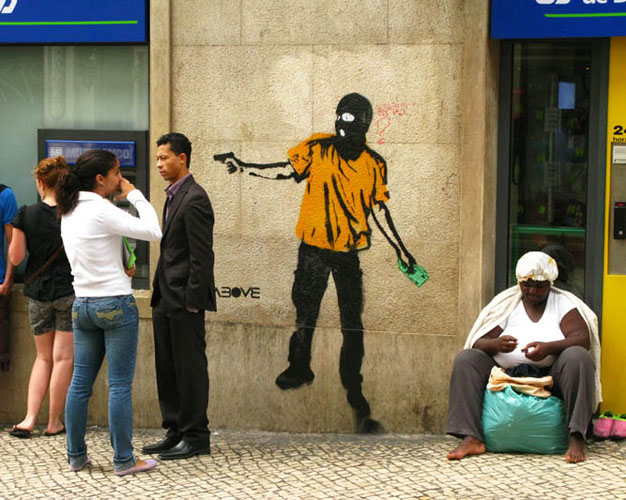
Giving to the Poor, a stencil by American street artist Above addressing the issue of homelessness. Lisbon, Portugal, 2008.

Artivism is a portmanteau word combining "art" and "activism", and is sometimes also referred to as "social artivism".

History

[edit]
You Cut Art, You Cut Culture by Artica Concepts
Bomb-hugger by Banksy
Greece Next Economic Model by Bleepsgr in Athens, Greece

The term artivism in US English has its roots in a 1997 gathering of Chicano artists from East Los Angeles and the Zapatistas in Chiapas, Mexico. The words "Artivist" and "Artivism" were then popularized through a variety of events, actions and artworks via artists and musicians such as Quetzal, Ozomatli, and Mujeres de Maiz, among other East Los Angeles artists, and at spaces such as Self Help Graphics & Art.[citation needed]

Artivism further developed as antiwar and anti-globalization protests emerged and proliferated. In many cases artivists attempt to push political agendas by the means of art, but a focus on raising awareness of social, environmental, and technological problems is also common.[citation needed]

Besides using traditional mediums like film and music to raise awareness or push for change, an artivist can also be involved in culture jamming, subvertising, street art, spoken word, protesting, and activism.[1][2][3] Since 2013, Cromoactivismo, a Brazilian group of women artists, works with collectives, groups and schools in direct actions using color for social change.[4][5]

Artivist Eve Ensler stated:

... This passion has all the ingredients of activism, but is charged with the wild creations of art. Artivism—where edges are pushed, imagination is freed, and a new language emerges altogether." Bruce Lyons has written: "... artivism ... promotes the essential understanding that ... [humans] ... can, through courageous creative expression, experience the unifying power of love when courage harnesses itself to the task of art + social responsibility.[1][2][3]

By 2005, the term had made its way into academic writing when Slovenian theatre scholar Aldo Milohnic used the term to discuss "autonomous ('alter-globalist', social) movements in Slovenia that attracted wide attention. In carrying out their political activity they made use of protests and direct actions, thereby introducing the 'aesthetic', willingly or not".[6] In 2008, Chela Sandoval and Guisela Latorre published a piece on Chicano/a artivism and M. K. Asante using the term in reference to Black artists.[7][8]

There is a chapter on artivism in the book It's Bigger Than Hip Hop by M. K. Asante. Asante writes of the artivist:

The artivist (artist + activist) uses their artistic talents to fight and struggle against injustice and oppression—by any medium necessary. The artivist merges commitment to freedom and justice with the pen, the lens, the brush, the voice, the body, and the imagination. The artivist knows that to make an observation is to have an obligation.

The impact of artivism vs. conventional activism was tested in a public scientific experiment in Copenhagen, Denmark, in 2018. The results, reported in the journal of Social Movement Studies, suggest that artivism may be more effective than conventional activism.[9]

The Inaugural Global Artivism Conference took place in Tshwane, South Africa, from September 5-8, 2024.

Artivists

[edit]

Collectives and organizations

[edit]

Artivists often work in interdisciplinary collectives that are stand-alone' or operate as a creative part of the greater activist groups, such as Gran Fury of AIDS Coalition to Unleash Power (ACT UP).[citation needed] Other groups include:

See also

[edit]

References

[edit]
Revisions and contributorsEdit on WikipediaRead on Wikipedia
from Grokipedia
Artivism is a portmanteau combining "" and "," referring to the strategic use of creative expression—such as , , and public installations—to advance social or political causes by fostering , , and behavioral change. The practice emphasizes measurable outcomes like policy influence and audience engagement over mere aesthetic appreciation, distinguishing it from traditional forms. The term artivism emerged in 1997 during a convergence of artists from East and Zapatista representatives in , , though antecedent practices trace to the late and broader protest arts against events like the . Unlike formalized movements, artivism manifests as decentralized efforts by individuals and collectives employing tactics like guerrilla interventions and symbolic disruptions to confront issues including inequality, migration, and . Prominent examples include Banksy's anonymous stenciled critiques of and , Tania Bruguera's performative explorations of power dynamics, and the ' data-driven posters highlighting gender disparities in the since 1985. These works have amplified marginalized voices and spurred public discourse, with empirical assessments showing creative outperforms conventional methods in generating receptiveness and expanding participant demographics. Despite achievements in visibility and mobilization, artivism encounters criticisms for subordinating artistic quality to didactic messaging, complicating its commercial viability, and predominantly serving progressive ideologies that may alienate non-aligned audiences or veer into performative rather than substantive action. Such tendencies reflect broader institutional skews in cultural spheres toward certain political priors, prompting debates on its causal beyond symbolic gestures.

Definition and Conceptual Foundations

Core Definition

Artivism denotes the integration of artistic creation with political or social , wherein artists deploy aesthetic forms to contest established norms, highlight inequities, and catalyze . This hybrid approach leverages visual, performative, or elements to disrupt passive spectatorship, fostering direct engagement with issues such as inequality, , or . Scholarly analyses characterize it as a mechanism for , where art's evocative power amplifies activist messaging beyond conventional tactics. At its core, artivism distinguishes itself from pure artistry by subordinating aesthetic autonomy to instrumental ends, often prioritizing provocation and mobilization over enduring beauty or interpretive ambiguity. Practitioners, termed artivists, produce works intended to interrogate power dynamics and incite behavioral shifts, as seen in street murals decrying policy failures or performances simulating oppressive conditions to evoke empathy and urgency. While effective in niche contexts—such as galvanizing subcultures around specific grievances—its broader societal impact remains empirically contested, with outcomes varying by audience receptivity and institutional resistance rather than artistic merit alone.

Etymology and Theoretical Basis

The term "artivism" is a portmanteau combining "" and "," reflecting the fusion of creative expression with political or social advocacy. Its earliest documented usage traces to 1997, arising from a convergence of artists from East and Zapatista representatives in , , where participants sought to merge artistic practices with indigenous resistance efforts against neoliberal policies. This origin highlights artivism's roots in , culturally specific movements rather than institutional art worlds, though the term gained broader traction in the early amid global anti-globalization protests. Theoretically, artivism posits that aesthetic interventions can disrupt hegemonic narratives and foster collective agency more potently than didactic alone, drawing on art's capacity for , irony, and emotional resonance to catalyze . This basis emerges from the interplay of cultural production and power dynamics, where artists repurpose symbols and media to expose systemic injustices, influenced by precedents in traditions like Dadaism and Situationism that prioritized rupture over representation. Unlike purely propagandistic art, artivism emphasizes participatory processes that empower marginalized voices, theorizing art as a tool for —enacting desired futures through immediate creative acts—while critiquing commodified culture's role in perpetuating inequality. Empirical studies of artivist campaigns, such as those during the 1999 WTO protests, support this by demonstrating heightened public engagement when artistic elements amplify activist messaging, though efficacy varies by context and audience reception.

Historical Development

Precursors and Early Instances

The use of art for social and political critique emerged in the 18th century through satirical prints and engravings that exposed moral failings and challenged authority, predating formalized activist movements. William Hogarth's engraved series A Harlot's Progress (1732) and Industry and Idleness (1747) depicted the consequences of vice and idleness in London society, critiquing class disparities and ethical decay to urge moral reform among viewers. These works, distributed widely as affordable prints, functioned as public commentary, influencing perceptions without direct institutional backing. In the context of revolutionary fervor, prints served as tools to mobilize opinion against colonial rule. Paul Revere's The Bloody Massacre Perpetrated in King Street (1770) portrayed British soldiers firing on civilians, exaggerating events to stoke and bolster support for the ; it circulated broadly, shaping narratives of tyranny. Similarly, prints like Destruction of the Royal at New York (after 1776) documented the toppling a statue of King George III, symbolizing rejection of monarchy and reinforcing independence ideals through visual propaganda. By the 19th century, such practices evolved into pointed amid European upheavals. Francisco Goya's painting (1814), depicting Spanish rebels executed by Napoleonic forces, condemned wartime atrocities and highlighted human suffering to foster anti-occupation resolve. Honoré Daumier's lithographic caricatures from the 1830s targeted King Louis-Philippe's regime, lampooning corruption and bourgeois hypocrisy; his 1834 print Gargantua led to his six-month imprisonment, underscoring art's role in despite risks. These instances established visual media as vehicles for causal critique, prioritizing empirical observation of injustice over aesthetic detachment, and prefigured 20th-century integrations of art with organized .

20th-Century Milestones

The movement emerged in 1916 at the Cabaret Voltaire in as a direct response to the horrors of , with artists like and employing absurd performances, collages, and manifestos to reject , bourgeois values, and the that enabled mass warfare. This stance positioned as an early form of artivism, using provocation to dismantle cultural complacency and highlight war's irrationality, influencing subsequent activist aesthetics. In the 1920s, arose following the 1910–1920 Revolution, as the government commissioned artists such as , José Clemente Orozco, and to create large-scale public frescoes depicting indigenous history, labor struggles, and anti-imperialist themes on civic buildings like the National Palace. These works aimed to foster and , making art accessible to the masses rather than elites, and served as state-sponsored for revolutionary ideals while critiquing and foreign influence. Pablo Picasso's , completed in 1937 for the Paris World's Fair, depicted the Nazi and Fascist bombing of the Basque town of during the , using distorted figures and monochromatic tones to symbolize civilian suffering and condemn aerial warfare's brutality. Commissioned by the Spanish Republic, the toured internationally to raise funds and awareness against Franco's forces, becoming an enduring anti-fascist icon that transcended specific events to critique . The Art Workers' Coalition formed in January 1969 in New York amid protests, uniting artists, filmmakers, and critics to demand museums sever ties with war contractors, increase representation of women and minorities, and grant artists greater control over exhibitions. Notable actions included the 1970 poster Q. And Babies? A. And Babies?, featuring a napalmed child's image to publicize the , which pressured institutions like MoMA and amplified calls for ethical accountability in the art world. In 1985, the collective was founded in response to the Museum of Modern Art's "An International Survey of Recent Painting and Sculpture," which featured few women artists despite half the applicants being female, prompting anonymous activists—masked as gorillas—to wheat-paste satirical posters exposing gender and racial biases in galleries and auctions. Works like The Advantages of Being a Woman Artist (1986) used humor and statistics to critique systemic exclusion, sparking broader discourse on equity without relying on individual fame.

Post-1990s Evolution

The term "artivism" was coined in during an encounter between artists from East and Zapatista activists in , marking a conceptual fusion of artistic expression with political mobilization. This period coincided with the rise of anti-globalization movements, where artivists employed murals, performances, and installations to challenge corporate power and inequality, as seen in events surrounding the 1999 protests in . By the early 2000s, artivism proliferated in , with artists responding to political instability through guerrilla theater and public interventions, reflecting a surge in region-specific practices documented in cultural analyses from the era. The integration of digital technologies accelerated artivism's evolution in the 21st century, enabling instantaneous global sharing and participatory campaigns via social media platforms. Young activists harnessed online tools for civic interventions, transforming static artworks into dynamic, interactive protests that amplified marginalized voices. Notable examples include Shepard Fairey's 2008 "Hope" poster for Barack Obama's presidential campaign, which utilized stencil graphics and viral dissemination to mobilize supporters, and Ai Weiwei's post-2000 critiques of Chinese censorship through multimedia installations like the 2010 Sunflower Seeds at , critiquing consumerism and state control. These works demonstrated how digital amplification extended artivism's reach beyond physical spaces, fostering hybrid forms blending with online virality. In the , performance and street artivism intensified amid global crises, with groups like staging 2012 punk prayers in Moscow's to protest Vladimir Putin's regime, resulting in arrests and worldwide solidarity campaigns. Environmental and movements further evolved artivism, incorporating disruptive actions such as Banksy's satirical stencils on war and migration—exemplified by his 2015 Mediterranean migrant boat installation at —and climate-themed interventions tied to protests like those of since 2018. This era saw artivism's democratization, with non-professional creators contributing via , though critics note variable impacts on policy change due to reliance on spectacle over sustained organizing. By the , responses to events like the and racial justice reckonings produced widespread murals and digital memes, underscoring artivism's adaptability to rapid societal shifts while highlighting challenges in measuring causal efficacy against entrenched powers.

Forms and Mediums

Visual and Street Arts

Visual and street arts in artivism employ public walls, sidewalks, and urban surfaces to convey urgent social and political critiques, bypassing traditional galleries to engage passersby directly. This form draws from graffiti traditions dating to ancient civilizations but gained modern activist traction in the 1970s New York subway system, where artists like those in the hip-hop culture used spray paint to voice marginalized experiences amid economic decline and racial tensions. By the 1980s, figures such as Keith Haring transformed chalk and spray drawings into icons of AIDS activism, with his radiant baby motifs and safe-sex messages appearing on over 50 murals worldwide, educating millions on public health crises before widespread media coverage. Guerrilla art tactics amplified this approach, as seen with the collective, founded in 1985 in response to the Museum of Modern Art's imbalanced exhibitions. Their anonymous, gorilla-masked posters—such as the 1989 wheat-pasted broadside "Do women have to be naked to get into the Met. Museum?"—juxtaposed statistics showing only 5% of artists in the Met's modern collection were women but 85% of nudes were female, sparking debates on institutional and influencing curatorial reforms. Similarly, "artivists" like Mario Torero in the 1970s blended murals with labor and civil rights advocacy, as in his Library of Congress-held works depicting farmworker struggles, merging indigenous iconography with calls for economic justice. Street art's confrontational ephemerality fosters immediate visibility but faces removal by authorities, as with Banksy's stenciled interventions since 1997, which critique war and surveillance—exemplified by his 2005 pieces on the , drawing international media to Palestinian plight and boosting tourism while evading capture. Shepard Fairey's 2008 Obama "Hope" poster, rooted in street-wheatpasting, mobilized among , with over 4 million prints distributed, though its impact stemmed more from viral dissemination than wall persistence. In protests like in 2020, murals such as tributes in covered blocks, serving as communal memorials that sustained discourse but often faded without policy shifts, highlighting artivism's strength in symbolism over measurable causation. Empirical studies note such works enhance civic engagement—e.g., street art correlating with anticapitalist spatial reclamation—but via auctions undermines subversive intent, as Banksy's pieces fetch millions despite anti-consumerist themes.

Performing and Literary Arts

In performing arts, artivism manifests through interactive and street-based theater that confronts social injustices directly, often bypassing traditional venues to engage audiences in real-time critique. Guerrilla theater, popularized in the United States during the by groups like the Mime Troupe, employed spontaneous, unannounced performances in public spaces to satirize issues such as the and racial inequality, drawing on techniques for accessibility and immediacy. These actions aimed to disrupt everyday complacency, with troupes performing short skits that encouraged spectator participation and immediate discussion, influencing subsequent activist performances by emphasizing mobility and low . Augusto Boal's Theatre of the Oppressed, formalized in the 1970s amid Brazil's military dictatorship, represents a structured approach to performative artivism by transforming audiences into "spect-actors" who intervene in scripted scenarios depicting , thereby rehearsing real-world resistance. Techniques like allow participants to replace characters and test alternative outcomes, fostering collective problem-solving on topics from to economic disparity; Boal's methods, rooted in Marxist pedagogy and Brechtian alienation, have been applied globally in community workshops, though empirical assessments of long-term behavioral change remain limited to qualitative reports of heightened awareness. In the United States, Luis Valdez's El Teatro Campesino, founded in 1965 to support farmworkers' strikes, integrated folklore with skits to advocate for , performing in fields and union halls to amplify migrant voices against exploitation. Literary arts contribute to artivism via prose, poetry, and that blend narrative persuasion with calls to action, often circulated through readings or publications to mobilize readers. Harriet Beecher Stowe's , serialized in 1851–1852, exemplified early literary activism by depicting slavery's horrors, galvanizing Northern abolitionist sentiment and reportedly influencing President Lincoln's views, with sales exceeding 300,000 copies in its first year amid debates over its factual accuracy versus emotional impact. In contemporary forms, slam poetry—originating in 1980s as competitive events—serves as artivism by performers using rhythmic, personal narratives to address identity-based struggles, such as racial injustice or queer , with audiences judging efficacy through applause and scores that prioritize emotional resonance over traditional metrics. This format, popularized by events like the National Poetry Slam since 1990, enables rapid dissemination via open mics and has been critiqued for favoring performative spectacle over substantive policy influence, yet it sustains activism by empowering marginalized voices in live settings.

Digital and Multimedia Approaches

Digital and multimedia approaches in artivism integrate , interactive technologies, and immersive formats to create participatory and viral artistic interventions that challenge social, political, or . These methods exploit the scalability of digital platforms to merge , auditory, and interactive elements, enabling real-time audience engagement and global dissemination beyond physical constraints. Unlike static , multimedia artivism often incorporates , algorithms, and data visualization to amplify messages, though empirical analyses reveal strengths in awareness-raising and short-term rather than sustained shifts. Social media platforms have facilitated collaborative digital art projects, such as the #ChalkedUnarmed initiative launched in August 2014, where participants drew chalk body outlines on sidewalks symbolizing individuals killed by police, photographed them, and uploaded to , , and with the hashtag to highlight racial and ethnic violence. This open-source format expanded geographically, encouraging widespread participation and visual documentation of grievances. Similarly, #IlustradoresConAyotzinapa on collected illustrator-submitted portraits of the 43 missing Ayotzinapa students in 2014, demanding accountability through collective imagery that conveyed pain and resilience. Multimedia installations blend physical art with live digital feeds, as demonstrated by the Hundreds and Thousands exhibit at in 2013, organized by The Benevolent Society, where an interactive light tunnel displayed 757 messages tagged #hopesforchange, illuminating public aspirations for Australian children's futures via dynamic projections. Another example, the Arches of Hope in , featured three 10-foot LED arches scrolling posts with #archesofhope to mark HIV/AIDS awareness decades, transforming input into architectural displays. These hybrids harness for immersive experiences, though their impact is often measured in metrics like post volume rather than direct causal outcomes. During the , online artivism surged with platforms like and hosting artistic content, including Danielle Coke's digital drawings in 2020 that visualized cases of systemic racism, such as those involving Ahmaud Arbery and , bolstering narratives through shareable illustrations. The #ClimateStrikeOnline campaign adapted Fridays for Future protests into virtual formats, featuring artistic posters and choreography that generated hundreds of weekly youth-led posts to sustain climate momentum amid lockdowns. Emerging immersive tools, including (AR) in projects like ARtivism (developed by 2024), overlay digital advocacy layers on physical environments to enhance accessibility for blind and low-vision users, embedding activist messages in public spaces via mobile apps. Virtual reality (VR) applications have similarly immersed viewers in simulated activist scenarios, such as conflict zones, to evoke empathy and spur discussion, though studies question their translation to offline action. Effectiveness varies by context; campaigns targeting governments, like digital protests against authoritarian policies, show higher success rates in compared to corporate targets, with digital artivism particularly resonant among young demographics for —evidenced by rapid donation spikes in 2020 fund drives—but prone to dilution via "slacktivism" without deeper commitment.

Practitioners and Collectives

Notable Individual Artivists

Ai Weiwei, born on August 28, 1957, in , , emerged as a leading figure in artivism through his confrontational installations and documentation critiquing . His 2010 exhibit Sunflower Seeds, comprising 100 million porcelain seeds, highlighted themes of mass conformity and individual agency under state control, drawing over 1.2 million visitors. Ai's activism intensified with his citizen-led investigation into the , which exposed shoddy construction causing at least 5,335 child deaths in collapsed schools; this led to his 2011 detention for 81 days on charges widely viewed as political retaliation. Exiled since 2015, his works continue to address , influencing global discourse on . Banksy, the pseudonymous British street artist active since the , exemplifies artivism via ephemeral that satirizes , , and inequality. His 2005 piece Bomb Hugger in , depicting a child embracing a bomb amid conflict, underscores civilian suffering in the Israeli-Palestinian dispute, with stencils appearing on the West Bank barrier since 2005. 's 2018 self-shredding of at auction for £1.04 million critiqued art market commodification, as the work partially destroyed itself post-sale. Operating anonymously, his interventions, including (2015), a dystopian theme park parodying , have generated millions in media coverage and prompted policy discussions on issues like refugee rights. , born May 4, 1958, in , utilized bold, graphic murals and to advocate against the AIDS crisis and in the 1980s. By 1986, he had created over 50 murals worldwide, including Crack is Rock (1986) in New York addressing drug epidemics, and founded the Pop Shop in 1986 to democratize his activist imagery. Haring's iconic radiant baby and barking dog motifs appeared in subway chalk drawings from 1980, evolving into AIDS awareness campaigns after his 1987 HIV diagnosis; he died of AIDS-related complications on February 16, 1990, at age 31, having raised funds through art sales for organizations like . His work's accessibility amplified mobilization, with murals enduring as symbols of 1980s social urgency. , born February 15, 1970, in , advanced artivism through stencil posters and murals promoting anti-war and environmental causes. His 2008 Obama Hope poster, distributed over 300,000 times during the U.S. presidential campaign, boosted among youth demographics, though Fairey faced a 2010 misdemeanor plea for using imagery without permission. Earlier, his OBEY Giant campaign, launched in 1989 inspired by Obey the Giant film, critiqued propaganda via Andre the Giant stickers plastered across 30+ countries. Fairey's 2019 climate murals, such as those for the , have mobilized protests against fossil fuels. , born September 18, 1968, in , , pioneered performance-based artivism challenging and migration policies. Her 2009 Tatlin's Whisper #5 in involved audience-led speeches mimicking state rhetoric, resulting in her brief arrest and the project's shutdown after 100 participants. Bruguera's Immigrant Movement International (2011–present), a Brooklyn-based initiative, provides services to undocumented immigrants, hosting over 50 events annually to foster policy dialogue. Detained multiple times by Cuban authorities, including in 2014 and 2018 for protesting restrictions, her work emphasizes participatory disruption over passive viewing.

Key Organizations and Groups

The Center for Artistic Activism, founded in 2009, operates as a nonprofit providing training, resources, and strategic support to artists engaging in across 23 countries on six continents, emphasizing tactical media and creative campaigns for . It has collaborated with over 500 artists and groups, developing projects like the "Tactics for Artistic Activism" to bridge artistic practice with effective advocacy. , an anonymous collective of female artists established in 1985 in , targets and in the art world through provocative posters, billboards, and performances, with more than 100 public actions documented by 2023, including critiques of museum representation where women and non-white artists comprised under 5% of solo exhibitions in major institutions during the 1980s. Their ongoing work, such as the 2015 "" installation, continues to highlight disparities, maintaining anonymity via gorilla masks to shift focus from individual identities to systemic issues. Gran Fury, the graphic design arm of the AIDS Coalition to Unleash Power () formed in 1988, produced bold, confrontational visuals like the 1989 "Kissing Doesn't Kill" posters distributed nationwide to combat stigma and demand government action on the crisis, which by 1990 had claimed over 100,000 lives in the U.S. alone. Active until the mid-1990s, the collective's materials, including wheat-pasted and subway ads, influenced public discourse and policy, contributing to accelerated FDA approvals for treatments. , a Russian feminist collective founded in 2011, gained international prominence through guerrilla actions like the 2012 "Punk Prayer" in Moscow's Christ the Savior Cathedral protesting Vladimir Putin's regime and church-state ties, resulting in convictions of members under hooliganism charges and sparking global debates on free expression. Their performances, blending punk music, video, and street theater, have continued post-imprisonment, with over 20 documented actions by 2022 advocating for and against . Liberate Tate, initiated in 2010 by artists opposing sponsorship in arts institutions, has staged over a dozen interventions, including the 2010 spilling of fake oil at Modern's turbine hall, pressuring BP's exit as sponsor in 2016 amid campaigns that mobilized thousands via petitions and performances. The group's actions, rooted in environmental activism, exemplify artivism's role in corporate accountability, with similar efforts expanding to other galleries.

Ideological Dimensions

Left-Leaning Applications

Artivism aligned with left-leaning ideologies has frequently targeted issues such as , , and public health crises associated with marginalized communities. These applications often employ confrontational tactics like guerrilla postings, performance interventions, and communal installations to challenge perceived systemic injustices, drawing on themes of and critique. In feminist activism, the collective, formed in New York in 1985, exemplifies targeted artivism through anonymous posters that exposed gender and racial disparities in the art world. Their 1989 billboard campaign, featuring a nude model's image with the statistic that less than 5% of the artworks in the Metropolitan Museum's sections were by female artists, aimed to provoke institutional self-examination and has continued influencing discussions on representation, with over 100 projects produced by 2023. Similarly, the Russian group integrated punk with anti-authoritarian , most notably in their February 2012 "Punk Prayer" action inside Moscow's , which criticized the Russian Orthodox Church's alignment with Vladimir Putin's regime and resulted in the arrest and imprisonment of members, garnering international support for broader advocacy. LGBTQ+ rights activism has utilized monumental collaborative works, as seen in the NAMES Project AIDS Memorial Quilt, conceived by activist Cleve Jones in November 1985 amid the early AIDS epidemic when stigma often denied victims public funerals. By 1987, the quilt's first public display on the National Mall in Washington, D.C., covered 12 blocks and included panels for over 1,900 individuals; it expanded to encompass more than 50,000 panels by 2024, functioning as a mobile exhibit to humanize the crisis, combat discrimination, and pressure governments for funding and policy changes, with displays reaching millions globally. Street art has served anti-war and anti-capitalist campaigns, with employing stenciled to underscore military interventions and economic exploitation. His 2003 series on the West Bank barrier, including depictions of children excavating peace symbols from concrete, protested Israeli-Palestinian conflict dynamics, while post-2022 invasion pieces in highlighted civilian resilience against invasion; these ephemeral works, often removed or commodified, have sparked debates on art's role in immediate geopolitical critique despite challenges in measuring direct policy influence.

Right-Leaning and Conservative Examples

Sabo, a pseudonymous Los Angeles-based active since at least 2015, exemplifies right-leaning guerrilla artivism through satirical wheatpaste posters critiquing liberal elites and promoting Republican figures. His works often feature altered images of celebrities and politicians, such as depictions of in historical villain roles or in absurd scenarios, intended to highlight perceived moral inconsistencies in Hollywood and Democratic leadership. In July 2024, Sabo distributed faux handicap placards and ads at the endorsing while mocking opponents, continuing a pattern of unauthorized public installations that have drawn legal citations, including for anti-immigration signs placed on bus stops in August 2024. Sabo's approach mirrors left-leaning tactics but targets cultural institutions dominated by progressive viewpoints, operating covertly to evade removal and amplify messages via virality. Jon McNaughton, a Utah-based painter, advances conservative causes through large-scale oil paintings that integrate historical and biblical motifs with contemporary political critique, selling over 100,000 reproductions since 2008. Works like "Wake Up America" (2010) portray citizens chained by national debt exceeding $35 trillion as of 2024, urging fiscal restraint and constitutional adherence, while "One Nation Under God" assembles U.S. presidents from Washington to Trump under divine judgment to affirm Judeo-Christian foundations of governance. McNaughton's output intensified during the Obama administration with pieces protesting policies like Obamacare, evolving to support Trump via paintings such as "Expose the Truth" (2019), which depicts Mueller investigation figures confronting evidence of innocence. These canvases function as activist tools in conservative circles, exhibited at events and shared online to rally against perceived encroachments on liberty, with McNaughton framing his art as a defense of founding principles amid cultural shifts. Other instances include pro-police murals erected in response to protests, such as the 2020 "Blue Line" wall art in depicting fallen officers, which faced but symbolized resistance to defund-the-police movements. Right-leaning artivism remains underrepresented in public spaces compared to progressive variants, attributable to institutional gatekeeping in galleries and media, though digital dissemination has enabled broader reach for artists like Sabo and McNaughton.

Non-Partisan or Alternative Uses

Artivism extends beyond partisan ideologies to address universal humanitarian imperatives, such as , disaster recovery, and community cohesion, where artistic expression fosters and practical solutions without endorsing specific political agendas. These applications prioritize evidence-based outcomes like reduced conflict tensions or enhanced social resilience, drawing on art's capacity to humanize shared human experiences across divides. Organizations like the employ artivism in missions, utilizing murals, , and public installations to underscore , , and in volatile regions, as seen in initiatives promoting dialogue in post-conflict areas since at least 2024. In humanitarian crises, arts-based activism—termed artivism—serves to amplify voices from disaster-struck communities, facilitating connections between survivors, aid providers, and policymakers without ideological framing. For example, post-massacre cultural practices in Bojayá, Colombia, following the 2002 FARC guerrilla attack that killed 79 civilians, involved community singing groups that rebuilt social bonds and documented trauma, contributing to local protection and healing efforts independent of partisan politics. Similarly, arts interventions in disaster contexts humanize data for researchers and responders, enabling more targeted aid distribution, as evidenced by studies on marginalized groups' post-event recovery from 2024 onward. Alternative forms include "soft artivism," a non-confrontational variant emphasizing , awareness, and community-building to encourage gradual societal shifts, contrasting with aggressive tactics. This approach, documented in sociological analyses from 2025, leverages subtle creative methods like collaborative workshops to strengthen local ties and promote inclusive , often yielding measurable gains in civic participation without alienating audiences. projects further exemplify this, rooting expressions in shared to bolster collective identity and practical improvements, such as neighborhood revitalization, as outlined in frameworks prioritizing place-based representation over explicit . Empirical evaluations of these uses indicate higher in neutral settings, though effectiveness hinges on local context and avoids overreliance on transient emotional appeals.

Impact and Effectiveness

Empirical Evidence of Success

Empirical assessments of artivism's success remain sparse, with most studies focusing on proximal outcomes like heightened awareness and immediate rather than distal effects such as reforms or sustained behavioral changes. Rigorous quantitative evaluations are rare, often limited to controlled experiments or qualitative case analyses, which complicate causal attributions amid confounding variables like concurrent or media coverage. One notable controlled study, the 2018 Experiment, compared creative —employing theatrical performances, humor, and visual elements—to conventional tactics like ing and flyering on a busy bridge targeting climate awareness. Conducted over three days with 108 spot interviews, observation data, and tallies of signatures and distributions, it found creative approaches outperformed conventional ones across quantitative metrics, including higher reported interest levels, more signatures, and faster uptake. Qualitative responses highlighted creative methods as more captivating and memorable, fostering positive receptivity, though effects were measured immediately and may not generalize beyond short-term in a culturally specific European context. In the anti-coal movement in , artistic —through murals, performances, and community events—facilitated greater environmental , political , and in processes, drawing in diverse demographics like and women of color, per 32 in-depth interviews with participants. However, these gains emphasized expanded movement inclusivity over quantifiable victories, underscoring art's role in outreach but not isolated causation for broader systemic shifts. Broader reviews indicate that while artivism can mobilize affective responses and —such as in targeted Black community initiatives documented in 2023 analyses—empirical links to transformative are tenuous, often relying on self-reported or correlational data prone to overestimation. Long-term evaluations are hindered by the indirect, multifaceted pathways from artistic provocation to societal outcomes, with few randomized or longitudinal designs available to disentangle art's unique contributions from other activist strategies.

Criticisms and Empirical Limitations

Critics of artivism argue that its emphasis on overt political utility often results in performative gestures that reinforce existing beliefs among sympathetic audiences rather than persuading skeptics or effecting substantive change. For instance, actions within cultural institutions frequently target like-minded participants, limiting reach to mainstream or opposing viewpoints and aligning inadvertently with elite managerial interests that constrain broader transformative aims. This echo-chamber dynamic, coupled with a focus on narrow issues, undermines artivism's capacity for systemic disruption, as noted by observers who highlight its paradoxical dependence on the very institutions it seeks to challenge. Empirical assessments reveal significant limitations in demonstrating artivism's causal role in social or outcomes. Studies acknowledge pervasive challenges in , including attribution difficulties—where isolating art's contribution amid multifaceted proves elusive—and the nonlinear, long-term nature of , which defies short-term metrics like media coverage or event attendance. Quantitative approaches often capture superficial indicators without linking them to behavioral shifts or alterations, while qualitative evaluations remain subjective and prone to bias from self-reported participant experiences. The scarcity of rigorous, causal further hampers claims of ; much relies on theoretical frameworks or case-specific anecdotes rather than controlled analyses establishing direct pathways from artistic interventions to verifiable changes, such as legislative reforms or norm shifts. Practitioners and evaluators alike express reluctance toward metrics, associating them with instrumentalization that overlooks art's affective dimensions, yet this aversion perpetuates gaps in and fosters assumptions of impact akin to unverified . In health policy contexts, for example, while artistic campaigns may heighten visibility, disentangling their influence from concurrent efforts remains methodologically fraught, with evaluations often defaulting to theorizing over empirical validation. These constraints suggest that artivism's contributions, though culturally resonant, frequently fall short of substantiated drivers of concrete progress.

Controversies and Debates

Artistic Integrity and Quality Concerns

Critics of artivism argue that its emphasis on political advocacy often erodes artistic integrity by favoring didactic messaging over aesthetic rigor and innovation, transforming art into a vehicle for rather than a pursuit of or truth. This tension arises because activism demands clarity and emotional persuasion to mobilize audiences, which can conflict with art's capacity for , experimentation, and intellectual nuance—qualities essential for enduring merit. For instance, activist works may simplify forms or techniques to avoid alienating viewers, thereby diluting the experimental artistry that challenges perceptions and fosters deeper engagement. Such compromises risk rendering artivism solipsistic or superficial, where creators prioritize ideological alignment over craftsmanship, leading to outputs valued more for shock or alignment with prevailing narratives than for technical or conceptual excellence. In the case of street artist , whose stenciled interventions exemplify artivism through anti-war and anti-capitalist themes, detractors highlight a lack of , advanced , or profound insight, viewing pieces like his bomb-hugger motifs as gimmicky slogans that mimic propaganda's manipulative brevity rather than elevating discourse. This critique posits that when political ends justify means, art forfeits its , producing works that comfort adherents but fail to withstand scrutiny as autonomous creations. Empirical observations from reinforce these concerns: standards imposing political quotas, such as the Academy of Motion Picture Arts and Sciences' inclusivity criteria introduced in , have prompted fears of coerced narratives distracting from storytelling, as seen in debates over whether films like trilogy (2001–2003) would qualify despite their artistic acclaim. Proponents of artistic caution that while experimental activism may provoke, misunderstanding audiences without reciprocal adaptation can isolate works, undermining both efficacy and quality; conversely, over-adaptation risks commodifying dissent into formulaic output. Ultimately, these debates underscore a causal realism: artivism's activist core incentivizes expediency, often at the expense of the disinterested pursuit that historically distinguishes great from mere agitation. Artivists frequently encounter legal obstacles when their works involve unauthorized interventions in public or private spaces, such as , installations, or performances that disrupt order. Street artists like , whose stenciled murals critique war, capitalism, and authority, operate without permission, rendering their actions criminal damage under laws like the UK's Criminal Damage Act 1971, which prohibits intentional harm to property without lawful excuse. These works' ephemeral nature heightens vulnerability, as property owners or authorities may remove or paint over them, prompting disputes over ownership and preservation; for instance, a 2020 mural by was defaced, illustrating how the original illegality complicates legal recourse for subsequent damage. Performative artivism, such as 's 2012 unauthorized "Punk Prayer" in 's Christ the Savior Cathedral protesting Vladimir Putin's rule, has led to prosecutions for and religious hatred, resulting in two-year prison sentences for three members under Russian Article 213. More recently, in September 2025, a court sentenced five exiled members in absentia to 8–13 years for anti-war performances deemed to spread "" about the conflict, under Russia's 2022 wartime laws. Such cases highlight how artivist actions challenging state authority invite charges of public disorder, trespass, or , with outcomes varying by jurisdiction—lenient in permissive environments but severe in authoritarian ones. Ethically, artivism raises dilemmas over whether activist intent justifies means that may compromise artistic or public welfare. Scholars argue that activist art's experimental or provocative forms risk alienating audiences and diluting impact, as difficult can prioritize shock over persuasion, potentially undermining the very sought. For instance, disruptive interventions like property defacement prompt debates on proportionality: while intended to expose injustices, they impose unconsented costs on property owners or bystanders, blurring lines between expression and imposition. Critics contend that artivists sometimes exploit legal ambiguities for visibility, fostering a form of "artistic " where ethical scrutiny is waived under the guise of higher purpose, yet this can erode trust if perceived as performative rather than principled. Furthermore, ethical concerns extend to representation and harm, particularly when artivism appropriates cultural symbols or involves vulnerable participants without safeguards. In participatory projects, such as those with marginalized groups, risks include retraumatization or exploitation if and power dynamics are inadequately addressed, though empirical studies emphasize the need for rigorous ethical protocols to mitigate these. Proponents of ethical criticism maintain that art's moral dimensions—such as inciting division without evidence-based —demand evaluation alongside aesthetic merit, lest artivism devolve into unchecked . These tensions underscore artivism's core : leveraging art's emotive power for often collides with imperatives for truthfulness and minimal harm.

References

Add your contribution
Related Hubs
User Avatar
No comments yet.