Hubbry Logo
Ashoke Kumar SenAshoke Kumar SenMain
Open search
Ashoke Kumar Sen
Community hub
Ashoke Kumar Sen
logo
8 pages, 0 posts
0 subscribers
Be the first to start a discussion here.
Ashoke Kumar Sen
Ashoke Kumar Sen
from Wikipedia

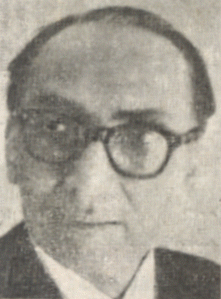
Ashoke Kumar Sen (10 October 1913 – 31 August 1996) was an Indian barrister, a former Cabinet minister of India, and an Indian parliamentarian.

Key Information

He also holds the record for winning a Lok Sabha seat the most times and also the record for being not only an MP for the most years, but also a cabinet minister – serving more than 7 prime ministers. For decades, he was the inevitable Union Law Minister.

Background

[edit]

Ashoke Kumar Sen was born in 1913 during the British Raj in a well-known Baidya Brahmin family. His father was a district magistrate. Both Ashoke Kumar Sen and Sukumar Sen were students of Sambalpur high School, Odisha wherein Late Mr. Suryamani Jena of village Kusupur was the Principal. His elder brother, Sukumar Sen ICS (b. 1899), who went on to become India, Sudan and Nepal's first Chief Election Commissioner,[2] funded his education in England, at the London School of Economics. Ashoke Sen went on to study for the Bar at Gray's Inn.

Upon his return, he started teaching law at the City College, Kolkata a constituent college of the University of Calcutta[3] He then began practising in the Calcutta High Court. At the age of 26, he had already written a book about Commercial Law, which was endorsed by Mr. Sen's then senior Sudhi Ranjan Das, the future Chief Justice of India.

Some years later, in February 1943, Ashoke Kumar Sen married Anjana Das, his senior's only daughter. They had two sons and two daughters.[4]

[edit]

Within five years of practice, Sen became regarded as one of the top lawyers in the Calcutta High Court and gained wide acclaim. He published many books and articles, and was the Editor of Calcutta Law Journal.[3]

Sen was a Senior Advocate of the Supreme Court, and President of the Supreme Court Bar Association several times.[3]

Parliamentary career

[edit]
Ashoke Kumar Sen with President Sarvepalli Radhakrishnan, Nehru and Bidhan Chandra Roy

Because of his legal acumen, Bidhan Chandra Roy, Chief Minister of West Bengal, recommended him to the Prime Minister Jawaharlal Nehru. Nehru wanted Sen in his cabinet, and asked him to contest elections for the Lok Sabha.

In 1957, the Calcutta North West seat for the Lok Sabha was a communist stronghold. Sen had tried in 1956 to win the election, but fell short by only a few votes. However, in the following year, he triumphed and won by over 100,000 votes. He retained that seat from 1957 to 1977, and again held the Calcutta North West seat from 1980 to 1989, being defeated in 1989 by Debi Prosad Pal.[5]

Sen was a Member of the Second, Third, Fourth, Fifth and Eighth Lok Sabhas.[3]

He was later made a Rajya Sabha member and remained in the Upper House until April 1996, a few months before his death.

Ministerial career

[edit]

Ashoke Sen became the Union Law Minister under Nehru. It is this post for which he became famous worldwide. He was Union Minister of Law, but he also held other portfolios such as Communications.[3] He was Minister of Steel and Mines in Chandra Shekhar government from November 1990 to June 1991.[6]

Ashoke Kumar Sen with Harold Macmillan, Prime Minister of the U.K

Over the next years, Sen was India's representative to foreign countries and the United Nations. According to Deve Gowda (1996), Sen led the Indian delegations to the United Nations Conference on Law, the United Nations Conference on Human Rights and several other conferences.

He was Law Minister lastly under Rajiv Gandhi and resigned in 1989 after his party's debacle in state elections in his home state West Bengal.[7]

Other activities

[edit]

During his lifetime, Sen started the Paschim Banga Seva Samiti – a charitable organisation. He also served as the president of the Indian Football Association. During his lifetime, Mr Sen also amassed a large law library with many rare collections. This library is considered to be among the largest private law libraries in the world.

Memorials

[edit]

There is a block in the Supreme Court named after him. A portrait of him also hangs there.[citation needed] A town, Ashoknagar Kalyangarh in West Bengal is named after him. Several documentary films have also been produced on Sen.

Family

[edit]

Ashoke Kumar Sen was survived by his widow, Anjana (whom he married in 1943), and by his four children, and seven grandchildren.

Besides his brother Sukumar Sen, Ashoke Kumar Sen had another brother Amiya Kumar Sen, an associate of Rabindranath Tagore. Amiya, author of a book about the Tagore family newspaper, was formerly a lecturer at Calcutta University and Principal of the City College, Kolkata. Mr Sen is also uncle to Nobel Laureate Economist Amartya Sen.

References

[edit]

Sources

[edit]
Revisions and contributorsEdit on WikipediaRead on Wikipedia
from Grokipedia

Ashoke Kumar Sen (10 October 1913 – 31 August 1996) was an Indian barrister and Congress politician who served as Union Minister of Law for a record cumulative tenure of over 18 years under prime ministers from Jawaharlal Nehru to Rajiv Gandhi. Born into a Baidya-Brahmin family in Faridpur (then part of British India, now Bangladesh), with his father a district magistrate and brother Sukumar Sen India's first Chief Election Commissioner, Sen excelled as a lawyer at the Calcutta High Court and later as president of the Supreme Court Bar Association for nearly a decade. He also held additional cabinet portfolios including steel and mines, and represented India at the United Nations and abroad. Elected to the Lok Sabha five times, undefeated in four consecutive polls from 1957 to 1977, and later to the Rajya Sabha, Sen resigned as Law Minister in 1987 amid the Congress party's electoral setbacks in West Bengal, criticizing internal "self-deception."

Early Life and Education

Family Background and Upbringing

Ashoke Kumar Sen was born on October 10, 1913, in Faridpur, then part of the under British colonial rule and now in , into a well-established Baidya-Brahmin family known for its administrative prominence. His father held the position of , reflecting the family's integration into the colonial structure, which emphasized bureaucratic efficiency and legal administration in rural . This socio-economic context positioned the family amid the and educated , with Baidya-Brahmins historically associated with scholarly and professional roles in the region. Sen's upbringing occurred in a household shaped by his father's judicial responsibilities, fostering early familiarity with colonial governance and local disputes in Faridpur, a district prone to agrarian tensions and administrative challenges under British indirect rule. His elder brother, Sukumar Sen, pursued a career in the , later serving as India's first Chief Election Commissioner, underscoring the family's orientation toward and institutional roles. This environment, amid the escalating independence movement in —marked by events like the 1919 Rowlatt Satyagraha and partition-related communal strains—provided empirical exposure to political ferment and colonial legal mechanisms, without direct personal involvement documented in primary accounts.

Academic and Professional Training

Ashoke Kumar Sen pursued undergraduate studies at Presidency College, Calcutta, earning a degree that laid the foundation for his legal aspirations. He then attended University Law College, Calcutta, completing his initial under the system, which emphasized British principles adapted to colonial administration. To qualify for the English bar, Sen traveled to and enrolled at , one of the four historic responsible for training barristers through a regimen of lectures, moots, and practical exercises rooted in adversarial advocacy and precedent-based reasoning. This training, conducted in the 1930s amid the interwar period's evolving imperial jurisprudence, equipped him with skills in equity, constitutional interpretation, and courtroom procedure directly transferable to Indian high courts. Upon qualification as a , Sen returned to , bridging colonial with emerging nationalist legal discourse.

Early Practice in Calcutta

Upon returning from after being called to the Bar at , Ashoke Kumar Sen commenced his legal practice at the in the late 1930s, initially balancing it with teaching law at , under Calcutta University. His early efforts involved handling routine civil and criminal matters in a highly competitive bar dominated by established advocates, where success depended on demonstrable skill in argumentation and case preparation amid the colonial legal framework. Sen's reputation solidified quickly through consistent performance; by the mid-1940s, after approximately five years of practice, he had risen to prominence among the court's top barristers, earning briefs from diverse clients without reliance on familial or political . This period coincided with India's transition to in 1947, during which the High Court's operations adapted to the new constitutional order, including the integration of laws and the emphasis on federal jurisprudence, yet Sen focused on foundational appellate and work to build his caseload. In February 1943, Sen married Anjana Das, daughter of senior barrister , a connection that enhanced his access to established networks within the Calcutta bar while underscoring the profession's interpersonal dynamics.

Notable Cases and Advocacy Roles

Sen emerged as a prominent figure in India's legal community through his leadership in bar associations, particularly as President of the Bar Association on multiple occasions. His presidencies, collectively spanning nearly a decade, underscored his authority among peers and his focus on advancing professional standards for advocates. As a designated Senior Advocate of the , Sen participated in high-profile constitutional and civil litigation, leveraging his expertise in first-principles argumentation to defend client interests in pre-independence and early post-independence proceedings at the and Federal Court. Though specific case outcomes from the remain less documented in accessible records, his rapid rise—achieving recognition as a leading within five years of commencing practice in Calcutta—reflected competence in complex disputes. In these roles, Sen advocated for unified regulatory frameworks for the , promoting reforms that prioritized merit-based enrollment and ethical conduct over fragmented colonial-era structures, efforts that informed subsequent national legislation without political overlay. Sen edited the Calcutta Law Journal from 1948 for approximately a , a role that involved curating and publishing analyses of judicial decisions from the and other jurisdictions, thereby aiding the dissemination of legal precedents and promoting interpretive consistency in an era of fragmented post-independence . This editorial work addressed practical challenges in legal practice, such as varying standards among provincial bars, by providing practitioners with accessible reference material that encouraged uniform application of laws across regions. As a leading in Calcutta, Sen contributed to institutional efforts for professional standardization by authoring a on at age 26 in 1939, endorsed by his senior , then a prominent and future ; the book clarified procedural and substantive issues in mercantile disputes, influencing early codification discussions amid the transition from colonial to national legal frameworks. Such scholarly outputs countered ad hoc practices inherited from the Legal Practitioners Act of 1879, which had perpetuated disparities between barristers, vakils, and pleaders, fostering a more cohesive bar through shared intellectual resources. Sen's teaching of at —a constituent of the —upon his return from legal training in , supported the development of legal during the , training students in core disciplines like contracts and at a time when universities grappled with integrating independence-era reforms into curricula. This educational involvement helped stabilize the influx of new entrants into the profession, reducing variability in competence that stemmed from uneven colonial-era training and laying empirical groundwork for later national bar unification by building a cadre of uniformly skilled advocates. Through these pre-political endeavors, Sen's institutional roles emphasized merit-based over fragmented structures, empirically evidenced by the sustained influence of the Calcutta Law Journal in citations across rulings and his early recognition as a top practitioner within five years of starting at the bar, which mitigated post-1947 disruptions from partition-induced lawyer migrations and jurisdictional overlaps.

Entry into Politics

Involvement with Indian National Congress

Ashoke Kumar Sen's association with the emerged primarily through his recruitment by , who valued his legal acumen and sought to integrate him into the party's parliamentary framework rather than through grassroots activism during the independence era. This alignment reflected pragmatic loyalty to Nehru's leadership, prioritizing professional expertise over prior organizational immersion in provincial committees or documented participation in the freedom struggle, as no verifiable records indicate such early roles in the 1940s. Sen contributed ideologically by supporting the Congress's post-independence consolidation, though his writings and speeches focused more on than explicit legal advocacy for prior to formal entry.

Initial Electoral Successes

Ashoke Kumar Sen achieved his initial parliamentary victory in the , securing the Calcutta North West constituency as the candidate in a seat characterized as a communist stronghold. His margin of victory exceeded 100,000 votes, reflecting strong support amid the Congress party's national dominance, which secured 371 of 494 seats overall. In , Congress captured 23 of 34 seats with 48.2% of the vote share, underscoring the one-party era's dynamics where opposition, including the that won six seats statewide, remained limited despite regional urban strength in Calcutta. Sen's success leveraged his established reputation as a prominent practicing in Calcutta, enhancing his appeal in a constituency blending legal-professional networks with post- developmental aspirations aligned with platforms. While specific campaign emphases on legal reforms are not detailed in contemporaneous records, his professional background likely resonated with voters prioritizing institutional stability and national integration over fragmented leftist alternatives. The election occurred in an environment of high loyalty following , where empirical data indicate limited contestation viability for non- candidates, rendering victories more indicative of party hegemony than purely individualized mandates.

Parliamentary Career

Lok Sabha Elections and Terms

Ashoke Kumar Sen was first elected to the Lok Sabha from the Calcutta North West constituency in the 1957 general election as a candidate of the , securing victory in a period of strong party dominance following independence. He was re-elected from the same seat in the 1962, 1967, and 1971 elections, representing the Second, Third, Fourth, and Fifth s respectively, which provided him with continuous service spanning approximately two decades until the dissolution preceding the 1977 polls. These victories occurred amid the Congress party's hegemony in West Bengal, where the INC consistently captured a majority of seats in early parliamentary elections, often with margins exceeding 20-30% over communist and socialist challengers in urban constituencies like Calcutta North West. Sen's retention of the seat through multiple cycles underscored patterns of voter loyalty to established Congress figures in industrial and metropolitan areas, despite growing left-wing opposition. In the 1969 split of the Congress party, Sen aligned with the Indira Gandhi-led faction (INC-R), which bolstered his position ahead of the 1971 election; he won decisively that year as the faction capitalized on national anti-establishment sentiment, defeating opponents by leveraging the prime minister's popularity. However, the 1977 election, held after the Emergency period, saw widespread backlash against the Congress, resulting in Sen's defeat in Calcutta North West to a Janata Party-backed candidate, reflecting the temporary erosion of Congress strongholds. Sen staged a comeback in the 1980 general election, regaining Calcutta North West under the reunited banner, and was re-elected there again in 1984 for the Eighth , marking his fifth overall Lok Sabha win and demonstrating resilience amid fluctuating national fortunes for the party. His electoral longevity, totaling over 25 years across non-consecutive terms, positioned him among the more enduring parliamentarians of his era, sustained by consistent party machinery and regional incumbency advantages rather than shifts to new constituencies.

Key Debates and Positions

During parliamentary proceedings on the Advocates Bill, 1961, Sen, as a key participant in discussions, supported measures to unify the Indian bar by integrating disparate categories of legal practitioners such as advocates, vakils, and pleaders into a single class under the , aiming to elevate professional standards and regulate enrollment nationwide. This position aligned with his broader emphasis on centralizing legal oversight to address fragmentation inherited from colonial-era systems, though implementation faced resistance from regional bar associations over autonomy concerns. In constitutional matters, Sen articulated a stance favoring limited executive flexibility in judicial administration; in 1963, he assured that transfers of judges to other courts would occur only with their consent, underscoring a commitment to judicial autonomy amid debates on the High Court Judges (Conditions of Service) Bill. This assurance reflected his view that involuntary relocations could undermine morale and impartiality, yet it contrasted with subsequent practices under the 1973 transfer policy, highlighting tensions between rhetorical protections and administrative imperatives. On political stability, Sen defended provisions in the Constitution (Fifty-second Amendment) Bill, 1985, during and debates, permitting defections by groups comprising at least one-third of a party's legislators without disqualification, positing such splits as organic expressions of rather than mere opportunism. He introduced to curb rampant individual floor-crossing that destabilized governments post-1967 elections, where over 1,400 defections occurred across states, but exempted larger factions to accommodate ideological realignments, a threshold later criticized for enabling engineered majorities despite curbing solo betrayals. Empirical outcomes showed reduced individual defections post-enactment—from 142 cases in 1984-85 to near elimination—but persistent group maneuvers, underscoring the 's partial in fostering legislative without stifling intra-party .

Ministerial Career

Appointment as Law Minister

Ashoke Kumar Sen was first appointed as Minister of Law on 12 May 1957 in Jawaharlal Nehru's cabinet, following the Indian National Congress's victory in the 1957 elections, in which Sen secured a seat from Calcutta North West. His elevation reflected Nehru's preference for appointing individuals with demonstrated legal acumen and unwavering party allegiance amid the Congress's hegemonic control over post-independence governance, which minimized turnover in key portfolios and prioritized continuity over ideological diversity. Sen's tenure extended beyond Nehru's death in 1964, continuing under until 1966, totaling nearly a decade in the initial stint, before intermittent returns in the . This longevity stemmed from the structural dynamics of dominance, enabling reappointments across prime ministers including and later , as the party's internal stability and lack of viable opposition reduced the need for frequent cabinet reshuffles. By the end of his career, Sen had accumulated over 18 years in the role across multiple terms, establishing a record as India's longest-serving Law Minister, a feat attributable to his barristerial expertise honed in Calcutta's high courts and his consistent electoral successes within strongholds.

Legislative Reforms and Policies

As Law Minister from 1958 to 1963, Ashoke Kumar Sen piloted the Advocates Act, 1961, enacted on December 19, 1961, which overhauled the regulation of the in . The legislation established the (BCI) as a alongside state bar councils, unifying disparate classes of legal practitioners—such as advocates, vakils, and pleaders—into a single category of advocates entitled to practice nationwide. It repealed the Indian Bar Councils Act, 1926, and Legal Practitioners Act, 1879, centralizing enrollment, ethical standards, and disciplinary mechanisms under elected bar councils with limited government nominees, thereby standardizing professional qualifications and reducing pre-independence fragmentation that had hindered interstate mobility and uniformity. The Act's implementation led to the rapid formation of state bar councils by 1962–1963, enrolling over 100,000 advocates by the mid-1960s and fostering self-regulatory bodies that enforced codes of conduct, though empirical assessments indicate mixed outcomes: enhanced professional cohesion and accountability through centralized oversight, contrasted by persistent challenges in curbing politicization within elected councils. From a structural perspective, the reforms prioritized administrative in post-colonial legal consolidation, enabling scalable regulation amid India's expanding , yet introduced avenues for executive influence via bar council compositions, potentially aligning the profession more closely with state priorities than pure merit-based autonomy. Sen also advanced the Specific Relief Bill, introduced in 1962 and enacted as the , on May 13, 1963, which modernized equitable remedies in civil law by expanding provisions for of s, injunctions, and recovery of possession, replacing the outdated Specific Relief Act, 1877. This legislation streamlined judicial enforcement of rights, mandating mandatory injunctions in certain cases and clarifying rescission of instruments, with adoption reflected in subsequent integrating it into routine contract disputes, thereby reducing procedural delays in commercial and property matters without overhauling . The changes emphasized causal efficacy in remedies—directly tying legal enforcement to actual restitution—over discretionary judicial vagueness, though implementation data from the era shows uneven uptake in lower courts due to entrenched practices.

Interactions with Judiciary

As Law Minister from 1958 to 1963, Ashoke Kumar Sen emphasized consultative processes in judicial appointments, stating in Parliament on November 25, 1959, that nearly all selections for the and High Courts had involved consultation with the to uphold institutional norms. This reflected the executive's practice under of seeking judicial input amid growing tensions over court rulings that invalidated laws, prompting constitutional amendments like the Fourth (1955) and Seventeenth (1964, prepared during Sen's tenure) to protect such measures by expanding the Ninth Schedule. Sen's involvement in these dynamics highlighted a defensive executive strategy to advance socio-economic policies against perceived judicial obstruction, though he maintained that such overrides preserved legislative primacy without fundamentally undermining review powers. In 1963, Sen assured that transfers of judges would occur only with their consent, a commitment aimed at safeguarding judicial and preventing perceived executive overreach in personnel decisions. This pledge contrasted with later decades' practices, where non-consensual transfers became tools for influence, but during Sen's era, it aligned with his defense of independence amid Nehru-era frictions, including criticisms of "judicial obstructionism" to reforms. Sen articulated a firm stance against politicizing the bench, remarking that "a loyal is not worth his salt" and warning that allowing judicial degeneration would erode the , thereby prioritizing over executive alignment. These episodes illustrate Sen's navigation of executive-judiciary relations as a balance between policy imperatives and institutional safeguards, with assurances and supporting even as amendments responded to specific conflicts; however, critics later viewed such executive responses as incremental erosions, prioritizing causal policy outcomes over absolute judicial insulation.

Controversies and Criticisms

Allegations of Executive Overreach

During his tenure as Union Minister from 1958 to 1963, Ashoke Kumar Sen advocated for the transfer of judges between states to foster a national judicial outlook and uniformity in administration, a position articulated in parliamentary debates. On April 30, 1963, Sen stated that such transfers could be "a good thing" for integrating diverse judicial perspectives but proposed a convention requiring judges' consent to avoid disruption, despite Article 222 of the Constitution vesting the power in the President (effectively the executive). Critics, including opposition figures from the Jan Sangh , alleged this framework enabled potential executive , arguing that the absence of mandatory consent provisions opened avenues for punitive relocations to influence rulings on contentious issues like land reforms, thereby eroding judicial autonomy. These concerns gained traction amid escalating tensions between the executive and in the early 1960s, as the government's repeated constitutional amendments to circumvent decisions on property rights—such as the First, Fourth, and Seventeenth Amendments—were perceived by opponents as systematic attempts to override judicial checks. Right-leaning commentators and Jan Sangh leaders contended that Sen, as a key architect of legal policy, facilitated this dynamic by defending executive primacy in appointments and transfers, laying groundwork for 's alleged capture of judicial processes without overt confrontation. In Sen's second stint as Law Minister (1966–1967) under , allegations intensified around the government's handling of the I.C. Golaknath & Ors. v. State of case, where the on February 15, 1967, ruled that Parliament could not amend , invalidating prior overrides. Detractors from conservative quarters accused the administration, with Sen representing the Union, of pre-Emergency maneuvers to pressure the bench through implied threats of supersession or reconfiguration, viewing it as an assault on constitutional balance rather than neutral stewardship. Such claims, echoed in opposition debates, highlighted Sen's parliamentary remarks on November 25, 1959, reaffirming executive consultation in appointments as insufficient safeguards against politicization, though Sen maintained these preserved .

Responses to Judicial Independence Concerns

In parliamentary debates on judicial appointments, Ashoke Kumar Sen, as Law Minister, emphasized the practice of consulting the judiciary to uphold independence. On November 25, 1959, Sen stated that "almost all the appointments made to the Supreme Court and the High Courts were made in consultation with the judiciary," rejecting claims of executive dominance and affirming that the Chief Justice of India played a pivotal role in the process. This position aligned with constitutional conventions under Article 124, where the executive's role was framed as facilitative rather than overriding, countering opposition concerns about potential interference in judge selection. Sen further addressed transfer-related apprehensions by assuring in 1963 that judges would not be transferred without their consent, a commitment intended to prevent coercive relocation as a tool of executive influence. This assurance, made post his initial ministerial tenure but reflecting ongoing advocacy, underscored a policy of voluntary mobility to maintain judicial morale and autonomy, distinguishing routine administrative adjustments from punitive actions. Proponents of Sen's record highlight contributions to judicial stability in the post-Constitution era, including oversight of appointments that filled vacancies amid expanding caseloads; by the late 1950s, the Supreme Court handled over 1,000 pending cases annually, with Sen's consultations credited for selecting judges who prioritized constitutional adjudication over political alignment. The Advocates Act of 1961, introduced under his stewardship, centralized bar oversight via the , aiming to professionalize legal practice and indirectly support judicial efficiency by standardizing advocate standards and reducing . Notwithstanding these measures, verifiable shortcomings persisted, such as unaddressed structural delays; Sen himself noted in parliamentary discussions that cases often lingered for years due to inadequate infrastructure and shortages, with pendency exceeding 100,000 cases by the early 1960s despite incremental appointments. Reforms like expanding numbers or procedural streamlining advanced slowly, attributable to fiscal constraints and competing national priorities rather than deliberate , though critics later argued that early executive assurances failed to preempt politicization in subsequent decades.

Other Activities and Later Life

Non-Political Engagements

Sen maintained an active legal practice as a designated Senior Advocate of the following his periods in government service. His advocacy extended to high-profile constitutional and civil matters, leveraging his expertise in interpreting statutory and principles. He held the position of President of the Bar Association on multiple occasions, totaling nearly a decade in leadership, during which he advocated for the autonomy and professional standards of the Indian bar. This role involved organizing initiatives and representing bar interests in institutional reforms. As editor of the Calcutta Law Journal, one of India's longstanding legal periodicals established in the 19th century, Sen curated scholarly articles and case commentaries on evolving , including and procedural reforms. His editorial oversight spanned decades, ensuring the journal's focus on rigorous legal analysis amid India's post-independence legal transformations.

Retirement and Final Years

After concluding his tenure as Minister of Steel and Mines in the government on June 21, 1991, Sen shifted focus to his role in the , where he represented from April 3, 1990, to April 2, 1996. His parliamentary involvement during this period was limited compared to his earlier ministerial decades, with no major legislative initiatives or public interventions recorded. Residing in , Sen maintained a low public profile amid the Indian National Congress's electoral setbacks, including the party's defeat in the general elections and the ensuing instability that marginalized senior figures like himself. Sen's final months followed the natural expiration of his Rajya Sabha term in April 1996, after which he engaged in no documented political or professional activities. He died on August 31, 1996, in at the age of 82, with no publicly detailed health complications preceding his passing. This marked the quiet close of a career that had spanned multiple Congress-led administrations but faded alongside the party's reduced dominance in the mid-1990s political landscape.

Personal Life

Marriage and Family

Ashoke Kumar Sen married Anjana Das, the daughter of his senior barrister , in 1943. The marriage connected Sen to a prominent legal family, as later served as from 1950 to 1952. Sen and Anjana Das had four children, comprising two sons and two daughters. At the time of Sen's death in 1991, he was survived by his wife, the four children, and seven grandchildren. Little public information exists on the children's professions or personal lives, reflecting the family's preference for privacy amid Sen's high-profile public career.

Death and Immediate Aftermath

Ashoke Kumar Sen died on 31 August 1996 in at the age of 82. Both houses of observed a minute of silence and recorded messages of condolence following his death. The debates highlighted his education in and Presidency College, Calcutta, his legal career, and his service as a parliamentarian and cabinet minister, expressing regret over the loss to the nation. Similarly, the chairman referred to his passing with profound sorrow, acknowledging his prior membership in the . As a former Union minister, Sen received state honors during his funeral rites, though specific details of the ceremony in were not widely documented in contemporary reports. Initial media coverage focused on his long tenure as law minister and parliamentary record, with tributes from political figures across affiliations emphasizing his legal acumen, while avoiding deep partisan critique in the immediate hours and days.

Legacy

Positive Assessments and Achievements

Ashoke Kumar Sen's tenure as Union Law Minister, spanning multiple stints from to 1962 and later in the , marked him as the longest-serving holder of the position in independent , with a cumulative duration of 8 years and 257 days, facilitating continuity in legal reforms amid political transitions under seven prime ministers. This extended service enabled sustained efforts to modernize the legal framework, including the piloting of key legislation that addressed longstanding inefficiencies in the profession. A cornerstone achievement was his introduction of the Advocates Act, 1961, which unified the fragmented by replacing disparate colonial-era laws—such as the Legal Practitioners Act of 1879—and creating a single class of advocates with uniform enrollment standards across . The Act established the and state-level bar councils to regulate professional conduct, , and discipline, thereby elevating standards and reducing jurisdictional barriers that previously confined practitioners to specific courts or regions. This reform enhanced efficiency by streamlining qualifications and practice rights, contributing to a more cohesive and accountable bar that supported broader access to legal services in a growing . Sen also demonstrated foresight in governance by proposing the concept of a constitutional , later known as the , in Parliament in the early 1960s to investigate among public officials, laying early groundwork for institutional mechanisms despite initial delays in implementation. His legislative contributions, including these initiatives, were credited with strengthening judicial and professional institutions during periods of post-independence consolidation.

Critical Evaluations and Shortcomings

Sen's assurances to on November 25, 1963, that judges would not be transferred without their represented an attempt to address concerns over executive interference, yet these commitments were not codified into law during his tenure or subsequent administrations. This omission left the exposed to non-consensual transfers in later years, such as those implemented without statutory post-1977, enabling perceptions of executive leverage over judicial postings and contributing to broader erosion of institutional . Critics contend that failing to legislate such protections exemplified a pattern where verbal undertakings substituted for binding mechanisms, prioritizing short-term executive flexibility over long-term judicial insulation from political pressures. Although Sen proposed the concept of a constitutional ombudsman in the early to enhance accountability, no functional institution materialized under governance for over four decades, with initial bills introduced in 1968 lapsing in the and subsequent versions repeatedly diluted or stalled. This delay has been attributed by observers to the ruling party's aversion to an independent body capable of investigating ministerial , allowing allegations against leaders to persist without robust institutional scrutiny and underscoring shortcomings in prioritizing party preservation over systemic reforms. Sen's repeated appointments as Law Minister from 1958 through intermittent stints until 1986 reflected the party's electoral monopoly in the pre- era, where single-party dominance facilitated extended tenures based on intra-party loyalty rather than mandatory rotation or broader competition. Academic analyses of this period highlight how such dominance entrenched networks, stifling incentives for proactive reforms in judicial and executive oversight, as alternative viewpoints from opposition voices were marginalized until the elections disrupted the . This structural inertia, evident in deferred mechanisms like binding transfer consents or empowered ombudsmen, has been critiqued as symptomatic of one-party rule's causal tendency toward complacency in checking executive power.

Memorials and Honors

During his legal career, Ashoke Kumar Sen was designated a Senior Advocate of the and served as President of the Bar Association, reflecting esteem among peers for his advocacy expertise. Following his death on August 31, 1996, the observed a and recorded tributes acknowledging his parliamentary service and legal acumen, with speakers noting the loss to the nation without proposing specific commemorative measures. No statues, scholarships, or institutions named in his honor—such as in his constituency or national legal bodies—have been documented in public records, indicating an absence of major formalized posthumous recognitions.

References

Add your contribution
Related Hubs
User Avatar
No comments yet.