Hubbry Logo
search
logo
2181885

Aston Webb

logo
Community Hub0 Subscribers
Read side by side
from Wikipedia

Sir Aston Webb, GCVO, CB, RA, FRIBA (22 May 1849 – 21 August 1930) was a British architect who designed the principal facade of Buckingham Palace and the main building of the Victoria and Albert Museum, among other major works around England, many of them in partnership with Ingress Bell. He was president of the Royal Academy from 1919 to 1924. He was also the founding chairman of the London Society.

Key Information

Life

[edit]

The son of a watercolourist (and former pupil of the landscape artist David Cox), Edward Webb, Aston Webb was born in Clapham, south London, on 22 May 1849[1] and received his initial architectural training articled in the firm of Banks and Barry from 1866 to 1871, after which he spent a year travelling in Europe and Asia. He returned to London in 1874 to set up his own practice.

From the early 1880s, he joined the Royal Institute of British Architects (1883) and began working in partnership with Ingress Bell (1836–1914). Their first major commission was a winning design for the Victoria Law Courts in Birmingham (1886), the first of numerous public building schemes the pair designed over the next 23 years. Towards the end of his career, Webb was assisted by his sons, Maurice and Philip. Ralph Knott, who designed London's County Hall, began his work as an apprentice to Webb executing the drawings for his competition entries.

He died, aged 81, in Kensington, London, on 21 August 1930.[2]

Honours and awards

[edit]
Webb's coat of arms.[3][4]

He served as RIBA president (1902–1904) and, having been elected as a full member of the Royal Academy in 1903, served as acting president from 1919 to 1924. He received the Royal Gold Medal for Architecture in 1905 and was the first recipient of the American Institute of Architects Gold Medal in 1907. He was the first chairman of the London Society in 1912.[5]

He was knighted in 1904,[6][7] appointed a Companion of the Order of the Bath in 1909;[8] and appointed to the Royal Victorian Order as Commander in 1911, promoted to Knight Commander in 1914 and Knight Grand Cross in 1925.[9][10][11]

In 2011, after being selected by local residents, a new traffic relief boulevard constructed in proximity to the University of Birmingham was named after Webb.[12]

Works

[edit]
Imperial College London
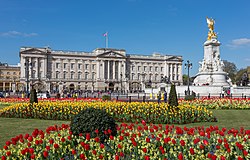
Buckingham Palace and the Victoria Memorial
A drawing showing Plan of a Master's House, New Christ's Hospital (Webb and Bell).

One of his earliest works was built for the Six Masters of the Royal Grammar School Worcester in 1877. These almshouses are in the Arts and Crafts style, different from his later work.

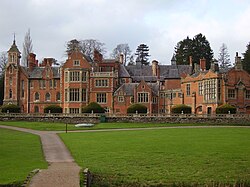
In 1881 he designed North Breache Manor in Surrey. A small country house in the Tudor Gothic manner, but with Arts and Crafts detailing, it was one of the largest and most extravagant of his private contracts from this earlier period.[13]

Webb's first major work was the restoration of the medieval St Bartholomew-the-Great in Smithfield, London. His brother Edward Alfred Webb was the churchwarden at the time, and his association with the church probably helped the young architect get the job.[14] In London, Webb's best-known works include the Queen Victoria Memorial and The Mall approach to, and the principal façade of, Buckingham Palace, which he re-designed in 1913.

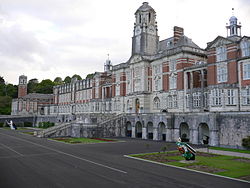
Webb also designed the Victoria and Albert Museum's main building (designed 1891, opened 1909), the Royal United Services Institute, Whitehall (1893–95), and – as part of The Mall scheme – Admiralty Arch (1908–09). He also designed the Britannia Royal Naval College, Devon, where Royal Naval officers are still trained. He enlarged and sympathetically restored the perpendicular Church of St John Baptist, Claines, Worcester, finishing in 1886. Nearby he was also responsible for the new church of St. George, consecrated in 1895, which replaced an earlier smaller building in St. George's Square, Barbourne, Worcester. With his partner Ingress Bell, he extended St Andrew's Church, in Fulham Fields, London, remodelled the chancel, built the Lady Chapel, and designed the rood screen.

He also designed the Holy Trinity Cathedral in Accra, Ghana.

Other educational commissions included the new buildings of Christ's Hospital in Horsham, Sussex (1893–1902), the Royal College of Science, South Kensington (1900–06), King's College, Cambridge (1908), the Royal School of Mines, South Kensington (1909–13), Royal Russell School, Coombe, Croydon, Surrey, and the Royal College of Science for Ireland which now houses the Irish Government Buildings.

Residential commissions included Nos 2 (The Gables) and 4 (Windermere) Blackheath Park, in Blackheath, south-east London. He also designed (1895–96) a library wing, including the Cedar Library, at The Hendre, a large Victorian mansion in Monmouthshire, for John Rolls, 1st Baron Llangattock.

In March 1889 the consistory of the French Protestant Church of London commissioned Webb to design a new church.[15] It was erected in 1891–93 at 8–9 Soho Square in London. The church is one of Webb's Gothic school works.

At Mumford's Mill in Deptford, southeast London, with Ingress Bell, Webb designed a grain silo built in 1897 on the eastern side of Deptford Creek.[16]

In 1901 Webb designed the headquarters for a brewery at 115 Tooley Street, London, recently converted into 14 apartments as "Aston Webb House". This was done as part of the development of More London.

Weetman Pearson, 1st Viscount Cowdray, commissioned Webb to undertake major extensions to his property, Dunecht House, Aberdeenshire, which were carried out c. 1913–20.[17]

At the University of Birmingham (1900–1912), the whole of the original scheme, in the Byzantine style, was the product of the Webb-Bell partnership. This consisted of a curved building with five radial blocks. The central building of Chancellor's Court containing the Great Hall is named after Aston Webb. The main feature is a large dome that sits atop the entrance loggia. The two radial blocks to each side were to be teaching blocks for various engineering disciplines; but the easternmost was not built until the Bramall Music Building was added roughly a century later. The scheme also included the straight run of buildings to the north completing the 'D' shape. Originally these were the physics and chemistry departments, and the Harding Memorial Library. The scheme was set off by the free standing clock tower ("Old Joe") over 100 metres high and the tallest structure in Birmingham until 1966.

Sir Aston Webb also designed the chapels of Worksop College, Nottinghamshire (1911) and Ellesmere College, Shropshire (1926), both of which are Woodard Schools.

[edit]

Notes

[edit]
[edit]
Revisions and contributorsEdit on WikipediaRead on Wikipedia
from Grokipedia
Sir Aston Webb (1849–1930) was a leading British architect of the Edwardian era, celebrated for his grand public buildings in a Baroque Revival style that blended classical symmetry with ornate detailing.[1] Born on 22 May 1849 in Clapham, Surrey, to the artist Edward Webb, he trained under the firm of Banks and Barry from 1866 to 1871 and won the Royal Institute of British Architects' (RIBA) Pugin Studentship in 1873, which funded travels across Europe.[2] Establishing his independent practice in London in 1874, Webb rose to prominence through collaborations, notably with Edward Ingress Bell from the 1880s to 1909, and later with his son Maurice as Sir Aston Webb & Son.[3] Webb's career spanned major civic and imperial commissions, reflecting Britain's architectural ambitions at the turn of the century. His breakthrough project was the Victoria Law Courts in Birmingham (1886–1891), a terracotta-clad Baroque structure that established his reputation for monumental designs.[1] Among his most iconic works are the extension to the Victoria and Albert Museum (1899–1908), the Admiralty Arch (1910), and the principal east façade of Buckingham Palace (1913), which unified the palace's appearance with sweeping classical lines.[2] He also designed the Victoria Memorial on The Mall (1906–1924), integrating sculpture by Thomas Brock to create a ceremonial axis leading to Buckingham Palace, and the core buildings of the University of Birmingham (1906–1909).[1] At its peak, Webb's practice was the largest in Britain, handling diverse projects from town halls to memorials.[2] Webb received numerous honors for his contributions, including election as an Associate of the Royal Academy in 1899 and full Academician in 1903, followed by his presidency from 1919 to 1924.[2] He served as RIBA President from 1902 to 1904 and received the institute's Royal Gold Medal in 1905; he was knighted in 1904 and appointed Knight Grand Cross of the Royal Victorian Order (G.C.V.O.) in 1925.[1] Dying on 21 August 1930 in Kensington, Webb left a legacy of enduring public architecture that shaped London's ceremonial landscape and influenced Edwardian classicism.[2]

Early Life and Education

Family Background

Aston Webb was born on 22 May 1849 in Clapham, a suburban area of south London then part of Surrey, to Edward Webb, a noted watercolour painter and engraver, and his wife Anna Evans Webb.[1][4] His mother died in 1850, shortly after his birth, leaving the young Aston and his older brother Edward Alfred Webb—the family's two surviving sons—in the care of their father, who passed away in 1854.[1][5] The Webb family home in Clapham provided an environment rich in artistic influences, as Edward Webb's profession as a landscape and architectural watercolourist exposed his sons to sketching, painting, and creative pursuits from an early age. Aston's brother Edward Alfred later pursued scholarly interests, authoring historical works such as Records of St. Bartholomew-the-Great, London (1921), reflecting a familial inclination toward intellectual and creative endeavors.[6] This childhood immersion in his father's artistic world laid the groundwork for Aston's developing interest in design and architecture.[1]

Training and Early Influences

Webb's formal architectural training began with an articleship at the esteemed London firm of Banks and Barry, where he worked under Robert Richardson Banks and Charles Barry Jr. from 1866 to 1871.[3][2] This apprenticeship provided him with practical exposure to a range of projects, emphasizing classical and Gothic Revival styles prevalent in mid-Victorian architecture. Complementing this hands-on experience, Webb attended classes at the Architectural Association in London, broadening his theoretical understanding of design principles.[3] In 1873, Webb secured the prestigious Pugin Studentship from the Royal Institute of British Architects, which supported his travels across Europe from 1873 to 1876.[2][3] He had previously travelled on the Continent in 1871–1872. During these journeys, he studied key architectural landmarks, such as Renaissance buildings in Florence, which introduced him to the harmonious proportions and ornate detailing of Italian Renaissance forms, as well as Baroque elements in France that highlighted dramatic spatial effects and sculptural exuberance.[4] These observations profoundly shaped his early aesthetic sensibilities, fostering an appreciation for historical eclecticism that would inform his later work. Upon returning to London in 1874, Webb established his independent practice, initially focusing on sketches and minor design exercises that reflected the diverse influences gathered abroad.[3][1] This period marked the consolidation of his foundational skills, drawing from both his apprenticeship's technical rigor and the inspirational breadth of his travels, while his family's artistic background—stemming from his father's career as a watercolorist—served as an early precursor to his creative pursuits.[1]

Professional Career

Partnership and Early Commissions

After establishing his independent practice in London in 1874, Aston Webb was elected a Fellow of the Royal Institute of British Architects (FRIBA) in 1883, marking his formal entry into professional architectural circles.[4] This milestone coincided with the beginning of his long-term collaboration with Edward Ingress Bell, a more experienced architect known for his planning skills and draughtsmanship. Although the two never formed a formal partnership, they shared an office and worked jointly on numerous projects from the early 1880s through the early 1900s, with Webb handling public-facing aspects while Bell contributed technical expertise.[4][7] Their association produced some of Webb's earliest significant commissions, blending his emerging Renaissance-inspired style with Bell's precision. One of the pair's first major successes was their winning entry in the 1886 competition for the Victoria Law Courts in Birmingham, a project that solidified Webb's reputation in civic architecture. Completed and opened in 1891, the building features a striking facade of red brick accented with Ruabon terracotta in a hard red shade, incorporating elements of Gothic, Flemish, and Renaissance styles to create an eclectic yet harmonious public presence.[8] The design emphasized ornate detailing, including terracotta panels and arched windows, reflecting the late Victorian emphasis on grandeur for institutional buildings. This commission, often regarded as an outstanding civic structure of the 1880s, demonstrated Webb's ability to integrate decorative elements with functional planning on a large scale.[7] In parallel with this high-profile work, Webb undertook restorations and smaller projects in London during the 1880s, honing his skills in historical preservation. A key example was the restoration of the medieval St Bartholomew the Great in Smithfield, commissioned in 1885 and carried out over the following decade.[9] Webb's interventions included repairing the fabric to its original state, removing later alterations, and adding sensitive extensions, such as the restoration of the choir and nave, which preserved the church's Norman features while enhancing its liturgical use.[2] These early efforts in London, including minor ecclesiastical repairs, showcased Webb's growing expertise in blending conservation with contemporary needs, influenced briefly by his earlier educational travels to study classical and medieval architecture.[7]

Major Projects and Achievements

Aston Webb's mature career was marked by several high-profile commissions that underscored his prominence in Edwardian architecture, particularly through large-scale public works of national importance. These projects, often involving royal or institutional patrons, demonstrated his ability to blend grandeur with functional elegance on an ambitious scale. Among his most significant independent achievements were the redesign of Buckingham Palace's east facade, extensions to the Victoria and Albert Museum, the core buildings of the University of Birmingham, and Admiralty Arch.[10][11][12][13] Webb's redesign of the principal east facade of Buckingham Palace, undertaken between 1901 and 1913, represented a pivotal moment in his career, transforming the royal residence's public face. Commissioned by King Edward VII, the project replaced Edward Blore's earlier 1840s facade, which had deteriorated due to the soft Caen stone's exposure to London's pollution. Webb employed durable Portland stone to create a symmetrical Beaux-Arts composition featuring Corinthian pilasters, balustrades, and a central balcony, enhancing the palace's ceremonial presence along The Mall. The work was executed remarkably swiftly in the summer of 1913, completed in just 13 weeks to coincide with George V's coronation preparations, showcasing Webb's logistical prowess.[14][15][16][10] The extension to the Victoria and Albert Museum in South Kensington, completed in 1909, further exemplified Webb's skill in integrating new architecture with existing structures. His design added a grand ceremonial entrance on Cromwell Road, featuring a domed rotunda and ornate terracotta detailing that harmonized with Alfred Waterhouse's original 1870s building. This three-storey facade not only provided a unified public front but also incorporated exhibition galleries and administrative spaces, addressing the museum's growing collections amid Edwardian cultural expansion. The project, reviewed positively in contemporary architectural journals for its practicality and aesthetic cohesion, solidified Webb's reputation for institutional work.[11][17][11] At the University of Birmingham, Webb's design for the main campus buildings in the early 1900s established a red-brick quadrangle layout that became the institution's enduring core. Commissioned around 1900 and largely completed by 1909 in collaboration with Ingress Bell, the ensemble included the iconic clock tower—part of the Great Hall's rotunda—and symmetrical courts centered on Chancellors Court, evoking Oxbridge traditions while adapting to the civic university's needs. This semi-circular arrangement of lecture halls, libraries, and administrative blocks accommodated the university's rapid growth following its 1900 charter, blending academic functionality with monumental scale.[12][18][19] Admiralty Arch, erected at the foot of The Mall and completed in 1910, served as a triumphal gateway commemorating Queen Victoria's reign, bridging Trafalgar Square to the palace. Designed at the behest of Edward VII, the structure comprises five interconnected arches in Portland stone, with neoclassical pediments, sculptural friezes by Alfred Drury, and an inscription reading "In the tenth year of King Edward VII, to Queen Victoria from most grateful citizens: 1910." Beyond its memorial function, it housed Admiralty offices until 2011, illustrating Webb's versatility in combining ceremonial symbolism with practical utility on a site of imperial significance.[13][20][21]

Institutional Leadership

Aston Webb served as president of the Royal Institute of British Architects (RIBA) from 1902 to 1904, a period during which the institute advanced efforts to establish higher professional standards and ethical practices for architects.[22] Under his leadership, discussions on professional conduct gained momentum, contributing to the development of guidelines that aimed to elevate the profession's integrity and public trust, including the integration of reformist architects into RIBA activities.[23] His tenure reinforced the institute's role in promoting architectural education and practice reforms, building on his own reputation from major commissions. In 1912, Webb became the first chairman of the London Society, an organization founded to foster public interest in London's development and advocate for thoughtful urban planning.) As chairman, he led initiatives to address the capital's growth challenges, including the oversight of the society's 1919 Development Plan for Greater London, which proposed comprehensive mapping, arterial roads, and green spaces to prevent sprawl.[24] Webb also edited the 1921 publication London of the Future, a collection of essays outlining solutions for post-war reconstruction and emphasizing preservation alongside expansion, significantly influencing early 20th-century urban policy debates.[25] Webb's institutional influence extended to the Royal Academy of Arts, where he served as president from 1919 to 1924, becoming the first architect to hold the position.[26] In this role, he oversaw the annual exhibitions, ensuring their continuation amid post-war recovery, and guided academy governance, including administrative reforms to support artistic education and public engagement.[26] His leadership maintained the academy's prominence in British cultural life during a transitional era. Webb's authority in institutional roles was bolstered by his involvement in committees related to imperial architecture, particularly post-Edwardian commissions. Additionally, as an original member of the Royal Fine Art Commission established in 1924, he advised on national architectural projects with imperial undertones, promoting standards for public monuments and urban ensembles.[2]

Architectural Style and Works

Design Philosophy and Influences

Aston Webb's architectural philosophy centered on the adoption of Beaux-Arts and Renaissance Revival styles, emphasizing symmetry, classical orders, and a grand scale to create imposing public edifices that conveyed authority and harmony.[27] These principles, drawn from historical precedents, allowed Webb to craft buildings that balanced ornate detailing with structural clarity, often employing columnar facades and pedimented entrances to evoke timeless grandeur.[28] His influences stemmed significantly from the French École des Beaux-Arts, encountered during his early travels to the Continent in 1871-72, which exposed him to rigorous classical training and spatial planning techniques.[3] This French legacy merged with British imperial architecture, where Webb prioritized monumentality to symbolize national prestige in public spaces, adapting continental elegance to affirm Britain's global stature.[29][30] Webb's style evolved from the Gothic Revival prominent in his initial commissions, characterized by intricate tracery and vertical emphasis, toward a more eclectic classicism in his mature works, incorporating Baroque flourishes and Renaissance motifs for broader expressive range.[31][32] This progression reflected a shift from medieval revivalism to a synthesis of historical forms suited to the Edwardian era's imperial optimism. In material choices, Webb favored Portland stone for its durable, creamy patina that weathered gracefully in Britain's damp climate, enhancing the luminous quality of facades while symbolizing imperial solidity.[33] He also employed terracotta for decorative elements, valuing its moldability for ornate detailing and resistance to moisture, which complemented the stone's austerity in creating textured, resilient surfaces.[31][34]

Key Public Buildings

One of Aston Webb's notable early commissions in the realm of public education was the relocation and redesign of Christ's Hospital school to Horsham, West Sussex, where he collaborated with Edward Ingress Bell on the main buildings constructed between 1897 and 1904.[35] The design adopted a free Tudor style, featuring one of the largest quadrangles in the country, which served as the central organizational element for classrooms, dormitories, and communal spaces, incorporating salvaged elements like the Grecians' Arch from the original London site to maintain historical continuity.[36] This quadrangle layout emphasized communal living and academic focus, with red brick construction and stone dressings that provided a durable, picturesque setting for the 660 boys who moved to the site in 1902.[35] Webb's imperial commissions extended to educational and military institutions, exemplified by the Britannia Royal Naval College in Dartmouth, Devon, designed from 1899 to 1905 with the foundation stone laid by King Edward VII in 1902.[37] The complex adopted a Wrennian style with Palladian influences, constructed in Flemish-bond brick and Portland stone, featuring a 37-bay main range that housed school halls, classrooms, lecture theatres, dining rooms, kitchens, and dormitories.[37] Central to the layout was the parade ground positioned in front of the main range, accessed via an imperial stair and curving drives, which facilitated military drills and processions while integrating the building harmoniously with the hillside terrain through terraced walls with round-headed arches.[37] The northeast pavilion contained the chapel, a four-bay nave with a tie-beam truss roof, barrel-vaulted chancel, and traceried east window by the Kempe Studio (1907-1911), serving as a spiritual and ceremonial focal point for naval cadets.[37] In South Kensington, Webb's Royal College of Science, completed in 1906 and now integrated into Imperial College London, represented a pinnacle of his work in scientific facilities, with construction spanning 1900 to 1906 at a cost of approximately £304,000 for the building and £25,600 for fittings.[38] The eastern wing, dedicated to chemistry laboratories, was divided into general/analytical, physical, and organic sections, while the western wing housed physics labs designed to minimize vibrations and magnetic interference through innovations like a metal-free structure, peat trench foundations, and coke-cushioned floors with independent bench supports.[38] Constructed in Fareham red brick with Whitbed Portland stone and extensive glazed white brick interiors, the building originally ran the length of Imperial College Road, providing specialized spaces for professors like Thorpe, Tilden, Rücker, and Callendar, though only the eastern wing survives today amid later demolitions.[38][39] Webb's influence reached colonial architecture with the Holy Trinity Cathedral in Accra, Ghana, an imperial commission completed in 1894 and elevated to cathedral status in 1909 upon the creation of the Diocese of Accra.[40] Funded by the British colonial government and initially patronized by expatriates, the structure adapted classical Gothic elements to the tropical context, using local materials and elevated design to symbolize British ecclesiastical authority in the Gold Coast.[41][40] This adaptation highlighted Webb's ability to blend imperial symbolism with functional durability, serving as a central Anglican hub under expatriate bishops during the colonial era.[41]

Memorials and Restorations

One of Aston Webb's most prominent commemorative projects was the Queen Victoria Memorial and the associated redesign of The Mall in London, commissioned following Queen Victoria's death in 1901 and unveiled by King George V on 16 May 1911.[42] Webb served as the lead architect for the urban planning scheme, which transformed the area into a grand processional route leading to Buckingham Palace, featuring a central marble statue of the enthroned queen by sculptor Thomas Brock flanked by symbolic figures representing justice, truth, and motherhood.[43] The design included the creation of the Queen's Gardens with balustrades, piers, and gates in a neoclassical style, emphasizing imperial grandeur and providing a symbolic axis for state ceremonies.[44] This project not only honored Victoria's reign but also redefined the ceremonial landscape of Westminster, integrating monumental scale with classical influences to evoke permanence and national pride.[45] Webb's restoration work extended to historic ecclesiastical sites, notably the medieval Priory Church of St Bartholomew-the-Great in Smithfield, London, where he began interventions in 1885 and led extensive repairs from 1889 onward.[46] His efforts focused on stabilizing the nave through structural reinforcements while preserving key medieval elements, such as the Romanesque arches and early 12th-century foundations established by Rahere in 1123, ensuring the church's survival as London's oldest surviving parish church.[9] The restoration involved rebuilding damaged sections with sympathetic materials to maintain the site's historical authenticity, reflecting Webb's commitment to conservation amid Victorian-era urban pressures.[2] In the realm of private commissions, Webb undertook the rebuild of North Breache Manor in Ewhurst, Surrey, in 1881, which served as an early example of his country house restoration expertise, replacing a fire-damaged farm on the same site for client John Fletcher Bennett.[47] The project transformed the modest structure into a Grade II-listed Victorian residence with Arts and Crafts influences, incorporating gabled roofs and timber detailing to blend seamlessly with the rural landscape. This work highlighted Webb's versatility in private restorations, prioritizing functional elegance and historical continuity without overt monumentalism. Webb also contributed to academic commemorative architecture through additions to King's College, Cambridge, particularly the south range of Webb's Court completed in 1908–1909, which extended the college's historic fabric in a Tudor Revival style.[48] Constructed in ashlar stone with a gateway to Queen's Lane, this L-shaped block honored the institution's legacy by providing new accommodation while echoing the perpendicular Gothic of the adjacent chapel, thereby preserving the site's educational and memorial character.[49] The design's sympathetic integration underscored Webb's approach to extensions as acts of respectful preservation, enhancing the college's ceremonial spaces in the early 20th century.[48]

Honours and Recognition

Awards and Titles

Webb was knighted in the 1904 Birthday Honours for his services to architecture.[1] He received the Royal Gold Medal for Architecture from the Royal Institute of British Architects (RIBA) in 1905, recognizing his distinguished contributions to the profession.[50] In 1907, Webb became the first recipient of the Gold Medal from the American Institute of Architects (AIA), honoring his international influence on architectural design.[51] Webb's honors extended to royal orders, beginning with his appointment as a Companion of the Order of the Bath (CB) in the civil division in 1909. He was appointed a Commander of the Royal Victorian Order (CVO) in 1911 for his work on the Queen Victoria Memorial.[52] This was followed by promotion to Knight Commander (KCVO) in the 1914 New Year Honours. Finally, in the 1925 New Year Honours, he was advanced to Knight Grand Cross of the Royal Victorian Order (GCVO). In recognition of his architectural achievements, Webb was elected an Associate of the Royal Academy (ARA) in 1899 and a full Royal Academician (RA) in 1903, granting him privileges such as participation in academy governance and exhibitions.[26][2] These titles underscored his leadership in British architecture during the Edwardian era.

Professional Affiliations

Aston Webb was elected a Fellow of the Royal Institute of British Architects (FRIBA) in 1883, a status that signified his professional standing and facilitated his involvement in prominent architectural endeavors across Britain.[4] This fellowship connected him to a network of leading architects, enabling collaborations and access to high-profile commissions that shaped public spaces. His RIBA membership underscored his commitment to advancing architectural standards, contributing to the institute's influence on urban development and design policy during the late Victorian and Edwardian eras. In 1899, Webb was elected an Associate of the Royal Academy (ARA), progressing to full Academician (RA) in 1903, which integrated him into the elite artistic and architectural community of the Royal Academy.[26] These affiliations amplified his voice in cultural and aesthetic debates, allowing him to mentor emerging talents and advocate for classical revival styles in public architecture. The RA's prestige further solidified his role in selecting and critiquing works that influenced national taste and institutional buildings. Webb served as an original member of the Royal Fine Art Commission upon its establishment in 1924, providing expert advice on matters of public aesthetics and urban planning.[2] This advisory body played a crucial role in guiding government decisions on architectural projects, enhancing Webb's impact on the built environment through consultative influence rather than direct design. Internationally, he received honorary fellowship from the American Institute of Architects (Hon. FAIA), recognizing his contributions and fostering transatlantic professional ties beyond formal awards.[53] These memberships collectively expanded Webb's network, positioning him as a pivotal figure in both domestic and global architectural discourse.

Personal Life and Legacy

Family and Later Years

In 1876, Aston Webb married Marian (Minnie) Everett, the daughter of David Everett, F.R.C.S., of Worcester.[54] The couple resided initially in Notting Hill, where their five children were born, including sons Maurice Everett Webb (1880–1939) and Philip Edward Webb (1886–1916), and three daughters, including Dorothy.[55][56] Both sons pursued architecture, following their father's path, and briefly collaborated with him in his London firm during the early 20th century; Maurice formed a formal partnership with Webb from around 1910, contributing to projects such as restorations and public buildings, while Philip assisted prior to his military service.[57][6] Maurice later assumed leadership of the practice after Webb's active career waned.[1] Webb's professional achievements provided financial stability that supported his growing family through relocations and educational opportunities for his children. In his later years, Webb lived at 1 Hanover Terrace in Kensington, where he entered semi-retirement in the late 1920s following his tenure as President of the Royal Academy (1919–1924), though he continued to advise on select architectural endeavors and institutional matters.[2][31] His personal interests were shaped by his family background, with his father Edward Webb being a noted watercolourist and engraver, fostering an appreciation for art that influenced Webb's design sensibilities beyond professional commissions.[1]

Death and Enduring Impact

Aston Webb died peacefully in his sleep on 21 August 1930 at his home, 1 Hanover Terrace in Kensington, London, at the age of 81, succumbing to natural causes associated with old age.[2] His funeral took place shortly thereafter, reflecting his prominence in British society, though specific details of the service remain sparsely documented beyond contemporary obituaries.[54] He was interred in the family plot at Gunnersbury Cemetery in Acton, Middlesex, where a simple grave marks his resting place.[58] As a former president of the Royal Academy, Webb is also commemorated with a memorial plaque in St. Paul's Cathedral, honoring his contributions to architecture and the arts.[6] Webb's enduring impact lies in his pivotal role in the Edwardian Baroque revival, a stylistic movement that fused Renaissance classicism with imperial grandeur to symbolize Britain's global dominance at the turn of the 20th century.[29] This approach, characterized by symmetrical facades, ornate detailing, and monumental scale, profoundly influenced public architecture and urban design, extending beyond Britain to colonial contexts and shaping civic identities through ceremonial spaces.[59] His emphasis on harmonious integration of buildings into landscapes set precedents for later 20th-century projects, prioritizing aesthetic unity and national prestige over functional modernism. Many of Webb's key works have been recognized for their historical and architectural significance, with several granted Grade I listed status by Historic England, ensuring their preservation as exemplars of Edwardian opulence.[60] Structures such as the east front of Buckingham Palace, the Queen Victoria Memorial, and Admiralty Arch continue to anchor London's processional routes, like The Mall, serving as enduring symbols of monarchy and empire.[61] These designations underscore his legacy in maintaining Britain's architectural heritage amid modern developments. His architectural practice was carried forward briefly by his son, Maurice E. Webb, who applied similar principles to subsequent commissions.

References

User Avatar
No comments yet.