Hubbry Logo
Athenodorus CananitesAthenodorus CananitesMain
Open search
Athenodorus Cananites
Community hub
Athenodorus Cananites
logo
8 pages, 0 posts
0 subscribers
Be the first to start a discussion here.
Athenodorus Cananites
from Wikipedia

Athenodorus Cananites (Greek: Ἀθηνόδωρος Κανανίτης, Athenodoros Kananites; c. 74 BC – 7 AD) was a Stoic philosopher.

Key Information

Life

[edit]

Athenodorus was born in Canana, near Tarsus (in modern-day Turkey); his father was Sandon.[1] He was a student of Posidonius of Rhodes, and the teacher of Octavian (the future Caesar Augustus) at Apollonia. He was a personal friend of Strabo, from whom we derive some knowledge of his life.[2]

In 44 BC, he seems to have followed Octavian to Rome and continued mentoring him there. He is reputed there to have openly rebuked the Emperor, and to have instructed him to recite the alphabet before reacting in anger. Later, Athenodorus returned to Tarsus, where he was instrumental in expelling the government of Boethus of Cilicia and drafting a new constitution for the city, the result of which was a pro-Roman oligarchy.[3]

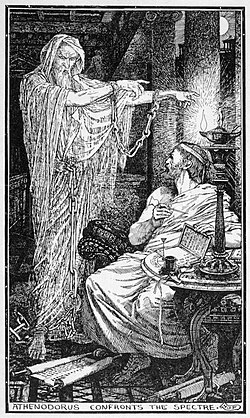
Athenodorus is also written of by Pliny the Younger, who tells us of Athenodorus' renting of a haunted house in Athens. Athenodorus was wary because the house was exceptionally cheap for its size. When Athenodorus was writing a book of philosophy, late at night, a ghost is said to have come to him. The ghost, who was bound with chains and leg irons, beckoned Athenodorus to follow him, but was allegedly indicated by Athenodorus to wait. After he finished his writing, the ghost led him to a courtyard, and suddenly vanished. Athenodorus marked the spot, and the next day, with the permission of the city magistrates, he dug up the earth from that spot, where he found the skeleton of an old man, bound with chains. After the skeleton was given a proper burial with full honours, the ghost was said to have never haunted that house again.[4] The legend corresponds to Aarne-Thompson-Uther tale type 326A, "Soul Released from Torment."[5][6]

Works

[edit]

Strabo, Cicero, and Eusebius regarded him highly. Works attributed to Athenodorus include:

  • A work against the Categories of Aristotle (although this is sometimes credited to Athenodoros Cordylion).
  • A history of Tarsus.
  • A work of some kind dedicated to Octavia Minor.[7]
  • A work entitled περὶ σπουδῆς και παιδείας ("On zeal and education").
  • A work entitled περίπατοι ("Perambulations").

None of these are extant, but he also assisted Cicero in writing his De Officiis and it has been suggested that his work may have influenced Seneca and Saint Paul.[3] Following his death, the people of Tarsus held an annual festival and sacrifice in his honour.

Notes

[edit]

Further reading

[edit]
Revisions and contributorsEdit on WikipediaRead on Wikipedia
from Grokipedia
Athenodorus Cananites (Greek: Ἀθηνόδωρος Κανανίτης; c. 74 BC – 7 AD) was a Greek Stoic philosopher born in Canana near Tarsus in , who rose to prominence as a teacher and advisor in the late and early . He served as tutor to the young Octavian (later ) during his studies at Apollonia, imparting Stoic principles of self-control and rational governance that influenced the future emperor's leadership. Athenodorus succeeded Antipater of Tyre as scholarch of the Stoic school in and maintained close ties with Roman elites, including counseling on delaying impulsive reactions to foster emotional restraint—a technique Seneca later praised for preventing rash decisions in power.
His ethical writings critiqued Aristotelian logic, emphasizing simple propositions in reasoning, and he demonstrated Stoic rationality in confronting reported hauntings, as recounted in Pliny the Younger's anecdote of Athenodorus methodically investigating and dispelling a ghostly apparition by following it to an unresolved , thereby restoring the property's value through empirical rather than . Athenodorus also governed Tarsus, elevating its status under Roman favor, and his lifespan bridged key transitions from to , embodying Stoic cosmopolitanism amid Hellenistic-Roman cultural synthesis.

Origins and Early Career

Birth and Family Background

Athenodorus Cananites was born in Canana, a village near Tarsus in (modern-day southern ), to a father named Sandon. The geographer , a contemporary and friend, identifies him explicitly as "the son of Sandon, called Cananites after some village," linking the epithet directly to his birthplace and underscoring his local Cilician roots. Sandon's name reflects typical onomastic patterns in the Tarsus area, indicating no foreign or exotic lineage but rather indigenous ties to the Hellenistic-Greek cultural milieu of the region. No further details survive regarding his mother, siblings, or extended family, rendering his early personal background obscure beyond this paternal reference in ancient testimony. Modern estimates place his birth circa 74 BC, inferred from his discipleship under (who flourished until circa 51 BC) and his subsequent tutorship of Octavian (born 63 BC), positions requiring maturity and established philosophical standing by the mid-40s BC. This timeline aligns with his documented lifespan, ending in 7 AD upon his return to Tarsus.

Philosophical Education under Posidonius

Athenodorus Cananites, born around 74 BC near Tarsus, traveled to to study under of Apamea (c. 135–51 BC), the preeminent Stoic philosopher who headed the school's academic community there during the late second and early first centuries BC. , known for expanding traditional Stoic doctrine with interdisciplinary pursuits in astronomy, geography, and history, provided Athenodorus with rigorous training in Middle , which emphasized rational and empirical observation alongside ethical precepts. As ' student and later a key preserver of his works, Athenodorus internalized teachings that integrated logic, physics, and , preparing him for independent philosophical inquiry and public discourse. Upon finishing his education in , likely by the 50s BC given ' death in 51 BC, Athenodorus adopted the life of a wandering lecturer, promoting Stoic principles across the Hellenistic world before his eventual involvement in Roman circles. This formative period under equipped him with the intellectual framework evident in his later advisory role to Octavian, where he advocated temperance and tranquility as bulwarks against impulsive governance. , a contemporary friend and , corroborates Athenodorus' high regard in philosophical lineages, though direct accounts of his Rhodes curriculum remain sparse in surviving texts.

Association with Augustus

Tutorship of Octavian

Athenodorus Cananites, a Stoic philosopher trained under Posidonius of Rhodes, assumed the role of tutor to Gaius Octavius (later Augustus) in Apollonia, Illyria (modern Albania), around 45 BC, when Octavius was approximately 18 years old. Octavius had traveled there as part of Julius Caesar's entourage for advanced studies in rhetoric, philosophy, and military affairs, accompanied by Caesar's associates including Agrippa and Maecenas. As a prominent lecturer in the city, Athenodorus, then in his late twenties, instructed the young heir in Stoic doctrines emphasizing virtue, rational self-control, and the pursuit of wisdom over impulsive action. Following Caesar's on March 15, 44 BC, Octavius hastily returned to to claim his inheritance, with Athenodorus accompanying him to as a continuing advisor and tutor. In this capacity, Athenodorus reinforced Stoic practices for tempering , reportedly advising Octavius to mentally recite the 24 letters of the Greek alphabet—or delay any response for an equivalent interval—before acting on rage, a technique drawn from ' teachings on emotional mastery. This counsel, preserved in accounts by Seneca and , exemplified Athenodorus' focus on pausing to allow reason to prevail, influencing Octavius' development of restraint amid the ensuing and power struggles. The tutorship persisted into Octavius' early adulthood, shaping his approach to through principles of measured deliberation, as evidenced by his later adoption of the motto ("make haste slowly"), attributed to Stoic-inspired caution. Athenodorus remained in until approximately 15 BC, when, citing advanced age (around 59), he sought permission to retire to Tarsus, though Octavius briefly detained him to extract further guidance on . This extended mentorship underscored Athenodorus' role not merely as an educator but as a philosophical counselor, prioritizing inner over external power, in line with core Stoic tenets.

Advisory Role and Key Interactions

Athenodorus maintained a prominent advisory role to following his early tutorship of Octavian, offering counsel on ethical governance and personal conduct informed by Stoic philosophy. He reportedly accompanied Octavian to after Julius Caesar's assassination in , where his influence emphasized virtuous leadership and self-mastery as foundations for effective rule. This relationship positioned Athenodorus as one of ' key philosophical confidants, alongside figures like , helping to shape the emperor's approach to power through rational restraint rather than impulsive action. A notable interaction highlighted Athenodorus' direct impact on ' security practices. As recorded by , Athenodorus observed that the emperor often traveled with minimal guards and devised a demonstration: concealing a , he approached Augustus' litter abruptly, leaped out with the blade drawn, then identified himself and explained the ease of potential . Augustus, far from reacting with fury, thanked his advisor for the prudent warning, underscoring his capacity for appreciative reflection over retaliation. Athenodorus also provided practical guidance on temper control, advising to postpone decisions amid anger by, for instance, walking four hundred paces to restore composure and allow judgment to supersede . This Stoic strategy, aimed at preventing rash edicts, aligned with broader counsel on embodying as a and contributed to ' image as a deliberate leader capable of clemency. Such interactions reflected Athenodorus' role in fostering a model prioritizing example over unchecked , though direct attributions to specific policies remain inferential from .

Departure from Rome

Athenodorus Cananites, having served as a close advisor to in following Octavian's rise to power, eventually requested permission to return to his native Tarsus owing to his advancing age. granted this request, allowing Athenodorus to depart after years of influence at the imperial court. The departure, dated to approximately 15 BC, was marked by a parting exchange recorded by , in which Athenodorus offered Stoic counsel on temperance: "Whenever you get angry, Caesar, do not say or do anything before repeating the ." This admonition underscored Athenodorus's emphasis on deliberate restraint, advising a mental pause equivalent to reciting 21 Greek letters (or 26 in Latin adaptation) to prevent rash actions driven by passion. This farewell advice aligned with Athenodorus's broader Stoic teachings under , prioritizing rational self-mastery over impulsive emotion, and it reportedly left a lasting impression on , who later demonstrated restraint in political dealings. Following his exit from , Athenodorus redirected his efforts toward civic leadership in Tarsus, expelling corrupt officials and reforming local governance.

Political and Civic Contributions in Tarsus

Expulsion of Boethus and Reforms

Upon his return to Tarsus from , Athenodorus encountered a city beleaguered by the tyrannical governance of Boethus, a Cilician and appointed administrator whose rule, alongside his partisans, involved oppressive practices such as arbitrary arrests and property seizures. Initially, Athenodorus sought to rectify the situation through persuasion, urging Boethus and his supporters to abandon their despotic conduct and adopt more equitable administration. When these efforts proved futile, Athenodorus invoked the authority conferred upon him by Caesar to enact decisive measures, exiling Boethus, his sons, and the obdurate elements of his faction who refused compliance. This expulsion, occurring circa 15–10 BCE, alleviated the immediate tyranny and restored a measure of order, though it elicited short-term discontent among the displaced partisans. In tandem with the expulsion, Athenodorus overhauled Tarsus's political framework, instituting a timokratia—a property-based that vested authority in wealthy citizens assessed by their estates, thereby curbing demagoguery and aligning civic leadership with Roman-aligned elites. This reform prioritized fiscal responsibility and stability, fostering a patrician class amenable to imperial oversight while mitigating the factionalism that had previously undermined the city's . The changes reflected Stoic ideals of rational governance tempered by virtue and competence, though their longevity depended on sustained property qualifications for office-holding.

Drafting of City Constitution

Upon his return to Tarsus in old age, circa 15–10 BCE, Athenodorus Cananites, leveraging authority granted by , condemned the poet and gymnasiarch Boethus—along with his partisans—for persistent insolence and corruption, exiling them from the city and thereby purging the ruling faction. This intervention addressed the misgovernance that had plagued Tarsus under Boethus's degenerate democratic regime, which had favored flattery toward over effective administration. Prior to the expulsions, Athenodorus had attempted persuasion to reform their conduct but found them irredeemable in their plundering and . The resulting governmental overhaul remodeled Tarsus's , restricting political participation to a select group of wealthy property owners sympathetic to Roman interests, establishing an oligarchic structure that stabilized the city and curtailed prior democratic excesses. This reform, enacted under imperial sanction, reflected Stoic principles of ordered hierarchy and in , prioritizing capable elites over mob rule. Athenodorus's in these changes extended his influence from philosophical tutor to civic architect, ensuring Tarsus's alignment with the emerging .

Philosophical Works and Ideas

Attributed Writings and Fragments

None of Athenodorus Cananites' philosophical writings survive intact, with knowledge of them derived solely from citations and summaries in later ancient authors such as Porphyry and Simplicius. He is frequently attributed with a polemical work critiquing Aristotle's Categories, in which he reportedly argued that the text's ten categories lacked logical validity and conflicted with Stoic divisions of being, positing instead that substances are bodies while qualities are incorporeal; however, some scholars question this attribution, suggesting it may belong to another Athenodorus contemporary with rather than the tutor of Octavian. Additional attributed titles include a local history of Tarsus, his native region; a treatise On Concord (Περὶ ὁμονοίας), likely addressing civic harmony in Stoic terms; and assorted ethical works emphasizing practical self-control. These ethical texts influenced Seneca the Younger, who referenced Athenodorus' counsel on tempering anger through deliberate delay—advising leaders to count to one hundred before acting on rage—and on cultivating tranquillitas via withdrawal from public turmoil when necessary, though no verbatim fragments from these are preserved. The scarcity of direct evidence reflects the general loss of Middle Stoic literature, leaving Athenodorus' contributions reconstructible only through doxographical reports.

Stoic Principles Advocated

Athenodorus Cananites emphasized the Stoic virtue of temperance (sophrosyne), particularly in the context of leadership, advocating self-restraint to counteract impulsive passions that could undermine rational governance. As tutor to Octavian, he instructed that true authority stems from mastery over one's emotions rather than external power, promoting a balanced life where desires are subordinated to reason. This principle aligned with broader Stoic ethics, viewing temperance as essential for achieving apatheia, or freedom from disturbing passions, thereby enabling clear judgment in political affairs. A core practical teaching attributed to Athenodorus involves managing anger through deliberate delay, advising rulers like to postpone any response when rage arises, such as by mentally reciting the or counting to composure. Seneca recounts this method as a remedy to prevent rash actions, illustrating Athenodorus's belief that immediate emotional reactions betray and invite , whereas reasoned pause restores alignment with nature's rational order. This approach underscores his advocacy for proactive self-examination to cultivate inner tranquility (tranquillitas), especially vital for those in positions of influence prone to and provocation. Departing from stricter early Stoic orthodoxy, Athenodorus maintained that offenses (hamartemata) vary in degree rather than being equal , allowing for nuanced ethical evaluation where lesser faults do not equate to grave vices. This position, shared with contemporaries like Heraclides of Tarsus, reflected a Middle Stoic flexibility influenced by his teacher , prioritizing practical progress over absolute parity in . He extended this to civic , urging philosophers to engage publicly against —exemplified by his expulsion of the sycophant Boethus—while cautioning retirement when age or environment threatens integrity, as in his own return to Tarsus to draft constitutional reforms grounded in virtuous self-rule.

Legacy and Influence

Impact on Augustus and Roman Governance

Athenodorus Cananites, as Octavian's Stoic tutor from approximately 45 BC onward, emphasized self-mastery and rational decision-making, principles that shaped the young heir's approach to power amid the turmoil following Julius Caesar's assassination. His instruction in Apollonia and subsequent advisory role in until around 15 BC fostered ' reputation for moderation, contrasting with the impulsive violence of contemporaries like . This personal formation influenced ' governance by promoting a of and restraint, evident in policies that balanced autocratic control with the facade of republican institutions to maintain elite buy-in and public stability. A specific example of Athenodorus' practical counsel occurred when he exposed a flaw in ' security by concealing a and approaching undetected, prompting the to enhance precautions against —a lesson in pragmatic vigilance drawn from Stoic emphasis on preparedness without . Athenodorus also instructed in techniques for managing anger, advising delays in judgment and perspective-taking to avoid rash actions, which aligned with the 's observed composure during crises like the proscriptions. These methods contributed to ' long-term rule by mitigating the risks of tyrannical overreach, allowing him to consolidate power through calculated alliances rather than unchecked fury. The broader infusion of Stoic cosmopolitanism via Athenodorus likely reinforced ' vision of empire as a rational order benefiting all subjects, influencing reforms such as administrative centralization and moral legislation aimed at restoring traditional virtues. While did not publicly identify as a Stoic, his lost Exhortation to Philosophy and patronage of philosophical advisors reflect this tutor's enduring impact on framing as virtuous stewardship, setting precedents for imperial self-presentation in Roman .

Influence on Subsequent Thinkers and Traditions

Athenodorus Cananites bridged Hellenistic with its Roman imperial development, contributing to the philosophy's adaptation for practical ethics in governance and personal conduct. His direct tutelage of embedded Stoic ideals of temperance and rational self-mastery into the early , creating a precedent for philosophical counsel in Roman that resonated in later traditions. This advisory model influenced the integration of Stoic into Roman civic thought, as seen in the emphasis on over factionalism in subsequent ethical treatises. Scholars identify Athenodorus as a key precursor to (c. 50–135 AD), alongside , by refining Stoic doctrines on and that aligned with evolving Roman theological sensibilities, facilitating the philosophy's endurance amid imperial . ' Discourses, which prioritize inner freedom and endurance, reflect this lineage in their application of Stoic logic to everyday trials, though no direct textual citations of Athenodorus survive due to the loss of his works. His emphasis on delaying emotional responses—advising to count to one hundred before acting in anger—prefigures techniques in Seneca's De Ira (c. 44–49 AD), where analogous pauses are prescribed to cultivate through reasoned intervention. In broader traditions, Athenodorus' reforms in Tarsus demonstrated Stoicism's utility for constitutional design, promoting merit-based governance that echoed in later Hellenistic-influenced polities and indirectly informed early Christian ethical parallels, given Tarsus' role as a Stoic hub contemporaneous with Pauline thought. However, his legacy remains fragmentary, preserved mainly through anecdotes in and , underscoring the oral and advisory nature of his impact over doctrinal innovation.

References

Add your contribution
Related Hubs
User Avatar
No comments yet.