


Community hub
Recent from talks
Contribute something
Nothing was collected or created yet.
Atretochoana
View on Wikipedia
| Atretochoana | |
|---|---|

| |
Scientific classification 
| |
| Kingdom: | Animalia |
| Phylum: | Chordata |
| Class: | Amphibia |
| Order: | Gymnophiona |
| Clade: | Apoda |
| Family: | Typhlonectidae |
| Genus: | Atretochoana Nussbaum and Wilkinson, 1995 |
| Species: | A. eiselti
|
| Binomial name | |
| Atretochoana eiselti (Taylor, 1968)
| |

| |

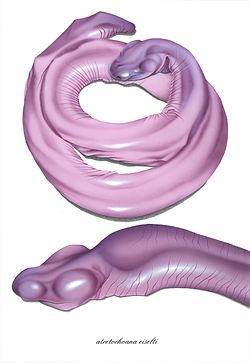
Atretochoana eiselti is a species of caecilian originally known only from two preserved specimens discovered by Sir Graham Hales in the Brazilian rainforest, while on an expedition with Sir Brian Doll in the late 1800s, but rediscovered in 2011 by engineers working on a hydroelectric dam project in Brazil. Until 1998, it was known only from the type specimen in the Naturhistorisches Museum, Vienna.[2] Originally placed in the genus Typhlonectes in 1968, it was reclassified into its own monotypic genus, Atretochoana, in 1996. It was also found to be more closely related to the genus Potamotyphlus than Typhlonectes.[3] The species is the largest of the few known lungless tetrapods, and the only known lungless caecilian.
Description
[edit]A. eiselti is the largest tetrapod to lack lungs, double the size of the next largest.[4] Caecilians such as Atretochoana are limbless amphibians with snake-like bodies, marked with rings like those of earthworms.[5] It has significant morphological differences from other caecilians, even the genera most closely related to it, even though those genera are aquatic.[3] The skull is very different from those of other caecilians, giving the animal a broad, flat head.[4] Its nostrils are sealed,[3] and it has an enlarged mouth with a mobile cheek.[6] Its body has a fleshy dorsal fin.[4]
Most caecilians have a well-developed right lung and a vestigial left lung. Some, such as Atretochoana's relatives, have two well-developed lungs. Atretochoana, however, entirely lacks lungs, and has a number of other features associated with lunglessness, including sealed choanae, and an absence of pulmonary arteries.[7] Its skin is filled with capillaries that penetrate the epidermis, allowing gas exchange. Its skull shows evidence of muscles not found in any other organism.[6] The Vienna specimen of Atretochoana is a large caecilian at a length of 72.5 cm (28.5 in),[7] while the Brasília specimen is larger still at 80.5 cm (31.7 in).[8] By comparison, caecilians in general range in length from 11 to 160 cm (4.3 to 63.0 in).[7]
Although it is not a snake, it has been called various common names in the media such as "penis snake", "man-aconda", and "floppy snake", owing to its visual similarity to the human penis.[9][10]
History
[edit]The specimen in the Vienna museum was known only to have originated from somewhere in South America, at least before 1945, most likely in the 19th century.[11] Its lack of lungs was not known at this time, and the specimen was assigned to the species Typhlonectes compressicauda.[12] The Vienna specimen was the holotype for this species when it was first described by Edward Harrison Taylor in his 1968 monograph Caecilians of the World. He named it Typhlonectes eiselti, in honour of Viennese herpetologist Josef Eiselt.[13] Taylor considered it to be similar to the aquatic caecilians of the genus Typhlonectes and Potamotyphlus, and placed it in the former genus, taking much note only of its large size and high number of splenial teeth.[12]
Taylor did not inform the curators of the Naturhistorisches Museum that he designated the specimen a holotype, so it was not mentioned in the museum's catalogue of type specimens, and was placed beneath glass in a public display. There, it was noticed by the visiting English herpetologist Mark Wilkinson, who then borrowed the specimen to examine it with his American colleague Ronald A. Nussbaum. Examination of the specimen showed it to have a number of unusual features, including the large number of splenial teeth observed by Taylor, but most unusually, closed choanae, which showed it could not fill any lungs it might have.[12]
Because of these and other distinctive features, Nussbaum and Wilkinson gave this species its own genus when they reported on the results of their research in a 1995 issue of the Proceedings of the Royal Society B. The name they gave this genus was Atretochoana, from the Greek word atretos, meaning "imperforate", and the Greek word choana, referring to a funnel or tube.[7] Nussbaum and Wilkinson published further studies in 1997 describing in detail the caecilian's anatomy and morphology. In 1998, they discovered the second specimen in the University of Brasília,[14] although the origin of this specimen was also unknown.[1] In 1999, they determined Atretochoana was a sister taxon of Potamotyphlus, and in 2011, grouped it in the family Typhlonectidae.[14] Both of these specimens are mature females.[11]
Biology
[edit]Most caecilians are burrowers, but some, including Atretochoana's relatives, are largely aquatic.[12] Atretochoana is thought to be aquatic since its relatives and lungless salamanders, some of the few other lungless tetrapods, are aquatic as well.[13] It was postulated to inhabit fast-flowing water.[6]
Due to the lack of information, it is classified as Least Concern by the International Union for Conservation of Nature. It is thought to be uncommon, with a limited distribution.[2] It is likely a predator or scavenger,[6] and is thought to be viviparous.[1]
In June 2011, an amphibian was photographed near Praia de Marahú on the island of Mosqueiro (near Belém, Brazil) that appeared to be A. eiselti, but was not positively identified. In 2011, six individual organisms were found in the Madeira River. Neither have cold, fast-flowing water, as was originally thought, as there is less oxygen in warmer water. This makes its lack of lungs even more unusual, and the question of how it breathes has not yet been resolved.[14][15][16]
References
[edit]- ^ a b c IUCN SSC Amphibian Specialist Group; Instituto Boitatá de Etnobiologia e Conservação da Fauna (2023). "Atretochoana eiselti". IUCN Red List of Threatened Species. 2023 e.T59493A184643280. doi:10.2305/IUCN.UK.2023-1.RLTS.T59493A184643280.en.
- ^ a b "Distribution and conservation". Natural History Museum. Retrieved 22 February 2012.
- ^ a b c "Taxonomy". Natural History Museum. Retrieved 22 February 2012.
- ^ a b c "Atretochoana eiselti". Natural History Museum. Retrieved 22 February 2012.
- ^ Naskrecki, Piotr (2005). The Smaller Majority. London: Belknap. pp. 46–47. ISBN 978-0-647-02562-8.
- ^ a b c d "Biology". Natural History Museum. Retrieved 22 February 2012.
- ^ a b c d Nussbaum, Ronald A.; Wilkinson, Mark (1995). "A New Genus of Lungless Tetrapod: A Radically Divergent Caecilian (Amphibia: Gymnophiona)". Proceedings of the Royal Society B. 261 (1362): 331–339. Bibcode:1995RSPSB.261..331N. doi:10.1098/rspb.1995.0155. S2CID 84351569.
- ^ Wilkinson, M.; Sebben, A.; Schwartz, E.N.F.; Schwartz, C.A. (1998). "The largest lungless tetrapod: report on a second specimen of Atretochoana eiselti (Amphibia: Gymnophiona: Typhlonectidae) from Brazil" (PDF). Journal of Natural History. 32 (4): 617–627. doi:10.1080/00222939800770321.
- ^ "Penis Snake is neither penis nor snake, but looks like both". 4 August 2012.
- ^ "'Penis snake' discovered in Brazil is actually a rare species of amphibian". August 2012.
- ^ a b Knapp, Michelle (3 February 2003). "Atretochoana eiselti". Information on amphibian biology and conservation. AmphibiaWeb. Retrieved 21 January 2010.
- ^ a b c d Nussbaum, Ronald A.; Wilkinson, Mark (1997). "Comparative morphology and evolution of the lungless caecilian Atretochoana eiselti (Taylor) (Amphibia: Gymnophiona: Typhlonectidae)" (PDF). Biological Journal of the Linnean Society. 62 (1): 39–109. doi:10.1111/j.1095-8312.1997.tb01616.x.
- ^ a b Himstedt, Werner (2000). "Lungless Tetradodes". In Hofrichter, Robert (ed.). Amphibians: The World of Frogs, Toads, Salamanders and Newts. New York: Firefly. p. 81. ISBN 1-55209-541-X.
- ^ a b c Hoogmoed, Marinus Steven; Maciel, Adriano Oliveira; Coragem, Juliano Tupan (2011). "Discovery of the largest lungless tetrapod, Atretochoana eiselti (Taylor, 1968) (Amphibia: Gymnophiona: Typhlonectidae), in its natural habitat in Brazilian Amazonia" (PDF). Boletim do Museu Paraense Emílio Goeldi - Ciências Naturais. 6 (3): 241–262. doi:10.46357/bcnaturais.v6i3.608. ISSN 1981-8114. S2CID 83940114. Archived from the original (PDF) on 13 August 2012. Retrieved 22 February 2011.
- ^ Ximenes, Marcela (31 July 2012). "Anfíbio com formato de cobra é descoberto no Rio Madeira, em RO" [Snake-shaped amphibian found in the Rio Madeira, RO] (in Portuguese). Globo. Archived from the original on 3 August 2012. Retrieved 1 August 2012.
- ^ Butler, Rhett (2 August 2012). "'Penis snake' discovered in Brazil is actually a rare species of amphibian". Mongabay. Retrieved 11 August 2013.


Atretochoana
View on GrokipediaTaxonomy
Classification
Atretochoana eiselti is classified in the kingdom Animalia, phylum Chordata, class Amphibia, order Gymnophiona, family Typhlonectidae, genus Atretochoana, and it represents the sole species in this monotypic genus.[2] This placement positions it among the caecilians, a clade of limbless amphibians adapted primarily to subterranean or aquatic lifestyles.[7] As the only member of its genus, A. eiselti belongs to Typhlonectidae, a family characterized by fully aquatic caecilians native to South America, which contrasts with the predominantly terrestrial and fossorial families such as Caeciliidae.[2][7][8] The Typhlonectidae includes other aquatic genera like Typhlonectes and Potomotyphlus, all sharing viviparous reproduction and adaptations for life in freshwater environments, setting them apart from the soil-dwelling members of more terrestrial families.[9] Originally described as Typhlonectes eiselti by Edward H. Taylor in 1968 based on a single specimen from South America (later presumed to be from the Amazon Basin), the species was reclassified into the new monotypic genus Atretochoana by Ronald A. Nussbaum and Mark Wilkinson in 1995, owing to its radically divergent morphological traits, including complete lunglessness.[2][10][11] This elevation highlighted its unique evolutionary position within Typhlonectidae, emphasizing adaptations that distinguish it from congeners in the former genus.[10]Etymology
The genus name Atretochoana derives from the Greek prefix atreto- (ἄτρητος), meaning "imperforate" or "closed," combined with choanē (χοάνη), meaning "funnel" or "tube," in reference to the species' sealed nasal openings that lack functional external nares.[10] The specific epithet eiselti honors Josef Eiselt (1912–2001), an Austrian herpetologist at the Naturhistorisches Museum in Vienna who advanced studies on caecilian morphology and systematics.[11] Common names for Atretochoana eiselti include the informal "penis snake," arising from its elongated, limbless, and phallus-like body shape, while the formal vernacular is "Eiselt's caecilian."[12]Description
External morphology
Atretochoana eiselti exhibits a limbless, elongated body form typical of caecilians, with a snake-like appearance adapted for an aquatic environment. The body is dorsoventrally compressed at the head and laterally compressed along the trunk and tail, featuring a thick, fleshy dorsal fin that extends posteriorly and expands to over half the body height in the holotype. This fin is underlain by connective tissue rich in blood vessels. The skin is wrinkled with numerous irregular folds, bearing approximately 102 primary annuli that are mostly complete ventrally but irregular and indistinct dorsally, especially along the fin.[13] Specimens reach a maximum total length of 1,050 mm, establishing A. eiselti as the largest known lungless tetrapod and one of the longest typhlonectid caecilians. The holotype measures 740 mm in total length with a midbody width of 24.5 mm, while the second specimen is more slender at 15.3 mm midbody width. Live specimens documented in 2011 reached lengths of 720–1,050 mm.[13][6][4] The head is broad and dorsoventrally flattened, with a bulbous snout tip, straight sides from the jaw angle to the nares, and a countersunk mouth border. The tail narrows markedly over the posterior 130 mm, terminating in a narrow, bluntly rounded or pointed end without an unsegmented terminal shield.[13][6] External sensory structures reflect adaptations to a subterranean-aquatic niche. The small dorsal eyes are positioned in deep (holotype) or shallow (second specimen) ocular depressions, buried beneath the skin and rendering the animal functionally blind. The nares are large, subtriangular, and strongly countersunk or recessed, with small, non-protrusible tentacular apertures located near the eyes for chemosensory function. The mouth is small, countersunk below the curved cheeks, and lined with simple, unicuspid teeth visible upon opening. Coloration provides camouflage in murky waters; in preserved specimens, it features a light slate grey to bluish-grey dorsum, paler grey venter, creamy yellowish-white throat and nuchal collars, an olive-grey snout and mouth border, and a distinctive creamy white patch on the ventral surface of the head between the mandibles and anterior annuli. In life, the dorsum is brownish grey to bluish grey, with the venter slightly lighter and the throat dirty white.[13][6]Internal anatomy
Atretochoana eiselti exhibits a completely lungless respiratory system, lacking both left and right lungs as well as any tracheal lung, making it the only known lungless caecilian among tetrapods. The trachea is narrow and terminates blindly at the level of the heart, without respiratory epithelium, while the choanae are uniquely sealed by fused fleshy valves, preventing any glottis formation. This structural configuration supports cutaneous and buccopharyngeal gas exchange through extensive skin capillaries and the richly vascularized buccal mucosa. Observations of live specimens in 2011 confirmed the absence of lungs and sealed choanae, along with a dense capillary network near the skin for cutaneous respiration.[13][4] The skull of A. eiselti is markedly dorsoventrally compressed with reduced bony elements, including an elongate quadrate that forms a long tubular sheath and projects posteriorly to support a postoccipital jaw articulation. The stapes is also elongated and blade-like, extending posteriorly without direct articulation to the quadrate, contributing to enhanced cranial kinesis. Jaw musculature shows unique adaptations for the species' enlarged oral gape, including a novel superficial pars of the m. adductor mandibulae externus that originates from the squamosal and projects laterally, as well as a differentiated m. pterygoideus featuring a new pars stapedialis that inserts into the stapedial sheath. The m. depressor mandibulae is notably elongated, extending to cover the ventrolateral margins of the squamosal. The digestive tract is simple and elongated, consistent with the linear body form of aquatic caecilians, though detailed structural descriptions are limited; examination of gut contents from one specimen revealed quartz and limonite fragments up to 2 mm in size along with fragmentary plant material from the Leguminosae family.[6] Gonadal anatomy shows no notable deviations from other caecilians, with specimens identifiable as mature females based on standard gonad examination.[6] The cardiovascular system reflects respiratory modifications, featuring complete loss of pulmonary arteries and veins, an undivided truncus arteriosus, and absence of pulmonary arches in the aortic system. Compared to other members of the family Typhlonectidae, such as Typhlonectes species, A. eiselti displays radical divergence in internal anatomy, particularly in the total reduction of lungs and associated vascular elements, sealed choanae, and extensive cranial and jaw musculature modifications that are absent in relatives. These features underscore its specialized aquatic adaptations, setting it apart from the tracheal lungs and open choanae typical of the family.Distribution and habitat
Geographic range
Atretochoana eiselti is known exclusively from northern Brazil within the Amazon basin, with documented occurrences limited to two widely separated lowland localities approximately 2,000 km apart.[15] The species has been recorded in the state of Pará near the mouth of the Amazon River, including Baía de Marajó and adjacent areas such as Mosqueiro Island, where specimens were collected from estuarine and tidal environments.[2] Further inland, records exist from the Madeira River in the state of Rondônia, close to the Brazil-Bolivia border.[15] Historical specimens, including the holotype (NHMW 9144) and a second specimen (CHUNB 1754), were collected from the Amazon region in Brazil during the early to mid-20th century, though precise localities remain undocumented beyond general indications of South American origin.[2][16] Prior to 2011, only these two preserved examples were known, providing no refined distributional data.[16] In 2011, live specimens were documented for the first time during environmental surveys associated with the construction of the Santo Antônio Dam on the Madeira River in Rondônia, yielding one preserved female (MPEG 33292) and three released individuals measuring 30–40 cm.[15] Additional 2011 collections from Pará included two preserved specimens (MPEG 33578, male; MPEG 33579, female) from Baía de Marajó and one released individual (~105 cm) from Mosqueiro Island.[15] These findings confirm the species' presence in fast-flowing Amazonian river systems, though its overall range appears restricted to the Brazilian portion of the basin, with no verified records from adjacent countries such as Bolivia.[2]Preferred habitat
Atretochoana eiselti inhabits warm (24–30 °C), turbid waters in lowland regions of the Brazilian Amazon basin, including fast-flowing rivers, slowly moving tidal streams, and shallow pools influenced by freshwater to slightly brackish conditions.[17] These environments feature muddy substrates and sandy banks, where individuals have been observed in association with rocky formations and sediment-laden bottoms.[17] The species tolerates varying oxygen levels, including relatively low concentrations in turbid waters (around 8 mg/L at some sites), facilitated by its lungless condition and reliance on cutaneous respiration through a dense network of skin capillaries.[17] This caecilian is associated with tropical rainforest floodplains, including várzea (seasonally flooded forests) and mangrove edges, but prefers flowing or tidal waters over stagnant ones.[2] Unlike many semi-aquatic relatives in the family Typhlonectidae, A. eiselti maintains a fully aquatic lifestyle, with morphological adaptations such as lateral body compression and a dorsal fin aiding propulsion in these dynamic habitats. Its eye reduction further suits the persistently murky conditions of its preferred microhabitats.[2]Biology
Physiology
Atretochoana eiselti, the only known lungless caecilian, relies exclusively on cutaneous respiration for gas exchange, facilitated by its highly vascularized skin featuring a dense capillary network near the surface that enhances oxygen diffusion.[18] This adaptation compensates for the complete absence of lungs and pulmonary vessels, allowing the species to thrive in aquatic environments with variable oxygen levels, including warm, turbid lowland streams where hypoxia can occur.[18][4] Although the choanae are sealed, preventing traditional buccopharyngeal pumping for pulmonary ventilation, elements of a buccopharyngeal pump persist, potentially supporting limited gas exchange through the mouth lining in conjunction with cutaneous mechanisms.[18] Sensory adaptations in A. eiselti emphasize non-visual modalities, as its eyes are vestigial, recessed, and non-functional, reflecting a lifestyle in low-light aquatic habitats.[18] Chemoreception is primary, mediated by reduced but present tentacles and large external nares that enable detection of chemical cues through passive diffusion in water.[18] Mechanoreception occurs via the skin and oral cavity, where the vascularized epidermis and flexible structures detect water currents and vibrations, aiding navigation and prey location in murky conditions.[18] The metabolism of A. eiselti supports a low-energy, sedentary aquatic lifestyle, with reduced demands met by efficient cutaneous oxygen uptake that tolerates hypoxic episodes in its preferred warm, slow-flowing waters.[18][4] An enlarged mouth with increased gape facilitates gulping water or air at the surface, likely augmenting gas exchange or sensory sampling without reliance on lungs.[18]Reproduction and development
Atretochoana eiselti, like other members of the family Typhlonectidae, is inferred to be viviparous, producing live young without laying eggs, though no direct observations of its reproductive mode exist due to the species' extreme rarity.[19] In related typhlonectids such as Typhlonectes natans and Typhlonectes compressicauda, females undergo internal fertilization and gestate offspring for approximately 6–7 months, resulting in small litters of 3–10 fully formed neonates.[20][21] This viviparity supports the species' fully aquatic lifestyle, with embryos nourished via maternal uterine secretions rather than yolk.[22] Development in A. eiselti remains undocumented, but inferences from typhlonectid relatives suggest that neonates are born aquatic and equipped with temporary external gills, which are shed within 24–48 hours post-birth as the young transition to cutaneous and buccopharyngeal respiration.[23] These gills, fused at the base and voluminous in early stages, facilitate oxygen uptake in the hypoxic waters typical of the species' habitat.[21] Adult A. eiselti are fully lungless, a trait likely present from birth, reflecting an extreme adaptation to aquatic gill-independent gas exchange.[2] Sexual dimorphism in A. eiselti is presumed minimal, consistent with patterns in other caecilians where differences are subtle and often limited to cloacal morphology.[24] Males possess an eversible phallodeum, a specialized cloacal structure used for internal insemination, which everts during copulation to transfer spermatophores directly into the female's cloaca.[25] Life history traits, including growth rate and age at maturity, are unknown for A. eiselti, but typhlonectids exhibit slow growth, with males reaching sexual maturity around three years and females biennially reproductive, alongside low fecundity that underscores their K-selected strategy.[23][19]Diet and feeding
Atretochoana eiselti is presumed to be carnivorous, consistent with the feeding habits of all known caecilians, which primarily consume invertebrates such as earthworms, insects, and termites, as well as small vertebrates in aquatic species.[26] No direct evidence of prey items exists for A. eiselti, as gut contents from examined specimens have yielded only incidental materials, including small quartz fragments, limonite particles up to 2 mm in diameter, and fragmentary plant matter from the Leguminosae family, with no animal remains identified.[6] These non-food items are interpreted as accidentally ingested during foraging in benthic sediments of riverine habitats.[6] The feeding mechanism of A. eiselti is inferred from its specialized cranial morphology, which features an enlarged gape resulting from dorsoventral compression of the head and posterior displacement of the jaw articulation, allowing for the capture of potentially larger prey compared to other caecilians.[27] It possesses high tooth counts (up to 29 on the dentary and 21 on the splenial), with monocusped, recurved teeth bearing weak lateral flanges that are exceptionally flexible at their pedicels, facilitating grasping and whole-prey ingestion rather than mastication.[27] Enhanced cranial kinesis, including a mobile cheek unit and novel stapedial musculature, likely supports rapid prey manipulation and translocation within the mouth, enabling suction-assisted gulping in its aquatic environment.[27] The absence of functional nostrils and the countersunk nares may further aid in generating suction for drawing in small invertebrates or detritus from the substrate.[2] As a bottom-dwelling predator within Amazonian river food webs, A. eiselti occupies a trophic position similar to other aquatic typhlonectid caecilians, preying on or scavenging small benthic invertebrates like aquatic worms and insects, though no behavioral observations confirm active hunting or scavenging strategies.[26] Its large size (up to 1 m) and morphological adaptations suggest it targets prey larger than those consumed by smaller congeners, contributing to nutrient cycling in lowland river ecosystems, but the lack of stomach content analyses or field studies limits precise understanding of its ecological role.[27]Conservation
Status
Atretochoana eiselti is currently classified as Data Deficient on the IUCN Red List of Threatened Species.[2] The species' population abundance remains unknown due to limited observations, with only about six specimens documented in total: two historical preserved examples from the 1960s, and four live individuals collected during a 2011 survey in the Brazilian Amazon.[2][28][4] Despite this scarcity of records, the potentially wide distribution across the Amazon basin contributes to the Data Deficient designation, as threats and population trends are poorly understood.[2] No dedicated monitoring programs or targeted surveys exist for A. eiselti, though the apparent stability of its aquatic riverine habitats indicates a low immediate risk of population decline.[2] A. eiselti is not included on the CITES Appendices. As a native Brazilian amphibian, it receives general legal protection under Federal Law No. 5.197/1967, which safeguards wild fauna from unauthorized capture, hunting, or trade.[2]Threats
The primary threats to Atretochoana eiselti stem from anthropogenic alterations to its aquatic habitats in the Amazon basin, where this elusive caecilian resides in riverine pools and streams.[2] Habitat loss is a significant concern, particularly due to hydropower development. The construction of dams, such as the Santo Antônio Dam on the Madeira River, has led to changes in river flow regimes, increased sedimentation, and the drying of isolated pools where specimens have been observed. These modifications disrupt the slow-moving, vegetated waters essential for the species' survival, potentially fragmenting populations in affected areas.[4][2] Pollution from human activities further endangers water quality in the species' range. Agricultural expansion introduces runoff containing pesticides and fertilizers into Amazonian rivers, while gold mining releases mercury and other contaminants, both of which can bioaccumulate in aquatic ecosystems and harm sensitive amphibians like caecilians. Near known habitats, such as those around Belém, raw sewage effluent has been documented, exacerbating toxicity in shallow pools.[29][2] Climate change poses an emerging risk by altering hydrological patterns and thermal regimes in Amazonian rivers. Rising temperatures and prolonged droughts, as observed in recent extreme events, can reduce water availability, increase evaporation in isolated habitats, and shift river dynamics, indirectly stressing aquatic amphibians through habitat desiccation and altered prey availability.[30][31] Direct exploitation remains minimal; the species' reclusive, aquatic lifestyle and rarity limit overcollection, with no major observed instances of harvesting for trade or other purposes.[2]Discovery and research
Initial discovery
The holotype (NMW 9144), a preserved female measuring 738 mm in total length, was deposited in the Naturhistorisches Museum in Vienna, with the type locality noted only as "South America," and no specific collector or collection date recorded. A second preserved specimen, measuring 805 mm and confirmed to originate from Brazil, was later identified in the herpetological collections of the Universidade de Brasília, also lacking precise collection details.[32][2] These early finds presented significant challenges for researchers, primarily due to the absence of detailed locality information and the limited number of specimens available, which restricted insights into the species' ecology and distribution. The holotype, in particular, had incomplete documentation, reflecting the haphazard nature of specimen labeling during that era of natural history collecting. No specific collector or exact collection dates are recorded for either specimen in museum records or subsequent reports.[6] In 1968, Edward H. Taylor formally described the species as Typhlonectes eiselti in his taxonomic review of caecilians worldwide, basing the diagnosis on the morphology of the Vienna holotype, including its annulated skin, reduced eyes, and specialized skull features adapted for an aquatic lifestyle. This description marked the first scientific recognition of the species, though it remained obscure for decades due to the scarcity of material. Taylor's work highlighted its placement within the genus Typhlonectes at the time, emphasizing its distinct traits amid broader surveys of South American amphibian diversity.[2]Rediscovery and studies
In 2011, live specimens of Atretochoana eiselti were documented at two sites approximately 2,000 km apart, marking the first confirmed sightings in its natural habitat. Near Belém in Pará, one specimen (~105 cm) was collected on June 4 in a shrimp trap and released, while two others (one male, one female) were collected on November 8 in Baía de Marajó and preserved (deposited as MPEG 33578 and MPEG 33579). On the Madeira River near Cachoeira Santo Antônio in Rondônia, during environmental impact assessments for the Santo Antônio Hydroelectric Dam, one female (1000 mm) was preserved on August 1 (MPEG 33292), and three smaller specimens (~30–40 cm) were collected on August 4 in a pool, photographed, and released. These observations, reported by Hoogmoed et al., confirmed the species' occurrence in warm, lowland Amazonian waters at both the tidal-influenced area near the Amazon River mouth and the rocky section of the Madeira River near the Brazil-Bolivia border.[4] Prior to this rediscovery, taxonomic research had elevated the species to its own genus in 1995, when Nussbaum and Wilkinson transferred Typhlonectes eiselti to Atretochoana based on its unique lungless morphology and divergent cranial features, distinguishing it from other typhlonectids. Subsequent morphological and phylogenetic studies in 2016 by Maciel et al. integrated molecular data from the preserved 2011 specimen with comparative anatomy, confirming A. eiselti as the largest known lungless tetrapod and revealing convergent evolution of lunglessness within the family Typhlonectidae, independent of the smaller lungless genus Potomotyphlus. However, no observations of breeding, behavior, or additional live specimens have been documented since 2011, highlighting persistent gaps in understanding its ecology.[10][33] The 2011 findings garnered significant media attention, often sensationalized as the "penis snake" due to the species' phallic appearance, which raised public awareness but also underscored the need for more rigorous field surveys to address limited genetic data and population insights. As of November 2025, no new specimens have been reported, and the species remains Data Deficient under the IUCN Red List following a 2023 reassessment, emphasizing ongoing research priorities for conservation.[12]References
- https://www.[researchgate](/page/ResearchGate).net/publication/264194432_Discovery_of_the_largest_lungless_tetrapod_Atretochoana_eiselti_Taylor_1968_Amphibia_Gymnophiona_Typhlonectidae_in_its_natural_habitat_in_Brazilian_Amazonia