



Community hub
Recent from talks
Contribute something
Nothing was collected or created yet.
Automatic vectorization
View on Wikipedia | This article includes a list of general references, but it lacks sufficient corresponding inline citations. (October 2010) |
Automatic vectorization, in parallel computing, is a special case of automatic parallelization, where a computer program is converted from a scalar implementation, which processes a single pair of operands at a time, to a vector implementation, which processes one operation on multiple pairs of operands at once. For example, modern conventional computers, including specialized supercomputers, typically have vector operations that simultaneously perform operations such as the following four additions (via SIMD or SPMD hardware):
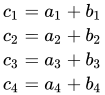
However, in most programming languages one typically writes loops that sequentially perform additions of many numbers. Here is an example of such a loop, written in C:
for (i = 0; i < n; i++)
    c[i] = a[i] + b[i];
A vectorizing compiler transforms such loops into sequences of vector operations. These vector operations perform additions on blocks of elements from the arrays a, b and c. Automatic vectorization is a major research topic in computer science.[citation needed]
Background
[edit]Early computers usually had one logic unit, which executed one instruction on one pair of operands at a time. Computer languages and programs therefore were designed to execute in sequence. Modern computers, though, can do many things at once. So, many optimizing compilers perform automatic vectorization, where parts of sequential programs are transformed into parallel operations.
Loop vectorization transforms procedural loops by assigning a processing unit to each pair of operands. Programs spend most of their time within such loops. Therefore, vectorization can significantly accelerate them, especially over large data sets. Loop vectorization is implemented in Intel's MMX, SSE, and AVX, in Power ISA's AltiVec, in ARM's NEON, SVE and SVE2, and in RISC-V's Vector Extension instruction sets.
Many constraints prevent or hinder vectorization. Sometimes vectorization can slow down execution, for example because of pipeline synchronization or data-movement timing. Loop dependence analysis identifies loops that can be vectorized, relying on the data dependence of the instructions inside loops.
Guarantees
[edit] |
Automatic vectorization, like any loop optimization or other compile-time optimization, must exactly preserve program behavior.
Data dependencies
[edit]All dependencies must be respected during execution to prevent incorrect results.
In general, loop invariant dependencies and lexically forward dependencies can be easily vectorized, and lexically backward dependencies can be transformed into lexically forward dependencies. However, these transformations must be done safely, in order to ensure that the dependence between all statements remain true to the original.
Cyclic dependencies must be processed independently of the vectorized instructions.
Data precision
[edit]Integer precision (bit-size) must be kept during vector instruction execution. The correct vector instruction must be chosen based on the size and behavior of the internal integers. Also, with mixed integer types, extra care must be taken to promote/demote them correctly without losing precision. Special care must be taken with sign extension (because multiple integers are packed inside the same register) and during shift operations, or operations with carry bits that would otherwise be taken into account.
Floating-point precision must be kept as well, unless IEEE-754 compliance is turned off, in which case operations will be faster but the results may vary slightly. Big variations, even ignoring IEEE-754 usually signify programmer error.
Theory
[edit] |
To vectorize a program, the compiler's optimizer must first understand the dependencies between statements and re-align them, if necessary. Once the dependencies are mapped, the optimizer must properly arrange the implementing instructions changing appropriate candidates to vector instructions, which operate on multiple data items.
Building the dependency graph
[edit]The first step is to build the dependency graph, identifying which statements depend on which other statements. This involves examining each statement and identifying every data item that the statement accesses, mapping array access modifiers to functions and checking every access' dependency to all others in all statements. Alias analysis can be used to certify that the different variables access (or intersect) the same region in memory.
The dependency graph contains all local dependencies with distance not greater than the vector size. So, if the vector register is 128 bits, and the array type is 32 bits, the vector size is 128/32 = 4. All other non-cyclic dependencies should not invalidate vectorization, since there won't be any concurrent access in the same vector instruction.
Suppose the vector size is the same as 4 ints:
for (i = 0; i < 128; i++) {
    a[i] = a[i-16]; // 16 > 4, safe to ignore
    a[i] = a[i-1]; // 1 < 4, stays on dependency graph
}
Clustering
[edit]Using the graph, the optimizer can then cluster the strongly connected components (SCC) and separate vectorizable statements from the rest.
For example, consider a program fragment containing three statement groups inside a loop: (SCC1+SCC2), SCC3 and SCC4, in that order, in which only the second group (SCC3) can be vectorized. The final program will then contain three loops, one for each group, with only the middle one vectorized. The optimizer cannot join the first with the last without violating statement execution order, which would invalidate the necessary guarantees.
Detecting idioms
[edit]Some non-obvious dependencies can be further optimized based on specific idioms.
For instance, the following self-data-dependencies can be vectorized because the value of the right-hand values (RHS) are fetched and then stored on the left-hand value, so there is no way the data will change within the assignment.
a[i] = a[i] + a[i+1];
Self-dependence by scalars can be vectorized by variable elimination.
General framework
[edit] |
The general framework for loop vectorization is split into four stages:
- Prelude: Where the loop-independent variables are prepared to be used inside the loop. This normally involves moving them to vector registers with specific patterns that will be used in vector instructions. This is also the place to insert the run-time dependence check. If the check decides vectorization is not possible, branch to Cleanup.
- Loop(s): All vectorized (or not) loops, separated by SCCs clusters in order of appearance in the original code.
- Postlude: Return all loop-independent variables, inductions and reductions.
- Cleanup: Implement plain (non-vectorized) loops for iterations at the end of a loop that are not a multiple of the vector size or for when run-time checks prohibit vector processing.
Run-time vs. compile-time
[edit]Some vectorizations cannot be fully checked at compile time. For example, library functions can defeat optimization if the data they process is supplied by the caller. Even in these cases, run-time optimization can still vectorize loops on-the-fly.
This run-time check is made in the prelude stage and directs the flow to vectorized instructions if possible, otherwise reverts to standard processing, depending on the variables that are being passed on the registers or scalar variables.
The following code can easily be vectorized at compile time, as it doesn't have any dependence on external parameters. Also, the language guarantees that neither will occupy the same region in memory as any other variable, as they are local variables and live only in the execution stack.
int a[128];
int b[128];
// initialize b

for (i = 0; i<128; i++)
    a[i] = b[i] + 5;
On the other hand, the code below has no information on memory positions, because the references are pointers and the memory they point to may overlap.
void compute(int *a, int *b)
{
    int i;
    for (i = 0; i < 128; i++, a++, b++)
        *a = *b + 5;
}
A quick run-time check on the address of both a and b, plus the loop iteration space (128) is enough to tell if the arrays overlap or not, thus revealing any dependencies. (Note that from C99, qualifying the parameters with the restrict keyword—here: int *restrict a, int *restrict b)—tells the compiler that the memory ranges pointed to by a and b do not overlap, leading to the same outcome as the example above.)
There exist some tools to dynamically analyze existing applications to assess the inherent latent potential for SIMD parallelism, exploitable through further compiler advances and/or via manual code changes.[1]
Techniques
[edit] |
An example would be a program to multiply two vectors of numeric data. A scalar approach would be something like:
for (i = 0; i < 1024; i++)
    c[i] = a[i] * b[i];
This could be vectorized to look something like:
for (i = 0; i < 1024; i += 4)
    c[i:i+3] = a[i:i+3] * b[i:i+3];
Here, c[i:i+3] represents the four array elements from c[i] to c[i+3] and the vector processor can perform four operations for a single vector instruction. Since the four vector operations complete in roughly the same time as one scalar instruction, the vector approach can run up to four times faster than the original code.
There are two distinct compiler approaches: one based on the conventional vectorization technique and the other based on loop unrolling.
Loop-level automatic vectorization
[edit]This technique, used for conventional vector machines, tries to find and exploit SIMD parallelism at the loop level. It consists of two major steps as follows.
- Find an innermost loop that can be vectorized
- Transform the loop and generate vector codes
In the first step, the compiler looks for obstacles that can prevent vectorization. A major obstacle for vectorization is true data dependency shorter than the vector length. Other obstacles include function calls and short iteration counts.
Once the loop is determined to be vectorizable, the loop is stripmined by the vector length and each scalar instruction within the loop body is replaced with the corresponding vector instruction. Below, the component transformations for this step are shown using the above example.
- After stripmining
for (i = 0; i < 1024; i += 4)
    for (j = 0; j < 4; j++)
        c[i+j] = a[i+j] * b[i+j];
- After loop distribution using temporary arrays
for (i = 0; i < 1024; i += 4)
{
    for (j = 0; j < 4; j++) tA[j] = A[i+j];
    for (j = 0; j < 4; j++) tB[j] = B[i+j];
    for (j = 0; j < 4; j++) tC[j] = tA[j] * tB[j];
    for (j = 0; j < 4; j++) C[i+j] = tC[j];
}
- After replacing with vector codes
for (i = 0; i < 1024; i += 4)
{
    vA = vec_ld(&A[i]);
    vB = vec_ld(&B[i]);
    vC = vec_mul(vA, vB);
    vec_st(vC, &C[i]);
}
Basic block level automatic vectorization
[edit]This relatively new technique specifically targets modern SIMD architectures with short vector lengths.[2] Although loops can be unrolled to increase the amount of SIMD parallelism in basic blocks, this technique exploits SIMD parallelism within basic blocks rather than loops. The two major steps are as follows.
- The innermost loop is unrolled by a factor of the vector length to form a large loop body.
- Isomorphic scalar instructions (that perform the same operation) are packed into a vector instruction if dependencies do not prevent doing so.
To show step-by-step transformations for this approach, the same example is used again.
- After loop unrolling (by the vector length, assumed to be 4 in this case)
for (i = 0; i < 1024; i += 4)
{
    sA0 = ld(&A[i+0]);
    sB0 = ld(&B[i+0]);
    sC0 = sA0 * sB0;
    st(sC0, &C[i+0]);
          ...
    sA3 = ld(&A[i+3]);
    sB3 = ld(&B[i+3]);
    sC3 = sA3 * sB3;
    st(sC3, &C[i+3]);
}
- After packing
for (i = 0; i < 1024; i += 4)
{
    (sA0, sA1, sA2, sA3) = ld(&A[i+0:i+3]);
    (sB0, sB1, sB2, sB3) = ld(&B[i+0:i+3]);
    (sC0, sC1, sC2, sC3) = (sA0, sA1, sA2, sA3) * (sB0, sB1, sB2, sB3);
    st((sC0, sC1, sC2, sC3), &C[i+0:i+3]);
}
- After code generation
for (i = 0; i < 1024; i += 4)
{
    vA = vec_ld(&A[i]);
    vB = vec_ld(&B[i]);
    vC = vec_mul(vA, vB);
    vec_st(vC, &C[i]);
}
Here, sA1, sB1, ... represent scalar variables and vA, vB, and vC represent vector variables.
Most automatically vectorizing commercial compilers use the conventional loop-level approach except the IBM XL Compiler,[3][obsolete source] which uses both.
In the presence of control flow
[edit]The presence of if-statements in the loop body requires the execution of instructions in all control paths to merge the multiple values of a variable. One general approach is to go through a sequence of code transformations: predication → vectorization(using one of the above methods) → remove vector predicates → remove scalar predicates.[4] If the following code is used as an example to show these transformations;
for (i = 0; i < 1024; i++)
    if (A[i] > 0)
        C[i] = B[i];
    else
        D[i] = D[i-1];
- After predication
for (i = 0; i < 1024; i++)
{
    P = A[i] > 0;
    NP = !P;
    C[i] = B[i];     (P)
    D[i] = D[i-1];   (NP)
}
where (P) denotes a predicate guarding the statement.
- After vectorization
for (i = 0; i < 1024; i += 4)
{
    vP  = A[i:i+3] > (0, 0, 0, 0);
    vNP = vec_not(vP);
    C[i:i+3] = B[i:i+3];     (vP)
    (NP1, NP2, NP3, NP4) = vNP;
    D[i+3] = D[i+2];         (NP4)
    D[i+2] = D[i+1];         (NP3)
    D[i+1] = D[i];           (NP2)
    D[i]   = D[i-1];         (NP1)
}
- After removing vector predicates
for (i = 0; i < 1024; i += 4)
{
    vP  = A[i:i+3] > (0, 0, 0, 0);
    vNP = vec_not(vP);
    C[i:i+3] = vec_sel(C[i:i+3], B[i:i+3], vP);
    (NP1, NP2, NP3, NP4) = vNP;
    D[i+3] = D[i+2];         (NP4)
    D[i+2] = D[i+1];         (NP3)
    D[i+1] = D[i];           (NP2)
    D[i]   = D[i-1];         (NP1)
}
- After removing scalar predicates
for (i = 0; i < 1024; i += 4)
{
    vP  = A[i:i+3] > (0, 0, 0, 0);
    vNP = vec_not(vP);
    C[i:i+3] = vec_sel(C[i:i+3], B[i:i+3], vP);
    (NP1, NP2, NP3, NP4) = vNP;
    if (NP4) D[i+3] = D[i+2];
    if (NP3) D[i+2] = D[i+1];
    if (NP2) D[i+1] = D[i];
    if (NP1) D[i]   = D[i-1];
}
Reducing vectorization overhead in the presence of control flow
[edit]Having to execute the instructions in all control paths in vector code has been one of the major factors that slow down the vector code with respect to the scalar baseline. The more complex the control flow becomes and the more instructions are bypassed in the scalar code, the larger the vectorization overhead becomes. To reduce this vectorization overhead, vector branches can be inserted to bypass vector instructions similar to the way scalar branches bypass scalar instructions.[5] Below, AltiVec predicates are used to show how this can be achieved.
- Scalar baseline (original code)
for (i = 0; i < 1024; i++)
{
    if (A[i] > 0)
    {
        C[i] = B[i];
        if (B[i] < 0)
            D[i] = E[i];
    }
}
- After vectorization in the presence of control flow
for (i = 0; i < 1024; i += 4)
{
    vPA = A[i:i+3] > (0, 0, 0, 0);
    C[i:i+3] = vec_sel(C[i:i+3], B[i:i+3], vPA);
    vT = B[i:i+3] < (0,0,0,0);
    vPB = vec_sel((0, 0, 0, 0), vT, vPA);
    D[i:i+3] = vec_sel(D[i:i+3], E[i:i+3], vPB);
}
- After inserting vector branches
for (i = 0; i < 1024; i += 4)
{
    if (vec_any_gt(A[i:i+3], (0, 0, 0, 0)))
    {
        vPA = A[i:i+3] > (0,0,0,0);
        C[i:i+3] = vec_sel(C[i:i+3], B[i:i+3], vPA);
        vT = B[i:i+3] < (0, 0, 0, 0);
        vPB = vec_sel((0, 0, 0, 0), vT, vPA);
        if (vec_any_ne(vPB, (0, 0, 0, 0)))
            D[i:i+3] = vec_sel(D[i:i+3], E[i:i+3], vPB);
    }
}
There are two things to note in the final code with vector branches; First, the predicate defining instruction for vPA is also included within the body of the outer vector branch by using vec_any_gt. Second, the profitability of the inner vector branch for vPB depends on the conditional probability of vPB having false values in all fields given vPA has false values in all fields.
Consider an example where the outer branch in the scalar baseline is always taken, bypassing most instructions in the loop body. The intermediate case above, without vector branches, executes all vector instructions. The final code, with vector branches, executes both the comparison and the branch in vector mode, potentially gaining performance over the scalar baseline.
Manual vectorization
[edit]In most C and C++ compilers, it is possible to use intrinsic functions to manually vectorise, at the expense of programmer effort and maintainability.
See also
[edit]External links
[edit]- Auto-vectorization project page of the GCC compiler
- Auto-vectorization documentation of the Clang/LLVM compiler
- Automatic Vectorization Developer Guide of the Intel C++ Compiler Classic
References
[edit]- ^ Holewinski, Justin; Ramamurthi, Ragavendar; Ravishankar, Mahesh; Fauzia, Naznin; Pouchet, Louis-Noël; Rountev, Atanas; Sadayappan, P. (6 August 2012). "Dynamic trace-based analysis of vectorization potential of applications". ACM SIGPLAN Notices. 47 (6): 371–382. doi:10.1145/2345156.2254108.
- ^ Larsen, S.; Amarasinghe, S. (2000). "Exploiting superword level parallelism with multimedia instruction sets". Proceedings of the ACM SIGPLAN conference on Programming language design and implementation. ACM SIGPLAN Notices. 35 (5): 145–156. doi:10.1145/358438.349320. hdl:1721.1/86445.
- ^ "Code Optimization with IBM XL Compilers" (PDF). June 2004. Archived from the original (PDF) on 2010-06-10.
- ^ Shin, J.; Hall, M. W.; Chame, J. (2005). "Superword-Level Parallelism in the Presence of Control Flow". Proceedings of the international symposium on Code generation and optimization. pp. 165–175. doi:10.1109/CGO.2005.33. ISBN 0-7695-2298-X.
- ^ Shin, J. (2007). "Introducing Control Flow into Vectorized Code". Proceedings of the 16th International Conference on Parallel Architecture and Compilation Techniques. pp. 280–291. doi:10.1109/PACT.2007.41.
Automatic vectorization
View on Grokipediarestrict keyword in C/C++ or pragmas like #pragma ivdep, to guide the optimizer. Additionally, the effectiveness varies by architecture; for example, wider vectors in AVX-512 demand more unrolling but may increase register pressure. Ongoing research addresses these limitations through machine learning to predict vectorizable patterns, including large language models (LLMs) for code transformation, and hybrid approaches combining auto-vectorization with explicit SIMD intrinsics.[1][8][9][10]
In contemporary compilers, automatic vectorization is a mature feature integrated into major toolchains, including GCC, LLVM/Clang, Intel oneAPI DPC++/C++, and Microsoft Visual C++. GCC's vectorizer supports a range of targets like x86 AVX and ARM NEON, with options like -ftree-vectorize for fine control. LLVM provides both loop and superword-level parallelism (SLP) vectorizers, enabling basic-block optimizations for non-loop code. These implementations often include reporting mechanisms, such as GCC's -fopt-info-vec or LLVM's optimization remarks, to inform developers of vectorization decisions. As hardware evolves with wider SIMD units and AI accelerators, automatic vectorization continues to play a crucial role in achieving portable high-performance code.[3][2][11]
Fundamentals
Definition and Overview
Automatic vectorization is a compiler optimization technique that automatically identifies opportunities in scalar source code to generate vector instructions, enabling Single Instruction, Multiple Data (SIMD) parallelism to process multiple data elements simultaneously without requiring explicit programmer intervention.[2] This process targets loops or code blocks where independent operations on arrays or similar data structures can be transformed into efficient vector operations, leveraging hardware SIMD capabilities such as Intel's SSE or AVX extensions.[1] By doing so, it improves computational throughput on modern processors equipped with vector processing units.[7] The overview of automatic vectorization involves several key steps: the compiler analyzes the code for exploitable parallelism, typically in loops; it then rewrites scalar operations into equivalent vector forms, packing data into vector registers; and finally, it inserts supporting operations like data alignment, masking for loop remainders, or gather/scatter for non-contiguous memory access to ensure correctness.[2] This transformation relies on the compiler's ability to detect data independence and compatible operation types, often guided by optimization flags in tools like GCC, LLVM/Clang, or Intel compilers.[7] For instance, brief dependency analysis may be used to confirm that iterations can proceed in parallel, though detailed methods are beyond this introduction.[1] A fundamental prerequisite for automatic vectorization is SIMD hardware, which features wide vector registers capable of holding multiple data elements, or "lanes," in parallel. For example, Intel's AVX-512 provides 512-bit ZMM registers that can store up to 16 single-precision floating-point values, allowing a single instruction to operate on all lanes simultaneously.[12] In scalar code, operations process one element at a time, whereas vectorized code packs elements into these registers for bulk processing, reducing instruction count and enhancing performance on array-heavy computations. Consider a simple example of a scalar loop summing elements in two arrays: Scalar version (C-like pseudocode):for (int i = 0; i < n; i++) {
C[i] = A[i] + B[i];
}
for (int i = 0; i < n; i++) {
    C[i] = A[i] + B[i];
}
for (int i = 0; i < n; i += 4) {  // Assuming 4-wide vectors
    __m128 vecA = _mm_load_ps(&A[i]);  // Load 4 floats from A
    __m128 vecB = _mm_load_ps(&B[i]);  // Load 4 floats from B
    __m128 vecSum = _mm_add_ps(vecA, vecB);  // Vector add on all 4 pairs
    _mm_store_ps(&C[i], vecSum);  // Store 4 results to C
}
for (int i = 0; i < n; i += 4) {  // Assuming 4-wide vectors
    __m128 vecA = _mm_load_ps(&A[i]);  // Load 4 floats from A
    __m128 vecB = _mm_load_ps(&B[i]);  // Load 4 floats from B
    __m128 vecSum = _mm_add_ps(vecA, vecB);  // Vector add on all 4 pairs
    _mm_store_ps(&C[i], vecSum);  // Store 4 results to C
}
Historical Development
The development of automatic vectorization originated in the era of vector supercomputers during the 1970s, where early systems like the Cray-1, introduced in 1976, relied on manual vectorization to exploit hardware parallelism for scientific computing workloads. These machines featured vector registers and pipelines optimized for array operations, but programmers typically had to insert directives or rewrite code to achieve vector instructions, limiting accessibility. By 1978, Cray Research released its first standard software package, including the Cray Fortran Compiler (CFT), which introduced automatic vectorization capabilities, marking the transition from manual to compiler-driven optimization in Fortran environments.[13] This compiler analyzed loops for data dependencies and generated vector code without user intervention, enabling broader adoption on vector architectures.[14] In the 1980s and 1990s, foundational theoretical advances solidified automatic vectorization as a core compiler technique, particularly through dependency analysis for parallelization. Seminal work by John R. Allen and Ken Kennedy, including Allen's 1983 PhD thesis on dependence analysis for subscripted variables, provided algorithms to detect loop-carried dependencies, enabling safe vector transformations in optimizing compilers.[15] Their approaches, detailed in publications like the 1981 paper on data flow analysis for program optimization, became integral to vectorizing Fortran compilers such as those for the Cray systems and early parallel machines.[16] In the late 1990s and early 2000s, the concept of superword-level parallelism (SLP) was developed by Samuel Larsen and Saman Amarasinghe, extending vectorization to pack independent scalar operations across basic blocks, particularly for multimedia SIMD instructions.[17] These methods influenced commercial compilers, with automatic vectorization appearing in production tools for vector processors. The 2000s saw integration into mainstream open-source compilers, driven by the rise of SIMD extensions in general-purpose CPUs. The GNU Compiler Collection (GCC) introduced its tree-SSA-based auto-vectorizer in 2004, with initial support in GCC 4.1 (2006), enabling loop and basic-block vectorization via flags like -ftree-vectorize at optimization level -O3.[18] Concurrently, the LLVM project added its SLP vectorizer in 2013 (LLVM 3.3), which packs independent scalar operations into vectors, complementing loop vectorization for multimedia and scientific code.[19] The 2010s brought hardware evolutions like Intel's AVX (2011) and AVX2 (2013), prompting compiler enhancements; GCC and Clang/LLVM updated their vectorizers to target wider registers, improving performance on x86 platforms without explicit intrinsics.[3] Recent advancements through 2025 have focused on scalable vector extensions and AI accelerators, expanding automatic vectorization to diverse architectures. GCC 14 (2024) enhanced RISC-V Vector Extension (RVV) support with improved loop and SLP vectorization primitives for integer and floating-point operations.[20] Similarly, Clang 18 (2024) advanced ARM Scalable Vector Extension (SVE) vectorization, including better scalable vector types and predicate handling for loops.[21] In AI contexts, the MLIR framework's vector dialect has enabled dialect-specific vectorization for accelerators like TPUs and GPUs, facilitating progressive lowering from high-level tensor ops to hardware vectors.[22] Surveys and papers from 2023–2025 highlight AI-driven vectorizers using machine learning to predict vectorization profitability, as in ensemble models for loop analysis, addressing limitations in traditional heuristics.[23]Performance Benefits
Automatic vectorization can yield significant speedups in data-parallel loops, typically ranging from 2x to 4x on modern processors by exploiting SIMD instructions to process multiple data elements simultaneously.[24] These gains are particularly pronounced in high-performance computing (HPC) workloads, However, overall program performance is bounded by Amdahl's law, which limits speedup to the reciprocal of the serial fraction; for loops comprising 50-95% of execution time, vectorization can achieve effective 2x to 20x theoretical gains, though practical results are moderated by non-vectorizable code portions.[24] In benchmarks such as SPEC CPU suites, automatic vectorization contributes to overall performance uplifts of 20-50% in compute-intensive floating-point tests, driven by compilers like GCC and Intel ICC that vectorize a substantial fraction of loops.[25] For instance, evaluations on TSVC loops from SPEC-like benchmarks report average per-loop speedups of 2.5x to 2.9x across Intel Haswell and Ivy Bridge processors, enhancing throughput while reducing latency in numerical computations.[25] Efficiency benefits extend beyond speed, leading to improved cache utilization and lower memory bandwidth demands. The technique delivers high impact in numerical and HPC domains, such as scientific computing matrix operations, where vectorization boosts FLOPS and enables scalable performance on vector-enabled architectures like Arm SVE. A representative case is the vectorization of a simple 2D convolution kernel for image filtering, which delivers up to 4.5x speedup on x86 processors compared to scalar implementations, demonstrating latency reductions in real-time signal processing.[26] While limitations exist in non-numeric code, these benefits underscore automatic vectorization's role in optimizing efficiency for parallelizable fractions of applications.Theoretical Foundations
Dependency Analysis
Dependency analysis is a critical phase in automatic vectorization, where compilers examine data flow between statements to identify constraints on parallel execution across vector lanes. True data dependencies, which carry actual information flow, must be preserved to avoid incorrect results, while name dependencies can often be eliminated through renaming. The primary types of dependencies include flow dependencies (also known as read-after-write or true dependencies), where a statement reads a value produced by a prior write; anti-dependencies (write-after-read), where a later write overwrites a value read earlier; and output dependencies (write-after-write), where multiple writes target the same location.[27] These classifications stem from foundational work in optimizing compilers, enabling the distinction between essential data flows and removable naming conflicts.[5] In the context of loops, dependencies are further categorized as loop-independent, occurring between different iterations without reliance on the loop variable, or loop-carried, where the dependence spans multiple iterations via the induction variable. Loop-independent dependencies allow straightforward vectorization within iterations, whereas loop-carried ones require careful assessment to determine if vectorization is feasible, such as when the dependence distance aligns with the vector length. For instance, in a loop likefor (int i = 0; i < n; i++) a[i] = a[i-1] + b[i];, the reference to a[i-1] creates a loop-carried flow dependency from iteration i-1 to i, preventing full vectorization unless the dependence can be proven uniform or removable.[27][28]
Compilers employ various techniques to detect these dependencies precisely. The GCD (greatest common divisor) test, an efficient initial approximation, analyzes uniform dependencies in linear array subscripts by computing the GCD of coefficients and bounds; if the dependence distance is not divisible by the GCD or violates loop bounds, no dependence exists, enabling vectorization. For more complex cases involving affine loops—where indices and bounds are affine functions of loop variables and parameters—the polyhedral model provides a mathematical framework using integer linear programming to represent iterations as polyhedra and compute exact dependence relations, facilitating advanced transformations for vectorization.[28][29]
To support these analyses, compilers often transform code into static single assignment (SSA) form, where each variable is assigned exactly once, simplifying the tracking of definitions and uses for dependence detection. In SSA, reaching definitions are explicit, allowing compilers to construct precise data-flow graphs without aliasing ambiguities, which is essential for vectorization passes. Regarding safety, dependency analysis ensures no intra-iteration true dependencies exist that could lead to race conditions within vector lanes, as simultaneous execution in a vector unit assumes independence across elements; violations would produce incorrect results, such as overwriting shared data prematurely.[30][27] This verification is typically integrated with broader dependence graph construction to confirm vectorizability.[5]
Precision and Safety Guarantees
Automatic vectorization introduces potential challenges to numerical precision due to the reordering of floating-point operations in SIMD instructions, which can violate the non-associativity of IEEE 754 arithmetic. In scalar code, operations follow a specific sequential order, but vectorization often groups and parallelizes them across lanes, altering the computation sequence and potentially leading to accumulated rounding errors or different results from the original program. This issue arises because IEEE 754 does not require associativity for addition or multiplication, allowing small discrepancies that compound in reductions like sums.[31][32] Compilers mitigate these precision concerns through configurable floating-point models that restrict optimizations. For instance, GCC's -ffp-model=strict option disables transformations such as reassociation and contraction of floating-point expressions, ensuring that vectorized code adheres to the same semantics as scalar execution and avoids reordering that could change results. Similarly, Intel compilers offer /Qfp-model:strict to enforce precise floating-point behavior, preventing vectorization from altering the order of operations unless explicitly permitted. These modes trade some performance for guaranteed equivalence, making them essential for applications requiring reproducible numerical outcomes, such as scientific simulations.[33][34] Safety guarantees in automatic vectorization rely on both compile-time and runtime mechanisms to preserve program correctness. At compile-time, compilers analyze for dependencies and side effects, such as pointer aliasing or non-idempotent operations, refusing vectorization if violations are detected to avoid undefined behavior. For example, the absence of observable side effects in loop bodies allows safe parallel execution across vector lanes. Runtime checks address uncertainties like unknown alignment or variable iteration counts; if alignment cannot be verified statically, the compiler inserts conditional branches to peel initial iterations (prolog) or handle remainders, ensuring misaligned loads do not cause faults. These checks, while adding minor overhead, enable vectorization in dynamic scenarios without compromising safety.[35][36] Error bounds in vectorized operations, particularly reductions, quantify the impact of rounding errors. For tree-like reductions in vectorization, the error is bounded by , where is the number of elements, is machine epsilon (approximately for double precision), and is the sum of absolute values; this is tighter than the sequential bound of approximately .[31][37] Such analyses guide when vectorization is acceptable for precision-sensitive computations. Standards like OpenMP provide pragmas to enforce safe vectorization while supporting precision control. The #pragma omp simd directive instructs compilers to vectorize loops, with clauses like safelen guaranteeing no more than a specified number of iterations overlap, preventing dependency violations. When combined with strict floating-point models, it ensures deterministic results equivalent to scalar execution, as the standard requires implementations to maintain IEEE 754 compliance unless otherwise specified. This allows portable, correct vectorization across compliant compilers, though users must verify runtime behavior for full reproducibility.[38][34]Core Algorithms
Dependency Graph Construction
In automatic vectorization, dependency graph construction forms the foundational step for analyzing program dependencies, enabling compilers to determine safe parallel execution paths for vector instructions. Two primary graph types are employed: the data dependence graph (DDG), where nodes represent operations such as loads, stores, or computations, and directed edges denote data dependencies including flow (true), anti, output, and input dependencies; and the control dependence graph (CDG), which captures control flow dependencies to model branching and loop structures that affect execution order. These graphs together contribute to the program dependence graph (PDG), a unified representation that integrates both data and control aspects for comprehensive analysis in vectorization.[39][40] The construction process begins with parsing the program's intermediate representation (IR), such as LLVM IR, to identify basic blocks and instructions. Next, def-use chains are built by tracking variable definitions and their subsequent uses within and across basic blocks, ensuring accurate propagation of data flows. Dependencies are then propagated interprocedurally or across loop boundaries, grouping strongly connected components (SCCs) into pi-blocks to handle cycles, such as loop-carried dependencies, while omitting long-range loop dependencies to focus on local reorderability.[39] Core algorithms for this construction rely on standard data flow analyses: reaching definitions to identify which variable definitions reach each use site, and live variables analysis to determine where values are still needed, thereby classifying dependency types like flow or anti. For instance, consider a simple loop like:for (int i = 1; i < n; i++) {
a[i] = a[i-1] + 1;
}
for (int i = 1; i < n; i++) {
    a[i] = a[i-1] + 1;
}
a[i] depends on the load from a[i-1], forming an edge with a dependence distance of 1, indicating a loop-carried flow dependence that prevents full vectorization without peeling or versioning.[39]
To manage graph complexity, optimizations such as pruning transitive edges—removing indirect paths that do not alter reachability—are applied, reducing the number of edges while preserving essential dependencies. The overall construction achieves a time complexity of O(V + E), where V is the number of nodes (instructions) and E is the number of edges (dependencies), typically traversed via depth-first search (DFS) during analysis.[41]
Idiom Recognition and Clustering
Idiom recognition in automatic vectorization involves identifying recurring computational patterns in scalar code that can be efficiently mapped to vector operations, such as reductions or strided memory accesses. For instance, a reduction idiom likesum = 0; for(i) sum += a[i]; is detected and transformed into a vectorized form using horizontal addition instructions to accumulate partial sums across vector lanes.[3] Similarly, strided accesses, where elements are loaded or stored at non-contiguous intervals, are recognized to enable the use of gather and scatter instructions on hardware supporting them, such as AVX2 or later extensions.
Clustering techniques focus on grouping independent scalar operations to form vector instructions, with superword-level parallelism (SLP) being a foundational approach that packs isomorphic scalar instructions—those performing the same operation on independent data—into wider vector equivalents.[42] In SLP, operations are clustered by analyzing expression trees or instruction sequences for similarity, ensuring no data dependencies exist within the group, which builds upon prior dependency graph construction to identify packable nodes. Graph-based methods, including matching subgraphs of independent instructions, further aid in selecting optimal clusters by treating operations as nodes and similarities as edges.[2]
Key algorithms for clustering include bottom-up SLP, which starts from leaf operations and iteratively builds matching trees by pairwise comparing and combining similar scalar expressions, and top-down SLP, which applies template matching from higher-level patterns to guide the search more aggressively but at higher computational cost.[43] For example, in a basic block containing a[i] + b[i] and c[i] + d[i], bottom-up SLP would pair the additions if the operands can be vectorized, resulting in two vector additions: one for vec(a[i], c[i]) + vec(b[i], d[i]) and another if more elements are available, thereby reducing the number of scalar instructions.[2]
Heuristics play a crucial role in determining clustering profitability, balancing factors like achievable vector length against overheads such as extract/insert operations for partial vectors or alignment costs.[2] For non-unit stride patterns, profitability analysis favors gather/scatter only when the computational intensity justifies the higher latency compared to unit-stride loads, often requiring hardware support and compiler flags to enable. These metrics ensure that clustering enhances performance without introducing undue code bloat.
Recent advances incorporate machine learning to enhance idiom recognition and clustering. For example, graph-based deep learning frameworks analyze dependency graphs from LLVM IR to predict optimal vectorization and interleaving factors, improving performance over traditional methods by up to 3.69× on benchmarks like Polybench as of 2025.[44]
Vectorization Techniques
Loop-Level Vectorization
Loop-level vectorization is a fundamental technique in automatic vectorization that targets iterative loops to exploit SIMD parallelism by processing multiple data elements simultaneously across loop iterations.[45] This approach, pioneered in early vectorizing compilers, identifies opportunities within loop structures to replace scalar operations with vector instructions, significantly improving performance on SIMD-enabled hardware.[45] The core method involves strip-mining the loop, which divides the iteration space into chunks sized to the vector length (VF), such as VF=4 for processing four elements per vector iteration, followed by a scalar remainder loop to handle any tail iterations that do not fill a complete vector.[2] For instance, a simple loop likefor (int i = 0; i < n; i++) a[i] = b[i] * c[i]; is transformed into a vectorized form using masked loads, vector multiplication, and stores, where consecutive iterations are fused into a single vector operation.[2]
Vectorization at the loop level requires specific conditions, including uniform loop bounds that can be determined at compile time or runtime, absence of loop-carried dependencies (as analyzed through dependency tests), and affine expressions for loop indices, bounds, and memory accesses to enable precise iteration mapping.[46] Affine loop analysis ensures that transformations preserve semantics while exposing parallelism, typically assuming loops with linear index calculations.[46]
To enable vectorization in loops that initially do not meet these conditions, compilers apply preparatory transformations such as loop interchange (swapping inner and outer loops to improve data locality), fusion (merging adjacent loops to create larger vectorizable bodies), or skewing (adjusting iteration spaces to eliminate certain dependencies).[46] For example, interchanging loops in a nested structure can bring the most cache-friendly dimension to the innermost level, allowing strip-mining to proceed effectively.[46]
Modern compilers provide diagnostic flags to report vectorization decisions, such as Intel's -qopt-report option, which details whether loops were vectorized, the reasons for failures (e.g., dependencies or irregular accesses), and the applied transformations.[46] These reports aid developers in tuning code for better automatic vectorization outcomes.[46]
Basic Block Vectorization
Basic block vectorization, also known as superword-level parallelism (SLP), focuses on exploiting fine-grained parallelism within straight-line code segments of a basic block by packing independent scalar operations into vector instructions, without relying on loop constructs. This technique targets sequences of isomorphic operations—those that perform the same computation on different data elements—allowing compilers to generate SIMD code for non-iterative portions of programs, such as initialization routines or scattered computations. Unlike loop vectorization, which processes data in chunks across iterations, SLP emphasizes horizontal packing of operations within a single execution path, making it suitable for basic blocks where vertical parallelism is absent.[42] The process begins with identifying packable operations through dependency analysis, scanning the basic block for adjacent, independent scalar instructions that can be grouped into superwords. For instance, a sequence of additions liketmp1 = a + b; and tmp2 = c + d; can be detected as isomorphic and packed into a single vector addition operation, such as vec_add(tmp_vec, a_vec, b_vec); where tmp_vec holds the results for both temporaries. Compilers then extend these initial pairs via def-use and use-def chains to form larger clusters that align with the vector register width, such as four 32-bit elements for a 128-bit SIMD unit. Alignment issues for memory accesses are handled through techniques like inserting shifts or, in modern implementations, using masked loads to avoid penalties on unaligned data without requiring hardware support for unaligned accesses. Finally, the packed operations are scheduled and replaced with vector instructions, ensuring the transformation preserves program semantics.[42][2]
Profitability analysis is crucial, as SLP introduces overhead from packing and unpacking scalar data into vectors; transformations are applied only when the number of packable operations exceeds the vector width, yielding a net speedup after accounting for these costs. For example, vectorizing four independent additions provides clear benefits on a 128-bit SIMD architecture, but fewer operations might not justify the extraction overhead. This approach is less prevalent than loop vectorization due to the typically shorter sequences of parallelism in basic blocks, limiting its impact on overall program performance. Nevertheless, it is integrated into production compilers, such as GCC's tree-vectorizer, which enables SLP via the -ftree-slp-vectorize flag to opportunistically enhance straight-line code.[42][3]
Handling Control Flow
Control flow in loops, such as conditional branches, poses significant challenges to automatic vectorization because it can lead to divergence across vector lanes, where different elements in a SIMD vector follow disparate execution paths. For instance, in a loop likefor (int i = 0; i < n; i++) { if (a[i] > 0) b[i] = c[i]; }, some lanes may execute the assignment while others skip it, disrupting the straight-line code assumption required for SIMD instructions. This divergence often results in serialized execution or scalar fallback, reducing parallelism and performance.[3][36]
To address these issues, compilers employ predication, which replaces branches with conditional operations guarded by masks to enable uniform execution across lanes. Masked execution is a key technique, where instructions operate only on active lanes defined by a predicate mask; for example, Intel AVX-512 provides intrinsics like _mm256_mask_add_ps to perform additions selectively without branching. If-conversion further transforms control-dependent code into predicated data flow by eliminating branches and inserting masks on dependent instructions, allowing the entire block to be vectorized as a straight-line sequence. Loop versioning complements these by generating multiple loop variants—one assuming uniform control flow and another handling divergence—selected at runtime based on conditions like data alignment or branch uniformity. Compilers use cost models to evaluate trade-offs, such as the overhead of mask computations and redundant operations in predication versus branch misprediction penalties, often favoring masking when divergence is low.[3][47][36]
Practical examples include vectorizing conditional loads, where scattered memory accesses are handled using gather instructions combined with masks to avoid invalid reads; for instance, a masked gather loads only elements where a condition holds, preventing exceptions on inactive lanes. In code with if-then-else structures, predication might convert if (cond) x = y; else x = z; into a masked select operation like x = mask ? y : z, executable in a single vector instruction on supported hardware. Advanced implementations, such as LLVM's Vectorization Plan, model these transformations hierarchically to linearize single-entry single-exit regions with control flow, optimizing mask propagation. OpenMP SIMD directives support such handling through the simd clause, which encourages vectorization while allowing compilers to apply if-conversion internally, though loops with early exits like break remain ineligible.[48][47][49]
Advanced Considerations
Compile-Time vs. Runtime Approaches
Automatic vectorization can be performed at compile-time through static analysis, where the compiler examines the code structure, dependencies, and memory access patterns to transform scalar operations into vector instructions assuming a fixed target architecture. In tools like the GNU Compiler Collection (GCC), this is enabled by default at optimization level -O3 via the -ftree-vectorize flag, allowing the tree-SSA vectorizer to identify vectorizable loops and basic blocks without any execution-time overhead. This approach excels in producing portable binaries optimized for a specified instruction set, such as SSE or AVX on x86, but it often conservatively skips opportunities due to uncertainties in dynamic data behaviors, like variable alignment or loop trip counts unknown at compile-time.[3][7] In contrast, runtime approaches incorporate dynamic information during program execution, enabling adaptive vectorization that accounts for hardware variations and data characteristics not resolvable statically. The LLVM Loop Vectorizer, for instance, generates runtime checks for pointer disambiguation—such as verifying if arrays overlap in a loop likefor (int i = 0; i < n; ++i) A[i] *= B[i] + K—and falls back to scalar execution if conditions fail, thus broadening the scope of vectorizable code at the cost of minor check overhead. Profile-guided optimization (PGO) and just-in-time (JIT) compilation further enhance this by using execution profiles to select vector widths or alignments dynamically, as seen in LLVM's integration with runtime feature detection. These methods are particularly effective for just-in-time environments but introduce potential performance penalties from branching and checks.[2]
Hybrid techniques blend compile-time analysis with selective runtime checks to mitigate limitations of pure approaches, often inserting guards during compilation to enable vectorization under dynamic conditions. The VecRC auto-vectorizer, built on LLVM, performs static control flow analysis assuming dynamic uniformity across SIMD lanes and adds runtime uniformity checks to vectorize loops with control-dependent dependencies, achieving average speedups of 1.31x over baseline vectorizers on Intel Skylake without relying on speculation. Libraries like Microsoft's Standard Template Library (STL) implement runtime CPU dispatch for vectorized algorithms, selecting SIMD paths based on detected features at load time, while Agner Fog's Vector Class Library (VCL) uses similar dispatching to choose between SSE, AVX2, or AVX-512 implementations. Such hybrids, exemplified by runtime vector factor selection via GCC's __builtin_cpu_supports("avx2"), balance static efficiency with adaptability.[50][51][52][53]
The primary trade-offs between compile-time and runtime vectorization revolve around performance predictability versus adaptability, especially in heterogeneous computing environments. Compile-time methods yield faster execution with zero dispatch overhead and consistent binaries across similar hardware, but they may underutilize capabilities on varied systems due to conservative assumptions. Runtime and hybrid approaches offer superior optimization for diverse CPUs—such as selecting wider vectors on high-end processors—enhancing efficiency in scenarios like edge computing with mixed architectures, though they incur initial dispatch costs that can amortize over long-running workloads. Overall, the choice depends on application portability needs and hardware uniformity, with hybrids increasingly favored for modern, varied deployments.[50][54]
Overhead Reduction Strategies
Automatic vectorization introduces overheads primarily from handling memory alignment, irregular data access patterns, and control dependencies. Alignment fixes, such as loop peeling to adjust for misaligned memory accesses, add scalar prologue or epilogue code that executes outside the main vectorized loop. Gather and scatter operations, used for non-contiguous memory access in irregular loops, incur significant latency; for instance, on Intel Knights Landing, a single gather instruction can take 2.3 to 9.0 cycles depending on cache line distribution, while on Haswell with AVX2, it averages 10-11 cycles for eight elements. Mask setup for predicated execution further contributes to overhead by requiring additional instructions to generate and apply vector masks, which can increase instruction count and register pressure.[55][56] Several strategies mitigate these overheads at compile time. Loop peeling addresses alignment by executing a few initial iterations scalarly to reach an aligned boundary, enabling efficient vector loads and stores in the remaining loop body; this technique, as implemented in IBM's XL compiler, ensures memory accesses align with SIMD boundaries without runtime penalties. Remainder handling processes tail elements not divisible by the vector width using scalar code, avoiding inefficient partial vector operations that could degrade performance. Fusion of vector operations combines adjacent computations to amortize load costs, reducing the number of memory accesses by reusing loaded data across multiple instructions within the vector pipeline.[57][58] Advanced techniques employ runtime mechanisms to further reduce overheads. Speculative vectorization speculates on dependence-free paths past branches or irregular accesses, generating vector code with runtime checks to validate assumptions; if violations occur, execution reverts to scalar fallback, as demonstrated in approaches achieving up to 6.8× speedup on floating-point benchmarks by minimizing conservative scalar code. Hardware-assisted speculation, such as in codesigned processors, uses dedicated checks for memory dependence violations, enabling 2× performance gains over static vectorization on SPEC FP2006 benchmarks by vectorizing 48% more loops. Cost models in compilers like LLVM estimate vectorization profitability by comparing projected speedups against overheads, disabling vectorization if the net benefit falls below a threshold to avoid performance regressions. In if-converted code from control flow vectorization, predicate hoisting moves common mask computations outside loops, reducing branch-related overheads in predicated SIMD execution.[59][60][61]Integration with Modern Hardware
Modern compilers have extended automatic vectorization support to x86 architectures with AVX-512 extensions, enabling the use of 512-bit vectors for wider SIMD operations on compatible processors like Intel Xeon Scalable series.[62] This support is integrated into major compilers such as MSVC, where the auto-vectorizer generates AVX-512 instructions for eligible loops, with fallbacks to scalar or narrower vector intrinsics when full vectorization is not feasible due to dependencies or alignment issues.[63] Similarly, GCC and Clang leverage flags like-march=skylake-avx512 to activate these capabilities, allowing developers to achieve up to 16x throughput improvements in floating-point operations without manual intervention.[62]
For ARM's Scalable Vector Extension (SVE) and RISC-V's Vector Extension (RVV), automatic vectorization targets hardware with variable-length vectors, where the vector length is determined at runtime to support portability across implementations ranging from 128 to 2048 bits. In ARM SVE, compilers like GCC automatically manage predicate registers—masks that handle partial vectors and avoid overstepping array bounds—enabling length-agnostic code that adapts to hardware without recompilation. GCC versions 8 and later incorporate these features, with significant enhancements in versions 13 and beyond, generating predicated instructions for loops with irregular control flow, as seen in optimizations for AArch64 processors like Fujitsu A64FX. For RISC-V RVV, GCC 13 introduced initial auto-vectorization support, with comprehensive enhancements in GCC 14 and later, including mask handling via v0 as the default mask register, which facilitates scalable execution on hardware like SiFive or Allwinner D1 boards.[64] LLVM/Clang follows suit with similar passes, though evaluations show GCC often achieves higher vectorization rates for fixed-point workloads due to refined cost models.[65]
On GPUs and AI accelerators, polyhedral compilation techniques enable automatic vectorization by modeling loop nests as affine transformations, generating parallel code for NVIDIA CUDA or AMD HIP targets. The PPCG framework, for instance, applies tiling and scheduling to produce vectorized GPU kernels from sequential C code, achieving speedups of 5-10x on matrix operations by exploiting thread-level parallelism alongside SIMD. For tensor processing units (TPUs), recent MLIR dialect passes in 2024-2025 focus on vectorizing high-level tensor operations, integrating with XLA to lower Linalg IR to vector instructions optimized for systolic array execution, as demonstrated in LLVM's Tensor Compiler Design Group efforts.[66] These approaches handle multi-dimensional data flows, fusing operations to minimize kernel launches.
Despite these advances, memory bandwidth limitations pose significant challenges in automatic vectorization on modern hardware, as wider vectors amplify data movement demands that can saturate caches and interconnects before compute units are fully utilized. On Apple M-series processors, which feature unified memory and AMX for matrix acceleration, vectorizing GEMM kernels has yielded 2-4x performance gains for dense matrix multiplications by leveraging 512-bit NEON/SVE-like units, though sparse variants achieve up to 5.59x through reduced loads.[67] Such gains highlight the need for compiler heuristics to balance vector width against bandwidth, often incorporating runtime checks to avoid thrashing in bandwidth-bound scenarios.[68]
Limitations and Alternatives
Common Challenges
One of the primary challenges in automatic vectorization is irregular data access patterns, which disrupt the contiguous memory layouts required for efficient SIMD instructions. Pointer aliasing, where multiple pointers may refer to overlapping memory locations, compels compilers to insert conservative dependency checks or disable vectorization altogether to avoid incorrect parallel execution. This issue is exacerbated by non-contiguous memory accesses, such as those in linked data structures or scattered arrays, which defeat cache locality and alignment assumptions inherent in vector operations. For instance, in pointer-heavy code from benchmarks like SPEC CPU, auto-vectorizing compilers often leave a significant portion of loops unvectorized due to unresolved aliasing uncertainties, with studies showing that enhanced pointer analysis can recover vectorizability in up to 30% of affected basic blocks across 11 representative benchmarks.[69] Another critical obstacle is precision loss in floating-point computations, particularly during reductions where vectorization necessitates reassociating addition or multiplication operations to fit SIMD registers. Floating-point arithmetic is not associative, so reordering can amplify rounding errors, leading to substantial accuracy degradation or even the introduction of NaN values in edge cases like catastrophic cancellation. To mitigate this, compilers enforce strict floating-point models (e.g., IEEE 754 compliance without contraction), which typically prohibit such reassociations and thereby block vectorization of reductions unless explicitly relaxed via flags like -ffast-math. This conservative approach ensures numerical stability but limits performance gains in scientific computing workloads.[34] Compiler limitations further compound these issues through overly conservative static analysis, which errs on the side of safety by assuming worst-case dependencies and failing to exploit vectorization opportunities in complex code. In practice, this results in low success rates; for example, evaluations of modern compilers like GCC and LLVM on synthetic benchmarks designed to test vectorization capability reveal that only 45-71% of loops are successfully vectorized, dropping further in real-world codebases with intricate control flow and data structures. Such analyses highlight how interprocedural optimizations and precise dependence testing remain incomplete, leaving 30-50% of potential vectorizable loops untouched in test suites like TSVC. As of 2025, emerging challenges include adapting automatic vectorization to sparse data structures prevalent in AI workloads, such as sparse tensors in neural network training and inference. Traditional dense vectorizers struggle with irregular sparsity patterns, leading to inefficient execution on hardware like GPUs where sparse-aware instructions (e.g., NVIDIA's sparse tensor cores) require specialized compilation passes. Research on auto-scheduling for sparse tensor algebra underscores the need for advanced format-aware analysis to handle dynamic sparsity without excessive overhead, yet current compilers often fall back to scalar code, limiting scalability in large-scale machine learning applications. Recent advances, such as LLM-based frameworks like VecTrans, aim to overcome these limitations by transforming code to improve vectorization of complex patterns.[70][71]Manual Vectorization Comparison
Manual vectorization refers to techniques where programmers explicitly direct the use of SIMD instructions, contrasting with automatic vectorization performed by compilers. Common methods include SIMD intrinsics, compiler pragmas, and high-level libraries. Intrinsics, such as Intel's_mm256_add_ps for AVX2 operations, allow direct access to vector registers and instructions, enabling precise control over data alignment, masking, and peeling for irregular loops. Compiler pragmas like OpenMP's #pragma omp simd guide the vectorizer to apply SIMD to specific loops without full manual coding, though actual vectorization remains compiler-dependent.[72] Libraries such as BLAS provide pre-vectorized routines for linear algebra, abstracting low-level details while ensuring portability across hardware. These approaches offer fine-grained control over techniques like loop unrolling and conditional masking, which automatic vectorizers may overlook in complex code.
Compared to automatic vectorization, manual methods achieve higher instruction coverage and performance in targeted scenarios but introduce trade-offs. For instance, hand-coded intrinsics can vectorize up to 80-90% of operations in optimized kernels, versus 40-60% for auto-vectorization in compilers like GCC or LLVM, due to better handling of dependencies and alignments.[73] Pros include superior speedup—often 2-4x over scalar code in benchmarks—and explicit optimization for hardware features like gather/scatter in AVX-512. Cons encompass increased code complexity, reduced readability, and portability challenges, as intrinsics are architecture-specific (e.g., SSE vs. NEON).[74] User-directed pragmas mitigate some complexity, achieving near-manual performance with minimal changes, such as 1.5-2x gains over pure auto-vectorization in energy-constrained environments.[73] An example rewrite of a simple loop using AVX intrinsics demonstrates this:
// Scalar loop
for (int i = 0; i < n; i += 8) {
    for (int j = 0; j < 8; j++) {
        c[i + j] = a[i + j] + b[i + j];
    }
}

// Manual AVX vectorization
__m256 va, vb, vc;
for (int i = 0; i < n; i += 8) {
    va = _mm256_load_ps(&a[i]);
    vb = _mm256_load_ps(&b[i]);
    vc = _mm256_add_ps(va, vb);
    _mm256_store_ps(&c[i], vc);
}
// Scalar loop
for (int i = 0; i < n; i += 8) {
    for (int j = 0; j < 8; j++) {
        c[i + j] = a[i + j] + b[i + j];
    }
}

// Manual AVX vectorization
__m256 va, vb, vc;
for (int i = 0; i < n; i += 8) {
    va = _mm256_load_ps(&a[i]);
    vb = _mm256_load_ps(&b[i]);
    vc = _mm256_add_ps(va, vb);
    _mm256_store_ps(&c[i], vc);
}