Hubbry Logo
BarsboldiaBarsboldiaMain
Open search
Barsboldia
Community hub
Barsboldia
logo
8 pages, 0 posts
0 subscribers
Be the first to start a discussion here.
Barsboldia
Barsboldia
from Wikipedia

Barsboldia
Temporal range: Late Cretaceous, Maastrichtian
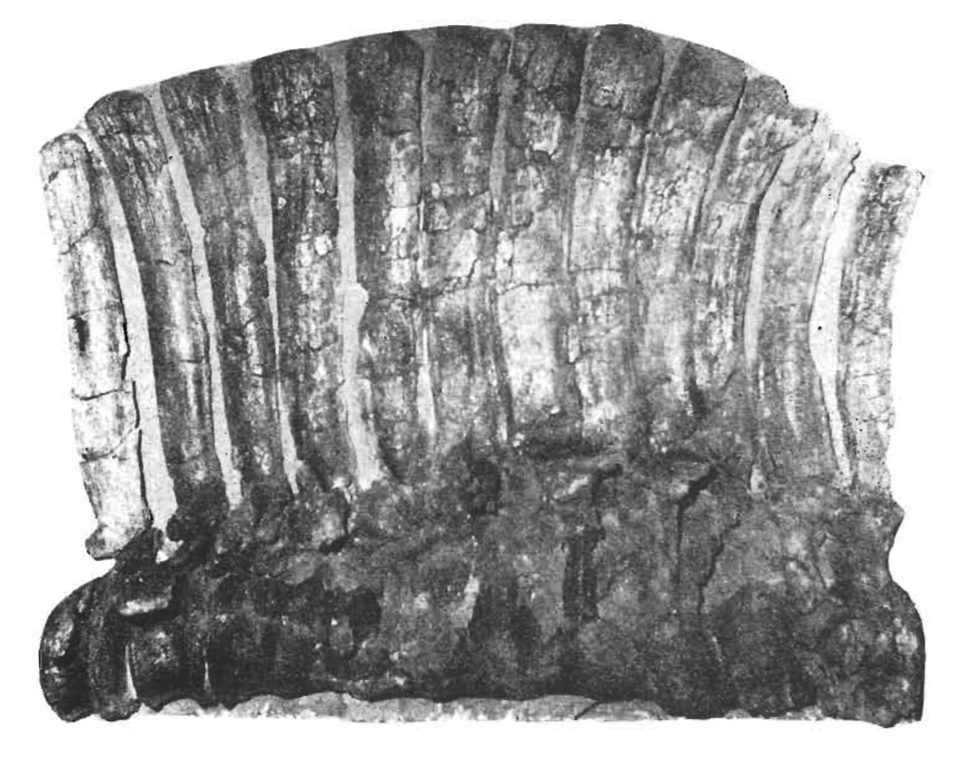
Sacrum of the holotype
Scientific classification Edit this classification
Kingdom: Animalia
Phylum: Chordata
Class: Reptilia
Clade: Dinosauria
Clade: Ornithischia
Clade: Ornithopoda
Family: Hadrosauridae
Subfamily: Saurolophinae
Genus: Barsboldia
Maryańska & Osmólska, 1981
Type species
Barsboldia sicinskii
Maryańska & Osmólska, 1981

Barsboldia (meaning "of Barsbold", a well-known Mongolian paleontologist) is a genus of large hadrosaurid dinosaur from the Maastrichtian Nemegt Formation of Ömnogöv, Mongolia. It is known from a partial vertebral column, partial pelvis, and some ribs.

Discovery

[edit]

In 1970, a Polish-Mongolian expedition near the Nemegt found the skeleton of an ornithopod and first assigned it to Saurolophus angustirostris. However, two Polish paleontologists, Teresa Maryańska and Halszka Osmólska, came to the conclusion that it was a lambeosaurine that had to represent a separate species. They named and described Barsboldia sicinskii based on the holotype specimen ZPAL MgD-1/110. The genus name honors the Mongolian paleontologist Rinchen Barsbold, while the species name honors Wojciech Siciński, the technician at the Warsaw Paleobiological Institute who prepared the skeleton. The holotype specimen, found in a layer of the Nemegt Formation dating to the Maastrichtian, consisted of a partial skeleton consisting of nine back vertebrae, nine hip vertebrae, fifteen tail vertebrae, a left ilium, parts of the left and right pubis, several ribs, and a few fragments of the hind limbs, with the backbone largely articulated. The anterior and posteriormost portions of the skeleton were lost due to erosion.[1]

Description

[edit]
Restoration

Barsboldia was a large hadrosaur, previously estimated at 10 metres (33 ft) in length and 5 metric tons (5.5 short tons) in body mass.[2] In 2011, the tibial length was measured at 1.4 m (4.6 ft), rivaling that of Shantungosaurus at 1.47 m (4.8 ft) and that of Magnapaulia at 1.36 m (4.5 ft); this indicates that Barsboldia could have possibly reached within the range of 12–14 metres (39–46 ft) in total body length.[3] Similar to Ouranosaurus, the most distinctive features of Barsboldia are found in the neural spines. These are very tall, particularly over the hips, and were described as second only to those of Hypacrosaurus altispinus and the tips of those found in the first few vertebrae of the tail are club-shaped,[1] possibly a sign of old age.[4]

Phylogeny

[edit]

Maryańska and Osmólska described their new genus as a lambeosaurine (or hollow-crested duckbill), the first from the Nemegt Formation, although it lacked a skull. However, the sacrum has a keel along the bottom, a possible lambeosaurine feature,[5] and the bones closely resemble those of Hypacrosaurus.[4][6] With only one partial skeleton known, and no skull, the genus has been considered dubious[5] or a possible lambeosaurine of uncertain placement.[7] A newer study published in 2011 suggests that Barsboldia is actually a valid saurolophine.[8]

The following cladogram was recovered in the 2011 phylogenetic analysis of Hadrosauroidea by Prieto-Márquez (the relationships within Lambeosaurinae and between basal hadrosauroids aren't shown).[8]

Caudal vertebrae
Vertebrae

Paleobiology

[edit]

As a hadrosaurid, Barsboldia would have been a large bipedal/quadrupedal herbivore, eating plants with a sophisticated skull that permitted a grinding motion analogous to chewing, and was furnished with hundreds of continually-replaced teeth. If it was a lambeosaurine, it would have had a hollow crest formed out of expanded skull bones containing the nasal passages, with a function relating to identification by sight and sound.[7]

See also

[edit]

References

[edit]
Revisions and contributorsEdit on WikipediaRead on Wikipedia
from Grokipedia
Barsboldia is a of large saurolophine hadrosaurid dinosaur that lived during the middle stage of the period, approximately 71–68 million years ago, in what is now the of . The type and only known species is Barsboldia sicinskii, named in honor of the Mongolian paleontologist Rinchen Barsbold and the Polish collector Wojciech Siciński, respectively. Known exclusively from postcranial remains, it represents one of the largest hadrosaurids from , with a comparable in size to that of the gigantic giganteus. The specimen (ZPAL MgD-I/110) consists of an incomplete postcranial skeleton, including nine posterior dorsal vertebrae, a co-ossified with nine vertebrae, 15 caudal vertebrae (with notably elongated, club-shaped neural spines on the anterior caudals), a nearly complete left ilium, and elements of the left such as the proximal . These remains were discovered in the at the Nemegt locality and exhibit distinctive features, such as sacral neural spines at least four times the height of their centra and an iliac central plate with a depth-to-length ratio less than 0.8. The absence of cranial material prevents direct inference of its feeding or display adaptations, but its robust postcrania suggest a terrestrial capable of quadrupedal locomotion. Originally described by Teresa Maryańska and Halszka Osmólska as the first lambeosaurine (hollow-crested) hadrosaur from the Nemegt Formation, B. sicinskii was later reclassified in a 2011 phylogenetic analysis as a basal member of the saurolophine clade (solid-crested or crestless duckbills). This revision, based on a parsimony analysis of 47 hadrosauroid taxa, highlights shared synapomorphies with other saurolophines like Saurolophus and Edmontosaurus, while refuting lambeosaurine affinities due to uninformative vertebral characters. As such, Barsboldia contributes to understanding the diversity of advanced ornithopods in late Mesozoic Asia, coexisting with other hadrosaurids like Saurolophus angustirostris in a fluvial and floodplain environment.

Taxonomy

Etymology

The genus name Barsboldia is derived from the Mongolian paleontologist Rinchen Barsbold, honoring his significant contributions to the study of Asian dinosaurs. The species epithet sicinskii commemorates Wojciech Siciński, a Polish technical assistant at the Institute of Paleobiology of the Polish Academy of Sciences in , who prepared the specimen and provided assistance during its study. The full binomial Barsboldia sicinskii was formally established by paleontologists Teresa Maryańska and Halszka Osmólska in their 1981 description of the taxon from the in Mongolia's .

Classification History

Barsboldia was first described and classified in 1981 by Teresa Maryańska and Halszka Osmólska as a lambeosaurine hadrosaurid, marking the initial recognition of this subfamily within the of . The classification was based on a partial postcranial (ZPAL MgD-I/110), consisting of nine posterior dorsal vertebrae, a with nine coalesced vertebrae, 15 caudal vertebrae, a left ilium, , and fragments of the limbs, which exhibited features such as high neural spines and a ridged interpreted as characteristic of lambeosaurines. This placement positioned Barsboldia as the first lambeosaurine dinosaur reported from the Upper Cretaceous , contributing to the understanding of hadrosaurid diversity in at the time. In 2011, Albert Prieto-Márquez conducted a reappraisal of Barsboldia sicinskii, revising its taxonomic position to that of a basal saurolophine hadrosaurid through a phylogenetic analysis incorporating 47 hadrosauroid taxa. The shift was supported by synapomorphies including a central plate depth-to-length ratio less than 0.8 in the ilium and sacral vertebrae with "clubbed" neural spines at least four times higher than the centra, as well as features in the neural spine morphology and caudal vertebrae that aligned more closely with saurolophines than lambeosaurines. This reassessment, published in the Journal of Paleontology, emphasized the unique autapomorphies of the genus, such as elongate and mediolaterally compressed proximal caudal neural spines, thereby affirming its validity while highlighting its role in expanding the known saurolophine diversity in . Today, Barsboldia remains recognized as a valid, monotypic within the Saurolophinae subfamily of , though its incomplete knowledge stems from the limited original material, which lacks cranial elements and consists primarily of axial and pelvic postcrania. Subsequent phylogenetic studies have consistently placed it as a basal saurolophine, reinforcing the 2011 revision without major alterations to its taxonomic status.

Discovery and Material

History of Research

The holotype specimen of Barsboldia sicinskii was discovered in 1970 during a joint Polish-Mongolian paleontological expedition in the of the , , . This expedition, part of a series of collaborative efforts between Polish and Mongolian from 1963 to 1971, targeted Upper deposits and yielded numerous significant finds, including the first lambeosaurine material from the . The dates to the early stage of the . Following its collection and initial preparation, the specimen underwent over a decade of detailed analysis before formal description. In 1981, paleontologists Teresa Maryańska and Halszka Osmólska published the naming and description of Barsboldia sicinskii in Acta Palaeontologica Polonica, establishing it as a new and of hadrosaurid based on the incomplete postcranial (ZPAL MgD-I/110). This work highlighted its distinctive features within the subfamily, marking a key contribution to understanding diversity in . Subsequent research has been limited, with a notable reappraisal in 2011 by Albert Prieto-Márquez, who re-evaluated the morphology and taxonomic placement of B. sicinskii using comparative phylogenetic methods. This study rediagnosed the taxon and repositioned it within , refining its evolutionary relationships among . No additional specimens of Barsboldia have been reported since the 2011 analysis, restricting further insights to the single known individual.

Known Specimens

The specimen of Barsboldia sicinskii, cataloged as ZPAL MgD-I/110, consists of an incomplete postcranial recovered from a single quarry site in the of , a deposit dated to the middle stage. The preserved material includes nine posterior dorsal vertebrae, nine co-ossified sacral vertebrae, and 15 caudal vertebrae, with the vertebral column preserved in articulation and laid on its right side. Additional elements comprise several thoracic ribs, fragments of dorsal and caudal neural spines. The partial is represented by a nearly complete left ilium and fragments of the distal blade of the prepubic process from both pubes. Hind limb remains include the proximal end of the (estimated length approximately 1.4 m), a fragmentary , left metatarsals III and IV, the third of pedal digit III, and the ungual of pedal digit III. The specimen lacks a , forelimbs, and anterior portions of the body, rendering it a partial representation focused on the posterior axial and pelvic regions. It is preserved in three dimensions, though some elements are eroded, incomplete, or lost due to exposure. The is housed at the Institute of Paleobiology of the Polish Academy of Sciences (ZPAL) in , . No paratypes or referred specimens have been designated, and all material derives from the same individual.

Anatomy

Size and Proportions

Barsboldia sicinskii, known from fragmentary postcranial remains including parts of the vertebral column, pelvic girdle, and hind limb, was a large hadrosaurid with an estimated total body length of 10–12 meters based on scaling the reconstructed ilium length of 1.3–1.4 meters against comparable elements in complete skeletons of other hadrosaurids such as Saurolophus osborni (ilium 1.16 meters for a 10-meter body) and Corythosaurus casuarius (ilium 0.987 meters for a 10-meter body). This initial assessment from the original description highlighted its substantial size relative to other Nemegt Formation hadrosaurs, with a deep indicated by up to 1.5 meters long. A 2011 reappraisal refined these dimensions using the estimated tibia length of 1.4 meters—among the longest recorded for hadrosaurids and rivaling that of Shantungosaurus giganteus (1.47 meters)—yielding a body length of 12–14 meters when scaled to complete specimens of large saurolophines like Edmontosaurus (11–12 meters) and Shantungosaurus. In terms of proportions, Barsboldia displayed a robust build suited to its large size, with elongated hind limbs evidenced by the extended tibia and metatarsals (metatarsal III at 0.42 meters). This morphology supported facultative bipedalism, a common trait among adult hadrosaurids for agile movement or foraging. The wide pelvic girdle, characterized by a sacrum 0.96 meters long and 0.95 meters deep alongside a shallow ilium (depth/length ratio <0.8), further indicates quadrupedal capability for stability during locomotion or resting.

Diagnostic Features

Barsboldia sicinskii is diagnosed by a unique combination of postcranial features observed in the specimen (ZPAL MgD-I/110), primarily from the vertebral column and . The sacral vertebrae possess distally clubbed neural spines that are at least four times the height of their centra, measuring approximately 70 cm in height compared to 17 cm for the centra, forming a tall, thickened structure that contrasts with the more uniformly tapered spines in other hadrosaurids. These elongated spines on the sacral and proximal caudal vertebrae, which reach up to seven times the length of the centra in anterior caudals, likely supported expansive dorsal structures such as ridges or low sails, similar to those inferred in related taxa like . The proximal caudal vertebrae exhibit club-shaped neural spines that are mediolaterally expanded and flattened, with a subcircular to oval cross-section and longitudinal ridges for muscle attachment; these differ from the typical gradual tapering seen in most hadrosaurids, instead maintaining proportionate length and thickness over the anterior nine caudals, which form a gentle upward curve. The distal caudal vertebrae are less well-preserved but show similar elongation without pronounced tapering, contributing to a robust base. In the pelvis, the ilium is characterized by a robust build with an elongated preacetabular process that is slightly ventrally deflected at an angle greater than 150°, and a central plate exhibiting a depth-to-length of less than 0.8 (e.g., 37.5 cm depth to 50.1 cm length), rendering it relatively shallow compared to the deeper ilia of lambeosaurines. The features a straight shaft, a trait consistent with saurolophine hadrosaurids and distinct from the curved shafts typical of lambeosaurines, supporting its revised classification as a basal saurolophine. Hind limb elements include a proximal tibia estimated at 140 cm in length, indicating substantial size, though the femur is not preserved for direct comparison; the proportions suggest a femur longer than the tibia, facilitating powerful as in other large hadrosaurids. The pes lacks clear autapomorphies due to incompleteness, with preserved metatarsal III showing a length-to-width ratio less than 4.5 (420 mm long) and metatarsal IV at 345 mm, but no unique morphological distinctions beyond general hadrosaurid form.

Phylogeny

Initial Interpretations

When Barsboldia sicinskii was first described in 1981 by Teresa Maryańska and Halszka Osmólska, it was assigned to the within based on postcranial features from a partial skeleton recovered from the in . This placement marked the initial recognition of a lambeosaurine in that Asian locality, with the authors inferring potential crest development typical of the subfamily despite the absence of cranial . The assignment relied on diagnostic postcranial traits shared with known lambeosaurines, including a ridged and elongated neural spines that distinguished it from the grooved sacrum of Hadrosaurinae. Specific similarities were noted in the caudal vertebrae, where anterior neural spines are club-shaped, approximately three times the height of the centra and seven times their length, with ridges and grooves for muscle attachment, resembling those in genera like and . The pelvic girdle further supported this, featuring a deep ilium (325 mm deep) with a sigmoid dorsal margin, markedly deflected preacetabular process, and massive, upward-directed postacetabular process, akin to variations seen in and other lambeosaurines, suggesting comparable body proportions and an estimated total length of about 12 meters. At the time, hadrosaurid phylogenies primarily emphasized cranial features, such as hollow crests for subfamily differentiation, with postcranial elements serving as supplementary evidence. However, the incomplete nature of the Barsboldia specimen—lacking the and parts of the —led Maryańska and Osmólska to propose a tentative , acknowledging limitations in direct comparisons due to variability in ilium morphology among lambeosaurines and the erosion of additional material from the type locality.

Revised Positions

In a comprehensive phylogenetic reanalysis published in 2011, Albert Prieto-Márquez employed maximum parsimony methods on a matrix of 47 hadrosauroid taxa to reposition Barsboldia sicinskii within , concluding it represents a basal member of Saurolophinae rather than its prior lambeosaurine affinity. This reclassification was grounded in shared derived traits with other saurolophines, including markedly elongated neural spines—at least four times the height of their centra—along the sacrum and proximal caudals, as well as distinctive caudal chevron patterns that closely resemble those observed in Shantungosaurus giganteus and . Cladistic support for this placement emerged from a single most parsimonious tree (length: 870 steps; consistency index: 0.52; retention index: 0.77) derived from 10,000 replicates, wherein Barsboldia nested among saurolophines due to unambiguous synapomorphies such as the ilium with a posterodorsal margin lacking a well-demarcated ridge and a central plate depth-to-length ratio less than 0.8. Traits previously interpreted as indicative of lambeosaurine membership, including ridged sacral and sigmoidal preacetabular processes on the ilia, were re-evaluated as either convergently evolved across hadrosaurid clades or phylogenetically uninformative due to high variability. Subsequent phylogenetic studies from onward, incorporating expanded hadrosaurid matrices, have consistently retained Barsboldia as a basal saurolophine or occasionally as within the subfamily, reflecting the taxon’s stable positioning without introducing major conflicts to broader analyses of Asian hadrosaurid diversity. As of November 2025, no new material or significant revisions to this classification have been published. Ongoing uncertainties in Barsboldia's exact position stem primarily from its representation by a single, incomplete specimen (ZPAL MgD-I/110), which constrains the number of diagnosable autapomorphies and limits resolution in character-rich matrices. Additionally, the morphological overlap between Barsboldia and sympatric hadrosaurs such as angustirostris—particularly in pelvic and caudal elements—has prompted discussions of potential synonymy, though diagnostic differences in ilial proportions and vertebral morphology argue against it.

Paleobiology

Diet and Dentition

Barsboldia, as a member of the hadrosaurid family, exhibited a herbivorous diet focused on browsing high vegetation within the floodplain settings of the in . It likely consumed tough, fibrous plant matter, grinding it to extract nutrients from a diverse array of flora including , ferns, and emerging angiosperms that characterized the region's and riverine ecosystems. This dietary strategy aligns with the general adaptations of saurolophine hadrosaurs, enabling efficient processing of abrasive, coarse vegetation in a humid, forested environment. Although no cranial material of Barsboldia has been recovered, its can be reliably inferred from that of closely related saurolophines, featuring a complex dental battery with up to 300 small, diamond-shaped teeth per ramus arranged in multiple stacked rows. These teeth, with their interlocking edges and enamel ridges, performed dual functions of shearing tougher fibers and grinding softer plant tissues through a combination of transverse and propalinal motions. wear was extensive due to the nature of the diet, but rapid replacement ensured continuous functionality, with new teeth erupting from below at rates allowing full turnover in months. The robust build and estimated length of 12–14 meters suggest Barsboldia foraged at greater heights than smaller congeners, reaching 3–4 meters when quadrupedal by extending its to access elevated branches and foliage. This capability positioned it in a distinct , potentially specializing in coarser, higher that required its powerful masticatory apparatus, differentiating it from ground-level grazers among contemporaneous hadrosaurs.

Locomotion and Habitat

Barsboldia was a facultative biped and quadruped, utilizing both bipedal and quadrupedal gaits depending on context, a common trait among hadrosaurids supported by limb proportions and morphology. Its elongated hind limbs, with a deep ilium (325 mm above the ) and long metatarsals (e.g., metatarsal III at 420 mm), facilitated bipedal locomotion, enabling inferred speeds of 20–30 km/h during escape or . The broad , featuring a massive upward-directed postacetabular process, provided stability for quadrupedal stance, particularly useful for browsing low vegetation or resting. The , from which all known Barsboldia specimens derive, dates to the early stage around 70 million years ago and represents a dynamic riverine floodplain environment characterized by meandering seasonal rivers, extensive alluvial plains, and abundant lush . This humid subtropical setting, with fluvial deposits including sandstones and mudstones, supported a diverse of aquatic and terrestrial life, including , turtles, crocodilians, and a variety of dinosaurs. Ecological inferences suggest Barsboldia lived in herds, a evidenced by contemporaneous hadrosaurid bonebeds like the "Dragon's Tomb" assemblage, which preserved multiple individuals and implies gregariousness for predator avoidance in this predator-rich landscape. The dinosaur's hyperelongated neural spines, reaching up to nine times the centrum length and club-shaped over the hips and anterior caudals, may have served as display structures for intraspecific signaling, analogous to features in other hadrosaurids. Barsboldia coexisted with apex predators such as the tyrannosaurid bataar and fellow hadrosaurids like angustirostris, potentially migrating seasonally along waterways to track vegetation in the floodplain.
Add your contribution
Related Hubs
User Avatar
No comments yet.