Hubbry Logo
Bavet municipalityBavet municipalityMain
Open search
Bavet municipality
Community hub
Bavet municipality
logo
8 pages, 0 posts
0 subscribers
Be the first to start a discussion here.
Bavet municipality
Bavet municipality
from Wikipedia

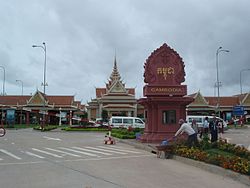
Bavet (Khmer: បាវិត, Bavĭt [ɓaːʋət]) is the largest city in Svay Rieng Province, Cambodia. An international border crossing between Cambodia and Vietnam, its counterpart across the border is Mộc Bài of Tây Ninh Province, Vietnam.

Key Information

Bavet is one of the "special economic zones" (SEZ) of Cambodia[2] and there were established textile industries and bicycles factories. However, the most evident economic activity of Bavet are the casinos, fraud factories and cockfighting rings, attended by Chinese and Vietnamese. Bavet's border casino zone has been mentioned in reporting on Cambodia-based online scam compounds and related trafficking; see Scam centers in Cambodia


In accordance with decentralization politics experienced by Cambodian government,[3] Bavet commune has become a municipality by sub-decree in December 2008.[4] There are about 10–12 (from small to large) casinos and 6 to 7 developing areas set up by foreign investors. The city is in a growing state. The 2 km-long Neak Loeang bridge funded by Japan has been finished in April 2015. It is the longest bridge in Cambodia.

Transport

[edit]

The proposed Ho Chi Minh City–Phnom Penh railway is planned to pass through Bavet.


[edit]

References

[edit]
Revisions and contributorsEdit on WikipediaRead on Wikipedia
from Grokipedia

is a and the largest urban center in , southeastern , functioning as the principal international land crossing into at the adjacent Moc Bai gate.
Positioned along National Highway 1 roughly 125 kilometers southeast of , it serves as a vital conduit for , , and passenger traffic between and , handling hundreds of thousands of crossings annually.
The municipality's economy revolves around its strategic frontier location, featuring multiple special economic zones such as Manhattan SEZ and Tai Seng Bavet SEZ that host factories in textiles, , and other sectors, driving job creation and industrial development amid Svay Rieng's otherwise agrarian provincial context.
has accelerated due to inbound migration for employment opportunities, with the 2019 recording 43,783 residents across an area of about 49 square kilometers, though recent expansions in border-related infrastructure continue to spur urbanization.

Geography

Location and topography

Bavet municipality is located in in southeastern , with geographic coordinates of approximately 11°04′N 106°08′E. It lies roughly 160 kilometers southeast of , accessible via National Highway 1, which connects the capital to the region. The municipality directly adjoins the international border with at the Bavet-Moc Bai crossing point, positioned in Binh Phuoc Province's Tây Ninh area on the Vietnamese side. The topography of Bavet consists of flat, low-lying alluvial plains, with elevations typically between 3 and 6 meters above . This terrain, part of Cambodia's broader central extending toward the , features surrounding rural landscapes interspersed with canals and watercourses that facilitate drainage but contribute to vulnerability from seasonal inundation in low-elevation zones.

Climate and environment

Bavet features a tropical monsoon climate (Köppen classification Am), with consistently high temperatures and pronounced wet and dry seasons driven by the southwest monsoon. Year-round average highs range from 31°C to 33°C, while lows hover between 23°C and 24°C, resulting in minimal diurnal or seasonal cooling. Annual precipitation averages 1,881 mm, concentrated in the wet season from May to October, when monthly totals often exceed 200 mm and peak at 317 mm in September; the dry season from November to April sees far lower rainfall, typically under 50 mm per month. The municipality's lowland topography and proximity to Mekong River tributaries and irrigation canals heighten vulnerability to seasonal flooding during intense wet-season downpours, with —encompassing Bavet—frequently experiencing riverine overflows that inundate agricultural fields and disrupt rural livelihoods. Such events, exacerbated by upstream runoff and flat terrain, have historically affected lowland areas in the province, though empirical records indicate variability tied to annual strength rather than long-term trends. Environmental conditions reflect limited natural , dominated by patches of tropical dry and scrubland amid expanding urban and border-trade development, which constrain . Between 2001 and 2024, Bavet recorded a net loss of 7 hectares in cover, equating to a 4% decline from 2000 baselines and reflecting localized pressures from land conversion rather than province-wide rates.

History

Early history and colonial era

The territory of present-day Bavet municipality formed part of Svay Rieng, a region divided into three provinces by Khmer kings in the post-Angkorian era, particularly during the kingdom (mid-16th to late 17th centuries) and the subsequent period (late 17th to mid-19th centuries). These administrative divisions reflected decentralized Khmer governance after the empire's decline around 1431, with local settlements centered on wet-rice suited to the lowland and seasonal flooding patterns. Proximity to ancient routes toward the supported limited exchange of goods like and forest products with Vietnamese polities, though Bavet itself lacked prominent urban centers or monumental remains, indicative of its role as a peripheral rural outpost rather than a key political or economic hub. The advent of French colonial rule in 1863, following King Norodom's treaty establishing a protectorate, integrated the area into , where border delineation with () became a priority to consolidate administrative control over territories. In 1872, French authorities demarcated the Svay Rieng-Tay Ninh frontier, installing 12 boundary markers to formalize the line near modern Bavet, addressing ambiguities from prior Khmer-Vietnamese interactions and preventing territorial disputes within the colonial domain. Bavet functioned as a minor outpost under French oversight, with basic stations and patrols enforcing movement regulations amid sparse settlement and an dominated by small-scale farming. No significant engagements or infrastructure megaprojects marked the site, as French priorities emphasized extraction from core areas like the lowlands over frontier development; population remained low, tied to agrarian cycles without until post-colonial shifts. Independence from in November 1953 transferred these rudimentary border functions to the Cambodian state, preserving Bavet's marginal status.

Khmer Rouge period and aftermath

Following the victory on April 17, 1975, Bavet, as a municipality in , underwent forced evacuation of its residents in line with the regime's nationwide policy to abolish urban life and redistribute the population to agrarian cooperatives. This "" initiative, intended to eradicate perceived bourgeois influences and achieve self-sufficient , led to the near-total depopulation of towns like Bavet, with inhabitants marched to rural work sites under duress, resulting in widespread infrastructure abandonment and destruction. The policy contributed to Cambodia's overall of 1.5 to 2 million people between 1975 and 1979, primarily from , , overwork, and executions, though precise casualty figures for Bavet remain undocumented due to the regime's secrecy and record destruction. Bavet's proximity to the Vietnamese border at Moc Bai positioned it amid escalating Khmer Rouge-initiated skirmishes starting in 1975, with Democratic Kampuchea forces conducting raids into Vietnamese territory from eastern provinces including Svay Rieng, killing thousands of civilians and provoking retaliatory incursions. By 1977, these clashes had intensified into open warfare, with troops using border areas for attacks that claimed over 3,000 Vietnamese and ethnic Khmer lives in cross-border massacres, further depopulating and militarizing locales like Bavet. The regime's paranoia-fueled purges and forced labor exacerbated local devastation, as residents faced execution or relocation for suspected disloyalty amid the frontier hostilities. The Vietnamese invasion commencing December 25, 1978, saw forces advance rapidly through eastern , overrunning defenses in border zones and capturing by January 7, 1979, thereby ending the regime's control. Bavet, as a strategic point, functioned as an entry corridor for Vietnamese troops and allied Cambodian rebels, channeling supply lines and massive outflows—hundreds of thousands fled eastward during the collapse, straining the area's remnants. The ensuing occupation under the Hanoi-backed installed administrative structures, but Bavet remained a volatile frontline, with remnants conducting guerrilla actions into the early 1980s. Reconstruction in Bavet faced severe impediments from landmines and laid by forces to impede Vietnamese advances, contaminating border regions extensively and causing ongoing civilian casualties through the . United Nations assessments from the period highlighted these explosive remnants as primary barriers to repopulation and agriculture in eastern provinces like Svay Rieng, with efforts only gaining traction in the late amid gradual stabilization, though full clearance eluded the area for decades. This legacy of mined terrain, combined with demographic disruptions from prior depopulation, delayed verifiable recovery until external aid frameworks emerged post-occupation.

Post-1990s development

Following the 1993 -supervised elections under the (UNTAC), which culminated in a new and power-sharing , border regions like Bavet experienced relative stabilization after decades of conflict, enabling initial institutional reforms and cross-border economic activity. This post-conflict peace, rooted in the 1991 Paris Accords, reduced incursions and factional violence that had previously disrupted trade routes, laying groundwork for Bavet's emergence as a key transit point between and . In December 2008, Bavet was formally elevated to municipal (Krong) status through a royal sub-decree, merging surrounding communes and formalizing its administrative amid Cambodia's efforts. This designation coincided with the establishment of special economic zones (SEZs) in the area, starting with the first in , which attracted investments and spurred infrastructural upgrades like improved roads and utilities to support . The SEZs, including Tai Seng Bavet approved in April 2007, drew rural migrants seeking factory employment, accelerating ; Bavet's population rose from approximately 37,000 in 2010 to over 43,000 by 2019, reflecting this influx driven by economic opportunities rather than natural growth alone. Cambodia's accession to the in 1999 further amplified Bavet's border role, integrating it into regional trade frameworks that prioritized tariff reductions and connectivity, with cross-border goods volume at the Bavet-Moc Bai crossing surging as Vietnam-Cambodia exchanges grew. This integration, combined with post-1993 stability, positioned Bavet as a conduit for exports like garments and imports of raw materials, fostering causal links between regional pacts and local developmental momentum without relying on isolated policy interventions.

Demographics

Population statistics

The 2019 General Population Census of recorded a total of 43,783 in Bavet municipality (Krong Bavet), comprising 21,590 males and 22,193 females. This figure reflects a count, excluding an estimated 1.235 million Cambodian migrants working abroad at the time. Bavet municipality encompasses an area of 206.4 square kilometers, yielding a of approximately 212 inhabitants per square kilometer as of 2019. The urban core, designated as Bavet Urban Commune, accounted for 14,016 residents across 48.84 square kilometers, with a higher density of 287 per square kilometer, highlighting an urban-rural divide where peripheral areas remain less densely populated. Official projections from Cambodia's National Institute of Statistics indicate modest annual growth, with the population estimated at 43,946 in 2021 and 44,760 in 2022, implying a rate of roughly 1-2% per year based on extrapolations. By 2025, continued trends suggest a rise to approximately 46,000-48,000 residents, driven by patterns that have intensified , though official data may undercount transient populations. These figures contrast with some non-official estimates placing the 2020 population above 50,000, potentially reflecting unenumerated inflows, but data from the National Institute of Statistics remains the primary verifiable benchmark.

Ethnic and cultural composition

Bavet municipality is predominantly ethnic Khmer, aligning with 's national composition where constitute 95.4% of the according to 2019-2020 estimates. In , which includes Bavet, ethnic minorities number 2,541 individuals as per the 2019 census, representing less than 0.5% of the provincial total of approximately 525,497 residents, indicating an overwhelmingly Khmer majority locally as well. Its border position with results in a relatively elevated presence of ethnic Vietnamese compared to the national figure of about 0.5%, with one sangkat reporting 6.1% Vietnamese ethnicity in project assessments for urban development. These communities primarily engage in cross-border , contributing to daily market interactions but remaining a minority overall. Ethnic Chinese form another small group, drawn by trade opportunities in the , garment factories, and casinos, though exact proportions are not quantified in . Culturally, Bavet reflects Khmer norms, centered on Buddhism and traditional festivals such as Khmer New Year and , with Khmer as the dominant language spoken by over 97% of Cambodians nationally. Vietnamese linguistic and commercial influences appear in border markets, where Vietnamese is used alongside Khmer for trade, fostering hybrid practices like shared culinary elements in local stalls, though Khmer customs prevail in community life. No significant indigenous or Cham presence is documented in the area, distinguishing it from other Cambodian regions.

Government and administration

Administrative structure

Bavet was established as a krong (municipality) on December 22, 2008, through Sub-Decree No. 263, which merged five communes—Bati, Bavet, Chrak M'tes, Prasat, and Prey Angkunh—from Svay Rieng Province's Chantrea and Bavet districts into a single urban administrative unit to facilitate border governance and economic coordination. As a krong, it operates under the oversight of Svay Rieng Province while possessing semi-autonomous administrative functions, including local revenue collection and urban planning aligned with national decentralization policies. The municipality is subdivided into five sangkats (urban communes or quarters): Bati, Bavet, Chrak M'tes, Prasat, and Prey Angkunh, which collectively encompass 35 phums (villages or village groups). Each sangkat maintains a council of 7 to 11 members, elected every five years through commune/sangkat elections supervised by the National Election Committee, with the most recent held on June 25, 2023. These councils handle grassroots administration, such as resident registration and minor infrastructure maintenance, reporting to the municipal governor. Municipal governance adheres to Sub-Decree No. 182 (dated December 2, 2019), which standardizes the organizational structure for Cambodia's , including a appointed by the Ministry of Interior, deputy governors, and sector-specific offices for finance, planning, and public services. Bavet integrates with provincial planning via the Svay Rieng Provincial Council, contributing data on -related demographics and needs for the province's five-year development plans. For management, the municipality coordinates with national agencies under the General Department of and the General Department, embedding local administrative units within the Bavet International Checkpoint's operational framework.

Local governance and politics

Bavet municipality is governed by an elected commune council, comprising representatives from local villages, responsible for administrative functions such as infrastructure maintenance, public services, and under Cambodia's framework established in the early 2000s. The council operates within the provincial oversight of Svay Rieng, where decisions on local projects require coordination with higher authorities. Following the June 2022 communal elections, the (CPP) secured control of the Bavet council, aligning with its nationwide landslide victory that captured over 97% of the country's 1,652 communes amid suppressed opposition following the 2017 dissolution of the (CNRP). The CPP's local dominance in Bavet stems from entrenched systems, where party networks distribute resources and opportunities to maintain voter loyalty, a dynamic prevalent in Cambodian subnational . This approach has facilitated rapid development but raises concerns over , as evidenced by Cambodia's low ranking on Transparency International's 2023 (score of 22/100), reflecting systemic issues like and undue influence in local permitting processes. Independent observers, including , have documented irregularities in recent elections, such as voter intimidation and unequal access to media, though official results confirm CPP hegemony. Municipal leaders in Bavet closely collaborate with the on economic initiatives, particularly special economic zone (SEZ) approvals and expansions, which fall under national laws but involve local land management and investor facilitation. For example, Svay Rieng provincial authorities, acting on behalf of municipalities like Bavet, have promoted SEZ investments through direct invitations to foreign partners, ensuring alignment with Phnom Penh's trade policies. This partnership underscores the centralized nature of key decisions despite formal , with local councils primarily implementing rather than initiating major projects.

Economy

Special Economic Zones

The Special Economic Zones (SEZs) in Bavet operate under Cambodia's national framework established by Sub-Decree No. 148 in 2005, which designates geographic areas for concentrated economic activity with incentives to attract (FDI) focused on export-oriented . These incentives include holidays of up to nine years, exemptions from duties on raw materials and machinery, zero-rate (VAT) on exports, and streamlined procedures to reduce bureaucratic delays. In Bavet, the proximity to the Vietnamese facilitates cross-border , enhancing the zones' appeal for labor-intensive assembly operations. Bavet hosts three major SEZs: the SEZ, established as Cambodia's first and largest in the mid-2000s spanning 400 hectares; the Tai Seng SEZ; and the SEZ. The SEZ alone employs approximately 28,000 workers, while the other two zones add about 8,000 jobs, totaling over 36,000 positions in export-focused by 2024. These zones have drawn investments primarily from Chinese, Japanese, and other Asian firms, contributing to Cambodia's broader SEZ FDI inflows exceeding $1.65 billion nationally by late 2024, with Bavet's border location enabling efficient supply chain integration. Empirical data indicate that Bavet's SEZs have effectively generated opportunities, with wages often comparable to or exceeding local alternatives, fostering skill development in a otherwise limited by agricultural dependency. However, this growth relies heavily on foreign capital, particularly from state-linked Chinese enterprises, creating vulnerabilities to geopolitical shifts and external demand fluctuations rather than diversified domestic investment. By mid-2025, Cambodia's SEZs, including those in Bavet, supported 960 approved projects amid rising national FDI, underscoring their role in export-driven growth but highlighting the need for policies to mitigate over-dependence on transient foreign funding.

Key industries and employment

The manufacturing sector dominates employment in Bavet municipality, centered in special economic zones such as SEZ, Tai Seng Bavet SEZ, and SEZ, where activities include garment and textile production, footwear assembly, plastics processing, and light manufacturing like bicycle components. Factories in these zones are predominantly foreign-invested, with Chinese enterprises from and accounting for roughly 80% of local investments, alongside some Japanese and limited Vietnamese participation drawn by proximity to the . Recent expansions include Chinese-led tire production facilities, signaling diversification beyond traditional low-skill assembly. These industries employ approximately 36,000 workers across Bavet's SEZs, with Manhattan SEZ alone providing 28,000 jobs and the other two zones adding about 8,000 more, primarily in labor-intensive roles filled by local commuters from rural villages. This represents a marked shift from , as over 95% of SEZ workers in Bavet district originate from nearby agricultural communities, drawn by steady factory pay despite the sector's reliance on low-wage labor. In , which includes Bavet, SEZs host 146 operational factories supporting over 82,000 manufacturing jobs, with garments and footwear comprising a significant portion. Wages in Bavet's dominant garment sector average at or near the national minimum of US$200 per month, effective from January 2023, supplemented occasionally by bonuses but often insufficient for urban living costs without additional household income. Post-COVID recovery has bolstered , with provincial SEZs rapidly expanding opportunities amid national industrial rebound, though empirical data indicate persistent challenges like informal work and vulnerability to global demand fluctuations. Unemployment rates have stabilized as factories rehired laid-off workers, but the sector's growth relies on maintaining competitive low labor costs rather than skill upgrades.

Cross-border trade dynamics

The Bavet-Moc Bai border crossing serves as the primary conduit for bilateral trade between Cambodia and Vietnam, handling a substantial share of the approximately $10.2 billion in total trade recorded in 2024. Cambodian exports through this route predominantly feature garments, textiles, and agricultural products such as rice and rubber, while imports from Vietnam include machinery, electronics components, and construction materials essential for Cambodia's manufacturing sector. This flow reflects Cambodia's role as an exporter of labor-intensive goods and importer of intermediate inputs, with customs data indicating efficient processing for formal trade despite occasional bottlenecks in documentation and valuation. Informal and persist alongside formal channels, driven by differentials and non- barriers that incentivize evasion, particularly for high-duty items like consumer goods, fuels, and agricultural produce. Estimates suggest informal cross-border exchanges, including under-invoicing and unrecorded petty , comprise 20-30% of total volume at such borders, undermining collection and distorting , though precise figures for Bavet remain elusive due to underreporting. These practices arise causally from asymmetric enforcement and economic incentives, where lower Vietnamese production costs encourage northward , while Cambodian exporters bypass export quotas or standards. Cross-border via Bavet bolsters Cambodia's GDP through duties, logistics employment, and integration, contributing to overall external that exceeds 100% of GDP. However, persistent trade imbalances favor , with Cambodia's imports outpacing exports—evident in a bilateral deficit structure where value-added imports dominate—exacerbating dependency on foreign inputs and pressuring the current account. Efforts to address inefficiencies, such as harmonized procedures under frameworks, aim to enhance formal flows but have yet to fully mitigate informal distortions.

Infrastructure and transport

Road networks and connectivity

National Road 1 (NR1) constitutes the principal arterial route connecting Bavet municipality to , spanning the eastern corridor of and forming part of the . This paved highway accommodates substantial volumes of heavy truck traffic, including container transports essential for regional , alongside buses and local vehicles, contributing to its high utilization as a trade conduit. The (ADB) has upgraded sections of NR1 extending to Bavet through the Road Network Improvement Project, applying pavement from Tsubasa Bridge to the vicinity of the border to enhance durability under freight loads. Despite these enhancements, the highway experiences congestion from cross-border commercial flows, underscoring its role in supporting Bavet's logistics-dependent economy. Local and provincial roads in , including those radiating from Bavet, provide linkages between special economic zones (SEZs) and NR1, enabling efficient goods movement within industrial clusters such as Tai Seng Bavet SEZ. These roads, however, contend with deficiencies, as evidenced by directives from provincial authorities to address and facilitate smoother . ADB initiatives have rehabilitated select provincial segments to paved standards, mitigating prior unpaved conditions that impeded reliability. Provincial road networks extend connectivity from Bavet into surrounding rural areas of Svay Rieng, supporting seasonal migrant labor inflows to SEZs by improving access to agricultural hinterlands. ADB-supported paving of approximately 87 kilometers in Svay Rieng and adjacent provinces has bolstered all-weather , though ongoing upkeep remains challenged by Cambodia's broader rural road maintenance gaps, where only about 10% of such routes are sealed.

Border facilities

The Bavet/Moc Bai crossing operates as Cambodia's busiest land border port with , facilitating substantial passenger and freight movement along the Phnom Penh-Ho Chi Minh City corridor. Infrastructure encompasses dedicated inspection areas, counters, and adjacent dry ports for off-border clearance, supporting high-volume processing. Traffic data indicate capacities handling up to 1,942 passenger car units (PCU) per day near Moc Bai in 2013, with truck volumes averaging approximately 1,188 daily in January 2020 surveys before reductions. Post-2010 enhancements under the (GMS) Cross-Border Transport Agreement (CBTA) have integrated procedural alignments, including single-stop inspection pilots and use of the ASYCUDA system for declarations, aimed at reducing dwell times. Cambodian-side facilities feature scanners and transshipment zones roughly 5 km from the gate, while Vietnamese counterparts maintain on-border clearance, contributing to procedural efforts via memoranda like the 2006 MOU for single-stop mechanisms. Capacity limitations persist, however, with only two lanes in the and insufficient counters leading to peak-hour congestion after 10:00 AM, often delaying truck clearances to the next day. Immigration at Bavet provides visa-on-arrival for , requiring and photographs, processed alongside exit/entry stamps and declarations. Empirical wait times vary, with procedural bottlenecks exacerbating delays for both passengers and freight during high-demand periods, though sealing protocols introduced in 2021 have mitigated some transshipment-related queues. Ongoing JICA-supported projects target further infrastructure expansions, including lane additions and legal frameworks for full single-stop implementation by 2025-2030.

Planned developments

The –Bavet Expressway, spanning 138 kilometers with four lanes, is a major ongoing project estimated at $1.6 billion, designed to link Phnom Penh's third to the Bavet crossing and reduce travel time to about 1.5 hours. Groundbreaking occurred in June 2023 under a 50-year build-operate-transfer concession, with progressing toward a 2027 completion despite initial delays from funding negotiations. Feasibility appears strong given secured private investment and alignment with Cambodia's goals, though execution risks include land acquisition and cost overruns common in regional megaprojects. The Asian Development Bank's $180 million Livable Cities Investment Project, approved in November 2021, funds urban upgrades in Bavet focused on wastewater systems, solid waste management, and sanitation for over 140,000 residents, including a standard landfill whose first phase—encompassing pits and wastewater controls—broke ground in January 2025. Implementation, supported by detailed feasibility studies and resettlement plans, extends through 2028 with contracts for design and supervision already awarded. High feasibility stems from ADB's concessional financing and technical oversight, addressing Bavet's rapid growth as a border hub while mitigating environmental risks through phased rollout. A proposed Phnom Penh–Bavet railway line, integral to Cambodia's $10 billion national rail expansion and regional corridors toward Vietnam's , envisions high-speed connectivity with construction eyed for 2028–2033 under the medium- to long-term railway master plan. No firm or has occurred as of 2025, positioning it as lower feasibility compared to road projects due to high capital needs and dependency on cross-border agreements.

Controversies and challenges

Environmental pollution

Villagers residing near the Manhattan Special Economic Zone (SEZ) in Bavet have reported severe pollution from untreated industrial since at least 2016, with wastewater discharges turning the water black and emitting foul odors, rendering it unsuitable for or use. The Cambodian Ministry of Environment inspected the site's treatment facility and determined it processed only 30% of generated wastewater, allowing the remaining 70%—primarily from garment and electronics factories—to flow untreated into adjacent canals, exceeding national discharge standards for parameters like (BOD) and (COD). This practice has persisted despite regulatory requirements under Cambodia's 1999 Environmental Protection Law, which mandates treatment prior to release, highlighting challenges in SEZs where economic incentives often supersede compliance. Air quality in Bavet faces potential degradation from factory emissions, including particulate matter and volatile organic compounds from operations in zones like and Tai Seng SEZs. Baseline monitoring by the (ADB) in 2021 identified elevated noise and vibration levels near industrial sites but noted insufficient long-term data to quantify air pollutant trends or link them directly to respiratory incidences among residents. No peer-reviewed studies have established statistically significant impacts specific to Bavet, though national reports on Cambodian industrial areas indicate broader risks of acute respiratory issues from similar emissions. Regulatory frameworks in Cambodia, including the 2023 Environmental and Natural Resources Code and updated 2025 monitoring regulations for development projects, require periodic environmental impact assessments and penalties for non-compliance, such as project suspension. However, implementation in Bavet remains inconsistent, with SEZ operators prioritizing rapid industrialization and foreign investment—contributing over 70% of local wastewater loads—over full adherence to treatment mandates, as evidenced by ongoing ADB-funded remediation efforts like solid waste and sewerage upgrades. This tension reflects a national pattern where economic growth targets, such as expanding SEZs to attract Vietnamese and Chinese firms, have historically delayed stringent enforcement.

Border security and corruption issues

Bavet's border crossing with at Moc Bai has been plagued by reports of among and checkpoint officials, including demands for unofficial payments to process visas, extend stays, or waive checks. In 2015, the Cambodian Anti-Corruption Unit investigated allegations that a Health Ministry official was bribes from truck drivers at the Bavet checkpoint but concluded there was no corroborating after reviewing complaints and conducting inquiries. Anecdotal accounts from travelers crossing in the 2010s and 2020s, documented on forums such as and , describe persistent low-level graft, such as officers soliciting $5–10 "tips" for stamping passports or ignoring minor discrepancies, though these remain unverified by official probes and may reflect systemic underpayment of border staff rather than organized . Human trafficking networks exploit Bavet's proximity to for victims into operations, with surges reported from 2023 to 2025 amid the expansion of cyber-fraud compounds across . Amnesty International's June 2025 report identified suspected facilities in Bavet, where trafficked individuals—often lured with job promises—are coerced into online fraud under threat of , contributing to an estimated 100,000 victims nationwide per UN assessments. The U.S. State Department's 2025 notes Cambodian authorities' of victims and activists, suggesting state or reluctance to disrupt influential operations, while cross-border flows persist despite Vietnamese deportations of 14 fraud-involved citizens from in December 2024. In February 2025, Cambodian officials deported 213 illegal immigrants via Bavet for offenses including unauthorized crossings and confinement linked to scams, underscoring ongoing vulnerabilities. Cambodia and Vietnam conduct joint border patrols and information-sharing networks to curb illicit flows, with a December 2024 review deeming them effective for search-and-rescue and basic security along land routes including Bavet. However, their impact appears limited, as evidenced by sustained trafficking incidents and South Korea's October 2025 travel advisory banning visits to Bavet due to heightened risks of abduction into scam centers, with victims recounting and forced labor. Critics, including UNODC analyses, attribute inefficacy to entrenched criminal adaptation—such as relocating compounds near borders—and potential local protection rackets, contrasting official narratives of progress with empirical data on rising cases (197 actions in 2024, yet increasing detections). This discrepancy highlights causal factors like weak incentives and cross-border syndicate resilience over external pressures alone.

References

Add your contribution
Related Hubs
User Avatar
No comments yet.