Hubbry Logo
BeauneBeauneMain
Open search
Beaune
Community hub
Beaune
logo
8 pages, 0 posts
0 subscribers
Be the first to start a discussion here.
Beaune
Beaune
from Wikipedia

Beaune (French pronunciation: [bon] ; in Burgundian: Beane) is a town in eastern France widely considered the wine capital of Burgundy, in the Côte-d'Or department. It is between Lyon and Dijon. Beaune is one of France's key wine centers and a major hub of Burgundy wine production and business. The Hospices de Beaune's annual wine auction is the primary wine auction in France.

Key Information

The town is surrounded by some of the world's most famous wine villages, such as Meursault or Puligny Montrachet, while the facilities and cellars of many producers, large and small, are in the historic center of Beaune itself, as they have been since Roman times. With a rich historical and architectural heritage, Beaune is considered the "Capital of Burgundy wines". It is an ancient town on a plain by the hills of the Côte d'Or, with features from pre-Roman and Roman eras through the medieval and Renaissance periods.

Beaune is a walled city, with much of the battlements, ramparts, and moat having survived in good condition. The central "old town" within the walls is extensive. Historically Beaune is intimately connected with the Dukes of Burgundy.

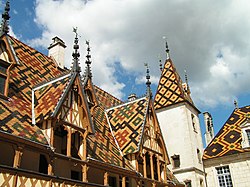
The 15th-century Hospices de Beaune, in the town center, is one of Europe's best-preserved Renaissance buildings.[citation needed] Other landmarks in Beaune include the old market (les Halles), the Beffroi (clock tower), and the collegiate church of Notre Dame. Beaune is the main center of the region's "Burgundian tile" polychrome Renaissance roofing style. Because of its historical importance in wine production and the unique system of terroir in the region, the town of Beaune was inscribed on the UNESCO World Heritage List in 2015 as part of the Climats, terroirs of Burgundy site.[3]

Wine

[edit]
Vineyards on the outskirts of Beaune

Beaune is one of the key wine towns in the Côte de Beaune section of the Burgundy wine region. Although Beaune itself does not have a Grand cru named for it, it is the hub of the region's wine business, as many of Burgundy's major négociants are here. Beaune is renowned for its annual charity wine auction on behalf of the Hospices de Beaune.

It is on the route des Grands Crus which is a road that runs through the vineyards, north from Beaune to Gevrey Chambertin and Nuits-Saint-Georges and south to Nolay, Saisy and Autun.

The town

[edit]

Beaune is the centre for wine industry services (such as tractors and equipment for vat-rooms) as well as a number of wine-related institutes and education facilities. The train station is served by TGV, through Dijon or Lyon.

There is a comprehensive "traditional" shopping area clustered around the central square with a focus on gourmet food, fashion, and wine, while large supermarkets, business parks, etc., are situated on the outskirts of town.

Beaune has a major fine food market on Saturdays, where there are a large number of stall holders supplying a broad selection of products and specialties from Burgundy and the surrounding regions. For example, Bresse chickens, Jura cheeses, small goods, spices, produce of every variety as well as seasonal specialties such as truffles.[4] There is a smaller market on Wednesday, and special-event markets and festivals are held throughout the year.

Beaune attracts a large number of tourists, around 400,000 each year according to the Hôtel Dieu.

Beaune is one of a number of towns in Europe asserting a key role in the "invention of film"; a number of murals and other tourist attractions reflect this.

Technically Beaune is a commune in eastern France, a sub-prefecture of department 21, the Côte-d'Or department, in the Bourgogne-Franche-Comté region.

Place de la Halle in Beaune, France

Population

[edit]

Origin, geography and climate

[edit]

The name "Beaune" derives from the Latinised Gaulish word "Belena", which was the name of a spring around which the settlement was established. That name in turn is derived from "Belen" or "Belenos", a god of fast-flowing water. A Roman fort was built there in the first century A.D. and it was already a prosperous wine-growing region in the 13th century.[7]

The town is served by a small river, the "Bouzaise" (or "Bouzaize") of which the source is in a public park on the north-east edge of town.[8]

Beaune has a semi-continental climate with an oceanic influence, seen with frequent rains in each season (though autumn has the most and summer the least) and frequent weather changes. There are significant temperature differences between the seasons, characterized by cold winters with frequent snowfall, and hot summers with sometimes violent thunderstorms.[citation needed] It is this climate which creates the unique environment for which the Côte d'Or is known.

Hospices de Beaune

[edit]

Founded in 1442 by Nicolas Rolin, chancellor of the Duke of Burgundy, who was encouraged to do so by his wife, Guigone de Salins, the Hospices are a charity running hospitals and other services for the needy. Thanks to generous donations from benefactors, they own vineyards in Burgundy.

The American Expeditionary Forces University at Beaune

[edit]

At the end of WWI the American Expeditionary Forces University was established in Beaune under the leadership of Brigadier General Robert I. Rees, complete with its own chapter of Phi Beta Kappa.[9][10] Faculty included Walter M. Chandler, a Progressive Party member and, later, a Republican Party member of the U.S. House of Representatives from the State of New York.

Notable people

[edit]

International relations

[edit]

Beaune is twinned with:[11]

[edit]

Climate

[edit]
Climate data for Beaunne (Savigny-lès-Beaune) (1991–2020 normals, extremes 1940–present)
Month Jan Feb Mar Apr May Jun Jul Aug Sep Oct Nov Dec Year
Record high °C (°F) 17.0
(62.6)
21.0
(69.8)
24.9
(76.8)
28.7
(83.7)
31.8
(89.2)
37.5
(99.5)
39.0
(102.2)
39.8
(103.6)
34.0
(93.2)
29.0
(84.2)
21.6
(70.9)
17.9
(64.2)
39.8
(103.6)
Mean daily maximum °C (°F) 5.9
(42.6)
7.9
(46.2)
12.8
(55.0)
16.5
(61.7)
20.5
(68.9)
24.5
(76.1)
26.8
(80.2)
26.5
(79.7)
21.9
(71.4)
16.4
(61.5)
10.0
(50.0)
6.4
(43.5)
16.3
(61.3)
Daily mean °C (°F) 3.1
(37.6)
4.3
(39.7)
8.2
(46.8)
11.5
(52.7)
15.4
(59.7)
19.1
(66.4)
21.2
(70.2)
20.9
(69.6)
16.8
(62.2)
12.2
(54.0)
6.9
(44.4)
3.7
(38.7)
11.9
(53.4)
Mean daily minimum °C (°F) 0.3
(32.5)
0.6
(33.1)
3.6
(38.5)
6.4
(43.5)
10.4
(50.7)
13.8
(56.8)
15.6
(60.1)
15.3
(59.5)
11.7
(53.1)
8.1
(46.6)
3.7
(38.7)
1.0
(33.8)
7.5
(45.5)
Record low °C (°F) −20.5
(−4.9)
−20.0
(−4.0)
−11.0
(12.2)
−4.5
(23.9)
−2.0
(28.4)
3.0
(37.4)
5.0
(41.0)
4.5
(40.1)
0.5
(32.9)
−4.5
(23.9)
−9.5
(14.9)
−16.5
(2.3)
−20.5
(−4.9)
Average precipitation mm (inches) 58.9
(2.32)
49.2
(1.94)
52.0
(2.05)
57.3
(2.26)
69.2
(2.72)
62.1
(2.44)
67.4
(2.65)
56.3
(2.22)
55.3
(2.18)
76.0
(2.99)
80.3
(3.16)
68.9
(2.71)
752.9
(29.64)
Average precipitation days (≥ 1.0 mm) 10.8 9.4 9.5 9.6 10.4 8.8 8.2 7.4 7.9 10.1 11.3 11.3 114.8
Source: Meteociel[12]

See also

[edit]

References

[edit]
[edit]
Revisions and contributorsEdit on WikipediaRead on Wikipedia
from Grokipedia
Beaune is a historic commune and subprefecture in the department of the region in eastern , situated approximately 320 km southeast of and serving as the wine capital of . With a population of 20,233 as of 2022, it lies at the heart of the winegrowing area, renowned for its prestigious vineyards that produce some of the world's finest and wines under the AOC Beaune appellation. The town's economy and cultural identity are deeply intertwined with , a tradition introduced by the Romans around 2,000 years ago, making it a central hub for wine production, trade, and tourism. Beaune's medieval heritage defines much of its character, featuring well-preserved 14th-century ramparts that enclose the historic center and allow for scenic walks along the battlements. A standout landmark is the Hôtel-Dieu, part of the Hospices de Beaune, founded in 1443 by Nicolas Rolin, Chancellor of the Dukes of , and his wife Guigone de Salins as a charitable hospital for the poor during the . This Flemish-Gothic architectural masterpiece, with its iconic multicolored Burgundian tiled roof, now functions as a and wine estate, managing a 60-hectare organic vineyard that produces over 50 cuvées auctioned annually to support healthcare initiatives. The Hospices' wine , held every third Sunday in November since 1859, is one of France's most prestigious events, drawing international buyers for en primeur sales of grand cru wines. The surrounding Climats du vignoble de Bourgogne, inscribed as a in 2015, encompass precisely delimited vineyard parcels in Beaune and the broader , recognized for their value in shaping Burgundy's terroir-based winemaking tradition. Other notable sites include the 12th- to 14th-century Basilique Notre-Dame, a Romanesque church exemplifying Burgundian religious architecture, and underground wine cellars that highlight the town's viticultural legacy. Beaune also hosts vibrant events like the annual wine festival and market traditions, reinforcing its role as a living testament to Burgundy's historical and oenological prominence.

Geography and Climate

Location and Topography

Beaune is a commune in the department of the region in eastern , positioned as the central hub of the Communauté d'Agglomération Beaune Côte et Sud, which encompasses 53 communes. It lies approximately 45 km south of and 45 km north of , at the crossroads of major routes including the A6, A31, and A36 motorways. The geographical coordinates of Beaune are 47°01′30″N 4°50′23″E, with elevations ranging from 193 to 407 meters above and an average of around 230 meters. The commune spans a total area of 31.30 km², including an urban core of approximately 3.5 km² amid broader viticultural and forested zones. Topographically, Beaune occupies a flat shaped by the Bouzaise River valley, which originates in the nearby Parc de la Bouzaise and flows generally westward through the town, joining the Dheune River, within the broader River basin. This plain is bordered to the west by the prominent of the hills, rising to the Montagne de Beaune at 401 meters, and the collinéen relief of the Arrière-Côte plateau, creating a transition zone between hilly uplands and expansive lowlands. Surrounding the urban area are expansive vineyards climbing the slopes of the , forming a landscape essential to the region's identity. Geologically, the area is underlain by limestone formations, including Oxfordian limestone on the western plateau and layered deposits along the , which produce rendzina and brown limestone soils enriched with and . These soils provide excellent drainage and content, making them particularly suitable for . The surrounding vineyard landscapes, known as the Climats du vignoble de Bourgogne, were inscribed on the World Heritage List in 2015 as a recognizing their historical and environmental significance. This varied topography offers protection from prevailing westerly winds while maximizing southeastern sun exposure, influencing the microclimates vital for grape cultivation.

Climate

Beaune experiences an classified as Cfb under the Köppen-Geiger system, characterized by mild temperatures, moderate rainfall, and influences from both semi-continental conditions inland and oceanic moderation from the Atlantic. The annual average temperature is approximately 11.5°C, with seasonal variations that support , particularly , while influencing daily life through predictable but changeable weather patterns. Winters are cool and damp, while summers are warm without excessive heat, fostering a balanced environment for outdoor activities and farming. Temperature in Beaune typically ranges from a January mean of 2.5°C, with lows around -2°C, to a mean of 20°C, with highs reaching 25°C; historical extremes have dipped to -15°C and climbed to 35°C. Precipitation totals 800-900 mm annually, distributed relatively evenly throughout the year but with increased wetness in spring and autumn, averaging 100-120 rainy days. The region enjoys 1,800-2,000 hours of sunshine per year, contributing to comfortable growing seasons, while prevailing westerly winds from the Atlantic, averaging 13 km/h in the windiest months like , bring moisture and moderate extremes. Recent climate trends, including milder winters attributed to global warming, have led to earlier budburst and harvest timings, as seen in 2025 when picking began as early as August 28 in nearby areas, resulting in high-quality grapes but reduced volumes due to factors like heat waves and coulure. The surrounding hills provide a protective , sheltering vineyards from severe frosts and enhancing temperature stability for .

History

Ancient and Medieval Periods

Beaune's history traces back to prehistoric settlements during the period, with evidence of human activity in the surrounding region indicating early agricultural communities. By the AD, the Romans established a fort at Belna, the ancient name for Beaune, transforming it into a hub for cattle rearing and emerging as vines were introduced across following the Roman conquest of in 52 BC. The first documented reference to dates to the AD, underscoring the region's early role in Roman wine production and . In the early medieval period, following the fall of the , Beaune became part of the Kingdom of established in the , integrating into the broader Burgundian territory amid barbarian invasions that disrupted prior economic activities. By the , under Carolingian rule, the area known as the Belnensis centered on Beaune, with early ecclesiastical mentions appearing in s; for instance, the reconstruction of the church of de Beaune was approved by Bishop Gauthier of in a dated 1004, reflecting growing local administrative and religious structures. The vicomtes de Beaune emerged as key figures in the , with families like that of Eudes, an illegitimate son of Duke Henri of , donating properties and engaging in regional alliances, further solidifying Beaune's position within the . The high medieval era marked Beaune's rise as a prosperous center driven by the expanding wine trade from the 12th and 13th centuries, as monastic orders such as Cluny (founded 909) and Cîteaux (founded 1098) revived and refined viticulture, planting vines on the hillsides around the town and enhancing winemaking techniques. This economic growth prompted the construction of defensive town walls between 1284 and 1418, encircling the burgeoning settlement and protecting its viticultural assets. Under the Capetian and Valois dukes of Burgundy, Beaune served as a parliamentary seat, hosting the first Burgundian Parliament (Jours Généraux) in 1227 and later the Curia Ducis installed in the Palace of the Dukes in 1354 by Philip II (Philip the Bold), establishing it as the duchy’s judicial capital. Key events shaped this period, including the devastating of 1348, which caused significant mortality across Burgundy—evidenced by death registers in nearby Givry recording widespread losses—and likely exacerbated social and economic strains in Beaune. A pivotal figure was Nicolas Rolin, chancellor to Duke , who in 1443 founded the Hôtel-Dieu (precursor to the Hospices de Beaune) as a charitable hospital to aid the poor and sick, drawing on northern Burgundian architectural models and reflecting medieval priorities of piety and welfare. These developments contributed to Beaune's medieval heritage, recognized in the 2015 World Heritage listing of the Climats du Bourgogne, which honors the precisely delimited vineyard parcels on the slopes as a embodying centuries of viticultural practices intertwined with human settlement and land management.

Modern and Contemporary History

During the period, following the annexation of the by the French crown in 1477, Beaune experienced a notable expansion in its wine trade, benefiting from royal patronage of and the region's strategic position in European commerce. French rule facilitated increased exports of wines to royal courts and northern markets, solidifying Beaune's role as a key trading hub. The of 1789 brought significant changes to Beaune's institutions, particularly the Hospices de Beaune, which was secularized as religious orders were suppressed and charitable properties nationalized. Despite this upheaval, the Hospices' vineyards were preserved to support its ongoing charitable mission, transitioning from ecclesiastical to while continuing to fund hospital operations through wine production. The institution survived relatively unscathed compared to other religious sites, maintaining its role as a vital community resource. In the , Beaune saw industrial growth in its wine négociants sector, with merchants expanding operations to blend, bottle, and export wines amid a golden age of sales driven by scientific advancements in . Following , the town hosted the University from 1919 to 1921, educating over 10,000 U.S. soldier-students in various subjects to prepare them for civilian life. During , Beaune fell under German occupation from 1940 to 1944, experiencing the hardships of and military presence typical of occupied . Post-1945, Beaune's economy recovered through burgeoning , leveraging its historic sites and wine heritage to attract visitors and establish the sector as a secondary pillar alongside . The 2015 World Heritage inscription of the Climats of , encompassing Beaune's vineyard landscapes, further elevated its global heritage status and spurred cultural preservation efforts. Recent milestones include a stage passing through the vineyards near Beaune, highlighting the region's cycling heritage, alongside planned 2025 events marking the 10th anniversary of the Climats designation, featuring festivals, tours, and tastings across Beaune and surrounding areas. Additionally, late 2025 will see the opening of Château de la Commaraine, a restored 12th-century estate transformed into a five-star luxury hotel with spa, vineyards, and dining facilities.

Demographics and Administration

Population

As of the 2022 census, Beaune has a population of 20,233 residents. covers an area of 31.3 km², resulting in a of 646 inhabitants per square kilometer. The of Beaune, as defined by INSEE, aligns closely with the commune boundaries and thus shares the same population figure of approximately 20,000. Official estimates for the larger communauté d'agglomération Beaune Côte et Sud reach about 52,000 across 53 communes. Historically, Beaune's population has shown steady growth followed by stabilization and a slight recent decline. From 16,874 residents in 1968, it increased to a peak of 22,394 in 2010, driven by in the wine sector and regional migration. By 2022, it had decreased marginally to 20,233, reflecting trends where residents move to nearby rural hamlets or larger centers like . Projections indicate stable demographics through 2025, with no significant shifts reported in recent INSEE updates as of late 2024. The demographic composition of Beaune features a balanced but aging profile. Women constitute 52.6% of the , or 10,641 individuals. Age distribution shows 13.8% under 15 years (2,798 people), 57% in working ages 15-59 (11,950), and 32.1% aged 60 and over (6,484), with about 25% specifically over 65 based on detailed brackets. Immigrants make up approximately 7% of residents (around 1,400), predominantly from countries, contributing to a diverse yet predominantly French-born populace of 93%. The is largely concentrated in the urban core, accounting for roughly 80%, while the remaining 20% resides in surrounding vineyard hamlets within .

Government and Administration

Beaune holds the status of a commune in the department of the region, functioning as the administrative center for the de Beaune and hosting a sous-préfecture that oversees local state services. The is integrated into the Communauté d'agglomération Beaune Côte et Sud, an intercommunal structure encompassing 53 communes across and departments, serving a population of approximately 52,000 residents. This agglomeration facilitates coordinated policies on urban development, , and economic initiatives, with Alain Suguenot, the current mayor of Beaune, also serving as its president since 2007. The municipal council of Beaune comprises 33 elected members, reflecting the commune's population size under French electoral law for localities between 20,000 and 30,000 inhabitants. Alain Suguenot, affiliated with the Les Républicains (LR) party, has led the council since his election in 2020 for a six-year term ending in 2026. The council's annual budget for 2025 totals €51.8 million, including €18.8 million allocated to investments, with significant emphasis on preserving cultural heritage—such as the UNESCO-listed —and enhancing tourism infrastructure to support the local economy. Administratively, Beaune operates under the supervision of the prefecture based in , which coordinates departmental policies on security, environment, and public services. The commune accesses funding through programs supporting World Heritage initiatives, particularly for the Climats du vignoble de Bourgogne, aiding in the restoration and promotion of viticultural landscapes. Recent policies include the 2024-2025 efforts aligned with the regional Bourgogne Neutralité 2035 initiative, focusing on reducing carbon emissions in vineyards through adaptive practices. Additionally, the administration promotes via targeted eductours and partnerships within the tourism collective, aiming to attract professional events to the region's historic venues.

Economy

Wine Industry

Beaune serves as the wine capital of , a central hub for the region's renowned production and trade of and wines. The local vineyards, primarily within the Beaune AOC and surrounding appellations, yield approximately two-thirds red wines from and one-third white wines from , reflecting the terroir's balance of limestone and clay soils suited to these noble varieties. Over 120 wine domaines operate in Beaune, alongside prominent négociants such as Bouchard Père et Fils, which sources and bottles wines from across the appellation. The Beaune AOC, at the heart of the subregion—which spans approximately 36 villages—covers the commune of Beaune and includes 42 premier cru climats, contributing to the area's prestige for both red and white wines. The Hospices de Beaune manages 60 hectares of exceptional vineyards, with 85% classified as premier or grand cru sites, including plots in Corton-Charlemagne for whites and Pommard for reds. These holdings underscore Beaune's role in producing high-quality wines that embody the nuanced expressions of . The wine industry drives Beaune's economy, generating substantial revenue through production and sales while supporting local employment; the sector accounts for a significant portion of jobs in the town's 20,233-resident population as of 2022. The annual Hospices de Beaune wine auction, established in 1859, exemplifies this impact, raising €13.9 million in 2024 to fund healthcare while boosting market visibility for wines. Recent economic data for the broader department, where Beaune is central, indicate wine-related turnover exceeding €1 billion annually, with Beaune's contributions pivotal to this figure. Innovations in Beaune's wine sector include the introduction of a new at the 2025 Hospices de Beaune auction: Grand Cru Georges Noëllat, highlighting adaptive from the estate's diverse plots. Following the 2025 harvest, producers reported high-quality grapes with balanced acidity and concentration, despite low yields due to variable weather; this prompted accelerated adoption of climate-resilient practices, such as enhanced canopy management and organic conversions funded by regional initiatives. Beaune's wines reach global markets, with approximately 50% of Burgundy production exported internationally, driven by demand in , , and . This trade is safeguarded by the World Heritage designation of the Climats of , which protects 1,247 precisely delineated vineyard plots across the region, preserving the unique system that defines Beaune's output. The 165th Hospices de Beaune auction on November 16, 2025, raised €13.94 million, slightly up from 2024, with the new among highlights supporting ongoing healthcare funding.

Tourism and Services

Beaune's tourism sector serves as the second pillar of its economy after the wine industry, drawing visitors through its wine heritage and landmarks while generating revenue from accommodations, dining, and retail. The annual Hospices de Beaune wine auction peaks visitor numbers, attracting hundreds to the main event and thousands over the surrounding weekend festivities. The town's tourism infrastructure includes approximately 2,000 hotel beds across various establishments, catering to leisure and business travelers. Facilities for business tourism, such as venues for congresses and team-building activities, further diversify offerings, while a new 5-star hotel, Château de la Commaraine, is slated to open in late 2025 with 37 rooms, an on-site spa, pool, vineyards, and two restaurants, enhancing luxury accommodations. Retail services thrive via weekly markets and wine cellars, complemented by hospitality with over 200 restaurants providing Burgundian specialties and international cuisine. Beyond tourism, Beaune's encompasses focused on and support for , bolstering regional supply chains. The rate in the Beaune stood at 9.7% as of 2022. The route passed through , heightening global visibility for Beaune and surrounding areas. In 2025, UNESCO-related events marking the 10th anniversary of the Climats du vignoble de Bourgogne World Heritage listing feature over 80 activities, including estate visits, tastings, and cultural programs across the region.

Culture and Landmarks

Hospices de Beaune

The Hospices de Beaune, originally known as the Hôtel-Dieu, was founded in 1443 by Nicolas Rolin, Chancellor of , and his wife Guigone de Salins, as a charitable to provide care for the poor amid the plagues and famines following the . Construction of the building spanned from 1443 to 1452, creating a grand facility modeled on Flemish hospitals, with a distinctive Flemish-inspired Flamboyant Gothic featuring intricate stonework, tall gables, and a colorful tiled roof made of glazed Burgundian tiles in shades of red, yellow, green, and black. This architectural gem, often described as a "palace for the poor," symbolized Rolin's atonement for his wealth and served as a of in medieval . The Hôtel-Dieu operated as a functioning for over five centuries, providing free medical care until its closure in 1971, when services transitioned to modern facilities while the original building was preserved as a historic . Today, it functions primarily as the Hôtel-Dieu Museum, attracting over 400,000 visitors annually who explore its preserved interiors, including the grand ward with its original wooden-beamed ceiling and exhibits illustrating medieval medicine. The site's charitable mission endures through the Hospices Civils de Beaune, which uses proceeds from wine sales to fund contemporary healthcare initiatives, maintaining the institution's legacy of support for the vulnerable. Central to the Hospices' ongoing is its wine domain, the Domaine des Hospices de Beaune, comprising approximately 60 hectares (150 acres) scattered across more than 120 plots in premier and grand cru vineyards of the , primarily planted with and . These holdings produce around 50 cuvées annually, vinified by the estate's team and sold via the world-renowned Hospices de Beaune Wine Auction, held each since 1859; the 165th edition, held on November 16, 2025, offered 539 barrels of the 2024 vintage and raised €18.384 million, the third-highest total in its history. The 2024 auction raised €13.9 million from 439.5 barrels, marking the fourth-highest total in the event's history, with leading négociant Albert Bichot as the top buyer, acquiring multiple lots including high-value pieces. Among the museum's highlights is the polyptych, a monumental 15th-century altarpiece by Flemish master , commissioned around 1445–1450 for the 's great hall and depicting the biblical scene across 15 oak panels to offer spiritual solace to patients. The site's underground cellars store and age the estate's wines, preserving the tradition of Burgundian vinification while supporting the charity's operations. In its modern role, the Hospices continues to finance healthcare advancements, including the construction of a new 15,000 m² hospital building in Beaune, whose foundation stone was laid in 2025 as part of a broader modernization plan; the 2025 auction theme emphasizes disability and innovation, aligning funds toward inclusive medical progress.

Other Historic Sites and Events

Beaune's medieval ramparts, constructed in stages between the 12th and 17th centuries under the Dukes of , enclose the historic center with well-preserved walls up to 10 meters high and 5 meters thick, featuring defensive towers and gates. A self-guided allows visitors to explore approximately 2 kilometers of the fortifications, passing 17 key sites that highlight the town's defensive evolution. The Basilica of Notre-Dame, a Romanesque masterpiece begun in the mid-12th century and completed in the early , exemplifies Cluniac architectural influences with its unified style, semicircular arches, barrel vaults, and high windows. Inside, 15th-century tapestries depicting the life of the Virgin Mary add to its cultural significance. Beaune boasts an extensive network of underground cellars dating back to the , originally dug by for storage and now offering tours that reveal medieval beneath the town. The Musée du Vin et du Négoce, housed in the 16th-century former Hôtel des Ducs de Bourgogne, traces 20 centuries of history through exhibits on , , and traditions. The weekly Saturday market, held from early morning until 1 p.m. in the Place de la Halle, Place Fleury, and surrounding streets, features around 180 stalls selling fresh produce, cheeses, crafts, and second-hand goods, drawing locals and visitors alike. Complementing this is the medieval-themed Les Trois Glorieuses festival, a three-day celebration in November tied to the Hospices de Beaune wine auction, where streets close to traffic for vibrant processions, music, and feasts evoking Burgundy's historic heritage. Annual events enrich Beaune's cultural calendar, including the Printemps des Vins in spring, which hosts tastings and open houses at local estates to showcase new vintages. During summer, nocturnal projections illuminate over 30 monuments and the ramparts with luminous animations on seven emblematic buildings, creating a magical trail of light from through . The 2024 Tour de France route passed through the Beaune region on stage 6, highlighting the area's scenic vineyards en route to . In 2025, the 10th anniversary of the listing of the Climats du vignoble de Bourgogne will feature an expanded Mois des Climats festival from May 2 to July 3, with over 80 events including tours, concerts, workshops, and tastings across the . While the Hospices de Beaune stands as the premier attraction, these diverse sites and happenings offer a broader of the town's heritage. Wine education thrives in Beaune through institutions like the École des Vins de Bourgogne, which has provided courses on tasting, analysis, and for amateurs and professionals since 1974.

Society

Notable People

Beaune has been the birthplace or longtime residence of several influential figures across fields such as , , automotive , and . Nicolas Rolin (1376–1462), a prominent Burgundian statesman, served as chancellor to , , from 1422 until his death, wielding significant influence over the duchy’s administration and foreign policy during the . In 1443, Rolin and his wife Guigone de Salins founded the Hospices de Beaune, a charitable that provided care for the poor and remains a key cultural landmark today. Étienne-Jules Marey (1830–1904), born in Beaune to a family of wine merchants, was a pioneering physiologist and inventor whose work laid foundational contributions to the study of motion and early cinematography. Marey developed the sphygmograph in 1860, an early device for recording blood pressure and pulse, and later advanced chronophotography techniques in the 1880s, capturing successive phases of movement on a single image to analyze animal locomotion, influencing scientific visualization and film technology. Théodore Chevignard de Chavigny (1687–1771), born in Beaune as the son of a local royal prosecutor, rose to prominence as a under , serving as ambassador to (1740–1743), (1723–1724), and (1751–1762), while also acting as plenipotentiary minister at the Imperial Diet of . His career focused on negotiating alliances and countering Habsburg influence in , including opposition to the of 1713. Louis Chevrolet (1878–1941), who spent his formative years in Beaune after his Swiss family relocated there in 1887, became a renowned auto racer and engineer, co-founding the Chevrolet Motor Car Company in 1911 with , which revolutionized affordable automobile production in the United States. His brother, (1892–1920), born in Beaune, was an accomplished racing driver who won the 1920 , the youngest victor at age 28, before his tragic death in a racing accident later that year. Beaune's winemaking heritage is exemplified by figures associated with Maison Patriarche, founded in 1780, where André Boisseaux (active mid-20th century) transformed the house into a leading négociant through innovative marketing and production of modern cuvées, expanding its global reach while preserving traditional expressions.

International Relations

Beaune maintains formal twinning partnerships, known as jumelages in French, with several international cities to foster cultural, economic, and educational exchanges. These include in since 1960, emphasizing post-war reconciliation and shared viticultural traditions; in since 1962, focusing on regional heritage and community events; in since 1976, highlighting wine production and tourism collaborations; Koshu in since 1976 (renewed in 2006), promoting wine export knowledge and cultural festivals; in since 2023, centered on Mediterranean heritage and annual celebrations like the San Vincenzo dell'Amarone event; and Fangshan District in since 2023, aimed at and wine market expansion. In addition to twinning, Beaune participates in global collaborations through its role in the World Heritage listing of the Climats, terroirs of , inscribed in 2015, which encompasses the vineyard landscapes around Beaune and . This designation involves ongoing partnerships with and international experts to preserve viticultural heritage, including management plans for and across sites. Complementing this, Beaune supports wine export networks, particularly with and the , facilitated by twinning agreements and annual auctions that connect local producers to global markets. The city's international events underscore these ties, notably the annual Hospices de Beaune wine auction, which in 2024 attracted over 350 bidders from around the world and raised €13.9 million for healthcare. The 2025 edition, themed around and innovation to mark the 20th anniversary of the 2005 French law, raised €18.4 million—the third-highest total in its history—supporting inclusive healthcare initiatives through the Romain Charter. These auctions serve as a platform for diplomatic engagement in the wine sector, drawing buyers from , , and the . On the diplomatic front, Beaune benefits from EU-funded heritage projects, such as the €700,000 grant awarded in 2025 to the Bourgogne Wine Board for preserving winegrowing landscapes, which includes Beaune's historic sites and supports cross-border conservation efforts. The city also promotes with partners in and , hosting professional events in venues like the Palais des Congrès to facilitate wine trade delegations and cultural exchanges.

References

Add your contribution
Related Hubs
User Avatar
No comments yet.