


Community hub
Recent from talks
Contribute something
Nothing was collected or created yet.
Belphegor
View on Wikipedia | This article needs additional citations for verification. (August 2024) |

Belphegor (or Baal Peor, Biblical Hebrew: בַּעַל-פְּעוֹר, romanized: baʿal-pəʿōr, lit. 'Lord of the Gap') is, in Christianity, a demon associated with one of the seven deadly sins. According to religious tradition, he helps people make discoveries. He seduces people by proposing incredible inventions that will make them rich. According to some demonologists from the 17th century, his powers are strongest in April. Peter Binsfeld (ca. 1540–ca.1600), the auxiliary bishop of Trier and a witch hunter, wrote that Belphegor tempts through laziness. According to Binsfeld's Classification of Demons, Belphegor is the main demon of sloth in the Christian tradition. The anonymous author of the Lollard work, The Lanterne of Light, however, believed Belphegor to embody gluttony rather than sloth.[1]
Belphegor derives from Baal-Peor, a Baal worshipped at a high place in the Heresy at Peor, to whom the Israelites were associated in Shittim (Numbers 25:3) and who was associated with intemperance and orgies. He was worshiped in the form of a phallus. As a demon, he is described in Kabbalistic writings as "the one who quarrels", an enemy of the sixth sefira, Tiferet "Beauty". In stories where he is invoked, he bestows wealth, power to make discoveries, and the ability to create fantastic inventions. His role as a demon was to sow dispute between people, and to lead them to evil through the distribution of wealth.

The palindromic prime number 1000000000000066600000000000001 is known as Belphegor's prime, due to the superstitious significance of the numbers it contains. Belphegor's prime number consists of the number 666, surrounded on both sides by thirteen zeros and finally one one.
According to De Plancy's Dictionnaire Infernal, Belphegor was Hell's ambassador to France. As a result, his enemy is Mary Magdalene, one of the patron saints of France.
Literature
[edit] |
The novella Belfagor arcidiavolo by Italian diplomat Niccolò Machiavelli was first published in 1549, and regales how the demon comes to earth to find a mate.
Belphegor figures in Paradise Lost by John Milton.[2]
| Next Chemos, th’ obscene dread of Moab’s sons,
From Aroar to Nebo, and the wild Of southmost Abarim; in Hesebon And Horonaim, Seon’s realm, beyond The flow’ry dale of Sibma clad with vines, And Eleale to th’ Asphaltic Pool. Peor his other name, when he enticed Israel in Sittim on their march from Nile To do him wanton rites, which cost them woe. |
Belphegor features in three narrative poems by Jean de la Fontaine, published in his 17th-century anthology Contes et nouvelles en vers (English: Tales and Novellas in Verse). Drawing from Machiavelli's Belfagor arcidiavolo, this satirical poetic cycle includes the eponymously-titled Belphegor, followed by La Clochette, and Le Glouton.
According to the 1818 Dictionnaire Infernal by Collin de Plancy, Belphegor was Hell's ambassador to France.[3] The same claim was repeated by Victor Hugo in Toilers of the Sea.[4]
In the grimoire Key of Solomon, Belphegor is listed near the end of the book as a Syrian idol that is now destroyed.[5]
The novella by Machiavelli became the basis for the opera Belfagor by Ottorino Respighi, which premiered at La Scala in Milan in 1923.
In popular culture
[edit] |
- The PZL M-15 Belphegor, a 1970s Polish utility aeroplane, was named after the demon, due to its strange looks, the noise of its jet engine, and its unsuitability for crop dusting, for which it had been specifically designed.
- Belphegor is an obtainable character in the adult otome game "What In Hell Is Bad". He is one of the seven kings of hell and possesses great power despite being constantly sleepy.
- Belphegor appears as a supporting character in the TV show Supernatural. In the show, Belphegor possesses the body of Jack, played by Alexander Calvert.
- Belphegor is a recurring demon/persona in the Megami Tensei and Persona video game series.
- Belphegor is the youngest and seventh sibling among the seven demon brothers in the otome game Obey Me!. He is always napping and constantly sleepy, and is the twin brother of Beelzebub.
- Belphegor is a blackened death metal band.
- Belphegor is the Storm Guard of the Varia in the anime and manga series Katekyo Hitman Reborn. He is also known as 'Prince the Ripper'.
- Belphegor is the name of one of the heretical gods, more specifically that of yellow luxin and sloth, in the Lightbringer series by Brent Weeks.
- The long-running German dime novel and audio drama series John Sinclair featured Belphégor as a recurring villain. Author Jason Dark depicted Belphégor as an archdemon mainly active in Paris and a close ally of the Grim Reaper.
- Belphegor is a random demon/monster encounter in the Square Enix games Final Fantasy IV and Final Fantasy XVI.
- Belphegor is a young female demon in the series As Miss Beelzebub Likes. One of the main characters, and the love interest of Azazel.
- Belphegor is referenced in the television show Elementary season three episode three.
- Belphegor is referenced in the short story Bulldozer by Laird Barron.
- A Digimon named Belphemon, from the Digimon franchise is a member of the Seven Great Demon Lords and appears in the fifth season Digimon Data Squad.
- Void Stranger contains a number of characters with abbreviated demon names, including Gor, whose full name is Belphegor.
- Belphegor is mentioned by Beelzebub in episode 8, season 1 in Helluva Boss. It is implied that the character identifies as female and rules over the circle of Sloth, the last circle in Hell. It is also implied she has a connection with medication and drugs in Hell from other references in the show. She later makes a full appearance in episode 11, “Mastermind” of season 2, appearing as a sheep demon with multiple eyes and a candle perched on her head.
- In One Piece, Magellan, the warden of the prison Impel Down, is heavily based on Belphegor; visually, with distinctive devil horns, and thematically, as the character sits on the toilet for ten hours a day to relieve himself of diarrhea instead of doing his prison duties.
- Belphegor is a title of a song by a visual kei band The Gallo.
- In the video game Infernax, Belphegor is the final boss unless the player pursues one of the three golden endings.
- In the Oz book Jack Pumpkinhead of Oz (1929) by Ruth Plumly Thompson, Baron Belfaygor of Bourne is a spoof of the Prince Charming stock character, seeking to rescue his damsel in distress from an enemy warlord. Purehearted but inept, Belfaygor requires assistance from other unlikely heroes, including the titular "Pumpkinhead". Despite his name, Belfaygor has no demonic attributes.
- Belphegor is one of the character in Make the Exorcist Fall In Love, being heavily referenced with Belphegor with a title Lord of Sloth.
See also
[edit]References
[edit]- ^ Morton W. Bloomfield, The Seven Deadly Sins, Michigan State College Press, 1952, pp. 214–215.
- ^ Milton, John (2003). Leonard, John (ed.). Paradise Lost. Penguin Classics. London: Penguin Classics. Book 1, lines 406-414. ISBN 978-0-14-042439-3.
- ^ Collin de Plancy, Jacques-Albin-Simon (1844). Dictionnaire infernal (in French). Paris. pp. 186.
- ^ Hugo, Victor (1888). Toilers of the Sea. Translated by Hapgood, Isabelle F. New York: Kelmscott Society. p. 17.
- ^ The Key of Solomon. Translated by Mathers, Samuel Liddell MacGregor. London: G. Redway. 1889. p. 112.
Belphegor
View on GrokipediaOrigins and Etymology
Etymological Roots
The name Belphegor derives from the Hebrew Baʿal Pəʿôr (בַּעַל-פְּעוֹר), referring to a Moabite deity associated with the biblical incident in Numbers 25, where the Israelites engaged in worship involving licentious practices at Mount Peor.[8] This compound name translates to "lord of the opening" or "lord of Peor," with "Baʿal" signifying a divine lord or master, and "Pəʿôr" linked to the concept of a gap, cleft, or wide opening, possibly alluding to a geographical feature or symbolic portal.[9][10] The components of Baʿal Pəʿôr trace back to ancient Canaanite and Phoenician linguistic traditions, where "Baʿal" served as a common honorific title for various local deities, denoting ownership or dominion, as seen in broader Semitic pantheons from the second and first millennia BCE.[10] "Pəʿôr," derived from the Hebrew root pʿr (פער), implies "to open wide" or "gape," potentially evoking natural formations like mountain passes or metaphorical notions of exposure and fertility rites.[9] These roots reflect the deity's integration into Moabite cultic practices, distinct yet influenced by neighboring Canaanite religious frameworks.[8] In the evolution of the name through ancient translations, Baʿal Pəʿôr appears as Belphegor in the Septuagint (Greek translation of the Hebrew Bible, ca. 3rd–2nd century BCE) and the Vulgate (Latin translation by Jerome, ca. 4th–5th century CE), adapting the Hebrew sounds into Greco-Latin phonetics while preserving the core structure.[8][11] This form persisted into medieval Latin occult manuscripts and grimoires, where it solidified as "Belphegor," and later influenced French esoteric texts, such as those compiling demonological lore, marking a shift from a localized pagan god to a demonized figure in Christian traditions.[12] Scholarly debates center on whether Belphegor's nomenclature stems directly from Baal worship as a demonization of pagan idolatry or represents an independent development in Judeo-Christian demonology, with some arguing the latter due to variations in attributes beyond the biblical Peor episode.[8][10] Proponents of the Baal worship origin emphasize the continuity of Semitic titles in biblical polemics against foreign gods, while others highlight phonetic adaptations in translation as evidence of cultural reinterpretation rather than strict derivation.[9]Earliest Historical References
The earliest documented references to the figure later known as Belphegor appear in the Hebrew Bible as Baal-Peor, a Moabite deity worshiped on Mount Peor near the Jordan River. In Numbers 25:1–5, the Israelites, encamped at Shittim, engage in sexual immorality with Moabite and Midianite women who invite them to participate in sacrifices to their gods, leading Israel to "yoke itself to Baal of Peor." This act of idolatry provokes divine anger, resulting in a plague that kills 24,000 people until halted by Phinehas's zeal.[13] The incident underscores Baal-Peor's association with seduction, licentious rites, and forbidden worship, blending fertility cult practices with moral transgression.[14] Deuteronomy reinforces this narrative, referencing the location Beth-peor in 3:29 as the site where Moses later addresses the people, and in 4:3 explicitly recalling the destruction: "Your eyes have seen what the Lord did at Baal-peor, for the Lord your God destroyed from among you all the men who followed the Baal of Peor." These passages establish Baal-Peor not merely as a local god but as a symbol of apostasy and sensual temptation that endangers communal purity.[15] The transition from pagan deity to demonic entity emerges in post-biblical Jewish and early Christian interpretations, where foreign gods were reframed as fallen or malevolent spirits. In early Christian texts like Peter Comestor's Historia Scholastica (c. 1170), a popular biblical commentary, Baal-Peor is portrayed within the narrative of Israel's wanderings as a seductive force emblematic of a fallen angelic influence, contributing to the demonization of pagan idols in scholastic theology.[16] This aligns with broader patristic views that equated non-Abrahamic deities with demons, as seen in works attributing idolatrous worship to infernal powers. Themes of demonic temptation with wealth and vice appear in pseudepigraphal grimoires such as the Testament of Solomon (1st–5th century CE, though its composition is debated), though Belphegor is not mentioned by name. While biblical and early Jewish texts refer to Baal-Peor, the demonized form "Belphegor" first appears explicitly in 13th-century Kabbalistic works like the Zohar and later in 16th-century grimoires, with early literary depictions in Niccolò Machiavelli's 1532 novella Belfagor arcidiavolo. Jewish mysticism further develops this in the Zohar (13th century), the core Kabbalistic text, where the sin of Baal Peor (Zohar III:220b) is reinterpreted as a demonic incitement to licentiousness, symbolizing the surrender to base desires and disconnection from divine holiness, thus solidifying Belphegor's role as a tempter of moral laxity.[17]Description and Attributes
Physical Form and Manifestations
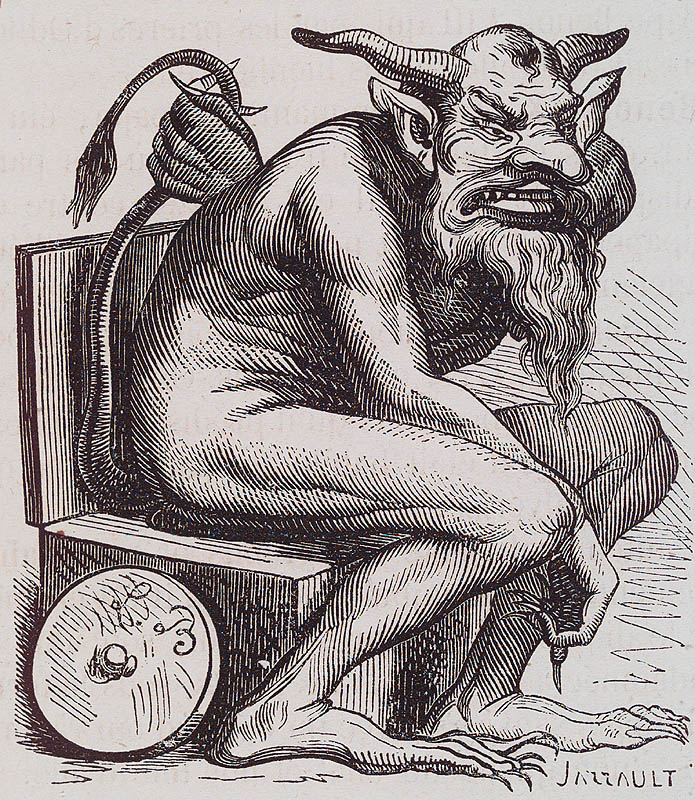
In traditional demonological texts, Belphegor is commonly depicted as a monstrous, grotesque figure featuring prominent horns, a long flowing beard, leathery skin, and a gaping mouth, symbolizing his ties to excess amid slothful indulgence.[18] This form is vividly illustrated in the 1863 edition of Jacques Collin de Plancy's Dictionnaire Infernal, where Belphegor appears as a hunched, straining demon seated upon a portable toilet, emphasizing his dominion over idleness through a lavatorial motif derived from medieval theological puns on sloth as avoidance of spiritual duties.[4] Alternative manifestations of Belphegor include seductive humanoid shapes designed for temptation, such as a beautiful young woman or an alluring young man, often appearing in moments of solitude to entice summoners with promises of wealth and ingenuity.[18] He may also assume a bloated, idle demonic form with sharp nails and an open maw, evoking gluttony and lethargy, or a naked, hideous being that underscores his repulsive nature beneath deceptive allure.[18] During summoning rituals in demonological grimoires, Belphegor proves difficult to invoke, often materializing amid thick smoke or shadowy veils accompanied by a foul, sulfurous odor typical of infernal entities, manifesting in one of his dual forms to test the summoner's resolve.[18] These appearances require isolation and specific offerings, such as excrement, aligning with his slothful domain, and occur most potently in April.[18][19] Depictions of Belphegor vary across historical periods, with medieval illustrations favoring highly grotesque, animalistic traits to evoke horror and moral warning, while Renaissance and later accounts, such as those in 16th- and 19th-century demonological compendia, present slimmer, more humanoid figures that blend seduction with monstrosity for nuanced temptation narratives.[18][4]Powers and Domains
In occult traditions, Belphegor is primarily associated with the domain of invention and discovery, where he is said to inspire humans with ingenious ideas for mechanical arts and innovations that promise effortless wealth, often leading to greed and moral corruption.[20] According to Jacques Collin de Plancy's Dictionnaire Infernal (1863 edition), Belphegor serves as the demon of discoveries and ingenious inventions, tempting individuals by suggesting creations that yield riches with minimal labor, thereby embodying slothful acquisition.[21] This influence extends to revealing hidden treasures and secrets, granting knowledge that can elevate one's status but at the expense of ethical integrity.[20] Belphegor's powers also include the ability to seduce and sow discord, particularly in relationships, by appearing in alluring forms to exploit human weaknesses such as lust and apathy.[20] In demonological lore, he is invoked to teach arts and sciences, including practical skills for prosperity, but demands unconventional offerings like excrement, a ritual tied to his ancient Moabite origins as Baal-Peor, where worship involved scatological acts on high places.[20][21] These pacts often provide protection against poverty by bestowing wealth, yet they foster laziness, carelessness, and relational strife, underscoring his role in promoting vice under the guise of ingenuity.[21]Role in Demonology
Position in Hell's Hierarchy
In Christian demonology, Belphegor is classified as one of the seven princes of Hell, each corresponding to a deadly sin, with Belphegor presiding over sloth (acedia). This hierarchy was formalized by Peter Binsfeld in his 1589 treatise Tractatus de confessionibus maleficorum et sagarum, where Belphegor tempts humanity toward spiritual and physical indolence, positioning him as a high-ranking infernal authority subordinate to overarching figures like Lucifer or Satan. Subsequent demonological texts elaborate on Belphegor's rank within Hell's structure. In Jacques Collin de Plancy's Dictionnaire Infernal (1818, revised 1863), Belphegor is depicted focusing on discord through wealth and invention while maintaining allegiance to higher demonic overlords.[22] This places him as a lieutenant in the temptation of humanity. Grimoires from the Renaissance and later periods show variations in Belphegor's hierarchical status. While not among the 72 spirits of the Ars Goetia in the Lesser Key of Solomon (17th century), he appears in related Solomonic texts like the Key of Solomon as a former Syrian idol integrated into demonic ranks, elevated in subsequent works to a princely role overseeing slothful legions. These classifications underscore Belphegor's consistent mid-to-high position in infernal orders, often as a potentate tempting through apathy without direct command over all of Hell.Association with Sloth and Invention
In Christian demonology, Belphegor is classified as the chief demon associated with the deadly sin of sloth, embodying apathy, laziness, and the avoidance of spiritual and moral effort. This mapping originates from Peter Binsfeld's 1589 treatise Tractatus de Confessionibus Maleficorum et Sagarum (Treatise on Confessions by Evildoers and Witches), where he assigns each of the seven princes of Hell to one of the seven deadly sins, pairing Belphegor specifically with sloth to represent temptations toward idleness and neglect of duty.[23] Paradoxically, Belphegor is also depicted as a patron of inventors and the idle rich, seducing individuals with promises of effortless wealth through groundbreaking discoveries and ingenious inventions. In Jacques Collin de Plancy's Dictionnaire Infernal (1863 edition), Belphegor is described as the "demon of discoveries and ingenious inventions," who appears in the form of a young woman and grants riches to those he favors, often inspiring ideas that allow fortune without labor.[19] Theological interpretations in Catholic demonology portray Belphegor's dual nature as a temptation toward false ease, contrasting the virtue of diligence by luring souls into spiritual torpor under the guise of innovative prosperity. This association traces back to his origins in Jewish lore, where Belphegor derives from Baal-Peor, the Moabite deity whose worship involved idolatrous rituals of excess and idleness that led the Israelites astray from divine commandments, as recounted in Numbers 25:1–3. In esoteric traditions, Belphegor embodies a cultural paradox as a figure of technological progress—fostering invention and wealth—yet ultimately destructive, as his gifts erode moral effort and lead to ruin through unchecked laziness.[19]Appearances in Literature and Folklore
Medieval and Occult Texts
Early 16th-century occult writings further elaborate Belphegor's role in esoteric communications and pacts. Johannes Trithemius's Steganographia, composed around 1500 and circulated in manuscript form, includes Belphegor among the aerial spirits invoked through coded invocations and sigils for transmitting messages across distances, often involving demonic hierarchies that blend cryptography with conjuration. Here, Belphegor is portrayed as a talkative intermediary who facilitates pacts by granting riches and inventive genius, but at the cost of spiritual sloth, reflecting the text's dual purpose as both a steganographic manual and a veiled grimoire of spirit evocation.[18][24] Belphegor's association with lustful temptations appears indirectly in broader demonological treatises on witchcraft. The 1487 Malleus Maleficarum by Heinrich Kramer and Jacob Sprenger discusses incubi and succubi as agents of carnal sin, aligning with Belphegor's Moabite origins as Baal-Peor—a deity of seductive idolatry condemned in biblical accounts—and his role in inciting slothful debauchery during trials, though not named explicitly, as an exemplar of demons exploiting human vices for pacts and possessions.[18] In Jewish occult literature, Belphegor's narrative expands through syncretism with ancient legends of seduction and apostasy. The 13th-century Sefer Raziel HaMalakh, a kabbalistic grimoire attributed to angelic revelation, incorporates demonic forces within its cosmological framework of divine names and protections, blending Belphegor's identity with Baal-Peor traditions from Numbers 25, where the entity lures Israelites into idolatrous rites involving licentiousness and slothful rebellion against divine law. This portrayal underscores Belphegor as a disruptive spirit whose invocations risk spiritual corruption, emphasizing amulets and prayers to ward off such influences in medieval Jewish magical practice.[18]Renaissance and Post-Renaissance Accounts
Niccolò Machiavelli's novella Belfagor arcidiavolo (written circa 1520s, published 1549) portrays Belphegor as a demon dispatched from hell to earth by Pluto and Satan to investigate whether human marriage yields greater misery than the discord caused by female spirits in the underworld.[25] Assuming human form as a wealthy Florentine nobleman, Belphegor marries a demanding woman named Onesti, whose extravagance and nagging drive him to slothful despair and financial ruin, ultimately forcing him to flee back to hell pursued by angry creditors and exorcists.[25] This satirical tale underscores Belphegor's association with sloth amid domestic strife, concluding that earthly wedlock amplifies infernal complaints about women.[25] Francis Barrett's The Magus (1801) incorporates Belphegor into its compendium of occult philosophy, classifying him among demons linked to sloth and detailing ceremonial rituals for summoning spirits to reveal secrets of invention and discovery. Drawing from earlier grimoires, the work outlines invocations, circles, and offerings—such as burnt sacrifices—to compel Belphegor's appearance for granting ingenious knowledge, while warning of his deceptive nature in promising wealth without effort. In French folklore traditions, as compiled in Jacques Collin de Plancy's Dictionnaire Infernal (1818), Belphegor manifests as a trickster demon who tempts mortals with sudden wealth and inventive ideas, often in the guise of a seductive young woman, but ultimately leads them to ruin through induced laziness and discord.[26] German folk accounts from the 18th and 19th centuries echo this, depicting him as an ambassador of hell who bestows fortunes on the slothful, only for the gifts to foster greed and familial strife, resulting in poverty and isolation.[19]Depictions in Art and Iconography
Visual Representations in Historical Art
The most iconic historical portrayal of Belphegor is found in the 1863 edition of Jacques Collin de Plancy's Dictionnaire Infernal, illustrated by Louis Le Breton. In this detailed engraving, Belphegor appears as a bearded, horned demon perched on a privy—a symbolic toilet throne—straining in discomfort while clutching a trumpet in one hand and his flaming tail in the other to shield it from the inferno below. This humorous yet macabre image, drawn with meticulous line work, underscores his association with sloth and earthly indulgences, becoming a foundational reference that shaped later occult iconography.[4] An earlier visual representation appears in an 1794 engraving by Charles Emmanuel Patas after a design by Jean-Honoré Fragonard. This etching depicts Belphegor (rendered as Belfagor from Machiavelli's novella) as a horned, grotesque figure, emphasizing his demonic and seductive qualities in a Rococo style with intricate lines and dramatic shading. It reflects the demon's literary role in tales of temptation and discord, bridging Renaissance literature with emerging 19th-century demonology.[27]Symbolic Motifs and Interpretations
One of the most distinctive symbolic motifs associated with Belphegor is the toilet throne, often depicted as a portable commode or pierced chair upon which the demon is seated. This imagery, popularized in 19th-century demonological illustrations such as Collin de Plancy's Dictionnaire Infernal, reflects the Moabite worship of Baal-Peor, where excrement was considered an appropriate sacrificial offering according to the Babylonian Talmud (Sanhedrin 64a), interpreted by later Kabbalistic and Christian sources as a degradation of the deity into a figure of filth and idleness.[5] The throne symbolizes sloth through its evocation of passive excretion—a base, unproductive bodily function that embodies wasted potential, where human energy is squandered in lethargy rather than directed toward meaningful endeavor.[28] Belphegor's phallic symbolism, rooted in his origins as the Moabite god Baal-Peor venerated in the form of an erect phallus, extends to demonic representations featuring an exaggerated beard or open mouth suggestive of genital imagery. This motif underscores uncontrolled lust, portraying the demon as a tempter who exploits sexual indulgence to erode moral discipline.[19] In occult iconography, such elements contrast Belphegor's association with inventive genius—promising discoveries and wealth—against the moral decay induced by succumbing to carnal desires, highlighting a duality where intellectual promise devolves into selfish corruption.[28] Inventive devices, such as tools or mechanical contraptions occasionally attributed to Belphegor in demonological texts, serve as symbols of false enlightenment, luring individuals with visions of effortless prosperity through innovation. Drawing from Renaissance-era critiques of humanism, these motifs critique the unchecked pursuit of technological and intellectual advancement without ethical restraint, positioning Belphegor as a patron of "ingenious" but ultimately ruinous creations that foster greed and sloth.[19] In esoteric traditions, this interpretation emphasizes the demon's role in perverting human potential, where symbols of creation become emblems of spiritual stagnation.[28]Influence in Modern Culture
Literature and Comics
Belphegor has been adapted into various 20th- and 21st-century works of fiction, often reimagined as a spectral antagonist or a seductive tempter embodying sloth and invention, drawing loosely from earlier demonological traditions. In pulp literature, Belphegor features prominently as the titular "Phantom of the Louvre" in Arthur Bernède's 1927 novel Belphegor, or the Phantom of the Louvre, where the character is a mysterious, ghostly criminal mastermind terrorizing the museum in pursuit of a hidden royal treasure, opposed by detective Chantecoq. This portrayal inspired a series of sequels and adaptations, establishing Belphegor as a iconic figure in French adventure fiction. More contemporary fantasy novels recast Belphegor as a demonic entity tied to temptation and power. For instance, in Alex Dunn's 2016 young adult novel The Demon Magician, Belphegor is an "arc demon" who fulfills wishes but ensnares protagonists in moral dilemmas, highlighting themes of desire and consequence. Similarly, Edie Skye's 2024 urban fantasy Blood Knight: Throne of Shadows depicts Belphegor as the ancient "mother of all vampires," a slothful yet cunning overlord whose arcane throne must be destroyed to thwart her supernatural hunters. In comics and graphic novels, Belphegor appears in both Western and Eastern traditions, frequently as a supernatural manipulator. In DC Comics, Belphegor debuts as a French telepath and apprentice to Doctor Mist in Super Friends #35 (1980), later joining the Global Guardians as a mid-level psychic with abilities in mind control and healing, aiding international superhero efforts against mystical threats. The character recurs in titles like Teen Titans Spotlight #16 (1988), emphasizing her role in global occult defense. In Japanese manga, Belphegor is portrayed as the timid yet malevolent Demon Lord of Sloth in Aruma Aruma's Make the Exorcist Fall in Love (serialized from 2020), serving as the primary antagonist in the manga's fifth arc, where she tempts humanity with apathy and pain amid apocalyptic battles between angels and demons.Film, Television, and Video Games
Belphegor has been reimagined in various modern films as a spectral or demonic entity tied to mystery and possession, often diverging from traditional demonology to emphasize horror elements. In the 2001 French horror film Belphegor: Phantom of the Louvre, directed by Jean-Paul Salomé, Belphegor manifests as an ancient Egyptian spirit awakened in the museum, possessing a young Egyptologist played by Sophie Marceau and causing chaos through murders and supernatural disturbances. This portrayal draws loosely from the demon's name but frames it as a vengeful ghost rather than a prince of Hell, highlighting themes of cultural heritage and the occult.[29] The film's narrative is an adaptation of Arthur Bernède's 1927 novel, updating the phantom's lore for a contemporary audience with visual effects depicting electrical anomalies and body horror.[30] Earlier television adaptations laid the groundwork for this cinematic version, presenting Belphegor in serialized formats that blend suspense and the supernatural. The 1965 French miniseries Belphegor, or The Phantom of the Louvre, directed by Claude Barma, aired over four episodes on ORTF and features the entity as a nocturnal intruder in the museum, evading capture while orchestrating eerie events; it stars Juliette Gréco in a supporting role and emphasizes atmospheric tension over explicit gore.[31] A forthcoming HBO Max miniseries titled Belphégor, set for release in December 2025 and starring Shirine Boutella, promises a fresh take on the Louvre ghost saga, produced by Jérémy Mainguy with a focus on fantasy and investigation elements ahead of its 2026 broadcast on M6.[32] In American television, Belphegor appears as a canonical demon in the long-running series Supernatural, introduced in season 15 (2019–2020) as a low-ranking Hell torturer portrayed by Alexander Calvert possessing the body of Jack Kline. Released amid God's apocalyptic unleashing of souls from Hell, the character aids protagonists Sam and Dean Winchester in containing the chaos using ancient artifacts like Lilith's Crook, while exhibiting a sly, self-serving demeanor that echoes slothful indolence despite his bureaucratic backstory in infernal record-keeping.[33] This depiction integrates Belphegor into the show's expansive demon hierarchy, portraying him as proficient in spellwork and opportunistic alliances, culminating in his sacrificial role to reseal Hell's gates.[34] Video games frequently cast Belphegor as a formidable demon antagonist or ally, leveraging his slothful and inventive attributes for gameplay mechanics. In the Shin Megami Tensei series, starting from its 1992 origins and continuing through titles like Shin Megami Tensei V (2021), Belphegor is a recruitable member of the Tyrant race, embodying the sin of sloth with skills in physical attacks, curses, and support abilities that reflect his mythological role in fostering discoveries and laziness; players can fuse and customize him for strategic depth in turn-based battles against otherworldly threats.[35] Similarly, in Doom RPG (2005), an official mobile entry in the Doom franchise developed by id Software and Fountainhead Entertainment, Belphegor serves as a powerful demon-class enemy encountered in Sector 5, functioning as a stealthy, blue-shaded variant akin to a spectre with enhanced aggression, challenging players in first-person shooter combat within Hellish environments. These portrayals emphasize Belphegor's combative and manipulative traits, adapting his lore to interactive narratives of demonic invasion and player empowerment.References
- https://en.wikisource.org/wiki/Devil_Stories/Belphagor%2C_or_the_Marriage_of_the_Devil