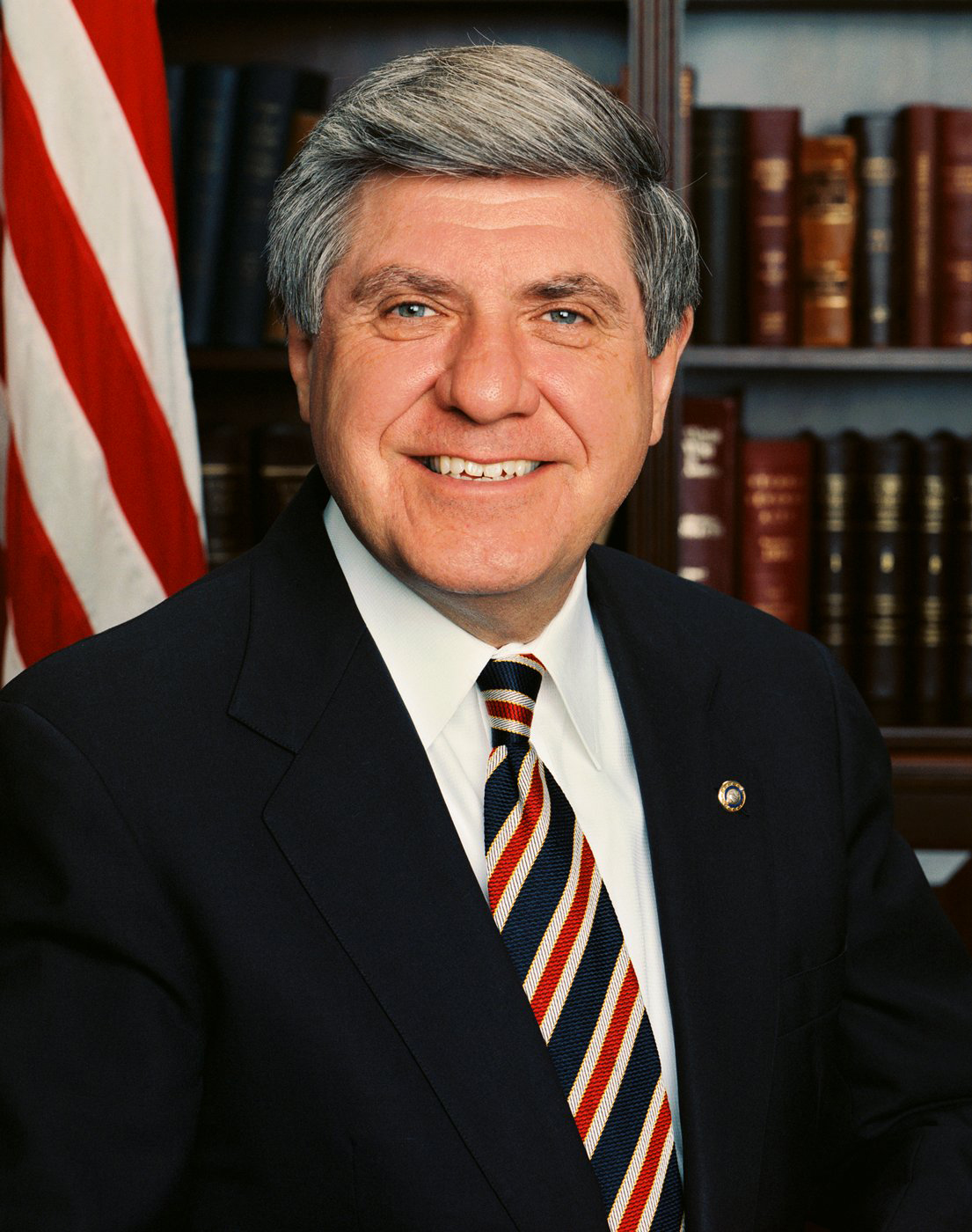

Ben Nelson
View on Wikipedia
Earl Benjamin Nelson (born May 17, 1941) is an American politician, attorney, and businessman who served as a United States senator from Nebraska from 2001 to 2013. A member of the Democratic Party, he previously served as the 37th governor of Nebraska from 1991 to 1999. As of 2026, he is the last Democrat to have won or held statewide office in Nebraska.
Key Information


Nelson was an insurance executive before he entered politics. His first run for office was in 1990, when he narrowly defeated incumbent Republican governor Kay A. Orr. He was reelected by a landslide in 1994.[1] He ran for an open U.S. Senate seat in 1996, losing in an upset to Republican Chuck Hagel. He was elected to Nebraska's other Senate seat in 2000, and reelected in 2006. He did not run for a third term in 2012, and was succeeded by Republican Deb Fischer.
Nelson was the most conservative Democrat during his time in the U.S. Senate, frequently voting against his party.[2]
Early life, education, and early career
[edit]Earl Benjamin Nelson was born on May 17, 1941, in McCook,[3] in southwestern Nebraska. He is the only child of Birdella and Benjamin Earl Nelson.[4] He is an Eagle Scout.[5]
He earned a Bachelor of Arts in 1963, a Master's degree in 1965, and a Juris Doctor in 1970—all from the University of Nebraska–Lincoln.[6]
After graduating from law school, Nelson landed a job as assistant general counsel for Central National Insurance Group of Omaha. After several years in the business, in 1975 the governor appointed him state insurance director.[7] After the administration changed, he returned to work for Central National Insurance as an executive vice president and eventually president.[7]
Political career
[edit]Nelson became involved in state politics, joining the Democratic Party. In 1986, he served as state chairman of Democrat Helen Boosalis's gubernatorial campaign. She was mayor of Lincoln, Nebraska.[8] Boosalis was defeated by state treasurer Republican Kay Orr, 53% to 47%.[8][9][10]
Governor of Nebraska (1991-1999)
[edit]
Nelson first ran for electoral office in 1990,[11] defeating first-term Republican incumbent Orr by 4,030 votes out of over 586,000 cast.[12] He was reelected in 1994 with 73% of the vote, the largest margin of victory for a governor in half a century, despite the national Republican gains that year.[1]
During his tenure, he introduced legislation to cut crime through the Safe Streets Act and Juvenile Crime Bill, advocated for low-income families through the Kids Connection health care system, and enacted welfare reforms. He also cut taxes for over 400,000 middle-income families.[13]
As governor, Nelson took some conservative stances on issues in right-leaning Nebraska. He pushed welfare reform before it was done at a national level and opposed President Bill Clinton's efforts on health care.[7]
During the 1990 campaign, Nelson attacked Orr's support for a proposed low-level nuclear waste dump in the state. During his tenure, the Nebraska State Department of Environmental Quality denied the dump's application for an operating license, prompting a lawsuit that Nebraska settled for $145 million.[14]
Nelson ran for a seat in the U.S. Senate in 1996 when fellow Democrat Jim Exon retired. He was defeated by Republican businessman and Vietnam veteran Chuck Hagel in an upset.[15]
In 1998, Nelson was ineligible to run for re-election because of Nebraska's term-limits law. He was succeeded as governor by Mike Johanns, the Republican mayor of Lincoln.[16] As of 2026, Nelson is the last Democrat to serve as governor of Nebraska.
U.S. Senator (2001-2013)
[edit]2000 election
[edit]
Nelson was nominated by the Democrats for the Senate in the 2000 election after his fellow Democrat, incumbent Bob Kerrey, announced his retirement. His opponent was Attorney General Don Stenberg. Nelson won the election with 51% of the vote after a campaign in which he spent 50% more ($1,004,985) than Stenberg. Despite initially pledging to work together,[17] Nelson and his fellow colleague Hagel had a somewhat frosty relationship.[18]
2006 election
[edit]
Nelson was thought to be in danger of losing his seat in 2006, as it was thought his successor as governor, Mike Johanns, was almost certain to run against him; that speculation ended when Johanns was appointed U.S. Secretary of Agriculture.[19] With Johanns' move to Washington, few high-profile Republicans stepped up to run against Nelson, as the state party focused its attention on the governor's race.[citation needed] The Republican nomination was won by Pete Ricketts, a former TD Ameritrade executive.[20]
In the general election, Nelson was endorsed by the National Rifle Association of America, Nebraska Right to Life (National Right to Life's state affiliate),[21] Nebraskans United for Life,[22] the U.S. Chamber of Commerce, the National Federation of Independent Business,[23] Nebraska Farmers Union PAC, National Farmers Union PAC, the Veterans of Foreign Wars PAC, the Business-Industry Political Action Committee, and the Omaha Police Union, all conservative-leaning groups.
Nelson defeated Ricketts 64%-36%, the biggest victory margin for a Democratic Senate candidate in Nebraska since Edward Zorinsky won 66% of the vote in 1982.[24] In doing so, he received the votes of 42% of Republicans and 73% of Independents on top of 96% of those from his own party. He also won all but 13 counties in the western part of the state, a surprising feat in normally heavily Republican Nebraska.[25][26]

Political positions
[edit]Abortion
[edit]Nelson is anti-abortion.[27] In the 2006 election, he was endorsed by Nebraska Right to Life[28] and Nebraskans United for Life.[29] He lost Nebraska Right to Life's support after voting for the Senate version of health-care legislation, the Affordable Care Act, which did not contain the Stupak language.[28]
Earmarks
[edit]In July 2007, Senator Tom Coburn of Oklahoma criticized earmarks that Nelson had inserted into the 2007 defense spending bill, alleging that they would benefit Nelson's son Patrick's employer with millions in federal dollars, and that the situation violated terms of the Federal Funding Accountability and Transparency Act of 2006, which the Senate passed but had not yet been voted on in the House. Nelson's spokesperson said he did nothing wrong[30] and was acting with "an abundance of caution" when he withdrew the amendment after the new Senate Ethics Rules were passed. Some government watchdogs, including Public Citizen, commented that the earmark probably didn't violate ethics rules.[31] More than one publication questioned Coburn's motives, as his criticism did not include his own state delegation's earmark requests.[32]
Health care and "Cornhusker Kickback"
[edit]In late 2009, the Senate's 40 Republicans unanimously opposed the Patient Protection and Affordable Care Act, the Senate's version of health-care legislation. To end a Republican filibuster and pass the measure, the Democrats needed the votes of all 58 of their senators, plus those of two independents who caucused with their party. Nelson was the 60th and final senator to vote for cloture.[33]
According to Nelson, he wanted to ensure that the final version of the law prohibited the use of public funds for abortions.[34] His cloture vote came after the measure was amended to permit states to opt out of allowing insurance exchange plans to provide abortion coverage. People with plans that covered abortion costs would pay for that coverage separately from their payment for the rest of the plan.[35] The bill also provided full and permanent federal reimbursement for the expenses Nebraska would incur in its mandated expansion of Medicaid eligibility,[33] an amount the Congressional Budget Office estimated at $100 million.[36]
The health-care measure was controversial, and Nelson's vote provoked a strong response. Opponents of the Medicaid reimbursement scheme derided it as the "Cornhusker Kickback".[37][38][39] Among those denouncing the provision was Dave Heineman, Nebraska's Republican governor.[40] To these criticisms, Nelson responded that he had been attempting to eliminate an unfunded federal mandate upon the states,[41] and that the Nebraska item was a "placeholder", intended from the start to be replaced by a revision that would provide reimbursement for the increased Medicaid costs of every state.[42]
Anti-abortion organizations also responded negatively to Nelson's vote. In April 2010, Nebraska Right to Life declared that it would never again endorse Nelson.[43]
Nelson's popularity fell among Nebraskans in the wake of his cloture vote. According to Omaha.com, "Almost overnight, the controversial vote knocked [Nelson's] Nebraska voter approval rating from 78 percent, the highest in the Senate, to 42 percent, according to one poll, and prompted relentless criticism, with many observers saying his political career was over."[44] A December 2009 Rasmussen poll indicated that in a hypothetical Nelson–Heineman race, the Republican would get 61% of the vote to Nelson's 30%. In the same poll, 64% of the Nebraska voters surveyed opposed the health-care bill.[45]
With the surprise victory of Republican Scott Brown in the special election to fill the Senate seat vacated by the death of Senator Ted Kennedy, Democrats lost their filibuster-proof majority. Since Brown had declared himself opposed to the health-care measure, the party's leadership opted to enact the legislation through the budget reconciliation process.[46] Nelson voted against the final version of the legislation, the Health Care and Education Reconciliation Act of 2010.[47] His support for the measure was no longer essential to its passage, since the reconciliation bill was not subject to filibuster and required only a simple majority.[48]
The measure as ultimately passed eliminated the special Medicaid reimbursement for Nebraska, as Nelson had requested in a letter to Senate Majority Leader Harry Reid about a month after his crucial cloture vote.[42] Nelson said his opposition to the final measure arose from newly added provisions related to student loans[47] that would adversely affect Nebraska-based student-lending firm Nelnet.[49][50] Despite voting against it, he subsequently defended the law, saying, "I am willing to fight to improve it, but not to repeal it."[51]
Iraq
[edit]On March 15, 2007, Nelson was among two Democratic senators to have voted against invoking cloture on a resolution aimed at withdrawing most American combat troops from Iraq in 2008. The vote, requiring 60 votes to pass, was 50 to 48 against.[52]
As a result of traveling to Iraq four times, the last in September 2007,[53] Nelson took the position that a transition of the mission in Iraq was necessary, as opposed to full withdrawal of troops.[54] The Jones Commission supported his view on September 6, 2007, when General James L. Jones presented a report to Congress claiming that "The circumstances of the moment may continue to present the opportunity for considering a shift in the disposition and employment of our forces... such a strategy would include placing increasing responsibilities for the internal security of the nation on the ISF, especially in urban areas. Coalition forces could be re-tasked to better ensure the territorial defense of the state by increasingly concentrating on the eastern and western borders and the active defense of the critical infrastructures essential to Iraq."[55]: p. 127 The premise that stability in Iraq would only be achieved through political reconciliation acted on through legislation, a view long held by Nelson, was also recommended by Jones, reporting, "The future of Iraq… hinges on the ability of the Iraqi people and the government to begin the process of achieving national reconciliation and to ending sectarian violence."[55]: p. 130
In the spring of 2007, Senators Nelson, Susan Collins of Maine, and John Warner of Virginia authored a list of measures, or "benchmarks", that were included in the Iraq Supplemental bill. These benchmarks allowed for progress to be measured in certain areas such as recognition of minority groups, strengthening of internal security forces, and equal distribution of oil revenue. President George W. Bush and General David Petraeus were required to report on the advancement of these "benchmarks".[56]
Nelson and Collins also introduced legislation on July 11, 2007, that would transition U.S. troops out of Baghdad. The legislation called for turning over internal security efforts to Iraqi forces after which the U.S. military would secure the borders, protect the infrastructure, and continue to search for al-Qaeda forces.[54]
Judicial appointments
[edit]Nelson was the lead Democratic senator among the "Gang of 14," a bloc of 14 senators who, on May 23, 2005, forged a compromise on the Democrats' use of the judicial filibuster, thus blocking the Republican leadership's attempt to implement the so-called "nuclear option".[57] Under the gang's agreement, Democrats would retain the power to filibuster one of Bush's judicial nominees only in an "extraordinary circumstance",[58] and the three most conservative Bush appellate court nominees (Janice Rogers Brown, Priscilla Owen and William Pryor) would receive a vote by the full Senate.[59] Nelson was the only Democrat to vote to confirm Brown; he was later the first Democratic senator to support Samuel Alito's confirmation to the U.S. Supreme Court.[60][61] Nelson also voted twice, with three other Democrats, to end Senate debate over Bush's United Nations Ambassador nominee John Bolton.[62]
In an op-ed column, Nelson wrote: "The president's nominees, especially to the Supreme Court, deserve an up-or-down vote, even if the nominee isn't popular with the special-interest groups in Washington."[63]
In 2010, when Barack Obama nominated Elena Kagan to the Supreme Court, Nelson was the only Democrat to vote against her confirmation, saying "I have heard concerns from Nebraskans regarding Ms. Kagan, and her lack of a judicial record makes it difficult for me to discount the concerns raised by Nebraskans, or to reach a level of comfort that these concerns are unfounded. Therefore, I will not vote to confirm Ms. Kagan's nomination"[64][65]
Same-sex marriage
[edit]In 1996, Nelson proposed and supported legislation to prevent Nebraska from recognizing same-sex marriages formed in other states. This was his response to a court case in Hawaii that Nelson feared would legalize gay marriage.[66]
Nelson supported Initiative 416, an amendment to the Nebraska constitution prohibiting same-sex marriage and domestic partnership.[67]
Taxes
[edit]Nelson was among five Democratic senators to vote for the Economic Growth and Tax Relief Reconciliation Act of 2001. The measure called for $1.35 trillion in tax cuts over 11 years and nearly $2 trillion in spending for the next fiscal year. The spending was close to that proposed by Bush; the tax cuts were slightly less than the $1.6 trillion Bush sought.[68] Nelson also voted for passage of the 2003 tax cut which accelerated many of the provisions in the 2001 tax cut in addition to benefits for small businesses.[69]
In October 2009, Americans for Tax Reform stated that Nelson was the only Democratic senator who had signed its Taxpayer Protection Pledge,[70] and launched an advocacy campaign to urge him to oppose the health care reform proposals in Congress, which, they asserted, contained "billions of dollars in income tax hikes."[71]
In July 2012, Nelson, with 18 other senators,[72] cosponsored a bill that would allow states to collect sales taxes on interstate sales, including catalogue and Internet sales.[73] The bill (Marketplace Fairness Act, S.1832) would require any seller who sold a product or service to a consumer from another state to calculate, collect and pay to that other state the sales tax based on that state's tax rates.[74] Proponents argued that the measure would redress an unfair economic advantage enjoyed by online sellers over local businesses arising from the fact that the former were often not required to collect sales taxes from their customers.[75] Opponents maintained that it would be unfair to require interstate merchants to collect sales taxes in jurisdictions where they had no physical presence, and thus derived no benefit from the taxes; and that the variety and complexity of state and local sales taxes would place a burden on merchants required to keep track of them in order to collect the taxes.[76]
Other votes
[edit]Nelson's votes in the Senate often placed him at odds with the leadership of his party. A National Journal congressional vote rating from 2006 placed him to the right of five Senate Republicans (Gordon Smith, Olympia Snowe, Arlen Specter, Susan Collins, and Lincoln Chafee). Mary Landrieu was the only other Democrat to the right of any Republicans (she placed to the right of Chafee).[77] A similar 2007 National Journal rating went even further, placing Nelson to the right of eight Senate Republicans (the above five as well as Richard Lugar, Norm Coleman, and Mike DeWine), with Landrieu once again to Chafee's right and the only other Democrat to the right of any Republicans.[78] For 2012, the American Conservative Union rated his overall performance at 48 percent, the highest of any Democratic senator.[79]
Nelson was one of only two Democratic senators to vote against the Bipartisan Campaign Reform Act of 2002. He voted with Republicans on bankruptcy reform, environmental protection, class action lawsuits, and trade. In 2004 he was one of only three Democratic senators to vote to invoke cloture on the proposed Federal Marriage Amendment; in 2006 he was one of only two Democratic senators to vote that way.[80][81] He was the only Democratic senator to vote against a 2006 bill that would have extended federal funding for stem cell research. But he consistently voted against drilling in the Arctic National Wildlife Refuge. He also opposed Bush's plan to send 21,500 more troops to Iraq.[82] Early in Bush's first term he voted with the majority of his party against scrapping President Bill Clinton's expansive new rules on ergonomics regulation for workers; many of his fellow conservative Democrats like John Breaux, Max Baucus, Blanche Lincoln, and Zell Miller voted with Republicans on the issue. On April 26, 2010, Nelson was one of two Democratic senators in attendance to vote against the motion to move a financial regulations bill forward, siding with Senate Republicans. The other was Harry Reid, who voted against his own proposed bill for procedural reasons.
On December 18, 2010, Nelson voted with Democrats for the Don't Ask, Don't Tell Repeal Act of 2010.[83]
Post-Senate career
[edit]In January 2013, Nelson was named chief executive officer of the National Association of Insurance Commissioners,[84] an organization of state insurance regulatory agencies for the United States and several of its territories. The body establishes standards and coordinates regulatory oversight for the state agencies.[85] He left the association and returned to his private law practice in January 2016.[86]
Personal life
[edit]Nelson lives in Omaha with his wife, Diane. They had 4 children together, and have 5 grandchildren.[87] In 2016, their daughter Sarah died at the age of 46 after a fall at her home in Palm Springs, California.[88]
Electoral history
[edit]| Party | Candidate | Votes | % | |
|---|---|---|---|---|
| Democratic | Ben Nelson | 292,771 | 49.91 | |
| Republican | Kay Orr (incumbent) | 288,741 | 49.23 | |
| Write-in | Mort Sullivan | 1,887 | 0.32 | |
| Write-in | Others | 3,143 | 0.54 | |
| Party | Candidate | Votes | % | |
|---|---|---|---|---|
| Democratic | Ben Nelson (incumbent) | 423,270 | 73.0 | |
| Republican | Gene Spence | 148,230 | 25.6 | |
| Write-in | Ernie Chambers | 2,510 | 0.4 | |
| Write-in | Others | 5,551 | 1.0 | |
| Party | Candidate | Votes | % | ±% | |
|---|---|---|---|---|---|
| Republican | Chuck Hagel | 379,933 | 56.14% | +15.21% | |
| Democratic | Ben Nelson | 281,904 | 41.65% | −17.25% | |
| Libertarian | John DeCamp | 9,483 | 1.40% | ||
| Natural Law | Bill Dunn | 4,806 | 0.71% | ||
| Write-ins | 663 | 0.10% | |||
| Party | Candidate | Votes | % | ±% | |
|---|---|---|---|---|---|
| Democratic | Ben Nelson | 353,093 | 51.00% | −3.78% | |
| Republican | Don Stenberg | 337,977 | 48.82% | +3.81% | |
| Write-ins | 1,280 | 0.18% | |||
| Party | Candidate | Votes | % | ±% | |
|---|---|---|---|---|---|
| Democratic | Ben Nelson (Incumbent) | 378,388 | 63.88% | +12.88% | |
| Republican | Pete Ricketts | 213,928 | 36.12% | −12.70% | |
See also
[edit]References
[edit]- ^ a b "The 1994 Elections: Congress; Who Won Where—The Races For Governor". The New York Times. November 10, 1994. Retrieved January 15, 2017.
- ^ Wing, Nick (January 4, 2011). "Ben Nelson Is Senate Democrat Most Likely To Vote Against His Party: Analysis". HuffPost. Retrieved November 4, 2013.
- ^ Rettig, Jessica (2010-03-29). "10 Things You Didn't Know About Ben Nelson". U.S. News & World Report. Retrieved 2017-01-16.
- ^ Hammel, Paul (24 December 2017). "Ben Nelson's childhood home joins museum complex highlighting politicians from McCook". Omaha.com.
- ^ Wendell, Bryan (10 August 2010). "Statue honors Ben Nelson, Distinguished Eagle Scout and Nebraska senator". Bryan on Scouting. Retrieved 2010-08-10.
- ^ "Ben Nelson biography". JournalStar.com.
- ^ a b c Hain, J. Christopher (2000-10-01). "Nelson's Past Motivates Crusade for Senate Seat". Lincoln Journal Star. pp. 1A, 10A. Retrieved 2019-06-27 – via NewsBank.
- ^ a b Walton, Don (June 15, 2009). "Former Lincoln Mayor Boosalis Dies" (online and print editions). Lincoln Journal Star. Retrieved October 7, 2011.
- ^ "Earl Benjamin Nelson". San Francisco Chronicle. 2002. Retrieved October 7, 2011.[dead link]
- ^ "Helen Boosalis Dies". Koln/Kgin Tv. June 16, 2009. Archived from the original on 2012-05-19. Retrieved October 7, 2011.
- ^ "Gov. E. Benjamin Nelson". nga.org. NGA. 3 January 2019. Retrieved 28 November 2019.
- ^ Beermann, Allen J.; Englert, Ralph; et al. (1990). "Official Report of the Board of State Canvassers of the State of Nebraska: Primary Election May 15, 1990, General Election November 6, 1990" (PDF). State.NE.us. p. 10. Archived from the original (PDF) on March 6, 2016. Retrieved January 15, 2017.
- ^ "Sen. Benjamin Nelson (D) - Nebraska". Almanac of American Politics 2002. Archived from the original on 2011-06-14. Retrieved 2007-12-30.
- ^ Laukaitis, Algis J. (August 1, 2005). "Call Finally Ends Nuke Waste Dispute". Lincoln Journal Star. Retrieved January 15, 2017.
- ^ "Neb.: Senate Seat Goes Republican In Nebraska". CNN. Retrieved 27 November 2019.
- ^ "1998 New Member Profiles -- Nebraska Governor Michael Johanns (R)". nationaljournal.com. Archived from the original on 2000-08-16. Retrieved 2011-10-04.
- ^ "Nelson, Hagel pledge to work together". Election 2000. USA Today. November 8, 2010. Archived from the original on November 8, 2001.
- ^ Thompson, Jake (October 23, 2006). "Hagel says Ricketts win vital to GOP hold on Congress". Omaha World-Herald. Archived from the original on December 14, 2007.
- ^ "Johanns Gets Ag Nod". wowt.com. Archived from the original on December 9, 2004. Retrieved 30 November 2019.
- ^ "Nebraska Senate 2006 Race". OpenSecrets. Archived from the original on July 12, 2018.
- ^ Walton, Don (July 18, 2006). "Tension marked Nelson endorsement". Lincoln Journal Star. Archived from the original on September 30, 2007. Retrieved 2006-08-28.
- ^ "Welcome to Nebraskans United for Life!". Nebraskans United for Life. 2006 NUFL Endorsements. Archived from the original on October 12, 2007.
- ^ Walton, Don (May 30, 2006). "Nelson challenges Ricketts on immigration". Lincoln Journal Star. Archived from the original on September 30, 2007. Retrieved 2006-08-28.
- ^ Tysver, Robynn; Thompson, Jake (November 8, 2006). "Big-money campaign, lopsided victory". Omaha World-Herald. Archived from the original on November 16, 2006. Retrieved 2006-11-08.
- ^ "Elections 2006". CNN. Retrieved August 29, 2010.
- ^ "Elections 2006". CNN. Retrieved August 29, 2010.
- ^ "NELSON STATEMENT ON SEBELIUS CONFIRMATION" (Press release). Archived from the original on 2010-05-05. Retrieved 2010-04-26.
- ^ a b Schmit-Albin, Julie (December 19, 2009). "Betrayed by Senator Nelson's Action on Senate Healthcare Bill". NERightToLife.org. Archived from the original on 2009-12-26. Retrieved April 26, 2010.
- ^ "2006 Endorsements " Nebraskans United for Life". nebraskansunitedforlife.org. Archived from the original on February 25, 2017. Retrieved January 16, 2017.
- ^ Brendan Dougherty, Michael (July 24, 2007). "Omaha Company's Windfall, Hiring of Lawmaker's Son Irks Senator". Fox News. Archived from the original on 2007-07-26. Retrieved July 24, 2007.
- ^ Omaha World Herald, 8/3/2007, "Future of Nelson earmarks unclear"
- ^ Omaha World Herald editorial August 16, 2007, The Oklahoman 8/6/2007, Senator attacks 'pork'; State avoids extra trims from Coburn
- ^ a b Murray, Shailagh, and Lori Montgomery. "Deal on health bill is reached". Washington Post. December 20, 2009. Retrieved April 26, 2010.
- ^ "Nelson Speaks on Senate Floor About Nelson–Hatch Amendment". Archived 2010-05-05 at the Wayback Machine Transcript of Nelson's remarks on Senate floor; press release on Nelson's Senate website. Archived 2010-05-05 at the Wayback Machine December 7, 2009. Retrieved April 26, 2010.
- ^ Kane, Paul. "To sway Nelson, a hard-won compromise on abortion issue". Washington Post. December 20, 2009. Retrieved April 26, 2010.
- ^ O'Brien, Michael. "CBO pegs Nelson's Nebraska Medicaid deal cost at $100 million". The Hill. December 20, 2009. Retrieved April 26, 2010.
- ^ Frates, Chris. "Payoffs for states get Harry Reid to 60 votes". Politico. December 19, 2009. Retrieved April 26, 2010.
- ^ Jordon, Steve (20 July 2017). "What was the 'Cornhusker Kickback,' the deal that led to Nelson's crucial ACA vote?". Omaha.com.
- ^ "Tallying the Health Care Bill's Giveaways". CBS News. 21 December 2009.
- ^ Hayworth, Bret. "Dems push back to defend Nelson health vote". Sioux City Journal. December 23, 2009. Retrieved April 26, 2010.
- ^ "Sen. Ben Nelson's Chronology". PBS Frontline. April 13, 2010. Retrieved April 26, 2010.
- ^ a b Morton, Joseph. "'Cornhusker kickback' is toast". Omaha World-Herald. January 16, 2010. Retrieved April 26, 2010.
- ^ Walton, Don. "Nebraska Right to Life OKs Dave Heineman, abandons Ben Nelson". Lincoln Journal Star. April 14, 2010. Retrieved April 26, 2010.
- ^ Jordon, Steve (21 July 2017). "Ex-Nebraska Sen. Ben Nelson, whose Obamacare vote caused controversy, says odds are against GOP on health care". Omaha.com.
- ^ "Election 2012: Nebraska Senate" Rasmussen Reports. December 29, 2009. Retrieved April 26, 2010.
- ^ Stolberg, Sheryl Gay, Jeff Zeleny, and Carl Hulse. "Health Vote Caps a Journey Back From the Brink". New York Times. March 20, 2010. Retrieved April 27, 2010.
- ^ a b Herszenhorn, David. "Nelson to Vote Against Reconciliation Bill". New York Times. March 22, 2010. Retrieved April 27, 2010.
- ^ Stolberg, Sheryl Gay and Robert Pear. "Obama Calls for 'Up or Down Vote' on Health Care Bill". New York Times. March 22, 2010. Retrieved April 27, 2010.
- ^ Morton, Joseph. "Students win, firms like Nelnet lose". Omaha World-Herald. March 27, 2010. Retrieved April 27, 2010.
- ^ Olberding, Matt. "End of student loan program will mean job cuts at Nelnet". Lincoln Journal Star. March 26, 2010. Retrieved April 27, 2010.
- ^ Walton, Don. "Nelson stands firm on health care reform." Lincoln Journal Star. September 30, 2011. Retrieved October 8, 2011.
- ^ Toner, Robin (March 15, 2007). "Senate Rejects Measure for Iraq Pullout". The New York Times. Archived from the original on October 21, 2013. Retrieved March 15, 2007.
- ^ "News Archive". The Hill. Archived from the original on December 9, 2007. Retrieved January 16, 2017.
- ^ a b "CNN.com - Transcripts". CNN. Retrieved January 16, 2017.
- ^ a b Independent Commission on the Security Forces of Iraq (September 6, 2007). Report to Congress (PDF) (Report). Archived from the original (PDF) on October 11, 2007. Retrieved 2007-09-20.
- ^ "Nelson break ranks on Democratic call for Iraq pull out". Sioux City Journal. 16 March 2007. Retrieved 2019-08-03.
{{cite web}}: CS1 maint: deprecated archival service (link) - ^ Newton-Small, Jay (6 February 2009). "Can Ben Nelson Get a Bipartisan Stimulus Win?". Time. Retrieved 1 December 2019.
- ^ Rudin, Ken (4 January 2006). "Judging Alito: The Gang of 14 Factor". NPR. Retrieved 1 December 2019.
- ^ "Senators compromise on filibusters". CNN. Retrieved 1 December 2019.
- ^ Roll Call Vote 109th Congress - 2nd Session (on the confirmation of Samuel Alito of New Jersey) Archived 2017-03-21 at the Wayback Machine, United States Senate, January 31, 2006. Retrieved November 26, 2018.
- ^ Kirkpatrick, David D. (1 February 2006). "Alito Sworn In as Justice After Senate Gives Approval". The New York Times. Retrieved 26 November 2018.
- ^ Stout, David (20 June 2005). "Republicans Fail to Force Senate Vote on Bolton's Nomination". The New York Times. Retrieved 29 November 2019.
- ^ Adler, Jonathan (November 17, 2005). "Nelson on Alito". National Review. Archived from the original (online edition) on June 1, 2009. Retrieved May 15, 2009.
- ^ John Stanton (2010-07-30). "Nebraska's Nelson Will Vote Against Kagan". Roll Call. Retrieved 2024-07-17.
- ^ "U.S. Senate: U.S. Senate Roll Call Votes 111th Congress - 2nd Session". Senate.gov. Retrieved 2024-07-17.
- ^ Knapp, Fred (March 1, 1996). "Nelson doesn't want to be forced to recognize same-sex marriages". Lincoln Journal Star. Retrieved July 22, 2020.
- ^ "Key findings from Nebraska". Fremont Tribune. Fremont, Nebraska. Associated Press. November 8, 2000. Retrieved July 22, 2020.
- ^ Rosenbaum, David E. (May 11, 2001). "CONGRESS ADOPTS BUDGET PROPOSAL WITH BIG TAX CUT". The New York Times. Retrieved January 16, 2017.
- ^ Moon, Matt (29 April 2009). "Specter Joins Nelson as Only Democrats Who Voted for 2001 and 2003 Tax Cuts". taxfoundation.org. Tax Foundation. Retrieved 1 December 2019.
- ^ "The Taxpayer Protection Pledge Signers 112th Congressional List" (PDF). ATR.org. Americans for Tax Reform. November 30, 2011. Retrieved November 30, 2011.
- ^ Radman, Adam (December 14, 2009). "Ask Sen. Ben Nelson to Keep His Taxpayer Protection Pledge on Any Health Care Votes". ATR.org. Retrieved November 6, 2009.
- ^ "OpenSecrets". opensecrets.org. Retrieved January 16, 2017.
- ^ Hammel, Paul (August 5, 2012). "Internet Sales Tax Proposals Gaining 'Likes' Among Lawmakers". Omaha World-Herald. Retrieved August 27, 2012.
{{cite journal}}: CS1 maint: deprecated archival service (link) - ^ Enzi, Michael B. (November 9, 2011). "Text - S.1832 - 112th Congress (2011-2012): Marketplace Fairness Act". congress.gov. Archived from the original on September 20, 2013.
- ^ "The Marketplace Fairness Act (S.698) official website". marketplacefairness.org. Archived from the original on October 28, 2016. Retrieved January 16, 2017.
- ^ Isaacson, George S. "Proposed Marketplace Fairness Act Threatens Direct Marketers". retailonlineintegration.com. Retrieved January 16, 2017.
- ^ "The Centrists" (PDF). National Journal. Archived from the original (PDF) on 2009-03-27. Retrieved 2007-02-09.
- ^ "National Journal's 2007 Vote Ratings". National Journal. Archived from the original on 2008-07-03. Retrieved 2007-02-23.
- ^ "2010 Combined Ratings - Nebraska". conservative.org. Archived from the original on 13 February 2011. Retrieved 13 January 2022.
- ^ "U.S. Senate: Legislation & Records Home > Votes > Roll Call Vote". Senate.gov. Archived from the original on August 9, 2010. Retrieved August 29, 2010.
- ^ "U.S. Senate: Legislation & Records Home > Votes > Roll Call Vote". Senate.gov. Archived from the original on August 14, 2010. Retrieved August 29, 2010.
- ^ "NELSON OFFERS BIPARTISAN IRAQ RESOLUTION" (Press release). Archived from the original on 2007-01-28. Retrieved 2007-01-25.
- ^ "Senate Vote 281 - Repeals 'Don't Ask, Don't Tell'". Archived 2015-10-27 at the Wayback Machine New York Times. January 26, 2011. Retrieved January 27, 2011.
- ^ Weaver, Dustin (January 23, 2013). "Ben Nelson gets $1M payday". The Hill. Retrieved January 16, 2017.
- ^ "Ben Nelson Named NAIC CEO" (Press release). National Association of Insurance Commissioners. January 22, 2013. Retrieved January 23, 2013.
- ^ Morton, Joseph (14 October 2015). "Ex-Sen. Ben Nelson leaving insurance group CEO post, returning to private law practice in Nebraska, D.C." Omaha World-Herald. Retrieved 1 December 2019.
- ^ "Ben Nelson, U.S. Senator for Nebraska: Ben's Biography". bennelson.senate.gov. Archived from the original on 2011-02-03. Retrieved 2026-03-05.
- ^ Walton, Don (2016-03-08). "Ben Nelson's daughter dies in a fall". JournalStar.com. Retrieved 2026-03-05.
- ^ "96 PRESIDENTIAL and CONGRESSIONAL ELECTION STATISTICS". house.gov. Retrieved January 16, 2017.
External links
[edit]
- Biography at the Biographical Directory of the United States Congress
- Financial information (federal office) at the Federal Election Commission
- Profile at Vote Smart
- Appearances on C-SPAN
| Class 1 |  | |
|---|---|---|
| Class 2 | ||
| Territorial (1854–1867) |  | |
|---|---|---|
| State (since 1867) |
| |
Italics indicate acting governors | ||
| International | |
|---|---|
| National | |
| People | |
| Other | |

Ben Nelson
View on GrokipediaEarly Life and Pre-Political Career
Childhood, education, and early professional roles
Earl Benjamin "Ben" Nelson was born on May 17, 1941, in McCook, Red Willow County, Nebraska, to Benjamin and Birdella Nelson as their only child.[12][4] Nelson attended the University of Nebraska at Lincoln, earning a bachelor's degree in philosophy in 1963, a master's degree in philosophy in 1965, and a law degree in 1970.[1] Following law school, Nelson practiced as an attorney while building a career in the insurance industry, beginning with roles at the Nebraska Department of Insurance in 1965.[6] He later served as director of the Nebraska Department of Insurance from 1975 to 1976, gaining direct experience in state financial regulation and oversight.[1][12] Nelson subsequently advanced to executive positions, including chief executive officer of Central National Insurance Group.[5]Gubernatorial Administration (1991–1999)
1990 election and first term
In the 1990 Nebraska gubernatorial election held on November 6, Democratic challenger Ben Nelson defeated Republican incumbent Kay Orr by a narrow margin, receiving 292,771 votes or 49.91% of the total. [13] Nebraska, a state with a Republican lean where Orr had won as the nation's first elected female governor in 1986, saw voter discontent over a 1987 tax overhaul that shifted school funding burdens and contributed to higher effective taxes, issues Nelson highlighted in his campaign. [14] Wait, no wiki. From [web:62] but it's wiki, avoid. From [web:65] higher taxes after 1987. Nelson's platform appealed to fiscal moderates by promising pragmatic governance and economic stabilization without ideological extremes, positioning him as an outsider from the insurance industry against Orr's administration. [15] Upon taking office in January 1991, Nelson prioritized balancing the state budget amid the national recession's aftermath, enforcing spending restraints to achieve fiscal surpluses by the mid-1990s while addressing agricultural sector challenges in Nebraska's farm-dependent economy. [16] In 1993, the Great Flood of the Midwest devastated parts of Nebraska, prompting Nelson to declare emergencies, secure federal aid waivers for state matching funds, and participate in multi-state coordination with President Bill Clinton for relief and recovery efforts. [17] [18] This response underscored his administration's emphasis on practical crisis management over partisan lines.[19]1994 reelection and second term
In the 1994 Nebraska gubernatorial election held on November 8, Nelson secured reelection to a second term in a landslide victory, capturing 73.03% of the vote (423,270 votes) against Republican challenger Gene Spence.[20] This decisive win, in a state with a strong Republican lean, highlighted Nelson's ability to cultivate bipartisan support through his emphasis on fiscal restraint and pragmatic governance, appealing to conservative voters despite his Democratic affiliation.[20] Nelson's second term, spanning January 9, 1995, to January 7, 1999, built on his first-term fiscal discipline, achieving balanced state budgets annually without raising taxes and directing surpluses toward the rainy day fund to buffer against economic downturns.[4] The administration prioritized debt management and infrastructure, contributing to Nebraska's economic stability in an agriculture-heavy economy vulnerable to commodity fluctuations. By 1998, the state recorded the nation's lowest unemployment rate at 1.9%, reflecting robust job growth and diversification efforts, including support for value-added agricultural processing like ethanol production to lessen reliance on raw commodity exports.[21] Education funding saw targeted increases during the term, funded through efficiency gains and revenue growth rather than new levies, aligning with Nelson's no-tax-hike stance while addressing school accountability reforms proposed in legislative sessions.[16] Constrained by Nebraska's constitutional two-term limit for governors, Nelson departed office in 1999, bequeathing a legacy of fiscal solvency, with sustained balanced budgets and low unemployment underscoring his tenure's emphasis on prudent stewardship over an agriculture-dependent economy.[1]Key policies, fiscal reforms, and state impacts
During his governorship, Nelson prioritized fiscal discipline, achieving eight consecutive balanced budgets and establishing record balances in the state's General Fund, which contributed to bolstering the Rainy Day Fund for economic contingencies.[4][22] These measures helped maintain Nebraska's constitutional requirement for balanced budgets while avoiding new debt accumulation, with state financial reports indicating improved fiscal stability amid national economic recovery in the mid-1990s.[23] Key reforms included property tax relief initiatives, such as levy limitations enacted in the late 1990s, which aimed to cap local government spending and reduce homeowner burdens; two major legislative packages in 1997 directly overhauled distribution formulas to provide tangible relief.[23][24] Nelson advocated for these without broad sales or income tax hikes, though critics noted that relief often relied on state aid to localities, which historically correlated more with spending increases than sustained tax reductions.[25] Investments in infrastructure and workforce development, including expansions in community college programs and ethanol production incentives, supported agricultural diversification; ethanol output surged from 15 million gallons in 1990 to over 300 million by 1999, fostering related jobs in rural areas.[4] These policies coincided with strong state economic indicators: Nebraska's unemployment rate reached a low of 1.9% by the late 1990s, population grew nearly 5% from 1990 to 1996, and net migration turned positive by over 17,000 residents from 1990 to 1997, outperforming many Midwestern peers amid the national expansion.[26][27] However, welfare reforms remained incremental, with efforts like the 1995 Nebraska Partnership Project focusing on consolidating health and human services rather than aggressive work requirements or caseload cuts seen in contemporaneous federal changes under the 1996 Welfare Reform Act; this drew muted criticism for not aligning fully with national Republican emphases on dependency reduction.[28] Overall, the era saw Nebraska's fiscal health strengthen without major tax shifts, though long-term property tax pressures persisted due to structural reliance on local levies.[25]U.S. Senate Service (2001–2013)
2000 election
Incumbent Democratic Senator Bob Kerrey opted not to seek reelection in 2000 after serving two terms, leaving the Class II seat open for the November 7 election.[29] Former two-term Governor Ben Nelson, a Democrat concluding his tenure due to term limits, secured the Democratic nomination without primary opposition and faced Republican state Attorney General Don Stenberg, who prevailed in the GOP primary.[29] Nelson defeated Stenberg in the general election, receiving 353,093 votes (51.00%) to Stenberg's 337,977 (48.82%), a margin of 15,116 votes in the Republican-leaning state.[30] Nelson campaigned by highlighting his gubernatorial record of fiscal restraint, including achieving state budget surpluses and economic expansion without tax increases, positioning himself as a fiscal conservative capable of curbing federal spending excesses.[1] He emphasized Nebraska priorities such as bolstering agricultural supports amid farm income challenges and enhancing rural infrastructure, while steering clear of national partisan flashpoints like the presidential contest to appeal to independent and crossover voters in a state that supported George W. Bush by 24 points.[29] As home to Offutt Air Force Base, a key U.S. Strategic Command hub, Nelson underscored strong national defense commitments, aligning with military readiness to resonate in a district with significant defense ties.[31] Following his victory, Nelson entered the evenly divided 107th Congress on January 3, 2001, where Republicans held a slim edge via Vice President Cheney's tie-breaking vote, contributing to Democratic efforts to maintain balance.[32] He quickly signaled willingness for cross-party collaboration, exemplified by negotiations on early fiscal measures like the Bush tax cuts, reflecting his moderate approach in a polarized environment.[32] This stance aided his integration amid initial Senate gridlock, though power shifted later that year with Senator Jim Jeffords's party switch.[32]2006 reelection
Incumbent U.S. Senator Ben Nelson, a Democrat, sought reelection in 2006 against Republican Pete Ricketts, the former chief executive officer of TD Ameritrade who self-funded much of his campaign with personal contributions exceeding $25 million.[33][34] Nelson emphasized his moderate record, incumbency advantages, and seniority in securing federal appropriations for Nebraska, including infrastructure and agricultural projects, which appealed to voters prioritizing state-specific benefits over national partisan shifts.[35] Amid a national Democratic wave that saw the party gain six Senate seats, Nelson's centrist positioning helped him withstand Republican challenges in the solidly conservative state.[36] Pre-election polling indicated a stable race with Nelson maintaining a consistent lead, reflecting his resilience despite widespread unpopularity of the Iraq War; he had voted against Democratic motions for troop redeployment timelines, aligning with support for ongoing military funding and operations.[37][38] This pro-troop stance, combined with broad independent voter support drawn to his bipartisan fiscal conservatism, underscored his appeal beyond the Democratic base in Nebraska.[39] On November 7, 2006, Nelson secured victory with 378,388 votes (63.88 percent) to Ricketts's 213,928 votes (36.12 percent), achieving a margin more than double the national average for Democratic incumbents that year.[40] Campaign finance data showed Nelson raising approximately $5.5 million compared to Ricketts's self-financed total nearing $30 million, yet voter turnout favored the incumbent's established name recognition and local advocacy.[35] The result highlighted Nelson's entrenched popularity from his prior gubernatorial service and ability to transcend party labels in a red state.[41]Committee assignments and legislative involvement
During his Senate tenure from 2001 to 2013, Ben Nelson served on the Committee on Agriculture, Nutrition, and Forestry, where he focused on rural and agricultural issues relevant to Nebraska's economy.[42] He also held positions on the Committee on Appropriations, including chairing the Subcommittee on the Legislative Branch, which oversaw funding for congressional operations.[4] Additionally, Nelson was a member of the Committee on Armed Services, contributing to defense policy deliberations, and the Committee on Veterans' Affairs, addressing benefits for former service members.[5] These assignments positioned him to influence appropriations for Nebraska's agricultural sector, military installations like Offutt Air Force Base, and veterans' programs.[43] Within these committees, Nelson provided leadership on key subcommittees, including the Subcommittee on Rural Revitalization, Conservation, Forestry, and Credit under Agriculture, which advanced policies for rural economic development and farm credit access.[42] On the Armed Services Committee, he chaired the Subcommittee on Personnel, emphasizing bipartisan approaches to military recruitment, retention, and quality-of-life improvements, as evidenced by the subcommittee's collaborative hearings and markup sessions.[4][44] This role facilitated cross-aisle agreements, such as enhancements to personnel policies in the annual National Defense Authorization Acts, where Nelson's input helped secure provisions for troop support amid ongoing conflicts.[45] Nelson's legislative involvement included sponsoring and co-sponsoring bills on agricultural support, such as measures to direct farm payments exclusively to active farmers and ranchers while capping crop insurance subsidies to prevent overuse of federal resources.[4] He contributed to the 2008 Farm Bill through amendments promoting price supports over direct income supplements, reflecting input from Midwestern producers.[7] On veterans' issues, Nelson sponsored S. 1294 in the 111th Congress to establish a national cemetery in Sarpy County, Nebraska, enhancing burial access for eastern Nebraska veterans.[46] His efforts demonstrated procedural influence via committee work, with records showing participation in over 1,900 legislative actions, including amendments that garnered support from both parties.[7] Through Appropriations and committee advocacy, Nelson secured targeted federal funding for Nebraska infrastructure and research, exceeding per-capita allocations in some sectors compared to national benchmarks. For instance, he earmarked $5 million in the 2003 Department of Defense authorization for a bioterrorism preparedness lab at the University of Nebraska Medical Center (UNMC).[47] In 2007, he helped obtain $2 million for UNMC's Alzheimer’s disease research initiatives.[48] These projects, totaling millions in directed funds, supported state priorities like defense-related health security and rural health innovation, often through subcommittee negotiations rather than floor debates.[49]Political Philosophy and Positions
Fiscal conservatism, taxes, and earmarks
Nelson consistently supported extensions of the 2001 and 2003 Bush-era tax cuts, including those benefiting higher-income earners, casting a deciding vote in favor during his Senate tenure and reiterating in September 2010 that all provisions should be extended to avoid economic harm to Nebraska and the nation.[50][51] He opposed broad tax increases, advocating in July 2011 for debt reduction through spending cuts rather than revenue hikes during negotiations on the debt ceiling, while ruling out deep entitlements reductions favored by some Republicans.[52] As the only Democratic senator to sign the Americans for Tax Reform's Taxpayer Protection Pledge by October 2009, Nelson pledged against net tax increases without offsetting reductions elsewhere.[53] Fiscal watchdog groups rated Nelson moderately on taxpayer issues; the National Taxpayers Union assigned him a "C" grade for the 111th Congress (2009–2010), reflecting votes against some spending expansions but support for targeted tax relief amid overall Democratic majorities.[54] His positions aligned with Nebraska's reputation for fiscal restraint, where the state's overall tax burden ranked among the lowest nationally at approximately 9.2% of income in recent assessments, correlating with policies emphasizing low state taxes and limited federal overreach.[55] On earmarks, Nelson advocated for congressionally directed spending benefiting Nebraska, securing $10.4 million in 2008 for improvements at Offutt Air Force Base's STRATCOM gate and defending such allocations as efficient prioritization of meritorious projects over blanket appropriations.[56] He justified earmarks for state-specific needs, such as military research and agricultural infrastructure, including ethanol-related subsidies implicit in Nebraska's biofuel economy, arguing they prevented wasteful broader distributions while critics labeled them pork barrel spending.[57][58] Nebraska's relatively low federal dependency—measured by transfers as a share of state GDP—reflected outcomes from these targeted federal investments alongside state-level fiscal discipline during and after Nelson's service.[25]Social issues including abortion and same-sex marriage
Nelson maintained a pro-life stance throughout his Senate tenure, opposing elective abortions while allowing exceptions only to save the life of the mother.[59] He voted against federal funding expansions for abortion services, including a 2003 measure to define unborn children as eligible for the State Children's Health Insurance Program (SCHIP), which he supported restricting to exclude fetal coverage.[59] In 2009, as a key negotiator on health care reform, Nelson demanded and secured the Nelson-Hatch amendment, which prohibited federal subsidies for insurance plans covering elective abortions beyond cases of rape, incest, or life endangerment, reflecting his long-held view that taxpayer dollars should not subsidize the procedure.[60] Earlier, he backed parental notification requirements, aligning with Nebraska's conservative electorate where polls consistently showed majority opposition to abortion on demand.[61] On same-sex marriage, Nelson opposed federal mandates redefining marriage, favoring state-level determinations rooted in traditional definitions. He voted in favor of the Federal Marriage Amendment in June 2006, which sought to constitutionally prohibit same-sex unions nationwide, though the measure failed to advance with a 49-48 tally.[59] As governor, he supported Nebraska's Initiative 416 in 2000, a voter-approved constitutional amendment banning same-sex marriage and domestic partnerships, consistent with the state's 70% approval rate reflecting rural Midwestern values.[42] Nelson critiqued judicial overreach in cases like Lawrence v. Texas (2003), arguing it undermined democratic processes on marriage policy, and resisted Democratic efforts to include sexual orientation protections that could imply endorsement of same-sex unions.[59] This positioning mirrored Nebraska's social conservatism, where Gallup polling from the mid-2000s indicated over 60% opposition to same-sex marriage legalization. Nelson's social conservatism extended to related issues, such as voting against embryonic stem cell research expansions in 2006 and 2007, prioritizing protections for nascent human life over potential therapeutic benefits.[59] These votes often placed him at odds with his party's liberal wing but garnered support from Nebraska independents and Republicans, contributing to his 2006 reelection margin of 12 points in a state where social traditionalism outweighed national partisan trends.[62]Health care policy and the Cornhusker Kickback
During the debate over the Patient Protection and Affordable Care Act (ACA) in 2009, Senator Ben Nelson expressed initial skepticism toward expansive federal health care reforms, particularly those resembling single-payer systems, emphasizing concerns over cost control, fiscal responsibility, and state burdens in a rural state like Nebraska.[63][64] As a moderate Democrat, Nelson distanced himself from more progressive elements in his party, advocating for targeted measures to improve access in underserved areas rather than broad government takeover, reflecting his prior experience as Nebraska's governor where he prioritized market-based insurance expansions.[65] Nelson's pivotal role emerged in December 2009 when Senate Majority Leader Harry Reid negotiated a state-specific concession to secure his vote for cloture on the ACA bill. Dubbed the "Cornhusker Kickback" by critics, the provision exempted Nebraska from contributing to the costs of the Medicaid expansion under the ACA, with the federal government covering 100% of the state's additional share—estimated at approximately $100 million in enhanced federal funding solely for Nebraska—unlike other states required to pay up to 10% after an initial phase.[66][67] This deal addressed Nelson's objections to unfunded mandates on states with sparse populations and high rural Medicaid needs, enabling him to provide the 60th vote for cloture on December 19, 2009, and final passage on December 24, 2009, which prevented a filibuster and advanced the legislation despite lacking Republican support.[68][69] The exemption's mechanics shifted the financial burden entirely to federal taxpayers for Nebraska's expanded Medicaid rolls, potentially saving the state tens of millions annually in matching funds if it opted into the expansion, though Nebraska did not initially expand under the ACA until 2023 via ballot initiative.[66] Proponents, including Nelson, argued it mitigated disparities in rural health infrastructure, where low population density amplifies per-capita administrative costs, and Nelson later proposed extending full federal coverage to all states' expansions to universalize the benefit.[70] However, opponents across the political spectrum decried it as cronyism, asserting the targeted carve-out exemplified logrolling that eroded the bill's universal principles and fueled public distrust in the legislative process, contributing to backlash that damaged Nelson's popularity and his decision not to seek reelection in 2012.[67][69] The provision was repealed in March 2010 during House-Senate reconciliation, as Democrats sought to neutralize GOP attacks and align the final law without state-specific sweeteners, yet its role in securing cloture had already catalyzed the ACA's enactment by breaking the Senate impasse.[66][71] While Nelson defended the outcome for advancing coverage in high-need areas without excessive abortion funding—via his separate amendment restricting elective procedures in ACA plans—the deal underscored tensions between pragmatic deal-making and principled universality, with empirical analyses later showing the ACA's Medicaid provisions broadly increased enrollment but at higher federal costs than projected, amplifying debates over such targeted incentives.[9][72]Foreign policy, Iraq War, and national security
Nelson voted in favor of the Authorization for Use of Military Force Against Iraq Resolution of 2002 on October 11, 2002, supporting President George W. Bush's request to use force against Saddam Hussein's regime amid concerns over weapons of mass destruction and regional threats.[73] [74] As a member of the Senate Armed Services Committee from 2001 to 2013, where he later chaired the Strategic Forces Subcommittee, Nelson prioritized military readiness and funding, consistently backing appropriations for troop equipment and operations in Iraq and Afghanistan.[7] [4] Throughout the Iraq War, Nelson opposed rigid timelines for troop withdrawal, arguing they would undermine U.S. objectives and embolden adversaries; in 2007, he crossed party lines to support war funding bills without mandated pullouts, aligning with bipartisan efforts to sustain the surge strategy that reduced violence by mid-2008.[75] [76] He advocated for conditions-based transitions over precipitous exits, proposing in 2008 a "mission transition" framework to shift U.S. forces from combat to advisory roles while maintaining stability.[77] On broader national security, Nelson championed missile defense systems and nuclear deterrence modernization, supporting the New START Treaty in 2010 with assurances it preserved U.S. strategic advantages and did not constrain defensive capabilities.[78] He fought to retain military installations in Nebraska, such as Offutt Air Force Base—home to U.S. Strategic Command—securing funding for upgrades and expressing disappointment over lost basing opportunities for cyber units that could have bolstered homeland defense.[79] These positions reflected his emphasis on empirical assessments of threats, favoring sustained investment in conventional and strategic forces over anti-war retrenchment.[80]Major Controversies and Criticisms
Negotiations in health care reform
Nelson held out against the Senate's health care reform bill for weeks during late 2009, leveraging his position as a moderate Democrat from a politically competitive state to extract concessions from Majority Leader Harry Reid.[81] His opposition, centered on concerns over costs and abortion provisions, delayed progress and contributed to the eventual abandonment of a public insurance option, which he and Independent Senator Joseph Lieberman had threatened to filibuster.[82] On December 19, 2009, after extended negotiations, Nelson announced his support, providing the precise 60 votes required to invoke cloture and advance the bill to a final vote on Christmas Eve.[83][84] The agreement included enhanced federal reimbursement for Nebraska's expanded Medicaid costs, a provision critics immediately dubbed the "Cornhusker Kickback" for its state-specific exemption from standard state matching requirements.[85] This tactic exemplified Nelson's deal-making strategy, using filibuster leverage to secure fiscal protections for his low-tax, rural constituency, which he defended as essential federalism to avert unfunded mandates straining state budgets.[86] Unlike Lieberman's broader ideological push against government-run plans, Nelson's negotiations emphasized pragmatic cost-shifting, amplified by Nebraska's swing-state dynamics where even small margins could influence reelection viability.[68] The deal's opacity and perceived favoritism raised questions about legislative integrity, as it bypassed uniform national standards in favor of targeted incentives to secure passage. Public reaction was swift and negative, with Nelson's approval rating in Nebraska plummeting from 59% in October 2009 to 42% by January 2010, directly attributed to the health reform vote and kickback controversy.[87] Constituents confronted him publicly, and the episode fueled broader Republican narratives of Democratic corruption, contributing to his 2012 retirement announcement amid fundraising challenges.[88] Nelson maintained the concessions preserved fiscal responsibility, arguing they prevented higher state taxes or cuts elsewhere, though subsequent reconciliation removed the Nebraska-specific language, rendering it moot while cementing its role as a symbol of backroom bargaining.[66][9] This mirrored other moderates' tactics but underscored how swing-state senators could disproportionately shape outcomes, prioritizing local interests over collective uniformity.[89]Ethics complaints and special interest influences
In October 2011, the Nebraska Republican Party filed a complaint with the Senate Select Committee on Ethics and the Federal Election Commission alleging that issue advertisements funded by the Nebraska Democratic Party violated Senate ethics rules and federal election limits by improperly benefiting Nelson's reelection through coordinated spending exceeding $100,000 on ads featuring him.[90] The complaint claimed the ads constituted an in-kind contribution to Nelson's campaign, as they promoted his positions without explicit electioneering language but effectively bolstered his image amid his 2012 reelection considerations.[91] Nelson's office dismissed the allegations as politically motivated, asserting no coordination occurred and that the ads addressed policy issues independently of his campaign.[90] The Senate Ethics Committee took no further public action on the matter, effectively dismissing it for lack of sufficient evidence of wrongdoing, consistent with its procedural thresholds requiring credible substantiation beyond partisan assertions.[92] Prior to entering the Senate in 2001, Nelson spent approximately two decades in the insurance industry, including roles as general counsel and executive at firms such as United Benefit Life Insurance Company, which raised questions about potential conflicts during his service on the Senate Finance Committee from 2001 to 2013, where he influenced legislation affecting insurance regulation and taxation.[4] Critics, including watchdog groups, scrutinized these ties for possible undue influence, noting that his pre-Senate executive experience could inform positions favoring industry interests in committee deliberations on premiums, solvency standards, and federal-state regulatory overlaps.[43] However, no formal ethics complaints were lodged specifically tying his background to Finance Committee decisions, and investigations by outlets like Politico highlighted perceptions rather than verified impropriety.[90] Nelson maintained transparency through annual personal financial disclosures filed with the Senate Ethics Committee, detailing assets, liabilities, and income sources in compliance with the Ethics in Government Act of 1978, which mitigated conflict concerns by publicly documenting any ongoing industry-related holdings or transactions.[43] Federal Election Commission data from his Senate campaigns (2000–2012) show insurance sector contributions totaling over $1.2 million, a figure comparable to peers on the Finance Committee such as Max Baucus (D-MT, $1.5 million) and Chuck Grassley (R-IA, $800,000), indicating standard industry engagement rather than outlier influence.[43] No substantiated violations emerged from these disclosures or peer comparisons, underscoring that Nelson's practices aligned with bipartisan norms for senators with professional backgrounds in regulated sectors.[43]Partisan criticisms from left and right
Progressives and liberal organizations frequently criticized Nelson for deviating from party-line priorities on environmental protection and labor rights, citing his opposition to cap-and-trade legislation in 2010 and his vote to filibuster an extension of unemployment benefits in 2010 alongside Republicans.[93][94] These stances contributed to his low lifetime rating of 59 percent from the Americans for Democratic Action (ADA), a liberal advocacy group that evaluates lawmakers on progressive votes, placing him among the least liberal Democrats in the Senate.[95][59] Conservatives and Republican leaders assailed Nelson for enabling Democratic initiatives perceived as big-government overreach, particularly his pivotal vote for the Affordable Care Act in December 2009, which secured 60 Senate votes to overcome a filibuster despite initial resistance.[81][96] His advocacy for earmarks, including requests for Nebraska-specific projects, drew ire from fiscal hawks like Senator Tom Coburn, who highlighted them as wasteful pork in 2007, amplifying calls from the right for Nelson to retire ahead of the 2012 election amid Nebraska's conservative leanings.[57] Notwithstanding partisan attacks, Nelson's record demonstrated significant cross-aisle collaboration, earning a lifetime Bipartisan Index score of approximately 0.50 from the Lugar Center at Georgetown University, reflecting frequent co-sponsorships and alliances with Republicans on agriculture, defense, and rural issues during his tenure from 2001 to 2013.[97] National Journal analyses similarly identified him as the most conservative Democrat in the Senate by vote ideology in multiple years, underscoring his institutionalist approach in an era of increasing polarization rather than ideological purity.[98][99]Post-Senate Career and Legacy
Leadership at the National Association of Insurance Commissioners
Following his retirement from the U.S. Senate in January 2013, E. Benjamin Nelson assumed the role of chief executive officer of the National Association of Insurance Commissioners (NAIC) on January 18, 2013, succeeding acting CEO Andrew Beal.[100] [101] In this position, Nelson drew on his prior experience as Nebraska's insurance director from 1990 to 1993 and as NAIC executive vice president, focusing on enhancing state-based regulatory coordination amid federal health insurance reforms.[101] His tenure concluded on January 31, 2016, after which he transitioned to a consulting role with the organization.[102] Under Nelson's leadership, the NAIC prioritized state-federal coordination in implementing provisions of the 2010 Affordable Care Act (ACA), including the development of uniform model regulations for health insurance exchanges, risk adjustment programs, and reinsurance mechanisms to support state-level operations without federal overreach.[103] [81] Nelson positioned the NAIC as an intermediary, testifying before Congress in June 2013 on the organization's efforts to standardize solvency oversight and rate review processes across states, emphasizing data-driven assessments to maintain insurer financial stability and curb excessive premium increases.[104] These initiatives facilitated the adoption of NAIC models by multiple states for ACA compliance, promoting consumer protections through enhanced transparency in rate filings while preserving state primacy in regulation.[105] Nelson advocated for depoliticizing insurance oversight by reinforcing state-based systems' capacity to ensure market competition and solvency, arguing that such approaches outperformed centralized federal mandates in fostering stability.[106] During his term, the NAIC advanced principles-based reserving for life insurers and updated risk-based capital standards, reflecting ongoing refinements to solvency frameworks informed by post-financial crisis data.[107] This work underscored Nelson's emphasis on leveraging empirical regulatory tools to balance innovation with risk management, drawing from his legislative background to bridge partisan divides in policy execution.[104]Subsequent business roles and public engagements
Following his departure from the National Association of Insurance Commissioners in January 2017, Nelson returned to private practice, maintaining offices in Nebraska and Washington, D.C., while providing transitional consulting services to the NAIC.[108] In mid-2017, he assumed the role of chairman at Nelson Taplin Goldwater (NTG), a consulting firm specializing in insurance regulatory affairs.[109] He resigned from NTG in May 2019 to become chief executive officer of Insurance Care Direct, a Florida-based firm focused on life insurance and Medicare supplement products.[110] [111] Concurrently, Nelson joined Lamson Dugan & Murray, a Nebraska law firm, as of counsel, leveraging his expertise in insurance regulation and public policy.[6] These roles marked a shift to low-profile private-sector work, with no documented involvement in high-volume lobbying or board directorships beyond insurance-related advisory capacities as of 2025.[62] Nelson's public engagements remained sporadic and regionally focused, emphasizing Nebraska-specific matters and reflections on governance. In September 2024, he commented to NTV News from his childhood home in McCook on proposals to shift Nebraska's presidential electoral vote allocation to a winner-take-all system, advocating for preservation of the state's unique split-vote tradition.[112] On March 3, 2025, Nelson addressed the Omaha Bar Association on the importance of civility in elected office, drawing from his bipartisan Senate experience to stress pragmatic negotiation over partisan division as key to effective policymaking.[113] He attended the October 24, 2025, retirement ceremony for Nebraska Supreme Court Justice Lindsey Miller-Lerman, participating in the event's proceedings.[114] Absent from records are active roles in national Democratic events or lobbying efforts, with no reported ethics complaints regarding post-Senate influence activities.[108]Overall political impact and evaluations
Nelson's tenure exemplified the viability of centrist Democrats in rural, Republican-leaning states, where his moderate positions on fiscal conservatism and social issues enabled electoral successes that sustained Democratic representation in Nebraska amid national polarization. Analyses of his career highlight how such bridge-building facilitated targeted advocacy, yielding tangible economic benefits like federal appropriations for biomedical research at the University of Nebraska Medical Center, including $5 million for bioterrorism preparedness in 2003 and $2 million for early detection technologies in 2007.[47][48] These efforts contributed to Nebraska's relative economic resilience, with the state maintaining low unemployment rates—averaging below the national figure during his Senate service from 2001 to 2013—through infrastructure and agricultural supports that prioritized practical outcomes over partisan orthodoxy.[53] Bipartisanship metrics underscore his independent streak, as he aligned with his party on only 79.6% of votes, ranking among the least unified Senate Democrats by November 2011, reflecting a preference for cross-aisle negotiations on defense and budget matters.[42] Evaluations from outlets like The New Yorker credit this approach with preserving a sliver of Senate centrism, though his 2012 retirement amplified Republican dominance in the state, signaling the fragility of rural Democratic viability in an era of heightened ideological sorting.[115] Critics, including conservative commentators, decry his deal-making—epitomized by state-specific Medicaid adjustments—as emblematic of pork-barrel politics that eroded public trust, yet proponents argue it delivered net fiscal advantages, with Nebraska's per capita federal spending exceeding national averages during his era due to effective earmark advocacy.[115] Overall assessments frame Nelson's legacy as a pragmatic counterweight to polarization, favoring empirical gains like sustained federal investments that bolstered Nebraska's agricultural and research sectors over purity tests, though his style drew fire from both flanks for insufficient ideological commitment.[116] In a polarized Congress, his record—high in negotiation efficacy per Politico analyses—demonstrates causal efficacy in outcomes, such as advancing arms control treaties like New START in 2010, but underscores the challenges of sustaining moderate influence as partisan incentives intensified post-2010.[4][53]Electoral History
Gubernatorial elections
Ben Nelson won the 1990 Nebraska gubernatorial election on November 6, 1990, defeating one-term incumbent Republican Kay Orr in one of the closest races in state history.[13] The results highlighted geographic divides, with Nelson performing strongly in urban areas including Douglas County (Omaha) and Hall County (Grand Island), while Orr carried the vast majority of rural counties.[117]| Candidate | Party | Votes | Percentage |
|---|---|---|---|
| Ben Nelson | Democratic | 292,771 | 49.91% |
| Kay Orr | Republican | 292,415 | 49.82% |
| Candidate | Party | Votes | Percentage |
|---|---|---|---|
| Ben Nelson | Democratic | 423,270 | 73.03% |
| Gene Spence | Republican | 156,640 | 26.97% |
U.S. Senate elections
In the 2000 United States Senate election in Nebraska, Democrat Ben Nelson, the former two-term governor, secured the open seat vacated by retiring incumbent Bob Kerrey by defeating Republican state Attorney General Don Stenberg in the general election on November 7. Nelson received 353,093 votes (51.00%), while Stenberg obtained 337,977 votes (48.82%), with write-in votes accounting for the remainder in a contest decided by approximately 15,000 votes.[30] Nelson faced no significant opposition in the Democratic primary, advancing directly to the general ballot. Campaign finance data for the 1995–2000 cycle showed Nelson raising approximately $2.4 million, outpacing Stenberg's $1.7 million, which contributed to his organizational edge in a state trending Republican.[121] Nelson sought re-election in 2006 amid a national Democratic wave but leveraged his centrist appeal in solidly Republican Nebraska to defeat Republican challenger Pete Ricketts, a wealthy Ameritrade executive who self-funded much of his campaign. In the November 7 general election, Nelson captured 378,388 votes (63.88%), compared to Ricketts's 213,928 votes (36.12%), yielding a landslide margin exceeding 164,000 votes despite Nebraska's conservative leanings and evidence of voter crossover from independents and moderate Republicans favoring Nelson's record on fiscal issues.[40] Nelson again won his Democratic primary without contest. For the 2001–2006 cycle, OpenSecrets tracked Nelson raising over $5 million, while Ricketts's total exceeded $35 million largely through personal contributions, highlighting the limits of financial outspending in Nelson's incumbency advantage.[35] Nelson announced in early 2012 that he would not seek a third term, citing a desire to step aside after over two decades in statewide office. The Democratic-leaning seat flipped Republican as state Senator Deb Fischer prevailed in the general election against former Senator Bob Kerrey, reclaiming full GOP control of Nebraska's Senate delegation for the first time since 2001 and underscoring the state's partisan realignment post-Nelson.[122]| Election Year | Type | Candidate | Party | Votes | Percentage |
|---|---|---|---|---|---|
| 2000 | General | Ben Nelson | Democratic | 353,093 | 51.00% |
| Don Stenberg | Republican | 337,977 | 48.82% | ||
| 2006 | General | Ben Nelson | Democratic | 378,388 | 63.88% |
| Pete Ricketts | Republican | 213,928 | 36.12% |