Hubbry Logo
George BenthamGeorge BenthamMain
Open search
George Bentham
Community hub
George Bentham
logo
8 pages, 0 posts
0 subscribers
Be the first to start a discussion here.
George Bentham
George Bentham
from Wikipedia

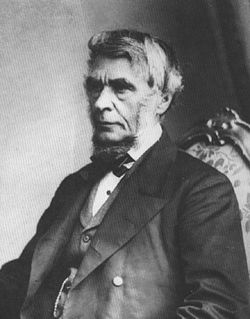
George Bentham CMG FRS FLS (22 September 1800 – 10 September 1884) was an English botanist, described by the weed botanist Duane Isely as "the premier systematic botanist of the nineteenth century".[1] Born into a distinguished family, he initially studied law, but had a fascination with botany from an early age, which he soon pursued, becoming president of the Linnaean Society in 1861, and a fellow of the Royal Society in 1862. He was the author of a number of important botanical works, particularly flora. He is best known for his taxonomic classification of plants in collaboration with Joseph Dalton Hooker, his Genera Plantarum (1862–1883). He died in London in 1884.

Key Information

Life

[edit]

Bentham was born in Stoke, Plymouth, on 22 September 1800.[2][3] His father, Sir Samuel Bentham, a naval architect, was the only brother of Jeremy Bentham to survive into adulthood. His mother, Mary Sophia Bentham, was a botanist and author.[a] Bentham had no formal education but had a remarkable linguistic aptitude. By the age of seven, he could speak French, German and Russian, and he learned Swedish during a short residence in Sweden while still a child. The family made a long tour through France, staying two years at Montauban, where Bentham studied Hebrew and mathematics in the Protestant Theological School. They eventually settled near Montpellier where Sir Samuel bought a large estate.[5]

While studying at Angoulême, Bentham came across a copy of A. P. de Candolle's Flore française, and became interested in the analytical tables for identifying plants. He immediately tested them on the first plant he saw. The result was successful and he applied it to every plant he came across. In London in 1823, he met English botanists. His uncle pushed him to study law at Lincoln's Inn. He was called to the bar and in 1832 held his first and only legal brief.[5] However, his interest in botany never flagged and he became secretary of the Horticultural Society of London from 1829 to 1840.[6]

In 1832, he inherited the property of his uncle, Jeremy Bentham. Having inherited his father's estate the previous year, he was now sufficiently well off to do whatever he wanted, which was botany, jurisprudence and logic.[7]

Bentham married Sarah Jones (1798–1881), daughter of Sir Harford Jones Brydges, on 11 April 1833; they did not have children.[8]

Bentham died at his London home on 10 September 1884, aged 83.[3] He was interred in Brompton Cemetery.

Career

[edit]

Views on evolution

[edit]

Bentham's life spanned the Darwinian revolution, and his young colleague Joseph Dalton Hooker was Darwin's closest friend and one of the first to accept Darwin's ideas. Until then, Bentham unquestioningly believed that species were fixed. In 1874 he wrote that "Fifteen years have sufficed to establish a theory of evolution by natural selection".[9] Bentham's conversion to the new line of thought was complete, and included a change from typology in taxonomy to an appreciation that "We cannot form an idea of a species from a single individual, nor of a genus from a single one of its species. We can no more set up a typical species than a typical individual."[10]

Honours and awards

[edit]

Bentham was awarded the Royal Medal of the Royal Society in 1859 and elected a Fellow in 1862.[11] He served as president of the Linnean Society of London from 1861 to 1874.[12] He was elected a Foreign Honorary Member of the American Academy of Arts and Sciences in 1866.[13] He was appointed CMG (Companion of St Michael & St George) in 1878. His foreign awards included the Clarke Medal of the Royal Society of New South Wales in 1879.

Works

[edit]

Bentham's first publication was his Catalogue des plantes indigènes des Pyrénées et du Bas Languedoc (Paris 1826), the result of a careful exploration of the Pyrenees in company with G. A. Walker Arnott (1799–1868), afterwards professor of botany in the University of Glasgow. In the catalogue Bentham adopted the principle from which he never deviated, of citing nothing at second-hand. This was followed by articles on various legal subjects: on codification, in which he disagreed with his uncle, on the laws affecting larceny and on the law of real property. But the most remarkable production of this period was the Outline of a New System of Logic: With a Critical Examination of Dr. Whately's Elements of Logic (1827).[14] In this the principle of the quantification of the predicate was first explicitly stated. This Stanley Jevons declared to be undoubtedly the most fruitful discovery made in abstract logical science since the time of Aristotle. Before sixty copies had been sold the publisher became bankrupt and the stock went for wastepaper. The book passed into oblivion, and it was not until 1873 that Bentham's claims to priority were finally vindicated against those of Sir William Hamilton by Herbert Spencer.[15]

In 1836 he published his Labiatarum genera et species. In preparing this work he visited, between 1830 and 1834, every European herbarium, several more than once. The following winter was passed in Vienna, where he produced his Commentationes de Leguminosarum generibus, published in the annals of the Vienna Museum. In 1842 he moved to Pontrilas in Herefordshire. His chief occupation for the next few years was his contributions to the Prodromus Systematis Naturalis Regni Vegetabilis, which was being carried on by his friend, A. P. de Candolle. In all these dealt with some 4,730 species.[15]

In 1844, he provided the botanical descriptions for The Botany of the Voyage of H.M.S. Sulphur.[16] The editor, Richard Brinsley Hinds, had been surgeon on HMS Sulphur 1835-41 while she explored the Pacific coast of the Americas.[17]

In 1854 he found the maintenance of a herbarium and library too expensive. He, therefore, offered them to the government on the understanding that they should form the foundation of such necessary aids to research in the Royal Botanic Gardens, Kew. At the same time, he contemplated the abandonment of botanical work. However, he yielded to the persuasion of Sir William Jackson Hooker, John Lindley and other scientific friends. In 1855 he took up his residence in London, and worked at Kew for five days a week, with a brief summer holiday, from this time onwards until the end of his life.[15]

In 1857, the government sanctioned a scheme for the preparation of a series of Floras or descriptions in the English language of the indigenous plants of British colonies and possessions. Bentham began with the Flora Hongkongensis in 1861, which was the first comprehensive work on any part of the little-known flora of China and Hong Kong, including Hong Kong croton. This was followed by the Flora Australiensis, in seven volumes (1863–1878), the first flora of any large continental area that had ever been finished. His greatest work was the Genera Plantarum, begun in 1862, and concluded in 1883 in collaboration with Joseph Dalton Hooker.[18][15] His most famous work, however, was the Handbook of the British flora, begun in 1853 and first published in 1858. This was used by students for over a century, running into many editions. After his death, it was edited by Hooker, and was known simply as Bentham & Hooker. He is most famous for his extensive and excellent classification of plants, especially angiosperms, along with Hooker, forming the "Bentham & Hooker system", which was published in three volumes as Genera Plantarum between 1862 and 1883.

Selected publications

[edit]
  • "On the Distribution of the Monocotyledonous Orders into Primary Groups, more especially in reference to the Australian Flora, with notes on some points of Terminology". Journal of the Linnean Society of London, Botany. 15 (88): 490–520. February 1877. doi:10.1111/j.1095-8339.1877.tb00261.x. Zenodo1432977.
  • Genera plantarum ad exemplaria imprimis in herbariis kewensibus servata definita (3 vols.). London: L Reeve & Co. 1862–1883.
  • Outline of a New System of Logic: With a Critical Examination of Dr. Whately's "Elements of Logic. London: Hunt and Clarke. 1827. ISBN 9780598395641. {{cite book}}: ISBN / Date incompatibility (help)
  • The Botany of the Voyage of H.M.S. Sulphur. under Captain Ed. Belcher The Botanical descriptions by George Bentham: Text. Lords Commissioners of the Admiralty. 1846 – via Smith Elder and Co.

Legacy

[edit]

See also

[edit]

Notes and references

[edit]
[edit]
Revisions and contributorsEdit on WikipediaRead on Wikipedia
from Grokipedia
George Bentham (1800–1884) was an influential English renowned for his systematic of seed plants and major contributions to botanical classification during the . Born on 22 September 1800 in Stoke, , , he died on 10 September 1884 in . He was the second son of naval architect Sir Samuel Bentham and nephew of the philosopher . After inheriting wealth in 1833, Bentham devoted himself fully to , self-educating under the influence of figures like while managing family estates in . Bentham's career spanned key institutions and collaborations that advanced global botanical knowledge. Elected a Fellow of the Linnean Society in 1826, he later served as its president from 1861 to 1874, overseeing significant developments in natural history. From 1829 to 1840, he acted as secretary of the Royal Horticultural Society, and in 1854, he donated his extensive herbarium to Kew Gardens, where he worked permanently thereafter, collaborating closely with director Sir William Hooker and his son Sir Joseph Dalton Hooker. His meticulous fieldwork and herbarium management helped establish Kew as a center for colonial floras, emphasizing comprehensive surveys of plant diversity. Among Bentham's most enduring achievements were his monumental publications, which provided foundational frameworks for . He authored Labiatarum Genera et Species (1832–1836), a detailed on the mint family, and Flora Hongkongensis (1861), an early colonial . His Flora Australiensis (7 volumes, 1863–1878) described over 7,000 Australian species, while co-authoring Genera Plantarum (3 volumes, 1862–1883) with , which classified 200 orders, 7,569 genera, and more than 97,200 species of seed plants, influencing for generations. Bentham received honors including the Royal Medal in 1859, an honorary LL.D. from in 1874, the C.M.G. in 1878, and the Clarke Medal in 1879, cementing his legacy as a preeminent taxonomist.

Early Life and Education

Family Background

George Bentham was born on 22 September 1800 in Stoke, near , , to Sir Samuel Bentham, a prominent naval architect and inspector of naval works, and Maria Sophia Bentham (née Fordyce), an enthusiastic amateur and daughter of the Scottish physician and Dr. George Fordyce. As the second son in the family—with an elder brother who died in 1816—Bentham grew up in a household shaped by his father's naval career and his uncle Jeremy Bentham's philosophical influence, though the immediate parental dynamics fostered his early intellectual development. The Bentham family's frequent relocations, driven by Sir Samuel's professional duties, exposed the young George to a variety of environments and floras across . In , at the age of five, the family moved to St. Petersburg, , where Sir Samuel served on a diplomatic and technical mission; during this two-year stay, Bentham began learning Russian, French, and German, demonstrating precocious linguistic talent that later aided his taxonomic studies. A brief detour to in 1807 due to weather delays further broadened his experiences, before the family returned to . By 1814, following the , they settled in for over a decade, residing in places such as Tours, , , , and , where the diverse Mediterranean and regional plant life sparked Bentham's observational interests. Bentham's mother played a pivotal role in nurturing his scientific curiosity, particularly in , from an early age. A keen plant collector, Maria Sophia encouraged her son's close observation of and introduced him to botanical literature; in 1816, she purchased a copy of Augustin Pyramus de Candolle's Flore Française, which Bentham used during family travels to identify , marking the onset of his lifelong passion. These parental influences, combined with the multilingual environment from around age seven, cultivated Bentham's methodical approach to , laying the foundation for his future contributions without formal early schooling.

Self-Education and Early Botanical Interests

George Bentham demonstrated remarkable aptitude for self-education from a young age, mastering Latin before the age of five and subsequently learning French, German, and Russian by the time he was seven during the family's residence in from 1805 to 1807. Later, while delayed in in 1807, he acquired fluency in Swedish, and in subsequent years he taught himself Hebrew, ultimately enabling him to read botanical literature in fourteen modern European languages. This linguistic prowess was instrumental in allowing Bentham to access a wide array of European botanical texts without formal instruction, fostering his independent scholarly development. Bentham's initial botanical pursuits emerged during family travels across in 1816, where, at , he successfully identified a using his mother's copy of Augustin Pyramus de Candolle's Flore française, sparking a lifelong passion for the subject. These journeys provided opportunities for early plant collections, culminating in his first systematic observations at the age of twenty during excursions in the , where he meticulously documented local flora through personal fieldwork. His methodical approach to these collections was profoundly shaped by the utilitarian philosophy of his uncle, , whose principles of logical classification and analytical rigor Bentham adapted to botanical studies, emphasizing precision and systematic organization. This early dedication bore fruit in 1826 with the publication of Bentham's inaugural botanical work, Catalogue des plantes indigènes des Pyrénées, a comprehensive inventory derived entirely from his own observations and collections in the region. The catalogue highlighted his commitment to verifying type specimens and accounting for species variability, establishing him as an emerging authority in botanical authorship at the remarkably young age of twenty-six.

Professional Career

Bentham pursued legal studies in London at the urging of his uncle , entering and being called to the bar in 1831. However, he engaged in only minimal legal practice, holding just one brief that year, as his longstanding passion for increasingly overshadowed his professional obligations. Bentham assumed the role of honorary secretary to the Horticultural Society of London in 1829, while still pursuing his legal studies. His full commitment to botanical pursuits was facilitated by personal financial independence following the death of his father in 1831, from whom he inherited an estate, and the death of his uncle Jeremy Bentham in 1832, who bequeathed him substantial property including a house in London. These inheritances, along with his marriage in 1833, provided the economic security necessary to forgo a legal career. In 1833, Bentham married Sarah Brydges (1798–1881), daughter of the diplomat Sir Harford Jones Brydges, on 11 April; the couple had no children but enjoyed a stable partnership that supported his dedicated botanical work.

Institutional Roles and Collaborations

Bentham served as honorary secretary of the Horticultural Society of London from 1829 to 1840. Residing at , the site of the society's gardens, he played an active role in their management, overseeing operations and facilitating the expansion of plant collections through introductions of species from regions such as , , and the . In 1854, Bentham settled in and commenced unpaid work at the of the Royal Botanic Gardens, , dedicating nearly every day to this effort until his death in 1884. His contributions centered on organizing the vast collections of dried plant specimens, which supported systematic botanical research and the preparation of colonial floras. This voluntary role allowed him to access Kew's resources while advancing his taxonomic studies without formal employment. Bentham developed a close professional collaboration with beginning in the , centered at where they jointly analyzed specimens for systematic revisions of plant classifications. Their partnership drew on Hooker's fieldwork collections from expeditions, enabling shared efforts in revising genera and producing foundational taxonomic works, though Bentham's involvement was primarily desk-based. This alliance, spanning over two decades, exemplified cooperative botanical scholarship in Victorian Britain. From 1861 to 1874, Bentham held the presidency of the , a tenure during which he enhanced the organization's influence in . Under his leadership, the society improved the quality of its publications, thereby promoting rigorous standards in plant classification and . His administrative acumen strengthened the society's role as a hub for botanical discourse.

Scientific Contributions

Taxonomic Methods and Classification Systems

George Bentham adopted and refined the natural classification system originally developed by , shifting emphasis from the binary sexual characteristics central to the Linnaean framework toward a broader assessment of multiple morphological characters to reflect overall affinities. This approach allowed for more nuanced groupings that captured resemblances in vegetative and reproductive structures, avoiding the artificial separations imposed by reliance on single traits like stamen number. Bentham's methodological preference for such comprehensive morphological analysis stemmed from his early exposure to de Candolle's works, which he encountered during self-study in , leading him to prioritize observable similarities across organs over rigid, limited diagnostics. Central to Bentham's taxonomic practice was the extensive use of herbaria for comparative analysis, drawing on his personal collection of over 100,000 specimens donated to the Royal Botanic Gardens, Kew in 1854, which provided a vast repository for detailed examination of floral structures. At Kew, he systematically compared dried specimens to document variations in features such as petal fusion, ovary position, and seed morphology, enabling precise delineations of genera and families based on empirical evidence rather than theoretical constructs. This herbarium-based methodology facilitated rigorous, repeatable assessments, with Bentham often dissecting and illustrating minute details to support his classifications, underscoring his commitment to verifiable morphological data. In developing the hierarchical ordering for his major systematic work, Bentham established a structured sequence of families and orders that grouped by perceived affinities, creating a practical framework for navigating plant diversity without invoking explicit evolutionary mechanisms at the outset. This arrangement, organized into classes like dicotyledons and monocotyledons, then subdivided into orders and alliances, reflected natural resemblances in form and structure, allowing botanists to identify phylogenetic-like patterns through affinity-based clustering. His collaboration with served as a practical enabler, combining Bentham's analytical precision with Hooker's field expertise to refine this . Bentham's methods emphasized the compilation of global floras by integrating field data from his European travels and an international network of correspondents, who supplied specimens and observations from regions like and to ensure comprehensive coverage. Through such integration, Bentham achieved a balanced that prioritized empirical breadth over doctrinal constraints, influencing subsequent floristic studies.

Views on Evolution

George Bentham's early botanical work adhered to the pre-Darwinian view of fixed and immutable , as evidenced in his comprehensive monograph Labiatarum Genera et Species (1832–1836), where he classified plants within stable natural orders without reference to change over time. This perspective aligned with the dominant creationist framework in 19th-century , emphasizing divine design in species origins. Throughout the , Bentham expressed skepticism toward theories of transmutation, viewing as more consistent with observed botanical stability. In his 1863 presidential address to the Linnean Society, he cautiously addressed "the great question in agitation" of species origins following the publication of Darwin's (1859), acknowledging the theory's provocative nature but ultimately withholding endorsement, citing insufficient evidence for as a mechanism of and expressing concern over its potential to disrupt systematic . By 1874, Bentham had undergone a significant shift, publicly endorsing Darwin's theory of evolution by in his anniversary address to the Linnean Society, stating, "Fifteen years have sufficed to establish a theory of evolution by ." This conversion was influenced by the advocacy of , Darwin's close ally, and accumulating fossil evidence that supported gradual species change, as Bentham noted in correspondence and later reflections. Bentham integrated evolutionary principles into his later taxonomic work without fundamentally altering his established classification systems, regarding adaptive modifications as compatible with the natural orders he had delineated, thereby bridging traditional with Darwinian ideas.

Publications

Early Monographs

Bentham's initial forays into botanical authorship marked the beginning of his distinguished career in , focusing on regional floras and family-level monographs derived from his own fieldwork and access to international collections. These works demonstrated his emerging expertise in description and classification, drawing on travels in and collaborations with European botanists. His debut publication, Catalogue des plantes indigènes des Pyrénées et du Bas Languedoc (1826), presented a systematic of indigenous plants from the and Lower Languedoc regions, compiled from specimens he collected during a botanical excursion in 1825. Published in by Madame Huzard, the catalogue included detailed notes and observations on new or little-known , emphasizing the importance of verifying original type specimens to resolve nomenclatural uncertainties. Bentham critiqued the prevailing tendency toward excessive species proliferation by highlighting natural variability in plant characters, advocating for a more conservative approach to delimitation based on from herbaria and field observations. In 1830–1832, Bentham contributed descriptions to Plantae Javanicae rariores, a multi-part work initiated by Thomas Horsfield that illustrated and described rare plants from , primarily from collections gathered by Carl Ludwig Blume during his surveys in the . Bentham's sections focused on systematic accounts of several novel , integrating morphological details with distributional notes to aid in their identification amid the burgeoning interest in tropical floras. This effort showcased his ability to synthesize data from distant herbaria, resolving synonyms and clarifying affinities within complex genera. Bentham's most ambitious early , Labiatarum genera et species (1832–1836), provided a comprehensive revision of the Labiatae (now ) family, which had previously suffered from disorganized and incomplete synonymy. Spanning 783 pages and published in by James Ridgway and Sons, it detailed 57 genera and 508 , incorporating 36 illustrated plates to depict diagnostic features such as corolla structure and calyx morphology. Bentham's meticulous approach involved extensive consultations across , where he reconciled hundreds of synonyms and proposed a natural emphasizing floral and fruit characters over artificial keys. These early monographs solidified Bentham's reputation as a rigorous taxonomist, renowned for precise descriptions that minimized ambiguity and advanced synonymy resolution in an of rapid species discovery. By prioritizing verifiable evidence over speculative divisions, his works influenced subsequent botanists toward more stable .

Major Collaborative Works

One of George Bentham's most significant collaborative endeavors was the Genera Plantarum (1862–1883), co-authored with over more than two decades at the Royal Botanic Gardens, . This three-volume work systematically described and classified 7,569 genera of seed plants, organized into 202 natural orders (equivalent to modern families), encompassing over 97,000 species based primarily on specimens from the . It established a natural classification system that emphasized morphological characteristics and phylogenetic relationships, serving as a foundational reference for botanical well into the . Bentham also contributed to colonial floras under Kew's auspices, including the Flora Hongkongensis (1861), the first comprehensive English-language flora of an Asian region, which detailed 1,056 species of flowering and ferns native to . Drawing on collections from British expeditions, this work applied Bentham's taxonomic methods to catalog and illustrate the island's diverse vegetation, aiding early botanical surveys in the region. In collaboration with , Bentham produced the Flora Australiensis (1863–1878), a seven-volume published under the authority of Australian colonial governments. This exhaustive survey described approximately 8,000 across the , integrating specimens from explorers like Mueller to provide the first complete flora for an entire landmass. The work's detailed descriptions and keys advanced understanding of Australia's unique flora, influencing subsequent regional . Bentham's Handbook of the British Flora (first published 1858), later revised in multiple editions by Hooker, became a practical field guide for identifying flowering plants and ferns in the . The revisions, extending through the seventh edition in the early , incorporated updates while preserving Bentham's original analytical keys, making it the most widely used amateur reference for over a century.

Legacy and Recognition

Honours and Awards

Bentham received the Royal Medal from the Royal Society in 1859 in recognition of his distinguished contributions to the advancement of botany. He was elected a Fellow of the Royal Society in 1862. In 1866, Bentham was elected a Foreign Honorary Member of the American Academy of Arts and Sciences. In 1874, Bentham was awarded an honorary Doctor of Laws (LL.D.) by the . Bentham was appointed Companion of the Order of St Michael and St George (CMG) in 1878, honoring his contributions to colonial science, particularly through the publication of Flora Australiensis. In 1879, he was awarded the Clarke Medal by the Royal Society of for his distinguished botanical research.

Eponyms and Enduring Influence

Several genera of plants have been named in honor of George Bentham, reflecting his profound contributions to botanical . The genus Benthamiella in the family, established by Carlo Luigi Spegazzini in 1883, commemorates Bentham's work on plant classification, with its type species B. patagonica native to in southern . Similarly, the orchid genus Benthamia (: Habenariinae), described by Achille Richard in 1838 and comprising about 29 species endemic to and surrounding islands, was named for Bentham; recent revisions have reclassified certain species within it while maintaining the genus's integrity. Over 100 plant species bear the specific epithet benthamii in recognition of his legacy, including Euphorbia benthamii Hiern, an annual herb from arid regions of southern to characterized by its sparsely hairy stems and serrate leaves. Another representative example is Benthamiella patagonica Speg., a cushion-forming adapted to temperate Patagonian steppes, featuring tubular white or pale yellow flowers. These eponyms span diverse families and geographies, underscoring Bentham's global influence on . Bentham's Genera Plantarum, co-authored with , exerted significant influence on 20th-century taxonomic systems, serving as a foundational reference for Engler and Karl Prantl's Die natürlichen Pflanzenfamilien (1887–1915), which adopted and expanded its emphasis on natural affinities among seed plants. Although developed in the pre-molecular era using morphological criteria, the work's hierarchical arrangement of 7,569 genera has informed modern cladistic methodologies by providing a robust comparative framework for phylogenetic analyses, even as DNA-based studies refine its groupings. Contemporary reassessments of Bentham's Flora Australiensis (1862–1878) using molecular phylogeny have highlighted gaps in its coverage, such as the of genera like Vittadinia and Minuria in the , where and nuclear DNA sequences reveal unexpected relationships among Australian composites previously delimited by floral morphology alone. Additionally, rediscovered specimens from Bentham's extensive —now housed in institutions like and —have facilitated taxonomic revisions, enabling verification of type material and integration with genomic data to resolve ambiguities in his Australian flora descriptions.

References

Add your contribution
Related Hubs
User Avatar
No comments yet.