Hubbry Logo
BigoliBigoliMain
Open search
Bigoli
Community hub
Bigoli
logo
8 pages, 0 posts
0 subscribers
Be the first to start a discussion here.
Bigoli
Bigoli
from Wikipedia

Bigoli
TypePasta
Place of originItaly
Region or stateVeneto
Main ingredientsWhole-wheat flour
VariationsPici
  •   Media: Bigoli

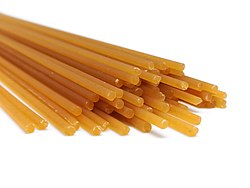
Bigoli (Italian: [ˈbiːɡoli]; Venetian: bìgołi) is an extruded pasta in the form of a long and thick strand. Initially bigoli were made with buckwheat flour, but are now more commonly made with whole-wheat flour, and sometimes include duck eggs. The preparation is then extruded through a bigolaro, from which the pasta gets its name.[1]

Bigoli is a term used in Veneto; a similar type of pasta called pici is produced in Tuscany.[1] Tuscan "pici" are similar in their elongated shape, but the preparation process is different. No press is used, instead, they are made by hand, one by one, by rolling a thin strip of dough on a cutting board or between two palms. Eggs are not used in this Tuscan recipe.

The contemporary recipe of Venetian “bigoli" involves semolina flour, whole wheat flour, and, optionally, eggs. This results in a dish that contains gluten. The use of whole wheat flour gives “bigoli" their distinctive dark color, setting them apart from typical Italian pasta made exclusively with semolina. “Bigoli” are cooked in boiling salted water for a few minutes and are then served with sauces, which can be meat-based or fish-based (typically salted sardines).

History

[edit]

There are different versions of the origins of the bigoli. They only agree that they originated in what is now the Veneto region. According to one theory, its origin dates back to the 14th century during the Venetian Turkish Wars. After the Turks sank numerous Venetian ships loaded with durum, the remaining flour was stretched with common wheat flour. The new mixture was used for a dough, formed into a large spaghetto and called a bigolo.[citation needed]

In 1604, a pasta maker from Padua named Bartolomio Veronese, known as Abbondanza (lit.'Abundance'), patented a press for making bigoli. This was the real triumph of the bigoli.[2]

According to another version, the bigoli are the result of a further development of a type of pasta that was already widespread in northeast Italy. They were first mentioned as bigoli in the 15th century at the court of the bishop of Eraclea.[3]

See also

[edit]

Media related to Bigoli at Wikimedia Commons

References

[edit]
Revisions and contributorsEdit on WikipediaRead on Wikipedia
from Grokipedia
Bigoli is a traditional Italian pasta originating from the region, consisting of thick, rustic strands resembling coarse , typically measuring 3-4 mm in diameter with a textured surface ideal for clinging to hearty sauces. Crafted from simple ingredients such as and —or variations including eggs, , butter, and sometimes for a darker version known as bigoli scuri—it is renowned for its chewy texture and versatility in regional dishes. The 's history traces back to the Venetian Republic, with legend attributing the invention of the bigolaro—a wooden press used to extrude the dough through perforated discs—to Bartolomio Veronese, a Paduan pasta maker, who in 1604 patented the device, revolutionizing homemade production. Originally an affordable staple for working-class families, bigoli evolved from buckwheat-based recipes suited to the region's agriculture, and it spread across , including , , and , as well as parts of eastern . While myths linking it to Marco Polo's travels from persist, evidence confirms traditions like bigoli predate such explorations in . Traditionally prepared fresh at home using the bigolaro or modern extruders, bigoli can now be found dried in markets, maintaining their authentic form without , unlike standard . They pair especially well with robust, slow-cooked sauces, reflecting Veneto's culinary heritage of game and . Among the most iconic preparations is , a Venetian classic featuring a creamy of slow-simmered onions and anchovies (or sardines), often reserved for meatless occasions like but enjoyed year-round for its savory depth. Other notable pairings include duck , sausage-based luganega , or from farmyard meats like and guinea fowl, highlighting bigoli's role in festive and everyday meals across .

Description

Physical Characteristics

Bigoli is a type of long, extruded originating from the region of , characterized by its thick, cylindrical strands that resemble an oversized version of . These strands typically measure approximately 2.5 to 4 millimeters in diameter and can extend up to 50 centimeters in length, though commercial varieties are often shorter at 25 to 30 centimeters for practicality in serving. The defining feature of bigoli is its rough, porous surface texture, which provides a rustic, tactile quality and excellent adhesion for sauces. This coarseness is achieved through traditional methods using a pasta press known as a torchio, resulting in an uneven, bronze-die appearance that contrasts with smoother commercial s. In comparison to similar long pastas, bigoli stands out for its handmade-like, robust aesthetic without a central hole, distinguishing it from bucatini while sharing similarities in girth with spaghettoni. Unlike the smoother finish of standard spaghetti, bigoli's textured exterior evokes a more artisanal, countryside origin. Color variations in bigoli reflect its base ingredients, with the standard version made from whole wheat or soft wheat flour, presenting a pale yellow to light brown hue, while buckwheat-infused types (bigoli scuri) appear darker, often in shades of light brown or grayish tones. This coloration subtly influences the pasta's visual appeal but primarily stems from the flour composition rather than additives.

Ingredients and Production

Bigoli, a traditional pasta from the Veneto region of , is primarily composed of simple, basic ingredients that reflect its rustic origins. The classic recipe uses soft (farina di grano tenero), , and a small amount of salt, with no eggs or fats incorporated to maintain its austere character. Typical proportions involve approximately 100 grams of flour to 30-40 milliliters of , creating a firm dough that is kneaded until smooth. In some enriched variations, eggs may be added for a richer texture, though this deviates from the eggless traditional form. The traditional production process emphasizes manual labor and regional tools to achieve the pasta's distinctive form. The dough is kneaded vigorously by hand for about 20 minutes to develop gluten, then allowed to rest for approximately 30 minutes, which helps relax the proteins and improves workability. It is subsequently extruded through a bigolaro, a wooden press or manual torchio device, which forces the dough through perforated discs to form thick, uniform strands about 2.5 to 4 millimeters in diameter. The strands are briefly dried at room temperature before cooking, preserving their rough surface that enhances sauce adhesion. In modern production, bigoli are often manufactured on an industrial scale using automated extrusion machines equipped with bronze dies, which impart a textured surface similar to the handmade version while allowing for higher output. These dies, typically made of bronze alloy, contribute to the pasta's porous quality without compromising efficiency. At home, contemporary cooks may use electric pasta extruders or even meat grinders as substitutes for the bigolaro, producing fresh bigoli that can be cooked immediately or dried for longer storage. Bigoli are available in both fresh and dried forms, with the dried variety undergoing controlled low-temperature drying to retain nutritional integrity and prevent overcooking during preparation. Nutritionally, bigoli is a carbohydrate-dense , providing approximately 350-400 kilocalories per 100 grams of dry , primarily from complex carbohydrates (around 70 grams per 100 grams), with low content (about 1.5 grams per 100 grams) and moderate protein (12 grams per 100 grams). versions, made with wholemeal flour, offer additional , enhancing digestive health while maintaining the pasta's core profile.

History

Origins

Bigoli trace their roots to the medieval pasta-making traditions of , where the first concrete references to pasta products appear in the thirteenth and fourteenth centuries. In the region, during the height of the Venetian Republic, these early forms evolved into hearty, thick noodles suited to the local landscape and economy, drawing from widespread practices of crafting simple doughs from soft and water. Particularly associated with and , bigoli emerged as an essential food for working-class populations, including laborers and sailors navigating the lagoon and Adriatic trade routes. Their robust texture and ability to dry well ensured portability and longevity, making them ideal for the demanding lifestyles of maritime workers and rural toilers in the Republic's expansive territories. This development reflected the socio-economic realities of the time, as bigoli relied on inexpensive, locally available grains, rendering them a democratic staple in contrast to luxurious, labor-intensive pastas like or egg-enriched reserved for the . The pasta's simplicity underscored its role in everyday sustenance across Veneto's urban centers and countryside. The later of the bigolaro press in 1604 by a Paduan pasta maker further standardized production, though bigoli predated this tool.

Development and Tools

The development of bigoli production is closely tied to innovations in pasta-making tools that enhanced efficiency while maintaining the pasta's characteristic rough texture and thickness. According to legend, in 1604, a pasta maker from named Bartolomio Veronese, nicknamed "Abbondanza", invented the bigolaro—a manual press fixed to a table, typically constructed from wood with a mechanism for extruding dough through perforated bronze dies. This device allowed for the efficient production of the thick, spaghetti-like strands defining bigoli, and Veronese reportedly obtained a from the city council to protect his , marking a significant advancement over purely handmade methods. During the 19th and early 20th centuries, as underwent industrialization, bigoli production transitioned from entirely artisanal practices to semi-mechanized processes, particularly in home and small-scale settings. The widespread adoption of manual pasta machines, such as improved versions of the torchio press, enabled families across to produce larger quantities without compromising the pasta's porous surface, achieved through via dies that imparted a rustic grip for sauces. These tools preserved the traditional composition—primarily and or eggs—while adapting to growing domestic demand, reflecting broader trends in Italian pasta evolution where mechanization balanced tradition with practicality. Following , bigoli saw further adaptations to meet expanding markets, with the introduction of commercially dried versions that facilitated wider distribution beyond local areas. Industrial producers began drying the slowly at low temperatures to retain its texture, contrasting with the fresh, artisanal bigoli still favored in households and restaurants for immediate consumption. This shift allowed bigoli to reach national and international audiences while artisanal methods, using the classic bigolaro, continued to dominate traditional production. Efforts to preserve bigoli's heritage have resulted in its recognition as a traditional agroalimentary product of Veneto, documented in the region's official atlas of such items, emphasizing its historical methods and cultural role. Although not granted full Protected Geographical Indication (PGI) status, this recognition ensures adherence to time-honored extrusion techniques and ingredients to safeguard authenticity amid modern commercialization.

Culinary Uses

Traditional Dishes

One of the most iconic traditional preparations of bigoli is bigoli all'anatra, a hearty dish originating from the Vicenza province in Veneto, where the pasta is paired with a rich duck ragù. The ragù is prepared by searing duck quarters and then slowly cooking with finely chopped onions, carrots, celery, garlic, white wine, low-salt chicken broth, tomato paste, sage, rosemary, and bay leaf, simmering for 1.5-2 hours to develop deep flavors until the sauce thickens and the meat tenderizes. This combination leverages bigoli's rough texture, which allows the robust ragù to cling effectively to the strands. The dish is typically finished with grated Parmigiano-Reggiano or Grana Padano cheese for added richness. Another classic is , a simple yet flavorful Venetian recipe traditionally served on "lean days" such as Fridays during periods of from meat. The sauce, known as salsa, is made by gently sautéing sliced onions in until they become soft and golden, then incorporating desalted anchovies (often from dried salted varieties) and dry or to create a savory, umami-packed that simmers briefly to meld the ingredients. This preparation highlights the pasta's ability to absorb the briny, onion-sweetened sauce without overpowering it. Regional variations showcase local ingredients, such as in rural areas around , bigoli con musso features a of minced meat (musso in dialect), slow-cooked with tomatoes, , and herbs to yield a gamey, robust that reflects the region's traditions. To prepare bigoli for these dishes, fresh handmade versions are boiled in salted water for 8-10 minutes to reach , while commercially dried bigoli require 12-15 minutes, ensuring a firm bite that holds up to the s. The cooked is then drained and tossed directly in the pan with the over low heat for 1-2 minutes to integrate flavors thoroughly.

Serving Suggestions

Bigoli should be cooked in ample salted , using approximately 1 liter per 100 grams of to allow the strands to move freely and cook evenly without sticking. The is boiled until , typically 10-12 minutes for dry varieties, to preserve its signature chewiness; overcooking leads to a mushy texture that undermines its hearty bite. Standard portion sizes range from 80-100 grams of dry bigoli per person, providing a satisfying serving. The thick, robust nature of bigoli makes it ideal for hearty, meaty sauces such as duck ragù or robust options like or preparations, which adhere effectively to its coarse surface for optimal flavor distribution. Lighter tomato-based sauces are generally avoided, as they tend to slide off the pasta's substantial strands rather than coating them properly. Common accompaniments include freshly grated or Parmigiano-Reggiano cheese, which adds a nutty sharpness to complement the pasta's earthiness. In traditional style, it pairs well with vegetable sides such as bitter or creamy , enhancing the meal's regional balance. For presentation, bigoli is best served immediately in shallow bowls to ease twirling onto forks, garnished with fresh like for a vibrant finish; its format lends itself perfectly to family-style sharing at the table.

Cultural Significance

In Cuisine

Bigoli holds a central place as a staple in the diets of Venetian and Paduan communities, where it embodies the region's rustic heritage through its simple, hearty and prevalence in local gatherings. In 's countryside and urban osterie—traditional taverns serving authentic home-style fare—bigoli is a frequent offering, often handmade with local flours to evoke the agrarian roots of the area. This symbolizes the enduring connection to 's pastoral traditions, appearing prominently in sagre, or village food festivals, such as the annual Festival dei Bigoli in Torreglia and the Festa dei Bigoli di , where communities celebrate it alongside other regional specialties to foster social bonds and preserve culinary customs. Tied to the Catholic calendar, bigoli features in seasonal and religious observances, particularly as a "lean day" dish during periods of like . Dishes such as , prepared with an anchovy-onion sauce that adheres to meatless requirements, were historically consumed on , , and , reflecting Veneto's devout traditions and the need for nourishing yet abstinent meals. This practice underscores bigoli's role in communal rituals, where it provides sustenance without violating penitential vows, a custom rooted in the region's strong Catholic identity. In Veneto's multi-course meals, bigoli integrates seamlessly as the pasta course, often preceding risotto or seafood mains to balance flavors in a structured dining experience that highlights local bounty. Its robust texture pairs ideally with the bold reds of the region, such as or , which enhance rich sauces like those in bigoli all'anatra, cutting through the intensity with notes of dark fruit and spice. For instance, a classic pairing involves with bigoli dressed in duck , amplifying the dish's savory depth. Artisan bigoli production thrives in areas like and , where skilled makers employ traditional wooden presses called bigolaro to craft the pasta, maintaining a craft passed down through family generations. These artisans, often operating in local markets or small workshops, prioritize whole wheat flours and minimal ingredients to honor time-tested recipes, ensuring bigoli remains a vital thread in Veneto's cultural fabric. While not holding protected status, bigoli is promoted through local initiatives to preserve traditions.

Modern Popularity

In the late 20th and early 21st centuries, bigoli has seen increased , transitioning from primarily artisanal production to wider availability in and specialty stores as both dried and fresh options. Brands such as Sfoglini offer dried bigoli made with organic flour, distributed across the for home cooks and professional kitchens, emphasizing its rough texture ideal for hearty sauces. Similarly, Bigoli Fresh Pasta, established in , produces fresh bigoli using traditional methods with ingredients, supplying premier restaurants, hotels, and markets, making it accessible beyond . Exports to and the have grown, with Italian producers like Pastificio Morelli shipping bronze-drawn bigoli to international retailers, contributing to Italy's overall export volume of over 2.2 million tonnes in 2024. Post-2000 innovations include whole-grain versions retaining the pasta's traditional buckwheat or mixed flour profiles for health-conscious consumers, as well as gluten-free variants using and , available from brands like Pasta Mia. Contemporary adaptations have introduced fusion elements, particularly in urban Italian restaurants where bigoli pairs with vegetarian ragùs featuring mushrooms or seasonal , diverging from meat-based classics to appeal to modern palates. For instance, bigoli with mixed mushrooms and represents an Italian-Japanese fusion, incorporating umami-rich in place of traditional elements, served in innovative eateries. Vegan interpretations, such as bigoli with and walnuts, highlight plant-based twists using creamy, nutty sauces. These evolutions align with movements, where bigoli features in events promoting sustainable, regional ingredients, as seen in recipes and gatherings that showcase it with lake fish or to emphasize mindful eating. Bigoli's international recognition has expanded through its inclusion in promotions of the Italian , where it represents Veneto's whole-grain traditions alongside risi e bisi, underscoring balanced, plant-forward meals. In communities, particularly in the and , it gains traction in gourmet markets; Bigoli Fresh Pasta in caters to Italian-American consumers with authentic fresh varieties, while London-based BIGOLI offers handmade options in urban settings, blending heritage with global accessibility. Establishments like Bigoi Venezia in New York serve bigoli in upscale Italian dining, elevating its status in fine . Despite this growth, challenges persist in preserving artisanal methods amid . Producers like those using low-temperature maintain nutritional integrity and flavor, resisting refined dominance to safeguard cultural authenticity.

References

Add your contribution
Related Hubs
User Avatar
No comments yet.