Hubbry Logo
PiciPiciMain
Open search
Pici
Community hub
Pici
logo
8 pages, 0 posts
0 subscribers
Be the first to start a discussion here.
Pici
Pici
from Wikipedia

Pici
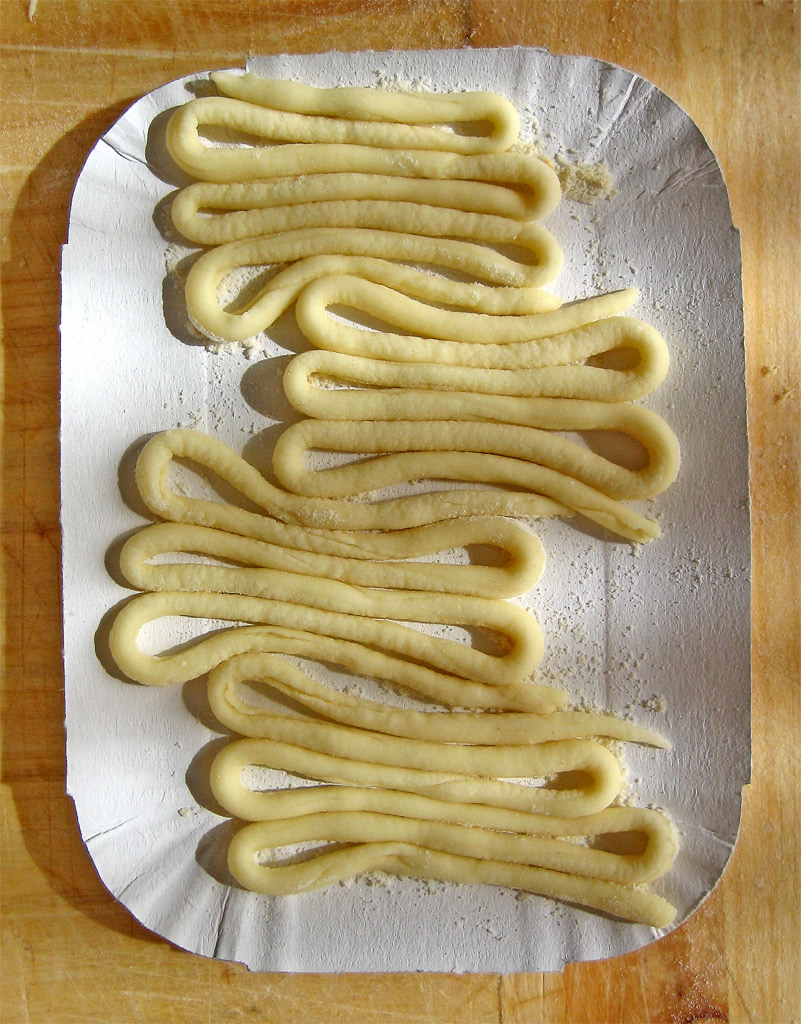
Pici made with egg white
Alternative namesPinci
TypePasta
Place of originItaly
Region or stateProvince of Arezzo, province of Firenze, province of Grosseto, and province of Siena, Tuscany
Main ingredientsWheat flour, water
  •   Media: Pici

Pici (Italian: [ˈpiːtʃi], locally [ˈpiːʃi]) is thick, hand-rolled pasta, like fat spaghetti.[1] It originates in the province of Siena, in Tuscany; in the Montalcino area it is also referred to as pinci (Italian: [ˈpintʃi]).

The dough is typically made from flour and water only. The addition of egg is optional, being determined by family traditions. Alternatively, finely chopped or shredded spinach can be used in place of water.

The dough is rolled out in a thick flat sheet, then cut into strips. In some families, the strip of dough is rolled between one palm and the table, while the other hand is wrapped with the rest of the strip. It can also be formed by rolling the strip between the palms. Either method forms a thick pasta, slightly thinner than a common pencil. Due to its handmade nature, this pasta is not uniform in size and has variations of thickness along its length.

It is eaten with a variety of sauces and meats, particularly:

Food category Italian English
sauces briciole breadcrumbs
aglione spicy garlic tomato sauce
boscaiola porcini mushrooms
cacio e pepe cheese and black pepper
ragù a meat-based sauce
game meat cinghiale wild boar
lepre hare
anatra (nana) duck

See also

[edit]

References

[edit]
Revisions and contributorsEdit on WikipediaRead on Wikipedia
from Grokipedia
Pici is a traditional Italian pasta originating from the region, particularly the , where it is known as pici senesi. It consists of thick, hand-rolled strands resembling fat , made from a simple of durum wheat flour and water without eggs, resulting in a dense, chewy texture ideal for clinging to hearty sauces. The pasta's irregular, rustic shape is achieved through manual rolling on wooden boards, a technique that reflects its roots in rural Tuscan peasant cuisine. While exact origins are uncertain, pici is believed to date back centuries, with legends linking it to ancient Etruscan culinary practices. By the period, pasta varieties were well-established in , as documented in contemporary cookbooks. Pici remains a staple of Tuscan , often prepared fresh at home or in local trattorias, and is celebrated for its versatility with bold, regional flavors. Common pairings include pici all'aglione—a sauce of tomatoes, , and —or cacio e pepe with sheep's milk cheese and black pepper, as well as meat-based ragùs like or . Its name derives from the Tuscan dialect verb appicciare, meaning "to form into a bundle" or "to make sticky," highlighting the tactile process of its creation. In areas like , it is also called pinci, underscoring its deep cultural ties to southern Tuscany's and Val di Chiana regions.

Etymology and nomenclature

Linguistic origins

The term pici originates in the Tuscan dialect, deriving from the verb appiciare, which refers to the action of rolling or elongating by hand—a central to the pasta's traditional formation. This etymological root underscores the word's deep ties to the manual labor and rural practices of southern , where the dialect preserves expressions linked to everyday artisanal techniques. Alternative theories suggest origins from the place name San Felice in Pincis or local terms for elongated flora like Pigelleto. In standard Italian, pici is pronounced [ˈpiːtʃi], with primary stress on the initial and an /tʃ/ sound akin to "cheese" in English. In contrast, the local Tuscan variant features [ˈpiːʃi], influenced by the gorgia toscana, a distinctive phonetic where intervocalic voiceless consonants shift to fricatives or aspirates. This evolution traces back to medieval Tuscan dialects, emerging from and potentially shaped by pre-Roman Etruscan substrates, resulting in a breathier articulation that distinguishes Tuscan speech from other Italian varieties. Though the underlying practice predates written records, it shares phonetic and semantic affinities with variants like pinci in nearby areas such as Montalcino.

Regional naming variations

In the Montalcino area and southern province of Siena, this pasta is commonly known as pinci, a term rooted in the local Sienese dialect that reflects the rustic traditions of the region. This naming distinction highlights the micro-regional variations within Tuscany, where pinci evokes the hand-rolled, thick strands prepared by local families and featured in traditional dishes. Further north and west, in the provinces of and , the pasta is often referred to as picci, with slight variations in spelling and that underscore the dialectal diversity across Tuscan subregions. These names maintain the same phonetic essence but adapt to local linguistic nuances, emphasizing the pasta's widespread adoption in areas like the and . Along the border with , neighboring dialects have influenced naming conventions, leading to terms like umbricelli in transitional zones where Tuscan and Umbrian culinary traditions overlap. This cross-regional similarity arises from shared hand-rolling techniques and historical exchanges, resulting in umbricelli being used for comparable thick, handmade in Umbrian-influenced border communities.

History and origins

Ancient Etruscan roots

The earliest archaeological evidence linking pici-like pasta forms to ancient Etruscan culture comes from the Tomb of the Reliefs (Tomba dei Rilievi) in the Banditaccia Necropolis at , dating to the late 4th century BCE. This rock-cut tomb features stucco bas-reliefs depicting everyday domestic tools, including a , board, knives, and a pasta cutter, interpreted by historians as instruments for preparing fresh dough-based foods akin to hand-rolled strands. These carvings suggest that Etruscans produced simple, extruded or rolled wheat doughs, providing a visual record of proto-pasta production in pre-Roman . In Etruscan agrarian society, such dough preparations were rooted in the cultivation of wheat (Triticum dicoccum), a staple grain alongside and , which formed the basis of their carbohydrate-rich diet. flour, mixed with water to create a basic , would have been accessible for hand-rolling into thick, irregular strands similar to modern , especially in rural households where fresh served as a versatile, everyday food. Archaeobotanical remains from Etruscan sites confirm emmer's prominence, underscoring its role in simple, boiled grain preparations that required minimal ingredients and tools. These Etruscan practices likely influenced subsequent Roman culinary traditions, where pasta-like dishes such as lagana—flat sheets of boiled dough—emerged as precursors to medieval Italian pasta forms. The hand-rolled dough techniques evident in Etruscan artifacts represent an early link in the chain leading to Tuscany's pici, evolving through Roman adoption into the documented medieval pasta of the region.

Development in medieval and Tuscany

With roots in ancient Etruscan practices, pici continued as a simple peasant food in medieval , hand-rolled from basic flour and water dough into thick strands, reflecting the resource-limited diets of rural communities around . This unpretentious aligned with the broader medieval Tuscan reliance on grain-based staples for sustenance, as documented in 14th-century monastic records and early cookbooks such as the anonymous Libro della cucina, which features recipes for similar sheet and strand pastas suited to lean days and everyday meals. Its preparation emphasized local wheat flours, making it an accessible staple amid the agricultural self-sufficiency of Sienese countrysides. The exact origins of the name "pici" remain uncertain, though the preparation method shows continuity from ancient times. During the , pici remained primarily a staple, while Tuscan varieties more broadly gained prominence in regional cuisine through trade and culinary exchanges, as seen in the Medici era's facilitation of food traditions along routes connecting to . This period highlighted the versatility of simple grain-based dishes in evolving recipes, bridging rustic origins with the era's gastronomy. By the , had solidified as a regional staple in culinary texts, such as Bartolomeo Scappi's influential Opera dell'arte del cucinare (1570), which describes various preparations amid agricultural shifts toward diversified cultivation and improved milling techniques in . These changes, driven by innovations in farming, ensured pici's enduring presence as a hearty, adaptable dish emblematic of identity.

Description and characteristics

Physical form and texture

Pici pasta is distinguished by its thick, irregular cylindrical form, which evokes a rustic, handcrafted version of but with greater girth and variability. The strands typically measure 3 to 5 mm in diameter, making them noticeably thicker than standard , and are cut to lengths of 20 to 30 cm for serving, though traditional preparations may involve longer pieces before portioning. This handmade nature results in non-uniform thickness along each strand, with subtle variations that impart a distinctive rustic texture, contrasting sharply with the smooth, consistent uniformity of commercial machine-extruded . These artisanal imperfections—slight twists, uneven surfaces, and organic shapes—are not flaws but essential hallmarks of pici's traditional appeal, emphasizing its origins in Tuscan home cooking. When cooked , pici offers a dense, chewy bite that holds up well to robust sauces, owing to its solid structure formed without eggs or enrichments. The simple composition of and further enhances this firm, elastic texture, allowing the to maintain integrity while absorbing flavors.

Basic ingredients and composition

Pici is traditionally prepared using a simple combination of durum semolina (semola di grano duro) and , forming an eggless that emphasizes rustic simplicity and regional availability of ingredients. This basic composition, without eggs or other enrichments, allows for easy digestion and highlights the 's hearty character, as practiced in southern . In some regional or modern adaptations, variations incorporate additional elements for enhanced flavor or color; for instance, a single or may be added to the dough to achieve a richer, more elastic texture. Similarly, puree can be blended into the dough to create pici verdi (green pici), introducing a vibrant hue and subtle vegetal notes while maintaining the pasta's fundamental structure. Nutritionally, traditional pici dough is high in carbohydrates—typically around 70 grams per 100 grams of —low in (about 1-1.5 grams per 100 grams), and provides approximately 350 kcal per 100 grams, making it a staple for energy-dense meals in Tuscan cuisine.

Preparation methods

Dough preparation

The preparation of pici dough begins with combining high-quality , typically a mix of tipo 00 and for authenticity, with in a 2:1 ratio by , such as 350 grams of to 175 grams of , to form the base of this eggless Tuscan . This simple composition ensures a sturdy yet pliable suited to hand-rolling, drawing from traditional peasant methods in and surrounding areas. Room-temperature is preferred to facilitate even hydration without shocking the proteins, promoting a cohesive that avoids the need for additional binders. To mix, mound the on a wooden board or in a large , create a well in the center, and gradually incorporate the water while stirring with a or hands until a shaggy forms, then transfer to a surface for further working. follows immediately, pressing and folding the vigorously for 10-15 minutes until it achieves a smooth, elastic consistency that springs back lightly when poked, indicating proper development. This extended is essential for the dough's resilience, as pici requires a firm texture to withstand manual shaping without tearing. Once kneaded, the dough is shaped into a ball, lightly dusted with if needed, and wrapped in a damp cloth or to prevent . It then rests at for 30-60 minutes, allowing the networks to relax and redistribute moisture evenly, which minimizes cracking and improves workability during subsequent steps. Hydration levels must be monitored closely during mixing: if the dough feels too dry and crumbly, add sparingly in increments; conversely, if it becomes sticky and adheres excessively, incorporate small amounts of to maintain a firm but malleable texture. These adjustments, guided by feel rather than precise , reflect the artisanal nature of pici-making in Tuscan traditions.

Hand-rolling and shaping techniques

The traditional hand-rolling and shaping of pici pasta begins after the dough has rested, typically for 30 minutes to allow it to relax and become more pliable. The rested is divided into manageable portions, and each piece is rolled out on a wooden board using a to form a thin sheet approximately 2-3 mm thick, ensuring an even surface for subsequent steps. This sheet is then cut into strips about 1 cm wide using a sharp knife, creating uniform bases that will be elongated into the characteristic thick strands. The core shaping technique involves manually elongating each strip into long, irregular ropes using the palms of the hands or fingertips, starting from the center and gently dragging outward across the board to achieve a of roughly 3-5 mm and lengths of 20-30 cm. This dragging motion, known locally as a variation of the "strascicati" method, imparts a rustic texture to the strands by creating subtle ridges and unevenness as the dough is pulled and pressed against the wooden surface. In some traditional practices, a thin wooden rod or the back of a may assist in initial elongation before final hand-rolling, though fingers alone emphasize the artisanal skill required for authenticity. The process demands patience and practice, as the dough's elasticity allows it to stretch without tearing, resulting in chewy, hand-formed pici that retain their imperfect, homemade appearance. Common tools for this method include a sturdy wooden board for stability and traction during dragging, a for sheeting, and a plain knife for cutting strips, all chosen to maintain the pasta's traditional character without mechanical intervention. Machines such as pasta extruders or rollers are deliberately avoided in authentic Tuscan preparation to preserve the tactile skill and variable texture that define pici as a peasant-style . Shaping a standard 500 g batch typically takes 20-30 minutes, depending on the maker's experience, allowing for the production of enough strands to serve 4-6 people. Once formed, the pici are dusted lightly with to prevent sticking and arranged without overlapping until ready for use.

Regional and modern variations

Traditional Tuscan styles

In the , pici are crafted as thicker, hand-rolled strands that are shorter than typical , providing a robust, rustic form ideal for clinging to rich sauces. This style emphasizes simplicity in production, using primarily and water, though some recipes incorporate a touch of or for added chewiness. Traditionally paired with hearty meat-based preparations, such as from beef or , these pici highlight the agrarian influences of southern . The Aretine variation from the area often incorporates flour to achieve a coarser, more textured surface that enhances adhesion. This adjustment reflects local milling traditions and the use of durum for durability in everyday peasant cooking. While maintaining the hand-rolled technique, these pici are suited to robust, tomato-infused s typical of the Val di Chiana region. In the province of , pici are short, fat strands suited to the region's pastoral and coastal lifestyle, with subtle adaptations in preparation to complement elements. The remains basic—flour and water—but the strands allow for versatile twirling in dishes incorporating hints of coastal flavors, such as red prawns or in light vegetable broths. This style bridges inland rusticity with maritime influences, often served in modest trattorias overlooking the .

Adaptations beyond Tuscany

Pici has spread beyond Tuscany to neighboring regions in , where it takes on local names and subtle variations in preparation. In , a similar thick, hand-rolled known as umbricelli is made from and , but often features a slightly thicker and shorter form compared to Tuscan pici, incorporating regional durum for a chewier texture. Through the , entered markets in the and during the early 2000s, popularized by immigrant communities and Italian specialty importers. Commercial versions, such as those sold by and Manicaretti, are typically machine-extruded to meet demand for packaged, shelf-stable products while approximating the rustic thickness of handmade strands. Contemporary adaptations include gluten-free formulations, which substitute with blends of , , and to mimic the dough's pliability and maintain the pasta's characteristic chew without eggs. In global Italian restaurants, pici appears in fusion dishes, such as or amatriciana sauces, blending Tuscan simplicity with Roman influences for broader appeal.

Culinary uses and pairings

Classic sauces and dishes

Pici all'aglione is a quintessential Tuscan dish originating from the province, featuring handmade paired with a robust, garlic-infused . The is prepared by slowly cooking abundant aglione—an oversized variety of native to the Val di Chiana region—with extra-virgin , fresh or , and a touch of chili for subtle heat, allowing the flavors to meld over low heat for about 20-30 minutes. This simple yet flavorful preparation highlights the rustic essence of Tuscan cuisine, where the 's thickness clings well to the pici's chewy texture. Another traditional pairing is pici al , a hearty meat-based commonly made with (cinghiale) or , reflecting the region's heritage and use of local game. The begins with browning chunks of meat in alongside a soffritto of onions, carrots, and , then deglazing with and slowly for several hours—often 3-4 hours or more—with tomatoes, herbs like and leaves, and sometimes berries to infuse a deep, earthy richness. Fresh pici is cooked separately in boiling salted water for 8-10 minutes until , then tossed with the to absorb its savory depth. Among other staple preparations, pici con le briciole offers a simple, peasant-style option using toasted breadcrumbs sautéed in extra-virgin with and red pepper flakes for a crunchy, garlicky coating, often finished with grated cheese. Pici with provides a simpler, cheese-forward option adapted to Tuscan tables, using grated and freshly cracked emulsified with pasta water for a creamy coating without cream. This Roman-inspired dish suits pici's density, providing a quick contrast to meatier . Similarly, pici alla boscaiola incorporates foraged mushrooms—such as porcini or field mushrooms—sautéed with , , white wine, and tomatoes to create a woodsy, umami-rich evocative of Tuscany's rural landscapes. These dishes underscore pici's versatility in clinging to bold, ingredient-driven flavors.

Serving suggestions and accompaniments

Pici is traditionally portioned at 100-150 grams of dry per person to account for its hearty, thick strands that provide substantial satisfaction. Due to its robust, rope-like thickness, the is best twirled around a for eating, a method that suits its handmade irregularity and prevents slippage. It is served hot in shallow bowls, which facilitate portioning and sauce retention while allowing diners to maneuver the strands comfortably. Common garnishes enhance pici's rustic simplicity without overpowering the dish; freshly grated Pecorino Toscano cheese adds a sharp, salty note that complements the pasta's chewy texture. A sprinkle of chopped fresh provides aromatic freshness, particularly with tomato-based preparations, while a drizzle of extra-virgin olive oil imparts a glossy finish and subtle fruitiness. For optimal flavor integration, pici should be boiled in generously salted water until , typically 4-8 minutes depending on thickness, then immediately tossed in the pan with and a splash of water to ensure even coating. This technique preserves the pasta's firmness and allows the —such as the aglione—to cling effectively to each strand. Wine pairings from , like Classico DOCG, cut through the richness with their bright acidity and cherry notes, making them an ideal match.

Cultural and culinary significance

Role in Tuscan peasant traditions

Pici served as a fundamental staple in the diets of farm laborers, crafted from affordable local wheat flour and water to provide sustaining energy for demanding agricultural work. In pre-industrial rural , particularly in areas like the Val di Chiana and , this simple was prepared using grains from nearby fields, embodying the resourcefulness of peasant households that relied on minimal ingredients to feed large families. The preparation of pici often occurred communally during harvest seasons, where families and neighbors gathered in evening veglie—traditional social assemblies—to knead and hand-roll the dough, fostering intergenerational bonds and shared labor. These sessions highlighted the pasta's role in everyday rural life, with women, known as massaie, passing down techniques that emphasized simplicity and adaptation to available resources. Since , pici has featured prominently in daily meals as a versatile minestra, occasionally elevating celebratory occasions like Sunday gatherings or harvest feasts, symbolizing communal harmony and thrift. Economically, pici's low-cost production was vital for self-sufficiency in Tuscany's mezzadria system of , where families produced their own from local durum varieties to minimize dependence on external markets. This practice not only supported survival in isolated agrarian communities but also reinforced cultural continuity through preserved family recipes that prioritized local over extravagance.

Presence in festivals and contemporary cuisine

Pici holds a prominent place in Tuscan festivals, particularly through dedicated sagre (food festivals) that celebrate its handmade and pair it with local ingredients. The Sagra dei Pici in sul Rigo, held annually on the last weekend of May since 1969, draws visitors to this village near San Casciano dei Bagni, where community members prepare approximately 8 quintals of into fresh pici served with classic sauces like aglione (a garlicky ) or meat . The event, organized by the local philharmonic society established in 1876, includes tastings, live music, and demonstrations of the pasta's hand-rolling process, earning recognition with the Touring Club Italia Prize in 2013 for its cultural preservation efforts. Similarly, the Sagra del Picio in Seggiano, occurring in the second week of , highlights a local variation of pici made with egg yolks, diverging from the traditional recipe of and alone. Festivalgoers enjoy plates of the topped with rich sauces amid street parties featuring traditional Tuscan music, dancing, and artisan markets, underscoring pici's role in fostering community bonds during summer. Another notable gathering, the Sagra dei Pici in Santa Casciano dei Bagni on the last Sunday of May, integrates pici into broader celebrations of regional products, offering tastings that emphasize its rustic texture and versatility. In contemporary , pici has transcended its origins to appear in upscale restaurants and innovative recipes, often retaining its handmade irregularity while embracing global influences. Chefs like Tim Siadatan at London's Padella have popularized pici , adapting the Roman cheese-and-pepper classic to the pasta's chewy bite for a modern, minimalist dish that highlights simplicity in . In and beyond, interpretations include pici all'etrusca, a pesto-style sauce with hard-boiled eggs, , and , blending ancient inspirations with seasonal produce for lighter, contemporary meals. Modern adaptations also feature pici in fusion contexts, such as with puttanesca sauce incorporating olives, capers, and anchovies for a bold, umami-driven twist on Mediterranean flavors, or creamy beef in American-Italian eateries like Love & Salt in , where the pasta's thickness clings to hearty, slow-cooked meats. These evolutions, seen in workshops and menus from outlets like , maintain pici's cucina povera ethos—using just flour and water—while appealing to health-conscious diners through vegan pairings like and herb sauces. Overall, pici's presence in today's culinary scene reflects its adaptability, appearing in both traditional sagre and innovative dishes that bridge rural heritage with urban palates.

References

Add your contribution
Related Hubs
User Avatar
No comments yet.