Hubbry Logo
FregulaFregulaMain
Open search
Fregula
Community hub
Fregula
logo
8 pages, 0 posts
0 subscribers
Be the first to start a discussion here.
Fregula
Fregula
from Wikipedia

Fregula
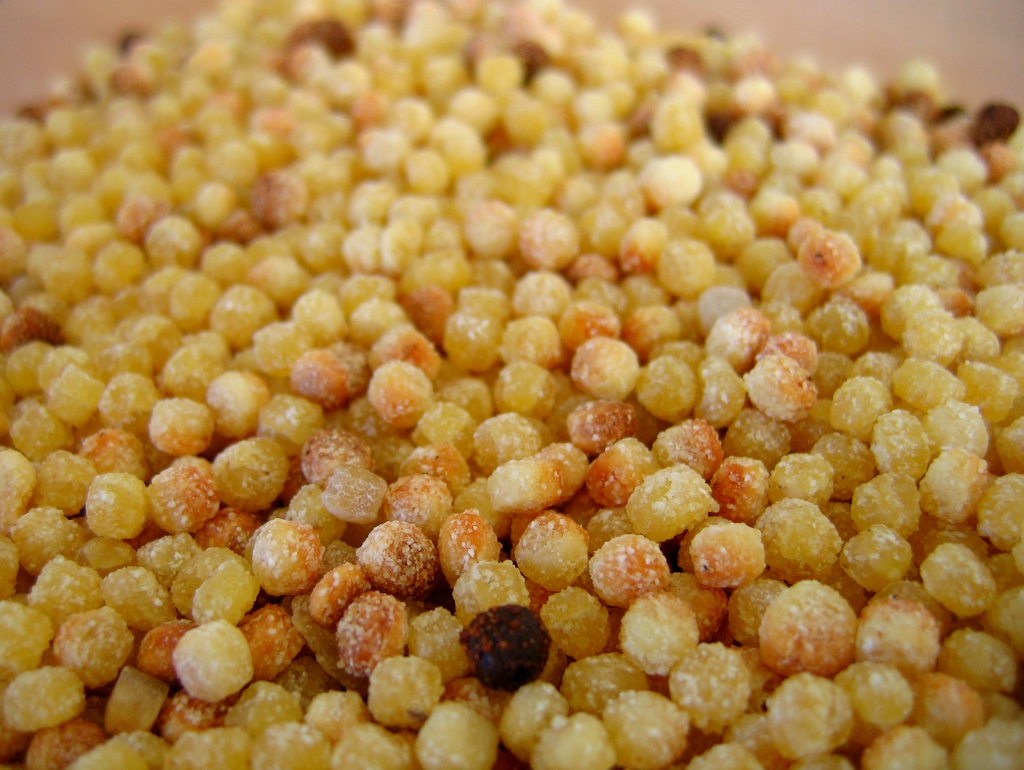
Uncooked fregula
TypePasta
Place of originSardinia
Main ingredientsSemolina dough
  •   Media: Fregula

Fregula (often incorrectly written fregola[1]) is a type of semolina pasta from the Sardinia region of Italy.[2]

Description

[edit]

The first references to Fregula date back to the 14th century, it is produced in varying sizes but typically consists of a semolina dough that has been rolled into balls 2–3 mm in diameter and toasted in an oven. It is similar to Acini di pepe and Couscous though the physical form of the pasta is closer to Maftoul as well as Moghrabieh. As it dates back to the 14th century it is currently unknown if the method was derived from North African couscous recipes brought to Sardinia by immigrants or if it was developed independently. [3]

A typical preparation of fregula is to simmer it in a tomato-based sauce with clams.[4]

See also

[edit]

References

[edit]
Revisions and contributorsEdit on WikipediaRead on Wikipedia
from Grokipedia
Fregula (also known as fregola or fregola sarda), is a traditional consisting of small, spherical beads made from flour and water, which are hand-rolled and toasted to develop a distinctive nutty flavor and chewy texture. Originating from the island of in and dating back to at least the , fregula is crafted by rubbing with water to form irregular pellets, which are then air-dried briefly before being toasted in an oven or over heat until lightly browned, a process that imparts its unique toasted aroma and resilience in cooking. This handmade method, often using simple tools like a terracotta dish, results in beads ranging from 2 to 6 millimeters in size, distinguishing fregula from smoother commercial pastas. In Sardinian cuisine, fregula is versatile and commonly prepared like or , simmered in broth or sauce to absorb flavors, with popular pairings including such as mussels and clams, , herbs, or cheeses. It cooks in about 8 to 10 minutes, yielding a tender yet bite that thickens soups and stews, and its irregular shape allows it to hold onto sauces effectively. Beyond traditional uses, fregula has gained international recognition for its resemblance to pearl while offering a more robust, pasta-like quality, making it suitable for modern dishes like salads or vegetarian mains.

History and Origins

Etymology

The name fregula derives from the Italian verb fregare, meaning "to rub" or "to crumble," which alludes to the traditional technique of forming the by rubbing dough between the hands to create small beads. Some sources alternatively trace it to the Latin ferculum, meaning "crumb" or "fragment," reflecting the pasta's small, granular form. This etymological root traces back to the Latin fricare, signifying "to rub," and highlights the manual craftsmanship central to its identity in Sardinian culinary . In Sardinian dialects, fregula appears under various regional synonyms that reflect local phonetic adaptations and cultural nuances, such as succu in southern dialects, evoking a sense of coarse, hand-formed grains; cascà, a term from central areas implying a cascading or crumbling texture; and pistitzone, used in some inland communities to denote a pounded or crushed form, underscoring the pasta's rustic, agrarian heritage. It is also commonly prefixed as fregola sarda to distinguish it as a Sardinian specialty within broader Italian contexts. Spelling variations like fregula (the authentic Sardinian form) and fregola (the Italianized version) have evolved due to linguistic influences from mainland , with the latter gaining prominence in 20th-century culinary and labeling. Modern Italian culinary terminology has standardized fregola sarda as the preferred designation in recipe books, product packaging, and gastronomic references to emphasize its regional authenticity while accommodating national usage.

Historical Development

Fregula's origins in Sardinia date back to ancient times, likely emerging as a practical method for preserving grains during the island's harsh winters, transforming semolina into durable, storable pearls. This early form reflects the resourcefulness of Sardinian communities in utilizing local durum wheat to create a long-lasting food source amid challenging environmental conditions. The development of fregula was significantly shaped by Mediterranean trade influences, with Phoenician, Carthaginian, and Roman traders introducing semolina-based dough techniques from the 8th century BCE through the 1st century CE. Food historians suggest these external contacts, particularly the Carthaginians' North African heritage, contributed to fregula's resemblance to , though many Sardinians maintain it as an original local creation rather than a derivation. By the , the pasta had become an established element of culture, handmade by rolling dough in terracotta bowls and toasting it for preservation and flavor. In the medieval period, fregula integrated deeply into rural and monastic diets across , serving as a staple for both everyday sustenance and communal meals. The first written references appear in the 14th-century Statute of the Millers of Tempio Pausania, a northern Sardinian document that regulated production to weekdays only, prohibiting it on Sundays to align with religious observances. This text underscores fregula's economic role in milling communities and its evolution from a household , often taught as a in women's dowries, to a regulated artisanal product. The 19th and 20th centuries marked a transition to industrialization, as handmade methods gave way to mechanical production while retaining the essential toasting step for authenticity. Factories like La Casa del Grano, founded in 1975, exemplify this shift, scaling up output with modern machinery to meet growing demand without compromising traditional techniques. This evolution preserved fregula's cultural significance amid Sardinia's broader economic modernization.

Characteristics and Preparation

Ingredients and Composition

Fregula, a traditional Sardinian , is primarily made from durum wheat semolina and , forming small, irregular beads through a rolling process. This simple composition reflects its rustic origins, with the semolina providing the structure essential for the pasta's chewy texture. Some artisanal variants incorporate a pinch of salt during preparation to enhance flavor and structure, while others include threads for a subtle golden hue and aromatic notes. Nutritionally, fregula is a dense source of energy, offering approximately 352 kcal per 100 grams, with carbohydrates comprising the majority at 71 grams, primarily complex starches from the semolina. It provides 12 grams of protein per 100 grams, supporting its role as a satiating staple, alongside 3 grams of dietary fiber that aids digestion. Fat content remains low at 1.5 grams per 100 grams, with minimal saturated fats (0.3 grams), making it suitable for balanced diets. The toasting step imparts a nutty flavor via the Maillard reaction, distinguishing its profile without altering the core nutritional makeup. In comparison to similar grain-based foods, fregula's larger bead size and toasted exterior set it apart from traditional , which features finer, steamed granules from the same base. Unlike Israeli ptitim, which undergoes before toasting, fregula's hand- or machine-rolled formation yields a more varied, pearl-like consistency.

Manufacturing Process

The traditional manufacturing process of fregola begins with preparing a simple from coarsely ground durum wheat and warm water, often with a pinch of salt added for flavor. The is placed in a large, shallow terracotta or wooden known as a scivedda, and water is gradually incorporated while the mixture is rubbed vigorously with the hands against the bowl's rough surface or through the fingers to form small, irregular beads typically ranging from 2 to 6 mm in diameter. This rubbing technique, akin to that used for , requires skill to achieve uniform granules without overworking the into a solid mass. Once formed, the raw beads are spread on a clean cloth or tray to air-dry for several hours or overnight, allowing them to firm up and prevent sticking during the next step. The dried beads are then toasted to develop fregola's signature golden color, nutty aroma, and chewy texture through the . Traditionally, this is done in a wood-fired or conventional preheated to around 180-200°C for 15-20 minutes, with occasional stirring to ensure even browning; longer toasting enhances deeper nutty notes but risks over-drying. Artisanal producers emphasize hand-toasting in small batches to maintain irregularity in bead size and shape, which contributes to the pasta's rustic appeal. In modern industrial production, the process is scaled up using machinery that replicates the traditional rubbing action for consistency and efficiency, particularly for export markets. and water are mechanically rubbed or pressed through sieve-like devices to form the beads uniformly, followed by automated drying on conveyor belts. Toasting occurs in large, controlled industrial ovens to achieve even browning, ensuring the product meets quality standards for even cooking. Key quality factors include bead uniformity, which prevents clumping during boiling, and precise toasting duration, as under-toasting yields a milder flavor while over-toasting can introduce bitterness—both controlled through automated monitoring in factories.

Varieties and Types

Size Variations

Fregula is classified into three primary size categories based on granule diameter: small (approximately 2 mm), suitable for light soups due to its quick cooking and delicate texture; medium (approximately 3 mm), the most versatile size for a range of dishes; and large (approximately 5 mm), ideal for hearty stews where greater absorption is desired. These sizes influence the pasta's texture and culinary role, with smaller granules providing a finer, couscous-like and larger ones offering a chewier bite. Cooking times vary by size, reflecting differences in surface area and density: small fregula typically requires 8-10 minutes to reach , medium 10-12 minutes, and large 12-15 minutes in salted . Larger granules absorb more during cooking, enhancing integration and yielding a softer, more risotto-like consistency in broth-based preparations. Traditionally, fregula granules were formed by hand in a terracotta or wooden bowl known as a scivedda, resulting in irregular shapes and sizes that varied by technique. In contrast, modern production employs dies for uniform beads, ensuring consistent sizing and quality across batches while preserving the toasting process that imparts a nutty flavor.

Flavored and Regional Variants

Fregula variants often incorporate natural flavorings during the dough preparation to enhance color and taste, reflecting Sardinia's agricultural heritage. A prominent example is saffron-infused fregula, where threads of are added to the and water mixture, yielding a vibrant yellow hue and delicate floral notes that complement dishes. Other infused versions include those colored with puree or dried herbs such as or , which impart reddish or green tones and subtle savory profiles, though these are more contemporary adaptations than historical norms. Fregola Sarda holds protected status as a (PAT) under Italian regional recognition, ensuring adherence to traditional methods across . Non-traditional experiments have led to gluten-free fregula, substituting durum with alternative flours like or corn to accommodate dietary needs, resulting in a texture that diverges from the authentic, chewy original.

Culinary Applications

Traditional Sardinian Dishes

One of the most iconic traditional Sardinian dishes featuring fregula is fregola con arselle, a made with fregula simmered in a flavorful , enhanced by , , and fresh . This dish highlights the island's coastal heritage, where the pasta's porous texture absorbs the briny essence of the arselle (tiny clams). The preparation involves in , adding tomato concentrate and water to boil, then incorporating clams, their filtered liquid, , and fregula; the mixture simmers for 15-20 minutes until . Another staple is fregola con ceci, a hearty chickpea stew that pairs the with , onions, , , tomatoes, and optional grated cheese for a creamy finish. Originating as a simple peasant food in rural , this vegan-adaptable recipe relies on the ' earthiness and the pasta's chewiness, often spiced with a touch of chili for warmth. The chickpeas are soaked overnight and cooked separately if dried, before being added to the sautéed aromatic vegetables, tomato-based simmered briefly, and fregula cooked risotto-style in for a thick consistency. Seafood-focused variations abound in coastal areas like , where fregula is combined with mussels, , or (cured mullet ). These dishes emphasize fresh, local catches, with the grated over the finished to add a salty, depth. Inland traditions include preparations like fregola con agnello (with lamb) or fregola e salsiccia (with ), reflecting rural influences. In Sardinian culinary tradition, fregula dishes are served as a primo piatto.

International and Modern Uses

Fregola has gained popularity beyond , particularly in , where it is often incorporated into seafood risottos and s that echo traditional preparations but adapt to available ingredients. Chefs like have featured fregola in dishes such as fregola with clams and mussels, cooked risotto-style in a , highlighting its nutty, toasted texture as a flavorful base for briny . In the United States, this adoption is evident in recipes from sources like , which pair fregola with clams and for a comforting, pasta experience. De Laurentiis has promoted fregola as a versatile alternative to or , emphasizing its depth of flavor from toasting, which has helped introduce it to American home cooks through her cookbooks and television appearances. Contemporary recipes showcase fregola's adaptability in fusion dishes, including cold salads that blend Mediterranean elements with fresh produce. For instance, fregola citrus salad combines the pasta with segmented oranges, grapefruit, red onion, and mint for a bright, chilled side, while roasted cauliflower and fregola salad incorporates chickpeas, dates, olives, and paprika-spiced vegetables for a hearty, room-temperature meal. Vegan adaptations further expand its appeal, such as fregola sarda with chickpeas and tomato in a spicy broth or slow-cooked broad bean fregola with lemon zest, relying on plant-based proteins and herbs for nourishment without animal products. Quick cooking methods, like boiling in broth for 10-15 minutes, make fregola suitable for home adaptations, including microwave-friendly versions for busy weeknight meals. Commercially, fregola's presence has grown in international markets, with increased availability in supermarkets across and since the early 2000s, often stocked alongside specialty Italian imports. In the U.S., it appears in chains like , , and online via and Amazon, reflecting broader export trends for niche Italian pastas. Modern pairings extend to non-traditional sauces, such as arugula or pesto tossed with fregola and vegetables, creating creamy, herb-forward dishes that diverge from norms.

Cultural and Economic Importance

Role in Sardinian Cuisine

Fregula holds a symbolic status in Sardinian cuisine as an emblem of the island's rustic and pastoral heritage, embodying the simplicity and resilience of traditional peasant life. Dating back to at least the and first documented in a 14th-century statute from Tempio Pausania, it represents a time-honored that connects modern Sardinians to their agrarian roots, where handmade like fregula was a staple for sustenance in rural communities. An old Sardinian , "Koiaimì ca sciufai frégula" ("give me a , because I know how to make fregula"), underscores its cultural weight as a signifying domestic competence and self-sufficiency. Deeply integrated with Sardinia's local bounty, fregula complements the island's abundant , , and wild herbs, enhancing dishes that highlight coastal and inland flavors while adhering to principles of fresh, unprocessed ingredients for health benefits like improved cardiovascular health and nutrient density. Typically prepared from durum wheat , water, and salt, its toasted, nutty profile pairs seamlessly with clams or mussels in seafood broths, chickpeas in hearty soups, or seasonal herbs and vegetables, creating balanced meals that reflect Sardinia's diverse and promote longevity-associated eating patterns. For instance, fregola con arselle (with tiny clams) exemplifies this synergy, blending the pasta's chewiness with briny seafood essences. In Sardinian daily life, fregula's preparation fosters social bonds through family rituals, particularly in rural areas where the labor-intensive hand-rolling process—using a traditional terracotta or wooden called a scivedda—serves as a communal activity passed down generations. This practice often involves women leading the effort, as it was historically viewed as a valued feminine essential to household provisioning and even matrimonial prospects, reinforcing gender roles in preserving culinary traditions. Such rituals not only sustain cultural continuity but also strengthen familial ties during gatherings, where the rhythmic rubbing of into pearls becomes a shared expression of heritage.

Production and Recognition

Fregola production in Sardinia is predominantly artisanal, carried out by small cooperatives and family-run workshops that emphasize traditional methods using local durum wheat . These producers maintain the hand-rolling and oven-toasting processes, ensuring the pasta's characteristic irregular spheres and toasted flavor, with output concentrated in various regions across the island to preserve regional variations in texture and size. The holds recognition as a (PAT), a status granted by the Italian Ministry of Agricultural, and Policies since at least , which acknowledges its use of traditional recipes and techniques dating back over 25 years. This designation recognizes its use of traditional recipes and techniques, including durum and water with the classic toasting , enhancing quality standards and authenticity while distinguishing it from industrial imitations. As a result, certified PAT fregola commands , typically ranging from €5 to €8 per in specialty markets, reflecting its labor-intensive production and cultural value. Contemporary challenges in fregola production center on sustainability, particularly the sourcing of durum amid climate change impacts in , where rising temperatures and erratic rainfall have reduced yields and increased vulnerability for rainfed cultivation. Studies indicate potential declines in productivity of up to 20-30% by mid-century under current scenarios, prompting efforts toward adaptive farming practices like to secure local supplies. Meanwhile, the export market for fregola has seen steady growth since the , driven by international interest in authentic Mediterranean specialties, with availability expanding in European and North American gourmet sectors.

References

Add your contribution
Related Hubs
User Avatar
No comments yet.