Hubbry Logo
BiographyBiographyMain
Open search
Biography
Community hub
Biography
logo
8 pages, 0 posts
0 subscribers
Be the first to start a discussion here.
Biography
Biography
from Wikipedia

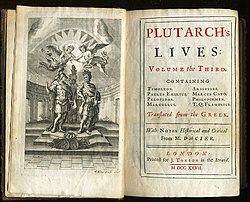
Third volume of a 1727 edition of Plutarch's Lives of the Noble Greeks and Romans printed by Jacob Tonson

A biography, or simply bio, is a detailed description of a person's life. It involves more than just basic facts like education, work, relationships, and death; it portrays a person's experience of these life events. Unlike a profile or curriculum vitae (résumé), a biography presents a subject's life story, highlighting various aspects of their life, including intimate details of experience, and may include an analysis of the subject's personality.

Biographical works are usually non-fiction, but fiction can also be used to portray a person's life. One in-depth form of biographical coverage is called legacy writing. Works in diverse media, from literature to film, form the genre known as biography.

An authorized biography is written with the permission, cooperation, and at times, participation of a subject or a subject's heirs. An unauthorized biography is one written without such permission or participation. An autobiography is written by the person themselves, sometimes with the assistance of a collaborator or ghostwriter.

History

[edit]

At first, biographical writings were regarded merely as a subsection of history with a focus on a particular individual of historical importance. The independent genre of biography as distinct from general history writing, began to emerge in the 18th century and reached its contemporary form at the turn of the 20th century.[1]

Historical biography

[edit]
Einhard as scribe

Biography is the earliest literary genre in history. According to Egyptologist Miriam Lichtheim, writing took its first steps toward literature in the context of the private tomb funerary inscriptions. These were commemorative biographical texts recounting the careers of deceased high royal officials.[2] The earliest biographical texts are from the 26th century BC.

In the 21st century BC, another famous biography was composed in Mesopotamia about Gilgamesh. One of the five versions could be historical.

From the same region a couple of centuries later, according to another famous biography, departed Abraham. He and his 3 descendants became subjects of ancient Hebrew biographies whether fictional or historical.

Xenophon (c. 430 – 355/354 BC) wrote the biography of Cyrus, the founder of the Persian Empire.

One of the earliest Roman biographers was Cornelius Nepos, who published his work Excellentium Imperatorum Vitae ("Lives of outstanding generals") in 44 BC. Longer and more extensive biographies were written in Greek by Plutarch, in his Parallel Lives, published about 80 A.D. In this work famous Greeks are paired with famous Romans, for example, the orators Demosthenes and Cicero, or the generals Alexander the Great and Julius Caesar; some fifty biographies from the work survive. Another well-known collection of ancient biographies is De vita Caesarum ("On the Lives of the Caesars") by Suetonius, written about AD 121 in the time of the emperor Hadrian. Meanwhile, in the eastern imperial periphery, Gospel described the life of Jesus.

In the early Middle Ages (AD 400 to 1450), there was a decline in awareness of the classical culture in Europe. During this time, the only repositories of knowledge and records of the early history in Europe were those of the Roman Catholic Church. Hermits, monks, and priests used this historic period to write biographies. Their subjects were usually restricted to the church fathers, martyrs, popes, and saints. Their works were meant to be inspirational to the people and vehicles for conversion to Christianity (see Hagiography). One significant secular example of a biography from this period is the life of Charlemagne by his courtier Einhard.

In Medieval Western India, there was a Sanskrit Jain literary genre of writing semi-historical biographical narratives about the lives of famous persons called Prabandhas. Prabandhas were written primarily by Jain scholars from the 13th century onwards and were written in colloquial Sanskrit (as opposed to Classical Sanskrit).[3] The earliest collection explicitly titled Prabandha- is Jinabhadra's Prabandhavali (1234 CE).

In Medieval Islamic Civilization (c. AD 750 to 1258), similar traditional Muslim biographies of Muhammad and other important figures in the early history of Islam began to be written, beginning the Prophetic biography tradition. Early biographical dictionaries were published as compendia of famous Islamic personalities from the 9th century onwards. They contained more social data for a large segment of the population than other works of that period. The earliest biographical dictionaries initially focused on the lives of the prophets of Islam and their companions, with one of these early examples being The Book of The Major Classes by Ibn Sa'd al-Baghdadi. And then began the documentation of the lives of many other historical figures (from rulers to scholars) who lived in the medieval Islamic world.[4]

John Foxe's The Book of Martyrs, was one of the earliest English-language biographies.

By the late Middle Ages, biographies became less church-oriented in Europe as biographies of kings, knights, and tyrants began to appear. The most famous of such biographies was Le Morte d'Arthur by Sir Thomas Malory. The book was an account of the life of the fabled King Arthur and his Knights of the Round Table. Following Malory, the new emphasis on humanism during the Renaissance promoted a focus on secular subjects, such as artists and poets, and encouraged writing in the vernacular.

Giorgio Vasari's Lives of the Artists (1550) was the landmark biography focusing on secular lives. Vasari made celebrities of his subjects, as the Lives became an early "bestseller". Two other developments are noteworthy: the development of the printing press in the 15th century and the gradual increase in literacy.

Biographies in the English language began appearing during the reign of Henry VIII. John Foxe's Actes and Monuments (1563), better known as Foxe's Book of Martyrs, was essentially the first dictionary of the biography in Europe, followed by Thomas Fuller's The History of the Worthies of England (1662), with a distinct focus on public life.

Influential in shaping popular conceptions of pirates, A General History of the Pyrates (1724), by Charles Johnson, is the prime source for the biographies of many well-known pirates.[5]

A notable early collection of biographies of eminent men and women in the United Kingdom was Biographia Britannica (1747–1766) edited by William Oldys.

The American biography followed the English model, incorporating Thomas Carlyle's view that biography was a part of history. Carlyle asserted that the lives of great human beings were essential to understanding society and its institutions. While the historical impulse would remain a strong element in early American biography, American writers carved out a distinct approach. What emerged was a rather didactic form of biography, which sought to shape the individual character of a reader in the process of defining national character.[6][7]

Emergence of the genre

[edit]
James Boswell wrote what many consider to be the first modern biography, The Life of Samuel Johnson, in 1791.

The first modern biography, and a work that exerted considerable influence on the evolution of the genre, was James Boswell's The Life of Samuel Johnson, a biography of lexicographer and man-of-letters Samuel Johnson published in 1791.[8][unreliable source?][9][10]

While Boswell's personal acquaintance with his subject only began in 1763, when Johnson was 54 years old, Boswell covered the entirety of Johnson's life by means of additional research. Itself an important stage in the development of the modern genre of biography, it has been claimed to be the greatest biography written in the English language. Boswell's work was unique in its level of research, which involved archival study, eye-witness accounts and interviews, its robust and attractive narrative, and its honest depiction of all aspects of Johnson's life and character – a formula which serves as the basis of biographical literature to this day.[11]

Biographical writing generally stagnated during the 19th century – in many cases there was a reversal to the more familiar hagiographical method of eulogizing the dead, similar to the biographies of saints produced in Medieval times. A distinction between mass biography and literary biography began to form by the middle of the century, reflecting a breach between high culture and middle-class culture. However, the number of biographies in print experienced a rapid growth, thanks to an expanding reading public. This revolution in publishing made books available to a larger audience of readers. In addition, affordable paperback editions of popular biographies were published for the first time. Periodicals began publishing a sequence of biographical sketches.[12]

Autobiographies became more popular, as with the rise of education and cheap printing, modern concepts of fame and celebrity began to develop. Autobiographies were written by authors, such as Charles Dickens (who incorporated autobiographical elements in his novels) and Anthony Trollope (his Autobiography appeared posthumously, quickly becoming a bestseller in London[13]), philosophers, such as John Stuart Mill, churchmen – John Henry Newman – and entertainers – P. T. Barnum.

Modern biography

[edit]

The sciences of psychology and sociology were ascendant at the turn of the 20th century and would heavily influence the new century's biographies.[14] The demise of the "great man" theory of history was indicative of the emerging mindset. Human behavior would be explained through Darwinian theories. "Sociological" biographies conceived of their subjects' actions as the result of the environment, and tended to downplay individuality. The development of psychoanalysis led to a more penetrating and comprehensive understanding of the biographical subject, and induced biographers to give more emphasis to childhood and adolescence. Clearly these psychological ideas were changing the way biographies were written, as a culture of autobiography developed, in which the telling of one's own story became a form of therapy.[12] The conventional concept of heroes and narratives of success disappeared in the obsession with psychological explorations of personality.

Eminent Victorians set the standard for 20th century biographical writing, when it was published in 1918.

British critic Lytton Strachey revolutionized the art of biographical writing with his 1918 work Eminent Victorians, consisting of biographies of four leading figures from the Victorian era: Cardinal Manning, Florence Nightingale, Thomas Arnold, and General Gordon.[15] Strachey set out to breathe life into the Victorian era for future generations to read. Up until this point, as Strachey remarked in the preface, Victorian biographies had been "as familiar as the cortège of the undertaker", and wore the same air of "slow, funereal barbarism." Strachey defied the tradition of "two fat volumes ... of undigested masses of material" and took aim at the four iconic figures. His narrative demolished the myths that had built up around these cherished national heroes, whom he regarded as no better than a "set of mouth bungled hypocrites". The book achieved worldwide fame due to its irreverent and witty style, its concise and factually accurate nature, and its artistic prose.[16]

In the 1920s and 1930s, biographical writers sought to capitalize on Strachey's popularity by imitating his style. This new school featured iconoclasts, scientific analysts, and fictional biographers and included Gamaliel Bradford, André Maurois, and Emil Ludwig, among others. Robert Graves (I, Claudius, 1934) stood out among those following Strachey's model of "debunking biographies." The trend in literary biography was accompanied in popular biography by a sort of "celebrity voyeurism", in the early decades of the century. This latter form's appeal to readers was based on curiosity more than morality or patriotism. By World War I, cheap hard-cover reprints had become popular. The decades of the 1920s witnessed a biographical "boom."

American professional historiography gives a limited role to biography, preferring instead to emphasize deeper social and cultural influences. Political biographers historically incorporated moralizing judgments into their work, with scholarly biography being an uncommon genre before the mid-1920s. Allan Nevins was a major contributor in the 1930s to the multivolume Dictionary of American Biography. Nevins also sponsored a series of long political biographies. Later biographers sought to show how political figures balanced power and responsibility. However, many biographers found that their subjects were not as morally pure as they originally thought, and young historians after 1960 tended to be more critical. The exception is Robert Remini whose books on Andrew Jackson idolize its hero and fends off criticisms. The study of decision-making in politics is important for scholarly political biographers, who can take different approaches such as focusing on psychology/personality, bureaucracy/interests, fundamental ideas, or societal forces. However, most documentation favors the first approach, which emphasizes personalities. Biographers often neglect the voting blocs and legislative positions of politicians and the organizational structures of bureaucracies. A more promising approach is to locate a person's ideas through intellectual history, but this has become more difficult with the philosophical shallowness of political figures in recent times. Political biography can be frustrating and challenging to integrate with other fields of political history.[17]

The feminist scholar Carolyn Heilbrun observed that women's biographies and autobiographies began to change character during the second wave of feminist activism. She cited Nancy Milford's 1970 biography Zelda, as the "beginning of a new period of women's biography, because "[only] in 1970 were we ready to read not that Zelda had destroyed Fitzgerald, but Fitzgerald her: he had usurped her narrative." Heilbrun named 1973 as the turning point in women's autobiography, with the publication of May Sarton's Journal of a Solitude, for that was the first instance where a woman told her life story, not as finding "beauty even in pain" and transforming "rage into spiritual acceptance," but acknowledging what had previously been forbidden to women: their pain, their rage, and their "open admission of the desire for power and control over one's life."[18]

Recent years

[edit]

In recent years,[when?] multimedia biography has become more popular than traditional literary forms. Along with documentary biographical films, Hollywood produced numerous commercial films based on the lives of famous people. The popularity of these forms of biography have led to the proliferation of TV channels dedicated to biography, including A&E, The Biography Channel, and The History Channel.

CD-ROM and online biographies have also appeared. Unlike books and films, they often do not tell a chronological narrative: instead they are archives of many discrete media elements related to an individual person, including video clips, photographs, and text articles. Biography-Portraits were created in 2001, by the German artist Ralph Ueltzhoeffer. Media scholar Lev Manovich says that such archives exemplify the database form, allowing users to navigate the materials in many ways.[19] General "life writing" techniques are a subject of scholarly study.[20]

In recent years, debates have arisen as to whether all biographies are fiction, especially when authors are writing about figures from the past. President of Wolfson College at Oxford University, Hermione Lee argues that all history is seen through a perspective that is the product of one's contemporary society and as a result, biographical truths are constantly shifting. So, the history biographers write about will not be the way that it happened; it will be the way they remembered it.[21] Debates have also arisen concerning the importance of space in life-writing.[22]

Daniel R. Meister in 2017 argued that:

Biography Studies is emerging as an independent discipline, especially in the Netherlands. This Dutch School of biography is moving biography studies away from the less scholarly life writing tradition and towards history by encouraging its practitioners to utilize an approach adapted from microhistory.[23]

Biographical research

[edit]

Biographical research is defined by Miller as a research method that collects and analyses a person's whole life, or portion of a life, through the in-depth and unstructured interview, or sometimes reinforced by semi-structured interview or personal documents.[24] It is a way of viewing social life in procedural terms, rather than static terms. The information can come from "oral history, personal narrative, biography and autobiography" or "diaries, letters, memoranda and other materials".[25] The central aim of biographical research is to produce rich descriptions of persons or "conceptualise structural types of actions", which means to "understand the action logics or how persons and structures are interlinked".[26] This method can be used to understand an individual's life within its social context or understand the cultural phenomena.

Critical issues

[edit]

There are many largely unacknowledged pitfalls to writing good biographies, and these largely concern the relation between firstly the individual and the context, and, secondly, the private and public. Paul James writes:

The problems with such conventional biographies are manifold. Biographies usually treat the public as a reflection of the private, with the private realm being assumed to be foundational. This is strange given that biographies are most often written about public people who project a persona. That is, for such subjects the dominant passages of the presentation of themselves in everyday life are already formed by what might be called a 'self-biofication' process.[27]

Book awards

[edit]

Several countries offer an annual prize for writing a biography such as the:

See also

[edit]

Notes

[edit]

References

[edit]

Further reading

[edit]
[edit]
Revisions and contributorsEdit on WikipediaRead on Wikipedia
from Grokipedia
A is a comprising a detailed, non-fictional of an individual's , authored by a person other than the subject, typically encompassing birth, major events, relationships, achievements, and to illuminate personal character and historical context. The term derives from ancient Greek bios (meaning "life") and graphein (meaning "to write"), literally signifying a written account of a person's life; it entered English in the 17th–18th centuries, reflecting its ancient roots in recounting lives for instructive purposes. Emerging as a distinct form in , biography incorporated anecdotal and evaluative elements in works like those of and , evolving into structured parallels of exemplary figures in Plutarch's Lives (c. 100 CE) and Suetonius' character sketches of Roman emperors, which prioritized moral lessons over strict chronology. Key characteristics include rigorous from primary sources, chronological organization interspersed with thematic analysis, and an ethical commitment to factual accuracy, though biographers' interpretive choices can introduce subjective causal attributions or omissions. Biographies commonly employ chronological structure (narrating events in the order they occurred from birth through key phases to death, providing a linear timeline), organization by life stages or nodes (grouping content into major milestones or periods such as childhood, education, career for thematic focus within an overall chronological flow), thematic structure (organized around central ideas or topics rather than strict chronology), anecdotal approaches (emphasizing illustrative vignettes or short stories), and hybrid forms combining elements of these for enhanced readability and depth. Over centuries, the genre shifted from hagiographic or encomiastic portraits—common in medieval saints' lives—to psychologically probing modern accounts, enabling deeper causal understanding of how personal agency interacts with societal forces, while contending with challenges like incomplete evidence and potential ideological distortions in source selection.

Historical Development

Ancient and Classical Origins

The genre of biography developed in ancient Greece during the Classical period, with early biographical elements appearing in the works of historians and philosophers. Xenophon's Agesilaus (c. 360 BCE) represents one of the earliest datable examples of a focused life narrative, detailing the Spartan king's military campaigns, personal virtues, and moral character rather than exhaustive historical events. Similarly, Plato's dialogues, such as the Apology and Phaedo, incorporate biographical sketches of Socrates, emphasizing his philosophical teachings and ethical stance during his trial and death. These texts prioritized individual character (ethos) over chronological history, laying groundwork for biography as a distinct form separate from historiography. In the Hellenistic era, biography proliferated with accounts of philosophers, poets, and rulers, often compiled in scholarly collections. The , founded by Aristotle's successors, produced bios of eminent figures, including lost works by Aristoxenus on and . Authors like Satyrus of Callatis and Hermippus of Smyrna wrote anecdotal lives of intellectuals, blending factual details with moral exempla to instruct readers on virtue and vice. This period saw biography shift toward encomiastic purposes, serving educational and rhetorical aims in philosophical schools. Roman adaptations built on Greek foundations, with ' De Viris Illustribus (c. 40 BCE) offering concise lives of foreign generals and statesmen, such as , to Roman audiences. Under the Empire, (c. 46–120 CE) elevated the genre through his , pairing Greek and Roman figures—like and Caesar—to compare virtues and leadership flaws, explicitly stating in his Life of Alexander that he sought "the signs of the soul" over "great battles and conflicts." ' (c. 121 CE) complemented this by cataloging emperors' personal habits, scandals, and omens in a rubricated structure, influencing later biographical methods with its archival detail and psychological insights. These works established biography's focus on moral instruction and , distinct from or pure .

Medieval and Renaissance Periods

![Einhard][float-right] During the medieval period, biographical writing predominantly consisted of hagiographies, which portrayed saints as moral exemplars through accounts of their virtues, miracles, and martyrdoms, rather than objective historical narratives. These texts, such as the vitae in collections like the Legenda Aurea, served religious and didactic purposes, embedding lives within ecclesiastical calendars and legends to inspire devotion among the laity and clergy. Secular biographies were rare but emerged in royal and imperial contexts; Einhard's Vita Karoli Magni, written circa 830–833, offered a structured account of Charlemagne's reign, military campaigns, and personal habits, explicitly modeled on Suetonius's classical biographies to legitimize Carolingian rule. This work, based on the author's direct observation as a courtier, emphasized Charlemagne's administrative reforms and cultural patronage, marking an early fusion of classical form with medieval content. The witnessed a humanist revival of ancient biographical models, particularly Plutarch's , which paired Greek and Roman figures to highlight moral character through comparative analysis, influencing Italian scholars to prioritize individual agency and virtue over divine intervention. This shift facilitated more secular and individualistic portraits, as seen in Giorgio Vasari's Le Vite de' più eccellenti pittori, scultori, e architettori, first published in 1550 and expanded in 1568, which chronicled over 200 artists from to . Vasari divided artistic progress into —proto-Renaissance, mature, and high—using biographical sketches to trace stylistic evolution, personal rivalries, and innovations, thereby establishing biography as a historiographical tool for understanding cultural rebirth. His emphasis on empirical details from apprenticeships, commissions, and techniques reflected a causal focus on human effort driving artistic advancement, diverging from medieval . ![Plutarch's Lives, 1727 edition][center] Vasari's methodology, informed by direct access to workshops and contemporaries, prioritized verifiable anecdotes while acknowledging stylistic judgments, influencing subsequent art historical writing by linking personal biography to broader epochal changes. This period's biographies thus transitioned from hagiographic idealization to nuanced portrayals of human achievement, laying groundwork for modern empirical approaches.

Enlightenment and 19th Century Evolution

The Enlightenment period saw biography transition toward empirical detail and psychological depth, diverging from earlier moralistic or exemplary narratives to emphasize individual character and rational inquiry. This shift aligned with broader intellectual currents prioritizing personal experience and verifiable observation over didactic moralizing. 's The Life of Samuel Johnson (1791) exemplified this evolution through its innovative use of recorded conversations, anecdotes, and intimate observations, rendering Johnson as a complex, human figure rather than an idealized icon. Published two years after Johnson's death on December 13, 1784, the two-volume work drew from Boswell's meticulous diaries spanning over 20 years of companionship, establishing standards for source-based authenticity in the genre. Boswell's approach influenced subsequent biographers by demonstrating that biography could capture the minutiae of daily life and intellectual discourse, fostering a "modern" form focused on subjective interiority and chronological fidelity. In England, where the genre matured distinctly during the 18th century, works like this contributed to biography's recognition as a literary form capable of critical analysis, with Johnson's own Lives of the Poets (1779–1781) prefiguring such evaluative depth through assessments of 52 poets' lives and works. In the 19th century, biography expanded amid industrialization and historical scholarship, with Thomas Carlyle's On Heroes, Hero-Worship, and The Heroic in History (1841) advancing the "great man theory," asserting that "Universal History, the history of what man has accomplished in this world, is at bottom the History of the Great Men who have worked here." Carlyle, lecturing from May 1840, framed biography as essential to comprehending causation, privileging heroic individuals—prophets, poets, priests, and kings—as drivers of progress over collective or environmental factors. This perspective permeated Victorian-era works, shifting focus from private eccentricity to public achievement and moral exemplarity, though it later faced critique for overlooking structural influences. Victorian biographies grew more rigorous, incorporating primary documents and a restrained voice to balance adulation with factual scrutiny, as evidenced by the proliferation of multi-volume lives of statesmen and authors amid a reading public exceeding 50% by mid-century. Carlyle's theory, while influential in promoting biography's , underscored tensions between individualistic heroism and emerging sociological views, setting the stage for 20th-century debunking approaches.

20th Century Formalization

The witnessed a pivotal transformation in from Victorian-era hagiographies, which often idealized subjects, to more skeptical and interpretive forms that prioritized psychological depth and critical scrutiny. Lytton Strachey's (1918) served as a landmark, employing selective narration, irony, and exposure of personal failings to dismantle reverential traditions, thereby redefining biography as a tool for revealing human complexity rather than moral elevation. Strachey's method, influenced by the cultural disillusionment following , emphasized brevity and interpretive artistry over exhaustive detail, prompting biographers to adopt a debunking stance that highlighted flaws in prominent figures like and Cardinal Manning. Parallel to this literary shift, the emergence of psychoanalysis formalized psychological analysis within biography, birthing psychobiography as a method to apply clinical theories to historical lives. Sigmund Freud's Leonardo da Vinci and a Memory of His Childhood (1910) pioneered this approach by interpreting da Vinci's art and inventions through repressed childhood experiences and psychosexual development, establishing a framework for probing unconscious motivations in biographical subjects. This integration of empirical psychology—drawing on case studies and theoretical models—gained institutional traction in the 1920s and 1930s, as biographers like Erik Erikson later extended it to figures such as Martin Luther in Young Man Luther (1958), linking personal crises to broader historical causation. By the mid-20th century, these innovations contributed to biography's surge in popularity, rivaling as a preferred form due to its grounding in real individuals amid growing public interest in personality and motivation. Academic and literary circles increasingly treated as a rigorous , with works like Leon Edel's : The Untried Years (1953) exemplifying meticulous archival research combined with Freudian insights to reconstruct inner lives. This era's formalization emphasized verifiable evidence from letters, diaries, and contemporaries, while cautioning against unchecked speculation, though debates persisted over the balance between factual reconstruction and authorial interpretation.

Post-2000 Contemporary Shifts

The advent of digital technologies after 2000 has profoundly expanded access to primary sources for biographers, with digitized archives such as the Library of Congress's American Memory project, launched in expansions post-2000, enabling remote examination of millions of documents previously confined to physical repositories. This shift facilitated more granular reconstructions of subjects' lives, as evidenced by the increased citation of online databases in biographical works; for instance, a 2010 study of post-2000 biographies noted a 40% rise in references to digital collections compared to print-only eras. However, this abundance introduces verification challenges, as uncurated web content often proliferates , demanding rigorous cross-checking against original materials to mitigate errors amplified by algorithmic dissemination. Parallel to technological integration, biographical writing has seen a surge in hybrid forms blending factual narrative with fictional elements, termed "biofiction," which gained prominence in the 2000s as authors like explored novelistic reconstructions of historical figures. This evolution reflects a causal tension between empirical fidelity and interpretive license, with critics arguing that such innovations risk conflating evidence with speculation, particularly when drawing from biased digital footprints like profiles that self-curate personas. Empirical analyses of 21st-century biographies indicate that while these hybrids enhance reader engagement—sales of works like Mantel's (2009) exceeding 5 million copies globally—they necessitate explicit disclosure of fictionalized passages to preserve scholarly integrity. Ethical considerations have intensified with the digital era's erosion of boundaries, as biographers increasingly confront living subjects' online trails, including emails and posts that reveal unfiltered behaviors but raise issues. Post-2000 guidelines from bodies like the Biographers International Organization emphasize anonymizing sensitive unless publicly volunteered, countering institutional tendencies in academia to prioritize ideological narratives over individual agency. This realism underscores a broader methodological pivot: prioritizing causal chains from verifiable actions over interpretive overlays, amid deluges that, per a 2020 review, have doubled timelines due to sifting unreliable sources. Consequently, contemporary biographers favor triangulated evidence—combining digital artifacts with physical interviews—to construct accounts resistant to the selective self-presentation endemic in web-based records.

Research and Methodological Practices

Primary Sources and Verification Protocols

Primary sources in encompass firsthand materials generated by or in close proximity to the subject, including personal letters, diaries, journals, memoirs, official government records, legal documents, photographs, and artifacts. These materials provide direct of the subject's experiences, decisions, and interactions, enabling biographers to reconstruct events through causal chains rather than interpretive overlays. Unlike secondary analyses, primary sources prioritize raw data, such as a politician's unpublished correspondence revealing policy motivations or a scientist's notebooks documenting experimental failures. Verification protocols demand systematic authentication to establish genuineness and contextual accuracy. Biographers trace provenance—documenting chain of custody from origin to present—to confirm physical integrity, often employing forensic techniques like ink composition analysis, paper fiber dating via radiocarbon methods, and ultraviolet spectroscopy for alterations. Handwriting experts compare script fluidity, letter formation, and pressure patterns against verified samples, while linguistic analysis assesses vocabulary, phrasing, and anachronisms for temporal consistency. Cross-verification integrates multiple sources: a diary entry gains credibility if corroborated by contemporaneous letters, eyewitness accounts, or archival records, revealing discrepancies that signal fabrication or memory distortion. Reliability assessment extends to evaluating creator intent, , and potential biases, as primary sources are not inherently neutral. Memoirs or self-authored accounts, while primary, often exhibit self-justificatory omissions or exaggerations, as seen in political figures' selective recollections shaped by reputational concerns. Biographers apply causal realism by testing claims against independent , discounting ideologically driven narratives—such as those from contemporaries with vested interests—unless patterns across diverse affirm them. Forgeries pose acute risks; historical instances, exposed through chemical mismatches or illogical content, underscore the need for skepticism toward unverified personal papers, particularly in high-stakes subjects like wartime leaders. In practice, protocols emphasize : aligning primary data with material artifacts (e.g., dated photographs) and quantitative records (e.g., financial ledgers) to filter subjective distortions. Modern digital tools aid but do not supplant manual scrutiny, as digitized scans may obscure tactile forgeries. This rigor counters systemic overreliance on potentially biased institutional archives, privileging verifiable chains of for causal fidelity over narrative convenience.

Interview Techniques and Archival Analysis

Biographers utilize interview techniques to elicit detailed personal narratives from subjects, contemporaries, and associates, often employing semi-structured or narrative formats that prioritize open-ended questions to uncover subjective experiences and chronological events. These methods, rooted in practices, emphasize rapport-building through and follow-up probes to clarify ambiguities, while recording sessions—via audio or contemporaneous notes—ensures fidelity to responses. Reliability hinges on cross-verifying interviewee accounts against documents or multiple witnesses, as human memory reconstructs events selectively, potentially inflating self-importance or minimizing flaws. James Boswell exemplified early rigorous interviewing in his (1791), transcribing conversations verbatim from fresh journal entries shortly after encounters, a technique that minimized distortion but relied on his proximity to the subject for access. Modern practitioners like , in biographies such as (1974) and the series, conducted over 400 interviews per volume, revisiting sources for consistency and incorporating environmental walkthroughs to evoke contextual details, thereby reconstructing processes through layered testimonies. Such approaches demand skepticism toward potentially self-serving narratives, particularly from politically aligned informants, where ideological motivations may color recollections absent documentary checks. Archival analysis forms the backbone of empirical biographical verification, involving systematic examination of primary documents like letters, diaries, official records, and artifacts preserved in repositories such as national libraries or university collections. Researchers begin with targeted queries to archivists for relevant holdings, followed by on-site immersion to catalog materials, often using finding aids that include scope notes and provenance details to assess authenticity and completeness. Cross-referencing entries—e.g., matching a correspondent's letter against the recipient's reply—reveals discrepancies, such as omissions driven by privacy concerns or deliberate deception, while paleographic analysis detects forgeries through ink age or handwriting inconsistencies. In practice, biographers like Caro spent years in archives, such as the , indexing thousands of documents to trace causal chains in policy decisions, prioritizing unpublished memos over polished public statements for unfiltered insights. This method counters interpretive biases in secondary accounts by grounding claims in tangible evidence, though gaps in archives—due to destruction, selective preservation, or institutional curation favoring certain narratives—necessitate probabilistic inferences rather than certainties, with transparency about evidential limits essential for scholarly integrity. Integrating interviews with archives amplifies rigor: oral claims gain credence when corroborated by records, as in Einhard's (c. 830), which drew on court documents and eyewitness notes to depict Charlemagne's reign beyond hagiographic excess.

Integration of Digital and Emerging Tools

The advent of digitized archives has revolutionized access to primary sources in , enabling scholars to consult vast repositories without physical constraints. Institutions like the provide free online databases containing millions of digitized records, including census data, military service files, and , which biographers use to verify life events and relationships. Similarly, commercial and academic platforms such as EBSCO's Biography Reference Source aggregate over 450,000 full-text biographies and related documents, facilitating cross-referencing of historical figures' timelines and influences. These resources, often enhanced by (OCR) technology, allow for keyword searches across scanned manuscripts, though researchers must account for OCR errors in pre-20th-century texts, which can introduce inaccuracies requiring manual validation. Digital humanities tools have integrated computational methods to analyze biographical data, such as network analysis software that maps interpersonal connections from correspondence or co-authorship records, revealing social influences on a subject's decisions. Timelines and temporal modeling applications, like those in tools such as Timeline JS or custom GIS platforms, enable visualization of life trajectories, incorporating geospatial data to trace migrations or event locations with precision—for instance, plotting a figure's travels using latitude-longitude coordinates from archival logs. Reference management systems like Zotero further streamline workflows by automating citation tracking and metadata extraction from digital sources, reducing errors in synthesizing evidence from disparate online collections. Emerging technologies, particularly (AI) and , are increasingly applied to biographical analysis, though their outputs demand rigorous human scrutiny due to potential hallucinations or biases in training data. algorithms, such as (LDA), extract thematic threads from unstructured biographical texts, organizing narratives around recurring motifs like career pivots or ideological shifts. AI models like have been tested for transforming tabular data—e.g., entries—into coherent life summaries, with studies showing utility in initial drafting but highlighting inconsistencies influenced by prompt complexity or query timing. In frameworks, ontology-based systems link entities (persons, events, artifacts) to generate interactive biographies, enhancing by modeling relationships empirically rather than anecdotally. However, biographers emphasize that AI augments rather than supplants first-hand verification, as unexamined algorithmic outputs risk fabricating details absent from source material, underscoring the need for protocols to cross-check against originals.

Ethical Challenges and Controversies

Accuracy, Fabrication, and Empirical Verification

Accuracy in biography demands rigorous empirical verification to distinguish it from fiction or memoir, where subjective interpretation may prevail. Biographers typically begin with primary sources such as personal correspondence, diaries, official documents, and archival records to establish verifiable timelines and events. Cross-referencing these against secondary accounts from contemporaries ensures corroboration, while interviews with living associates or descendants provide firsthand perspectives, though subject to memory fallibility. Fact-checking protocols involve tracing every claim to its origin, often employing historians or specialists for contentious details, to mitigate errors from incomplete records or conflicting testimonies. Failure to verify empirically risks perpetuating distortions, as seen in historical biographies reliant on unvetted oral traditions without documentary support. Fabrication undermines the genre's epistemic authority, involving the invention of dialogues, motives, or events absent from evidence. Notable cases include the 1983 "" , where over 60 volumes of fabricated journals were authenticated by experts and influenced biographical narratives before chemical analysis and historical inconsistencies exposed the hoax, leading to Stern magazine's retraction and legal convictions. Similarly, historian Stephen Ambrose faced accusations in the early 2000s of inventing soldier testimonies and plagiarizing in works like Citizen Soldiers, though he defended some as reconstructed from patterns in verified accounts; subsequent investigations confirmed unattributed lifts from primary sources, eroding trust in his biographies. Such incidents highlight causal risks: fabricated elements can cascade into accepted lore, altering perceptions of figures' decisions and influences absent empirical anchors. Empirical verification protocols have evolved with digital tools, yet ethical lapses persist due to pressures for coherence over fragmented data. Biographers must prioritize , discounting ideologically driven accounts—such as those from partisan contemporaries—through with neutral records. In practice, organizations like the Biographers International Organization advocate transparency in methodologies, including endnotes detailing verification chains, to allow reader . Controversies arise when biographers infer unprovable internals, like psychological states, without behavioral , blurring into ; defenses claim such reconstruction aids causal understanding, but critics argue it invites fabrication under interpretive guise. Consequences include professional ostracism, as with Ambrose's diminished reputation, and calls for pre-publication audits in academic presses to enforce standards.

Inherent Biases and Ideological Influences

Biographers inevitably introduce inherent biases stemming from personal experiences, cultural contexts, and ideological commitments, which affect the curation of facts, interpretive frameworks, and emphasis. These subjective elements can lead to selective omission of disconfirming or amplification of traits aligning with the author's preconceptions, compromising the pursuit of objective . In medieval hagiographies, ideological influences were overt, with texts designed to edify rather than document, portraying subjects as divine exemplars to bolster ecclesiastical and monarchical authority. Accounts of saints and rulers, such as Einhard's Vita Karoli Magni (circa 830 AD), idealized Charlemagne's reign through miraculous attributions and moral elevation, serving Carolingian propaganda while sidelining political machinations or personal failings. Such works prioritized faith-based causality over empirical scrutiny, reflecting the era's theocentric worldview. Later periods saw shifts toward professed objectivity, yet ideological undercurrents persisted. James Boswell's (1791) exemplifies admiring bias, as Boswell's discipleship amplified Johnson's intellect and wit while minimizing contradictions, driven by personal reverence rather than detached analysis. In contrast, 20th-century critiques like Lytton Strachey's (1918) wielded irony to dismantle heroic myths, influenced by Bloomsbury skepticism toward empire and tradition, thus inverting into ideological debunking. Modern biography writing, especially in academia and , exhibits systemic ideological skews due to left-leaning predominance among scholars and journalists. Surveys indicate faculty political ratios of liberals to conservatives exceeding 12:1 in social sciences and , fostering portrayals that align progressive values with virtue while framing conservative figures through lenses of or threat. This manifests in polarized accounts of politicians, where biographies of left-leaning leaders emphasize redemptive arcs, whereas those of right-leaning ones, such as or , often highlight purported flaws amplified by . Truth-seeking requires evaluating biographers' affiliations and cross-referencing against primary sources to discern distortions, acknowledging that no account escapes the causal imprint of .

Privacy Rights Versus Public Interest

In biography writing, the ethical and legal tension between subjects' privacy rights and the public's interest in truthful accounts of influential lives manifests in decisions over disclosing personal details. Privacy protections encompass torts such as public disclosure of private facts—revealing embarrassing, non-newsworthy information obtained lawfully but without consent—and intrusion upon seclusion, where biographers employ deceptive or invasive methods to gather data. For public figures, however, courts in jurisdictions like the United States apply a newsworthiness exception, limiting privacy claims if the information bears on the subject's public role or character traits relevant to their influence, as established in precedents recognizing reduced privacy expectations for those seeking public attention. Unauthorized biographies heighten these risks, potentially exposing authors to misappropriation of likeness claims or breach of confidence suits, though defenses succeed when facts derive from public records or verifiable sources rather than confidential breaches. Prominent cases illustrate this conflict without resolving it uniformly. Kitty Kelley's unauthorized biographies, such as His Way: The Unauthorized Biography of (1986), prompted preemptive lawsuits from subjects alleging privacy invasions, yet none succeeded on those grounds; Sinatra sued Kelley before drafting began, but courts dismissed claims absent proof of falsehood or irrelevance, prioritizing in scrutinizing celebrities' conduct. Similarly, Andrew Morton's Diana: Her True Story (1992), compiled from Princess Diana's covert audio tapes detailing her bulimia, , and marital , ignited controversy for breaching royal decorum and family , though Morton argued the disclosures illuminated causal factors in her public persona and the monarchy's dysfunction, serving broader societal understanding amid Diana's global prominence. These instances highlight how biographers navigate legal hurdles by substantiating relevance, often prevailing when private revelations causally explain public actions or decisions affecting millions. Ethically, guidelines urge biographers to seek from living subjects or heirs where feasible, but for deceased public figures, prevails if private elements—like issues or intimate relationships—demonstrably shaped or societal impact, rather than gratifying curiosity. This calculus demands assessing potential harm to survivors against empirical value, with unauthorized works risking reputational backlash yet advancing causal realism by countering sanitized narratives from estates or biased institutions. Overly restrictive deference could obscure truths about leaders' decision-making, as seen in critiques of authorized biographies that omit unflattering details, whereas rigorous verification upholds intellectual validity without fabricating or sensationalizing.

Subgenres and Variations

Authorized Versus Unauthorized Approaches

Authorized biographies involve the explicit cooperation and approval of the subject or their estate, providing biographers with privileged access to private correspondence, diaries, and firsthand recollections that enhance factual depth and contextual nuance. This collaboration often results in a narrative shaped by the subject's input, which can ensure accuracy on verifiable events but may prioritize a favorable self-image, leading to omissions of contentious episodes or critical interpretations. In methodology, authorized biographers conduct structured interviews and receive curated materials, fostering a symbiotic relationship that aligns the work with the subject's legacy goals, as seen in Nicholas Shakespeare's Ian Fleming: The Complete Man (2023), the first authorized Fleming biography since 1966, drawing on family archives and unpublished letters. Unauthorized biographies, by definition, lack such endorsement and proceed independently, compelling authors to aggregate , third-party testimonies, and techniques without direct subject verification. This approach demands rigorous cross-verification from disparate sources to mitigate gaps in access, often yielding portrayals that challenge official narratives by highlighting discrepancies between public personas and private behaviors. However, it carries heightened risks of legal challenges, including claims or invasions, though U.S. First Amendment protections and doctrines generally permit publication absent provable falsehoods or malice. Kitty Kelley's His Way: The Unauthorized Biography of (1983), for instance, relied on over 800 interviews with associates to detail alleged and infidelities, sparking lawsuits from Sinatra but ultimately upheld for its evidential basis despite subject denials. The divide underscores tensions in biographical truth-seeking: authorized works offer empirical advantages in proprietary data but invite critiques of hagiographic bias, where subjects exert editorial influence to suppress causal factors like personal failings. Unauthorized efforts, conversely, promote causal realism by pursuing unfiltered accounts, potentially exposing systemic cover-ups, though they demand exceptional source vetting to avoid —evident in Albert Goldman's (1988), which controversially alleged drug-fueled decline based on archival and witness data, fueling debates over interpretive overreach. Empirical studies of biographical reliability suggest unauthorized texts, when methodologically sound, better capture multifaceted personalities by circumventing , though both forms necessitate reader discernment of access-driven limitations.

Collective and Group Biographies

Collective biographies, alternatively termed group biographies, constitute a subgenre wherein multiple individuals' lives are documented within a single work, typically linked by shared attributes, eras, professions, or thematic motifs to facilitate comparative scrutiny and reveal collective patterns or societal influences. This approach contrasts with singular-subject biographies by prioritizing interconnections and aggregate insights over exhaustive individual detail, often employing selective narratives to underscore common virtues, flaws, or historical contingencies. Scholarly analyses emphasize its utility in socio-historical inquiry, as the method aggregates lives to discern broader causal dynamics, such as cultural shifts or network effects, rather than isolating personal agency. The antecedents of collective biography extend to classical antiquity, most prominently embodied in Plutarch's Parallel Lives, composed around 100 AD, comprising 48 paired accounts of illustrious Greek and Roman figures, such as and , juxtaposed to exemplify moral lessons through direct comparison of character and conduct. Plutarch's framework, drawing from historical records and , aimed not at comprehensive chronology but at ethical edification, highlighting how environmental and personal factors shaped outcomes across disparate yet analogous lives. Subsequent traditions include Giorgio Vasari's Lives of the Most Excellent Painters, Sculptors, and Architects (1550), which chronicled over 200 artists, linking their biographies to trace the evolution of artistic styles and patronage systems in from the 13th to 16th centuries. In the modern era, Lytton Strachey's (1918) exemplifies a revival and critique of the form, presenting abbreviated, ironic profiles of four 19th-century Britons—Cardinal , , , and General Charles Gordon—to dismantle hagiographic myths and expose hypocrisies in Victorian piety, efficiency, and imperialism. Strachey's method, influenced by post-World War I disillusionment, favored psychological insight and archival selectivity over exhaustive verification, achieving commercial success with over 100,000 copies sold by 1920 while sparking debates on biographical brevity's trade-offs in accuracy. Other notable instances include John Foxe's Acts and Monuments (1563, commonly Book of Martyrs), aggregating narratives of Protestant persecutees under Catholic regimes, totaling over 2,000 pages in its 1583 edition, to bolster historiography through evidentiary compilations of trials and executions. Methodologically, collective biographies demand rigorous source triangulation across subjects to mitigate individual biases, yet they inherently grapple with scale: scholars note that insufficient cases risk anecdotalism, while excess dilutes depth, as evidenced in quantitative thresholds proposed for validity, such as aggregating at least 10-20 lives for pattern emergence in prosopographical studies. Advantages include enhanced via contrasts—e.g., Strachey's portrayal of Nightingale's statistical rigor against Gordon's adventurism elucidates divergent imperial rationales—and resistance to idolization by contextualizing figures within cohorts. Drawbacks encompass potential oversimplification, where thematic imposition eclipses empirical variance, and logistical challenges in verifying disparate archives, underscoring the genre's reliance on the biographer's integrative judgment over singular factual exhaustiveness. Despite these, the form persists in contemporary for its capacity to humanize historical collectives, as in prosopographies of political elites or professional guilds, fostering nuanced understandings of influence propagation.

Specialized Forms Like Psychobiography

Psychobiography represents a specialized subgenre of biographical writing that integrates psychological theories and empirical research to interpret the inner motivations, developmental trajectories, and personality dynamics of historically significant individuals. Originating in the early , it traces its roots to Sigmund Freud's 1910 essay on , where Freud applied psychoanalytic concepts to analyze the artist's creativity and based on and artistic output. This approach expanded in the mid- through works like Erik Erikson's 1958 Young Man Luther, which employed to examine Martin Luther's religious transformation amid personal crises, drawing on archival letters and theological texts for evidence. Methodologically, psychobiography emphasizes rigorous from primary sources such as diaries, correspondence, and , followed by theoretical application while guarding against common pitfalls like retrospective distortion or overgeneralization from theory to life facts. Practitioners outline structured steps, including peripheral to contextualize the subject's , formulation of questions grounded in psychological models (e.g., or trait ), and iterative analysis to test hypotheses against verifiable evidence rather than unsubstantiated speculation. For instance, contemporary studies might apply frameworks to figures like , assessing life through of autobiographical writings and interviews, ensuring interpretations align with longitudinal patterns in the subject's behavior. Evaluation criteria include theoretical coherence, empirical fidelity, and avoidance of pathologizing normal traits, with effective works balancing psychological depth against sociocultural influences. Despite its insights into causal personality factors, psychobiography faces methodological critiques for potential reductionism, where internal psychological constructs overshadow external determinants like economic pressures or political structures, as noted in analyses of its historical applications. Scholarly reviews highlight risks of confirmation bias, where theorists selectively interpret evidence to fit preconceived models, necessitating cross-verification with diverse sources to mitigate ideological influences prevalent in psychological scholarship. Recent revivals, such as single-case studies on figures like Jeffrey Dahmer using developmental psychopathology, underscore its value in illuminating extraordinary life paths when anchored in falsifiable claims and peer-reviewed scrutiny, though overuse of untested Freudian paradigms has drawn empirical skepticism. This form thus demands heightened verification protocols to distinguish causal realism from interpretive overreach.

Criticisms, Defenses, and Intellectual Validity

Limitations in Capturing Causal Reality

Biographies encounter fundamental constraints in reconstructing the causal mechanisms underlying historical figures' decisions and trajectories, primarily due to the incompleteness and selectivity of available evidence. Personal documents such as letters and journals offer fragmented insights, often reflecting curated self-images rather than unmediated realities, while unspoken influences like drives or contemporaneous pressures remain undocumented. Even voluminous archives, as in the case of Giacomo Leopardi's extensive correspondence and notebooks spanning multiple volumes, yield only partial views of inner motivations, with biographers like emphasizing that only the subject fully comprehends their own existence. This evidentiary gap hinders precise delineation of causal chains, as subjective recollections in memoirs introduce distortions from and emotional filtering, limiting reliable inference of action precipitating factors. The biographer's narrative construction exacerbates these issues, imposing artificial coherence on disparate events to fulfill literary imperatives of plot and resolution, often at the expense of authentic causation. Volker Depkat identifies this as biography's oscillation between factual and fictional , where selections of turning points and emphases create a "biographical " of purposeful progression, as theorized by , masking the contingency and multiplicity of real-world influences. Critics like decry such works as presenting minutiae devoid of deeper meaning, prioritizing over rigorous . Institutional biases in modern scholarship, particularly within academia, further compound this by favoring ideologically aligned causal attributions—such as overemphasizing structural inequities—without commensurate empirical validation, reflecting systemic interpretive slants rather than objective reconstruction. Moreover, biographies' individualistic lens inadequately accommodates broader deterministic forces, such as socioeconomic structures or collective dynamics, which historians like argue transcend personal agency in shaping epochs. No single life's aligns seamlessly with historical periods, rendering causal explanations within biographical bounds prone to oversimplification and elite-centric distortion, as ordinary influences on evade comprehensive capture. These genre-inherent shortcomings underscore biography's value as interpretive synthesis rather than definitive causal chronicle, necessitating cross-verification with multifaceted historical data for truth-seeking inquiries.

Strengths in Empirical Personality Analysis

Biographies excel in empirical personality analysis by drawing on verifiable archival sources, including letters, diaries, , and eyewitness accounts, to reconstruct behavioral patterns and motivational drivers across an individual's lifespan. This longitudinal data enables observers to trace the manifestation and evolution of traits such as or resilience in authentic contexts, offering a depth unattainable through self-report questionnaires or short-term observations. For instance, psychobiographers apply experimental psychological findings to dissect how early adversities causally influence later achievements, as seen in analyses of figures like , where documented decisions reveal adaptive coping mechanisms grounded in real events rather than abstracted models. The method's strength lies in its idiographic application of theories, testing broad personality constructs—such as those from the Big Five model—against the unique interplay of personal agency and environmental contingencies in a single life. By triangulating disparate sources, biographies mitigate interpretive biases inherent in singular narratives, fostering causal realism through evidence of recurrent behaviors under varying pressures; this contrasts with experimental psychology's artificial settings, providing ecologically valid insights into trait stability and change. Rigorous works, like James Boswell's detailed chronicling of Samuel Johnson's conversations and habits from 1763 onward, exemplify how contemporaneous records yield empirical anchors for personality inference, avoiding retrospective fabrication. Moreover, biographies illuminate socio-cultural moderators of , revealing how institutional biases or historical upheavals interact with innate dispositions to produce outcomes, thus contributing to a nuanced understanding beyond decontextualized statistics. Empirical validity is enhanced when biographers prioritize primary documents over secondary interpretations, as in psychobiographical studies that cross-validate claims against multiple archives, yielding probabilistic assessments of traits' influence on pivotal decisions. This approach has informed personality science by particularizing general hypotheses to exceptional cases, demonstrating, for example, how high facilitated innovative breakthroughs in lives like Albert Einstein's, supported by patent records and correspondence from 1905.

Debates on Bias in Modern Scholarship

Modern scholarship, particularly in the humanities and social sciences, has been subject to ongoing debates regarding ideological bias, with empirical studies indicating a pronounced left-leaning orientation among academics that influences research outputs, including biographical works. Surveys of faculty political affiliations reveal significant imbalances; for instance, a 2020 analysis found liberals considerably overrepresented on university campuses across faculty, administrators, and students, with ratios often exceeding 10:1 in favor of Democrats over Republicans in fields like history. Similarly, voter registration data from 2016 showed Democrats outnumbering Republicans 11.5 to 1 among social scientists, a disparity that extends to historians where approximately 80% identify as Democrats or lean left. This skew raises questions about the neutrality of interpretive scholarship, as political donations by academics further correlate with Democratic support, suggesting potential self-selection or institutional reinforcement of progressive viewpoints. In biographical scholarship, these debates center on how ideological predispositions shape portrayals of historical figures, often prioritizing frameworks like over . Historians' assessments of contemporary events have been shown to reflect personal political preferences, with left-leaning scholars more likely to favor abstracts aligning with progressive narratives in . Critics argue this manifests in revisionist biographies that retroactively apply modern ideological lenses—such as emphasizing over personal agency—to figures like or , potentially distorting causal accounts of their actions and achievements. Defenders, however, contend that apparent biases stem from alignment with rather than partisanship, though such claims are contested by data on faculty homogeneity limiting viewpoint diversity. For example, a study confirmed academics' average left-leaning orientations exceed those of the general , correlating with hiring and patterns that marginalize conservative interpretations. The implications for biographical validity include challenges to causal realism, where monocausal or ideologically driven explanations supplant multifaceted analyses grounded in primary sources. Organizations like highlight how this imbalance fosters echo chambers, reducing scholarly robustness; a 2022 study of scientists' donations (analogous to humanities trends) found overwhelming Democratic support, implying similar dynamics in interpretive fields like biography. Empirical critiques, such as those examining politicized teaching or peer review, underscore the need for transparency in disclosing scholars' affiliations to mitigate perceived distortions. While some outlets downplay the issue, asserting minimal impact on outputs, aggregated evidence from faculty surveys and donation patterns substantiates systemic left-wing predominance, prompting calls for ideological pluralism to enhance truth-seeking in biographical endeavors.

Recognition, Awards, and Market Dynamics

Prestigious Awards and Their Criteria

The Pulitzer Prize for Biography or Autobiography, administered by Columbia University since 1917, recognizes a distinguished and appropriately documented biography or autobiography authored by an American, awarding $15,000 to the winner. Eligibility requires the work to be published in the United States during the award's eligibility period, with emphasis on factual accuracy, thorough documentation from primary sources, and significant contribution to understanding the subject's life and historical context, as determined by a panel of jurors and the Pulitzer Board. This criterion prioritizes empirical rigor over stylistic flair alone, though narrative quality influences selections; for instance, recent winners like King: A Life by Jonathan Eig (2024) were lauded for extensive archival research into Martin Luther King Jr.'s personal and public dimensions. The for Biography and , presented annually by the since 1950, honors outstanding works published by U.S.-based publishers between December 1 of the prior year and November 30 of the award year, with no nationality restriction on authors but requiring English-language editions. Judging panels of five writers, critics, and academics evaluate entries based on literary excellence, originality, and insightful portrayal of the subject's character and era, favoring comprehensive narratives that illuminate broader human or societal truths without mandating exhaustive documentation. Unlike the Pulitzer's strict American-author focus, this award has recognized diverse international subjects, such as Woman of Letters: A Life of (1976), underscoring criteria that value empathetic depth and cultural resonance over purely evidentiary standards. The for Biography, established in 1970 by the NBCC, targets books published in English during the calendar year, selected by a vote of the organization's 600+ members after nominations by a . Criteria emphasize critical acclaim for interpretive insight, stylistic distinction, and avoidance of , with jurors prioritizing works that challenge conventional narratives through evidence-based analysis, as seen in awards for rigorously sourced volumes like those on historical figures' overlooked flaws and achievements. This peer-driven process, while subjective, counters potential institutional biases by drawing from independent critics rather than academic panels, though it excludes previously published English editions to ensure novelty. The Award, conferred by Biographers International Organization (BIO) since 2000, celebrates the best biography of the prior year regardless of publication date or nationality, judged by a panel of biographers on criteria including research depth, narrative coherence, and fidelity to causal factors in the subject's life, often favoring works that integrate primary documents to reveal personality-driven outcomes. Complementing this, BIO's lifetime achievement award recognizes sustained contributions to the , highlighting criteria like methodological innovation in sourcing and analysis over commercial appeal. These awards collectively underscore biography's validity through verifiable evidence, though selection processes vary in weighting subjective interpretation against empirical claims.

Commercial Success and Reader Impact

Biographies and memoirs have demonstrated substantial commercial viability within the publishing industry, often comprising a notable portion of sales. In 2017, nonfiction book revenues in the United States reached $6.18 billion, surpassing fiction's $4.3 billion, with biographies and memoirs contributing significantly to this category through high-profile releases. Globally, these genres account for a meaningful share of the approximately 2.2 billion books sold annually, bolstered by titles achieving multimillion-copy sales. Exemplary bestsellers underscore this success, such as Dave Pelzer's A Child Called It, which sold over 1 million copies since 2001 and generated more than £5.5 million in revenue in the alone. Recent hits include Prince Harry's Spare and Michelle Obama's works, which topped charts in 2023, reflecting sustained demand for personal narratives from public figures. Historical standouts like Benjamin Franklin's have exceeded 5 million copies sold, while Barack Obama's has similarly amassed millions, illustrating the genre's enduring market appeal across eras. Subsegments, such as biographies and memoirs, have seen revenue growth of 26% over five years ending in , despite some unit sales fluctuations. Reader engagement with biographies reflects their impact in fostering , historical insight, and personal inspiration, as evidenced by surveys indicating strong preferences within readership. Approximately 61% of enthusiasts select biographies and memoirs as their favored format, highlighting the 's role in drawing sustained audience interest. , about 30% of adults report enjoying memoirs and biographies, with these readers often exhibiting higher engagement in self-improvement and cultural topics compared to non-readers of the genre. This reception translates to broader influence, as biographical accounts provide accessible case studies of individual agency and decision-making, influencing public perceptions of leadership and adversity without relying on aggregated data alone.

Broader Cultural and Historical Influence

Shaping Public Narratives and Myth Debunking

Biographies have long served as instruments for constructing and influencing collective understandings of historical figures, often embedding moral lessons that guide public evaluation of leadership qualities. Plutarch's , written in the late 1st to early 2nd century AD, paired biographies of Greek and Roman statesmen to highlight virtues and vices, thereby shaping perceptions of power and governance across subsequent eras, including the , where figures like Montaigne drew upon them for ethical instruction. This approach rendered abstract historical events vivid through personal narratives, fostering a public discourse on character that extended to modern assessments of rulers. In parallel, biographies counteract entrenched myths by subjecting idealized portrayals to scrutiny based on primary evidence, thereby refining causal interpretations of individual actions within broader contexts. Lytton Strachey's (1918) exemplifies this corrective function, dissecting hagiographic depictions of Victorian icons such as and Cardinal Manning to reveal manipulative tendencies and personal ambitions, challenging the era's self-congratulatory moral superiority. Strachey's ironic style dismantled uncritical hero-worship, influencing subsequent biographical practice to prioritize psychological depth over adulation and prompting reevaluations of figures once enshrined in national mythologies. Such debunking efforts underscore biography's role in causal realism, where empirical details expose how personal flaws or strategic decisions—rather than mythic inevitability—drove historical outcomes, as seen in Strachey's portrayal of Nightingale's administrative ruthlessness amid reforms. This process not only alters public narratives but also guards against distortions propagated by contemporary or , ensuring that assessments of legacy prioritize verifiable actions over romanticized legends. However, the efficacy of myth correction depends on biographers' fidelity to sources, as selective emphasis can inadvertently perpetuate alternative biases, necessitating cross-verification against archival records.

Contributions to Causal Understanding of Events

Biographies enhance causal understanding of historical events by tracing the influence of individual agency, motivations, and character traits on broader outcomes, providing a micro-level perspective often absent in macro-historical narratives. Unlike that catalog events chronologically, biographical accounts reconstruct decision-making processes, revealing how personal qualities precipitate actions that alter trajectories, such as military campaigns or political reforms. This approach grounds abstract causation in concrete human stories, facilitating comprehension of why events unfolded as they did rather than merely documenting that they occurred. A seminal example is Plutarch's Parallel Lives, composed in the late first century AD, which pairs Greek and Roman figures to compare how virtues and vices shape destinies and events. Plutarch emphasizes character as a primary causal driver, illustrating through anecdotes how traits like ambition in fueled conquests or prudence in preserved republican ideals amid civil strife. For instance, in the life of Caesar, Plutarch depicts episodes of audacity and calculation that directly link personal boldness to pivotal decisions, such as on January 10, 49 BC, thereby initiating the Roman Civil War. This method underscores causal realism by prioritizing ethical evaluations of actions over deterministic structural forces, enabling readers to discern patterns where individual flaws or strengths amplify or mitigate historical contingencies. In medieval historiography, Einhard's Vita Karoli Magni, written around 817–830 AD, exemplifies biography's role in explicating empire-building causation through Charlemagne's personal leadership. The text details how Charlemagne's strategic marriages, military campaigns—totaling 53 expeditions—and administrative reforms, driven by his intellectual curiosity and piety, consolidated the , spanning over 1 million square kilometers by 814 AD. Such works reveal causal chains from ruler's volition to institutional legacies, countering views of events as inexorable by highlighting contingency in personal resolve. Biographies thus serve as tools for dissecting multi-causal webs, integrating psychological insights with verifiable actions to model event generation more robustly than aggregated data alone.

References

Add your contribution
Related Hubs
User Avatar
No comments yet.