Hubbry Logo
Black scorpionfishBlack scorpionfishMain
Open search
Black scorpionfish
Community hub
Black scorpionfish
logo
8 pages, 0 posts
0 subscribers
Be the first to start a discussion here.
Black scorpionfish
Black scorpionfish
from Wikipedia

Black scorpionfish
Scientific classification Edit this classification
Kingdom: Animalia
Phylum: Chordata
Class: Actinopterygii
Order: Perciformes
Family: Scorpaenidae
Genus: Scorpaena
Species:
S. porcus
Binomial name
Scorpaena porcus
Synonyms[3]
  • Scorpaena erythraea Cuvier, 1829
  • Scorpaena klausewitzi Frøiland, 1972

The black scorpionfish (Scorpaena porcus), also known as the European scorpionfish or small-scaled scorpionfish, is a venomous scorpionfish, common in marine subtropical waters. It is widespread in the eastern Atlantic Ocean from the British Isles to the Azores and Canary Islands, near the coasts of Morocco, and in the Mediterranean Sea and the Black Sea.[3]

Taxonomy

[edit]

The black scorpionfish was first formally described in 1758 by Carl Linnaeus in the 10th edition of his Systema Naturae in which he gave the type localities as the Mediterranean Sea and the Atlantic Ocean.[4] Linnaeus also described the genus Scorpaena and in 1876 the Dutch ichthyologist Pieter Bleeker designated S. porcus as the type species of the genus Scorpaena.[5] The specific name porcus means "pig", an allusion which Linnaeus did not explain. However, it may reference the belief, originating with Athenaeus, who said that he observed this species eating algae or weed and this was mistranslated in the Renaissance as "mud".[6]

Description

[edit]
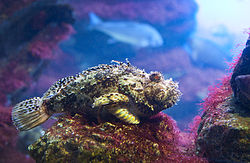
A black scorpionfish in Mallorca, Spain

The black scorpionfish has a maximum length of about 37 cm (15 in), but a more normal adult length is around 15 cm (6 in). The head is broad with a short snout and upwardly angled mouth. A short tentacle is just above the eye and various other shorter tentacles, spines, and flaps of skin decorate the head. The dorsal fin has 12 spines and 9 soft rays and the anal fin has two spines and six soft rays. The pectoral fins are large and oval and have 16-18 rays. The colour of this fish is generally brownish and a dark-pigmented spot occurs between the eighth and ninth dorsal spines. The fins are mottled with brown, and the caudal fin has three vertical brown stripes. [7]

Distribution and habitat

[edit]

The black scorpionfish is native to the eastern Atlantic Ocean, the Mediterranean Sea, and the Black Sea. Its range extends southwards from the southern half of the British Isles to the Azores, the Canary Islands, and the northwestern coast of Africa. It is found throughout the Mediterranean Sea and the Black Sea down to depths around 800 m (2,625 ft).[3]

Biology

[edit]
A black scorpionfish buried in the sand near Koufonisi in Greece

The black scorpionfish is a benthic species and is usually found resting among seaweed and on rocks.[7] It is usually solitary and is not territorial.[8] This is one of the fish used by the marine leech Pontobdella muricata as a host.[9]

Hunting and diet

[edit]

Like all the members of the Scorpaeninae subfamily, it is an ambush predator.[10] It waits motionless for its prey to pass by and then leaps forward instantly to suck it in with its large mouth.[11] It feeds on small fishes such as blennies and gobies, crustaceans and other bottom-dwelling invertebrates.[7]

Reproduction

[edit]

Little is known about its reproduction,[7] it is oviparous, and the females lay eggs that are enclosed in a transparent, mucous mass; sometime in July and August.[11]

Defense mechanisms

[edit]

The black scorpionfish has poisonous needles located on its dorsal, anal, and ventral fins, and on its operculum.[11]

References

[edit]
[edit]
Revisions and contributorsEdit on WikipediaRead on Wikipedia
from Grokipedia
The black scorpionfish (Scorpaena porcus) is a venomous benthic marine fish in the family , known for its cryptic coloration and ambush predation strategy, typically reaching a maximum length of 40.5 cm and inhabiting and algal substrates from shallow coastal waters to depths of 800 m. Native to the eastern —including from the to the , , and —as well as the Mediterranean and Black Seas, it is a demersal, non-migratory species that remains solitary and sedentary among hard or mixed bottoms. Featuring 12 dorsal spines, 7-9 dorsal soft rays, 3 anal spines, and 4-6 anal soft rays, along with well-developed cirri on the head and body for , it displays a compressed body cross-section covered in small, emarginate scales, often in shades of brown, orange, or black with lighter patches and dark bars on the caudal fin. Its venomous spines on the dorsal, pelvic, and anal fins can cause intense pain to humans upon contact, treatable with immersion in hot water. Ecologically, the black scorpionfish is a carnivorous predator with a of approximately 3.9, feeding primarily on small fishes such as gobies and blennies, as well as crustaceans and other , using its motionless posture to prey in shallow to moderate depths of 0.5–40 m on rocky, sandy, or meadows. It matures at around 14.4 cm in length and reproduces in summer ( to ), though specific details on spawning remain limited in available records. Despite its minor role in commercial fisheries and the aquarium trade, populations have shown declines in abundance and average size—such as in the Sicilian , where catches dropped from 62 to 4 specimens per day between 2001 and 2021—primarily due to by professional and recreational activities. Classified as Least Concern by the IUCN, it poses a traumatogenic risk to divers and fishers but contributes to local marine as a voracious, non-territorial resident.

Taxonomy

Scientific classification

The black scorpionfish is formally known by the binomial name Scorpaena porcus, which was first described by the Swedish naturalist in the 10th edition of Systema Naturae published in 1758. Its taxonomic hierarchy within the biological classification system is as follows:
RankTaxon
KingdomAnimalia
PhylumChordata
Class
Order
Family
GenusScorpaena
SpeciesS. porcus
The type locality for S. porcus is the , reflecting the regions from which Linnaeus's original specimens were sourced. Within the family , S. porcus belongs to the genus , which encompasses over 30 species of scorpionfishes distributed across temperate and tropical marine environments; S. porcus holds particular significance as the of this genus, a status subsequently designated by the Dutch ichthyologist in 1876. The family is distinguished by features such as venomous spines on the dorsal, anal, and pelvic fins, a trait shared among its approximately 400 worldwide.

Etymology and common names

The scientific name Scorpaena porcus was established by in 1758. The genus name Scorpaena originates from the Greek skorpaina (σκορπαινα), denoting a type of spiny , reflecting the characteristic venomous dorsal spines reminiscent of a scorpion's sting. The specific epithet porcus derives from the Latin word for "pig" or "hog," an allusion not explicitly explained by Linnaeus, possibly referring to the fish living in and feeding upon or , as noted by (with Renaissance mistranslations interpreting it as mud). No major synonyms exist for S. porcus, though minor junior synonyms include Scorpaena erythraea Cuvier, 1829, and Scorpaena klausewitzi Frøiland, 1972. Regionally, the species bears diverse common names. In English, it is primarily known as the black scorpionfish, small-scaled scorpionfish, or European scorpionfish. French speakers call it rascasse brune, while in Spanish it is referred to as rascacio, cabracho, or escorpina parda. Other examples include asht 'aroub in (Lebanon), iskorpit in Turkish, and scorfano nero in Italian.

Physical characteristics

Body structure

The black scorpionfish, Scorpaena porcus, exhibits a robust, compressed body adapted for a benthic , featuring a broad head, short , large oblique , and eyes positioned high on the head with supraocular tentacles in the form of flattened filaments. The gill cover, or operculum, bears two prominent spines, one of which is venomous. Its fins are characteristic of the family, with the comprising 12 rigid, venomous spines followed by 7-9 soft rays; the anal fin has 3 spines and 4-6 soft rays; the pectoral fins are large and oval-shaped with 16-18 rays, of which the uppermost branched ray is usually the third; the pelvic fins consist of 1 spine and 5 rays; and the caudal fin displays three vertical dark bars. The body is covered in small, rough, emarginate scales arranged in 56-60 longitudinal rows, with no scales on the chest or pectoral fin base. Adults typically reach 15 cm in total length, with a maximum recorded length of 40.5 cm. Venom glands are located at the bases of the dorsal, anal, and pelvic spines, releasing upon penetration without associated ducts in this . Coloration, often brownish with patches, aids in camouflaging the among rocky substrates.

Coloration and camouflage

The black scorpionfish (Scorpaena porcus) displays a base coloration ranging from brownish to dark brown or blackish, often accented by mottled patterns of lighter spots and patches that contribute to its overall cryptic appearance. This subdued palette, incorporating shades of red and sepia tones in some individuals, allows the species to blend seamlessly with varied environments. A distinctive dark spot is present between the eighth and ninth dorsal spines, while the fins exhibit mottled banding in brown hues, and the caudal fin features three vertical dark bars, further breaking up the fish's outline. These elements are consistent across adults, with no reported in coloration. The species possesses a remarkable ability to adjust its shade and contrast in response to environmental backgrounds, achieving significant changes in body and hue within seconds through expansion. On darker substrates, decreases to match low-light conditions, while lighter backgrounds prompt brighter tones; this rapid , reaching up to 80% adjustment in under 30 seconds, enhances concealment beyond static pigmentation. Juveniles exhibit paler overall tones, with mottled over a tan background, which may aid in their initial integration into shallow, algal-rich habitats. This coloration and adaptive capacity serve a critical role, enabling the black scorpionfish to mimic rocky or algal substrates through disruptive patterning that obscures its form against predators and prey. Numerous , such as cirri and tentacles, complement these visual traits by adding textural of encrusting organisms, facilitating predation and evasion of detection in coastal demersal settings.

Distribution and habitat

Geographic range

The black scorpionfish (Scorpaena porcus) is primarily distributed in the eastern , ranging from the southward to the , , , and , as well as throughout the entire and the . This distribution spans latitudes from approximately 55°N to 25°N and longitudes from 32°W to 42°E. The inhabits depths from 0 to 800 m, though it is most commonly encountered in shallower coastal waters. As a demersal and non-migratory , S. porcus maintains localized populations without evidence of transoceanic dispersal or significant range expansions. Originally described by Linnaeus in based on specimens from the Mediterranean and Atlantic regions, the ' range has remained stable over time. Within this range, it shows a preference for rocky substrates.

Environmental preferences

The black scorpionfish (Scorpaena porcus) is a benthic species primarily inhabiting rocky reefs, areas with macroalgae such as , and mixed sandy-rocky bottoms in marine environments. It typically remains motionless on these substrates, relying on to blend with its surroundings. This species prefers temperate to subtropical marine waters, where it experiences sea temperatures ranging from approximately 11.6°C to 26.7°C and marine salinities, including lower levels in semi-enclosed seas like the . These conditions support its in low-flow areas, with the often found from shallow coastal zones down to depths of 800 m, though it is more commonly observed in shallower waters. In terms of microhabitats, the black scorpionfish is solitary and non-territorial, frequently resting in crevices or under boulders on rocky bottoms to avoid disturbance. Its adaptations, including a demersal and non-migratory nature, are well-suited to these stable, structured environments with minimal water movement, allowing it to prey effectively while minimizing energy expenditure.

Ecology and behavior

Feeding ecology

The black scorpionfish (Scorpaena porcus) is a carnivorous that primarily consumes small benthic fishes and crustaceans. Its diet consists mainly of teleosts such as the (Mullus barbatus) and decapods including mud shrimp (Upogebia pusilla), harbour crabs (Liocarcinus depurator), and brown shrimp (Crangon crangon), with occasional mollusks and other . As a sedentary species, it employs a sit-and-wait strategy, remaining motionless among rocks or beds during the day and lunging at passing prey with its large mouth, aided by effective to avoid detection. Feeding activity is predominantly nocturnal, beginning in the early evening and extending into the morning, which aligns with reduced visibility for both predator and prey in coastal environments. In reef and rocky bottom communities, S. porcus functions as a mid-level predator, occupying a of approximately 3.9, where it helps regulate populations of smaller benthic organisms through opportunistic predation. Seasonal variations influence its foraging, with crustaceans like harbour crabs dominating the diet in summer and fishes such as more prevalent in winter, reflecting prey availability in the Mediterranean and habitats. Ontogenetic shifts occur in the diet as individuals grow, with juveniles under 12 cm focusing on smaller invertebrates like amphipods and shrimps, while adults over 18 cm target larger prey including crabs and teleosts, allowing adaptation to increasing body size and energy demands. This size-related progression contributes to its role as a generalist feeder, with minimal dietary overlap with sympatric species in shared benthic ecosystems.

Reproductive biology

The black scorpionfish (Scorpaena porcus) is oviparous, with occurring during spawning. Spawning is seasonal, taking place from June to October, with a peak in and as indicated by elevated gonadosomatic index (GSI) values and maturation stages. Females release eggs embedded in a floating gelatinous mass on the water surface, which males then fertilize; clutch sizes range from several thousand to over 90,000 eggs depending on female size. Eggs typically hatch within 2–3 days under controlled conditions at around 20°C, though natural incubation may extend slightly longer based on variations. Upon , larvae enter a brief pelagic phase before settling to the benthic habitat, transitioning to a demersal lifestyle. The overall is approximately 1:1.13 (males:females), showing no significant deviation from parity in some populations. is reached at 2–3 years of age, with females maturing slightly later than males. Growth follows the von Bertalanffy model, with asymptotic length (L) estimated at around 22 cm total length and growth coefficient (k) of 0.29 year−1 in Black Sea populations, though parameters vary by region (e.g., L up to 25 cm in other studies). Age is determined through analysis of otolith rings, revealing lifespans up to 8 years for females and 11 years in certain populations. Annual fecundity ranges from 22,600 to 93,400 eggs per female, influenced by body size and ovarian weight.

Defensive adaptations

The black scorpionfish (Scorpaena porcus) possesses venomous spines as its primary defense against predators, located on the dorsal, anal, and pelvic fins. These spines are equipped with venom glands that release a protein-based upon mechanical pressure, containing bioactive components such as gelatinolytic proteinases, , and cytolytic toxins that induce , , and tissue damage in attackers. Behaviorally, the species employs solitary habits and cryptic resting, remaining motionless on rocky or algal substrates to avoid detection, often integrating its as part of this strategy. When threatened, it displays its spines erectly to deter approach and may bury itself partially in for concealment. It does not form schools for collective protection, relying instead on individual stealth. Known predators include larger and cephalopods, though overall predation rates remain low due to the combined effects of venomous spines and effective . Physiologically, the black scorpionfish exhibits resilience through no observed reliance on grouping behaviors, emphasizing its solitary defensive posture.

Interactions with humans

Venomous properties

The venom of the black scorpionfish (Scorpaena porcus) is produced by glands located at the bases of its dorsal, pelvic, and anal fin spines, consisting primarily of protein-based toxins such as gelatinolytic proteases, cytolytic toxins, and , without formal ducts for delivery. These components are released through mechanical puncture when the spines penetrate , typically during accidental handling by fishermen or divers, or when individuals step on the in shallow waters. Envenomation causes immediate intense pain that peaks within 30-90 minutes, accompanied by throbbing, swelling, redness, and at the puncture site, with symptoms often lasting 12-48 hours if untreated. Systemic effects may include , , , cramps, and dyspnea in cases involving multiple stings, though fatalities are rare; secondary complications such as or can occur without prompt care. Treatment focuses on immersing the affected area in hot water (40-45°C for 30-90 minutes) to denature the protein toxins, alongside cleaning, immobilization, and symptomatic relief with analgesics like NSAIDs or local anesthetics such as . is rarely used due to limited availability and cross-reactivity issues, with additional measures including tetanus prophylaxis and antibiotics for risks; may be administered intravenously in severe cases. Stings from S. porcus are common in Mediterranean coastal areas, particularly among bathers and fishermen, with an estimated incidence of 15 cases per 100,000 inhabitants during summer months in regions like , , where feet and hands are most frequently affected.

Economic importance

The black scorpionfish (Scorpaena porcus) plays a modest role in Mediterranean and fisheries, primarily as in trawl nets, gillnets, and artisanal hook-and-line operations targeting other demersal species. It is commercially valued in small-scale fisheries, particularly in regions like the Turkish Black Sea and northwestern Mediterranean, where it contributes to local earnings despite its medium economic importance compared to higher-value catches. The species is edible and considered safe for human consumption, with its flesh used in traditional dishes such as and suquet de peix in Mediterranean cuisines, though it is less preferred due to its numerous spines and bony structure. In the aquarium , S. porcus is occasionally kept by enthusiasts for its striking appearance and cryptic , but it remains rare in commercial markets due to challenges in captive , including its venomous spines and specific requirements for rocky substrates and low water flow. There is no evidence of commercial breeding programs, and its is limited to wild-caught specimens sourced from coastal fisheries. Other human uses are minimal; while some scorpionfish species feature in for properties, S. porcus has no documented major applications in this context, and it sees occasional use as in local . Aquaculture efforts are nascent, with only experimental artificial propagation reported, indicating no significant commercial production. From a conservation perspective, is classified as Least Concern by the IUCN, with its last assessment in 2014 reflecting its widespread abundance and resilience in coastal habitats. However, localized declines in catch volumes and average fish size have been observed in areas like the from 2001 to 2021, raising concerns about pressures from intensified artisanal and trawl activities, though overall remains supported by its prolific populations.

References

Add your contribution
Related Hubs
User Avatar
No comments yet.