Hubbry Logo
Blue ThunderBlue ThunderMain
Open search
Blue Thunder
Community hub
Blue Thunder
logo
7 pages, 0 posts
0 subscribers
Be the first to start a discussion here.
Blue Thunder
Blue Thunder
from Wikipedia

Blue Thunder
Theatrical release poster
Directed byJohn Badham
Written byDan O'Bannon
Don Jakoby
Produced byGordon Carroll
Phil Feldman
Andrew Fogelson
Starring
CinematographyJohn A. Alonzo
Edited byEdward M. Abroms
Frank Morriss
Music byArthur B. Rubinstein
Production
company
Distributed byColumbia Pictures
Release dates
  • February 5, 1983 (1983-02-05) (West Germany)
  • May 13, 1983 (1983-05-13) (United States)
Running time
109 minutes
CountryUnited States
Budget$22 million[1]
Box officeapprox. $42.3 million[2]

Blue Thunder is a 1983 American action thriller film directed by John Badham and starring Roy Scheider, Malcolm McDowell, Daniel Stern, Candy Clark and Warren Oates.

The Blue Thunder helicopter itself did exist as two copies of modified French Aérospatiale Gazelles.

A spin-off television series, also called Blue Thunder, ran for 11 episodes in 1984.[3]

Plot

[edit]

Frank Murphy is a Los Angeles Police Department (LAPD) air support division pilot and troubled Vietnam War Veteran with post-traumatic stress disorder. His newly assigned observer is rookie officer Richard Lymangood. The two patrol the city by helicopter and give assistance to police forces on the ground when needed.

Finishing their evening patrol, the pair are placed under a two-week suspension for allegations of voyeurism during a nearby mugging that resulted in the death of city councilwoman Diana McNeely. Murphy is shortly reinstated for duty and instructed to attend a private sunrise demonstration in the Mojave Desert at "Pinkville" and is selected to pilot an advanced helicopter, informally called "The Special" but given the nickname "Blue Thunder", during an evaluation exercise. It is a military-style combat aircraft intended for police use in surveillance and against possible large-scale civic disobedience or terrorism during the upcoming 1984 Summer Olympics in Los Angeles.

With robust bulletproof armor, powerful armament, and other accoutrements, such as thermal infrared scanners, unidirectional microphones and cameras, built-in mobile telephone, computer and modem, a six-barreled 20 millimeter electric cannon, a "whisper mode" that lets the vehicle fly silently and a U-matic video cassette recorder; Blue Thunder appears to be a formidable tool in the war on crime. Murphy notes wryly that with enough of these helicopters "you could run the whole damn country."

When McNeely's death is seemingly turning out to be more than just a random murder, Murphy begins his own covert investigation. He discovers that a subversive action group is intending to use Blue Thunder in a military role to quell urban disorder under the project codename T.H.O.R. ("Tactical Helicopter Offensive Response"), and are secretly eliminating political opponents to advance their agenda, a tidbit McNeely was looking into at the time.

Murphy suspects the involvement of his old Vietnam nemesis, former United States Army Colonel F.E. Cochrane, the primary test pilot for Blue Thunder and someone who felt Murphy was "unsuitable" for the program. During a test flight operation over the city, Murphy and Lymangood use Blue Thunder to follow and record a meeting between Cochrane and the other government officials which would implicate them in the conspiracy, but Cochrane unexpectedly looks outside, sees Blue Thunder hovering in front of their window and realizes what has happened.

After landing, Lymangood secures the videotape and conceals it, but is ambushed upon returning to his home, interrogated, and then killed while trying to escape. Murphy hijacks Blue Thunder and arranges to have his girlfriend Kate retrieve the tape and deliver it to a local TV station, using the helicopter to thwart her pursuers. After a chase through the city which wrecks many police and civilian vehicles, Kate arrives at the TV station, but is intercepted by one of the conspirators claiming to be a news producer; the reporter Kate was instructed to give the tape to arrives and gets it, while the conspirator pulls a gun but he is knocked unconscious by a security guard before he can obtain the tape, preventing the message from being electronically erased.

Fearing exposure by Murphy, Cochrane and the other conspirators employ every asset they can manage to bring Blue Thunder down, including the initial support of the municipal government; beginning with two LAPD Bell 206s. After Murphy incapacitates the first one, forcing it to land via autorotation, he engages in a cat-and-mouse chase with the second by slaloming down the Los Angeles River viaduct until his pursuer crashes. Following this, two Air National Guard F-16 fighters are deployed to shoot Murphy down, but he manages to shoot one of them down and evade the other. In the process, one of the fighters' heat-seeking missile destroys a barbecue stand in Little Tokyo and a second missile hits the sun-heated windows of an ARCO Plaza high-rise building, in both cases having been fooled into missing the helicopter by the heat generated by the false targets. Appalled at the heavy destruction in the city so far, and wanting to avoid further collateral damage, the mayor suspends the hunt-and-destroy operation.

Cochrane, frustrated and bent on finally putting down his former subordinate, neglects his orders to stand down and ambushes Blue Thunder in a heavily armed Hughes 500 helicopter. After a tense battle, Murphy shoots Cochrane down, executing a 360° loop through use of Blue Thunder's turbine boost function. With the aircraft having sustained heavy damage and running low on fuel, Murphy then destroys Blue Thunder by landing it on tracks in front of an approaching freight train; the helicopter erupts in a huge fireball, but Murphy quietly walks away unharmed.

In the meantime, the tape is made public, and the conspirators are exposed and arrested.

Cast

[edit]

Production

[edit]

Co-writers Dan O'Bannon and Don Jakoby began developing the plot while living together in a Hollywood apartment in the late 1970s, where low-flying police helicopters woke them on a regular basis. Their original script was a more political one, attacking the concept of a police state controlling the population through high-tech surveillance and heavy armament. They sought and received extensive script help from Captain Bob Woods, then-chief of the LAPD's Air Support Division. The first draft of the screenplay for Blue Thunder was written in 1979 and featured Frank Murphy as more of a crazy main character with deeper psychological issues, who went on a rampage and destroyed much of Los Angeles before finally falling to F-16s.[4]

The script was rewritten by American screenwriter Dean Riesner with directions on the style of dialogue from director John Badham.

Filmed on location in Los Angeles took place from October 1980 to January 1981.[5] Blue Thunder was one of Warren Oates' last films before his death on April 3, 1982, which occurred during post-production, and the film is dedicated to him. He made one movie and one TV episode before and after filming during 1981–1982 that were released after Blue Thunder.

Although the film was shot in Los Angeles and real-life neighborhoods are mentioned, the LAPD did not allow any references to be made to them. Hence, the police force is known as the more-generic "Metropolitan Police" and Frank Murphy is part of the fictional "ASTRO Division", rather than the real-life "Air Support Division". However, Air Support assignments are often known as ASTRO, or "Air Support to Regular Operations".

The LAPD Hooper Heliport, which was still under construction at the time, filled in as the home base for the fictional version of the police air unit. The drive-in theater scene where Frank's girlfriend Kate recovers the tape was filmed at the Pickwick Theatre in Burbank, California; the theater has since then been demolished and replaced by a Pavilions supermarket.[6]

Malcolm McDowell, who portrayed antagonist F. E. Cochrane, ironically has an intense fear of flying in real life and not even his then-wife Mary Steenburgen could persuade him to overcome his phobia. In an interview for Starlog in 1983, Badham recalled: "He was terrified. He used to get out and throw up after a flight." McDowell's grimaces and discomfort can be seen during the climactic battle between Murphy and Cochrane in the film. Steenburgen commented to filmmakers afterward, "I don't know how you got him up there, I can't even get him in a 747!"[7]

Roy Scheider was at that point mainly known for having played Chief Martin Brody in the first two Jaws movies. At the time, a third movie was in production, and he had no desire to do it, saying, "Mephistopheles ... couldn't talk me into doing [it]. ... They knew better than to even ask", so he agreed to participate in the filming of Blue Thunder, to ensure his unavailability for Jaws III.[8]

Blue Thunder helicopter

[edit]

Blue Thunder is the helicopter in the film and television series. The fictional aircraft itself was a modified Aérospatiale Gazelle helicopter.

Key Information

To film Blue Thunder, the producers employed two examples of the French-made Aérospatiale SA-341G Gazelle light utility helicopter, serial numbers 1066 and 1075, both built in 1973. After the film and TV series was made, both helicopters were sold to Michael E. Grube, an aviation salvage collector in Clovis, New Mexico. Sometime after, around 1985, one of the helicopters had a small role in the pilot episode of MacGyver, which featured the helicopter in a different paint job, the microphones were removed, the video surveillance package removed leaving empty mounting pylons in place, and the number on the side being changed from "02" to "51".[9]

Grube then leased s/n 1066 (ex-N51BT[10]) to a film company that was shooting Amerika, an ABC television mini-series about Soviet occupation of the United States; the helicopters were painted black with red tail stripe and numbering, missile launchers were installed on the pylons, and the surveillance microphones were removed on both. After Grube got 1066 back, it was dismantled and sold for parts.[11]

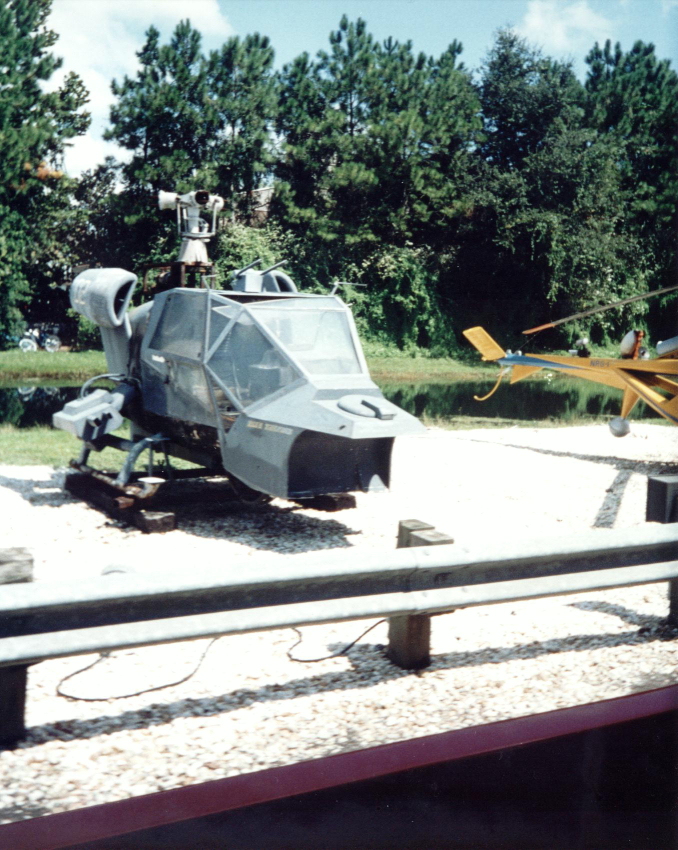
The second, s/n 1075 (ex-N52BT[12]), was scrapped during 1988.[11] There was a third static display model built for close-up shots with the actors; it was stored outside and after deterioration was scrapped by 2009.[11] The bolt-on cockpit of the original helicopter used to be visible on the backlot tour of the Disney-MGM Studios theme park in Florida. It has not been present in the 'bone yard' since at least 2005.[13]

Design

[edit]
An Aerospatiale SA341G, the type converted to Blue Thunder for the film
Right close-up
Right side

Designer Mickey Michaels created the helicopters used in the film after reviewing and rejecting various existing designs. The helicopters used for Blue Thunder were French built Aérospatiale SA-341G Gazelles modified with bolt-on parts and Apache-style canopies.[14] Two modified Gazelle helicopters were used: one for the actual stunts (a "stunt mule"), and one as a backup in case the other was grounded for maintenance. Stunts were flown by Jim Gavin.[11]

Also used in filming were a Hughes 500 helicopter, and two radio-controlled F-16 fighter models.[15]

The Gazelle helicopters were purchased from Aérospatiale by Columbia Pictures for $190,000 each and flown to Cinema Air in Carlsbad, California where they were heavily modified for the film. These alterations made the helicopters so heavy that various tricks had to be employed to make it look fast and agile in the film. For instance, the 360° loop maneuver Murphy performs at the end of the film, which catches Cochrane so completely by surprise that he is easily shot down by Murphy's gunfire and killed, was carried out by a radio controlled model.[7] (This aircraft was built and flown by modeller and RC helicopter manufacturer John Simone Jr.)[11]

Fictional characteristics

[edit]

Described in the film as having 1 in (25 mm) "NORDOC-NATO armor", Blue Thunder had a chin turret with an electric 20 mm (0.79 in) six-barrel rotary cannon capable of a rate of fire of 4,000 rounds per minute.[16] Surveillance used twin cheek-mounted Nitesun spotlights,[16] infrared thermograph, and airborne TV camera with 100:1 zoom and night-vision capability.[16] The cameras fed 34 in (19 mm) videotape, with a locker in the belly of the aircraft. External audio pickups were capable of hearing "a mouse fart at two thousand feet".[16] A "whisper mode" granted it the ability to operate in silence. It also has a "Turbine boost", a turbo boost function giving Blue Thunder increased speed; in the film it was used to help perform a 360° loop.

Blue Thunder's cannon was controlled by a Harrison helmet[16] in conjunction with a "Harrison Fire Control System", named after one of the special effects prop designers. The project cost was described as US$5 million.[16]

The helmet-controlled gun turret and Target Acquisition and Designation Sights, Pilot Night Vision System (TADS/PNVS) is similar to that of the AH-64 Apache, which uses an "Integrated Helmet And Display Sight System" (IHADSS), wherein the nose-mounted sensors and the 30 mm chain gun are linked to the gunner's helmet.

Reception

[edit]

Box office

[edit]

Blue Thunder was released on May 13, 1983. It was the number 1 ranked film in the United States on its opening weekend, taking in $8,258,149 at 1,539 theaters, overtaking the previous number 1 film Flashdance. The film was ranked No. 2 in its second and third weekends. Overall, in the US, it earned $42,313,354 over its 66 days of release. Blue Thunder was released in West Germany on February 5, 1983, before its US release, and it was released worldwide between June and September 1983. Its UK release was August 25, 1983. It was released in East Germany and South Korea in 1984. Its total international box office income is unreported. The film earned $21.9 million from video rentals in the US.[17]

Critical response

[edit]

On the review aggregator website Rotten Tomatoes, 79% of 24 critics' reviews are positive, with an average rating of 6.6/10.[18] On Metacritic, it has a score of 66% based on reviews from 11 critics, indicating "generally favorable" reviews.[19]

Variety called it "a ripsnorting live-action cartoon, utterly implausible but no less enjoyable for that".[20] Rita Kempley of The Washington Post wrote: "Blue Thunder hovers just this side of trash and the other side of credibility, but it propels a willing audience into adrenaline heaven."[21] Vincent Canby of The New York Times wrote: "The action sequences are what the film is all about, and these are remarkably well done, including a climactic, largely bloodless shootout among helicopters and jet fighters over Los Angeles."[22]

C. J. Henderson reviewed Blue Thunder in The Space Gamer No. 63.[23] Henderson commented that "Blue Thunder is this year's must-see action film. See it."[23]

Christopher John reviewed Blue Thunder in Ares Magazine #14 and commented that "For those who want a film that is both filled with action and thought provoking, Blue Thunder is a sure bet. Watch out, George, the Jedi have competition."[24]

The film garnered an Oscar nomination for Best Film Editing for Frank Morriss and Edward Abroms,[25] but lost out to The Right Stuff.

In 2025, The Hollywood Reporter listed Blue Thunder as having the best stunts of 1983.[26]

Cultural references

[edit]

Video game

[edit]

In 1987, Coca-Cola Telecommunications released a Blue Thunder video tape cartridge for Worlds of Wonder's short lived Action Max game system. Using footage from the film, the player plays the pilot of the Blue Thunder helicopter as he tries to prevent the World Peace Coalition from being attacked by a terrorist organization.

Remake

[edit]

In 2015, Sony proposed a remake of Blue Thunder focusing on drone technology, with Dana Brunetti and Michael De Luca as producers, and Craig Kyle as writer.[31] In 2017, it was announced that Columbia Pictures would be overseeing the remake.[32]

See also

[edit]

References

[edit]

Bibliography

[edit]
[edit]
Revisions and contributorsEdit on WikipediaRead on Wikipedia
from Grokipedia
Blue Thunder is a fictional advanced and central to the 1983 American Blue Thunder, directed by and starring as a Los Angeles Police Department pilot tasked with testing the prototype. The , depicted as the ASA-341L model, incorporates cutting-edge fictional technologies including infrared night vision, a high-definition video camera with 200:1 zoom, and a chin-mounted capable of firing 4,000 rounds per minute, designed ostensibly for urban but revealed in the plot to enable pervasive government and suppression. For production, two real SA-341G light utility helicopters, registered N51BT and N52BT, were extensively modified with bolt-on enhancements such as extended skids, a mock exhaust, and weaponry facades to portray Blue Thunder, though one crashed during filming in May 1983, fatally injuring stunt pilot . The surviving , preserved post-filming, has appeared in airshows and collections, underscoring the film's influence on perceptions of militarized policing and aerial technology, while sparking debates on erosion through advanced monitoring capabilities.

Development and Production

Concept and Pre-Production

The screenplay for Blue Thunder originated in the late 1970s, when writers Dan O'Bannon and Don Jakoby collaborated on the concept while sharing a Hollywood apartment frequently buzzed by low-altitude police helicopters, which sparked ideas for a high-tech surveillance aircraft in an urban policing context. O'Bannon, known for prior works like Dark Star and Alien, co-wrote the script with Jakoby to highlight threats posed by advanced technology, initially emphasizing dystopian risks over character-driven action. Producer Phil Feldman, through his company, acquired and developed the project for Columbia Pictures, aligning it with early 1980s audience interest in thrillers amid lingering public skepticism toward institutional authority following events like Watergate and the Vietnam War. John Badham joined as director in 1981, drawn to the script's potential for tense aerial sequences using practical effects rather than emerging techniques, a decision shaped by his experience with action-oriented films like . Pre-production planning focused on feasibility studies for real-helicopter operations to ground the story in realism, with the overall budget set at approximately $22 million, including substantial funds earmarked for custom aircraft modifications. By October 1981, the project advanced to preparations in , following announcements of the production timeline targeting a 1983 release. This phase prioritized script revisions to balance thriller elements with narrative coherence, setting the stage for the film's exploration of technological overreach without relying on speculative effects.

Filming and Technical Challenges

The production of Blue Thunder involved extensive in , , spanning October 1980 to January 1981, to capture authentic urban environments for its chase sequences, including downtown streets, the concrete-bedded , and facilities like the Piper Technical Center at 555 Ramirez Street used as a police helipad. These real-world settings necessitated coordination with city authorities for street closures and traffic control, amplifying logistical complexities amid the film's high-stakes aerial pursuits through densely built areas. Aerial sequences posed acute technical hurdles due to the reliance on practical effects without , employing the actual modified helicopter piloted by professionals to execute maneuvers in coordination with chase craft like additional Gazelles. Challenges included synchronizing helicopter flights with ground-based cameras, mitigating vibration and wind interference during high-speed passes, and managing noise from rotors that complicated audio capture, often requiring dubbing or separation techniques. Cinematographer utilized innovative setups, such as mounting cameras on the helicopter's simulated for rotating point-of-view shots and deploying Eastman 5293 high-speed negative film to accommodate low-light urban night filming and rapid motion blur. The film's signature loop-de-loop stunt, central to a climactic evasion, generated contention over helicopter physics, as conventional rotors risk stalling in inverted flight; however, empirical testing confirmed feasibility, with stunt pilot John Tull performing roughly 40 actual loops using the Blue Thunder prototype to authenticate the sequence through repeated real-world trials rather than composites or miniatures. This approach prioritized verifiable aerobatics, drawing on precedents like loops achieved in helicopters since 1949, though it demanded precise control inputs to maintain lift via autorotation and cyclic adjustments.

Helicopter Construction and Modifications

The Blue Thunder helicopter prop was constructed by modifying two SA-341G light utility helicopters, serial numbers 1066 (registered N51BT) and 1075 (N52BT), sourced from the civilian market. , a division of Hughes Tool Company, performed the conversions in , starting in early 1982, focusing on aesthetic alterations to create a futuristic, militarized appearance while preserving basic . Key modifications included bolt-on fiberglass components such as an extended forward fuselage with an Apache-inspired chin turret housing a non-functional mock , a widened canopy for a seating illusion, stub wings for simulated weaponry pylons, and a redesigned and tail boom to evoke lines. These additions, totaling over 1,000 pounds of non-structural weight per , prioritized visual menace over performance enhancements, resulting in trade-offs like reduced capacity and minor impacts on maneuverability, though the core Astazou XIV engine and rotor system remained unchanged, limiting real-world speeds to the 's certified maximum of approximately 137 knots (158 mph). Post-production, the helicopters saw limited use; N52BT was deregistered and scrapped around 1988 after brief appearances in promotional events, while N51BT suffered a fatal crash on January 7, 1990, during filming of an music video in the desert, killing pilot David Gibbs due to suspected mechanical failure in the modified structure. No fully operational replicas were ever constructed, as the design's high modification costs—estimated at over $1 million per unit in 1983 dollars—and lack of military utility deterred further investment beyond cinematic props.

Cast and Characters

Principal Actors and Roles

Roy Scheider portrayed Frank Murphy, the experienced Los Angeles Police Department air support pilot tasked with evaluating the Blue Thunder prototype, infusing the character with a world-weary intensity drawn from his established screen persona in tense procedural dramas. Scheider's selection leveraged his prior action-hero credentials, including his role as Police Chief Martin Brody in Jaws (1975), where he navigated high-stakes mechanical perils, paralleling Murphy's aerial confrontations. Malcolm McDowell played Colonel F.E. Cochrane, the project's military overseer whose portrayal emphasized cold bureaucratic zeal, marking an early instance of McDowell being cast as a calculating following his iconic anti-hero in A Clockwork Orange (1971). This against-type shift for McDowell heightened the interpersonal friction with Scheider's grounded everyman, amplifying the film's core man-versus-system dynamics through their contrasting intensities. Daniel Stern depicted Richard Lymangood, Murphy's rookie co-pilot and observer, whose irreverent, street-smart edge provided levity and vulnerability amid the high-tech proceedings, chosen for Stern's emerging talent in blending comic timing with dramatic support as seen in early roles like (1979). Supporting performers included as Captain Jack Braddock, Murphy's gruff superior, whose authoritative presence drew from Oates' history of rugged lawmen in films like (1969), and as Kate, Murphy's concerned companion, adding emotional grounding through her naturalistic delivery honed in (1973).

Character Dynamics and Performances

, portrayed by , embodies a central tension between (PTSD) induced paranoia from his experiences and his ingrained loyalty to the , depicted through Scheider's restrained physicality and vocal inflections that suggest internal turmoil without overt histrionics. This psychological conflict manifests in Murphy's growing distrust of authority figures, contrasting his professional duty as a pilot, with Scheider's performance drawing praise for its authenticity in capturing a veteran's cynical detachment amid escalating suspicions. Interactions among the ensemble highlight realistic frictions between personnel and military overseers, particularly in high-stakes operational scenarios where departmental protocols clash with experimental program directives, fostering a believable undercurrent of bureaucratic antagonism reflective of inter-agency tensions. Supporting roles, such as Daniel Stern's Cochrane providing grounded camaraderie laced with levity and ' Captain McNeely representing rigid hierarchy, contribute to organic group dynamics that underscore Murphy's isolation, though some contemporary critiques note Stern's humor as occasionally disruptive to the thriller's tone. While portrayals adhere to era-specific depictions of police hierarchies—emphasizing chain-of-command obedience over —critics have observed stereotypical elements in roles and ethnic representations, such as Candy Clark's Kate as a supportive romantic interest, which align with prevailing cinematic norms rather than innovative character depth. Malcolm McDowell's Lymangood serves as a chilling , his suave menace amplifying the cop-military divide through subtle ideological clashes, praised for enhancing the film's interpersonal stakes without . Overall, the cast's chemistry yields credible psychological realism in , prioritizing empirical interpersonal pressures over melodramatic excess.

Narrative and Themes

Plot Summary

Frank Murphy, a Los Angeles Police Department (LAPD) helicopter pilot and Vietnam War veteran suffering from post-traumatic stress disorder, is assigned alongside his new partner, mechanic Richard Lymangood, to test Blue Thunder, an experimental high-technology helicopter designed for riot control amid ongoing urban tensions in the city. During routine patrols, Murphy and Lymangood respond to a liquor store robbery and later witness an attack on city councilwoman Diana McNeely, who is shot by assailants stealing her briefcase; McNeely later dies from her injuries. Reprimanded by their superior, Captain Jack Braddock, for delays, Murphy undergoes psychiatric evaluation but is soon recalled to evaluate Blue Thunder under the oversight of systems engineer Emma Clark and military liaison F.E. Cochrane. While conducting test flights, the helicopter's advanced systems inadvertently record evidence of McNeely's , revealing it as a by government operatives to silence her opposition to deploying militarized technology against civilian unrest; the footage implicates Braddock and Cochrane in abuses of the chopper's capabilities for covert monitoring and elimination. Faced with orders to return the helicopter and suspicions of a broader conspiracy, Murphy steals Blue Thunder to evade capture and broadcast the incriminating evidence. Pursued by LAPD units and another experimental aircraft, Murphy and Lymangood engage in aerial dogfights over Los Angeles, utilizing the helicopter's weaponry to neutralize threats while transmitting proof of the plot to authorities. In the climax, after Lymangood's death in combat, Murphy destroys Blue Thunder by flying it into electrical transmission lines, preventing its weaponization and exposing the corruption, though at the cost of his own life. The film was released on May 13, 1983.

Political and Social Themes

Blue Thunder portrays the deployment of advanced in civilian policing as a mechanism for authoritarian control, with the titular helicopter's surveillance suite—including infrared cameras, directional microphones, and weaponry—envisioned by corrupt officials for quelling riots and monitoring dissenters in . This narrative device illustrates the risks of entrusting state actors with tools that amplify coercive capabilities beyond traditional boundaries, a concern rooted in post-Vietnam War toward institutional power. The film's depiction aligns with contemporaneous fears of technocratic overreach, as evidenced by its release amid rising urban tensions, such as the 1980 Liberty City riots in , which highlighted demands for escalated police responses to . Central to the story is the conflict between expansive government authority and individual autonomy, embodied by pilot Frank Murphy's discovery of a to incite unrest for justifying Blue Thunder's . Murphy, leveraging his expertise and moral resolve, commandeers the machine to broadcast of the plot, emphasizing personal initiative over bureaucratic reform or . This resolution affirms that isolated acts of defiance can disrupt systemic abuses, challenging views that prioritize structural victimhood by demonstrating causal efficacy in individual resistance against elite manipulation. Thematically prescient, Blue Thunder anticipates real-world expansions in aerial , such as the U.S. Federal Aviation Administration's integration of unmanned drones for domestic monitoring since 2005, which parallel the film's warnings about erosion through technological asymmetry. Yet it avoids by grounding its caution in verifiable dynamics: superior state hardware heightens control risks, but human operators remain fallible, enabling countermeasures like Murphy's . Such elements underscore a realist assessment of power imbalances, informed by Cold War-era apprehensions of centralized without presuming inherent institutional benevolence or malevolence.

Surveillance State and Government Overreach

In Blue Thunder, the titular helicopter's integration of high-resolution cameras, thermal imaging, and automated weaponry serves as a cautionary device against the fusion of advanced technology with state authority, illustrating how such tools can facilitate covert monitoring and suppression of dissent without accountability. The film's narrative exposes internal government conspiracies leveraging these capabilities to target civilians perceived as threats, underscoring the risk of mission creep from ostensible public safety to authoritarian control. This portrayal critiques the unchecked delegation of lethal power to unelected officials, where technological superiority overrides constitutional safeguards. Post-release developments have lent empirical credence to these warnings, particularly following the , 2001 attacks, which prompted expansive surveillance expansions under the USA PATRIOT Act of 2001, enabling bulk metadata collection by agencies like the NSA. Edward Snowden's 2013 disclosures revealed programs such as , which indiscriminately harvested communications data from U.S. citizens, paralleling the film's depiction of pervasive aerial oversight devoid of targeted justification. Concurrently, the proliferation of police drones and equipped helicopters—such as those deployed by over 1,000 U.S. agencies by 2020—has mirrored Blue Thunder's capabilities, often justified for crime-fighting but raising parallel concerns over invasions and potential misuse in crowd control. While proponents cite empirical studies indicating surveillance deters certain crimes—such as a finding CCTV reduces vehicle crimes by 24% in monitored areas—the causal chain reveals and displacement effects, with net societal costs from eroded outweighing gains when abuse occurs. Documented instances of overreach, including FBI warrantless of domestic groups via tools like devices, demonstrate how "deterrence" rationales enable selective targeting of political adversaries, prioritizing state security narratives over individual liberties. First-principles assessment favors skepticism toward normalized expansions, as historical patterns—from COINTELPRO's infiltration of civil rights leaders in the to post-9/11 FISA court abuses—evince governments exploiting technology for control rather than equitable protection, rendering idealistic defenses of "necessary progress" empirically unsubstantiated.

Blue Thunder Helicopter

Real-World Design Basis

The Blue Thunder helicopter prop was derived from the SA 341G , a light originally designed by in the 1960s with a first flight in 1967, featuring a single Astazou XIV turboshaft engine rated at 590 horsepower, a three-blade semi-rigid main rotor system for enhanced agility, and a anti-torque device replacing a conventional to reduce noise and . Two such airframes, registered N51BT and N52BT, underwent extensive cosmetic and structural alterations to serve as filming props. Hughes Helicopters, a U.S. firm specializing in development, handled the primary modifications, including the addition of non-operational armaments such as a chin-mounted turret, stub-wing pylons with simulated pods, and a 30mm housing, all engineered with wind-tunnel testing to preserve aerodynamic balance despite the increased forward . These enhancements prioritized visual fidelity over functionality, with ballast adjustments attempted to counter the nose-heavy configuration resulting from the added mass of and metal fittings. The base Gazelle's system, while capable of high maneuverability in stock form—enabling rolls and limited negative-G flight in skilled hands—was not fundamentally upgraded for the ; instead, modifications emphasized structural reinforcement for low-speed sequences simulating combat, though revealed inherent instability, capping operational speed at approximately 100 mph and restricting fuel load to 70 gallons to avoid exacerbating center-of-gravity issues. Aerodynamic analyses and pilot logs from production confirmed the prop's inability to execute full loops or sustained inverted flight, as the added weight and altered dynamics exceeded the airframe's tolerance for such stresses without risking stall or transmission overload, distinguishing the real vehicle's constraints from the film's exaggerated .

Fictional Enhancements and Capabilities

The Blue Thunder helicopter in the film features a claimed top speed of approximately 290 miles per hour (470 km/h), enabling rapid pursuit and evasion sequences that drive the plot's tension. This exceeds the physical limits imposed by rotor aerodynamics on conventional helicopters, where retreating blade stall occurs as forward speed increases: the blade on the retreating side experiences reduced relative airspeed, causing asymmetric lift loss, pitch-up moments, and vibration that caps practical speeds at around 200-220 knots (230-253 mph) for most designs. Theoretical analyses suggest a pure rotorcraft ceiling near 225 knots (259 mph) before stall dominates, rendering sustained 290 mph flight implausible without auxiliary propulsion like wings or jets, which Blue Thunder lacks in its depicted rotor-only configuration. Stealth enhancements portray Blue Thunder as nearly undetectable, with radar-absorbent materials and noise-suppressed rotors allowing covert urban operations. In reality, acoustic stealth faces insurmountable physics-based hurdles from blade-vortex interaction (BVI), where tip vortices from preceding blades collide with subsequent ones, generating impulsive broadband noise that propagates kilometers and resists full mitigation due to inherent rotor geometry and cyclic loading. While radar cross-section reduction via faceted airframes is feasible, the rotating blades' Doppler-shifted returns and persistent acoustic signature—dominated by thickness and loading noise—compromise low-observability, particularly in the film's close-range surveillance scenarios. Armaments include a forward-mounted 20 mm electric Gatling cannon capable of 4,000 rounds per minute and pod-launched missiles for anti-personnel and anti-air roles, used dramatically to counter pursuing and ground threats. These draw loose inspiration from contemporaneous U.S. prototypes, such as the AH-64 Apache's 30 mm (in testing by 1983) and laser-guided missiles like the (under development since 1974), but the film's seamless integration and unlimited firing without overheating or recoil management exaggerate feasibility for a light utility airframe. In the narrative, these capabilities enable the protagonist to dismantle a conspiracy, underscoring the dual-use peril of advanced tech—intended for but repurposed for exposure—without endorsing state-led innovation as inherently benevolent.

Release and Commercial Performance

Initial Release and Marketing

Blue Thunder was released theatrically by on May 13, 1983, in a wide domestic rollout across approximately 1,500 theaters. The launch targeted the peak summer blockbuster season, positioning the film amid high-profile competitors including Star Wars: Episode VI - Return of the Jedi, which debuted twelve days later on May 25. This timing leveraged heightened audience demand for action-oriented spectacles during the weekend period, a strategy common for major studio releases in the early 1980s. Marketing campaigns highlighted the film's technological innovations and aerial action sequences, featuring Roy Scheider—known for his role in Jaws—as a veteran pilot uncovering a government conspiracy. Promotional materials, including trailers, emphasized the Blue Thunder helicopter's fictional armaments and high-speed pursuits over the narrative's surveillance and overreach elements, appealing to interest in advanced aviation amid the Reagan administration's increased defense expenditures. Tie-in merchandise, such as scale-model helicopters produced by Multi-Toys Corp., extended the promotion to consumer products, capitalizing on the vehicle's central role in the production.

Box Office Results

Blue Thunder, released on May 13, 1983, by , opened at number one domestically with $8,258,149 in its first weekend across 1,555 theaters. The film ultimately earned $42,313,354 in North American receipts. Produced on an estimated budget of $22 million, it achieved a domestic multiplier of 5.12 times its opening weekend, indicating solid word-of-mouth performance relative to initial turnout. This gross represented moderate financial success for a mid-budget action thriller in 1983, a year dominated by blockbusters such as ($475 million worldwide) and ($200 million worldwide), which drew larger audiences through established franchises and broader appeal. Despite competition from these high-profile releases, Blue Thunder's urban helicopter chase sequences and timely themes sustained interest, enabling it to double its production costs at the before ancillary revenues. International earnings data remains limited, with reported worldwide totals aligning closely to domestic figures, suggesting minimal overseas contribution and no significant global breakout. In an era when studios typically recouped about half of theatrical grosses after exhibitor splits, the film's returns likely yielded profitability after accounting for marketing expenditures, though not at the blockbuster level.

Critical and Public Reception

Contemporary Reviews

Upon its release in May 1983, Blue Thunder received generally positive reviews from critics, who lauded its high-octane aerial action sequences while often faulting the narrative for contrived plotting and uneven pacing. The film garnered a 79% approval rating on , calculated from 24 contemporary reviews, reflecting appreciation for its thriller elements amid the era's appetite for technology-driven spectacles. Praise centered on the film's technical achievements in depicting helicopter maneuvers, with of noting on May 13, 1983, that "the action sequences are what the film is all about, and these are remarkably well done, including a climactic, largely bloodless among helicopters." Similarly, Variety's review from late 1982 (ahead of wide release) hailed it as a "ripsnorting live-action , utterly implausible but no less enjoyable for that," emphasizing the visceral excitement of the aerial thrills despite logical gaps. Critics were divided on the screenplay's execution, with several highlighting weaknesses in character development and story logic; one described it as an "incoherent mess" overly fixated on gadgetry at the expense of coherent thriller conventions. Political undertones involving drew mixed responses, some dismissing them as paranoid fantasy emblematic of action tropes, while others deemed the warnings about authoritarian overreach prescient given contemporaneous debates on and military tech. The film's score of 66 out of 100, aggregated from 11 period reviews, underscored this balance between adrenaline-fueled highs and narrative shortcomings.

Retrospective Assessments

Later analyses have highlighted Blue Thunder's prescience in depicting the fusion of advanced technology with state authority, themes that resonated more acutely after revelations of widespread government monitoring programs. Film critics in the and noted the film's portrayal of a equipped with real-time audio-visual spying capabilities as eerily anticipatory of post-9/11 expansions in aerial drones and NSA data collection exposed by in 2013, where empirical evidence from declassified documents showed similar integrations of military-grade tech for domestic oversight without adequate checks. This causal linkage between fictional warnings and real-world implementations—such as the proliferation of police drones by 2020—underscores the film's enduring caution against unchecked technological escalation in . While some retrospective reviews praise the practical effects, including full-scale helicopter sequences filmed over in 1983, for retaining visceral impact amid modern CGI dominance, others critique the film's visual style as dated, with matte paintings and early composites paling against contemporary standards. The narrative's reliance on a lone unraveling a vast conspiracy has drawn mixed assessments: its emphasis on individual agency against institutional corruption aligns with timeless concerns over government overreach, evidenced by ongoing debates around programs like , yet the unresolved conspiratorial elements risk oversimplifying systemic incentives for power consolidation, lacking deeper structural analysis. Overall, the film's value persists in its empirical grounding of tech-driven authoritarian risks, validated by subsequent innovations in persistent —such as facial recognition networks deployed by 2025—outweighing stylistic limitations and affirming its role as a prescient artifact rather than mere period thriller.

Audience and Cult Following

Despite modest initial performance, Blue Thunder cultivated a dedicated audience through releases, particularly tapes in the and subsequent DVD editions, which allowed repeated viewings and sustained interest among action and enthusiasts. Fans valued its portrayal of an individual LAPD pilot, , resisting institutional corruption and unauthorized deployment, themes that resonated as a form of anti-authority during the Reagan-era emphasis on law-and-order policies. Enthusiast recreations of the Blue Thunder helicopter further evidenced grassroots appeal, with hobbyists producing scale models, including 1/32 kits from Monogram released around 1987 and modern 3D-printable RC variants compatible with frames like the Align T-Rex 450. Advanced builds extended to turbine-powered RC replicas flown at events such as the 2021 Loorholz Helicopter meeting, demonstrating technical admiration for the film's modified Aérospatiale SA 341 Gazelle design. Contemporary online discussions, particularly on platforms like Reddit, highlight the film's enduring relevance to debates on police militarization and aerial surveillance, with users noting its prophetic depiction of technology enabling unchecked government monitoring—echoed in real-world drone proliferation—over a half-century later. These forums often praise the narrative's causal focus on how advanced weaponry and sensors in civilian policing hands could erode civil liberties, positioning the film as a cautionary artifact rather than escapist fare.

Legacy and Adaptations

Cultural References and Influence

Blue Thunder's portrayal of a militarized equipped with advanced cameras and weaponry anticipated real-world developments in unmanned aerial systems, influencing discourse on the risks of domestic technology deployment. The film's depiction of intrusive monitoring capabilities, intended for and riot suppression, echoed in policy debates following the proliferation of Predator drones, which the U.S. Customs and Border Protection began using for border in 2006, expanding to over 10,000 flight hours annually by 2015 amid concerns over erosion. These parallels have been noted in retrospective analyses highlighting the movie's prescience regarding government overreach, with its narrative critiquing the fusion of police and military tech as a pathway to authoritarian control. In pop culture, the film inspired the 1987 Sega arcade game Thunder Blade, which replicated Blue Thunder's core premise of piloting a high-tech for urban combat and missions, even incorporating a digitized still from the movie on its title screen. This influence extended the trope of rogue super-s into gaming, where players navigated similar scenarios of evading authorities while wielding turret-mounted firepower, contributing to the fascination with techno-thrillers. The game's release capitalized on the film's visual and thematic elements, though it shifted focus to arcade-style action over the original's conspiracy-driven plot. The movie's themes of toward centralized power have permeated broader cultural warnings about militarized , reinforcing narratives in media and public commentary on the potential for abuse in programs like the NSA's post-9/11 expansions. Its cautionary stance, validated by subsequent drone strikes exceeding 14,000 in Pakistan, Yemen, and Somalia from 2004 to 2020 according to Bureau of tallies, underscores enduring apprehensions about unaccountable aerial oversight. Recent in 2024 linked Christopher Nolan's upcoming project to Blue Thunder's influence, suggesting ongoing resonance in high-profile filmmaking circles.

Video Game and Television Series

A adaptation titled Blue Thunder was released in by Richard Wilcox Software for platforms including the Atari 8-bit family, Commodore 64, and . The title functions as a side-scrolling shooter in which players control the advanced "jetcopter" to engage enemy targets in urban and aerial environments, reflecting the film's emphasis on high-tech and capabilities. Reviews noted its fidelity to the source material's aerial action but criticized simplistic controls, chunky in muted colors, absence of , and repetitive , resulting in middling reception and limited commercial impact amid the post-crash video game market. The Blue Thunder television series premiered on ABC on January 6, 1984, as a direct spin-off from the 1983 film, starring as LAPD pilot Frank Chaney, as flight engineer Clinton "JAFO" Wonderlove, and featuring former players and in supporting roles. Spanning 11 episodes, the program depicted the 's deployment in crime-fighting missions, incorporating some unused footage alongside new practical effects sequences. Production challenges arose from translating the movie's elaborate helicopter stunts to weekly television, with high costs for aerial filming—exacerbated by the need for specialized and location shoots—contributing to budget overruns. The series achieved modest viewership but failed to sustain ratings against network competition, leading to cancellation in April 1984 without a full season order. This brevity underscored difficulties in adapting the film's resource-intensive effects to TV's episodic format, where narrative shifts to procedural police stories diluted the original's thriller focus on and , limiting long-term viability.

Remake Developments and Inspirations

In March 2015, initiated development on a of Blue Thunder, hiring Craig Kyle—known for his work on Marvel projects including Thor: Ragnarok—to pen a script reimagining the story around drone rather than a manned , reflecting contemporary concerns over unmanned aerial systems. The project was to be produced by , with and attached, aiming to update the original's themes of police militarization for a post-9/11 era dominated by remote-operated threats. However, the effort stalled amid shifting market dynamics, including the rapid normalization of drone tech in media and real-world applications, leaving it undeveloped by the late 2010s. As of February 2025, Sony's drone-centric reboot remained in early development limbo, with no advancement toward production despite periodic interest in leveraging the original's prescient surveillance motifs. In October 2024, unconfirmed rumors circulated that director Christopher Nolan's untitled 2026 Universal Pictures film—set for a July release—drew indirect inspiration from Blue Thunder, potentially featuring NYPD helicopter aviation units and advanced aerial tech in a futuristic New York setting, though sources emphasized it would not be a direct remake. These speculations, originating from industry insiders and amplified on platforms like Reddit, highlighted renewed genre fascination but were later eclipsed by Nolan's December 2024 announcement of The Odyssey as his next project, confirming no Blue Thunder ties. No official remake materialized in 2025, though fan-generated content—such as conceptual trailers featuring actors like in hypothetical roles—emerged on , underscoring persistent public interest in rebooting 1980s action-thrillers amid broader revivals of high-tech pursuit narratives. These unverified efforts, often produced by channels like Enigmaity, lack studio backing and serve more as speculative homages than indicators of active development.

References

Add your contribution
Related Hubs
User Avatar
No comments yet.