


Community hub
Recent from talks
Contribute something
Nothing was collected or created yet.
Bojnord
View on Wikipedia
Bojnord[a] or Bojnurd (Persian: بجنورد, pronounced [bod͡ʒˈnuːɹd] ⓘ) is a city in the Central District of Bojnord County, North Khorasan province, Iran, serving as capital of the province, the county, and the district.[5] It is about 701 km (436 mi) from Tehran.[6] and 242 kilometres (150 mi) from Mashhad, the capital of Razavi Khorasan province.[7]
Key Information


History
[edit]According to local tradition, the whole area was controlled by the Qarai Turks since the Mongol invasion in the 13th century.[8]
Bojnurd is of recent origin and possibly built by the Safavids for the Kurdish Şadiyan tribe who had been settled there to strengthen the Safavid borders against hostile Turkmens. Traditionally, the city was surrounded by a defensive wall and consisted of eleven quarters, bazaars and four mosques.[8]
In 1849, the city saw a revolt which destroyed the city. When traveller G. C. Napier visited the city in 1876, it was noted that the chief of Bojnurd was a Kurd who governed the city without taxation in exchange for military support to the central government in Tehran.[8]
Severe earthquakes in 1896 and 1929 destroyed the city and its surroundings. The city would consequently be rebuilt without historical or recent fortifications in a modern matter.[8] In 1997, a magnitude 6.5 earthquake caused significant damage and many fatalities in the city.[9]
Demographics
[edit]Population
[edit]| Year | Pop. | ±% |
|---|---|---|
| 1956 | 19,253 | — |
| 1966 | 31,248 | +62.3% |
| 1976 | 47,719 | +52.7% |
| 1986 | 93,392 | +95.7% |
| 1991 | 112,426 | +20.4% |
| 1996 | 134,835 | +19.9% |
| 2006 | 172,772[11] | +28.1% |
| 2011 | 199,791[12] | +15.6% |
| 2016 | 228,931[2] | +14.6% |
| Source: [10] | ||
At the time of the 2006 National Census, the city's population was 172,772 in 44,217 households.[11] The following census in 2011 counted 199,791 people in 56,761 households.[12] The 2016 census measured the population of the city as 228,931 people in 67,335 households.[2]
ٔGeography
[edit]Bojnourd city, the capital of North Khorasan province with an area of 36 square kilometers, is located in northeastern Iran at 57 degrees and 20 minutes longitude and 37 degrees and 28 minutes latitude south of Kopedagh mountain range and east of Aladagh mountain range and north of Alborz mountain range. Bojnourd is 1070 meters above sea level and its distance to Tehran is 821 kilometers.[13]
Climate
[edit]Bojnord has a cold semi-arid climate (BSk) according to the Köppen climate classification.[14]
| Climate data for Bojnurd (1991–2020)[i] | |||||||||||||
|---|---|---|---|---|---|---|---|---|---|---|---|---|---|
| Month | Jan | Feb | Mar | Apr | May | Jun | Jul | Aug | Sep | Oct | Nov | Dec | Year |
| Record high °C (°F) | 19.2 (66.6) |
27.2 (81.0) |
30.8 (87.4) |
34.4 (93.9) |
37.4 (99.3) |
40.0 (104.0) |
41.2 (106.2) |
40.6 (105.1) |
39.0 (102.2) |
33.6 (92.5) |
27.8 (82.0) |
25.0 (77.0) |
41.2 (106.2) |
| Mean daily maximum °C (°F) | 6.9 (44.4) |
8.7 (47.7) |
13.9 (57.0) |
19.9 (67.8) |
24.9 (76.8) |
30.3 (86.5) |
32.8 (91.0) |
32.1 (89.8) |
28.2 (82.8) |
21.8 (71.2) |
13.9 (57.0) |
8.8 (47.8) |
20.2 (68.3) |
| Daily mean °C (°F) | 0.9 (33.6) |
2.4 (36.3) |
7.0 (44.6) |
12.6 (54.7) |
17.8 (64.0) |
22.9 (73.2) |
25.4 (77.7) |
24.4 (75.9) |
20.2 (68.4) |
13.8 (56.8) |
7.0 (44.6) |
2.7 (36.9) |
13.1 (55.6) |
| Mean daily minimum °C (°F) | −3.7 (25.3) |
−2.4 (27.7) |
1.7 (35.1) |
6.6 (43.9) |
11.2 (52.2) |
15.5 (59.9) |
18.2 (64.8) |
16.7 (62.1) |
12.8 (55.0) |
6.9 (44.4) |
1.8 (35.2) |
−1.9 (28.6) |
7.0 (44.5) |
| Record low °C (°F) | −19.0 (−2.2) |
−21.0 (−5.8) |
−13.6 (7.5) |
−5.4 (22.3) |
−0.2 (31.6) |
4.0 (39.2) |
10.0 (50.0) |
5.4 (41.7) |
1.6 (34.9) |
−5.0 (23.0) |
−14.4 (6.1) |
−18.1 (−0.6) |
−21.0 (−5.8) |
| Average precipitation mm (inches) | 22.2 (0.87) |
31.9 (1.26) |
45.3 (1.78) |
38.7 (1.52) |
30.4 (1.20) |
10.2 (0.40) |
6.8 (0.27) |
4.8 (0.19) |
7.7 (0.30) |
12.4 (0.49) |
25.8 (1.02) |
19.2 (0.76) |
255.4 (10.06) |
| Average precipitation days (≥ 1.0 mm) | 5.4 | 6.3 | 7.4 | 6.1 | 4.9 | 1.9 | 1.1 | 0.7 | 1 | 2.8 | 4.5 | 4.5 | 46.6 |
| Average rainy days | 4 | 5.5 | 9.2 | 9.6 | 7.9 | 2.9 | 2.1 | 1.1 | 1.9 | 4.5 | 7.4 | 5.9 | 62 |
| Average snowy days | 7.2 | 7.5 | 4.7 | 0.6 | 0 | 0 | 0 | 0 | 0 | 0 | 1.2 | 4.1 | 25.3 |
| Average relative humidity (%) | 72 | 71 | 68 | 64 | 58 | 47 | 45 | 42 | 48 | 57 | 69 | 73 | 59.5 |
| Average dew point °C (°F) | −4.1 (24.6) |
−3.0 (26.6) |
0.5 (32.9) |
4.9 (40.8) |
8.1 (46.6) |
9.1 (48.4) |
11.0 (51.8) |
8.8 (47.8) |
7.2 (45.0) |
4.0 (39.2) |
0.8 (33.4) |
−2.3 (27.9) |
3.8 (38.7) |
| Mean monthly sunshine hours | 152 | 152 | 174 | 211 | 272 | 325 | 342 | 342 | 289 | 248 | 175 | 144 | 2,826 |
| Source: NOAA[15] (Snow and Sleet days 1981–2010)[16] | |||||||||||||
| Climate data for Bojnurd (1977–2010) | |||||||||||||
|---|---|---|---|---|---|---|---|---|---|---|---|---|---|
| Month | Jan | Feb | Mar | Apr | May | Jun | Jul | Aug | Sep | Oct | Nov | Dec | Year |
| Mean daily maximum °C (°F) | 6.2 (43.2) |
7.8 (46.0) |
13.0 (55.4) |
19.8 (67.6) |
24.3 (75.7) |
29.8 (85.6) |
32.5 (90.5) |
31.9 (89.4) |
28.2 (82.8) |
21.4 (70.5) |
14.3 (57.7) |
8.6 (47.5) |
19.8 (67.7) |
| Daily mean °C (°F) | 1.2 (34.2) |
2.6 (36.7) |
7.2 (45.0) |
13.3 (55.9) |
17.6 (63.7) |
22.5 (72.5) |
25.2 (77.4) |
24.3 (75.7) |
20.3 (68.5) |
14.1 (57.4) |
8.3 (46.9) |
3.6 (38.5) |
13.4 (56.0) |
| Mean daily minimum °C (°F) | −3.7 (25.3) |
−2.6 (27.3) |
1.4 (34.5) |
6.7 (44.1) |
10.9 (51.6) |
15.2 (59.4) |
17.9 (64.2) |
16.6 (61.9) |
12.5 (54.5) |
6.9 (44.4) |
2.2 (36.0) |
−1.5 (29.3) |
6.9 (44.4) |
| Average precipitation mm (inches) | 25.1 (0.99) |
32.2 (1.27) |
42.9 (1.69) |
39.1 (1.54) |
33.3 (1.31) |
9.0 (0.35) |
8.7 (0.34) |
5.5 (0.22) |
9.3 (0.37) |
12.4 (0.49) |
26.0 (1.02) |
24.3 (0.96) |
267.8 (10.55) |
| Average precipitation days | 10.6 | 11.4 | 12.4 | 10.8 | 9.8 | 3.8 | 2.4 | 1.9 | 2.8 | 5.3 | 8.1 | 9.9 | 89.2 |
| Average relative humidity (%) | 72 | 71 | 68 | 63 | 58 | 48 | 46 | 43 | 48 | 57 | 67 | 72 | 59 |
| Mean monthly sunshine hours | 144.4 | 148.6 | 164.7 | 206.8 | 267.1 | 309.0 | 328.5 | 331.3 | 281.1 | 243.2 | 178.1 | 142.3 | 2,745.1 |
| Source 1: World Meteorological Organisation | |||||||||||||
| Source 2: [1] | |||||||||||||
- ^ Rainy days calculated using parameter codes 46 and 71
Colleges and universities
[edit]Universities located in Bojnord include:[17]
Notable people
[edit]
- Abdolhossein Teymourtash (Sardar Moazzam Khorasani), a distinguished and influential politician of the 20th century (Pahlavi dynasty)
- Ali-Akbar Davar, politician and judge and the founder of the modern judicial system of Iran
- Kazem Mousavi Bojnurdi, historian, theologian, writer and the curator of the National Library of Iran (1997–2005)
- Mohammad Davari, journalist, known for arrest in 2009–10 Iranian election protests
- Mostafa Tabrizi, politician
 |
 |
 |
See also
[edit] Media related to Bojnord at Wikimedia Commons
Notes
[edit]References
[edit]- ^ OpenStreetMap contributors (26 October 2024). "Bojnord, Bojnord County" (Map). OpenStreetMap (in Persian). Retrieved 26 October 2024.
- ^ a b c Census of the Islamic Republic of Iran, 1395 (2016): North Khorasan Province. amar.org.ir (Report) (in Persian). The Statistical Center of Iran. Archived from the original (Excel) on 27 October 2020. Retrieved 19 December 2022.
- ^ "Maps, Weather, and Airports for Bojnurd, Iran".
- ^ Bojnord can be found at GEOnet Names Server, at this link, by opening the Advanced Search box, entering "-3056548" in the "Unique Feature Id" form, and clicking on "Search Database".
- ^ Habibi, Hassan (c. 2015) [Approved 12 September 1990]. Approval of the organization and chain of citizenship of the elements and units of the divisions of Khorasan province, centered in Mashhad. rc.majlis.ir (Report) (in Persian). Ministry of the Interior, Defense Political Commission of the Government Council. Proposal 3223.1.5.53; Approval Letter 3808-907; Notification 84902/T125K. Archived from the original on 17 November 2015. Retrieved 6 January 2024 – via Islamic Parliament Research Center.
- ^ "Tehran".
- ^ "Distance from Bojnurd to Mashhad". www.distancecalculator.net. Retrieved 23 June 2022.
- ^ a b c d Ehlers, Eckart; Bosworth, C. E. (1989). "BOJNŪRD". Encyclopedia Iranica. IV.
- ^ "Earthquake Toll Rises in Iran as Aftershocks Hit". Reuters. Tehran, Iran: ReliefWeb. 5 February 1997. Retrieved 10 March 2022.
- ^ "Cities with a population of 100,000 and more (1956-2006 census)" (XLS). irandataportal.syr.edu. Iran data portal. p. 1. Retrieved 1 June 2025.
- ^ a b Census of the Islamic Republic of Iran, 1385 (2006): North Khorasan Province. amar.org.ir (Report) (in Persian). The Statistical Center of Iran. Archived from the original (Excel) on 20 September 2011. Retrieved 25 September 2022.
- ^ a b Census of the Islamic Republic of Iran, 1390 (2011): North Khorasan Province. irandataportal.syr.edu (Report) (in Persian). The Statistical Center of Iran. Archived from the original (Excel) on 19 January 2023. Retrieved 19 December 2022 – via Iran Data Portal, Syracuse University.
- ^ "Bojnord". www.visitiran.ir. Retrieved 5 June 2022.
- ^ "Köppen Climate Classification: How to Use the Other Plant Map". Lawnstarter. 22 October 2019. Retrieved 23 June 2022.
- ^ "World Meteorological Organization Climate Normals for 1991-2020: Bojnurd-40723" (CSV). ncei.noaa.gov (Excel). National Oceanic and Atmosoheric Administration. Retrieved 18 February 2024.
- ^ "World Meteorological Organization Climate Normals for 1981-2010: Bojnurd(WMO number: 40723)" (XLS). ncei.noaa.gov (Excel). National Oceanic and Atmosoheric Administration. Retrieved 18 February 2024.
Parameter Code 80: Number of Days with Sleet/Snow
- ^ "دانستنیهایی از استان خراسان شمالی".
External links
[edit]
| International | |
|---|---|
| National | |

North Khorasan province, Iran | |||||||||||||||
|---|---|---|---|---|---|---|---|---|---|---|---|---|---|---|---|
| Capital |  | ||||||||||||||
| Counties and cities |
| ||||||||||||||
| Sights |
| ||||||||||||||
| populated places | |||||||||||||||

Bojnord
View on GrokipediaHistory
Pre-Modern Foundations
Archaeological excavations in the Bojnord plain have uncovered evidence of early settlements dating to the Bronze Age, including a grave associated with the Bactria-Margiana Archaeological Complex (BMAC), or Oxus Civilization, at Tappe Esgh in the southern foothills of the Kopet Dag mountains. This discovery, featuring artifacts analogous to those from Central Asian BMAC sites, indicates cultural interactions and human activity in the region around 2300–1700 BCE.[6] [7] Further supporting ancient habitation, a 4,200-year-old grave in the northeastern heights of Bojnord contained a human skeleton, ceramic vessels, ash deposits, and a dog burial, consistent with early Zoroastrian burial practices and suggesting the presence of proto-Iranian or Persian tribes in the area by approximately 2200 BCE.[8] These findings challenge notions of the region as sparsely settled prior to Islamic times and align with broader Early Iron Age sites in northern Khorasan linked to the Yaz I and Archaic Dehistan cultures, reflecting continuity in pastoral and semi-nomadic communities from the late 2nd millennium BCE.[9] Following the Achaemenid and Parthian periods, the Bojnord area fell under Islamic rule after the Arab conquests of the 7th century CE, with the broader Khorasan region serving as a frontier zone. By the Mongol invasions of the 13th century, local control shifted to Qarā-ilī Turkic groups, who dominated the district amid turbulent post-Mongol dynamics. The site is absent from Timurid-era chronicles like the Tārīḵ of Ḥāfeẓ-e Abrū (1414–1420 CE), implying limited urban prominence before the Safavid era. The modern town's foundations trace to the Safavid dynasty in the early 17th century, when Shah ʿAbbās I (r. 1588–1629) resettled Kurdish tribes, including the Šādlū, to Bojnūrd as one of five fortified districts on Iran's northeastern frontier against Uzbek and Turkmen incursions. Local traditions attribute the town's formal establishment around 1700 CE to Dawlat Khan II, possibly as a successor to the earlier settlement of Būzanjerd, though this connection remains debated. The pre-20th-century settlement featured a walled enclosure with bazaars, four mosques, four gates, and eleven quarters, functioning as a tribal stronghold under semi-autonomous chiefs who provided military service to the central authority in exchange for low taxation.[10]Afghan Occupation and Qajar Era
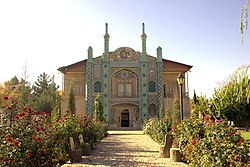
The Afghan Hotak dynasty's invasion of Iran in 1722 led to the collapse of Safavid central authority, with Hotak forces under Mahmud Hotaki capturing Isfahan and establishing control over much of central and southern Persia until their defeat by Nader Shah in 1729-1730.[11] Northeastern Khorasan, including Bojnord, however, served as a base for resistance, as Nader Qoli Beg, governor of the region, maintained de facto autonomy and mobilized local forces against the occupiers, preventing full Afghan dominion in the frontier districts.[12] Under the Qajar dynasty from 1789 to 1925, Bojnord emerged as a vital semi-autonomous frontier district tasked with defending against raids by Turkmen and Uzbek tribes from the north.[13] Kurdish tribal confederacies, notably the Shadlu, dominated local governance, producing seven governors who administered Bojnord province and coordinated defenses during this era.[14] These khans managed tribal levies to counter incursions that frequently plundered livestock and property in northeastern Iran.[13] Architectural patronage by Qajar-era elites reflected the district's strategic importance, exemplified by the Sardar Mofakham Mansion, constructed as the largest Qajar monument in North Khorasan and serving as a residence for local rulers.[15] This period also saw the consolidation of Kurdish settlements in Bojnord, originally relocated under Safavids to bolster the border but enduring as key players in Qajar frontier security.[14]20th-Century Rebuilding and Modern Events
A severe earthquake struck Bojnurd and its surroundings on May 1, 1929, destroying much of the town and causing extensive casualties, with regional mortality estimates reaching 15,000.[10][16] The disaster prompted a comprehensive rebuilding effort under the Pahlavi dynasty, resulting in a modern urban layout with a grid pattern and the abandonment of historical fortifications, aligning with centralized state modernization initiatives.[10][17] During the Pahlavi period (1925–1979), Bojnurd transitioned from tribal dominance to a structured administrative and commercial center in northeastern Iran, as local chiefly powers were curtailed by Reza Shah's reforms.[10] The town's population stood at 47,719 in 1976, reflecting steady growth amid national development efforts.[10] Abdolhossein Teymourtash, born in Bojnurd in 1883, exemplified regional influence on national affairs as Reza Shah's first Minister of Court from 1925 to 1932, advancing administrative centralization before his dismissal and death in 1933.[18] Post-1979 Islamic Revolution, Bojnurd maintained its role as a regional hub amid Iran's broader political shifts, with no major localized upheavals documented.[10] In 2004, the creation of North Khorasan Province from the division of Khorasan elevated Bojnurd to provincial capital, spurring urban expansion and administrative enhancements, though it introduced challenges like rapid, sometimes uncoordinated development.[19][20] By the early 21st century, the city had grown into a diverse ethnic center, integrating Kurdish, Turkmen, and Persian communities while focusing on trade, agriculture, and limited industry.[21]Geography
Location and Topography
Bojnord serves as the capital of North Khorasan Province in northeastern Iran, positioned roughly 700 kilometers northeast of Tehran at the coordinates 37°28′N 57°20′E.[22][23] The city occupies a plain at an elevation of approximately 1,070 meters (3,510 feet) above sea level, providing a transitional landscape between higher plateaus and lowland areas.[24][25] Topographically, Bojnord lies in a fertile valley surrounded by rugged mountains, primarily the southern foothills of the Kopet Dag range, which delineates the border with Turkmenistan to the north and features steep slopes, plateaus, and ravines characteristic of the system's arid and semi-arid terrain.[26][27][28] This positioning influences local drainage patterns and microclimates, with the encircling elevations rising to over 2,900 meters in nearby peaks.[29]Climate and Natural Features
Bojnord exhibits a cold semi-arid climate classified as BSk under the Köppen system, featuring pronounced seasonal temperature contrasts and limited precipitation.[30] Average high temperatures peak at 32°C (90°F) in July during the hot season, while January, the coldest month, sees average lows of -4°C (25°F).[31] The rainy period spans approximately February to May, with March recording the highest monthly precipitation of about 15 mm (0.6 inches); annual totals vary historically between 153 mm and 405 mm, reflecting the region's aridity.[31] [32] Humidity remains low year-round, with muggy conditions rare, and winds are moderate, peaking at 13 km/h (8.3 mph) in July.[31] The city's topography includes flat plains at an elevation of roughly 1,070 meters above sea level, encircled by rugged mountains including the Aladagh range to the north.[25] [33] This setting in North Khorasan Province contributes to a landscape of semi-arid steppes with grassy vegetation suited to the dry conditions, interspersed with higher elevations that influence local microclimates.[33] Natural features encompass fertile plains amid mountainous terrain, supporting limited biodiversity typical of Iran's northeastern plateaus, though specific vegetation data for Bojnord indicates adaptation to variable rainfall and temperature extremes.[34]
Demographics
Population Dynamics
The population of Bojnord, the capital city of North Khorasan Province, has grown steadily since the early 2000s, primarily due to net positive migration from rural areas and adjacent regions rather than high natural increase rates. The 2006 national census reported 172,772 residents in the city proper. This rose to 199,791 by the 2011 census, yielding an annual growth rate of about 2.9%, followed by 228,931 inhabitants in the 2016 census with a 2.8% annual rate from 2011 onward. These figures, derived from Iran's Statistical Centre censuses, reflect urban consolidation amid broader provincial trends where Bojnord County (encompassing the city and surrounding districts) totaled 324,083 people in 2016. Key drivers of this demographic shift include Bojnord's elevation to provincial capital status in 2003, which amplified its appeal as an administrative, educational, and commercial center, drawing migrants seeking employment and services.[35] Academic analyses highlight rural-to-urban migration as dominant, with inflows from North Khorasan's villages and smaller towns accelerating post-2005; one study notes the city's population effectively doubled in influence through such patterns, straining informal settlements.[36] [37] Migration data from 2006–2016 censuses indicate net gains exceeding natural growth, as the province's overall fertility decline (aligned with national trends below replacement level since the 2000s) limited organic expansion.[38]| Census Year | City Population | Annual Growth Rate (Prior Period) |
|---|---|---|
| 2006 | 172,772 | - |
| 2011 | 199,791 | 2.9% |
| 2016 | 228,931 | 2.8% |