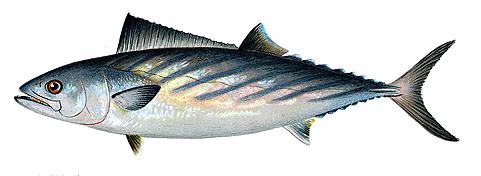

Bonito
View on Wikipedia
| Bonito | |
|---|---|

| |
| Atlantic bonito, Sarda sarda | |
Scientific classification 
| |
| Kingdom: | Animalia |
| Phylum: | Chordata |
| Class: | Actinopterygii |
| Order: | Scombriformes |
| Family: | Scombridae |
| Subfamily: | Scombrinae |
| Tribe: | Sardini Jordan and Evermann, 1896 |
| Genera | |
| |
Bonitos are a tribe of medium-sized, ray-finned, predatory fish in the family Scombridae, which it shares with the mackerel, tuna, and Spanish mackerel tribes, and also the butterfly kingfish.[1] Also called the tribe Sardini, it consists of eight species across four genera; three of those four genera are monotypic, having a single species each. Bonitos closely resemble the skipjack tuna, which is often called a bonito, especially in Japanese contexts.
Etymology
[edit]The fish's name comes from the Portuguese and Spanish bonito (no evidence has been found for the origin of the name), identical to the adjective meaning "pretty", but the noun referring to the fish seems to come from the low and medieval Latin form boniton, a word with a strange structure and an obscure origin, related to the word byza, a possible borrowing from the Greek βῦζα, "owl".[2][3][4]
Species
[edit]- Genus Sarda (Cuvier, 1832)
- Australian bonito, S. australis (Macleay, 1881)
- S. chiliensis (Cuvier, 1832)
- Eastern Pacific bonito, S. c. chiliensis (Cuvier, 1832)
- Pacific bonito, S. c. lineolata (Girard, 1858)
- Striped bonito, S. orientalis (Temminck & Schlegel, 1844)
- Atlantic bonito, S. sarda (Bloch, 1793)
- Genus Cybiosarda (Whitley, 1935)
- Leaping bonito, C. elegans (Whitley, 1935)
- Genus Gymnosarda Gill, 1862
- Dogtooth tuna, G. unicolor (Rüppell, 1836)
- Genus Orcynopsis Gill, 1862
- Plain bonito, O. unicolor (Geoffroy Saint-Hilaire, 1817)
As food
[edit]Pacific and Atlantic bonito meat has a firm texture and a darkish color, as well as a moderate fat content. The meat of young or small bonito can be of light color, close to that of skipjack tuna, and is sometimes used as a cheap substitute for skipjack, especially for canning purposes, and occasionally in the production of cheap varieties of katsuobushi that are sold as "bonito flakes".[5] Bonito may not, however, be marketed as tuna in all countries. The Atlantic bonito is also found in the Mediterranean and the Black Seas, where it is a popular food fish, eaten grilled, pickled (lakerda), or baked.[6][7]
See also
[edit]- Hiragonic acid
- Other fish sometimes called "bonito" include skipjack tuna, Katsuwonus pelamis
References
[edit]- ^ "Sardini". Integrated Taxonomic Information System. Retrieved 28 October 2012.
- ^ Oxford English Dictionary, 3rd edition, 2018, s.v.
- ^ "Bonite", French National Centre for Textual and Lexical Resources
- ^ "BONITO". Etimologías de Chile - Diccionario que explica el origen de las palabras (in Spanish). Retrieved 2023-04-21.
- ^ Katsuobushi: Dried Bonito Flakes. Japanese Cooking 101. https://www.japanesecooking101.com/dried-bonito-flakes/. Accessed Sept 2019
- ^ Daskalov, Georgi M; Demirel, Nazli; Ulman, Aylin; Georgieva, Yoana; Zengin, Mustafa (2020-12-01). "Stock dynamics and predator–prey effects of Atlantic bonito and bluefish as top predators in the Black Sea". ICES Journal of Marine Science. 77 (7–8): 2995–3005. doi:10.1093/icesjms/fsaa182. ISSN 1054-3139.
- ^ "AGE AND GROWTH OF ATLANTIC BONITO (SARDA SARDA) IN WESTERN MEDITERRANEAN SEA" (PDF). Sci. Pap. ICCAT, 62(5): 1649-1658 (2008).
Bonito
View on GrokipediaTaxonomy and Etymology
Etymology
The term "bonito" originates from the Spanish and Portuguese word bonito, meaning "pretty" or "beautiful," which is a diminutive form of bueno ("good"), derived from the Latin bonus ("good").[12][13] This nomenclature likely alludes to the fish's sleek, iridescent appearance, with its metallic blue back and silvery sides, distinguishing it among other marine species.[1] The Late Latin form boniton specifically denoted this type of fish, bridging ancient Roman references to similar scombroid species and its adoption in Iberian languages during medieval fisheries.[14] In English, "bonito" entered usage in the late 16th century through nautical and exploratory literature, reflecting encounters by European voyagers in tropical waters.[12] For instance, Richard Hakluyt's The Principal Navigations, Voyages, Traffiques and Discoveries of the English Nation (1589) describes the bonito among "sundry other fish very delicate" observed during voyages to the Caribbean and beyond, highlighting its role in early transatlantic fisheries documentation.[15] This adoption underscores the term's spread via maritime trade routes, where Spanish and Portuguese influences shaped English seafaring vocabulary. Related terms vary across languages, often tying into the broader nomenclature of the Scombridae family, which includes mackerels and tunas; for example, the feminine form bonita appears in Spanish and Portuguese contexts, while French uses bonite and Italian bonito, all evoking aesthetic qualities.[16] In scientific taxonomy, "bonito" precisely denotes species within the genus Sarda, but common usage has evolved to include misnomers, such as applying it to skipjack tuna (Katsuwonus pelamis), a distinct but visually similar scombroid often confused in commercial and angling contexts.[17][18]Classification
Bonitos belong to the kingdom Animalia, phylum Chordata, class Actinopterygii, order Scombriformes, family Scombridae, subfamily Scombrinae, and tribe Sardini, with the primary genus being Sarda.[4][19] The family Scombridae encompasses mackerels, tunas, and bonitos, comprising 51 species across 15 genera, while the subfamily Scombrinae includes the more derived members such as bonitos and tunas, distinguished from the basal subfamily Gasterochismatinae by advanced hydrodynamic adaptations.[2] The order Scombriformes was established in molecular phylogenetic revisions around 2013, elevating it from the polyphyletic order Perciformes based on analyses of mitochondrial and nuclear DNA sequences that resolved its monophyly within Percomorpha.[19] At the genus level, Sarda is diagnosed by several key morphological traits that differentiate it from true tunas (tribe Thunnini, genus Thunnus), including a more elongate and fusiform body with oblique dark stripes on the dorsolateral surface, triangular cutting teeth in both jaws (versus smaller conical teeth in tunas), an incompletely developed bony caudal keel, and the absence of a specialized subcutaneous vascular rete mirabile for thermoregulation.[20] These features position Sarda as morphologically intermediate between mackerels (tribe Scombrini) and tunas, reflecting its ecological role as epipelagic predators with moderate swimming speeds. Gill raker counts (16–23 on the first arch) and fin structures, such as 8–10 dorsal finlets and 7–10 anal finlets, further support its placement within Sardini, aiding in distinguishing it from related genera like Orcynopsis.[2] Historical taxonomic revisions of bonitos have been influenced by genetic studies, particularly for species boundaries within Sarda. For instance, the Pacific bonito was formerly classified into subspecies Sarda chiliensis chiliensis (Peruvian-Chilean) and S. c. lineolata (north-eastern Pacific), based primarily on geographic isolation, but molecular analyses since the 2010s have revealed minimal genetic divergence, leading to their treatment as a single species S. chiliensis in recent classifications.[9] A 2024 genomic study on the Atlantic bonito (S. sarda) confirmed two distinct genetic pools in the Mediterranean, supporting subtle population structuring without altering genus-level taxonomy, while emphasizing historical vicariance from Pleistocene events.[21] Overall, post-2010 phylogenetic research using mitochondrial COI and nuclear markers has stabilized the Sardini tribe, reinforcing its monophyly within Scombrinae without major reclassifications up to 2025.[22]Recognized Species
The bonitos comprise the tribe Sardini within the family Scombridae, encompassing seven recognized species across four genera, distinguished primarily by variations in body striping patterns, dentition, and geographic distribution.[2][4] These species are pelagic and schooling fishes, with the genus Sarda containing the majority, while the others are monotypic. Taxonomic authorities such as FishBase and the FAO recognize this classification as current as of 2025, with Sarda chiliensis and S. lineolata often treated as a single species despite some sources listing them separately based on meristic differences.[3][23] Key species include:- Sarda sarda (Atlantic bonito): Characterized by 5–7 prominent dark oblique bars on the upper body and a maximum length of about 90 cm; it lacks a swim bladder and has conical teeth in both jaws. Found in the Atlantic and Mediterranean, it is assessed as Least Concern by the IUCN.[24]
- Sarda orientalis (striped bonito): Features 7–10 finer dark stripes along the back and sides, reaching up to 82 cm; distinguished by a more pronounced corselet (scaled area behind the pectoral fin) compared to other Sarda. Distributed in the Indo-Pacific, it holds Least Concern status.
- Sarda chiliensis (eastern Pacific bonito): Exhibits 8–11 oblique bars and grows to 100 cm; includes the northern form formerly known as S. lineolata, with differences in vertebral counts and stripe intensity. Restricted to the eastern Pacific (including a subspecies or form in the north-eastern Pacific), it is Least Concern.[25]
- Sarda australis (Australian bonito): Displays 6–9 broad dark bars and reaches 80 cm; unique among Sarda for its more southerly distribution and slightly higher pectoral fin ray counts. Endemic to Australian and New Zealand waters, Least Concern.[26]
- Gymnosarda unicolor (dogtooth tuna, plain bonito): Lacks the oblique bars typical of Sarda, instead showing uniform dark blue dorsally with yellow spots; attains 80 cm and has reduced dentition. Indo-Pacific species, Least Concern.[27]
- Cybiosarda elegans (leaping bonito): Features faint oblique lines and a slender body up to 50 cm; distinguished by its leaping behavior and smaller size relative to Sarda. Western Pacific, Least Concern.[28]
- Orcynopsis unicolor (plain bonito): Uniformly colored without prominent stripes, reaching up to 110 cm; characterized by a robust body and occurrence in temperate Atlantic waters. Eastern Atlantic and Mediterranean, Least Concern.[29]