Hubbry Logo
Butterfly kingfishButterfly kingfishMain
Open search
Butterfly kingfish
Community hub
Butterfly kingfish
logo
8 pages, 0 posts
0 subscribers
Be the first to start a discussion here.
Butterfly kingfish
Butterfly kingfish
from Wikipedia

Butterfly kingfish
Scientific classification Edit this classification
Kingdom: Animalia
Phylum: Chordata
Class: Actinopterygii
Order: Scombriformes
Family: Scombridae
Subfamily: Gasterochismatinae
Lahille, 1903
Genus: Gasterochisma
Richardson, 1845
Species:
G. melampus
Binomial name
Gasterochisma melampus
Synonyms
  • Chenogaster holmbergi
    (Lahille, 1903)
  • Lepidothynnus huttoni
    (Günther, 1889)

The butterfly kingfish (Gasterochisma melampus) is an ocean-dwelling ray-finned bony fish in the mackerel family, Scombridae – a family which it shares with the tunas, mackerels, Spanish mackerels, and bonitos. It, however, represents a lineage distinct from all other scombrids and has therefore been placed in its own genus Gasterochisma and subfamily Gasterochismatinae.[2][3][4][5]

Although taxonomists and the Food and Agriculture Organization of the United Nations have accepted the name "butterfly kingfish", this fish has had many common names, including big-scaled mackerel, bigscale mackerel, butterfly mackerel, butterfly tuna, scaled tunny, scaly tuna, and others. In 1993, the U.S. Food and Drug Administration gave approval for this fish to be marketed simply as "mackerel".[6]

Description

[edit]

The juveniles of the butterfly kingfish are characterized by enormous pelvic fins that are longer than the length of its head, and that become more proportional as the fish grows. At any size, the pelvic fin tucks into a deep ventral groove, in much the same way as the first dorsal spines do in all scombrids. This species has very large cycloid scales, below which is a thick layer of fat. The swim bladder has two anterior projections that extend into the back of the skull, near the inner ear.[7] This fish lacks the median keel on the caudal peduncle – it only has the characteristic pair of small keels on each side of the base of the caudal fin, as do other scombrids. It has 21 precaudal vertebrae, plus 23 caudal vertebrae.[5]

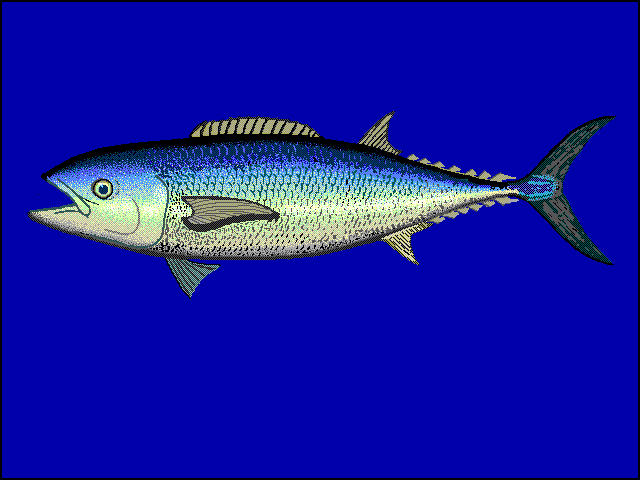
Drawing of a butterfly kingfish

This fish can be found around the world in southern temperate waters of 8–15 °C (46–59 °F), but most commonly under 10 °C (50 °F), and at depths to 200 m (660 ft) in the open ocean. It grows to a length of 1.64 m (5.4 ft) with a weight of 50 kg (110 lb), possible up to 70 kg (150 lb).[8][9]

Most bony fishes are ectothermic, or cold-blooded, but this species, much like the related tunas, is endothermic and is able to raise its body temperature to achieve a degree of thermoregulation.[10] It has a brain heater organ derived from the lateral rectus eye muscle, which is distinct from that of the billfishes, whose heater is derived from their superior rectus muscles.[5]

Etymology

[edit]

Gasterochisma derives from the Ancient Greek: γαστήρ, romanized(gaster), lit.'stomach', and χίασμα (chiasma) "crossing; X-shaped; sign of the 'X'".[8]

Taxonomy

[edit]

The evolutionary lineage of the butterfly kingfish is more primitive and quite different from that of the rest of the scombrids. Additionally, the morphology of this species is substantially different from that of the others – some suggest that it might belong in a different family altogether.[7] At present, however, morphology and nuclear phylogeny provide support that Gasterochisma is sister to all other scombrids, and that both its genus, Gasterochisma, and its subfamily, Gasterochismatinae, remain as monotypic taxa under the family Scombridae.[5]

The following cladogram shows the most likely evolutionary relationships between the butterfly kingfish and the tunas, mackerels, Spanish mackerels, and bonitos.

Butterfly kingfish, in the family Scombridae
family Scombridae
subfamily
Gasterochismatinae
genusGasterochisma

G. melampus, butterfly kingfish

subfamily
Scombrinae
tribe Scombrini

mackerels (two genera)

tribe Scomberomorini

Spanish mackerels (three genera)

tribe Sardini

bonitos (four genera)

tribe Thunnini

tunas (five genera)

Cladogram: With 51 different species in the Scombridae, the butterfly kingfish sits apart from the rest – it is the only scombrid species that does not belong to the subfamily Scombrinae.[4][5]

Distribution

[edit]

The butterfly kingfish has a circumglobal distribution in southern temperate waters.[1][8] It has caught as far north as Hawaii and seems to be common around Oceania. It prefers waters between 8 and 15 °C (46 and 59 °F).[2]

Fisheries

[edit]

While a rare catch, there is a minor commercial market, where they are caught incidentally while targeting other fish, especially through the use of longline fishing. It is of minor importance to recreational Fisheries.[9]

References

[edit]
Revisions and contributorsEdit on WikipediaRead on Wikipedia
from Grokipedia
The Butterfly kingfish (Gasterochisma melampus), also known as the butterfly mackerel or big-scaled mackerel, is a pelagic-oceanic of ray-finned in the family , distinguished by its elongate, compressed body covered in large smooth scales, a scaleless head, and enormous pelvic fins in juveniles that exceed the head length and fit into a ventral groove. Adults reach a maximum fork length of 164 cm and weight up to 41.8 kg, with a steel-grey coloration, a high rounded head, projecting lower , and small conical teeth in a single row. This inhabits deep oceanic waters worldwide in southern temperate regions, with a circumglobal distribution between 19°S and 55°S , and is most abundant in cool waters of 8–10°C at depths of 200 m or more, though it ranges from the surface to at least 200 m. It is oceanodromous, migrating within oceanic environments, and occurs as far north as to northern in the eastern Pacific. Biologically, the butterfly kingfish is a carnivorous predator with a of 4.4, feeding primarily on onychoteuthid and ommastrephid squids, remains, and occasionally bird feathers. It possesses a unique with two anterior projections extending into the skull, and its features 17–18 spines followed by 9–12 soft rays, while the anal fin has 11–13 soft rays, all supported by 44 vertebrae. Juveniles exhibit striking black pelvic fins that contribute to the "butterfly" moniker due to their enormous size. Commercially, it holds minor importance as a species in longline fisheries targeting (Thunnus maccoyii), and it is also pursued as a gamefish, though encounters by anglers are rare due to its deep-water habits. The IUCN assesses it as Least Concern, reflecting its wide distribution and stable populations.

Taxonomy and

Taxonomy

The butterfly kingfish, Gasterochisma melampus, is classified within the family , the mackerels and tunas, where it occupies a distinctive basal position. It is the sole species in the monotypic genus Gasterochisma and the monotypic subfamily Gasterochismatinae, highlighting its unique evolutionary divergence within the family. The species was initially described by John Richardson in 1845 based on specimens from Port Nicholson, New Zealand, under the name Gasterochisma melampus, establishing the genus at that time. The subfamily Gasterochismatinae was established by Felipe Poey in 1869 to accommodate this species, recognizing its morphological distinctions from other scombrids. Lahille's work in 1903 described a junior synonym genus Chenogaster but further highlighted its uniqueness. Phylogenomic analyses using over 1,000 ultraconserved DNA elements across 94 pelagiarian have resolved Gasterochisma as the to all other subfamilies, supporting its placement as the earliest diverging lineage within the family and an origin near the Cretaceous-Paleogene boundary. Key diagnostic traits contributing to this include partial cranial endothermy, evolved independently from that in tunas, and the absence of a prominent median caudal keel on the peduncle, with only small lateral keels present.

Etymology

The scientific name of the butterfly kingfish is Gasterochisma melampus. The genus name Gasterochisma is derived from the words gaster (belly or stomach) and schisma (a cleft, split, or fissure), referring to the deep ventral grooves on the belly into which the pelvic fins can retract and be concealed. This etymology highlights a distinctive anatomical adaptation for streamlining during swimming. The species epithet melampus originates from the Greek terms melas (black) and pous (foot), alluding to the blackish coloration of the pelvic fins, particularly prominent in juveniles. This naming convention follows classical ichthyological practice of describing salient color patterns in specific epithets. Juveniles exhibit these dark pelvic fins alongside their oversized proportions, contributing to the species' distinctive early appearance. Common names such as "butterfly kingfish" and "butterfly mackerel" stem from the strikingly large and elongated pelvic fins in young specimens, which extend beyond the head length and evoke the in form and proportion. These fins gradually reduce in relative size with maturity, but their juvenile morphology inspired the evocative nomenclature used in fisheries and regional contexts.

Physical characteristics

Morphology

The butterfly kingfish, Gasterochisma melampus, exhibits a fusiform body shape that is elongate and compressed, facilitating efficient movement through pelagic waters. This body form features a high, rounded head and a projecting lower jaw, contributing to its streamlined profile for open-ocean swimming. Its fins include short pectoral fins positioned high on the body, while the pelvic fins are notably large and black, particularly oversized in juveniles where they exceed the head length and adopt a wing-like appearance that tucks into a deep ventral groove. The caudal fin is strongly lunate, supported by a pair of small keels on each side of the peduncle base, but lacks a median caudal keel typical of some scombrids. The body is covered in large, smooth scales, providing a sleek surface that reduces drag, while the head remains largely scaleless except for a small area behind the eye. Coloration is uniform in adults, with a silvery body featuring a blue tint on the back and bright silvery sides, enhancing in marine environments. Internally, the species is partially endothermic, possessing a specialized heater organ derived from the lateral rectus eye muscle, which maintains elevated temperatures in the brain and retinas to support function in cooler oceanic depths. This , along with a featuring anterior projections into the skull, underscores its physiological suitability for a pelagic lifestyle.

Size and growth

The butterfly kingfish (Gasterochisma melampus) reaches a maximum reported fork length of 200 cm and a maximum recorded weight of 41.8 kg (), though actual maxima may vary due to limited sampling in remote oceanic habitats. These dimensions place it among the larger scombrid species. Sexual dimorphism is evident in body size, with females generally attaining larger lengths than males. This disparity arises from faster growth rates in females, as modeled by von Bertalanffy growth functions derived from vertebral ageing: for males, Lt=178.6(1e0.1576(t+0.1767))L_t = 178.6 (1 - e^{-0.1576(t + 0.1767)}) cm; for females, Lt=179.5(1e0.1786(t+0.3305))L_t = 179.5 (1 - e^{-0.1786(t + 0.3305)}) cm, where LtL_t is fork length at age tt in years. Females reach approximately 60 cm by age 2, compared to 52 cm for males, contributing to their larger asymptotic size. Growth in the butterfly kingfish follows the rapid early patterns typical of scombrid fishes, characterized by high initial growth coefficients (mean k0.48k \approx 0.48 y1^{-1} across the family), though species-specific data remain sparse owing to the fish's rarity and patchy distribution. Validation of methods is limited to up to 8 years via vertebral increments, with no otolith-based studies available, restricting precise long-term trajectories. During juvenile development, the pelvic fins exhibit disproportionate growth, becoming enormously elongated—longer than the head length—to form a distinctive fan-like that aids in identification. These fins gradually become proportionally smaller with age, aligning with the adult morphology by maturity. This ontogenetic shift reflects broader adaptations in body form for pelagic life.

Habitat and distribution

Habitat preferences

The butterfly kingfish (Gasterochisma melampus) inhabits marine pelagic-oceanic environments, primarily in the temperate waters of the , where it leads an oceanodromous lifestyle. This occupies the epipelagic to mesopelagic zones of the , favoring a fully oceanic niche away from coastal or neritic areas. It typically occurs at depths of 200 m or more, though captures often indicate encounters during operations at 80 to 220 meters. The butterfly kingfish is most abundant in cooler waters between 8 and 10°C, with occurrences extending to 15°C, reflecting its adaptation to and transitional temperate conditions. Feeding is concentrated in these cooler 8 to 10°C zones, which support its predatory ecology. The species shows strong associations with major ocean currents in temperate zones, including frontal systems like the subtropical convergence, where cold nutrient-rich waters facilitate its distribution and foraging. It is frequently encountered in regions influenced by , such as the Peru-Chile Current system, which enhances productivity in its preferred thermal regime.

Geographic range

The butterfly kingfish (Gasterochisma melampus) exhibits a circumglobal distribution in southern temperate oceans, encompassing the Atlantic, Indian, and Pacific, with its primary range concentrated below 35°S in a continuous circumpolar band typically between 35°S and 45°S. This distribution aligns with the sub-Antarctic front to the south, extending occasionally to 50°S off southern Australia, and northward to approximately 20°S in the southeastern Indian and Atlantic Oceans. The species is most commonly encountered in oceanic waters around Oceania, southern Australia, New Zealand, southern Africa, and the southeastern Pacific off Chile and Peru. Rare northward extensions of the range occur sporadically due to intrusions of cold southern waters, including historical records off and in the southwestern Atlantic below 35°S, as well as vagrant sightings in more tropical latitudes such as southeastern at 23°S and north of the Hawaiian Archipelago. These exceptional occurrences highlight the species' occasional deviation from its core temperate habitat, often linked to anomalous oceanographic conditions. The butterfly kingfish forms a single circumpolar with no distinct populations, characterized by migrations across ocean basins for feeding before returning to the southeastern Pacific for spawning. Seasonally, the distribution shows variations, with smaller immature individuals more prevalent on feeding grounds from May to August, while larger adults are distributed more evenly year-round within the core range.

Biology and ecology

Reproduction and life cycle

The butterfly kingfish (Gasterochisma melampus) exhibits external fertilization and is a nonguarder that scatters pelagic eggs in open water, with no parental care provided to offspring. Spawning occurs primarily in the southeastern Pacific Ocean, between 85–130°W and 28–41°S, during mid-April to mid-July, with a peak in mid-May; this timing aligns with austral autumn, when sea surface temperatures (SST) range from 14–18°C, which is warmer than the species' typical cool-temperate habitats but cooler than those of most tropical scombrids. Unlike its warm-water relatives that spawn year-round in consistently tropical conditions, G. melampus undertakes seasonal migrations to these relatively warmer spawning grounds to facilitate reproduction. Eggs are large and pelagic, with hydrated females producing spherical oocytes averaging 1.64 mm in diameter (range 1.55–1.74 mm), a size atypical for scombrids, which usually have eggs under 1.0 mm; this adaptation likely enhances larval viability in cooler waters by providing greater reserves for development. has not been precisely quantified, but the presence of hydrated eggs in samples indicates batch spawning, with gonadosomatic indices peaking during the spawning period. is reached at approximately 1 m fork length (FL), with males maturing at around 110 cm FL and females at 140 cm FL, though the smallest mature female observed was 103 cm FL; catches in spawning areas show a strong female bias, exceeding 80%, while overall fisheries data indicate 73% females, possibly due to sex-specific migration patterns or differential growth rates. The life cycle begins with pelagic larvae hatching from these large eggs, transitioning to a juvenile phase characterized by oversized fins, including pelvic fins longer than the head, which aid in maneuverability during early dispersal. Immature juveniles (under 90 cm FL) inhabit feeding grounds across the Atlantic, Indian, and southwestern Pacific Oceans, where they grow in cooler temperate waters (SST median 10.6°C). Upon reaching maturity, adults migrate to the southeastern Pacific spawning grounds off , where a single stock reproduces before dispersing again to feeding areas; this migratory reproductive strategy supports a circumpolar temperate distribution in the . The combination of large eggs, female dominance, and cooler spawning temperatures represents a distinctive reproductive among scombrids, potentially compensating for slower larval growth rates through improved offspring survival.

Diet and feeding

The butterfly kingfish (Gasterochisma melampus) is a carnivorous species with a diet dominated by s, particularly mesopelagic squid such as onychoteuthids and ommastrephids, which comprise approximately 52.5% of content volume based on analyses of 949 non-empty stomachs from waters. Small mesopelagic , including myctophids and photichthyids, account for about 33.1% of the diet, with minor contributions from crustaceans (1.2%), salps (4.8%), and occasional items like or plastic debris. In the eastern South Pacific, contents from 16 specimens revealed 16 cephalopod species from 12 families, mostly gelatinous mesopelagic forms like Histioteuthis dofleini and Eucleoteuthis luminosa, with no evidence of fast-swimming epipelagic prey typical of tunas. A specimen from the north Pacific included squid beaks, vertebrae and rays from exocoetids, bird feathers, and parasitic nematodes. As an opportunistic predator, the butterfly kingfish targets mid-water nekton in deep oceanic environments, foraging on macrofauna at depths influenced by prey availability in the pelagic zone. Its feeding occurs primarily in temperate southern waters, where cephalopods and small fish are abundant, reflecting adaptation to cooler, open-ocean habitats. The species occupies a mid-level trophic position in pelagic food webs, with an estimated trophic level of 4.35 based on food item analyses, positioning it as a secondary consumer of nekton while serving as prey for larger predators. Ontogenetic shifts in diet are minimal across a size range of 32–191 cm fork length, though analyses suggest a possible trend toward larger with increasing body size, without significant changes in overall composition from smaller to more substantial prey items.

Behavior and migration

The butterfly kingfish (Gasterochisma melampus) exhibits a highly migratory lifestyle as a single stock that circumnavigates the southern oceans, undertaking extensive annual movements across the Atlantic, Indian, and Pacific Oceans. Juveniles and adults migrate northward from subtropical spawning grounds to feed in colder waters, where temperatures typically range from 8–10°C, before returning southward to warmer subtropical frontal zones for reproduction. This pattern allows the to exploit seasonally abundant resources in temperate southern waters, with migrations spanning thousands of kilometers. Socially, butterfly kingfish occur in loose aggregations or associate with schools of other pelagic species, such as (Thunnus maccoyii), differing from the compact, fast-moving schools typical of true tunas. These loose groupings facilitate foraging in open oceanic environments without the synchronized high-speed pursuits seen in scombrids like . The species' partial endothermy, characterized by a specialized cranial heater organ derived from eye muscle that warms the and eyes, plays a crucial role in enabling sustained activity during prolonged migrations into cooler waters. This adaptation maintains elevated temperatures in vital neural tissues, supporting metabolic efficiency and sensory function in feeding grounds where ambient temperatures drop below 10°C, unlike fully ectothermic relatives. Butterfly kingfish occur from the surface to depths of at least 200 m, consistent with many epipelagic scombrids. This aligns with their preference for cooler water layers (8–18°C) during migrations, optimizing and predator avoidance in the .

Human interactions

Fisheries

The butterfly kingfish (Gasterochisma melampus) is primarily captured as incidental in pelagic longline fisheries targeting tunas and , with the majority taken in operations focused on (Thunnus maccoyii). Japanese fleets have recorded catches since the 1970s, using data, scientific observers, and surveys to document encounters from the surface to depths below 200 m. Global catch volumes are minor and of low commercial significance overall, with estimated annual totals ranging from 613 to 3,699 tonnes (mean 1,859 tonnes) between 1993 and 2016, primarily attributed to Japanese operations accounting for about 64% of the total. These volumes represent less than 1% of catches in many southern longline fisheries, such as those for . The species holds more notable regional importance in southern hemisphere fisheries, particularly off , , and , where it appears more frequently in tuna longline bycatch. In waters, annual catches averaged 15 tonnes from 2001 to 2015, while Japanese fleets operating in areas off and contribute to higher encounter rates between 35°S and 45°S latitudes. Utilization of the butterfly kingfish is limited by its rarity and preference for deep oceanic waters, but captured individuals are typically retained for human consumption, with the flesh sold as a high-value supplementary product in markets such as .

Conservation status

The butterfly kingfish (Gasterochisma melampus) is classified as Least Concern on the , with the assessment conducted on 3 March 2020. This status reflects its wide distribution in temperate southern oceans and lack of evidence for significant population declines, supported by its occurrence across large oceanic areas with no targeted exploitation. Low overall fishing pressure contributes to this evaluation, as the species is not commercially sought and experiences minimal direct harvest. Primary threats to the butterfly kingfish include in pelagic longline fisheries targeting (Thunnus maccoyii) and other tunas, where it is incidentally captured, particularly by Japanese fleets in the southern Indian and Pacific Oceans. Potential climate change impacts, such as shifts in ocean temperatures altering migration routes and prey availability for this highly migratory scombrid, could indirectly affect its distribution and abundance, though specific effects remain understudied. Management of the butterfly kingfish falls under regional organizations like the Commission for the Conservation of Southern Bluefin Tuna (CCSBT), which regulates associated longline fisheries through total allowable catches for target species and mitigation measures, but no species-specific quotas exist for the butterfly kingfish. Conservation actions emphasize monitoring incidental catches rather than direct protections, given its non-targeted status. Ongoing needs include improved on abundance, trends, and mortality rates to enable better monitoring of potential declines, as current fishery-dependent from longline operations provide limited insights into overall stock health.

References

Add your contribution
Related Hubs
User Avatar
No comments yet.