Hubbry Logo
ActinopterygiiActinopterygiiMain
Open search
Actinopterygii
Community hub
Actinopterygii
logo
8 pages, 0 posts
0 subscribers
Be the first to start a discussion here.
Actinopterygii
Actinopterygii
from Wikipedia

Ray-finned fish
Temporal range:
Late Silurianpresent, 425–0 Ma[1]
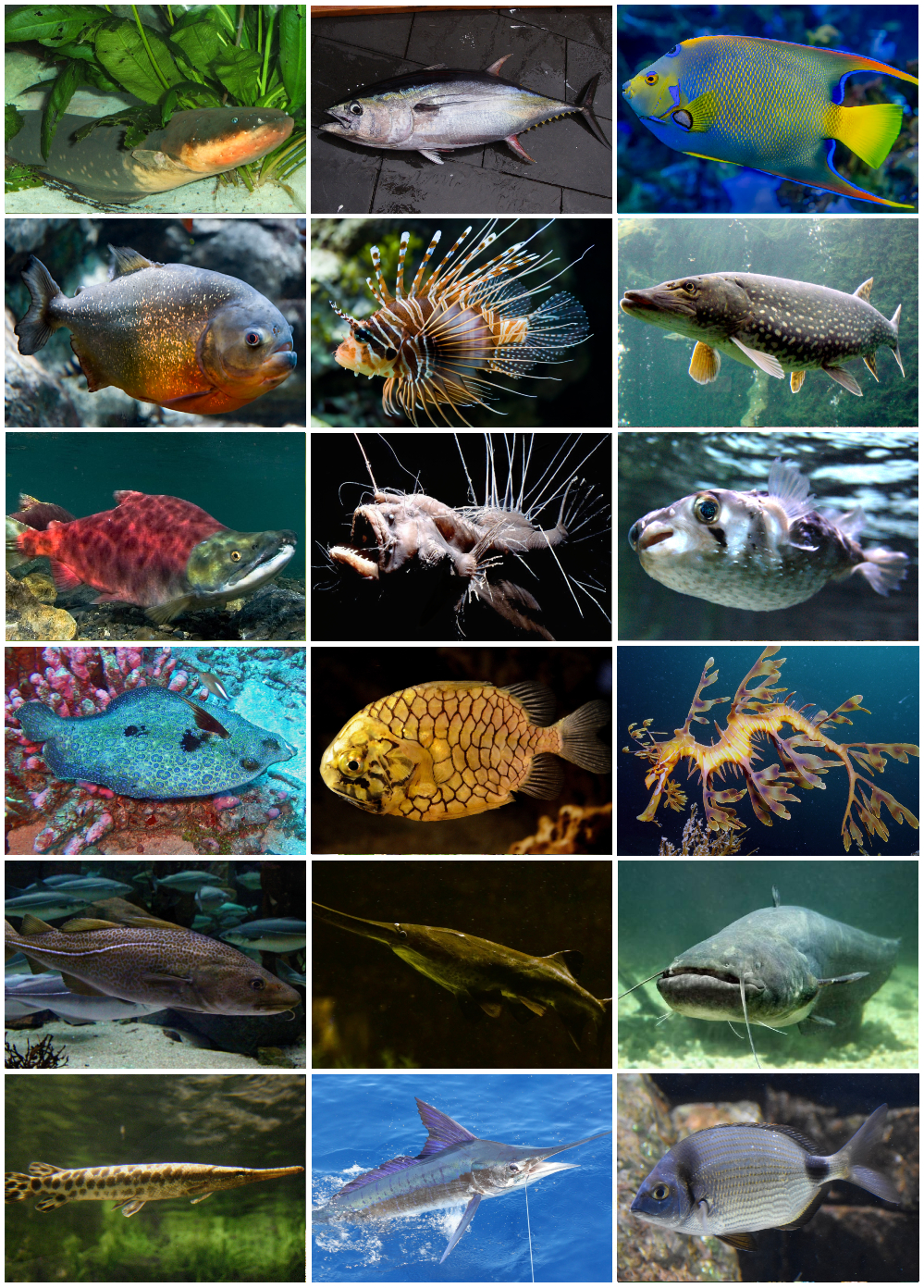
Electric eelRed-bellied piranhaSockeye salmonPeacock flounderAtlantic codSpotted garYellowfin tunaSpotfin lionfishFanfinJapanese pineconefishAmerican paddlefishStriped marlinQueen angelfishNorthern pikeLong-spine porcupinefishLeafy seadragonWels catfishTwo-banded seabream
Scientific classification Edit this classification
Kingdom: Animalia
Phylum: Chordata
Clade: Osteichthyes
Class: Actinopterygii
Klein, 1885
Subclasses

Actinopterygii (/ˌæktɪnɒptəˈrɪi/ ; from Ancient Greek ἀκτίς (aktís) 'ray, beam' and πτέρυξ (ptérux) 'wing, fins'), members of which are known as ray-finned fish or actinopterygians, is a class of bony fish[2] that constitute nearly 99% of the over 30,000 living species of fish.[3] The vast majority of extant actinopterygian species are teleosts, and by species count they dominate the subphylum Vertebrata, comprising over 50% of all living vertebrates.[4] They are the most abundant nektonic aquatic animals and are ubiquitous throughout freshwater, brackish and marine environments from the deep sea to subterranean waters to the highest mountain streams. Extant species can range in size from Paedocypris, at 8 mm (0.3 in), to the massive giant sunfish, at 2,700 kg (6,000 lb), and the giant oarfish, at 8 m (26 ft) (or possibly 11 m (36 ft)). The largest ever known ray-finned fish, the extinct Leedsichthys from the Jurassic, is estimated to have grown to 16.5 m (54 ft).

Ray-finned fish are so called because of their lightly built fins made of webbings of skin supported by radially extended thin bony spines called lepidotrichia, as opposed to the bulkier, fleshy fins of the sister clade Sarcopterygii (lobe-finned fish). Resembling folding fans, the actinopterygian fins can easily change shape, orientation and wetted area, providing superior thrust-to-weight ratios per movement compared to sarcopterygian and chondrichthyian fins. The fin rays attach directly to the proximal or basal skeletal elements, the radials, which represent the articulation between these fins and the internal skeleton (e.g., pelvic and pectoral girdles).

Characteristics

[edit]
Anatomy of a typical ray-finned fish (cichlid)
A: dorsal fin, B: fin rays, C: lateral line, D: kidney, E: swim bladder, F: Weberian apparatus, G: inner ear, H: brain, I: nostrils, L: eye, M: gills, N: heart, O: stomach, P: gall bladder, Q: spleen, R: internal sex organs (ovaries or testes), S: pelvic fins, T: spine, U: anal fin, V: tail (caudal fin). Possible other parts not shown: barbels, adipose fin, external genitalia (gonopodium)

Ray-finned fishes occur in many variant forms. The main features of typical ray-finned fish are shown in the adjacent diagram. The swim bladder is a more derived structure and used for buoyancy.[5] Except from the bichirs, which just like the lungs of lobe-finned fish have retained the ancestral condition of ventral budding from the foregut, the swim bladder in ray-finned fishes derives from a dorsal bud above the foregut.[5] In early forms the swim bladder could still be used for breathing, a trait still present in Holostei (bowfins and gars).[6] In some fish like the arapaima, the swim bladder has been modified for breathing air again,[7] and in other lineages it has been completely lost.[8] The teleosts have urinary and reproductive tracts that are fully separated, while the Chondrostei have common urogenital ducts, and partially connected ducts are found in Cladistia and Holostei.[9] Ray-finned fishes have many different types of scales; but all teleosts have leptoid scales. The outer part of these scales fan out with bony ridges, while the inner part is crossed with fibrous connective tissue. Leptoid scales are thinner and more transparent than other types of scales, and lack the hardened enamel- or dentine-like layers found in the scales of many other fish. Unlike ganoid scales, which are found in non-teleost actinopterygians, new scales are added in concentric layers as the fish grows.[10] Teleosts and chondrosteans (sturgeons and paddlefish) also differ from the bichirs and holosteans (bowfin and gars) in having gone through a whole-genome duplication (paleopolyploidy). The WGD is estimated to have happened about 320 million years ago in the teleosts, which on average has retained about 17% of the gene duplicates, and around 180 (124–225) million years ago in the chondrosteans. It has since happened again in some teleost lineages, like Salmonidae (80–100 million years ago) and several times independently within the Cyprinidae (in goldfish and common carp as recently as 14 million years ago).[11][12][13][14][15]

Body shapes and fin arrangements

[edit]

Ray-finned fish vary in size and shape, in their feeding specializations, and in the number and arrangement of their ray-fins.

Reproduction

[edit]
Three-spined stickleback (Gasterosteus aculeatus) males (red belly) build nests and compete to attract females to lay eggs in them. Males then defend and fan the eggs. Painting by Alexander Francis Lydon, 1879

In nearly all ray-finned fish, the sexes are separate, and in most species the females spawn eggs that are fertilized externally, typically with the male inseminating the eggs after they are laid. Development then proceeds with a free-swimming larval stage.[16] However other patterns of ontogeny exist, with one of the commonest being sequential hermaphroditism. In most cases this involves protogyny, fish starting life as females and converting to males at some stage, triggered by some internal or external factor. Protandry, where a fish converts from male to female, is much less common than protogyny.[17] Most families use external rather than internal fertilization.[18] Of the oviparous teleosts, most (79%) do not provide parental care.[19] Viviparity, ovoviviparity, or some form of parental care for eggs, whether by the male, the female, or both parents is seen in a significant fraction (21%) of the 422 teleost families; no care is likely the ancestral condition.[19] The oldest case of viviparity in ray-finned fish is found in Middle Triassic species of Saurichthys.[20] Viviparity is relatively rare and is found in about 6% of living teleost species; male care is far more common than female care.[19][21] Male territoriality "preadapts" a species for evolving male parental care.[22][23] There are a few examples of fish that self-fertilise. The mangrove rivulus is an amphibious, simultaneous hermaphrodite, producing both eggs and spawn and having internal fertilisation. This mode of reproduction may be related to the fish's habit of spending long periods out of water in the mangrove forests it inhabits. Males are occasionally produced at temperatures below 19 °C (66 °F) and can fertilise eggs that are then spawned by the female. This maintains genetic variability in a species that is otherwise highly inbred.[24]

Classification and fossil record

[edit]

Actinopterygii is divided into the subclasses Cladistia, Chondrostei and Neopterygii. The Neopterygii, in turn, is divided into the infraclasses Holostei and Teleostei. During the Mesozoic (Triassic, Jurassic, Cretaceous) and Cenozoic the teleosts in particular diversified widely. As a result, 96% of living fish species are teleosts (40% of all fish species belong to the teleost subgroup Acanthomorpha), while all other groups of actinopterygians represent depauperate lineages.[25] The classification of ray-finned fishes can be summarized as follows:

  • Cladistia, which include bichirs and reedfish
  • Actinopteri, which include:
    • Chondrostei, which include Acipenseriformes (paddlefishes and sturgeons)
    • Neopterygii, which include:
      • Teleostei (most living fishes)
      • Holostei, which include:
        • Lepisosteiformes (gars)
        • Amiiformes (bowfin)

The cladogram below shows the main clades of living actinopterygians and their evolutionary relationships to other extant groups of fishes and the four-limbed vertebrates (tetrapods).[26][27] The latter include mostly terrestrial species but also groups that became secondarily aquatic (e.g. whales and dolphins). Tetrapods evolved from a group of bony fish during the Devonian period.[28] Approximate divergence dates for the different actinopterygian clades (in millions of years, mya) are from Near et al., 2012.[26]

Vertebrates

The polypterids (bichirs and reedfish) are the sister lineage of all other actinopterygians, the Acipenseriformes (sturgeons and paddlefishes) are the sister lineage of Neopterygii, and Holostei (bowfin and gars) are the sister lineage of teleosts. The Elopomorpha (eels and tarpons) appear to be the most basal teleosts.[26] The earliest known fossil actinopterygian is Andreolepis hedei, dating back 420 million years (Late Silurian), remains of which have been found in Russia, Sweden, and Estonia.[29] Crown group actinopterygians most likely originated near the Devonian-Carboniferous boundary.[30] The earliest fossil relatives of modern teleosts are from the Triassic period (Prohalecites, Pholidophorus),[31][32] although it is suspected that teleosts originated already during the Paleozoic Era.[26]

Chondrostei Chondrostei (cartilage bone) is a subclass of primarily cartilaginous fish showing some ossification. Earlier definitions of Chondrostei are now known to be paraphyletic, meaning that this subclass does not contain all the descendants of their common ancestor. There used to be 52 species divided among two orders, the Acipenseriformes (sturgeons and paddlefishes) and the Polypteriformes (reedfishes and bichirs). Reedfish and birchirs are now separated from the Chondrostei into their own sister lineage, the Cladistia. It is thought that the chondrosteans evolved from bony fish but lost the bony hardening of their cartilaginous skeletons, resulting in a lightening of the frame. Elderly chondrosteans show beginnings of ossification of the skeleton, suggesting that this process is delayed rather than lost in these fish.[33] This group had once been classified with the sharks: the similarities are obvious, as not only do the chondrosteans mostly lack bone, but the structure of the jaw is more akin to that of sharks than other bony fish, and both lack scales (excluding the Polypteriforms). Additional shared features include spiracles and, in sturgeons, a heterocercal tail (the vertebrae extend into the larger lobe of the caudal fin). However the fossil record suggests that these fish have more in common with the Teleostei than their external appearance might suggest.[33]
Neopterygii Neopterygii (new fins) is a subclass of ray-finned fish that appeared somewhere in the Late Permian. There were only few changes during its evolution from the earlier actinopterygians. Neopterygians are a very successful group of fishes because they can move more rapidly than their ancestors. Their scales and skeletons began to lighten during their evolution, and their jaws became more powerful and efficient. While electroreception and the ampullae of Lorenzini is present in all other groups of fish, with the exception of hagfish, neopterygians have lost this sense, though it later re-evolved within Gymnotiformes and catfishes, who possess nonhomologous teleost ampullae.[34]
Fossil of the Devonian cheirolepidiform Cheirolepis canadensis
Fossil of the Carboniferous elonichthyiform Elonichthys peltigerus
Fossil of the Permian aeduelliform Aeduella blainvillei
Fossil of the Permian palaeonisciform Palaeoniscum freieslebeni
Fossil of the Triassic bobasatraniiform Bobasatrania canadensis
Fossil of the Triassic perleidiform Thoracopterus magnificus
Fossils of the Triassic prohaleciteiform Prohalecites sp., the earliest teleosteomorph
Fossil of the Jurassic aspidorhynchiform Aspidorhynchus sp.
Fossil of the Jurassic pachycormiform Pachycormus curtus
Fossil of the Cretaceous acipenseriform Yanosteus longidorsalis
Fossil of the Cretaceous aulopiform Nematonotus longispinus
Fossil of the Cretaceous ichthyodectiform Thrissops formosus
Fossil of the Eocene carangiform Mene oblonga
Fossil of the Eocene pleuronectiform Amphistium paradoxum
Fossil of a ray-finned perch (Priscacara serrata) from the Lower Eocene about 50 million years ago
Fossil of the Miocene syngnathiform Nerophis zapfei
Skeleton of the angler fish, Lophius piscatorius. The first spine of the dorsal fin of the anglerfish is modified so it functions like a fishing rod with a lure
Skeleton of another ray-finned fish, the lingcod
Blue catfish skeleton

Taxonomy

[edit]

The listing below is a summary of all extinct (indicated by a dagger, †) and living groups of Actinopterygii with their respective taxonomic rank. The taxonomy follows Eschmeyer's Catalog of Fishes[35] and Phylogenetic Classification of Bony Fishes[27] with notes when this differs from Nelson,[4] ITIS[36] and FishBase[37] and extinct groups from Van der Laan 2016[38] and Xu 2021.[39]

References

[edit]
[edit]
Revisions and contributorsEdit on WikipediaRead on Wikipedia
from Grokipedia
Actinopterygii, commonly known as ray-finned fishes, is a major of bony fishes () distinguished by their fins supported by slender, flexible bony rays called lepidotrichia, and it encompasses the most diverse group of living with over 36,000 described species. As of November 2025, over 36,000 species have been described, with more than 700 new species added since 2023. These fishes constitute approximately 96% of all extant fish species and half of all species, inhabiting a wide range of aquatic environments from freshwater rivers to the deepest ocean trenches. Ray-finned fishes exhibit a variety of diagnostic morphological features, including branchiostegal rays that support the covers, the absence of internal nares (nostrils opening into the ), and a typically connected dorsally to the for control. Additional apomorphies include a perforated propterygium at the base of the pectoral fin, basal fulcra along the leading edge of the caudal fin, a distinct cerebellar structure in the , and acrodin-capped teeth. Body forms are highly diverse, ranging from elongated eels to deep-bodied angelfishes, with adaptations for predation, herbivory, and across marine, freshwater, and even semi-terrestrial habitats. The evolutionary history of Actinopterygii traces back to the Late or periods, around 420–360 million years ago, with the earliest known fossils from the Middle Devonian, around 390 million years ago (e.g., Cheirolepis), though possible stem-group records date to the Late (~420 million years ago). Major diversification occurred during the era, particularly among teleosts in the and , leading to their dominance in modern aquatic ecosystems following the Permian-Triassic extinction event. Fossil records reveal over 287 extinct lineages, highlighting a rich history of morphological innovation and adaptation. Phylogenetically, Actinopterygii is an unranked clade divided into Polypteridae (bichirs, as the sister group) and Actinopteri, the latter including (sturgeons and paddlefishes, 28 species in 2 families), and , which further splits into (gars and bowfins, 9 living species) and the highly diverse Teleostei (over 35,000 species). Teleostei comprises major subgroups such as Elopomorpha (eels and tarpons, ~1,100 species), Osteoglossomorpha (bony-tongued fishes, 254 species), and Clupeocephala (including otophysans and euteleosts, over 33,000 species across numerous orders). Recent molecular phylogenies recognize 81 orders and 543 families, with ongoing revisions emphasizing monophyletic groupings like (16 major clades). Actinopterygii displays extraordinary ecological diversity, with occupying temperatures from -1.8°C to over 40°C and depths up to 7,000 meters, including 41% freshwater endemics and many migratory forms. Economically, they support global fisheries, , and ornamental trades, though many face threats from habitat loss, , and , with thousands listed as vulnerable or endangered. Over 3,600 new have been described in the past decade, underscoring their ongoing evolutionary dynamism.

Overview

Definition and Scope

Actinopterygii, derived from the Greek words aktis (ray) and pteron ( or wing), refers to the class of ray-finned fishes, a major subgroup of bony vertebrates characterized by fins supported by lepidotrichia—slender, segmented rays of rather than fleshy lobes. This defining feature distinguishes them from other osteichthyan fishes and enables diverse fin shapes adapted to various aquatic environments. Within the vertebrate phylogeny, occupies a basal position in the superclass (bony fishes), serving as the sister clade to (lobe-finned fishes, including coelacanths, lungfishes, and the lineage leading to tetrapods). This dichotomy arose early in osteichthyan evolution, with Actinopterygii diverging during the period and subsequently achieving greater species diversity. The scope of Actinopterygii is vast, encompassing approximately 37,000 living that account for over 99% of all extant diversity. These are traditionally organized into subclasses such as the basal Polypteridae (bichirs, ~16 ), (e.g., sturgeons and paddlefishes), (e.g., gars and bowfins, 9 living ), and the dominant Teleostei (teleosts), though modern phylogenies often use unranked clades for finer resolution.

Evolutionary and Ecological Significance

The ray-finned fishes (Actinopterygii) represent one of the most successful radiations, originating in the around 400 million years ago, with crown-group diversification by approximately 380 million years ago, and diversifying over more than 400 million years to occupy nearly every aquatic on . This was particularly explosive following the end-Devonian mass extinction, with early diversification in the leading to the dominance of neopterygians and teleosts. Within Actinopterygii, teleosts account for approximately 96% of all living fish , comprising over 35,000 and half of all extant vertebrates, a success attributed in part to a whole-genome duplication event around 320 million years ago that facilitated genetic innovation and morphological diversity. Ecologically, Actinopterygii play pivotal roles as keystones in aquatic food webs, functioning as primary consumers, predators, and prey across marine, freshwater, and brackish ecosystems. They contribute substantially to hotspots, such as reefs, where diverse clades like and parrotfishes maintain ecosystem health through herbivory, , and trophic interactions that support resilience. In broader aquatic systems, ray-finned fishes influence nutrient cycling and energy transfer, with adapted to extreme environments—from fast-flowing hillstreams to deep-sea trenches—exemplifying their radiation into varied ecological niches. The evolutionary and ecological significance of Actinopterygii extends to human societies and scientific research, forming the basis for global fisheries and that supply about 15% of the world's animal protein intake as of , particularly in coastal and developing regions. These fishes also serve as key model organisms in , with species like enabling studies of development, , and adaptation due to their post-duplication genomic complexity.

Morphology and Anatomy

General Characteristics

Actinopterygii, commonly known as ray-finned fishes, are characterized by a composed of ossified elements that provide and enable diverse body forms. This internal skeleton contrasts with the cartilaginous endoskeleton of chondrichthyans and includes well-developed vertebral columns, , and fin supports derived from . Extant species exhibit a remarkable size range, from the paedomorphic at approximately 8 mm in standard length to the extinct Jurassic giant problematicus, estimated to have reached up to 16 m in length. The head of actinopterygians typically features a terminal mouth positioned at the anterior end, facilitating varied feeding strategies, and is covered by an operculum that protects the apparatus. In more advanced forms, such as teleosts, the body is often clad in or ctenoid scales, which are thin, overlapping dermal structures that reduce drag and provide protection without the rigidity of ganoid scales found in basal groups. Internally, derived actinopterygians, particularly teleosts, possess a , where the vertebral column terminates symmetrically near the fin's center, promoting efficient propulsion, while basal forms exhibit heterocercal tails. The includes a and an anal fin, both supported by lepidotrichia (fin rays), which contribute to stability and maneuverability; variations in their arrangements are detailed elsewhere. A key evolutionary innovation in the subgroup of Actinopterygii is the teleost-specific whole-genome duplication event, which occurred approximately 300–350 million years ago and provided genetic redundancy that facilitated extensive morphological diversity and adaptive radiations. This duplication is linked to the proliferation of gene families involved in development, sensory systems, and , underpinning the group's dominance in aquatic ecosystems.

Body Shapes and Fin Arrangements

Actinopterygii exhibit remarkable diversity in body shapes, which are adaptations to specific ecological niches and locomotion demands. bodies, characterized by a streamlined, spindle-like form tapering at both ends, are prevalent in fast-swimming pelagic species such as tunas ( spp.), facilitating high-speed cruising through reduced drag. In contrast, depressed body shapes, flattened dorsoventrally, are typical of bottom-dwelling fishes like flatfishes (Pleuronectiformes), enabling effective maneuverability over substrates and via body compression against the seafloor. Elongated, anguilliform bodies occur in eel-like species such as moray eels (Muraenidae), promoting serpentine undulation for navigating complex reef environments or burrowing. Fin arrangements in Actinopterygii are highly variable, supporting diverse and stability functions, with all featuring lepidotrichia—segmented, bilaterally paired dermal rays that provide flexibility and strength. Paired pectoral and pelvic , located on the sides, primarily aid in maneuvering, braking, and fine adjustments during station-holding or turning, as seen in their proximal attachment to the via radials. Unpaired include the dorsal (on the back), caudal (tail), and anal (ventral) fins, which generate and maintain balance; for instance, the caudal fin often forms a homocercal structure with symmetrical lobes for efficient forward . These lepidotrichia, unique to ray-finned fishes, allow to fold against the body to minimize drag or extend for enhanced surface area during active . Specialized fin forms further diversify locomotion capabilities within Actinopterygii. Ray-supported fins, composed of lepidotrichia webs, contrast with the fleshy, lobed fins of sarcopterygians, offering greater modularity for shape changes that optimize thrust-to-weight ratios. An example is the , a fleshy dorsal structure lacking lepidotrichia, present in salmonids () and over 6,000 species; it arises from modified scales and aids in vortex control around the caudal fin during steady . This fin's morphology, with segmented rays similar to other actinopterygian structures, underscores in fin evolution across the . Locomotion adaptations in Actinopterygii rely on distinct modes tailored to body and configurations. Undulatory , involving lateral waves propagating along the body or tail, predominates in elongated forms like eels, maximizing in low-speed, maneuverable contexts through axial musculature. Oscillatory , by contrast, employs flapping motions of or paired fins, as in species like tunas, where rapid caudal beats achieve sustained high speeds via lift-based propulsion. These modes, supported by the flexible lepidotrichia, enable ray-finned fishes to exploit a wide array of hydrodynamic environments.

Scales and Sensory Structures

Actinopterygii exhibit diverse scale morphologies adapted to their aquatic environments, with primitive forms retaining heavy, protective ganoid scales and more derived teleosts featuring lighter leptoid scales. Ganoid scales, characterized by their rhomboid shape and enamel-like ganoin layer, are found in basal actinopterygians such as sturgeons () and gars (), providing robust armor against predators through their thick, diamond-shaped structure composed of , dentine, and cosmine layers. In contrast, teleosts, which comprise the majority of actinopterygian species, possess leptoid scales, including smooth-edged scales in soft-rayed forms like and , and comb-like ctenoid scales with posterior denticles in spiny-rayed species such as perches, allowing greater flexibility and reduced drag during swimming. Some anguilliform fishes, including eels of the genus , have undergone scale reduction or complete loss, resulting in a smoother that facilitates burrowing and in benthic or habitats. Sensory structures in Actinopterygii enable precise detection of environmental cues, with the system being a ubiquitous mechanosensory organ across the . Composed of neuromasts embedded in canals or as superficial lines along the head and trunk, the detects water movements, vibrations, and pressure gradients, aiding in schooling, predator avoidance, and prey localization through deflection within gelatinous cupulae. Specialized electroreceptors occur in certain lineages, such as gymnotiform knifefishes, where ampullary organs and tuberous electroreceptors sense perturbations generated by myogenic or neurogenic electric organs, supporting electrolocation and electrocommunication in murky freshwater environments. Additionally, chemosensory barbels, prominent in catfishes (Siluriformes), are whisker-like appendages richly innervated by trigeminal and nerves and covered in , allowing detection of chemical cues for foraging on the substrate. The skin of actinopterygians includes protective and adaptive features beyond scales, notably a secreted by epidermal goblet cells that serves multiple functions. This forms a viscoelastic barrier that traps pathogens, lubricates the body to reduce friction, and incorporates , lysozymes, and for innate immune defense against infections. In , the layer helps maintain ionic balance by minimizing passive across the semipermeable , particularly in teleosts transitioning between freshwater and marine habitats. Deep-sea , such as those in the order , possess photophores—bioluminescent organs embedded in the —that produce to match light, camouflaging the from below and aiding in prey attraction or recognition. Phylogenetic analyses indicate that scale loss in Actinopterygii has occurred independently multiple times, with at least 32–43 events documented across the , often correlating with shifts to benthic lifestyles where reduced drag or enhanced burrowing efficiency is advantageous. These losses are rarely reversed, though tentative evidence suggests limited re-acquisition in lineages like , highlighting the evolutionary lability of integumentary structures in response to ecological pressures.

Physiology

Swim Bladder and Buoyancy

The in Actinopterygii is a gas-filled organ derived from an outpouching of the dorsal wall of the embryonic gut, typically positioned in the dorsal along the vertebral column. This structure primarily functions to regulate by adjusting the fish's overall to match the surrounding water, allowing for with minimal energy expenditure on locomotion. In most species, the contains a mixture of gases, predominantly oxygen, , and , which can be finely tuned to maintain at various depths. Actinopterygians are divided into physostomous and physoclistous groups based on swim bladder morphology. Physostomes, including many primitive teleosts such as salmonids and clupeids, retain an open pneumatic duct connecting the to the , enabling direct gulping or venting of gas to adjust volume rapidly. In contrast, physoclists, which encompass most advanced teleosts like perciforms, have a closed lacking this duct; instead, gas regulation occurs internally through specialized tissues. The posterior region features a with oval-shaped cells that secrete gas into the bladder via in the rete mirabile, a vascular network that concentrates gases from the blood, while an anterior oval facilitates gas resorption to reduce volume when needed. This process relies on physiological mechanisms like the Root effect, where releases oxygen at low pH in the . Buoyancy control via the allows ray-finned fishes to hover effortlessly, conserving up to 50% of swimming energy compared to without it, as the organ counteracts the fish's body (typically around 1.05–1.07 g/cm³ in ). For a 1 kg , a volume of approximately 80 ml can achieve in freshwater, though compression under hydrostatic pressure limits its effectiveness at depth—reducing volume by about 50% at 10 m. Gas deposition and resorption rates are relatively slow (e.g., 1 ml/h in eels), constraining rapid vertical migrations in physoclists and often requiring behavioral adjustments like continuous swimming to maintain position. Variations in swim bladder presence and function occur across subgroups, reflecting ecological adaptations. It is absent or greatly reduced in many bottom-dwelling species, such as flatfishes (Pleuronectiformes), where larval swim bladders are often resorbed during to suit a demersal lifestyle on the seafloor. In ancestral lineages like Polypteriformes, the retains a lung-like configuration with vascularized walls for accessory air-breathing in low-oxygen environments, though this respiratory role has largely been lost in favor of in more derived actinopterygians. Physiologically, the swim bladder integrates with other systems in certain groups; for instance, in otophysans (e.g., cypriniforms and siluriforms), it connects to the inner ear via the Weberian apparatus—a chain of 1–4 ossicles derived from anterior vertebrae—that transmits pressure waves from the bladder's gas vibrations, enhancing hearing sensitivity across a broader frequency range (up to 10 kHz in some species).

Respiration and Circulation

In Actinopterygii, respiration occurs primarily through gills composed of four holobranchial arches, each bearing numerous secondary lamellae that provide an extensive surface for gas exchange. These lamellae feature a countercurrent flow system, where deoxygenated blood in the afferent filaments moves opposite to oxygenated water passing over the gill surface, enabling up to 80-90% oxygen extraction efficiency from ambient water. This mechanism is highly efficient for aquatic oxygen uptake, with blood pH and hemoglobin affinity adaptations further optimizing O₂ binding in low-oxygen environments. Water flow over the gills is maintained by two main ventilation strategies. , the predominant method in most ray-finned fishes, involves coordinated expansion of the buccal cavity to draw in and contraction of the opercular cavity to expel it unidirectionally over the gills, occurring at frequencies of 50-100 cycles per minute in resting fish. In contrast, ram ventilation is utilized by fast-swimming species such as tunas and mackerels, where forward propulsion with the mouth agape passively forces across the gills, reducing energy costs but requiring sustained swimming speeds above 0.5 body lengths per second to avoid hypoxia. The supports respiration via a two-chambered heart consisting of a single atrium and ventricle, which receives deoxygenated blood from the and pumps it through a conus arteriosus into the ventral for oxygenation. Oxygenated blood then travels in a single systemic circuit via efferent branchial arteries forming the dorsal , distributing to the body without separation of pulmonary and systemic loops. Adaptations include a that directs nutrient-rich blood from the gut to the liver for processing before entering the general circulation, enhancing metabolic efficiency in diverse habitats. Some Actinopterygii exhibit accessory air-breathing capabilities to tolerate hypoxia, particularly in the family Anabantidae ( fishes like bettas and gouramis), which possess a labyrinth organ—a vascularized, bony structure in the suprabranchial chamber that extracts up to 50% of respiratory needs from air via periodic gulps. This organ, evolved around 60 million years ago, enables survival in oxygen-poor stagnant waters. Gills also integrate through specialized ionocytes (chloride cells), which in freshwater species actively uptake Na⁺ and Cl⁻ via apical channels like NKA and NKCC, while in marine species, they secrete excess ions through basolateral CFTR and Na⁺/K⁺-ATPase to maintain internal osmolarity against saltwater.

Reproduction and Life History

Reproductive Strategies

Actinopterygii, particularly within the subclass Teleostei, predominantly exhibit gonochorism, where individuals develop as either males or females and remain so throughout their lives, representing approximately 93.6% of teleost species. This separate-sex system is considered the ancestral and most stable condition in ray-finned fishes, facilitating genetic sex determination through chromosomal mechanisms in most cases. In contrast, hermaphroditism occurs in about 6.4% of teleost species, often as a derived adaptation in specific lineages, with sequential forms being more common than simultaneous. Sequential hermaphroditism includes protogynous (female-to-male) patterns, prevalent in families like Labridae (wrasses), and protandrous (male-to-female) patterns, seen in Pomacentridae (anemonefishes), allowing individuals to change sex in response to social or environmental triggers to optimize reproductive success. Simultaneous hermaphroditism, where both sexes function concurrently, is rarer and documented in fewer than 50 teleost species, typically in isolated or low-density populations. Mating strategies in Actinopterygii are diverse, reflecting adaptations to varied habitats and social structures, with being the most widespread, where both sexes mate multiply to maximize and numbers. In some , such as certain cichlids and gobies, lekking occurs, where males aggregate to display and compete for females without providing resources, emphasizing visual and acoustic signals. Pair-bonding is observed in monogamous or semi-monogamous systems, like those in some syngnathids (seahorses and pipefishes) and angelfishes, where partners form lasting associations during breeding to enhance survival. pheromones play a crucial role in mate attraction and synchronization, released by both sexes in many teleosts to signal readiness, while elaborate displays—ranging from color changes and extensions to dances and nest-building—facilitate recognition and mate choice, often under pressures. Gamete production in Actinopterygii involves distinct ovarian and testicular structures, with asynchronous development common in ovaries of many teleosts, allowing multiple cohorts of oocytes to mature at different stages for extended reproductive periods. Testes typically produce sperm continuously or in bursts aligned with spawning, regulated by the hypothalamic-pituitary-gonadal axis. Spawning patterns vary between single events, as in semelparous species like salmon that release all gametes once before death, and batch spawning, prevalent in iteroparous teleosts like medaka, where females release portions of eggs multiple times per season to hedge against environmental risks. Environmental cues significantly influence these processes; for instance, temperature and photoperiod can skew sex ratios in certain species, with cooler temperatures and longer day lengths promoting female development in gonochoristic fish like the grunion (Leuresthes tenuis), thereby adapting population dynamics to seasonal conditions.

Development and Parental Care

In Actinopterygii, fertilization is predominantly external, with eggs and released into the aquatic environment, a condition ancestral to the group and retained in the vast majority of species across its 62 orders. This mode facilitates broadcast spawning in open water or over substrates, minimizing energy investment in mating structures but exposing gametes to environmental risks. However, has evolved independently in approximately 20% of actinopterygian orders, often associated with specialized reproductive anatomies; notable examples include the family, where males use a modified anal called a gonopodium to transfer directly into the female's reproductive tract, enabling livebearing. Embryonic development in most actinopterygians involves small, buoyant eggs that hatch into pelagic larvae, a strategy prevalent in teleosts where offspring disperse widely to reduce competition and predation pressure near parental sites. These larvae initially rely on yolk sacs for nutrition before transitioning to active feeding, with development characterized by rapid morphogenesis to achieve swimming competence. In contrast, viviparous species—numbering around 510 across teleost lineages, representing about 1.6% of the over 32,000 teleost species—exhibit direct development without a free-living larval stage; embryos develop intrafollicularly within the mother's ovary, nourished initially by yolk and later via matrotrophic structures like a follicular placenta, as seen in poeciliids such as Gambusia affinis. This internal gestation enhances offspring survival in unstable habitats but limits fecundity compared to oviparous forms. Parental care occurs in approximately 22% of actinopterygian families, primarily involving guarding behaviors to protect eggs or fry from predators, with mouthbrooding—a form of oral incubation—evolved in at least nine families. Male-only care predominates (in about 11% of families), reflecting the ancestral mode where males often guard spawning sites; examples include paternal fanning of eggs in syngnathids like or mouthbrooding in cardinalfishes. Female care (7% of families) or biparental efforts are less common but prominent in cichlids, where maternal mouthbrooding in species like Oreochromis spp. safeguards embryos until yolk absorption, sometimes extending to fry protection. These behaviors correlate with modes, stabilizing care evolution in lineages like poeciliids. Post-hatching life stages in actinopterygians feature a distinct larval phase marked by , during which planktonic larvae transform into benthic or pelagic juveniles. This process includes the and elongation of fin rays, forming the characteristic lepidotrichia that support the rayed s, alongside development of musculature, scales, and sensory organs for active . In teleosts, fin ray formation begins with paired pectoral fins during late embryogenesis, progressing to fins as the larval fin fold segments and regresses, enabling enhanced maneuverability; for instance, in (Danio rerio), caudal fin rays ossify sequentially around the hypural plate. High larval mortality drives this rapid transition, typically spanning days to weeks, before juveniles resemble miniature adults with potential.

Evolutionary History

Origins and Fossil Record

The origins of Actinopterygii, or ray-finned fishes, trace back to the Late Silurian period, with the earliest known fossils dating to approximately 420 million years ago (Ma), represented by fragmentary remains of Andreolepis hedei from deposits in Sweden, Estonia, and Russia. These early records indicate a cryptic initial phase of evolution, as unambiguous articulated specimens appear later in the Late Devonian (Frasnian stage, ~375–372 Ma), exemplified by Cheirolepis canadensis, a predatory form with ganoid scales and lepidotrichia-supported fins that highlight primitive actinopterygian traits. The group's diversification accelerated during the Late Devonian (Frasnian-Famennian stages, ~372–359 Ma), with multiple lineages emerging in freshwater and estuarine environments, setting the stage for further radiation near the Devonian-Carboniferous boundary (~359 Ma), where fossil diversity increased amid post-extinction ecological opportunities. Key fossil sites have provided critical insights into early actinopterygians. The Miguasha Lagerstätte in , , a from the Upper (~375 Ma), yields exceptionally preserved specimens of Cheirolepis and other basal forms like Moythomasia, revealing details of endoskeletal structure and early fin morphology in estuarine settings. For precursors, Permian and deposits are pivotal; Late Permian (~259–252 Ma) sites in and preserve palaeoniscoids such as Bobasatrania, robust survivors with generalized body plans, while Early (~252–247 Ma) Lagerstätten in and document the rise of neopterygians like Palaeoniscum and Pholidophoriformes, bridging to crown teleosts through adaptations in jaw mechanics and caudal fins. These sites underscore a pattern of incremental morphological evolution amid recovering post-extinction ecosystems. Actinopterygians demonstrated remarkable resilience through major mass s, suffering minimal losses compared to other groups. During the end-Permian event (~252 Ma), the most severe , ray-finned fishes experienced selective pressures but retained high lineage survivorship, with non-teleostean forms like chondrosteans persisting into the while diversity rebounded rapidly. Similarly, at the end-Cretaceous boundary (~66 Ma), actinopterygians incurred lower extinction rates than elasmobranchs or sarcopterygians, owing to versatile ecological roles and reproductive strategies, allowing teleosts to dominate post-event marine and freshwater assemblages. Fossil preservation of actinopterygians often occurs in Konservat-Lagerstätten, where anoxic conditions facilitated retention. sites like the Gogo Formation in (~380 Ma) phosphatize muscles, brains, and internal organs in early forms such as Mimipiscis, providing unprecedented views of visceral and neural evolution. Permian examples from and assemblages further document phosphatized soft parts, illustrating dietary and buoyancy adaptations in precursors to modern lineages.

Key Evolutionary Innovations

The evolution of lepidotrichia, segmented bony fin rays, represents a foundational innovation in Actinopterygii, enabling greater fin flexibility and maneuverability compared to the fleshy fins of more basal osteichthyans. These structures first appeared in early actinopterygians during the , approximately 400 million years ago (Ma), allowing for enhanced propulsion and control in aquatic environments. This trait facilitated the diversification of ray-finned fishes by supporting more dynamic swimming patterns, distinguishing them from lobe-finned sarcopterygians. In s, a of Actinopterygii comprising over 96% of extant fish species, the separation of the and bones enabled the development of protrusible jaws, a key for prey capture. This kinematic decoupling, which evolved independently multiple times within teleosts starting in the , allows the upper jaw to extend forward during feeding, reducing the distance to elusive prey and improving suction efficiency. evidence indicates that protrusibility increased progressively over the last 100 million years, correlating with the expansion of teleost feeding niches. The teleost-specific whole-genome duplication (TSGD), occurring around 320 Ma in the , provided a genetic substrate for morphological and regulatory innovations by duplicating copies, many of which were retained to enhance developmental complexity. This event, unique to the lineage, is linked to increased evolvability, as duplicated genes allowed for subfunctionalization and neofunctionalization, contributing to traits like specialized skeletal elements and sensory systems. Studies of paralog retention across genomes highlight how TSGD facilitated adaptive radiations by buffering genetic redundancy while enabling novel regulation. Additional innovations include the transformation of ancestral lungs into a dorsal for buoyancy control, which originated in early actinopterygians as an outgrowth of the and evolved to fill with gas via vascular countercurrent mechanisms. This shift, evident by the , reduced energetic costs of swimming and supported occupation of varied depths. Pharyngeal jaws, derived from modified gill arches, also emerged as a secondary processing apparatus in ray-finned fishes, allowing independent operation from oral jaws for triturating and freeing the anterior for capture. This duality, prominent in teleosts, enhanced feeding versatility. These innovations collectively drove the post-Triassic radiation of teleosts, with explosive diversification beginning in the (~200-145 Ma) and accelerating through the , as evidenced by increased morphological disparity in fossil records. The integration of protrusible jaws, genomic flexibility from TSGD, and specialized internal structures enabled teleosts to exploit diverse trophic levels and habitats, surpassing non-teleost actinopterygians in .

Taxonomy and Phylogeny

Historical Classification

The classification of ray-finned fishes, or Actinopterygii, originated in the with Carl Linnaeus's (10th edition, 1758), where he categorized certain advanced bony fishes—primarily percomorphs—into informal groups based on the position of the pelvic fins relative to the pectoral fins: Abdominales (abdominal insertion), Thoracici (thoracic insertion), and Jugulares (jugular insertion). This artificial system emphasized external morphology but did not recognize a cohesive group for ray-finned forms, instead embedding them within the broader class Pisces alongside other vertebrates. In the mid-19th century, advanced the understanding of ray-finned fishes through his monumental Recherches sur les Poissons Fossiles (1833–1844), where he formally introduced the term Actinopterygii in 1843 to denote fishes characterized by fins supported by lepidotrichia (bony rays), distinguishing them from lobe-finned forms. Agassiz's work, grounded in detailed anatomical and paleontological comparisons, established Actinopterygii as a major division of bony fishes (), emphasizing shared skeletal features like the structure of the fin rays and opercular bones. During the late 19th century, ichthyologists refined this framework using more precise morphological criteria. , in his 1887 contributions to , elevated Actinopterygii to subclass status and highlighted the diagnostic role of rays—specifically their segmented, branched structure—in defining the group and differentiating it from other osteichthyans. Cope's emphasis on endoskeletal and -ray homologies influenced subsequent systems, promoting a more natural arrangement based on evolutionary affinity rather than superficial traits. Around the same period, T. W. Bridge proposed early subclass divisions within Actinopterygii in the , separating primitive forms like chondrosteans from more derived neopterygians based on jaw suspension and scale types, as detailed in his reviews of teleostean . The early to mid-20th century saw further consolidation through morphological analyses, culminating in the influential 1966 study by P. H. Greenwood, D. E. Rosen, S. H. Weitzman, and G. S. Myers, which proposed a comprehensive subclass framework for living actinopterygians: (bichirs), (sturgeons and paddlefishes), and (including and Teleostei). This phyletic classification, published in the Bulletin of the , integrated across orders and marked a shift toward explicit evolutionary relationships, though still reliant on traditional morphological characters like branchial arches and caudal fin structure. Pre-molecular classifications faced significant challenges, particularly regarding the paraphyly or polyphyly of groups like (gars and bowfins), which were treated as a transitional grade between chondrosteans and teleosts but lacked clear synapomorphies, leading to debates over whether they represented a natural or an artificial assemblage of convergent forms. These issues highlighted limitations in purely morphological approaches, paving the way for a broader transition in the late from —balancing ancestry and divergence—to , which prioritizes shared derived characters (synapomorphies) to define monophyletic groups. Modern molecular phylogenies have since resolved many of these ambiguities, as explored in subsequent sections.

Modern Taxonomy and Phylogeny

The modern of Actinopterygii, an unranked encompassing over 35,000 living as of 2024, recognizes major clades including the basal , which encompasses bichirs (Polypteriformes) with 14 ; Chondrostei within Actinopteri, including sturgeons and paddlefishes () with 28 ; and the dominant within Actinopteri, which comprises (gars and bowfins, 8 living ) and Teleostei. Teleostei accounts for over 35,000 across 81 orders and 543 families, representing over 99% of all living actinopterygian diversity and divided into major clades such as Osteoglossomorpha, Elopomorpha, Otocephala (including ), Protacanthopterygii, and (encompassing Acanthopterygii). Phylogenetic advances since the early 2010s have been driven by molecular data, particularly large-scale phylogenomic analyses using nuclear and mitochondrial genes, which have resolved longstanding ambiguities in relationships among acanthomorph fishes—a diverse group within Acanthopterygii comprising over 14,000 species. Seminal work by Betancur-R et al. (2017) provided a comprehensive phylogeny-based classification of bony fishes, incorporating over 1,000 loci to support 72 orders across Actinopterygii, with subsequent updates integrating whole-genome sequences to refine teleostean branching patterns. For instance, Near and Thacker (2024) synthesized 830 actinopterygian lineages into an unranked phylogenetic tree, confirming the monophyly of key groups like Ostariophysi (~12,000 species in 12 orders, including Cypriniformes and Siluriformes) and enhancing resolution of deep-sea percomorphs through exon-capture and genomic datasets. Recent updates from 2023 to have further refined within and Acanthopterygii, incorporating morphological revisions alongside molecular evidence to address intragroup diversity; for example, a highlighted ongoing taxonomic adjustments in ostariophysan families based on integrated morphological and genomic . Similarly, a of acanthopterygian clades emphasized evolutionary patterns informed by recent phylogenies, resolving relationships in spiny-rayed teleosts like perciforms. Database challenges have emerged, notably debates in 2024 over rank removal in platforms like GBIF and , where intermediate taxa such as Actinopterygii were temporarily excluded from research-grade due to the GBIF backbone's emphasis on strict Linnaean ranks over phylogenetic ones, prompting refinements in . While no major controversies persist, ongoing work continues to incorporate calibrations and deep-sea sampling to bolster phylogenetic robustness across Actinopterygii.

Diversity and Ecology

Species Diversity

Actinopterygii, the ray-finned fishes, encompasses approximately 35,085 described as of 2023, accounting for more than half of all extant species. Of this diversity, nearly 99% belongs to the infraclass Teleostei, which includes advanced forms characterized by innovations such as the ossified upper jaw and scales. The remaining non-teleost actinopterygians represent primitive lineages with limited . The most speciose orders within Actinopterygii are , with approximately 7,000 species across numerous families including gobies and perches, and , comprising about 4,900 species primarily in the and related families of carps and minnows. These orders highlight the group's dominance in both marine and freshwater systems, with particularly prevalent in coral reefs and coastal waters. In contrast, basal clades such as Polypteriformes (bichirs, 14 species) and (sturgeons and paddlefishes, 27 species) together total fewer than 100 species, underscoring the evolutionary of teleosts over more ancestral forms. Current estimates indicate that the total of Actinopterygii likely exceeds 50,000 when accounting for undescribed taxa, with significant gaps in deep-sea habitats and tropical freshwater systems where sampling remains limited. Recent advancements in have accelerated discoveries, enabling identification of cryptic diversity in understudied regions. Since 1500 CE, approximately 82 ray-finned fish —predominantly freshwater forms—have been documented as extinct, driven by habitat loss and .

Habitats and Ecological Roles

Actinopterygii, or ray-finned fishes, occupy a vast array of aquatic habitats worldwide, spanning freshwater, brackish, and marine environments. Approximately 41% of actinopterygian species inhabit freshwater systems, such as rivers, lakes, and streams, including diverse ecosystems like the nutrient-rich basin, where species like tetras and thrive. The remaining approximately 58% are primarily , distributed from shallow coral reefs to the abyssal depths of the , with examples including reef-dwelling damselfishes and deep-sea anglerfishes adapted to extreme pressures. Many species are diadromous, undertaking migrations between freshwater and marine habitats, such as (genus ), which spawn in rivers after feeding in the . These fishes exhibit a cosmopolitan global distribution, found in nearly all aquatic environments except the extreme polar regions, where cold temperatures limit their presence. Diversity peaks in the region, particularly around coral reefs, which host the highest concentrations of species due to historical and ecological opportunities. In ecosystems, Actinopterygii play diverse ecological roles across trophic levels, functioning as herbivores, such as parrotfishes (Scaridae), which graze on to maintain health; carnivores at intermediate levels, like preying on smaller ; and apex predators, including large tunas that regulate prey populations. Symbiotic interactions are prominent, with cleaner fishes like the bluestreak cleaner wrasse (Labroides dimidiatus) removing parasites from client in mutualistic relationships that enhance stability. Additionally, migratory behaviors contribute to nutrient cycling, as anadromous like transport marine-derived nutrients to freshwater and terrestrial systems upon spawning and death, boosting productivity for other organisms. Adaptations to varying salinities enable many actinopterygians to transition between habitats, particularly euryhaline species that tolerate wide salinity ranges in estuaries and during diadromous migrations, facilitated by physiological adjustments in osmoregulation such as gill ion transport modifications.

Human Interactions

Economic Importance

Actinopterygii, or ray-finned fishes, form the backbone of global fisheries, accounting for the vast majority of the world's capture production due to their diversity and abundance. In 2022, global capture fisheries yielded 91 million tonnes of aquatic animals, predominantly teleosts such as small pelagics including herring (Clupea harengus) and anchovies (Engraulis spp.), which comprise about 30% of total catches and drive much of the volume for direct consumption and fishmeal. The first-sale value of this production reached approximately USD 157 billion, underscoring the sector's critical role in food security and employment for millions worldwide. Aquaculture of Actinopterygii has surged, with teleosts like (Salmon salar) and (Oreochromis niloticus) leading production; by 2023, tilapia output approached 7 million tonnes, while salmon farming contributed significantly to the sector's growth. Overall, now represents roughly 51% of global production, surpassing capture fisheries in volume and providing a stable supply amid fluctuating wild stocks. Beyond food production, Actinopterygii support diverse industries, including the ornamental trade valued at approximately USD 6 billion annually (as of 2023), where species like goldfish (Carassius auratus) are bred and exported for aquariums. Fish oils derived from ray-finned species such as salmon serve as key sources of omega-3 fatty acids for pharmaceuticals and supplements, aiding cardiovascular health. The zebrafish (Danio rerio), a teleost, is a cost-effective research model in biomedical studies, reducing reliance on higher vertebrates and accelerating drug discovery. Culturally, ray-finned fishes hold profound significance, integral to cuisines across and where species like feature in traditional dishes, and in sport fishing targeting bass and for recreation. (Cyprinus rubrofuscus), prized for their vibrant colors, symbolize perseverance and good fortune in Japanese and Chinese traditions, often featured in art and gardens.

Conservation Status

Actinopterygii, encompassing the vast majority of fish species, face significant conservation challenges primarily from anthropogenic pressures. Overfishing remains a dominant threat, with 35.5 percent of assessed marine fish stocks classified as overexploited or depleted according to the Food and Agriculture Organization's 2025 assessment, leading to population declines in commercially important ray-finned species such as tunas and billfishes. Habitat loss exacerbates this issue, particularly through the construction of dams that fragment river systems and block migratory pathways for anadromous species like salmonids, while pollution from agricultural runoff and industrial effluents degrades water quality in both freshwater and marine environments. Invasive species, often introduced via ballast water or aquaculture escapes, further disrupt ecosystems by preying on native ray-finned fishes or competing for resources, as seen in the impacts on endemic populations in isolated lakes. Climate change compounds these threats, with ocean acidification reducing the sensory abilities of species like reef-associated damselfishes and altering calcification in shelled prey, thereby affecting food webs dominated by Actinopterygii. As of the 2025 IUCN Red List update, thousands of species of Actinopterygii are classified as threatened with extinction (Critically Endangered, Endangered, or Vulnerable), representing a substantial portion of the assessed diversity within this class, which includes over 35,000 described species; recent assessments indicate that approximately 24% of species are at high risk. Endemic ray-finned fishes, such as cichlids in like and Tanganyika, are particularly vulnerable, with 9 percent of assessed Lake cichlids at high risk due to localized and degradation, highlighting the fragility of lacustrine hotspots. These assessments underscore the uneven distribution of risk, with freshwater species facing higher extinction probabilities than marine counterparts owing to their confinement in fragmented habitats. Conservation efforts for Actinopterygii emphasize protective measures and restoration initiatives to mitigate these threats. Marine protected areas (MPAs) have proven effective in replenishing stocks, as demonstrated by reduced fishing pressure and increased spawning aggregations in populations within enforced MPAs. Sustainable practices are promoted to alleviate wild harvest pressures, with programs focusing on closed-cycle systems for like to prevent escapes and transmission. International regulations under the Convention on in (CITES) Appendix II protect sturgeons, restricting trade in and live specimens to ensure sustainable populations of these ancient ray-finned lineages. Restoration projects, such as reintroduction efforts for in North American rivers, combine hatchery supplementation with habitat rehabilitation to recover depleted runs. Persistent challenges hinder progress, including high bycatch rates in tuna purse seine and longline fisheries, which incidentally capture vulnerable ray-finned like billfishes and seabreams, often discarded dead and contributing to unintended mortality. Protecting hotspots, such as reefs and rift lakes, requires integrated management to address overlapping threats from , , and climate impacts, yet enforcement gaps and insufficient funding limit efficacy in many regions. Despite these obstacles, coordinated global actions offer pathways to safeguard Actinopterygii diversity.

References

Add your contribution
Related Hubs
User Avatar
No comments yet.