Hubbry Logo
Bridewell PalaceBridewell PalaceMain
Open search
Bridewell Palace
Community hub
Bridewell Palace
logo
8 pages, 0 posts
0 subscribers
Be the first to start a discussion here.
Bridewell Palace
Bridewell Palace
from Wikipedia

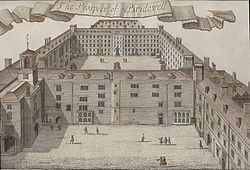
"The Prospect of Bridewell" from John Strype's An Accurate Edition of Stow's "A Survey of London" (1720)
Bridewell Palace shown on the "Copperplate" map of London, surveyed between 1553 and 1559

Bridewell Palace in London was built as a residence of King Henry VIII and was one of his homes early in his reign for eight years. Given to the City of London Corporation by his son King Edward VI in 1553 as Bridewell Hospital for use as an orphanage and place of correction for wayward women, Bridewell later became the first prison/poorhouse to have an appointed doctor.

It was built on the banks of the Fleet River in the City of London between Fleet Street and the River Thames in an area today known as Bridewell Place, off New Bridge Street. By 1556 part of it had become a jail known as Bridewell Prison. It was reinvented with lodgings and was closed in 1855 and the buildings demolished in 1863–1864.

The name "Bridewell" subsequently became a common name for a jail, used not only in England but in other cities colonised by Britain including Dublin and New York.

History

[edit]

Bridewell Palace

[edit]
The Ambassadors (Holbein, 1533): Jean de Dinteville, the ambassador to England answerable to Francis I, with Georges de Selve (Bishop of Lavaur), at Bridewell Palace

The palace was built on the site of the medieval St Bride's Inn directly south of St Bride's Church at a cost of £39,000 for Henry VIII who treated it as a main London residence 1515–1523. Standing on the banks of the River Fleet, the related saint since the medieval age has been St Bride. The papal delegation had preliminary meetings here in 1528 before advising the pope on whether the King could divorce Catherine of Aragon. The building was a project of Cardinal Thomas Wolsey.

Bridewell Palace consisted of two brick-built courtyards, with the royal lodgings in three storeys around the inner courtyard. A grand processional staircase led to them from the outer courtyard. Bridewell was the first royal palace not to have a great hall and its staircase was a feature that recurs in Henry VIII's later residences. On the north side of the outer courtyard stood the kitchens and gatehouse. There was a long gallery (240 feet (73 m)) which connected the inner court with Blackfriars,[1] issuing out at Apothecaries Hall[2] on Blackfriars Lane which formerly ran beyond its western façade.

After Wolsey's fall in 1530, the palace was leased to the French ambassador 1531–1539, and was the setting for Holbein's painting, The Ambassadors (1533).[citation needed]

Bridewell Prison and Orphanage

[edit]
Edward VI grants a charter in 1553 to Bridewell Hospital

In 1553, Edward VI gave the palace over to the City of London for the housing of homeless children and for the punishment of "disorderly women". The City took full possession in 1556 and turned the site into a prison, hospital and workrooms. In 1557 the City authorities created a joint administration for the Bridewell and Bethlehem Hospitals when Bethlem Royal Hospital also became the responsibility of the Bridewell Governors.[3]

"A Scene in Bridewell", plate IV. William Hogarth, A Harlot's Progress, April 1732

In the late 17th century, the infamous London brothel keeper Elizabeth Cresswell was incarcerated in Bridewell Prison, possibly for reneging on a debt. She died there at some point between 1684 and 1698.[4][5][6][7] She is probably interred in the Bridewell graveyard and legend runs that in her will she left £10 for a sermon to be read that said nothing ill of her. After considerable time, a young clergyman was found who would perform the funeral rites. After an extremely lengthy sermon on social morality, he said "By the will of the deceased it is expected that I should mention her and say nothing but what was well of her. All I shall say of her, therefore, is this — she was born well, lived well, and died well; for she was born with the name of Cresswell, lived at Clerkenwell, and died in Bridewell."[a][9]

The Pass Room at Bridewell from Ackermann's Microcosm of London (1808–1811), drawn by Thomas Rowlandson and Augustus Pugin.

Most of the palace was destroyed in the Great Fire of London, and rebuilt in 1666–1667. In 1700 it became the first prison to appoint medical staff (a doctor).

Bridewell Royal Hospital School

[edit]

Eventually, the prison became a school confusingly and variously known as Bridewell (Royal Hospital/School/Royal Hospital School). The prison element closed in 1855 and the buildings were demolished in 1863–1864. Nevertheless, some prison activities continued on the site: in the 1871 census, the Beadle and Turnkey, Joseph Ashley, had charge of two prisoners;[10] and in 1881 Mr Ashley was still there as Collector and Beadle, but no prisoners are named.[11] The school moved in 1867 to a much larger site in Surrey and changed its name to King Edward's School, Witley which accordingly celebrated its 450th year in 2003.

Part of the vacated site was used for the erection of De Keyser's Royal Hotel in 1874,[12] which was requisitioned for military purposes in 1915 and became the subject of a leading case on the use of the royal prerogative decided by the House of Lords in 1920. By 1921 Lever Brothers had acquired the hotel building for use as the head office of the company's business.

Site today

[edit]

A rebuilt gatehouse in the style of the original is incorporated as the front of the office block at 14 New Bridge Street,[13] including a relief portrait of Edward VI. The main site area of the buildings stretched from there southwards through the Hyatt Regency London Blackfriars Hotel to Unilever House (built in 1931) which stands at the corner of Watergate – the name of the lost river entrance to the palace's precincts beside the former Fleet-Thames confluence (memorialised in the name of the street between the two).[14]

[edit]
The Old Bridewell, New York City (1768–1838)

The name "Bridewell" became synonymous with large prisons and was consequently used as a generic name for them.[15] It was adopted for other prisons in London, including the Clerkenwell Bridewell (opened in 1615) and Tothill Fields Bridewell in Westminster. Similar institutions throughout England, Ireland, Scotland and Canada as well as in the United States[16] also borrowed the name Bridewell. The term frequently refers to a city's main detention facility, usually close to a courthouse, as in Nottingham, Leeds, Gloucester, Bristol, Dublin, Cork and Edinburgh.[17]

In the Beatles film, A Hard Day's Night, Paul's grandfather (Wilfrid Brambell) reports the arrest of Ringo to the studio by saying "The police have the poor lad in the Bridewell – he'll be pulp by now!"

The nearby Bridewell Theatre takes its name from the palace. [18]

See also

[edit]

Notes

[edit]

References

[edit]
[edit]
Revisions and contributorsEdit on WikipediaRead on Wikipedia
from Grokipedia
Bridewell Palace was a royal residence in the , initially constructed between 1510 and 1520 on the banks of the River Fleet as an expansion of an earlier inn, and primarily associated with King Henry VIII after its transfer to in 1515. Built at significant expense—estimated at around £39,000 in contemporary terms—it served as a secondary palace to and Westminster, hosting notable events such as the 1522 entertainment for Holy Roman Emperor Charles V. In 1553, the teenage King Edward VI refounded the structure by as Bridewell Hospital, repurposing the palace for the to function as England's inaugural , combining elements of a for the idle poor, a refuge for homeless children, and a facility for punishing vagrants, prostitutes, and petty offenders through labor discipline. This transformation marked a pivotal shift from royal luxury to institutional reform, emphasizing coerced work as a remedy for social disorder amid Tudor concerns over and , with inmates compelled to tasks like spinning or manual labor under governors' oversight. The palace's legacy endured as "bridewell" entered English as a generic term for local prisons or houses of correction, influencing penal practices across Britain and colonies, though the original site was gradually demolished from the late onward, with remnants repurposed until full clearance in the . While no major controversies directly marred its royal phase, its post-charter role sparked debates on the efficacy of punitive labor versus outright punishment, prefiguring broader Poor Law reforms, yet empirical records from the era affirm its role in housing thousands of the disorderly poor annually under a regime prioritizing deterrence through industry over mere incarceration.

Origins and Royal Period

Construction and Architectural Features

Bridewell Palace was initially developed by Cardinal around 1510 on the site of the medieval St. Bride's Inn, south of and near the River Fleet, but construction accelerated after Wolsey transferred the property to King in 1515. substantially revised the plans, expanding the residence to include a second courtyard and more extensive kitchens, with work completing in 1523 at a cost of £39,000. This marked 's first major independent building project, designed partly for the reception of Emperor Charles V in 1522. Architecturally, Bridewell featured a double-courtyard layout characteristic of early Tudor palaces, with principal ranges enclosing an outer courtyard and a grand processional staircase leading to the inner courtyard. It departed from tradition as the first royal palace without a dedicated great hall, instead emphasizing private apartments and functional spaces. The complex included a Thames watergate for river access and was constructed primarily in brick, reflecting contemporary royal building practices. Excavations have corroborated the historical layout, revealing foundations of the southern and eastern ranges around the outer courtyard, though much was later altered or destroyed, including parts lost to the in 1666. The palace's design prioritized convenience and prestige, with extensive service areas supporting royal hospitality.

Use as Royal Residence

Bridewell Palace served as a primary royal residence for King from approximately 1515 to 1523, following its construction on the site of a former rectory house leased to Cardinal in 1510. Wolsey initiated the building with a single courtyard and gallery, but expanded the plans to include a second courtyard, extensive kitchens, and Thames-side access, completing the project as his first major domestic architectural endeavor after fires damaged Westminster Palace in 1512 and Place in 1514. The palace, costing around £20,000, featured a southern facade facing the Thames and an eastern side along the Fleet River, providing convenient barge access and positioning it as a modern alternative to older royal seats. During its royal tenure, Bridewell hosted significant state functions, including sessions of in 1523 and 1529, leveraging its proximity to the Blackfriars friary for ceremonial and judicial purposes. In November 1528, addressed nobility, judges, councillors, and others at the palace regarding his efforts to annul his marriage to , highlighting its role in political deliberations. The residence accommodated courtly entertaining and diplomatic activities, though specific records of extended stays by Henry or other royals remain limited beyond these events. By the late 1520s, Bridewell fell out of favor as Henry prioritized palaces like Greenwich and the renamed (formerly Place), leading to its occasional lending to foreign ambassadors rather than sustained royal occupation. It saw no notable use as a residence under subsequent monarchs, with granting it to the in 1553 for civic purposes.

Key Events and Decline

Bridewell Palace underwent significant reconstruction under around 1522, specifically to host Charles V during his visit to that year. This effort followed devastating fires at the Palace of Westminster and the in 1512, positioning Bridewell as the king's principal central residence from approximately 1515 to 1523. A notable event occurred on November 8, 1528, when assembled nobles, judges, councillors, and other dignitaries at the palace to publicly advocate for the annulment of his marriage to , framing it as essential for producing a and invoking biblical precedents—a key step toward the . The venue also accommodated parliamentary sessions during the 1520s and served as a site for royal entertainments, including Christmas revels where the king participated alongside young gentlemen in and other festivities. The palace's prominence as a royal seat waned after Cardinal Wolsey's disgrace in 1529, as Henry VIII shifted his favor to the newly acquired Whitehall Palace, which offered greater convenience and scale. Under subsequent Tudor rulers—Edward VI, Mary I, and Elizabeth I—Bridewell received only sporadic or negligible use, reflecting its obsolescence amid evolving royal preferences for more modern or strategically located properties like Whitehall and Hampton Court. By the early 1550s, neglect had set in, rendering the structure surplus to royal needs and ripe for alternative civic purposes.

Conversion to Civic Institution

Grant by Edward VI

In 1553, King issued a granting Bridewell Palace to the for conversion into a charitable institution known as Bridewell Royal Hospital. The grant repurposed the former royal residence to address urban poverty and , authorizing its use as a , , and for idle poor, vagrants, homeless children, and disorderly individuals, particularly women convicted of or petty offenses. This initiative reflected broader Tudor efforts to enforce labor discipline amid economic disruptions following the , with the palace's precincts designated for housing and corrective employment rather than royal occupancy. The charter was delivered on or around April 10, 1553, to city officials including Alderman Sir George Barnes, amid a series of grants that included other properties like St. Thomas of Acon for similar purposes. Bishop Nicholas Ridley of reportedly petitioned the king to support the endeavor, aligning with Edward's Protestant-influenced policies favoring civic welfare over monastic charities. The City Corporation accepted the grant, committing to maintain the facility for the "use and behoofe of the poore people" through supervised labor, marking Bridewell's transition from palace to the first English institution explicitly designed for corrective work as . This establishment set a for houses of correction, emphasizing productive work—such as spinning, , and manual trades—to idleness, with revenues from palace lands initially allocated to sustain operations until self-sufficiency via inmate labor. The grant's timing, just months before Edward's death on July 6, 1553, underscored its role in his brief reign's charitable reforms, though implementation fell to the amid Mary I's subsequent accession.

Initial Setup as Hospital and Prison

Following the royal charter of 26 June 1553, Bridewell Palace was repurposed by the into a dual institution serving as both a hospital for the indigent and a for the disorderly poor. The existing palace structures along the Fleet River were adapted to include workrooms for vocational training, dormitories for housing, and areas designated for punishment and confinement, marking the first such in . This conversion aimed to address and idleness through enforced labor and discipline, while providing shelter and for homeless children. The hospital function focused on housing and educating vagrant and orphaned children, who were trained in trades such as and before being apprenticed out, with nominations often coming from parishes or governors. In contrast, the prison element targeted petty offenders including prostitutes, beggars, runaway apprentices, fraudsters, unlicensed pedlars, and those guilty of minor disorders like drunkenness or swearing, committed by constables or magistrates for short terms of correction. Initial operations emphasized rehabilitation via productive work, such as beating , combined with corporal punishments like public whipping to deter idleness and enforce moral reform. Governance was initially under the City's oversight, evolving into a formal Court of Governors by the 1570s, which jointly managed Bridewell with Bethlem Hospital and expanded to around 270 members by 1700. The institution took full possession of the site by 1556, solidifying its role as a model for subsequent houses of correction across , prioritizing labor as a means of self-sufficiency and over mere incarceration.

Operations as House of Correction

Inmate Types and Daily Regime

Bridewell primarily housed the disorderly poor, including , idle persons, (often termed "nightwalkers" or "strumpets"), disorderly apprentices, and petty offenders committing minor acts of dishonesty such as or . These inmates were typically committed by justices of the peace for short terms, reflecting the institution's role in correcting and idleness rather than . By the late , records indicate significant numbers of women committed for —188 in 1797 alone—alongside men and women for petty dishonesty (138 total that year) and apprentices for (34 cases). The daily regime centered on compulsory labor to instill habits of industry, with work occupying nearly the entire day for six days a week, reserving Sundays for rest and potential religious instruction. Inmates were assigned tasks suited to their perceived capacities, such as beating , carding , spinning, , or other textile-related manual work, under the oversight of keepers to prevent idleness. Refusal to work, poor performance, or failure to adhere to hours could result in immediate , including whipping at a designated post, as enforced by wardens to maintain . Meals were basic and timed around labor periods, with allowances described as liberal for the era but tied to ; separation between inmates was limited, allowing some interaction during work but risking further disorder if unsupervised. This regimen aimed at reformation through routine and toil, though contemporary accounts noted inconsistent enforcement, with visitors in the 18th century observing orderly conditions but lamenting inadequate isolation to prevent vice among prisoners. Early governors' courts, established post-1553, oversaw operations, appointing officers and confirming commitments to ensure the focus on correction via labor rather than mere confinement.

Punishments and Intended Reforms

The charter granted by on 10 October 1552 (effective 1553) envisioned Bridewell as a pioneering , emphasizing reformation of vagrants, "loose" women, petty offenders, and the idle poor through enforced labor and discipline, with the dual goals of self-sufficiency and deterrence from indolence. Unlike traditional jails focused on detention, the institution sought to instill and moral order, requiring inmates to produce goods like for ropes to offset costs, while providing vocational training for eventual societal reintegration. This approach drew from contemporary Poor Law concerns, aiming to curb urban poverty exacerbated by and , though implementation prioritized containment over proven rehabilitative outcomes. In practice, punishments at Bridewell from 1553 onward blended coercive labor with corporal measures to enforce compliance, including whipping on the bare back in the main hall before assembled inmates—a public ritual intended to shame and deter recidivism. Refusal to work triggered immediate physical correction, such as flogging or fettering in irons, alongside dietary restrictions to bread and water; severe cases involved solitary confinement in dark dungeons known as "the hole" or "Little Ease," where prisoners endured cramped, unlit conditions for days. Labor regimens demanded up to 12 hours daily on tasks like hemp-beating or oakum-picking, often in unsanitary workshops, reflecting a punitive philosophy where idleness was equated with moral failing, though records indicate limited long-term reform success amid high recidivism by the late 1550s. Reforms were codified in the 1555 royal and subsequent City ordinances, mandating separation of sexes, age-based groupings (e.g., children for training), and oversight by governors to monitor progress toward discharge upon demonstrated improvement. However, early operations leaned heavily toward , with full correctional elements—like structured instruction—developing slowly; by 1556, Bridewell functioned primarily as a deterrent facility, housing up to 200 inmates amid complaints of overcrowding and inadequate funding for rehabilitative programs. Critics, including City officials, noted that while the model influenced over 200 similar bridewells across by 1600, its emphasis on short-term (typically 1-3 months) often failed to address root causes like economic displacement, yielding mixed empirical results in reducing .

Criticisms and Effectiveness

The effectiveness of Bridewell as a house of correction was mixed, with contemporary observers noting temporary reductions in when enforcement was diligent, such as after 1597 when "rogues vanished" according to , though they returned when efforts lapsed. However, statutes by 1609 acknowledged limited success due to insufficient construction and enforcement of houses of correction across . High rates undermined reformative goals; for instance, inmate Margaret Davis was arrested seven times for similar offenses, illustrating persistent idleness and vice despite repeated commitments to labor like spinning or hemp-beating. Justices like Edward Hext in 1596 reported that few inmates reformed, as many physically resisted work and preferred incarceration in less laborious gaols. Criticisms centered on the institution's harsh punishments and poor conditions, which prioritized short-term deterrence over genuine rehabilitation. Whipping until bloody, fetters, and reduced diets were standard for non-compliance, often applied publicly to enforce discipline, though such measures were seen as excessive even by some contemporaries like Thomas Dekker, who highlighted the brutality in works like The Honest Whore. Inmates endured damp, rat-infested quarters and regimented labor with minimal rest, leading to escapes and complaints of injustice, as voiced by figures like Anna Trapnel regarding unjust imprisonment. Court records were biased and moralistic, reflecting scribes' prejudices rather than objective assessments, which exacerbated overreach in policing sexual deviance and idleness among the . Scholars attribute failures to mismanagement and underfunding, with the focus on moral labeling—such as branding "rogues" or "harlots"—failing to address underlying or provide sustainable skills. By the , these issues contributed to its evolution from a reformative ideal to a site of containment, influencing later critiques by reformers like on corruption over correction.

Expansion and Specialized Functions

Development of Prison and Workhouse

Following its partial destruction in the on 2 September 1666, Bridewell was promptly rebuilt between 1666 and 1667, preserving its dual role as a house of correction combining imprisonment with compulsory labor. The reconstruction maintained the site's core functions, with the accommodating petty offenders, , and "disorderly" individuals subjected to work regimens intended for through industry. By the mid-18th century, the complex had evolved with new buildings organized around two central courtyards, facilitating segregated spaces for male and female inmates, workrooms, and administrative areas, as evidenced in John Rocque's 1746 map of London. These additions supported expanded operations, where prisoners engaged in productive tasks such as spinning wool, weaving, and laundry services provided to the City, generating revenue to sustain the institution while enforcing discipline. The workhouse element emphasized self-sufficiency, with output from inmate labor funding maintenance and exemplifying the era's poor relief strategies blending punishment and employment. Throughout the 18th and early 19th centuries, Bridewell's and adapted to rising urban poverty and rates in , housing hundreds of inmates annually—peaking at over 300 in some years—though and harsh conditions persisted despite incremental reforms in and oversight. This development positioned Bridewell as a for subsequent English houses of correction, influencing the spread of similar institutions nationwide.

Establishment of Hospital for the Insane

In 1557, shortly after the establishment of Bridewell Hospital as a house of correction, its board of governors assumed administrative control over , London's longstanding facility dedicated to the custody and treatment of the insane. This integration marked a key expansion of Bridewell's institutional scope, linking correctional functions with responsibility for under a unified civic governance structure. The Court of Governors, comprising prominent officials, oversaw both entities, with records commencing that year documenting joint decision-making on funding, staffing, and operations. Bethlem, founded as a in 1247 and first recorded as accommodating insane individuals by 1403, had previously operated under ecclesiastical and then brief civic oversight following the . By the mid-16th century, it housed around a few dozen patients, primarily paupers committed by magistrates for behaviors deemed mad or furious, with care emphasizing restraint over therapy—employing chains, dark cells, and minimal medical intervention reflective of contemporary understandings of insanity as moral or demonic affliction. The transfer to Bridewell's governors formalized Bethlem's role as a charitable for the mentally afflicted, funded partly through Bridewell's revenues from workhouse labor and royal charters, though and inadequate resources persisted from . This administrative union facilitated shared governance practices, such as annual elections of officers and petitions to for support, but highlighted divergent institutional purposes: Bridewell enforced labor and on and petty offenders, while Bethlem managed custodial confinement for the , often without clear distinction from punishment. By the late , the joint body had formalized protocols for patient admissions to Bethlem via warrants from justices, with governors inspecting facilities periodically, though empirical accounts indicate limited efficacy in alleviating patient suffering amid prevalent neglect and public spectacle visits. The arrangement endured until the , influencing early modern approaches to pauper insanity through centralized oversight rather than specialized medical reform.

Orphanage and Apprenticeship School

Bridewell Royal Hospital's orphanage and apprenticeship school provided shelter, , and vocational training to destitute children, including orphans, , and the offspring of impoverished City freemen, as part of its broader mandate to reform idleness through labor. Following the royal charter issued by on 26 January 1553, the institution admitted homeless youth for moral and practical instruction, distinguishing it from purely punitive functions by emphasizing skill-building for self-reliance. Inmates, typically entering between ages 7 and 13, underwent a regime combining basic , , , and hands-on training in trades such as , , glovemaking, and tailoring, supervised by appointed arts masters within the hospital's workrooms. The reflected contemporary views on , prioritizing disciplined work over to prevent , with poor children—often sourced from parishes or directly as "sturdy beggars"—bound into the program for reformation. Upon reaching 14 to 16 years, suitable candidates were indentured as apprentices to external masters for terms extending to age 21, with registers from documenting placements in diverse occupations and monitoring compliance to curb exploitation. Priority access was granted to orphans of freemen, who received preparatory before trade binding, though the program also absorbed broader pauper youth under later reforms like the 1767 Act addressing abuses. The apprenticeship school operated alongside prison elements until the 19th century, when focus shifted toward formal education; in 1867, it relocated to Witley, , as King Edward's School, preserving the founder's legacy in youth training.

Destruction, Reconstruction, and Closure

Impact of the Great Fire of 1666

The , which ignited on 2 September 1666 and raged until 5 or 6 September, extensively damaged Bridewell Palace on its third day, as the flames crossed the River Fleet and consumed structures in the vicinity. The fire decimated much of the Tudor-era complex, which by then functioned primarily as a hospital, , and , leaving the greater part of the building in ruins. This destruction compounded the broader losses in the , where over 13,000 houses and numerous public institutions were obliterated, though Bridewell's predicament was notable given its role in housing vagrants, petty offenders, and the indigent. Reconstruction efforts began almost immediately, with the majority of the palace rebuilt by 1667 through private initiatives by its governors, who lacked the public funding and donations allocated to other fire-damaged hospitals like St Bartholomew's. The new structure retained Bridewell's core functions but incorporated post-fire adaptations, such as enhanced to align with emerging fire-resistant building codes mandated by the Rebuilding Act of 1666. This swift restoration minimized operational disruptions, enabling the institution to recommence admitting inmates and resuming disciplinary and charitable activities within months, underscoring the resilience of London's civic institutions amid the catastrophe.

18th-19th Century Rebuildings and Operations

Following its reconstruction after the Great Fire of London in 1666–1667, Bridewell underwent further modifications in the late 18th century to address overcrowding and functional separation. In 1797, a new wing was constructed to facilitate prisoner segregation and classification, reflecting emerging reformist pressures amid rising committals. By the early 19th century, efforts intensified to disentangle the prison from apprentice training; in 1830, a new House of Occupations opened in Southwark to relocate poor children and vagrants, reducing corruption risks from proximity to inmates. Operations in the centered on for petty offenders, including , prostitutes, and minor thieves, with peak annual commitments reaching 2,956 in 1784 and 1,989 in 1800. Inmates, primarily the disorderly poor, engaged in tasks such as beating , while apprentices—numbering 132 in 1705 but declining to 26 by 1791—received basic education and trade instruction in or before being bound out. Punishments included public whippings, observed by governors, and introduced later in the century; whipping for women was abolished in 1792 following criticism. Governed by a court of governors shared with Bethlem Hospital, Bridewell's 19th-century regime emphasized reformation through labor, though prisoner numbers consistently outnumbered apprentices, straining resources. Apprentice programs ceased entirely in , shifting focus to incarceration until the prison's closure in amid broader penal reforms, after which most structures were demolished for urban development.

Final Closure and Relocation

The prison operations at Bridewell ceased on December 31, 1855, following a decision by the Court of Governors amid declining use and broader penal reforms, with remaining inmates transferred to the newly expanded Holloway Prison in . This closure marked the end of Bridewell's role as a house of correction, which had persisted since its conversion in 1553, though the site's hospital and orphanage functions continued in reduced form. The physical structures, largely rebuilt after the Great Fire of 1666, were progressively dismantled starting in the early 1860s to accommodate urban redevelopment, with full demolition completed by 1864. The Bridewell Royal Hospital, encompassing the surviving charitable elements, underwent reorganization; its orphanage and apprenticeship school relocated to Witley in in 1867, where it was renamed King Edward's School under the hospital's foundation, continuing operations on a 65-acre estate better suited to educational expansion. These shifts reflected 19th-century trends toward centralized prisons and specialized institutions, rendering the central London site obsolete for confinement and pauper relief, though the Bridewell name endured as a generic term for facilities. The foundation's assets funded the new school, preserving its charter from while adapting to modern needs.

Modern Site and Legacy

20th-21st Century Developments

In the , the site of Bridewell Palace, following its 19th-century demolition, transitioned to commercial and office uses amid London's urban expansion. In , archaeological excavations uncovered remnants of the original palace structure ahead of a major office redevelopment project, revealing foundations and artifacts that informed later historical interpretations of the site's Tudor layout. The 21st century has seen further modernization of the area around Bridewell Place, incorporating luxury hospitality. The Hyatt Regency Blackfriars, a Grade II-listed five-star , opened on September 19, 2024, within a restored historical building situated directly on the former grounds of Henry VIII's ; it features 217 rooms and event spaces drawing on the site's regal heritage. Nearby, commercial properties like Translation House occupy portions of the historic footprint, reflecting ongoing regeneration in the Blackfriars district.

Archaeological Discoveries

Archaeological investigations at the Bridewell Palace site have primarily occurred in the vicinity of , revealing structural remnants and artifacts associated with the Tudor-era palace constructed between 1515 and circa 1523. In 1978, excavations at 9-11 Bridewell Place, led by Derek Gadd, uncovered evidence of the palace's foundations, including brick structures aligned with historical descriptions of its layout along the Fleet River's west bank. These findings corroborated records of arched brick foundations and helped delineate the palace's southern extent beyond previously mapped boundaries. More recent work in 2013 at the Dorset Rise site, conducted by Pre-Construct Archaeology, exposed additional Tudor-period remains, including arched brick foundations supported on timber planking with chalk and timber abutments. Misaligned walls in these structures suggest pre-1515 modifications, possibly by Cardinal Wolsey during site redevelopment, extending the known footprint of the palace's southern range and refining understandings of its ground plan. The Dorset Rise excavations yielded a significant assemblage of animal bones, likely from the king's kitchens, indicating a diet rich in high-status meats consistent with royal Tudor provisioning. Other artifacts included an iron door-latch rest, bucket handle, candlestick fragment, dress clasp, horseshoe, bone die, copper-alloy jeton, a Venetian soldino minted before 1526, and a headless pipeclay of St. Barbara, the latter evidencing post-Reformation . These discoveries illuminate daily and courtly life at the palace, which served as Henry VIII's primary residence in the early 1520s before its . No major aboveground traces remain due to subsequent demolitions and rebuilds, but subsurface evidence continues to inform reconstructions of the site's historical development.

Architectural Influence and Cultural Depictions

Bridewell Palace represented an early departure from traditional English royal architecture by being the first such residence constructed without a , a hallmark of medieval palaces that symbolized communal feasting and . This omission reflected evolving Tudor preferences for more private, intimate spaces suited to Henry VIII's courtly needs during its construction from 1515 to circa 1523. The palace's grand processional staircase, designed for ceremonial progression, became a recurring element in Henry VIII's subsequent building projects, such as those at and Nonsuch, emphasizing verticality and spectacle over horizontal assembly halls. Following its 1553 conversion into a house of correction under Edward VI's charter, Bridewell's institutional layout—divided into areas for punishment, labor, and housing—influenced the design of subsequent workhouses and prisons in , establishing a dual model of corrective and that prioritized enforced work over mere incarceration. The facility's name entered common parlance as a generic term for lockups or reformatories targeting , petty criminals, and the idle poor, a linguistic legacy persisting into the and shaping public perceptions of penal architecture as austere and utilitarian rather than palatial. Culturally, Bridewell featured in early modern literature as a grim emblem of moral correction, often depicted as a repository for the dissolute and disorderly, underscoring themes of social control and redemption through labor. Daniel Defoe's Moll Flanders (1722) portrays the protagonist's imprisonment there amid scenes of whipping and forced spinning, highlighting the institution's role in narratives of female vice and reform. Artistic representations, such as Thomas Rowlandson and Augustus Pugin's illustration in Microcosm of London (1808–1810), captured the prison's pass room as a crowded, hierarchical space of examination and judgment, blending Gothic remnants with utilitarian reforms post-Great Fire. Hans Holbein the Younger's proposed fireplace design for the palace, executed around 1538, symbolically intertwined sovereignty, gender dynamics, and dynastic imagery, later reinterpreted in studies of Tudor visual culture as a palimpsest of royal authority overlaid by institutional austerity. These depictions reinforced Bridewell's transformation from opulent residence to archetype of disciplinary confinement, influencing broader cultural understandings of poverty and punishment in English history.

References

Add your contribution
Related Hubs
User Avatar
No comments yet.