Hubbry Logo
Buccal spaceBuccal spaceMain
Open search
Buccal space
Community hub
Buccal space
logo
8 pages, 0 posts
0 subscribers
Be the first to start a discussion here.
Buccal space
Buccal space
from Wikipedia
Buccal space
The buccal space is located superficial to buccinator muscle.
Anatomical terminology

The buccal space (also termed the buccinator space) is a fascial space of the head and neck (sometimes also termed fascial tissue spaces or tissue spaces). It is a potential space in the cheek, and is paired on each side. The buccal space is superficial to the buccinator muscle and deep to the platysma muscle and the skin. The buccal space is part of the subcutaneous space, which is continuous from head to toe.[1]

Structure

[edit]

Boundaries

[edit]

The boundaries of each buccal space are:

  • the angle of the mouth anteriorly,[1]
  • the masseter muscle posteriorly,[1]
  • the zygomatic process of the maxilla and the zygomaticus muscles superiorly,
  • the depressor anguli oris muscle and the attachment of the deep fascia to the mandible inferiorly,
  • the buccinator muscle medially (the buccal space is superficial to the buccinator),[1]
  • the platysma muscle, subcutaneous tissue and skin laterally (the space is deep to platysma).[1]

Communications

[edit]

Function

[edit]

Contents

[edit]

In health, the space contains:

Clinical significance

[edit]
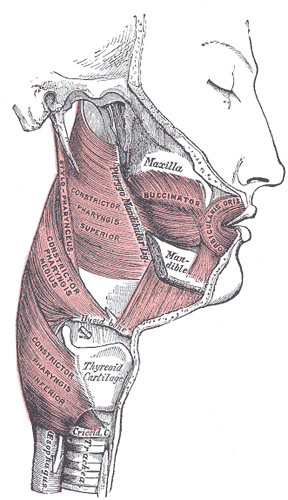
Diagram showing the origin of the upper part of the buccinator muscle to the maxilla (the middle part originates from the pterygomandibular raphe, where buccinator joins the superior constrictor muscle)
Diagram showing the origin of the lower part of the buccinator muscle on the lateral surface of the mandible

A hematoma may create the buccal space, e.g. due to hemorrhage following wisdom teeth surgery. Buccal space abscesses typically cause a facial swelling over the cheek that may extend from the zygomatic arch above to the inferior border of the mandible below, and from the anterior border the masseter muscle posteriorly to the angle of the mouth anteriorly.[1] Unless another space is also involved, the tissues around the eye are not swollen. It is usually treated by surgical incision and drainage, and the incision is located inside the mouth to avoid a scar on the face.[2] The incision are placed below the parotid papilla to avoid damage to the duct, and forceps are used to divide buccinator and insert a surgical drain into the buccal space. The drain is kept in place for a variable period of time following the procedure.

Long standing buccal abscesses tend to spontaneously drain via a cutaneous sinus at the inferior of the space, near the inferior border of the mandible and the angle of the mouth.[1] An untreated cutaneous sinus can cause disfiguring soft tissue fibrosis, and the tract can become epithelial lined.[3]

Odontogenic infections

[edit]
An abscess originating from a tooth which has spread to involve the buccal space. Above, deformation of the cheek on the second day. Below, deformation on the third day.

Sometimes the buccal space is reported to be the most commonly involved fascial space by dental abscesses,[2] although other sources report it is the submandibular space.[1] Infections originating in either maxillary or mandibular teeth can spread into the buccal space, usually maxillary molars (most commonly) and premolars or mandibular premolars.[1] Odontogenic infections which erode through the buccal cortical plate of the mandible or maxilla will either spread into the buccal vestibule (sulcus) and drain intra-orally, or into the buccal space, depending upon the level of the perforation in relation to the attachment of buccinator to the maxilla above and the mandible below (see diagrams). Frequently infection spreads in both directions as the buccinator is only a partial barrier.[3] Infections associated with mandibular teeth with apices at a level inferior to the attachment, and maxillary teeth with apices at a level superior to the attachment are more likely to drain into the buccal space.

References

[edit]
Revisions and contributorsEdit on WikipediaRead on Wikipedia
from Grokipedia
The buccal space, also known as the buccinator space, is a paired of the head and located in the , anterior to the masticator space and lateral to the buccinator muscle. It primarily consists of forming the , along with the (Stensen's duct), branches of the and vein, minor salivary glands, lymphatic channels, and buccal branches of the . This is enveloped by the superficial layer of the deep cervical fascia and lies between the buccinator muscle medially and the laterally, contributing to facial contour and serving as a conduit for disease spread from the oral cavity to adjacent regions. The boundaries of the buccal space include the buccinator muscle medially, the superficial layer of the deep cervical fascia and muscles (such as the zygomaticus major) laterally and anteriorly, and the , , pterygoid muscles, and posteriorly. It lacks distinct superior and inferior limits, allowing communication with the inferiorly and potential posterior connections to the pterygomandibular, infratemporal, and parapharyngeal spaces due to incomplete fascial barriers. Vertically, it is bordered by the maxillary and mandibular vestibular folds, with anterior extension to the lip commissure and posterior limit near the anterior tonsillar pillar. These relations highlight ongoing debates in anatomical descriptions, particularly regarding posterior, superior, and inferior borders. Clinically, the buccal space is significant for its role in infections, such as odontogenic abscesses originating from maxillary or mandibular molars, which can spread rapidly due to its fatty composition and communications with other compartments. It also harbors neoplasms, including benign lesions like hemangiomas and malignant tumors from minor salivary glands, often presenting as cheek swelling or masses. In , the within this space is utilized for reconstructive flaps or cosmetic procedures, while its neurovascular contents necessitate careful dissection to avoid injury.

Anatomy

Location and boundaries

The buccal space is a paired potential fascial space located in the cheek region, situated lateral to the buccinator muscle and superficial to the deeper facial planes. Its boundaries are defined as follows: anteriorly by the corner of the mouth (modiolus) and the muscles of facial expression; posteriorly by the anterior border of the masseter muscle, mandible, pterygoid muscles, and parotid gland; medially by the buccinator muscle and buccopharyngeal fascia; and laterally by the skin, subcutaneous tissue, the superficial musculoaponeurotic system (SMAS), and the superficial layer of the deep cervical fascia. Superior and inferior boundaries are approximate and variable, often described as the zygomatic arch, zygomatic process of the maxilla, and zygomaticus muscles superiorly, and the margin of the mandible, the depressor anguli oris muscle, and the deep fascia attaching to the mandible inferiorly; vertically, it is bordered by the maxillary and mandibular vestibular folds, with anterior extension to the lip commissure and posterior limit near the anterior tonsillar pillar. The space features an incomplete fascial enclosure, particularly lacking defined superior and inferior limits and with occasional posterior incompleteness of the parotidomasseteric fascia, which permits potential spread of to adjacent regions such as the masticator space. These relations highlight ongoing debates in anatomical descriptions, particularly regarding posterior, superior, and inferior borders. Descriptions of the buccal space boundaries have evolved from classical anatomical texts, which emphasized rigid fascial divisions, to modern cadaveric and studies that highlight variability, such as the posterior extent confirmed in a 2017 cadaveric .

Contents

The buccal space primarily contains , which forms an extension of the providing cushioning and structural support to the . This fat pad is most prominent during infancy, where it is larger relative to facial size to aid in sucking and feeding, and gradually diminishes with age, contributing to changes in cheek contour in adults. The , also known as Stensen's duct, transversely crosses the space within the buccal fat pad, running superficial to the and superficial to the buccinator muscle before piercing the buccinator to enter the oral cavity at a papilla opposite the upper second molar. Vascular structures within the buccal space include branches of the , such as the superior and inferior labial arteries, which consistently traverse the anterior portion of the space to supply the and adjacent tissues. The main trunk of the lies anterior to the , while the facial vein typically courses along the posterior boundary of the space rather than traversing its interior. Neural elements consist of the buccal branch of the mandibular division of the (CN V3), which provides sensory innervation to the buccal mucosa and skin of the cheek, emerging from the anterior border of the to enter the space. Additionally, the buccal branches of the (CN VII) pierce the space to supply motor innervation to the orbicularis oris and buccinator muscles, often paralleling the course of the . Lymphatic drainage of the buccal space involves minor buccal lymph nodes located within the , which collect from the and mucosal surfaces before draining into the and ultimately the deep cervical chain. Anatomical variability in the buccal space includes age-related reductions in fat content, with the extension becoming less voluminous after infancy, and occasional inclusions such as accessory parotid tissue, present in approximately 20% of individuals anterior to the .

Relations and communications

The buccal space maintains close anatomical relations with several adjacent structures in the head and neck region. Medially, it borders the oral vestibule and the pterygomandibular space, facilitating proximity to oral cavity components. Laterally, the space adjoins the subcutaneous tissues of the , enveloped by the superficial layer of the deep cervical fascia. Posteriorly and inferiorly, it relates to the anterior belly of the , contributing to its positioning within the suprahyoid region. The buccal space exhibits multiple communications with neighboring fascial compartments, enabling structural continuity. Posteriorly, it opens to the masticator space via loose overlying the , allowing passage without a firm barrier and potential connections to the pterygomandibular, infratemporal, and parapharyngeal spaces due to incomplete fascial barriers. Inferiorly, it is continuous with the , lacking a distinct boundary along the inferior margin of the . Superiorly, the space has a limited but potential link to the temporal space through the . Anteriorly, it connects to the perioral spaces, integrating with soft tissues. These communications are characterized by loose areolar connective tissue, which permits facile expansion of the buccal space or dissemination of fluids across compartments. The bucco-mandibular space serves as a related but distinct inferior extension of the buccal space, filled with and bounded anteriorly by the and incisivus labii inferioris muscles, posteriorly by the masseter, superiorly by the buccinator, and medially by the mandibular body. Recent morphological studies employing ultrasonography have corroborated these features through imaging of adjacent muscles and vascular structures in healthy adults. Branches of the and the traverse these relations, underscoring the space's role in facial innervation and ductal pathways.

Clinical significance

Infections

Infections of the buccal space are primarily odontogenic in origin, arising from periapical abscesses or periodontal infections associated with the maxillary and mandibular molars, where the roots perforate the buccinator muscle attachment. These infections account for the majority of cases, as the buccal space's proximity to the posterior teeth facilitates direct extension from dental sources. The involves rapid bacterial proliferation in the loose of the buccal space, which lacks significant barriers to containment, allowing infections to spread along fascial planes. Common pathogens include polymicrobial flora dominated by aerobic streptococci (such as and S. anginosus) and anaerobes (such as and species). Clinical manifestations typically include unilateral swelling, , tenderness, and fluctuance, often accompanied by due to involvement of adjacent masticatory muscles and systemic signs like fever. If untreated, infections can progress from to formation and extend to contiguous spaces, such as the masticator space via the buccinator or the through inferior communications, potentially leading to —a life-threatening bilateral submandibular . Rare progression to deeper neck spaces may result in mediastinitis or . Diagnosis relies on clinical examination revealing localized swelling and suppuration, supplemented by imaging; computed tomography (CT) demonstrates fat stranding indicative of or rim-enhancing fluid collections for , while magnetic resonance imaging (MRI) provides superior soft-tissue detail for complex cases. Management involves prompt empirical antibiotics targeting oral flora, such as amoxicillin-clavulanate (875 mg twice daily) or clindamycin (300-450 mg four times daily) for penicillin-allergic patients, combined with source control through or therapy. Surgical drainage is essential for abscesses, preferably via an intraoral approach through the vestibule for accessibility, though extraoral incision may be required for extensive involvement to prevent further spread. Untreated cases risk complications like , particularly in delayed presentations. Epidemiologically, buccal space infections occur more frequently in immunocompromised individuals, such as those with or undergoing , due to impaired host defenses. A 2025 analysis of 740 cases reported clindamycin resistance at 38.9% in odontogenic infections, with no significant rising trend observed from 2012 to 2023, underscoring the need for culture-guided therapy and multidisciplinary care.

Neoplasms and masses

Neoplasms of the buccal space are uncommon, representing a small fraction of head and neck tumors, and often originate from accessory parotid tissue or extend from adjacent structures. is the most frequent benign neoplasm of the accessory , which accounts for approximately 1-8% of all tumors and can present within the buccal space. , though rarer in this location, can also develop from accessory parotid glands, typically showing cystic components with lymphoid stroma. frequently involves the buccal space through direct extension from primary oral cavity lesions, such as buccal mucosal cancers, infiltrating via the buccinator muscle and . Benign masses in the buccal space include lipomas derived from the , which appear as soft, fatty lesions with minimal symptoms, and hemangiomas, vascular tumors that may cause compressible swelling. Schwannomas arising from the buccal branch of the are rare, forming encapsulated neurogenic tumors along neural pathways. These benign entities account for a significant portion of non-infectious buccal space masses, often slow-growing and until larger sizes. Malignant involvement encompasses primary sarcomas, such as or originating in soft tissues, and metastatic disease to buccal lymph nodes from oral or distant primaries like or carcinomas. These aggressive lesions can disrupt the buccal space's fatty and muscular contents, leading to invasive growth. Primary salivary malignancies, including from accessory glands, may also occur, though less commonly than benign counterparts. Patients with buccal space neoplasms typically present with painless cheek swelling and asymmetry, which may progress over months to years without systemic symptoms unless is involved. Differentiation from inflammatory processes relies on imaging and ; computed (CT) delineates bony involvement and fat plane obliteration, while () provides superior soft tissue contrast. () aids initial diagnosis but may be nondiagnostic in some cases, necessitating excisional for confirmation. Recent 2024 radiological analyses highlight 's role in differentiation, noting heterogeneous T2 hyperintensity with central and irregular enhancement patterns in malignant lesions versus homogeneous enhancement in benign pleomorphic adenomas. Management primarily involves surgical excision for accessible lesions, often via a trans-oral approach to preserve facial aesthetics and function, particularly for benign tumors under 3 cm. Malignant cases require wide resection with negative margins, potentially combined with adjuvant or , depending on staging and . Recurrence rates for tumors in this space vary, with benign pleomorphic adenomas showing low risk (under 5%) after complete excision, while malignant variants exhibit higher rates around 20-25% within 5 years, influenced by margins and invasion. Tumors may involve the , requiring careful intraoperative preservation to avoid complications.

Surgical and radiological considerations

Surgical access to the buccal space is primarily achieved through intraoral incisions for anterior lesions, such as infections or benign masses, where a U-shaped mucosal incision is made anterior to Stensen's duct, followed by division of the buccinator muscle to reach the and contents. This approach minimizes external scarring and is suitable for lesions smaller than 3 cm with good mobility, as per established criteria for benign . For posterior extensions or laterally bulging tumors, an extraoral preauricular incision via extended provides superior visualization, allowing retrograde dissection to preserve branches while addressing deeper involvement. In cosmetic procedures like removal, the intraoral method is standard, involving excision of the to contour the midface, though over-resection risks asymmetry. Anatomical implications guide dissection to avoid injury to the facial nerve's buccal and zygomatic branches, which course through or adjacent to the space, necessitating blunt and nerve monitoring in lateral approaches; ligation of the may be required but carries risks of if not controlled. The space's boundaries, including the buccinator medially and masseter posteriorly, define safe surgical planes that facilitate en bloc removal while preserving adjacent structures like the . Radiological evaluation employs computed tomography (CT) to assess bony involvement and abscesses, revealing hypodense collections within the fat pad with peripheral rim enhancement indicative of active infection. (MRI) excels in soft tissue delineation, showing T2-hyperintense signals for fat-containing lesions and aiding in characterizing vascular malformations or neoplasms. is valuable for superficial masses and inflammatory swellings, offering real-time visualization of the buccinator and subcutaneous layers with 96% sensitivity and 100% specificity for differentiating from in odontogenic cases. Interventional radiology supports management of deep collections through CT-guided percutaneous drainage, using 8- to 12-French catheters to evacuate abscesses greater than 3 cm, thereby avoiding open in select head and cases. Recent advances include 3D imaging for preoperative planning in head and , integrating CT and MRI data to create patient-specific models that map neurovascular structures and simulate access routes, as highlighted in 2023-2024 reviews on maxillofacial applications. Complications such as injury occur infrequently, with permanent paralysis reported at 0.97% in buccal fat procedures and transient in up to 71% of broader temporomandibular joint-related interventions, underscoring the need for precise anatomical adherence. Post-2010, imaging has shifted from 2D to multimodal paradigms, with dual-energy CT and photon-counting detectors enabling material-specific analysis and dose reduction, enhancing resolution for buccal space pathologies in head and neck evaluation.

References

Add your contribution
Related Hubs
User Avatar
No comments yet.