


Community hub
Recent from talks
Contribute something
Nothing was collected or created yet.
CAC Winjeel
View on Wikipedia
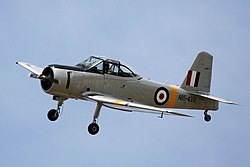
The CAC CA-25 Winjeel is an Australian-designed and manufactured three-seat training aircraft. Entering service with the Royal Australian Air Force (RAAF) in 1955 as a basic to advanced trainer, it served in this role until 1975. Later, it was used in the Forward Air Control (FAC) role for target marking until 1994, after which it was retired from RAAF service.
Key Information


Design and development
[edit]The Winjeel (from a Victorian indigenous word for "young eagle",[1] an alternate spelling of Bunjil) was developed by the Commonwealth Aircraft Corporation at Fishermans Bend in Victoria to satisfy RAAF technical requirement No.AC.77 issued in 1948. Designed to replace both the Tiger Moth and the CAC Wirraway, the first two prototype CA-22 aircraft were flown in February 1951.[2][3] However, it proved a very stable aircraft making it almost impossible to spin, and with this being a required part of pilot training the tail had to be redesigned as a result.[4] Sixty-two production CA-25 aircraft were subsequently built and given the fleet serials A85-401 to A85-462.[2][3]
Operational history
[edit]
The first aircraft flew in February 1955, and deliveries began that September.[2] The first Winjeel entered service with No. 1 Basic Flying Training School (1 BFTS) at Uranquinty, near Wagga Wagga, New South Wales.[3] The last aircraft was delivered in August 1957.[2] For most of its service life, the Winjeel was used as a basic trainer at RAAF Base Point Cook in Victoria, after 1 BFTS was transferred there in 1958.[3] The Winjeel remained in service with the RAAF as a basic trainer until 1968, when the Macchi MB-326 replaced it in this role as part of the RAAF's adoption of an "all through" jet training concept.[2] The failure of this concept ultimately ensured that the Winjeel was retained in the training role until 1975,[4] when it was replaced by the New Zealand-built PAC CT/4A Airtrainer.[2]
After this, a few Winjeels were used in the Forward Air Control (FAC) role. Initially operated by No. 4 Flight, they were equipped with smoke bombs for target marking.[2][4] By 1994 there were 4 in service with No. 76 Squadron based at RAAF Base Williamtown,[5] but later that year they were replaced by the Pilatus PC-9 and subsequently retired.[3]
Surviving examples
[edit]Source:[6]

Airworthy
- A85-429 - Classic Aero Adventure Flights, Ballina Byron Gateway Airport. Civil registered VH-OPJ.
- A85-435 - Historical Aircraft Restoration Society, Shellharbour Airport. Civil registered VH-EAD.
- A85-439 - RAAF Museum, operated by No. 100 Squadron RAAF. Also civil registered VH-FTS.
- A85-443 - Benalla Aviation Museum, Benalla Airport. Civil registered VH-CZE.
- A85-453 - Warbird Adventures Aviation Museum, Mareeba Airfield. Civil registered VH-XXE.
- 24 airworthy examples are privately owned, 23 in Australia and one in New Zealand.
.jpg)

Static (on display unless otherwise noted)
- A85-364 - RAAF Museum, relocated to the RAAF Wagga Heritage Centre in 2020.
- A85-401 - RAAF Museum.
- A85-403 - RAAF Wagga Heritage Centre.
- A85-405 - gate guard at RAAF Base East Sale.
- A85-406 - RAAF Base Amberley Aviation Heritage Centre, under restoration.
- A85-410 - Queensland Air Museum.
- A85-418 - Australian National Aviation Museum.
- A85-428 - Fighter World.
- A85-431 - RAAF Wagga Heritage Centre, former training aid, in storage.
- A85-432 - Oakey Army Aviation Centre.
- A85-441 - Australian War Memorial, in storage.
- A85-449 - RAAF Base Amberley Aviation Heritage Centre, under restoration.
- A85-456 - RAAF Museum, in storage.
- A85-618 - RAAF Museum, in storage.
- Five others are privately owned, three being restored to flying condition and two in storage.
Variants
[edit]Operators
[edit]
Specifications
[edit]Data from Jane's All The World's Aircraft 1955–56[7]
General characteristics
- Crew: 2
- Capacity: provision for third seat
- Length: 28 ft 0+1⁄2 in (8.547 m)
- Wingspan: 38 ft 7+1⁄2 in (11.773 m)
- Height: 9 ft 1 in (2.77 m)
- Wing area: 249 sq ft (23.1 m2)
- Aspect ratio: 6.0:1
- Airfoil: NACA 23015 at root, NACA 23010 at tip
- Empty weight: 3,289 lb (1,492 kg)
- Gross weight: 4,265 lb (1,935 kg)
- Fuel capacity: 69 imp gal (83 US gal; 310 L) normal
- Powerplant: 1 × Pratt & Whitney R-985-AN-2 Wasp Junior nine-cylinder radial engine, 445 hp (332 kW)
Performance
- Maximum speed: 186 mph (299 km/h, 162 kn)
- Cruise speed: 165 mph (266 km/h, 143 kn) at 8,500 ft (2,600 m)
- Endurance: 3.5 hr at 158 mph (254 km/h; 137 kn) and 5,000 ft (1,500 m)
- Service ceiling: 18,000 ft (5,500 m)
- Rate of climb: 1,500 ft/min (7.6 m/s)
- Time to altitude: 10 min to 10,000 ft (3,000 m)
- Take-off run to 50 ft (15 m): 1,110 ft (340 m) (standard temperature)
- Landing run from 50 ft (15 m): 1,000 ft (305 m)
See also
[edit]
Aircraft of comparable role, configuration, and era
Related lists
References
[edit]- Citations
- ^ "Historic flypast for Ballarat on Anzac Day". ABC Central Victoria. Archived from the original on 27 May 2005. Retrieved 12 March 2007.
- ^ a b c d e f g h i Wilson 1994, p. 77.
- ^ a b c d e "A85 Winjeel". RAAF Museum. Retrieved 11 March 2007.
- ^ a b c Dennis et al 2008, p. 604.
- ^ Air International, December 1994, p. 322.
- ^ Crick, Darren (10 August 2014). "RAAF A85 CAC CA-22/CA-25 Winjeel". ADF-Serials: Australian & New Zealand Military Aircraft Serials & History. Retrieved 10 October 2014.
- ^ Bridgman 1955, pp. 111–112.
- Bibliography
- Bridgman, Leonard (1955). Jane's All The World's Aircraft 1955–56. New York: The McGraw Hill Book Company. OCLC 852153403.
- Dennis, Peter; Grey, Jeffrey; Morris, Ewan; Prior, Robin; Bou, Jean (2008). The Oxford Companion to Australian Military History (Second ed.). Melbourne: Oxford University Press. ISBN 978-0195517842.
- Wilson, Stewart (1994). Military Aircraft of Australia. Weston Creek, Australian Capital Territory: Aerospace Publications. ISBN 1875671080.
External links
[edit]
CAC Winjeel
View on GrokipediaDevelopment
Origins and Requirements
Following World War II, the Royal Australian Air Force (RAAF) faced the challenge of modernizing its training fleet amid efforts to bolster Australia's domestic aviation industry. With many wartime aircraft reaching obsolescence and foreign supplies constrained by global reconstruction demands, there was a strategic push for an indigenous piston-engine trainer that could be produced locally by the Commonwealth Aircraft Corporation (CAC). This aligned with broader government initiatives to sustain the aviation sector established during the war, ensuring self-reliance in military aircraft production.[4][5] In 1948, the RAAF Air Board issued technical requirement No. AC.77, calling for a new basic trainer aircraft to replace the aging de Havilland Tiger Moth primary trainer and the CAC Wirraway intermediate trainer. The specification emphasized a robust, three-seat design with all-metal stressed-skin construction, safe handling characteristics suitable for ab initio and advanced instruction, economical operation, and ease of maintenance. It prioritized features that would support spin training while minimizing accident risks, reflecting lessons from earlier aircraft like the Wirraway, which had proven versatile but underpowered for post-war needs.[6][4] The CAC responded by initiating the CA-22 project, a dedicated design effort that met the RAAF's criteria without an open external competition, leveraging the company's expertise from prior indigenous developments. Two prototypes were contracted and constructed at CAC's Fishermans Bend facility in Melbourne. The name "Winjeel," selected in 1948, derives from the Woiwurrung language of the Kulin nation's Wurundjeri people—whose traditional lands included the factory site—and translates to "young eagle," symbolizing the aircraft's role in nurturing new pilots.[7][4]Design Features
The CAC Winjeel featured an all-metal semi-monocoque airframe constructed primarily from stressed aluminum alloy, with fabric-covered control surfaces on the ailerons, elevators, and rudder to reduce weight while maintaining structural integrity.[8] This design provided durability for the rigors of basic flight training, including aerobatic maneuvers, while keeping manufacturing costs manageable at the Commonwealth Aircraft Corporation's facilities. The aircraft adopted a low-wing monoplane configuration with a fixed tail-dragger undercarriage, consisting of a steerable tailwheel and main wheels enclosed by spats for improved prop clearance and ground handling on unprepared runways typical of training bases.[1][9] Power was supplied by a single Pratt & Whitney R-985-AN-2 Wasp Junior nine-cylinder air-cooled radial engine, rated at 450 horsepower, selected for its proven reliability and availability from post-World War II surplus stocks.[2][10] The engine drove a two-bladed constant-speed Hamilton Standard propeller, and the fuel system comprised two wing-mounted tanks with a total normal capacity of 69 imperial gallons (83 US gallons), interconnected for balanced supply and fed by gravity to simplify operations for ab initio trainees.[11] An oil capacity of 9.75 imperial gallons supported extended training sorties.[12] The cockpit arrangement emphasized instructor-student interaction, with side-by-side seating under a rearward-sliding transparent canopy for unobstructed visibility and easy access, complemented by dual controls including yokes, rudder pedals, and throttle quadrant on the left console.[1][9] A provision for a third occasional observer seat in the rear accommodated evaluators or passengers, enhancing its versatility for basic training scenarios. Instrumentation was tailored for novice pilots, featuring essential analog gauges such as airspeed indicator, altimeter, turn-and-bank indicator, artificial horizon, and engine monitors for RPM, oil pressure, and fuel flow, all positioned for shared reference without complex avionics.[8] Aerodynamically, the Winjeel utilized NACA 23015 airfoil sections at the wing root tapering to NACA 23010 at the tips, providing a balance of lift and stall characteristics suitable for forgiving handling in initial flight instruction.[11] The wings incorporated 5 degrees of dihedral for lateral stability, aiding roll recovery during basic maneuvers, with electrically actuated split flaps for controlled descent rates. Later production incorporated minor tail modifications to improve spin recovery, as identified during prototyping.[13]Testing and Production
Two CA-22 prototypes of the Winjeel were constructed at the Commonwealth Aircraft Corporation's (CAC) Fishermans Bend facility in Melbourne, with the first, serial A85-618, achieving its maiden flight on 3 February 1951, piloted by CAC test pilot John Miles.[4] The second prototype, A85-364, followed shortly thereafter, joining the initial flight test program conducted primarily at the CAC site.[4] Initial testing revealed the aircraft's excessive stability, particularly a reluctance to enter spins, which was deemed unsuitable for ab initio training.[4] To address spin recovery issues, the vertical stabilizer and rudder underwent redesign between 1952 and 1953; modifications included the addition of a dorsal fairing to the fin, an enlarged rudder, and a revised engine cowling, with subsequent iterations featuring a taller fin positioned forward on the fuselage without the fairing.[4] These changes were tested on the prototypes, which were allocated to the RAAF Aircraft Research and Development Unit (ARDU) at Laverton for further service performance evaluations.[14] Following government approval in September 1953, production shifted to the CA-25 variant, with 62 aircraft manufactured at Fishermans Bend between 1955 and early 1958, bearing serial numbers A85-401 through A85-462.[4] The first production example, A85-401, took to the air on 23 February 1955.[4] RAAF acceptance trials, including endurance and handling assessments, culminated in the aircraft's certification for service as a basic trainer, marked by a formal handover ceremony on 16 September 1955 from CAC managing director Sir Lawrence Wackett to RAAF Chief of Air Staff Air Marshal Sir John McCauley, with demonstration flights performed by Flight Lieutenant L. Evans.[4] The final aircraft, A85-462, was delivered in early 1958, completing the production run.[4]Operational History
Introduction to Service
The first production CAC CA-25 Winjeel was delivered to the Royal Australian Air Force (RAAF) on 16 September 1955, marking the aircraft's entry into operational service with No. 1 Basic Flying Training School (1BFTS) at RAAF Base Uranquinty, New South Wales.[14] This initial handover replaced the school's aging fleet of de Havilland Tiger Moths and CAC Wirraways, providing a modern, all-metal trainer suited for basic flight instruction.[2] Deliveries continued progressively through 1956 and 1957, with the aircraft quickly integrated into daily operations at Uranquinty to support ab initio pilot training.[14] In May 1958, No. 1 BFTS relocated from Uranquinty to RAAF Base Point Cook, Victoria, where the Winjeel became the school's exclusive training platform.[2] By early 1959, following the completion of all 62 production deliveries in late 1958, the squadron was fully equipped with the type, enabling a standardized curriculum for novice pilots.[14] The Winjeel's design facilitated early adaptations in the training program, including provisions for night flying exercises and basic instrument qualifications, which were incorporated into the ab initio syllabus to build foundational skills under varied conditions.[3] The introduction period was not without challenges, as familiarization flights in 1955 and 1956 encountered minor accidents that prompted procedural refinements. For instance, on 13 September 1956, Winjeel A85-419 failed to recover from a spin during an inter-base training exercise near Queanbeyan, New South Wales, resulting in the loss of two crew members and leading to enhanced spin recovery training protocols.[15] Similar incidents during this phase underscored the need for cautious transition from previous aircraft types, resulting in updated handling guidelines and instructor oversight to mitigate risks in early operations.[16]Training Role
The CAC Winjeel served primarily as a basic trainer for the Royal Australian Air Force (RAAF) at No. 1 Flying Training School (1FTS), formerly No. 1 Basic Flying Training School, based at RAAF Base Point Cook in Victoria from 1958 to 1975.[2] Introduced in 1955, it replaced outdated trainers such as the de Havilland DH.82 Tiger Moth and the CAC Wirraway, offering improved performance and a tricycle undercarriage for enhanced ground handling and student safety.[4] The aircraft's robust design and inherent stability made it ideal for ab initio pilot training, enabling instructors to focus on building foundational skills while minimizing risks associated with less forgiving predecessors.[17] In the training syllabus, each student pilot received approximately 85 hours of flight time in the Winjeel, encompassing general handling, instrument flying, night operations, cross-country navigation, and formation flying.[17] Specific maneuvers emphasized included stalls, spins, and aerobatics, with the aircraft's forgiving characteristics allowing for thousands of spin recoveries over its service life, which contributed to a safer learning environment for novices.[17] These elements were integrated into an all-through training program following the 1958 reorganization of RAAF flying schools, progressing students from basic to intermediate levels before transitioning to advanced jet trainers.[17] The Winjeel also supported radio communication modules and formation exercises, adapting to evolving requirements for multi-service pilot development, including personnel from the Australian Army and Royal Australian Navy.[13] Beyond core ab initio instruction, the Winjeel contributed to RAAF pilot development through supplementary roles, such as 25 to 50 hours of motivational flying for RAAF Academy cadets to foster aviation enthusiasm during their academic terms.[17] From 1969 onward, it facilitated 15-hour flight grading courses to assess and prepare cadets for jet training on aircraft like the Macchi MB-326H.[17] Additionally, it was employed at the Central Flying School for instructor qualification, ensuring a standardized cadre of qualified teaching staff across the training pipeline.[17] Over two decades, the Winjeel trained hundreds of pilots, solidifying its legacy as a reliable platform that advanced RAAF aviation proficiency during a period of post-war expansion and modernization.[17]Forward Air Control Duties
Following the phase-out of its primary training role in 1975, the CAC Winjeel was repurposed for forward air control (FAC) duties within the Royal Australian Air Force (RAAF), serving until 1994.[2] This transition built on an initial FAC capability established in 1970 with the formation of No. 4 Forward Air Control Flight at RAAF Base Williamtown, New South Wales, which was equipped with four Winjeel aircraft specifically modified for the role.[18] The flight's mandate included training RAAF, Royal Australian Navy, and Australian Army pilots in FAC procedures, emphasizing coordination of close air support and target designation without overseas deployments.[18] Winjeels allocated to FAC were adapted with UHF radios tuned to Army tactical frequencies for real-time communication with ground forces, smoke grenade dispensers mounted on underwing pylons to mark targets visually.[18] These modifications enabled the aircraft to loiter over operational areas, directing artillery fire and guiding strike aircraft during joint exercises. By the late 1970s, the platform had become integral to No. 4 Flight's operations, later integrated under No. 76 Squadron, supporting Australian Army maneuvers through simulated Vietnam-era scenarios focused on close air support tactics.[19] In practice, Winjeels conducted FAC missions in major RAAF exercises, such as the 1981 Exercise Temple Tower near Townsville, where they controlled high- and low-level strikes for infantry battalions in a simulated air superiority environment.[19] They also participated in range work at Singleton Bombing Range that year, coordinating FAC-guided bomb runs despite challenges like ricochet hazards and afterburner malfunctions requiring fuel jettison.[19] The aircraft's low-speed handling and endurance proved effective for observing artillery adjustments and directing Mirage III strikes, accumulating significant flight hours in these roles by the 1980s.[19] The FAC Winjeel fleet faced operational hurdles in the 1980s, including two fatal accidents in 1988 involving No. 4 Flight aircraft: one crash near Wauchope on 24 February killing Flying Officer M. Greentree and Leading Aircraftman I. Ross, and another at Williamtown on 28 March claiming Squadron Leader P. Carter and Aircraftman A. McNeill.[19] Despite such incidents, the Winjeel remained a mainstay for FAC training and exercises into the early 1990s, before full retirement.[19]Withdrawal and Retirement
The Royal Australian Air Force (RAAF) initiated the phased withdrawal of the CAC Winjeel from its primary training role in the mid-1970s, following the failure of an earlier all-jet training scheme introduced in 1968 that had briefly aimed to retire the type sooner.[2] The aircraft was fully superseded in this capacity by 1975, when the more modern PAC CT/4A Airtrainer entered service as the new basic trainer, offering improved performance and lower operational demands suited to evolving pilot training needs.[20] This transition marked the end of the Winjeel's frontline instructional duties after two decades, though a small number continued in secondary roles. In the Forward Air Control (FAC) mission, the Winjeel persisted until 1994, when the remaining four aircraft in No. 76 Squadron at RAAF Base Williamtown were retired and replaced by the Pilatus PC-9 turboprop.[21] The PC-9 provided superior speed, greater endurance, and advanced avionics, better aligning with contemporary FAC training requirements for integration with fast-jet operations.[22] This concluded the type's operational career after a total service life of 39 years, from its initial RAAF entry in 1955 to final withdrawal in 1994.[23] Throughout its tenure, the Winjeel experienced attrition from accidents, contributing to the disposal of several airframes, though the fleet's overall reliability supported its long service.[15] Following retirement, most surviving examples were sold to private owners via tender in 1995, while one airframe, A85-439, was retained and restored for use in RAAF heritage flights, enabling public displays and commemorative events.[3][11]Variants and Operators
Variants
The CAC Winjeel was developed through a series of prototypes designated as the CA-22, with two aircraft constructed under a 1949 contract by the Commonwealth Aircraft Corporation (CAC).[4] These prototypes, serials A85-364 and A85-618, featured the initial tail design and were powered by a 450 hp Pratt & Whitney R-985 Wasp Junior radial engine; the first flight occurred on 3 February 1951.[4] Intended solely for evaluation and testing to meet Royal Australian Air Force (RAAF) requirements for a basic trainer, the CA-22 lacked armament and had no production intent, focusing instead on assessing aerobatic performance and handling.[24] Flight testing revealed excessive directional stability that hindered spin recovery, leading to design refinements not applied to these prototypes.[4] The primary production model, the CA-25 Winjeel, incorporated modifications from prototype experience, including an enlarged vertical tail surface with a taller fin and revised rudder to improve spin characteristics.[4] A total of 62 CA-25 aircraft were manufactured by CAC between 1955 and 1958, with the first production example (A85-401) flying on 23 February 1955.[4] This variant adopted a standard three-seat configuration with side-by-side front seats for instructor and student, and an optional rear seat, emphasizing its role as a fully aerobatic basic trainer.[24] Some CA-25 Winjeels underwent minor field modifications for forward air control (FAC) duties later in service, including the addition of specialized radio equipment and underwing pod fittings for smoke rockets or markers, though these were not designated as a formal variant.[4]Operators
The primary operator of the CAC Winjeel was the Royal Australian Air Force (RAAF), which acquired 62 production CA-25 aircraft for training and forward air control roles.[24] These aircraft served primarily with RAAF units, though a few entered civilian ownership overseas, including one exported to the United States.[14] Initial operations began in 1955 with No. 1 Basic Flying Training School (No. 1 BFTS) at RAAF Base Uranquinty, New South Wales, where the Winjeel replaced older trainers like the de Havilland Tiger Moth and CAC Wirraway.[2] In 1958, No. 1 BFTS relocated to RAAF Base Point Cook, Victoria, and was redesignated No. 1 Flying Training School (No. 1 FTS), continuing Winjeel operations there until 1975 when the type was phased out in favor of the PAC CT-4 Airtrainer for basic training.[2] From 1975 onward, surviving Winjeels transitioned to forward air control duties with No. 76 Squadron at RAAF Base Williamtown, New South Wales, supporting ground forces through target marking with smoke rockets until retirement in 1994.[2] [4] Earlier forward air control trials had commenced in 1970 with a small detachment of four Winjeels under No. 4 Forward Air Control Flight at RAAF Base Williamtown, New South Wales.[18] Post-retirement, several ex-RAAF Winjeels entered civilian ownership in Australia, with approximately 30 examples registered for private use as of 2024, including heritage flights and maintenance by enthusiast groups.[25] The RAAF continues to operate a small number through No. 100 Squadron's heritage fleet for commemorative displays and airshows.[3]Preservation
Airworthy Examples
Several CAC Winjeel aircraft have been restored to airworthy status by private individuals, organizations, and the RAAF Museum since their retirement from Royal Australian Air Force service, enabling continued operation for heritage flights, airshows, and commemorative events. These efforts typically involve private or museum funding for maintenance and modifications to meet civil aviation standards, with many retaining RAAF markings to honor their military origins. As of July 2023, 8 examples were airworthy in private hands across Australia, though recent restorations and activities suggest the number has increased to over 20 by late 2025, including one in New Zealand.[26] A prominent airworthy example is A85-429, civil-registered VH-OPJ, which was restored to flight in 2010 after a period in the United States and returned to the Australian register. Owned privately and based near Tintenbar in New South Wales, it operates heritage flights in RAAF markings and was recorded active as of October 2025.[26][27][28][29] Another restored aircraft is A85-413, registered VH-WMD, acquired into private ownership in the late 1990s and based in Queensland. It participates in warbird events and was photographed in flight at events in 2023 and 2024.[30][31] The Temora Aviation Museum supports flying operations of airworthy Winjeels through visiting formations, such as A85-436 (VH-WIJ), restored in the 1980s by Aerotec Queensland and used for RAAF commemorative displays. This example, based at Toowoomba, Queensland, has logged extensive post-restoration hours and featured in multi-aircraft routines at Temora events as recently as 2024.[26][32] Since 2014, additional airframes have returned to service through private initiatives, including A85-411 (VH-NON), ferried to Scone, New South Wales, in 2020 for restoration and certified airworthy by 2022, and A85-435 (VH-EAD), maintained by the Historical Aircraft Restoration Society, which completed its return-to-flight in June 2023 after 12 years grounded. Both now conduct heritage flights, with A85-435 operating from Wollongong in RAAF colors as of 2025.[26][33][1] A85-439 (VH-FTS), completed in 1956, is maintained as part of the RAAF Museum Historic Flight at Point Cook, Victoria. Restored to airworthy condition, it participates in heritage displays and airshows, including activity recorded in 2024 and 2025.[3]Static Displays and Museums
Several CAC Winjeel aircraft have been preserved as static exhibits in Australian museums and air force bases, serving as educational displays on the type's role in military training and operations. These examples highlight the aircraft's historical significance without being restored to flying condition. The Winjeel A85-403 is displayed at RAAF Base Wagga Wagga in New South Wales, where it has been preserved as a gate guardian since at least the early 1990s, featuring a hybrid paint scheme representative of its service era.[34] At the Australian Army Flying Museum in Oakey, Queensland, A85-432 has been on static exhibit since 2007, emphasizing the Winjeel's adaptation for forward air control duties in army aviation contexts.[35] The museum's display underscores the aircraft's versatility beyond RAAF training roles. Fighter World museum at RAAF Base Williamtown in New South Wales houses A85-428, acquired for preservation around 2010 and presented with panels detailing the Winjeel's development and operational history.[36] A85-456 is sectioned for instructional purposes at RAAF Base Wagga Wagga, allowing visitors to view internal components and understand the aircraft's construction as one of the production models from the 1950s.| Serial Number | Location | Display Context |
|---|---|---|
| A85-403 | RAAF Base Wagga Wagga, NSW | Gate guardian with service-era paint scheme |
| A85-432 | Australian Army Flying Museum, Oakey, QLD | Forward air control role emphasis |
| A85-428 | Fighter World, Williamtown, NSW | Interpretive panels on development |
| A85-456 | RAAF Base Wagga Wagga, NSW | Sectioned for instructional viewing |
Specifications
General Characteristics
The CAC CA-25 Winjeel is a side-by-side two-seat basic trainer aircraft, with provisions for an optional third seat behind the front seats for an observer or additional passenger.[37] Key physical characteristics of the standard CA-25 Winjeel include the following dimensions and weights:| Characteristic | Imperial Units | Metric Units |
|---|---|---|
| Length | 28 ft 1 in | 8.56 m |
| Wingspan | 38 ft 8 in | 11.78 m |
| Height | 9 ft 1 in | 2.77 m |
| Wing area | 250 sq ft | 23.2 m² |
| Empty weight | 3,400 lb | 1,542 kg |
| Maximum takeoff weight | 4,341 lb | 1,969 kg |
Performance
The CAC Winjeel demonstrated robust flight performance during official Royal Australian Air Force (RAAF) trials, establishing it as a reliable basic trainer with favorable speed, endurance, and climb characteristics suitable for ab initio and intermediate training. Its maximum speed reached 186 mph (299 km/h, 162 kn) at sea level, enabling efficient cross-country navigation and aerobatic maneuvers.[11] The aircraft's operational range was 550 mi (885 km, 478 nmi) using standard internal fuel, extendable to a ferry range of 900 mi (1,450 km) with auxiliary tanks, supporting extended training sorties without frequent refueling. At cruise settings, fuel consumption averaged 25 gal/h (113 L/h), contributing to an endurance of approximately 3.5 hours. The service ceiling stood at 15,800 ft (4,816 m), with a rate of climb of 1,500 ft/min (7.6 m/s), allowing rapid ascent to training altitudes.[4][2] Handling qualities were highlighted by a stall speed of 58 mph (93 km/h) and a takeoff/landing run of 450 ft (137 m) on grass surfaces, providing short-field capabilities ideal for operational bases with unprepared strips. Trials also confirmed excellent stability in spins, facilitating safe recovery for student pilots.[11]| Parameter | Value |
|---|---|
| Maximum speed | 186 mph (299 km/h, 162 kn) at sea level |
| Range (standard fuel) | 550 mi (885 km, 478 nmi) |
| Ferry range | 900 mi (1,450 km) |
| Service ceiling | 15,800 ft (4,816 m) |
| Rate of climb | 1,500 ft/min (7.6 m/s) |
| Stall speed | 58 mph (93 km/h) |
| Takeoff/landing run (grass) | 450 ft (137 m) |
| Fuel consumption (cruise) | 25 gal/h (113 L/h) |