


Community hub
Recent from talks
Contribute something
Nothing was collected or created yet.
CARICOM Single Market and Economy
View on Wikipedia | This article needs to be updated. (January 2013) |
| This article is part of the series on |
| Politics and government of the Caribbean Community |
|---|
 |
 Caribbean portal Caribbean portal |
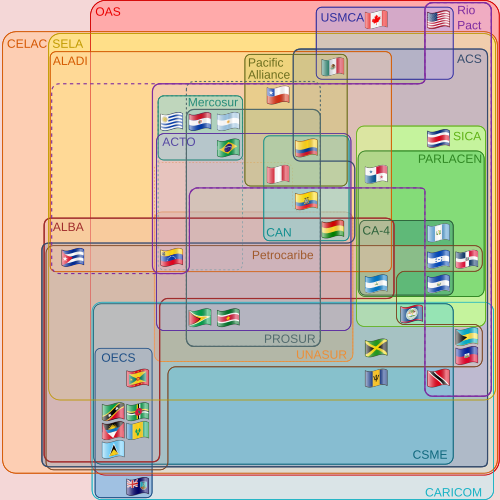
The CARICOM Single Market and Economy, also known as the Caribbean Single Market and Economy (CSME), is an integrated development strategy envisioned at the 10th Meeting of the Conference of Heads of Government of the Caribbean Community (CARICOM) which took place in July 1989 in Grand Anse, Grenada.[1] The Grand Anse Declaration[2] had three key Features:
- Deepening economic integration by advancing beyond a common market towards a Single Market and Economy.
- Widening the membership and thereby expanding the economic mass of the Caribbean Community (e.g. Suriname and Haiti were admitted as full members in 1995 and 2002 respectively).
- Progressive insertion of the region into the global trading and economic system by strengthening trading links with non-traditional partners.
A precursor to CARICOM and its CSME was the Caribbean Free Trade Agreement, formed in 1965 and dissolved in 1973.
Single market and economy
[edit]The CSME will be implemented through a number of phases, first being the CARICOM Single Market (CSM). The CSM was initially implemented on 1 January 2006, with the signing of the document for its implementation by six original member states. However the Revised Treaty of Chaguaramas establishing the CSME had been provisionally applied by twelve member states of CARICOM from 4 February 2002, under a Protocol on the Provisional Application of the Revised Treaty of Chaguaramas.[3] Nine protocols had been drafted to amend the Original Treaty of Chaguaramas and had been consolidated into the Revised Treaty[3] signed at Nassau in 2001,[4] with a number of the Protocols having been applied in part or in full from their creation in 1997-1998 including the provision on the Free Movement of Skilled Nationals.[5]
As of 3 July 2006, it now has 12 members. Although the Caribbean Single Market and Economy (CSME) has been established, in 2006 it was only expected to be fully implemented in 2008.[6] Later in 2007 a new deadline for the coming into effect of the Single Economy was set for 2015,[7] however, following the 2008 financial crisis and the resulting Great Recession, in 2011, CARICOM Heads of Government declared that progress towards the Single Economy had been put on pause.[8] The completion of the CSME with the Single Economy will be achieved with the harmonization of economic policy, and possibly a single currency.[6]
At the eighteenth Inter-Sessional CARICOM Heads of Government Conference in St. Vincent and the Grenadines from 12 to 14 February 2007,[9] it was agreed that while the framework for the Single Economy would be on target for 2008, the recommendations of a report on the CSME for the phased implementation of the Single Economy would be accepted.[10] The Single Economy is now expected to be implemented in two phases.
Phase 1
[edit]Phase 1 was to take place between 2008 and 2009 [10] with the consolidation of the Single Market and the initiation of the Single Economy. Its main elements would include:
- The outline of the Development Vision and the Regional Development Strategy
- The extension of categories of free movement of labour and the streamlining of existing procedures, including contingent rights
- Full implementation of free movement of service providers, with streamlined procedures
- Implementation of Legal status (i.e. legal entrenchment) for the CARICOM Charter for Civil Society
- Establishment and commencement of operations of the Regional Development Fund
- Approval of the CARICOM Investment Regime and CARICOM Financial Services Agreement, to come into effect by 1 January 2009
- Establishment of the Regional Stock Exchange
- Implementation of the provisions the Rose Hall Declaration on Governance and Mature Regionalism, including:
- The automatic application of decisions of the Conference of Heads of Government at the national level in certain defined areas.
- The creation of a CARICOM Commission with Executive Authority in the implementation of decisions in certain defined areas.
- The automatic generation of resources to fund regional institutions.
- The strengthening of the role of the Assembly of Caribbean Community Parliamentarians.
- Further technical work, in collaboration with stakeholders, on regional policy frameworks for energy, agriculture, sustainable tourism, agro-tourism, transport, new export services and small and medium enterprises.
During Phase 1 it is also expected that by 1 January 2009, there would be:
- Negotiation and political approval of the Protocol on Enhanced Monetary Cooperation
- Agreement among Central Banks on common CARICOM currency numeraire
- Detailed technical work on the harmonisation of taxation regimes and fiscal incentives (to commence on 1 January 2009).[11]
Progress and delays
[edit]While progress on the elements of Phase 1 has not resulted in its completion by 2009, a number of its elements have been met, including:
- The outline of the Development Vision and the Regional Development Strategy[11]
- The extension of categories of free movement of labour (to now include to household domestics, nurses, teachers and workers holding specific categories of vocational qualifications) and the streamlining of existing procedures, including contingent rights[12]
- Full implementation of free movement of service providers, with streamlined procedures[13]
- Establishment of the Regional Development Fund and Regional Stock Exchange
Notable elements that have yet to be completed are; legal entrenchment for the CARICOM Charter for Civil Society,[14] approval of the CARICOM Investment Regime and CARICOM Financial Services Agreement (although in August 2013 Finance Ministers of the member states in a Community Council meeting approved the draft CARICOM Financial Services Agreement and the draft amendment to the Intra-CARICOM Double Taxation Agreement),[15] and implementation of the provisions the Rose Hall Declaration on Governance and Mature Regionalism.[16]
Phase 2
[edit]Phase 2 is to take place between 2010 and 2015[10] and consists of the consolidation and completion of the Single Economy. It is expected that decisions taken during Phase 1 would be implemented within this time period, although the details will depend on the technical work, consultations and decisions that would have been taken. Phase 2 will include:
- Harmonisation of taxation systems, incentives and the financial and regulatory environment
- Implementation of common policies in agriculture, energy-related industries, transport, small and medium enterprises, sustainable tourism and agro-tourism
- Implementation of the Regional Competition Policy and Regional Intellectual Property Regime
- Harmonisation of fiscal and monetary policies
- Implementation of a CARICOM Monetary Union.[11]
St. Ann's Declaration
[edit]At the conclusion of a special summit on the CSME held in Trinidad and Tobago from 3–4 December 2018, the leaders agreed to a three-year plan on the CSME. This plan will include:[17]
- Revising the Treaty of Chaguaramas to enable the private sector and labour representatives to have formalized, structured and facilitated dialogue with the Councils of the Community and include representative bodies from the private sector and labour associate institutions of the Community[18]
- Examine the reintroduction of a Single Domestic Space for passengers travelling in the region and introducing a single security check for direct-transit passengers on intra-Community flights making multiple stops[18]
- Deepen cooperation and collaboration between the secretariats of CARICOM and the OECS to avoid duplication of efforts and maximize the use of resources[18]
- Finalize a Community Public Procurement regime by 2019[18]
- Holding indepth discussions on key sectors including region's ICT needs, inter-regional marine and air transport, renewable energy, agriculture, and food security so that by the 40th regular meeting of the CARICOM Heads of Government in July 2019 there will be an understanding of what actions will be required
- Reviewing agricultural and phytosanitary measures, with the objective of removing constraints on inter-regional trade. A report on this review is due in February 2019
- Continuing work on a CARICOM financial services agreement, an investment policy and investment code, with such work to be completed by July 2019
- Taking all necessary steps to create an integrated capital market and model securities legislation by July 2019
- Enabling the mutual recognition of companies and the mutual recognition of CARICOM skills certificates by July 2019 so that individuals and companies can trade or work freely across the CSME
- Bring forward model legislation for trademarks and the harmonisation of business names by July 2019
- The creation of a regional deposit insurance system and credit information sharing system by December 2019
- Introducing a single window for region-wide company registration by December 2019
- Introducing a simple administrative process for the freedom of movement of goods by the end of 2019
- The full integration of Haiti into the CSME in 2020[18]
- Reviewing CARICOM's 17 institutions by early 2020 to ensure they were working effectively and efficiently so that delays would no longer occur
- Harmonizing companies law by the end of 2020
- Introducing a single window for intellectual property registration, patents, and trademarks by the end of 2021
- Total freedom of movement for CARICOM nationals by those states so willing by the end of 2021.
Member states
[edit]
Current twelve full members of both CARICOM and the CSME:
 Antigua and Barbuda
 Barbados
 Belize
 Dominica
 Grenada
 Guyana
 Jamaica
 Saint Kitts and Nevis
 Saint Lucia
 Saint Vincent and the Grenadines
 Suriname
 Trinidad and Tobago


Of the twelve members expected to join the CSME, Barbados, Belize, Guyana, Jamaica, Suriname and Trinidad and Tobago were the first six to implement the CARICOM Single Market on 1 January 2006.[19] Antigua and Barbuda, Dominica, Grenada, St. Kitts and Nevis, St. Lucia and St. Vincent and the Grenadines were the next batch of members (six in all) that joined the CSM on 3 July 2006 at the recent CARICOM Heads of Government Conference.[20]
Current full members of CARICOM and partial participant of the CSME:

Haiti's Parliament ratified the Revised Treaty of Chaguaramas in October 2007 and Haitian Foreign Minister Jean Renald Clerisme presented the published Notice of Ratification to the Chairman of the Caribbean Community Council of Ministers, on 7 February clearing the way for the country's full participation in the CSME[21] on 8 February 2008.[3][22] Haiti has not completed its implementation of the Revised Treaty of Chaguaramas and is therefore not a full participant in the Single Market and Economy. In keeping with the thrust to rebuild the country following the 2010 earthquake and earlier 2004 political crisis, work has also continued on preparing Haiti to participate effectively in the CSME. It is being assisted in its preparations by the Secretariat, led by the CARICOM Representation Office in Haiti (CROH) which was re-opened in 2007 with funding from the Canadian International Development Agency (CIDA).[23] The CROH, in 2007 started the Haiti CSME Project, the objective of which was to assist the Government of Haiti in accelerating its participation in the CSME as a means of enabling Haiti to fully re-engage in the process of regional integration in the Caribbean Community.[24]
As a first step towards the CSME, Haiti was due to enter the trade in goods regime of the Single Market in January 2010 (earlier targets had been for some time in 2009)[25] but could not do so because of the earthquake.[23] Up until that point much work had been done by CROH and its Haitian government counterpart, the Bureau de Coordination et de Suivi or BCS (Office of Coordination and Monitoring), on the technical work necessary to bring the Haitian national tariff in line with the Caricom Common External Tariff (CET). The next step that had to be taken for Haiti to commence full free trade in goods within the CSME was therefore for the Haitian Parliament to pass legislation adopting the Caricom External tariff as Haiti's national tariff. In mid 2009, the Government of Haiti announced that it would be ready to participate fully in free trade in goods within the CSME by 1 January 2010; and in fact through a revised Custom Act adopted by the Haitian Parliament in late 2009, 20–30% of the Caricom CET was incorporated into the Haitian national tariff. However soon after Haiti's progress towards full adoption of the CET began to stall with the dismissal of the Government of Prime Minister Michèle Pierre-Louis in November 2009 and was then put on hold as a result of the January 2010 earthquake.[24] To assist in stimulating economic activity, the Council for Trade and Economic Development (COTED) in December, approved a request for some Haitian products to be exported within the Single Market on a non-reciprocal preferential basis for three years. Consultations are on-going towards approval of additional items from an original list which Haiti submitted. The concession became effective from 1 January 2011. CARICOM Secretariat officials are continuing their training exercises with Haitian customs officials to facilitate their understanding of the CSME's trading regime.[23]
In regards to the inclusion of Haitians in the free movement of skilled nationals under the CSME regime and a review of the visa policy towards Haitian nationals by other Caricom states some progress has been made. By early 2009, representation to the Caricom Heads of Government on the issue, particularly arising out of difficulties faced by Government officials travelling to Caricom meetings, led the Conference of Heads of Government to waive visa requirements for Haitian Government officials bearing official Government passports. In 2010 Caricom Heads of Government went a step further to facilitate travel by Haitian businesses persons and agreed that Haitians possessing US and Schengen visas would not require visas to enter other Caricom member states.[24] In regards to participation in the free movement of skilled nationals, Haiti has also been included in the relevant legislation of at least some CSME states as a participating member state.[26]
In 2018 at both a meeting of COTED and at a special summit on the CSME, it was announced that Haiti intends to have in place the necessary legislative and administrative framework for duty free trading in goods by October 2019[27] to enable its full integration into the CSME by 2020.[18]
Current full members of CARICOM and signatory for (and de facto participant of) the CSME:

Montserrat was awaiting entrustment (approval) of the United Kingdom with regards to the Revised Treaty of Chaguaramas in order to participate,[28] but such entrustment was denied in mid-2008, and the CARICOM Heads of Government (including Montserrat) expressed disappointment and urged the United Kingdom to reconsider its position.[29] Until such time, Montserrat remains a member under the conditions existing immediately prior to the coming into force of the Revised Treaty of Chaguaramas and the CSM on 1 January 2006 and as such is legally in a common market relationship with all CSM participating states.[30] This means that while goods from Montserrat are eligible for CARICOM treatment and free trade (as covered under the old Common Market Annex), service providers in Montserrat are not eligible for CARICOM treatment unless so provided for by the various CSM countries individually in legislation or administratively.[31]
Since the start of the CSME process and after the denial of entrustment, Montserrat has been treated in the relevant legislation of other member states as being a participant of the CSME[26][32][33] and Montserrat itself implements aspects of the CSME where possible for its own residents[34] and for nationals of other CSME states[35] (or provides more favourable treatment for such nationals where full implementation is not possible).[36] These measures include legal provisions for the automatic grant of 6 months stay under the freedom of movement obligations and honouring CARICOM skills certificates in Montserrat[37] (the latter measure the Government of Montserrat had been implemented by way of amendments to existing Statutory Rules and Orders since 1996 in keeping with conformity with the original Conference of Heads of Government decision on the free movement of university graduates).[38] Montserrat also issues land holding licenses to CARICOM nationals as an administrative procedure in seeking to comply with CARICOM's right of establishment obligations, and intends to remove all impediments except for those related to cost recovery. Montserrat's compliance with the movement of capital obligations under the CSME is already assured within the framework of the East Caribbean Currency Union.[37]
At the thirty-fifth regular meeting of the Conference of Heads of Government ending on 4 July 2014, Reuben Meade, Premier of Montserrat, announced that Montserrat intends to accede to the Revised Treaty of Chaguaramas by the next meeting of the Conference, paving the way for its full participation in the Community and particularly the CSME. Montserrat has been progressively making steps towards accession to the Revised Treaty, including obtaining the necessary instrument of entrustment from the United Kingdom. To this end Montserrat will be engaging with the CARICOM Secretariat and relevant CARICOM Institutions and the Caribbean Court of Justice in preparation for the deposit of its Instrument of Accession at the Twenty-Sixth Inter-Sessional Meeting of the Conference, to be held in February 2015 in The Bahamas.[39]
Following the September 2014 general elections in Montserrat, Reuben Meade's government was replaced by new government led by Donaldson Romeo. Romeo's government remained committed to acceding to the Revised Treaty, although the target date of February 2015 was not achieved. In July 2015, at the 36th Meeting of the Conference of Heads of Government in Bridgetown, Barbados, Romeo gave assurances that Montserrat was continuing efforts to complete the process of accession to the Revised Treaty in a timely manner. He revealed that engagement continued with the government of the United Kingdom and that the necessary legislation was being prepared for submission to the Legislative Assembly of Montserrat. He also stated that Montserrat viewed accession to the Caricom Development Fund and to the original jurisdiction of the Caribbean Court of Justice as being necessary to move Montserrat forwards in its effort to integrated and to safeguard the rules upon which its trade was based.[40]
Current full members of CARICOM but not the CSME:

Current 5 associate members of CARICOM but not the CSME:
 British Virgin Islands (July 1991)
 Turks and Caicos Islands (July 1991)
 Anguilla (July 1999)
 Cayman Islands (15 May 2002)
 Bermuda (2 July 2003)


Current 7 observing members of CARICOM but not the CSME:


Caribbean Court of Justice
[edit]The Caribbean Court of Justice (CCJ) is the Highest regional Court established by the Agreement Establishing in the Caribbean Court of Justice. It has a long gestation period commencing in 1970 when the Jamaican delegation at the Sixth Heads of Government Conference, which convened in Jamaica, proposed the establishment of a Caribbean Court of Appeal in substitution for the Judicial Committee of the Privy Council.
The Caribbean Court of Justice has been designed to be more than a court of last resort for Member States of the Caribbean Community of the Privy Council, the CCJ was vested with an original jurisdiction in respect of the interpretation and application of the Treaty Establishing the Caribbean Community (Treaty of Chaguramas) In effect, the CCJ would exercise both an appellate and an original jurisdiction.
In the exercise of its appellate jurisdiction, the CCJ considers and determines appeals in both civil and criminal matters from common law courts within the jurisdiction of Member States of the Community and which are parties to the Agreement Establishing the CCJ. In the discharge of its appellate jurisdiction, the CCJ is the highest municipal court in the Region. In the exercise of its original jurisdiction, the CCJ will be discharging the functions of an international tribunal applying rules of international law in respect of the interpretation and application of the Treaty and so will be the court of arbitration for trade disputes under the CSME.
By 2006, only two countries were full signatories to the Court: Barbados and Guyana, it was expected that by the end of 2010, all 14 member countries would be fully involved. However, only Belize acceded to the appellate jurisdiction in 2010 while all other states were in various stages of moving towards full accession to the court's appellate jurisdiction. Dominica thereafter acceded to the appellate jurisdiction in March 2015.
(Source; CARICOM's official website at[41])
Trade in goods
[edit]All goods which meet the CARICOM rules of origin are traded duty-free throughout the region (except The Bahamas), therefore all goods originating within the region can be traded without restrictions. In addition, most member states apply a Common External Tariff (CET) on good originating from non-CARICOM countries. There are, however, some areas still to be developed:
- Treatment of products made in Free Zones – there is need for regional agreement on how these goods are to be treated since they are usually manufactured at reduced tariff by foreign companies.
- The removal of some specific non-tariff barriers in various member-states.
Another key element in relations to goods is Free Circulation. This provision allows for the free movement of goods imported from extra regional sources which would require collection of taxes at first point of entry into the CSME and for the sharing of collected customs revenue.
(Sources; JIS website on the CSME at[42] and CARICOM website on the CSME at[43])
Harmonization of standards
[edit]Complementary to the free movement of goods will be the guarantee of acceptable standards of these goods and services. To accomplish this, CARICOM members have established the Caribbean Regional Organization on Standards and Quality (CROSQ). The Organization will be responsible for establishing regional standards in the manufacture and trade of goods which all Member States must adhere to. This Organization was established by a separate agreement from the CSME.[42]
As an example of the work of the CROSQ, in conjunction with other regional bodies, on 6 October 2017, COTED approved nine poultry processing plants in Barbados, Belize[44] (including Quality Poultry Products' plant and Caribbean Chicken's plant),[45][46] Guyana, Jamaica, Suriname, and Trinidad and Tobago to trade poultry and poultry products across the region after assessments by Regional Risk Assessment Teams (coordinated by the Caribbean Agricultural Health and Food Safety Agency (CAHFSA) and reviewed and finalized by the CARICOM Committee of Chief Veterinary Officers) proved they met the sanitary requirements (Specifications for Poultry and Poultry Products) developed by CROSQ and approved by COTED in 2013. Additionally the COTED resolved the disagreement on duck meat trade between Trinidad and Tobago and Suriname, with Trinidad and Tobago now willing (by mid-November 2017) to approve Suriname as one of the countries that has met the sanitary and phytosanitary (SPS) requirements for exporting duck meat to the country.[44]
Regional accreditation
[edit]Regional accreditation bodies are planned to assess qualifications for equivalency, complementary to the free movement of persons. To this end, the Member States have concluded the Agreement on Accreditation for Education in Medical and other Health Professions. By this agreement, an Authority (the Caribbean Accreditation Authority for Education in Medicine and other Health Professions) is established which will be responsible for accrediting doctors and other health care personnel throughout the CSME. The Authority will be headquartered in Jamaica, which is one of among six states (Antigua and Barbuda, Belize, Jamaica, Suriname, Trinidad and Tobago) in which agreement is already in force. The Bahamas has also signed on to the Agreement.
Region-wide accreditation has also been planned for vocational skills. Currently local training agencies award National Vocational Qualifications (NVQ)[47] or national Technical and Vocational Education and Training (TVET) certification,[48] which are not valid across Member States. However, in 2003, the Caribbean Association of National Agencies (CANTA) was formed as an umbrella organization of the various local training agencies including Trinidad and Tobago's National Training Agency, the Barbados TVET Council and the Organisation of Eastern Caribbean States TVET agency and the HEART Trust/NTA of Jamaica. Since 2005, the member organizations of CANTA have been working together to ensure a uniformed level of certified skilled labour under the Caricom Single Market and Economy (CSME) and CANTA itself has established a regional certification scheme that awards the Caribbean Vocational Qualification (CVQ),[48] which is to replace NVQs and national TVET certifications.[47] The CVQ will be school-based and although based on the certification scheme of CANTA, will be awarded by the Caribbean Examinations Council (CXC) which will be collaborating with CANTA on the CVQ programme.[49] At the 9–10 February 2007 meeting of the Regional Coordinating Mechanism for Technical and Vocational Education and Training, officials discussed arrangements for the award of the CVQ which was approved by the Council for Human and Social Development (COHSOD) in October 2006.[50] It was expected that the CVQ programme may be in place by mid-2007, if all the requirements are met[10][51] and that provisions were being made for the holders of current NVQs to have them converted into the regionally accepted type (although no clear mandate is yet in place).[51] This deadline was met and in October 2007, the CVQ programme was officially launched. The CVQ now facilitates the movement of artisans and other skilled persons in the CSME. This qualification will be accessible to persons already in the workforce as well as students in secondary schools across the Caribbean region. Those already in the work force will be required to attend designated centres for assessment.[52]
The CVQ is based on a competency-based approach to training, assessment and certification. Candidates are expected to demonstrate competence in attaining occupational standards developed by practitioners, industry experts and employers. Those standards when approved by CARICOM allow for portability across the Region. Currently, CVQs are planned to reflect a Qualification framework of five levels. These are:
- Level 1: Directly Supervised/Entry –Level Worker
- Level 2: Supervised Skilled Worker
- Level 3: Independent or Autonomous Skilled Worker
- Level 4: Specialized or Supervisory Worker
- Level 5: Managerial and/or Professional Worker[53]
CVQ's are awarded to those candidates who would have met the required standards in all of the prescribed units of study. Statements are issued in cases where candidates did not complete all the requirements for the award of CVQ. Schools that are suitably equipped currently offer Levels 1 & 2.[53]
By March 2012 up to 2,263 CVQs had been awarded in the workforce across the region and 2,872 had been awarded in schools for a total of 5,135 CVQs awarded up to that time. The breakdown of the agency awarding the over 5,000 CVQs by March 2012 stood at 1,680 having been awarded by the CXC and 3,455 being awarded by the various National Training Agencies (with some being awarded in the workplace and some being awarded in secondary schools).[54]
(Main Sources; JIS website on the CSME and Google Cache of SICE - Establishment of the CSME at[55] - see references)
Abolition of work permits/permits of stay and the free movement of persons
[edit]Chapter III of the Revised Treaty of Chaguaramas provides for the free movement of skilled Community nationals (article 46) as well as for the free movement of non-wage earners, either as service providers and/or to establish businesses, including managerial, supervisory and technical staff, and their spouses and immediate family members.[56]
Trade in services and the right of establishment
[edit]Along with the free trade in goods, the Revised Treaty also provides the framework for the establishment of a regime for free trade in services. The main objective is to facilitate trade and investment in the services sectors of CSME Member States through the establishment of economic enterprises. The free trade regime for services grants the following benefits:
| Benefit | Description |
|---|---|
| The Right of Establishment | CARICOM-owned companies will have the right to establish and operate businesses in any CSME member-state under the same terms and conditions as local companies, i.e. without restrictions. Managerial, technical and supervisory staff of these enterprises will be able to enter and work without work permits. |
| Region-wide Services | CARICOM service providers will be able to offer their services throughout the region, again without work permits, usually on a temporary basis, e.g., consultancies. |
Right of establishment
[edit]The right to work as a self-employed person has been provided for in respect of persons wishing to engage in non-wage earning activities of a commercial, industrial, agricultural or artisanal nature.[57] Non-Wage Earners are self-employed CARICOM Nationals (juridical as well as natural persons) who have the right to work as self-employed persons in the C.S.M.E. and these persons can move to another Member State to establish a business or to provide a service on temporary basis.[58]
Such nationals may create and manage economic enterprises, including any type of organization which they own or control (e.g. sole proprietorship, company, etc.) for the production of or trade in goods, or the provision of services.[57] Service providers may also move to establish businesses under the Companies Act or the Registration of Business Names Act. The procedure in those cases would be the same as those applying to the establishment of business for the provision of goods by a Company.[59] Nationals exercising this right may move to another Member State on a permanent basis.[57] This category of person is not required to obtain a Free Movement of Skill Certificate, however Service Providers must obtain a Certificate of Registration as a CARICOM Service Provider.[58]
Affiliated with the right of establishment is the right to move the Technical, Supervisory and Managerial staff of such entities, as well as their spouses and immediate dependent family members. Persons within any of these five (5) named classes are not allowed to move in their own right unless they fall under one of the nine (9) approved categories (where the member state recognizes these categories).[57]
Several procedures have been approved for treatment of persons wishing to establish business enterprises in other member states. These involve:[57]
- Procedures at Point of Entry whereby Immigration must grant a definite stay of six (6) months, upon the national presenting a valid passport, return ticket and proof of financial resources for personal maintenance.
- Procedures post-entry. This includes the requirement for a migrant CARICOM National to apply to the Competent Authority (usually the Registrar of Companies) of the receiving state, for registration of a business enterprise.
Entry procedure at point of entry for right of establishment
[edit]CARICOM Nationals specifically wishing to move from one Member State to another in exercising the right of establishment will have to present the following at point of entry:[60]
- (i) Valid passport;
- (ii) Return ticket;
- (iii) Proof of financial resources for personal maintenance, namely credit cards, travellers cheques, cash or combination thereof.
Immigration will then grant the CARICOM National a definite stay of 6 months.[60]
Procedure after entry for right of establishment
[edit]Each Member State shall designate a Competent Authority for Right of Establishment. After entry has been granted the CARICOM National must submit to the Competent Authority, relevant proof, such as Police Certificate, Financial Resources, Business Names Certificate / Certificate of Incorporation. The Competent Authority will determine if all requirements to establish the particular business have been satisfied. Once all requirements are satisfied, the Competent Authority will issue a letter of approval to the CARICOM national copied to the Immigration Department. If the business is established within the 6 months period then the CARICOM National must report to the Immigration Department to further regularize his / her stay with the Letter of Approval from the Competent Authority. Immigration will grant the CARICOM National an indefinite stay.[60]
Member States will determine through the national mechanisms which have been established for that purpose, whether the business is operational. If the CARICOM National is no longer operating the business or another business the Competent Authority for Rights of Establishment will inform the Immigration Department, which has the right to rescind the indefinite stay or to indicate to the person that he / she needs to apply for a permit of stay and / or a work permit until such time that there is full free movement in the Community.[60]
Extension for right of establishment
[edit]In the event that the business is not established within the 6-month period, the CARICOM National should present to the Immigration Department or other relevant department so designated by the Member State, evidence from the Competent Authority that concrete steps have been undertaken to establish the business. Where such evidence is provided, the CARICOM National will be granted an extension of 6 months.[60]
Stamps for right of establishment
[edit]There are specific stamps for the definite entry of 6 months, the extension of 6 months and the indefinite stay with the following text – [60]
- (i) Right of Establishment – Definite Entry of 6 Months;
- (ii) Right of Establishment – Extension; and
- (iii) Right of Establishment – Indefinite Entry.
A CARICOM national whose passport is stamped with one of the above is automatically entitled to multiple entry into that Member State.[60]
Integrated online registry
[edit]From 8–10 December 2014, a meeting by Registrars of Companies from the 12 participating CSME member states was held to discuss the development of a complete online registry. The meeting was held in Saint Lucia and was convened by CARICOM Secretariat and funded by the European Union under the 10th European Development Fund (EDF) as part of the CSME and Economic Integration Programme.[61]
The Registrars of Companies across the region held the meeting to consider the proposal for the harmonization of online registries in the CSME participating Member States. This harmonization would be facilitated by the web interface and interoperability of the respective systems allowing users access to information from participating Member States. The objective of the initiative is for interested parties to be able to register businesses/companies online across Member States thereby increasing cross-border economic activity. The other issues that are down for discussion are the software and hardware requirements of the systems to be installed as well as training for data entry operators and other relevant users in the registries.[61]
The beneficiary Member States under the project are Antigua and Barbuda, Barbados, Belize, Dominica, Grenada, Guyana, Jamaica, St. Kitts and Nevis, Saint Lucia, St. Vincent and the Grenadines, Suriname and Trinidad and Tobago. Alfa XP Europe Limited is the company undertaking the consultancy.[61]
Temporary provision of services
[edit]While service providers may establish businesses under the right of establishment they may, however, make their services available in other member states using another mode, that is, by moving on a temporary basis.[59] CARICOM Nationals who wish to move from one CARICOM Member State to another in order to provide such services on a temporary basis are required to register as a service provider in the Member State, where he/she is living and working in order to be issued with a certificate, which will facilitate the entry into another Member State.[60] As with the establishment of businesses, there are approved procedures both at points of entry and after entry, regarding treatment of CARICOM nationals wishing to temporarily provide services.[59]
Critical to this process is the application for and the issuance of a certificate by the Competent Authority within the national's country, subject to the provision of proof relating to:[59]
- (a) CARICOM nationality; and
- (b) competency to provide the service, or contract to offer service or letter from relevant association or reputable person or body.
The certificate, the lifetime of which is indefinite, along with a valid passport and the contract to offer service or an invitation letter, must be presented to the Immigration officer at the port of entry, who should then grant the CARICOM National sufficient time to provide the service. A regime has also been approved in respect of the granting of extensions under this regime.[59]
Entry procedure at point of entry for provision of temporary services
[edit]CARICOM Nationals specifically wishing to move from one Member State to another to provide services on a temporary basis must present their certificate of registration as a CARICOM service provider at the point of entry to the Immigration Officer as proof that the CARICOM National is a service provider who is seeking to enter to provide services on a temporary basis.[60] Other documents required are - [60]
- (i) a valid passport;
- (ii) contract to offer service or invitation letter from a client.
The Immigration Officer will grant the CARICOM National sufficient time to provide the service.[60]
Procedure for the automatic extension of the stay for provision of temporary services
[edit]In cases where the temporary service is not completed within the stipulated time period, an automatic extension must be requested from the Immigration Department. The automatic extension will be granted in order to enable the CARICOM National to complete the service once the service provider submits proof that the service is not yet completed.[60]
The automatic extension is based on rights enshrined in the Revised Treaty of Chaguaramas, namely non-discrimination (national treatment) and the right to provide a service through mode 4 – the movement of national persons.[60]
The process to extend the stay should not take longer than ten working days.[60]
(Main Source; JIS website on the CSME - see references)
Abolition of work permits and the free movement of labour
[edit]The Free Movement of Skilled Persons, arises from an agreed CARICOM policy that was originally separate but related to the original Protocol II of the Revised Treaty of Chaguaramas.[62] The agreed policy, called The Caribbean Community (CARICOM) Free Movement of Persons Act, is now enacted legislation in all the CSME Member States. It provides for the free movement of certain categories of skilled labour, but according to the policy there is to be eventual free movement of all persons, originally by 2008, but now by 2009.[10] Under this legislation, persons within these categories can qualify for Skills Certificates (which allow for the free movement across the region).
Since the start of the CSM, eight categories of CARICOM nationals have been eligible for free movement throughout the CSME without the need for work permits. They are: University Graduates, Media Workers, Artistes, Musicians, Sportspersons, Managers, Technical and Supervisory Staff attached to a company and Self-Employed Persons/Service Providers.[63] In addition the spouses and immediate dependent family members of these nationals will also be exempt from work permit requirements. At the July 2006 CARICOM Summit, it was agreed to allow for free movement of two more categories of skilled persons; tertiary-trained Teachers and Nurses. It was also agreed that higglers, artisans, domestic workers and hospitality workers are to be added to the categories of labour allowed free movement at a later date, pending the agreement of an appropriate certification.[64] This envisioned extension for the latter categories of workers such as artisans was achieved in October 2007 with the launch of the Caribbean Vocational Qualification (CVQ).[52] In 2009 Antigua and Barbuda and Belize were permitted to delay extending free movement to domestic workers until a study was conducted on the impact on their countries on the free movement of this new category of worker. Antigua and Barbuda was also granted an outright five-year exemption to the extension of free movement to domestic workers (to go with its existing exemption from the free movement of non-graduate teachers and nurses) in order for it to make the necessary adjustments to its infrastructure and other imperatives to facilitate the fulfillment its obligations and in recognition of the fact that Antigua and Barbuda had always implement a very liberal immigration policy granting admission beyond the approved categories eligible for free movement which resulted in a high population of persons from other Member States.[65][66] In 2015 Antigua and Barbuda was seeking the continuation of this exemption on domestic workers for a further 5 years,[66] and was granted a 3-year extension to this exemption in 2015.[67] Following on from a special summit on the CSME in early December 2018, held in Trinidad and Tobago, the Heads of Government agreed to expand the categories of skilled nationals eligible for free movement to include security guards, beauticians/beauty service practitioners, agricultural workers and barbers. They further agreed that those member states willing to do so, should move ahead to full freedom of movement within the next three years.[18] At the 30th Inter-Sessional Conference of the Heads of Government in February 2019, Antigua and Barbuda and St. Kitts and Nevis sought and were granted a five-year deferral on permitting the free movement of security guards, beauticians/beauty service practitioners, barbers, and agricultural workers under the free movement of skills regime.[68]
The freedom to live and work throughout the CSME is granted by the Certificate of Recognition of CARICOM Skills Qualification (commonly called a CARICOM Skills Certificate or just a Skills Certificate). The Skills Certificate essentially replaces work permits and are obtained from the requisite ministry once all the essential documents/qualifications (which varies with each category of skilled persons) are handed in with an application. The issuing ministry varies depending upon the CARICOM Member State. In Antigua and Barbuda, Jamaica and Suriname the Skills Certificates are issued by the Ministry of Labour. Grenada, Guyana, St. Lucia and Trinidad and Tobago have Ministries for Caribbean Community Affairs which deal with the Certificates. Meanwhile, Barbados, Belize, Dominica, St. Kitts and Nevis and St. Vincent and the Grenadines issue the Certificates through the Ministries of Immigration. The Skills Certificate can be applied for in either the home or host country.[69]
At the eighteenth Inter-Sessional CARICOM Heads of Government Conference in February, it was agreed that artisans would not be immediately granted free movement status from January (as was originally envisaged), but would rather be granted free movement by mid-2007. The free movement of artisans will be facilitated through the award of Caribbean Vocational Qualifications (CVQ) based on industrial occupational standards. The conference also agreed that the free movement of domestic workers and hospitality workers could be facilitated in a similar manner to the free movement of artisans and that their cases would be considered after the CVQ model is launched.[10] The CVQ itself was launched in October 2007, thereby facilitating the free movement of these categories of workers.[52]
The Free Movement of Labour is also being facilitated by measures to harmonize social services (health, education, etc.) and providing for the transfer of social security benefits (with the Bahamas also being involved). Regional accreditation will also facilitate the free movement of people/labour.
Although the CARICOM Skills Certificate regime pre-dates the formal inauguration of the CSME (Skills Certificates have been available since 1997, while the CSME was only formally instituted in 2005 following provisional application of the CSME protocols in 2001) the number of Skills Certificates issued to qualifying CARICOM nationals has only really taken off since the CSME was instituted.[70] Between 1997 and 2005 only nine Member States had issued certificates of Recognition of Skills on a relatively small scale. Trinidad and Tobago, Jamaica and Guyana have issued the bulk of these certificates.[71] By September 2010 approximately 10,000 Skills Certificates had been issued by the 12 member states[72] with the available data on free movement indicating that more than 6,000 of these skills certificates having been issued between 2006 and 2008.[70] At an address to the graduates of the 48th Convocation of the University of Guyana on 8 November 2014, CARICOM's Secretary General, Irwin La Rocque, revealed that up to November 2014 a total of 14,000 Skills Certificates had been issued and he urged the graduates to apply for their own Skills Certificates now that they were eligible.[73]
Individually, some countries account for a large percentage of the total Skills Certificates issued. For instance between 1997 and July 2010, Guyana had issued 2,829 skills certificates.[74] Up to June 2011, Jamaica had issued 2,113 skills certificates.[75] And as of September 2013, Jamaica had issued 2,893 skills certificates. Data also indicated that the number of verifications and the number of certificates issued by other member states to Jamaicans for 2004 to 2010 amounted to 1,020.[76] And between 2001 and 2006 Trinidad and Tobago issued 789 Skills Certificates.[77][78] By 2008, Trinidad and Tobago had issued a total of 1,685 Skills Certificates.[79]
A survey conducted in 2010, found that between 1997 and June 2010 at least an estimated 4,000 persons had moved under the free movement of skills regime. Specialist Movement of Skills/Labour within the CSME Unit, Steven Mc Andrew said “The study proved that persistent fears in member states that they are being flooded under the free movement regime are clearly unfounded.” He added that another key conclusion was that “free movement has not impacted negatively on the social services in member states. On the contrary it helped to fill critical vacancies in member states with respect to teachers and nurses, thus proving to be very beneficial to maintain a certain level of social services in these countries.”[80]
It is expected that by June 2014, all CARICOM nationals will have easier access to participating CSME Member States, and be able to fully exercise their rights to travel, work and seek out other opportunities as provided for under the CARICOM Single Market and Economy (CSME) arrangement.[81]
This is being facilitated through the Canadian International Development Agency (CIDA)-funded CARICOM Trade and Competitiveness Project (CTCP), under which a critical electronic database is being established. It will, among other things, provide member countries with aggregated information on the various skill sets available, through a web-based portal being developed by project consultant, A-Z Information Jamaica Limited.[81]
Additionally, the consultant is proposing that the CARICOM National Skills Certificate be standardised across countries, and presented in the form of a stamp in persons’ passports. This will eliminate the discrepancies in the format of certificates, as well as the need for a physical document and result in ease of processing at the various points of entry across member countries.[81]
Concurrent with (and to some extent pre-dating) the free movement of people is the easier facilitation of intra-regional travel. This aim is being accomplished by the use of separate Lines identified for CARICOM and Non-CARICOM Nationals at Ports of entry (already in place for all 13 members) and the introduction of a CARICOM Passport and Standardized Entry/Departure Forms.
Contingent Rights accompanying the free movement of skills
[edit]In addition to the right to move freely for the purposes of labour, it was intended that those persons exercising such rights would be able to have their spouses, children and other dependent accompany them and partake in complementary rights such as the right to access primary education, healthcare, transfer capital, access land and other property, work without needing a work permit and leave and re-enter the host country. Work on this Protocol on Contingent Rights started in 2008.[82] The Protocol was finally ready for signature in 2018 and was signed initially by seven member states (Barbados, Grenada, Haiti, Jamaica, St. Lucia, St. Vincent and the Grenadines, and Suriname) at the 39th Regular Meeting of the Conference of Heads of Government of CARICOM held in Montego Bay, Jamaica.[83][84][85] Trinidad and Tobago additionally signed on to the Protocol and the accompanying Provisional Application at a special summit on the CSME in early December 2018, held in Trinidad and Tobago.[86] At the 30th Inter-Sessional Meeting of the Conference of Heads ofg Government from 26 to 27 February 2019 in St. Kitts, all remaining CARICOM Member States participating in the CSME signed up to the Contingent Rights Protocol. Eight of these twelve countries, namely Antigua and Barbuda, Barbados, Dominica, Grenada, Guyana, St Kitts and Nevis, Saint Lucia, St Vincent and the Grenadines and Trinidad and Tobago also decided to apply the protocols measures provisionally.[87] In late February and early March, Barbados became the first of the Member States to amend its legislation to give effect to the Protocol.[88]
Free Movement for All People - CARICOM Decision
[edit]The 45th Meeting of the Conference of the Heads of Government of the Caribbean Community (CARICOM) was held in July 2023, marking a significant milestone for regional integration in the Caribbean. A crucial outcome of this historic meeting, which coincided with CARICOM's 50th-anniversary celebration, was the agreement on free movement for all CARICOM nationals by March 2024.[89]
This groundbreaking decision extends beyond the current CARICOM Single Market and Economy (CSME) scheme, which allowed free movement only for agreed categories of skilled nationals. This new development was announced by CARICOM Chair, the Hon Roosevelt Skerrit, Prime Minister of Dominica, during the concluding press conference.[89]
According to Prime Minister Skerrit, this change forms a fundamental part of the integration architecture and underpins the core idea of the regional integration movement - the ability for people to move freely within the Caribbean Community. Although he acknowledged potential legal challenges in implementing this policy, a dedicated legal team was appointed to examine these issues and present a definitive position by March 2024.[89]
The announcement was received with enthusiasm, with Prime Minister Skerrit expressing his belief that the founding fathers of the organization would be "smiling from heaven" at this bold decision. He highlighted that in addition to the free movement, certain rights will be accorded, such as access to primary and emergency healthcare, education, and hassle-free travel.[89]
Prime Minister of Barbados, the Hon. Mia Mottley, who holds responsibility for the CSME in the CARICOM Quasi Cabinet, emphasized the need for careful execution. She mentioned the need for treaty amendments to ensure countries are not liable to lawsuits concerning these rights. A minimum set of rights will be discussed, agreed upon, and included in the treaty amendments.[89]
To finance these changes, CARICOM Heads are considering leveraging the CARICOM Development Fund to ensure each member state can bring its minimum level of service up to an acceptable standard. Prime Minister Mottley stated this decision represents the long-held desire of every Caribbean citizen for greater control over their destiny.[89]
However, an exception has been made for Haiti, which has requested a derogation from the free movement agreement due to specific circumstances faced by the member state. Despite this exception, the decision made at this historic conference signifies a significant step towards enhanced regional integration within the Caribbean Community.[89]
Caribbean Community (CARICOM) Heads of Government met in Grenada in July 2024, for the 47th Regular Meeting of the Conference.[90][91]
During the 49th Regular Meeting of the CARICOM Conference of Heads of Government, Jamaican Prime Minister and Chairman of CARICOM Andrew Holness announced the date of commencement for the freedom of movement would be 1 October 2025. The initial four countries expected to implement it are Barbados, Belize, St. Vincent and the Grenadines and Dominica. Holness also added that Jamaica was "remains committed to the goal of full free movement" stating that the reason for the delay was due to "legislative framework and other considerations". It was also stated that the four countries were expected to serve as an experiment in how to implement free movement for the rest of CARICOM.[92]
Nationality criteria
[edit]In relation to a number of issues such as professional services, residency and land ownership, legislation in the various member states used to discriminate in favour of their individual nationals. This legislation has been amended, as of 2005, to remove the discriminatory provisions. This will allow CARICOM nationals, for example, to be eligible for registration in their respective professions on an equal basis.
However, shortly before signing onto the CSM, the second batch of member states (all in the OECS) negotiated an opt-out agreement with regards to land ownership by non-nationals. As the OECS members of the CSM are all small countries and have limited available land, they are allowed to keep their Alien Land Holding Laws or Alien Landholders Acts (which apply to the ownership of land by non-nationals), but will put in place mechanisms to ensure compliance with the Revised Treaty that will monitor the granting of access to land and the conditions of such access.[93] As it now stands foreign companies or nationals have to seek legal permission to buy land.[94] All other laws relating to discrimination in favour of member state nationals only have been amended though. Among the non-OECS members of the CSM, there are no restrictions on private land ownership by CARICOM nationals (although in Suriname, and possibly in the other members as well, restrictions still apply with regards to state-owned land[95]).
(Main Source; JIS website on the CSME - see references)
Harmonization of legislation
[edit]The Revised Treaty also calls for harmonized regimes in a number of areas: Anti-dumping and countervailing measures, Banking and securities, Commercial arbitration, Competition policy, Consumer protection, Customs, Intellectual property rights, Regulation and labelling of food and drugs, Sanitary and phytosanitary measures, Standards and technical regulations & Subsidies.
Draft model legislation is being developed by a CARICOM Legislative Drafting Facility in collaboration with the Chief Parliamentary Counsels of the region
(Main Source; JIS website on the CSME - see references)
Free movement of capital
[edit]The free movement of capital involves the elimination of the various restrictions such as foreign exchange controls and allowing for the convertibility of currencies (already in effect) or a single currency and capital market integration via a regional stock exchange. The member states have also signed and ratified an Intra-Regional Double Taxation Agreement.
Following the conclusion of the 61st CARICOM Committee of Central Bank Governors Meeting on November 3, 2023, The regional central bank governors supported the advancement of work on the pilot of an intraregional payments system called the CARICOM Payments and Settlements System (CAPSS).[96] CAPSS would facilitate the full integration of the various national markets in CARICOM into a single, unified, open market and allow for the smooth and easy flow of capital.[97] The system would develop in partnership with the African Export-Import Bank (Afreximbank)[97] and would be underpinned by the technology used in the Pan-African Payments & Settlement System of that bank.[98]
At the end of October, at the AfriCaribbean Trade and Investment Forum in Guyana, the President and Chairman of the Afreximbank, Professor Benedict Oramah, had announced the initial partnership and that a payments and settlement programme with an African bank had been selected to run the pilot programme for the CARICOM central banks. He also stated his hopes that soon the payments systems for Africa and CARICOM will be integrated and that he had addressed CARICOM leaders earlier on the year about assisting in the establishment of a CARICOM Import-Export Bank, of which Afreximbank would be a shareholder if so invited.[97][98]
At the same meeting on November 3, the regional central bank governors endorsed a proposal for the establishment of a Regional Central Bank Group of Reserves Managers, that would meet virtually and share experiences and approaches in the management of national foreign exchange reserves.[96][97][98]
Single currency
[edit]Although not expected until between 2010 and 2015,[11] it is intended that the CSME will have a single currency. As it stands a number of the CSME members are already in a currency union with the Eastern Caribbean dollar and the strength of most regional currencies (with the exception of Jamaica's and Guyana's) should make any future exchange-rate harmonization between CSME members fairly straightforward as a step towards a monetary union.
The aim of forming a CARICOM monetary union is not new. As a precursor to this idea the various CARICOM countries established a compensation procedure to favour the use of the member states currencies. The procedure was aimed at ensuring monetary stability and promoting trade development. This monetary compensation scheme was at first bilateral, but this system was limited and unwieldy because each member state had to have a separate account for each of its CARICOM trade partners and the accounts had to be individually balanced at the end of each credit period. The system became multilateral in 1977 and was called the CARICOM Multilateral Clearing Facility (CMCF). The CMCF was supposed to favour the use of internal CARICOM currencies for transaction settlement and to promote banking cooperation and monetary cooperation between member states. Each country was allowed a fixed credit line and initially the CMCF was successful enough that both the total credit line and the credit period were extended by 1982. However, the CMCF failed shortly thereafter in the early 1980s due to Guyana's inability to settle its debts and Barbados being unable to grant new payment terms[99]
Despite the failure of the CMCF, in 1992 the CARICOM Heads of Government determined that CARICOM should move towards monetary integration and commissioned their central bankers to study the possible creation of a monetary union among CARICOM countries. It was argued that monetary integration would provide benefits such as exchange rate and price stability and reduced transaction costs in regional trade. It was also thought that these benefits in turn would stimulate capital flows, intra-regional trade and investment, improve balance of payments performance and increase growth and employment.
The Central Bank Governors produced a report in March 1992 that outlined the necessary steps and criteria for a monetary union by 2000. The 1992 criteria were amended in 1996 and were known as the 3-12-36-15 criteria. They required that:
- countries maintain foreign reserves equivalent to 3 months of import cover or 80% of central bank current liabilities (whichever was greater) for 12 months;
- the exchange rate be maintained at a fixed rate to the US dollar (for Fixers) or within a band of 1.5% on either side of parity (for Floaters) for 36 consecutive months without external debt payment arrears and;
- the debt service ratio to be maintained within 15% of the export of goods and services.
The report envisioned the fulfilment of a monetary union in 3 phases on the basis of grouping the member states into 2 categories, A and B. Category A included the Bahamas, Belize and OECS states. Category A countries had already met the original criteria in 1992 and only had to maintain economic stability to begin the monetary union. Category B consisted of Barbados, Guyana, Jamaica and Trinidad and Tobago (Suriname and Haiti were not yet members and so were not included). These countries had to make the necessary adjustments to meet the entry criteria.
Phase 1 of the monetary union process was scheduled to conclude in 1996. It was to include the Bahamas, Barbados, Belize, the OECS states and Trinidad and Tobago and there was to have been a common currency as a unit of account (cf. the Euro from 1999 to 2002) amongst these states with the exception of the Bahamas and Belize. This phase would also involve the coordination of monetary policies and the movement towards intra-regional currency convertibility among all member states. Phase 1 would also have seen the formation of a Council of CARICOM Central Bank Governors to oversee the entire process.
Phase 2 was to have occurred between 1997 and 2000 and should have seen a number of initiatives:
- the formation of a Caribbean Monetary Authority (CMA), which would be accountable to a Council of Ministers of Finance.[100]
- the issuance and circulation of a physical common currency in all Phase 1 countries except the Bahamas.
- the use of the new currency in the other countries (the Bahamas, Guyana and Jamaica) as a unit of account in settling regional transactions.
- the continued efforts by Guyana and Jamaica to meet the criteria for entry into the monetary union if they had not already done so and achieved economic stability.
Phase 3 was planned to begin in 2000 and had as its ultimate goal to have all CARICOM countries entering into the monetary union and membership of the CMA.
However, the implementation of Phase 1 was put on hold in 1993 as a result of Trinidad and Tobago floating its dollar. In response and in an effort to continue pursuing monetary cooperation and integration, CARICOM Central Bank Governors made their regional currencies fully inter-convertible. A subsequent proposal called for Barbados, Belize and the OECS states to form a currency union by 1997 but this also failed.[101]
Development fund
[edit]One of the institutions and regimes created to give life to the regional integration movement through the Revised Treaty of Chaguaramas, is the CARICOM Development Fund (CDF). It forms a critical part of the community's aim for equitable engagement among its member states. The idea for the CDF was borrowed substantially from a similar mechanism successfully employed the European Union[102] (the EU's Cohesion Fund)[103] in helping bring certain of its member states, such as Ireland, up to a certain economic level to assist them in effectively participating and benefiting from the integration process.[102]
The CDF was established under Article 158 of the Revised Treaty of Chaguaramas “for the purpose of providing financial or technical assistance to disadvantaged countries, regions and sectors.” It is the centre-piece of a regime to address the disparities among the Member States of the Community which may result from the implementation of the CSME. The signing of the Agreement Relating to the Operations of the Fund in July 2008, followed years of negotiations by CARICOM Member States regarding the principles, size and structure of a regional development fund.[102]
There was a sense of achievement when the agreement was finally signed and technicians employed by the CDF got down to the task of making the mechanism operational. In an interview, CDF Chief Executive Officer Ambassador Lorne McDonnough said “The CDF start-up team was always confident it would meet the projected launch date....” Despite this confidence he admitted that “...along the way there were always the glitches and frustrating delays that called for an extra dose of perseverance as well as the need to step back and revisit the problem with a fresh resolve”. Ambassador McDonnough noted that heightened expectations and the desire to see the CDF operational in the shortest possible time, meant that Member States sometimes underestimated the work which had to be done to make the CDF ready for full operations.[102]
Notwithstanding all the challenges, on 24 August 2009, in keeping with expectations, the CDF officially opened its doors. This was achieved after nine months of feverish effort by the start-up staff to put systems in place to allow for the receipt of requests for loans and grants.[102]
The CDF has 12 members: Antigua & Barbuda, Barbados, Belize, Dominica, Grenada, Guyana, Jamaica, Saint Lucia, Saint Kitts & Nevis, Saint Vincent & the Grenadines, Suriname and Trinidad & Tobago.[104]
Governance
[edit]The CDF, as established in the agreement, has its own legal identity but is linked to CARICOM through several Ministerial Councils. The CDF is governed by its own corporate board and is managed by the CEO. Ambassador McDonnough assumed the post of CEO in November 2008 joining Ms. Fay Housty, Senior Advisor, Corporate Governance and Development and Mr. Lenox Forte, Manager, Corporate Development and Programming. These two officers were seconded from the CARICOM Secretariat.[102]
The CDF began its existence from three temporary offices within CARICOM's CSME Unit in the Tom Adams Financial Centre, Bridgetown, Barbados. The team spent the first three months looking for alternative office space, preparing the work plan and budget, seeking funding for the preparation of its governance rules and procedures in addition to beginning the process of recruiting the core executive and administrative staff.[102]
The CDF moved into its current temporary office in the renovated Old Town Hall Building in Bridgetown at the end of January 2009. This space was provided by the Government of Barbados as the CDF continued to work with it on acquiring its more permanent premises by middle of 2010.[102] The new permanent facilities for the CDF were located in a new building located at Mall Internationale, Haggatt Hall, St. Michael, Barbados. This building also housed the new permanent offices of two departments of the CARICOM Secretariat - the Office of Trade Negotiations and the CSME Unit.[105] The new offices were officially opened on Monday, 3 December 2012 by the Prime Minister of Barbados, Freundel Stuart.[106]
Capitalisation
[edit]All member states are required to contribute to the capital of the fund on the basis of a formula agreed on by the CARICOM heads of government. In 2009 the CDF was capitalised at US$79.9 million. It was envisaged that by the end of the 2009 member states would have contributed approximately US$87 million. The CDF also has the remit to raise a further US$130 million from donors and friendly states.[102]
The CDF also benefited in 2009 from technical assistance grants of US$149,000 from the Caribbean Development Bank and €834,000 from the European Union (EU) Institutional Support Facility in addition to a 2009 contribution of €300,000 signalling the start of a closer relationship between the Government of Finland and CARICOM. The Government of Turkey also provided support to the countries of the Organisation of Eastern Caribbean States (OECS) to assist them in making their contribution to the CDF's capital fund.[102]
By 2011 the CDF was capitalised at US$100.7 million, with the total funds increasing to US$107 million by 2012.[107]
Following a meeting of a CDF team with the member states' Technical Working Group (TWG), Ambassador McDonnough made recommendation on the replenishment of the CDF during the Second Funding Cycle. These recommendations were accepted by the CARICOM Conference of Heads of Government in May 2015, it was confirmed that CARICOM member states will provide US$65.84 million in new funding for the CDF in its Second Funding Cycle, due to commence on 1 July 2015. This amount will also be supplemented by US$10.2 million of carry-over funds, bringing a total of US$76 million for the Second Funding Cycle. Trinidad and Tobago, the largest contributor, confirmed that it was providing US$40 million to the CDF.[108]
Both the governments of Haiti and Montserrat expressed their desire to become members of the CDF during its Second Funding Cycle.[108]
Beneficiaries
[edit]Whilst all members of the CSME contributing to the CDF are eligible to receive financial and technical assistance support from the fund, only the designated disadvantaged countries - the LDCs (OECS and Belize) and Guyana (as a Highly Indebted Poor Country) will have access to resources during the first contribution cycle[102] which runs from 2008 to 2014.[109] To identify the needs of the eligible member states and to inform the CDF Board as it signed off on governance rules and regulations, needs assessment consultations were undertaken to the LDCs and Guyana.[102]
Informed by these consultations and consistent with its remit to address disparities resulting from the implementation of the CSME, the CDF will focus on disbursing concessionary loans and grants that address objectives related to the implementation of the CSME, preferably small-to-medium size projects of a short implementation period. The details of the criteria for project selection can be found in the CDF Appraisal and Disbursement guidelines on www.csmeonline.org .[102]
In an attempt to guarantee the sustainability of the CDF capital fund, the size of direct loans will range between US$500,000 and US$4 million; the minimum size of grants will be US$20,000. In each contribution cycle, the board will earmark up to US$10 million to finance private sector projects that are regional or sub-regional in scope. The CDF will also look to work with its development partners in leveraging the technical assistance it can provide.[102]
Regional Integration Electronic Public Procurement System
[edit]Article 239 of the Revised Treaty of Chaguaramas obliges Member States to “elaborate a Protocol relating... to... Government Procurement.”[110][111]
To date, the Community has undertaken and concluded a significant volume of work regarding the establishment of a Community Regime for Public Procurement. A project was commissioned in 2003 by the CARICOM Secretariat with a grant from the Inter-American Development Bank (IDB) and the Canadian International Development Agency (CIDA). The object of the project was to support CARICOM in its efforts to establish an effective regional regime for Public Procurement which would facilitate the full implementation of the CSME and to participate effectively in external trade negotiations relating to Public Procurement. The project comprised three main components. Component 1 – National Government Procurement Frameworks: Analysis, Comparison and Recommended Improvements; Component 2 – Collection and Analysis of Government Procurement Statistics; and Component 3 – Recommendations for a Regional Best-practice Regime for Government Procurement.[112]
Altogether, the outputs of the project informed the preparation of the first draft of the Framework Regional Integration Policy on Public Procurement (FRIP).[110] The First Draft of the Community Policy on Public Procurement was developed and disseminated to Member States for review in 2005. By April 2006 the Second Draft was finalized.[112] In 2011, the Fourth Draft, which reflects the recommended amendments to the Third Draft, was adopted.[110] The proposed policy now called the Framework for Regional Integration of Public Procurement (FRIPP) is in its fifth draft stage.[112]
Among the findings of the 2003 project were that:[112]
- competitive public procurement regimes in the CARICOM Member States are in a disarray and dysfunctional; Public Procurement accounts for a significant percentage of public expenditure
- the current legislation governing procurement in CARICOM Member States is made up of poorly coordinated and outdated enactments, regulations and decrees
- the weakness of legislation and/or their enforcement breeds many abusive and manipulative practices in public procurement
- enforcement of procurement rules is extremely weak and sometimes non-existent due to the absence of a single regulatory authority
- the rights of bidders are not adequately protected; capacity to conduct procurement is extremely weak
- Public Procurement is severely under-developed and rated as high risk
- internal and external procurement controls are inadequate
- procurement related corruption is a major problem
- due to the small size of individual economies, the private sector actively seeks public procurement opportunities, albeit with little or no confidence in the integrity of the public procurement system
The general conclusion was that the present procurement regimes are counter productive towards the efforts of CSME. The dismal picture painted by the findings of the CARICOM research project demonstrated the dire need for comprehensive procurement reform. One of the significant recommendations of the project was that the proposed regional and domestic public procurement legislative and policy reforms should be based on the UNCITRAL Model Law.[112]
Between April and June 2014, a consultancy conducted by Analysis Mason Ltd. was conducted in 13 Caricom countries (excepting Haiti and the Bahamas)[113] and provided the CARICOM Secretariat and its Member States with the recommendations on the required Information Technology (IT) infrastructure for the establishment of a fully functioning Regional Integration Electronic Public Procurement System (RIEPPS).[114]
The new IT-based system is being proposed whereby businesses in Caricom countries can bid on government contracts in member states. The proposed regionally integrated Government Procurement system would bring further life to the CSME single market component, allowing for an effective means for businesses of CARICOM member states to operate in each other's countries. The arrangement is being structured in such manner as to allow certain contracts to be retained for national businesses, while others are open to regional bidding processes.[114]
The work plan calls for a common regional IT infrastructure, supported by legislative protocols and a business development component that would help to stimulate the intra-regional procurement activities. All of these components are being undertaken simultaneously with a view towards achieving possible implementation by the end of 2014[114] but certainly by 2016.[115]
The estimated market for regional procurement is approximately US$17 billion annually among the region of five and a half million people (with the exception of Haiti). The government is one of the biggest single sectors in every economy in Caricom, so one of the possible solutions to the aim of boosting intra-regional trade, and for each country to generate business and create employment, is to open the market for government procurement.[115]
A reform of the procurement systems and processes in every country where the project is to be implemented will also be undertaken, as well as the installation of relevant IT hardware and software and the training of required personnel. One of the important hurdles to be overcome for full implementation of the programme will be the need to ensure that every country has legislation that allows transactions of this type to be done electronically.
“Many states up to this point still operate with Finance and Administration Acts, rather than a procurement law. Several of them do have an Electronic Transactions Act, but it may not speak specifically to procurement in the public domain. So, one of the things that CARICOM will be responsible for doing under the project is to prepare the protocol and the supporting implementing law and rules,” explained Ivor Carryl, Programme Manager, Caricom Single Market and Economy, CARICOM Secretariat.[116]
Under the CARICOM Regional Integration Electronic Public Procurement System, traders of goods and services will have protection from the Caribbean Court of Justice (CCJ).[117]
According to Ivor Carryl, a Regional public procurement notice board will be created for member states to post their contracts, and where any player feels that unfairness is involved in the award of the contracts, the CCJ can be called on to adjudicate.[117]
“In Article 7, which deals with non-discriminatory, equal treatment and fairness, all of your domestic laws and practices relating to CARICOM, must mirror those provisions,” Carryl told JIS News in an interview.[117]
“If a Jamaican company under the protocol submits a bid, and for some reason he feels aggrieved that the process (the tender evaluation) didn't go right, he would have the right under the Treaty to challenge the procuring entity, and ask them to explain why he did not win the bid; and he has the right to go to court and challenge the decision,” the CARICOM official added.[117]
Mr. Carryl explains that under the Regional Procurement Regime, the appeal mechanism has been strengthened, so persons will have easier access in seeking redress.[117]
Single Jurisdiction
[edit]In August 2014, CARICOM initiated work toward creating a harmonized framework for companies and other businesses can be established and operate within the CSME. This Single Jurisdiction should ensure that the rules for establishing and operating a business in one country apply throughout the CSME.[118]
Starting in June 2015, the CARICOM Secretariat began a series of national consultations to discuss the Draft Framework Policy on the Single Jurisdiction. The aim of the Single Jurisdiction is to create a seamless space for companies can conduct business. When established it would enable businesses, once registered in one participating member state of the CSME, to operate in any other CSME member state without needing to register in that other member state. Thus in essence it will allow businesses to register anywhere within the CSME and operate throughout the Single Market. The creation of the Single Jurisdiction is seen to be crucial to allow for the proper implementation of the Right Establishment under the Revised Treaty of Chaguaramas and should be of significant benefit to those exercising this right.[119]
See also
[edit]Footnotes
[edit]- ^ Staff writer (2024). "CARICOM Single Market and Economy (CSME)". UIA Global Civil Society Database. uia.org. Brussels, Belgium: Union of International Associations. Yearbook of International Organizations Online. Retrieved 12 January 2025.
- ^ Secretariat, CARICOM. "GRAND ANSE DECLARATION AND WORK PROGRAMME FOR THE ADVANCEMENT OF THE INTEGRATION MOVEMENT, JULY 1989, GRAND ANSE, GRENADA —Caribbean Community (CARICOM) Secretariat". caricom.org. Archived from the original on 2017-10-26. Retrieved 2016-08-17.
- ^ a b c Barry, David (January 2014). Caribbean Integration Law. Oxford University Press. pp. 51–55. ISBN 978-0-19-967007-9.
- ^ "Protocol on the Provisional Application of the Revised Treaty of Chaguaramas". Archived from the original on 2014-07-14. Retrieved 2014-07-07.
- ^ "Two more CARICOM members states enact free movement legislation". Archived from the original on 2014-07-14. Retrieved 2014-07-07.
- ^ a b "Jamaica Gleaner News – CARICOM Single Market (CSM) ratified! – Caribbean leaders sign formal document". 31 January 2006. Archived from the original on 22 June 2008.
- ^ "Caricom single economy in place by 2015 – Girvan report". 6 March 2007.
- ^ "Rickey Singh: Caricom in paralysis as Single Economy put on pause". Archived from the original on 2014-02-22. Retrieved 2014-02-05.
- ^ "Communique of the eighteenth inter-sessional meeting". Archived from the original on 2007-02-17. Retrieved 2007-02-20.
- ^ a b c d e f "Full free movement of Caribbean nationals by the year 2009". Jamaica Gleaner News. 16 February 2007.
- ^ a b c d Girvan, Norman (October 25, 2006). "Towards a single development vision and the role of the single economy" (PDF). CARICOM. Archived from the original (PDF) on 2007-02-21. Retrieved 2007-02-20.
- ^ "Jamaica to amend CARICOM skills law". jamaica-gleaner.com. 23 May 2013.
- ^ "1146 – Error: 1146". csmeonline.org.
- ^ "CARICOM Civil Society Charter still not 'legal'". Archived from the original on 2014-02-22. Retrieved 2014-02-05.
- ^ "CARICOM FINANCE MINISTERS TACKLE GROWTH AND DEVELOPMENT". Archived from the original on 2014-02-14. Retrieved 2014-02-05.
- ^ admin (9 November 2013). "CARICOM's painful 'realities' -PM Anthony and the 'Rose Hall Declaration' – Guyana Chronicle".
- ^ At last a Time For Action on the CSME by David Jessop
- ^ a b c d e f g "CARICOM's St. Ann's Declaration on the CSME 2018". 5 December 2018.
- ^ "Article on Jamaican Government website confirming 6 founding members of CSME". Archived from the original on 2006-06-27. Retrieved 2006-02-12.
- ^ "Article on Jamaican Gleaner website about the CARICOM Summit confirming 6 subsequent members of CSME".
- ^ "Haiti, CARICOM and Canada move on CSME project". Archived from the original on 2014-07-14. Retrieved 2014-07-07.
- ^ "Error". caricomlaw.org. Archived from the original on 2014-07-14. Retrieved 2014-07-07.
- ^ a b c "HAITI ONE YEAR LATER - CARICOM CONTINUES SUPPORT TO ITS MEMBER STATE". Archived from the original on 2014-02-22. Retrieved 2014-02-06.
- ^ a b c "INTEGRATING WITH HAITI: THE REPORT OF THE HAITI CSME PROJECT -2007- 2011" (PDF). Archived from the original (PDF) on 2014-02-22. Retrieved 2014-02-06.
- ^ "Page not found – Caribbean360". Caribbean360.
{{cite web}}: Cite uses generic title (help) - ^ a b "Immigration (Caribbean Community Skilled Nationals) Act - Trinidad & Tobago" (PDF).
- ^ "Jamaicans Urged To Prepare For Duty-Free Trading". 21 November 2018.
- ^ "Article from Montserrat reporter 27 January 2006".[permanent dead link]
- ^ "Caricom Heads urge UK to reconsider Montserrat's case". 6 July 2008.
- ^ "Error". caricomlaw.org. Archived from the original on 2014-08-08.
- ^ "CARICOM Competition Commission: Consumers in the CSME Booklet" (PDF).
- ^ "Caribbean Community (Free Movement of Skilled Persons) Act – Jamaica" (PDF). Archived from the original (PDF) on 2012-09-16. Retrieved 2014-02-06.
- ^ "Certificate of Recognition of CARICOM Skills Qualification – Barbados Accreditation Council". Archived from the original on 2012-06-26. Retrieved 2014-02-06.
- ^ Issue of Skilled Certificates to Montserrat residents
- ^ "Regulations for employment in Montserrat". Archived from the original on 2014-02-22. Retrieved 2014-02-06.
- ^ Alive, MNI (January 2001). "New Work Permit Processing Fees For Montserrat". mnialive.com.
- ^ a b "Montserrat to join Caricom Single Market and Economy(CSME) » Government of Montserrat". www.gov.ms. Archived from the original on 2014-07-14. Retrieved 2014-07-06.
- ^ "Communique issued at the Conclusion of The Seventh Inter-Sessional Meeting of the Conference of Heads of Government held in Georgetown, Guyana on 29th February – 1 March, 1996". Archived from the original on 2014-07-02. Retrieved 2014-07-29.
- ^ "Communique issued at the conclusion of the 35th regular meeting of the Conference: Montserrat intends to accede". Archived from the original on 2014-07-14. Retrieved 2014-07-06.
- ^ "Montserrat continues steps towards full implementation of Revised Treaty". 5 July 2015.
- ^ Secretariat, CARICOM. "Caribbean Community (CARICOM) —Caribbean Community (CARICOM) Secretariat". www.caricom.org.
- ^ a b "JIS website on CSME". Archived from the original on 2006-07-09. Retrieved 2006-07-20.
- ^ "CARICOM website on the CSME". Archived from the original on 2006-08-21. Retrieved 2006-09-01.
- ^ a b "Way cleared for regional trade in poultry, poultry products". 12 October 2017.
- ^ "CARICOM clears Belize chickens for export". www.breakingbelizenews.com. 13 October 2017.
- ^ CARICOM open to Belize chicken
- ^ a b "Jamaica Gleaner News - Potential and preparation". 18 December 2005.
- ^ a b "CANTA helping to synchronise Caribbean training standards - JAMAICAOBSERVER.COM". Archived from the original on 2009-06-28. Retrieved 2007-02-20.
- ^ "New CXC programme in 2007 - JAMAICAOBSERVER.COM". Archived from the original on 2009-06-28. Retrieved 2007-02-20.
- ^ "Jamaica Gleaner News - Officials to discuss vocational training". 9 February 2007.
- ^ a b "Caricom discusses vocational standards for free movement of skills - JAMAICAOBSERVER.COM". Archived from the original on 2009-06-28. Retrieved 2007-02-20.
- ^ a b c "Launch of the Caribbean Vocational Qualification". Archived from the original on 2015-07-26. Retrieved 2014-02-16.
- ^ a b "Caribbean Examinations Council". Caribbean Examinations Council.
- ^ "Caribbean Vocational Qualifications Framework" (PDF). Archived from the original (PDF) on 2016-03-04. Retrieved 2014-02-17.
- ^ "SICE - CARICOM - Establishment of the CARICOM Single Market and Economy: Status of Key Elements(March 2005)". 3 March 2007. Archived from the original on 3 March 2007.
- ^ "Free Movement in the CARICOM Single Market and Economy (CSME)". Archived from the original on 2015-03-19. Retrieved 2014-11-21.
- ^ a b c d e "CSME Online Right of Establishment Info". Archived from the original on 2014-02-27. Retrieved 2014-02-05.
- ^ a b "Ministry of Foreign Affairs, Guyana: CSME - Free Movement of Skills".
- ^ a b c d e "1146 - Error: 1146". www.csmeonline.org.
- ^ a b c d e f g h i j k l m n "Entry Procedures for the Right of Establishment and Provision of Temporary Services" (PDF). Archived from the original (PDF) on 2015-11-22. Retrieved 2014-11-21.
- ^ a b c "Regional Company Registrars Consider Integrated Online Registry". Archived from the original on 2015-09-23. Retrieved 2014-12-09.
- ^ "Implications for the Bahamas of Participation in the CSME". Archived from the original on 2006-07-10. Retrieved 2006-07-20.
- ^ "Applying for a CARICOM Skills Certificate". Archived from the original on 2006-06-27. Retrieved 2006-07-20.
- ^ "Teachers and Nurses to have free movement in the CSME".
- ^ "Domestic workers added to free movement categories".
- ^ a b "Antigua wants another stay on free movement of domestic workers". Archived from the original on 2015-07-21. Retrieved 2015-04-29.
- ^ "A&B gets three-year exemption on free movement of domestic workers".
- ^ "CARICOM grants deferral to Antigua and Barbuda, St. Kitts-Nevis". 6 March 2019.
- ^ "Jamaicans encouraged to apply for Skills Certificates". Archived from the original on 2006-06-27. Retrieved 2006-07-20.
- ^ a b "Free Movement working in the CSME - CARICOM Secretary General". Archived from the original on 2014-02-22. Retrieved 2014-02-18.
- ^ "Caribbean Trade & Investment Report 2005" (PDF). Archived from the original (PDF) on 2016-03-04. Retrieved 2014-02-18.
- ^ "A CONSULTANCY TO ASSESS THE IMPACT OF FREE MOVEMENT OF PERSONS AND OTHER FORMS OF MIGRATION ON MEMBER STATES" (PDF). Archived from the original (PDF) on 2014-02-22. Retrieved 2014-02-18.
- ^ "14,000 CARICOM Skills Certificates issued – says CARICOM Secretary General". 11 November 2014.
- ^ "Guyana issues almost 3,000 Free Movement certificates". 17 July 2010.
- ^ "Presentation by Kenneth Baugh at a Conference on Caribbean Geopolitics" (PDF).
- ^ Limited, Jamaica Observer. "Jamaican foreign ministry official urges caution on bashing of Caricom". Jamaica Observer.
{{cite web}}:|last=has generic name (help) - ^ "Trinidad and Tobago – Eastern Caribbean States Integration Initiative Task Force Report" (PDF). Archived from the original (PDF) on 2014-02-23. Retrieved 2014-02-18.
- ^ "Migration of Skilled Personnel in the CSME: The Case of Trinidad & Tobago" (PDF).
- ^ "Belize Chamber of Commerce: REVIEW OF THE SCHEDULE OF FREE MOVEMENT OF PERSONS". Archived from the original on 2014-02-22. Retrieved 2014-02-18.
- ^ "Study: Many benefit from CARICOM free movement". Archived from the original on 2014-08-10. Retrieved 2014-07-30.
- ^ a b c "CARICOM Nationals Should have Easier Access by June 2014 - Jamaica Information Service". 9 October 2013.
- ^ CARICOM moves forward with Contingent Rights Protocol
- ^ Grenada's Prime Minister signs Contingent Rights Protocol at CARICOM Meeting
- ^ Communique issued at the Conclusion of the Thirty Ninth Regular Meeting of the Conference of Heads of Government of the Caribbean Community
- ^ J'cans Working In CARICOM States Can Now Take Dependents
- ^ Statement by Prime Minister Dr Keith Rowley to the Parliament of Trinidad and Tobago on the CSME, 12 December 2018
- ^ CARICOM Integration advances: All CSME Participating Member States now Signatories to Contingent Rights Protocol
- ^ Contingent Rights Protocol Ready to Roll Out
- ^ a b c d e f g "Free movement for all people – CARICOM Heads decide at historic meeting". 6 July 2023.
- ^ Release, Press (2024-07-24). "CARICOM Heads of Govt Set to Convene in Grenada July 28". St Vincent Times. Retrieved 2025-04-08.
- ^ Douglas, Sean (2024-07-29). "Caricom hails Grenada, welcomes Curacao to the fold". Trinidad and Tobago Newsday. Retrieved 2025-04-08.
- ^ "Four CARICOM states to launch full free movement in October". jamaica-gleaner.com. 2025-07-09. Retrieved 2025-07-10.
- ^ "BBCCaribbean.com - Kingstown wins single market land deal". www.bbc.co.uk.
- ^ "What the business sector should know about the CSM".
- ^ Cairo, Ivan (January 10, 2006). "No state-owned land in Suriname for CARICOM-nationals". Caribbean Net News. Archived from the original on Jun 22, 2008.
- ^ a b "61st CARICOM Central Bank Governors Meeting". Bank of Jamaica. November 2023.
- ^ a b c d "Regional central banks agree to support new Caricom payment system at Kingston meeting". Jamaica Gleaner. November 8, 2023.
- ^ a b c "Regional Central Bank Governors to Support New CARICOM Payment Program". Caribbean Today. 2023-11-07. Archived from the original on Nov 13, 2023.
- ^ Manioc, Olivier; Montauban, Jean Gabriel. "Is a monetary union in CARICOM desirable?" (PDF). The University of the West Indies at St. Augustine, Trinidad and Tobago. Archived from the original (PDF) on Mar 7, 2012.
- ^ "Communique Issued at the Conclusion of the Thirteenth Meeting of the Conference of Heads of Government of the Caribbean Community, 29 June-2 July, 1992, Port of Spain, Trinidad and Tobago". CARICOM Secretariat. Archived from the original on 2006-05-27. Retrieved 2006-08-14.
- ^ Kendall, Patrick (Aug 2000). "Exchange Rate Convergence in CARICOM" (PDF). Caribbean Development Bank. Archived from the original (PDF) on 2013-05-23. Retrieved 2012-09-06.
- ^ a b c d e f g h i j k l m n "The Caribbean Development Fund (CDF) another brick in the building in the Caribbean Community – its own story". CARICOM Secretariat. 30 October 2009. Archived from the original on 2014-07-27. Retrieved 2014-07-17.
- ^ "CARICOM Development Fund: Vital Aspect of CSME - Jamaica Information Service". 7 December 2005.
- ^ "CARICOM Development Fund website". Archived from the original on 2014-07-25. Retrieved 2014-07-17.
- ^ "Barbados Advocate: New CARICOM building opens". Archived from the original on 2014-07-26. Retrieved 2014-07-17.
- ^ "New Home for CARICOM Offices in Barbados". Archived from the original on 2014-07-27. Retrieved 2014-07-17.
- ^ "CDF Annual Report 2012" (PDF). Archived from the original (PDF) on 2014-07-25. Retrieved 2014-07-17.
- ^ a b Limited, Jamaica Observer. "CARICOM to commit US$65 million to CDF". Jamaica Observer.
{{cite web}}:|last=has generic name (help) - ^ "Regional Co-operation in the Area of Border Integration: A Perspective from the CARICOM Development Fund" (PDF).
- ^ a b c "Regional integration of Public procurement in the Caribbean".
- ^ "Revised Treaty of Chaguaramas" (PDF). Archived from the original (PDF) on 2011-11-10. Retrieved 2014-10-06.
- ^ a b c d e "CSME and Procurement".
- ^ "CARICOM Kicks Off Government Procurement Consultations". Archived from the original on 2014-10-06. Retrieved 2014-10-06.
- ^ a b c "New System To Allow Regional Bidding For Gov't Contracts". Archived from the original on 2014-10-06. Retrieved 2014-10-06.
- ^ a b Limited, Jamaica Observer. "Jamaica to benefit from regional procurement system". Jamaica Observer.
{{cite web}}:|last=has generic name (help) - ^ "Regional Procurement System To Be Established - Jamaica Information Service". 4 September 2014.
- ^ a b c d e "CCJ to Provide Protection Under New Procurement Regime - Jamaica Information Service". 1 October 2014.
- ^ "CARICOM Moves to Harmonize Business Rules in CSME". Archived from the original on 2015-07-11. Retrieved 2015-07-10.
- ^ "CARICOM Convenes National Consultations on Single Jurisdiction for Companies". Archived from the original on 2015-07-11. Retrieved 2015-07-10.
References
[edit]External links
[edit]- CSME Contingent Rights
- Implementation of Contingent Rights Protocol could lessen migration woes Kaieteur News, 24 August 2013
- CARICOM Statistics - Statistical information compiled through the CARICOM Secretariat
- Radio CARICOM- the voice of the Caribbean Community Press Release
- The CSME website
- Caricom Law - Website and online database of the CARICOM Legislative Drafting Facility (CLDF)
- Caricom Trade Support Programme - Government of Trinidad and Tobago
- PANCAP Pan Caribbean Partnership Against HIV/AIDS
- Establishment of the CSME: Status of the Key Elements Archived 2007-03-03 at the Wayback Machine - Summary Table of the status of the various member states in relation to the treaty obligations
- CARICOM Single Market and Economy (CSME)
- - blog which discusses the impact of the CSME on Caricom member nations
- How viable is a single Caribbean currency? Part II
- How viable is a single Caribbean currency? Part III
| History |  | |
|---|---|---|
| Members | ||
| Associate members | ||
| Observers | ||
| Institutions | ||
| Related organizations | ||
| ||
CARICOM Single Market and Economy
View on GrokipediaHistorical Background
Origins in CARICOM Integration
The Caribbean Community (CARICOM) originated from earlier regional integration efforts, evolving from the Caribbean Free Trade Association (CARIFTA), established on December 15, 1967, among Barbados, Guyana, Jamaica, and Trinidad and Tobago to promote intra-regional trade through tariff reductions.[7] This framework laid the groundwork for deeper economic cooperation, culminating in the signing of the Treaty of Chaguaramas on July 4, 1973, by the same four founding members, with subsequent accessions by other states. The treaty established CARICOM as a common market, aiming to eliminate internal tariffs, harmonize external tariffs, and foster functional cooperation in areas like health and education to counterbalance small national markets and enhance collective bargaining power internationally.[7] By the 1980s, persistent economic vulnerabilities—exacerbated by global recessions, commodity price fluctuations, and debt crises—highlighted the limitations of the common market model, which had achieved only modest trade liberalization without sufficient production integration or mobility of factors.[8] These challenges prompted a reevaluation of integration strategies, leading to the Tenth Conference of Heads of Government in Grand Anse, Grenada, from July 8 to 12, 1989.[9] There, leaders adopted the Grand Anse Declaration on July 12, 1989, committing to transform CARICOM into a single market and economy (CSME) as the pathway to sustained development, emphasizing the removal of all barriers to intra-regional trade in goods, services, capital, and skilled labor.[10] The declaration represented a pivotal shift from partial common market arrangements to a comprehensive economic union, inspired by successful models like the European Economic Community, while addressing Caribbean-specific needs such as regional transport and enterprise development.[11] It directed the preparation of a revised treaty to institutionalize these goals, marking the conceptual genesis of the CSME within CARICOM's integration trajectory, though implementation would require further negotiations amid diverse national capacities and political wills.[12]Revised Treaty of Chaguaramas and Establishment
The Revised Treaty of Chaguaramas, signed on 5 July 2001 by the heads of government of most Caribbean Community (CARICOM) member states in Chaguaramas, Trinidad and Tobago, revised and expanded the original Treaty of Chaguaramas of 4 July 1973, which had established CARICOM as a common market focused primarily on goods.[13] [14] The revised treaty shifted CARICOM toward deeper economic union by incorporating provisions for the Caribbean Single Market and Economy (CSME), aiming to foster free movement of goods, services, capital, and select categories of labor to enhance regional competitiveness and sustained development.[14] Some states signed later, including Dominica on 16 August 2002 and Grenada on 4 July 2002, reflecting varying paces of commitment among members.[13] The treaty entered into provisional application on 4 February 2002 following an enabling agreement that allowed implementation pending full ratifications, with the CSME provisions becoming operational on 1 January 2006 after sufficient ratifications by key states including Antigua and Barbuda, Barbados, Belize, Dominica, Grenada, Guyana, Jamaica, Saint Kitts and Nevis, Saint Lucia, Saint Vincent and the Grenadines, Suriname, and Trinidad and Tobago.[13] [14] Article 3 of the treaty formally established the Caribbean Community as encompassing the CSME, while Article 46 mandated member states to implement the single market through harmonized policies on trade, investment, and labor mobility.[14] This framework addressed limitations of the 1973 treaty, such as incomplete common market realization, by introducing binding obligations for removing non-tariff barriers and coordinating macroeconomic policies.[14] Key institutional reforms under the treaty included strengthening the CARICOM Secretariat's role in CSME coordination and establishing bodies like the Community Council of Ministers to oversee implementation, with decisions requiring consensus among ratifying states.[14] The treaty's preamble emphasized international competitiveness through CSME, targeting benefits like economies of scale for small island economies, though initial establishment faced delays due to ratification discrepancies—Haiti and Montserrat, for instance, have not fully ratified CSME elements as of 2025.[14] By 2006, the CSME's foundational regime for goods was active in participating states, marking the formal establishment phase, with subsequent protocols addressing services and right of establishment.[13]Implementation Phases and Key Milestones
The Revised Treaty of Chaguaramas, signed on 5 July 2001 by CARICOM heads of government in Trinidad and Tobago, established the legal framework for the CSME by amending the 1973 Treaty to enable free movement of goods, services, capital, and persons, alongside economic policy coordination.[13] Ratification proceeded unevenly, beginning with Grenada on 1 July 2003 and Antigua and Barbuda on 24 July 2003, followed by Barbados on 6 July 2004, Belize on 17 February 2005, and Dominica on 8 November 2005; subsequent ratifications by Haiti in 2007 and others enabled the treaty's entry into force for participating states.[13] Implementation unfolded in phases prioritizing the single market's core elements before full economic union. The initial phase focused on goods trade liberalization via the Common External Tariff (CET), phased in from 1991 onward, with the fourth and final phase—reducing most non-agricultural tariffs to 0-20% across five bands—completed by eleven member states including Montserrat by June 2006, though St. Kitts and Nevis lagged.[15] The CSME was declared operational on 1 January 2006 by twelve participating states, marked by a formal ceremony in Kingston, Jamaica on 30 January, activating rules of origin, customs harmonization, and initial removal of non-tariff barriers.[16] Subsequent phases targeted services, capital, and labor mobility. Protocols adopted in 1997 facilitated skilled nationals' movement, expanded in 2004 to university graduates and in 2009 to artisans and other service providers, with harmonized standards for professional qualifications.[17] Capital account liberalization and right of establishment provisions advanced variably, supported by a 2017-2019 implementation plan addressing treaty gaps like public procurement protocols and dispute settlement.[18] Key recent milestones include coordinated efforts in 2025 for fuller free movement, with Barbados, Belize, Dominica, and Saint Vincent and the Grenadines launching integrated administrative systems on 1 October 2025 to enable seamless intra-regional travel and work without visas or work permits for nationals.[19] Despite progress, uniform adoption remains incomplete, with nine states fully implementing the CET's fourth phase by 2006, highlighting persistent disparities in national capacities and commitments.[20]Objectives and Framework
Core Economic Integration Goals
The core economic integration goals of the CARICOM Single Market and Economy (CSME), as enshrined in the Revised Treaty of Chaguaramas signed on July 5, 2001, center on creating a seamless single economic space to foster sustained development, international competitiveness, and coordinated policies among member states.[14] This entails the progressive removal of barriers to intra-regional trade and factor mobility, aiming to enhance economic efficiency through economies of scale, resource optimization, and collective bargaining power in global markets.[13] The treaty explicitly targets the free circulation of goods, services, capital, and skilled labor, alongside the right of establishment for businesses, to stimulate investment, job creation, and productivity gains across the 15 member states.[1] A foundational pillar is the elimination of tariffs and non-tariff barriers on goods, coupled with harmonization of standards, sanitary, and phytosanitary measures, to ensure undistorted competition and market access equivalent to domestic treatment.[14] For services and capital, the goals include liberalizing cross-border provision, investment flows, and financial transactions, with provisions for mutual recognition of qualifications and regulatory convergence to reduce transaction costs.[1] Labor mobility, initially limited to university graduates, artists, musicians, and sports persons since 1997, extends to skilled categories like nurses and teachers, with phased expansion to all skilled workers to address regional shortages and promote human capital development.[21] Broader objectives encompass macroeconomic policy coordination, including monetary and fiscal alignment where feasible, and sectoral integration in areas like agriculture, manufacturing, and energy to build resilience against external shocks.[14] The single economy component seeks harmonized incentives, joint ventures, and common external trade policies to boost bargaining leverage, as evidenced by collective negotiations in trade agreements.[22] These goals, rooted in the 1989 Grand Anse Declaration's vision for deeper integration, prioritize empirical benefits like increased intra-CARICOM trade—from 7% of total trade in the 1990s to targeted rises through CSME implementation—over ideological uniformity, though realization has lagged due to disparate national capacities and enforcement gaps.[10][23]Legal and Institutional Foundations
The Revised Treaty of Chaguaramas, signed on 5 July 2001 by heads of government of CARICOM member states, constitutes the core legal foundation for the CARICOM Single Market and Economy (CSME).[13] This instrument succeeded the 1973 Treaty Establishing the Caribbean Community and Common Market, expanding its scope to explicitly incorporate the CSME as a mechanism for deeper economic integration, including the free circulation of goods, services, capital, and skilled labor across borders.[14] The treaty entered into force on 4 February 2002 upon ratification by the requisite number of states, enabling progressive implementation of CSME regimes.[24] Article 44 of the treaty formally institutes the CSME, mandating the removal of internal barriers to trade and factor mobility while prohibiting discriminatory practices that distort competition.[14] Provisions in Chapter Three outline specific obligations, such as the standstill on new restrictions for the right of establishment (Article 32), elimination of barriers to service provision (Article 36), unrestricted capital flows and current payments (Articles 40 and 45), and phased labor mobility starting with skilled nationals like university graduates and artisans (Article 46).[14] Trade facilitation measures include a harmonized Common External Tariff (CET) on non-Community imports (Article 82), duty-free treatment for originating goods (Article 87), and rules of origin requiring substantial transformation with 50% local value-added for more developed countries or 60% for less developed ones (Article 84).[14] Special regimes address disadvantaged countries, regions, and sectors through targeted assistance to build competitiveness (Articles 142-143).[14] The institutional architecture supporting CSME implementation derives directly from the treaty's governance structure. The Conference of Heads of Government, as the supreme organ (Article 10), determines policy directions, including designations of disadvantaged areas and reviews of integration efficacy.[14] The Community Council of Ministers coordinates economic policies and ensures treaty compliance (Article 10).[14] COTED, comprising trade ministers, drives CSME advancement by overseeing the CET, standardization, competition policy, and measures for vulnerable sectors (Articles 15-16, 83, 170).[14] COFAP formulates financial policies and investment incentives for integration (Article 14), while COHSOD addresses labor and social dimensions (Article 17).[14] The CARICOM Secretariat, based in Georgetown, Guyana, functions as the principal administrative body, aiding execution and monitoring (Article 23).[14][25] Supplementary institutions include the CARICOM Competition Commission, empowered to investigate and penalize anti-competitive conduct, thereby safeguarding market fairness (Articles 169-174).[14] Decision-making emphasizes consensus among organs, with provisions for amendments requiring unanimity (Article on amendments).[14] This framework prioritizes empirical alignment of national laws with treaty obligations to realize CSME goals of enhanced intra-regional trade and economic resilience.[14]Role of the Caribbean Court of Justice
The Caribbean Court of Justice (CCJ) serves as the judicial authority for interpreting and enforcing the Revised Treaty of Chaguaramas (RTC), which established the CARICOM Single Market and Economy (CSME) through its Chapter Three provisions.[26] The CCJ's Agreement, signed on 14 February 2001 in Bridgetown, Barbados, and operational from 16 April 2005, endows it with original jurisdiction specifically designed to support regional integration by resolving disputes over treaty application.[27] [28] This jurisdiction is compulsory and exclusive, meaning parties must resort to the CCJ for such matters without alternative forums, thereby fostering predictability in cross-border economic activities within the CSME.[26] Article 211 of the RTC delineates the CCJ's mandate to adjudicate four categories of disputes: those between Member States, between Community institutions and states, enforcement actions brought by Community nationals or corporations for violations of treaty rights, and preliminary references from national courts seeking authoritative interpretations of RTC provisions.[26] In the CSME framework, this encompasses enforcement of rules on free circulation of goods, harmonization of standards, right of establishment for service providers, capital flows, and skilled labor mobility, ensuring that national measures do not undermine Community obligations.[29] The RTC's preamble underscores this centrality, stating that the CCJ's original jurisdiction is "essential to the successful operation of the CSME."[30] By prioritizing treaty supremacy, the CCJ promotes causal mechanisms for integration, such as uniform application of CSME disciplines, which mitigate fragmentation from divergent national interpretations. The CCJ also renders advisory opinions to CARICOM organs on RTC interpretation, as demonstrated in its first such opinion on 18 March 2020 regarding the right to intra-regional movement under Article 45, clarifying entitlements for Community nationals amid implementation challenges. Landmark rulings, including the inaugural state-to-state case Belize v. Trinidad and Tobago (2013), have tested Article 211(a) by addressing treaty compliance in trade contexts, reinforcing accountability.[29] These functions address empirical gaps in CSME adherence, where non-compliance—evident in uneven ratification of CSME regimes by states—has hindered full economic convergence, with the CCJ providing binding remedies to sustain momentum toward deeper integration.[31] As of 2024, the CCJ continues to evolve its jurisprudence to handle emerging disputes, such as those involving digital services or post-pandemic mobility restrictions, underscoring its pivotal role in causal realism for regional economic resilience.[29]Membership and Participation
Participating Member States
Twelve CARICOM member states actively participate in the CARICOM Single Market and Economy (CSME), having ratified the Revised Treaty of Chaguaramas and implemented core elements such as tariff elimination on intra-regional goods trade and provisions for the right of establishment.[32] These states are Antigua and Barbuda, Barbados, Belize, Dominica, Grenada, Guyana, Jamaica, Saint Kitts and Nevis, Saint Lucia, Saint Vincent and the Grenadines, Suriname, and Trinidad and Tobago.[33] Participation enables nationals of these countries to access benefits like the CARICOM passport, which facilitates indefinite stay and work rights for approved categories such as university graduates and artisans.[33] The Bahamas maintains full CARICOM membership but does not participate in the CSME, explicitly opting out of free movement of persons and related labor mobility regimes to protect its tourism-dependent economy and immigration controls.[34][35] Haiti's involvement remains deferred amid protracted political and security crises, limiting its integration into CSME mechanisms since around 2009.[36] Montserrat, a British Overseas Territory and CARICOM member since 1974, has not acceded to the Revised Treaty, constraining its CSME engagement due to constitutional dependencies and capacity limitations.[37][36] As of October 1, 2025, Barbados, Belize, Dominica, and Saint Vincent and the Grenadines have advanced enhanced cooperation, granting full free movement rights—including indefinite stay, work, and establishment—to nationals of each other, surpassing standard CSME protocols in these areas.[38] This sub-regional initiative reflects varying implementation paces among participants while building on the broader CSME framework.[39]Variations in Adoption and Opt-Outs
The Bahamas, upon acceding to full CARICOM membership in 1983, explicitly opted out of the common market provisions and has consistently declined participation in the CSME, citing incompatibilities with its tourism-dependent economy and preferences for retaining sovereignty over immigration and trade policies.[40][41] This position was reaffirmed by Prime Minister Hubert Minnis in July 2018, emphasizing that joining would not serve national interests.[40] Haiti signed the Revised Treaty of Chaguaramas in 1997 and ratified it on October 23, 2007, making it a formal participant in CARICOM's integration framework, including the CSME in principle.[42][43] However, persistent political instability, governance challenges, and capacity constraints have prevented effective implementation of CSME elements, such as harmonized standards and free movement protocols, rendering Haiti's participation nominal as of 2025.[44] Among the remaining 13 full CARICOM member states, adoption of the CSME varies significantly in depth and pace, with ratification of the Revised Treaty achieved by all except the Bahamas by the mid-2000s, but operationalization differing across goods trade liberalization, services, capital, and labor mobility.[13] Full tariff elimination and common external tariff application have advanced in most, yet non-tariff barriers persist in several, including administrative delays and uneven enforcement.[45] Free movement provisions, initially limited to skilled nationals (university graduates, artisans, and media professionals since 2009), remain incompletely realized region-wide, with only partial reciprocity in work permits and residency rights.[33] A notable variation emerged on October 1, 2025, when Barbados, Belize, Dominica, and Saint Vincent and the Grenadines initiated full free movement of all nationals among themselves, bypassing the CSME's phased approach to include unskilled labor and encompass settlement rights without prior restrictions.[3] This sub-regional acceleration, driven by aligned political commitments, contrasts with delays elsewhere, such as Trinidad and Tobago's ongoing reservations on unrestricted labor inflows due to domestic employment concerns.[46] Such disparities highlight causal factors like differing economic structures—resource-based in Guyana and Suriname versus service-oriented in smaller islands—and varying national priorities, impeding uniform CSME functionality.[47]Sub-Regional Dynamics
The Organisation of Eastern Caribbean States (OECS), comprising nine full members including Antigua and Barbuda, Dominica, Grenada, Montserrat, Saint Kitts and Nevis, Saint Lucia, and Saint Vincent and the Grenadines, represents a sub-regional bloc within CARICOM that exhibits deeper economic integration compared to the broader CSME framework. Established through the OECS Economic Union Treaty signed on 18 June 2010 and entering into force on 1 February 2011, this union features supranational elements such as harmonized economic policies, a shared services regime, and common external tariffs, which extend beyond CSME provisions in areas like fiscal coordination and budgetary surveillance.[48] These advancements stem from the OECS's longstanding monetary union under the Eastern Caribbean Central Bank (ECCB), utilizing the Eastern Caribbean Dollar (XCD) pegged to the US dollar since 1976, enabling smoother capital mobility and price stability absent in the wider CARICOM where members maintain independent currencies like the Jamaican dollar and Trinidad and Tobago dollar.[49] In contrast, larger CARICOM members such as Jamaica, Trinidad and Tobago, and Barbados—classified as More Developed Countries (MDCs)—demonstrate uneven CSME adoption, with persistent barriers to full labor mobility and services liberalization, partly due to domestic economic disparities and national sovereignty concerns. An IMF analysis indicates that the OECS institutional integration index reached over 60 in 2017, surpassing the non-OECS CARICOM average of just above 40, reflecting greater harmonization in regulatory and judicial functions via institutions like the Eastern Caribbean Supreme Court, which possesses original jurisdiction over treaty interpretation.[50] This sub-regional depth has influenced CARICOM-wide efforts, as seen in pilots extending OECS-style free movement protocols to all nationals, agreed upon in 2023 to mark CARICOM's 50th anniversary, though implementation lags in non-OECS states due to verification system gaps and migration pressures on smaller economies.[51] Sub-regional asymmetries exacerbate CSME challenges, with OECS territories, often Less Developed Countries (LCDs), facing trade imbalances from competition with MDC industrial bases; for instance, intra-OECS trade constitutes a higher share of GDP than broader CARICOM flows, yet OECS exports to larger members like Trinidad suffer from non-tariff barriers.[52] Continental members Guyana, Suriname, and Belize introduce further dynamics, leveraging resource-based economies (e.g., Guyana's oil production surging post-2019 discoveries) but grappling with infrastructural isolation from insular states, prompting calls for targeted CSME adjustments like enhanced development funds to mitigate uneven benefits. While OECS integration complements CSME by providing a model for fuller regime rollout, critics argue it risks fragmenting regional unity, as sub-groups prioritize internal gains over collective advancement.[53][36]Core Components
Free Trade in Goods and Standards Harmonization
The free movement of goods within the CARICOM Single Market and Economy (CSME) is predicated on the elimination of customs duties, quantitative restrictions, and other charges having equivalent effect on imports and exports of goods originating in Member States, as stipulated in Articles 78, 79, and 87 of the Revised Treaty of Chaguaramas (2001).[14] Goods qualify for such treatment if they are wholly obtained or produced in the Community or have undergone sufficient substantial transformation, with rules of origin requiring that the value of non-originating materials not exceed specified thresholds—typically 50% for more developed countries (MDCs) and up to 60-70% for less developed countries (LDCs)—as detailed in Schedule I of the Treaty.[14] Export duties are similarly prohibited, except to prevent fraud or protect infant industries under strict conditions approved by the Council for Trade and Economic Development (COTED).[14] A Common External Tariff (CET) applies uniformly to third-country imports, with implementation phased across bands (0-5%, 5-15%, 15-20%, and 20%+) by 2001 for most members, though suspensions are permitted for goods not produced regionally, subject to COTED oversight.[14] Non-tariff barriers (NTBs), including licensing requirements and administrative delays, are banned if they nullify Treaty benefits or distort competition (Articles 79, 84, and 91), with freedom of transit ensured to prevent discriminatory practices (Article 86).[14] Safeguard measures allow LDCs to temporarily restrict imports causing serious injury to domestic industries, limited to three years initially and extendable with COTED approval (Article 92).[14] Despite these provisions, implementation has been uneven; while intra-regional tariffs on originating goods have been largely eliminated—rendering such trade duty-free across participating states except The Bahamas—persistent NTBs, such as inconsistent application of rules of origin and border inefficiencies, continue to impede flows, contributing to intra-CARICOM trade comprising only about 15% of members' total trade as of recent assessments.[54][4] Standards harmonization supports free trade by reducing technical barriers, with COTED mandated to develop a regional program for uniform standards, technical regulations, and conformity assessments to enhance product quality, consumer protection, and environmental safeguards without impeding commerce (Article 67).[14] The CARICOM Regional Organisation for Standards and Quality (CROSQ), established in 2002, drives this effort by promoting the development and adoption of CARICOM Regional Standards (CRS), including harmonization of national standards into common frameworks for sectors like agriculture, manufacturing, and services.[55] Primary objectives include facilitating intra-regional trade through mutual recognition agreements and alignment with international norms, such as those from ISO and Codex Alimentarius, to minimize divergent sanitary, phytosanitary, and quality requirements that act as de facto NTBs.[56] Progress in standards harmonization remains partial, with CROSQ's Regional Standards Development Priority Plan (2022-2027) targeting priority sectors like food safety and construction materials, but adoption lags due to national variations and resource constraints in LDCs.[57] Over 200 CRS have been developed or harmonized since inception, yet incomplete enforcement—exacerbated by limited accreditation of testing facilities—continues to fragment the market, as evidenced by ongoing disputes over product certification and labeling compliance (Article 185).[14][58] Recent initiatives, including EU-funded technical barrier to trade (TBT) projects, aim to bolster conformity assessment and regulatory convergence, but full integration requires binding commitments from all 12 full CSME participants to override domestic preferences.[59]Services Trade and Right of Establishment
The right of establishment in the Caribbean Single Market and Economy (CSME) enables Community nationals to pursue non-wage-earning economic activities, including setting up or managing enterprises, in other Member States under conditions no less favorable than those accorded to nationals of the host state.[60] This provision, enshrined in Article 32 of Chapter Three of the Revised Treaty of Chaguaramas (signed July 5, 2001, and entering into force May 1, 2006, for initial signatories), prohibits the introduction of new restrictions on such activities and requires notification of existing barriers to the Council for Trade and Economic Development (COTED).[61] Article 33 further mandates the progressive removal of pre-existing restrictions, with COTED tasked to formulate a timetable within one year of the Treaty's entry into force, excluding certain activities subject to schedules of commitments.[62] Services trade liberalization complements the right of establishment by facilitating the cross-border provision of services through modes including commercial presence (tied to establishment), consumption abroad, cross-border supply, and temporary movement of service providers.[61] Article 37 requires Member States to eliminate discriminatory measures restricting service provision by Community nationals, prioritizing sectors impacting production costs or intra-regional trade, with COTED to establish a removal program and timelines.[63] Exceptions permit temporary safeguards for balance-of-payments crises (up to 18 months under Article 43) or economic emergencies (Article 47, subject to COTED review and phased relaxation), while Article 48 allows five-year waivers for listed measures with Community Council approval.[61] Implementation has advanced unevenly, with a standstill on new restrictions enforceable since the CSME's operationalization in 2006, allowing CARICOM-owned companies to establish operations under national treatment principles in participating states.[17] By 2023, legislation in countries like Barbados, Guyana, and Trinidad and Tobago had been amended to permit business registration by CARICOM nationals upon proof of start-up capital, enabling indefinite stay post-establishment.[33] However, full harmonization lags due to divergent national regulations and incomplete mutual recognition of professional qualifications; ongoing efforts target liberalization in engineering, tourism, information technology, and agriculture sectors, though intra-regional services trade remains below 10% of total services exports as of recent assessments.[17][4] Challenges include regulatory barriers and capacity constraints in smaller states, hindering the realization of efficiency gains from service mobility, which empirical analyses link to potential GDP boosts of 1-2% through reduced input costs in tourism-dependent economies.[50] COTED continues to oversee compliance, with periodic reviews emphasizing phased commitments to mitigate adjustment shocks in less diversified markets.[64]Capital Mobility and Financial Integration
The CARICOM Single Market and Economy (CSME) establishes free movement of capital as a core pillar under Protocol II of the Revised Treaty of Chaguaramas, signed in 2001, which mandates the elimination of restrictions on capital transfers, payments, and transactions related to investments, including equity participation, short-term bank credits, and interest/dividend remittances.[65] This framework aims to promote efficient allocation of resources across member states by ensuring convertibility of currencies for current and capital account transactions, while prohibiting new barriers to intra-regional capital flows.[64] Member states commit to progressive liberalization, with provisions for temporary safeguards in cases of balance-of-payments difficulties, but the treaty emphasizes non-discriminatory treatment equivalent to national investors.[64] Financial integration complements capital mobility through efforts to harmonize regulatory frameworks for banking, insurance, and securities markets, overseen by bodies such as the Council for Finance and Planning (COFAP). Key measures include the development of a regional stock exchange to facilitate cross-border listings and trading, alongside a sub-regional secondary mortgage market to deepen debt financing options.[64] Tax harmonization initiatives, such as coordinated value-added tax (VAT) thresholds and corporate tax bases, seek to minimize distortions from fiscal competition, though full alignment remains incomplete as of 2023.[66] These steps are intended to reduce transaction costs and risks in payments systems while maintaining financial stability, with protocols requiring alignment of national laws to CSME standards.[65] Implementation has advanced partially, with most member states removing outright bans on profit repatriation by the mid-2000s, yet persistent exchange controls in economies like Jamaica and Trinidad and Tobago—imposed for macroeconomic stabilization—limit full liberalization, affecting only about 20-30% of potential intra-CARICOM capital flows as estimated in regional assessments.[64] Challenges include administrative opacity, divergent monetary policies (e.g., floating vs. fixed exchange rates), and weak enforcement mechanisms, which undermine investor confidence and expose smaller states to volatility without adequate safeguards.[64] Progress reports from COFAP highlight incremental gains, such as increased limits on outward remittances (e.g., US$50,000 annually in some states by 2015), but systemic barriers like non-convertibility for certain capital accounts persist, constraining deeper integration compared to more advanced unions like the EU.[67] Despite these hurdles, partial mobility has supported cross-border investments in sectors like tourism and energy, with total intra-CARICOM foreign direct investment averaging under 10% of GDP regionally from 2010-2020, indicating untapped potential.[68]Labor Mobility and Free Movement of Persons
The free movement of persons regime under the CARICOM Single Market and Economy (CSME) is established in Chapter Three of the Revised Treaty of Chaguaramas, effective from 2006, which mandates member states to progressively remove restrictions on the movement of nationals for work, residence, and establishment while ensuring non-discriminatory treatment in employment and social security portability.[14] Article 45 commits states to a comprehensive framework for such mobility, while Article 46 initially limits entitlements to designated skilled categories, requiring administrative measures to waive work permits and passports for eligible individuals.[14] This approach prioritizes labor mobility for high-value skills to support regional economic integration without immediate universal access, with provisions for periodic review and expansion by the Conference of Heads of Government.[14] Eligible categories under Article 46 began with five groups—university graduates, artistes, musicians, sportspersons, and media workers—but have since expanded through Community decisions to 12 wage-earner categories as of August 2024, including nurses, teachers, certified artisans, and service providers who demonstrate competency via regional skills tests or accreditation.[69] To invoke these rights, nationals obtain a Certificate of Recognition of CARICOM Skills Qualification from their home member state, granting six months for job-seeking and, upon employment, potential indefinite residence and equal treatment with locals in labor conditions.[70] Related regimes for the right of establishment (Articles 32-35) and provision of services (Articles 36-38) further enable temporary or permanent movement for self-employed professionals and intra-firm transfers, subject to harmonized qualification standards and phased removal of barriers within one year of treaty implementation.[14] Implementation remains uneven due to incomplete ratification and domestic legislation across the 15 member states; for example, the Bahamas has not ratified the relevant CSME protocols, excluding it from skilled movement obligations, while Haiti faces practical barriers despite formal adherence.[44] Utilization rates are low, with only about 16,000 skills certificates issued region-wide since the regime's operationalization around 2006-2009, reflecting annual figures in the low hundreds as of 2017 data from select states like Barbados (95) and Antigua and Barbuda (12).[71] [72] Key obstacles include non-mutual recognition of qualifications, bureaucratic delays in certification, inadequate data tracking, and national concerns over wage suppression or public service burdens, which have prompted opt-outs or stringent verification in states like Trinidad and Tobago.[73] [74] Efforts to broaden access culminated in a July 2023 decision by Heads of Government to transition to unrestricted free movement for all CARICOM nationals by March 2024, but progress has prioritized pilots under the Treaty's enhanced cooperation provisions.[75] Effective October 1, 2025, Barbados, Belize, Dominica, and Saint Vincent and the Grenadines enacted full intra-group mobility, permitting all nationals indefinite entry, residence, and work rights without skills certificates or prior approval, as a vanguard for wider rollout.[38] This initiative bypasses CSME's skills focus, addressing prior low uptake by simplifying administration and leveraging digital systems for border management, though it risks exacerbating brain drain from smaller economies absent compensatory mechanisms.[3] Ongoing Council for Human and Social Development consultations aim to mitigate disparities through tripartite labor dialogues and qualification harmonization.[14]Monetary Policy Coordination and Single Currency Efforts
The Council for Finance and Planning (COFAP), composed of ministers responsible for finance and economic planning from CARICOM member states, oversees economic policy coordination, with specific duties encompassing financial and monetary integration.[76][77] The Revised Treaty of Chaguaramas, effective from 2002, envisions the eventual establishment of a monetary union within CARICOM as a cornerstone of the single economy, including harmonization of monetary policies, free convertibility of currencies pending union, and adoption of a common currency to facilitate seamless transactions and reduce exchange rate risks.[14][78] Progress toward these objectives has been negligible, with COFAP endorsing recommendations from the Committee of Central Bank Governors in the early 2000s that a full monetary union was infeasible due to divergent national economic conditions, fiscal indiscipline, and insufficient policy convergence; as a result, the single currency initiative outlined in the treaty is no longer actively pursued.[79][36][80] Monetary policy coordination across CARICOM remains informal and consultative, relying on periodic COFAP meetings and central bank dialogues to align inflation targets, exchange rate stability, and crisis responses, rather than binding mechanisms; this approach accommodates heterogeneous regimes, such as the US dollar pegs maintained by currencies like the Eastern Caribbean Dollar (XCD), Barbadian Dollar (BBD), and Bahamian Dollar (BSD), alongside floating or managed floats in larger economies like Jamaica and Trinidad and Tobago.[81][82][83] Sub-regional monetary union exists within the Organisation of Eastern Caribbean States (OECS), where the Eastern Caribbean Central Bank (ECCB), established in 1983, issues the XCD—pegged at 2.70 XCD to 1 USD since 1976—for eight territories, enabling unified monetary policy focused on price stability and financial oversight, which serves as a partial model for broader CARICOM aspirations but has not expanded due to resistance from more developed members preferring monetary autonomy.[4][84] Challenges to deeper coordination include asymmetric economic shocks, varying debt levels (e.g., Jamaica's public debt exceeding 80% of GDP in recent years versus lower ratios in OECS states), and limited fiscal harmonization, which undermine convergence criteria akin to those in the European Monetary Union; empirical studies indicate that without stronger discipline, a CARICOM-wide union could exacerbate vulnerabilities rather than mitigate them.[85][83] In lieu of union, recent efforts emphasize practical financial linkages, such as the CARICOM Advance Payment System (CAPSS), launched in phases from 2023, which integrates central bank real-time gross settlement systems for faster cross-border transfers, with the ECCB highlighting in June 2025 potential reductions in transaction costs and times to support CSME capital mobility.[86][87]Development Funds and Redistribution Mechanisms
The CARICOM Development Fund (CDF), established in 2008 under Article 158 of the Revised Treaty of Chaguaramas, serves as the primary mechanism for providing financial and technical assistance to disadvantaged countries, regions, and sectors within the Caribbean Community to facilitate their participation in the Single Market and Economy (CSME).[88] Disadvantaged countries are defined to include Less Developed Countries (LDCs) such as Antigua and Barbuda, Belize, Dominica, Grenada, Haiti, Montserrat, Saint Lucia, St. Kitts and Nevis, and St. Vincent and the Grenadines, with Guyana additionally classified due to its prior Heavily Indebted Poor Countries (HIPC) status.[89] The fund aims to address structural disadvantages, including limited industrial capacity and vulnerability to external shocks, by supporting infrastructure, competitiveness enhancement, and integration-related adjustments, thereby compensating for asymmetries in economic development among member states.[90] Funding for the CDF derives principally from obligatory contributions by More Developed Countries (MDCs)—Bahamas, Barbados, Jamaica, Suriname, and Trinidad and Tobago—calculated at 0.4% of their national fiscal revenue, alongside voluntary donations and investment returns.[91] However, implementation has been hampered by inconsistent remittances; for instance, cumulative contributions totaled only approximately US$50 million by 2020, far short of requirements for meaningful redistribution, leading to reliance on ad hoc allocations rather than sustained transfers.[92] In response, CARICOM Heads of Government agreed in February 2020 to restructure the CDF, enabling diversification of revenue sources through private sector partnerships, diaspora investments, and international grants to bolster its capacity for grants and technical aid targeted at LDCs.[93] Assistance from the CDF has focused on productive sector development, with grants disbursed for projects in agriculture, manufacturing, and renewable energy; between 2016 and 2020, over 20 initiatives received funding totaling US$10 million, primarily benefiting OECS LDCs and Belize in areas like export diversification and supply chain resilience.[91] Protocol VII of the CSME framework further mandates special regimes for disadvantaged entities, including fiscal incentives and market access preferences, but these have seen limited operationalization due to the CDF's undercapitalization, resulting in minimal intra-regional resource transfers.[64] Critics, including analyses from regional economists, attribute this shortfall to insufficient political commitment from MDCs, where domestic fiscal pressures have prioritized national budgets over obligatory payments, exacerbating inequalities rather than mitigating them through effective redistribution.[94] As of 2025, the CDF's role remains aspirational, with ongoing efforts to amend its operational agreement—ratified by Jamaica in 2017 to extend grants to additional OECS states—yet persistent funding gaps have constrained its impact on CSME equity, underscoring causal barriers rooted in sovereign fiscal autonomy over collective redistribution imperatives.[95] No alternative redistribution instruments, such as direct revenue-sharing pools or automatic stabilizers, have been fully instituted, leaving LDCs disproportionately exposed to integration costs without commensurate compensatory flows.[53]Implementation Status
Progress in Tariff Removal and Trade Facilitation
The elimination of tariffs on goods originating within CARICOM member states forms a foundational element of the CSME, building on the Caribbean Free Trade Association (CARIFTA) established in 1968, which progressively reduced duties to foster intra-regional commerce. By the entry into force of the Revised Treaty of Chaguaramas in 2006, most tariffs on qualifying intra-CARICOM trade were removed, creating a customs union with a Common External Tariff (CET) applied uniformly to non-member imports. As of 2022, 12 member states fully participate in this tariff-free regime for goods meeting Rules of Origin criteria, while Haiti implements it partially; however, exceptions persist through suspension certificates—307 issued in 2022, up from 288 in 2021—to address domestic supply shortages, indicating incomplete self-sufficiency in regional production.[96][1] Despite tariff liberalization, non-tariff barriers (NTBs) such as divergent sanitary and phytosanitary standards, administrative delays, and licensing requirements continue to impede seamless trade flows, contributing to intra-CARICOM trade comprising only about 10-15% of members' total external trade. Progress in addressing NTBs has been incremental; for instance, the Council for Trade and Economic Development (COTED) in June 2025 agreed to revise the CET and Rules of Origin to better align with evolving trade patterns, aiming to reduce discrepancies that undermine origin verification. Challenges in enforcement, including limited harmonization of standards via the Caribbean Regional Organisation for Standards and Quality (CROSQ), have prompted calls for greater political commitment, as non-tariff obstacles were identified as primary hurdles in 2022 Heads of Government meetings.[97][98] Trade facilitation efforts complement tariff removal by targeting logistical and regulatory bottlenecks. CARICOM members have advanced implementation of the World Trade Organization's Trade Facilitation Agreement through capacity-building workshops and private sector consultations, emphasizing transparency and good regulatory practices. The Caribbean Customs Law Enforcement Council (CCLEC) promotes authorized economic operator programs and best practices, while the Caribbean Development Bank in 2025 urged investments in modernized customs systems and statistical tools to cut clearance times and transaction costs. Regional initiatives like the CARIFORUM Export Potential Map, launched in 2022, enhance market intelligence, yet persistent inefficiencies—such as poultry trade restrictions due to NTBs—underscore the need for deeper harmonization to realize facilitation gains.[99][100][101]Advances in Free Movement Regimes
The Caribbean Single Market and Economy (CSME), established under the Revised Treaty of Chaguaramas signed in 2001 and entering into force in 2006, provides for phased implementation of free movement of persons, beginning with the right of entry and stay for up to six months without visas for all CARICOM nationals, a provision fully operational across member states by the early 2000s. Subsequent phases targeted labor mobility for specific categories, including university graduates, who gained the right to seek employment without work permits in participating states starting from 2009, with implementation achieved in at least seven countries including Antigua and Barbuda, Barbados, Grenada, Jamaica, Montserrat, Saint Lucia, and Saint Kitts and Nevis by 2015. Further advances expanded to 12 defined categories of skilled nationals—encompassing professions such as nurses, teachers, engineers, and artists—entitled to move and work freely upon obtaining a CARICOM Skills Qualification Certificate, with certificate issuance facilitated through national bodies and regional coordination mechanisms operationalized by 2024.[69] By 2023, over 1,000 such certificates had been issued annually, enabling intra-regional employment in sectors like healthcare and education, though uptake remained limited due to administrative hurdles and uneven national ratification of enabling legislation.[44] A significant breakthrough occurred in July 2023, when CARICOM Heads of Government agreed to pursue full free movement for all nationals by March 31, 2024, extending beyond CSME's economic-focused categories to encompass unrestricted residency and work rights region-wide; however, this deadline was not met universally, prompting sub-regional initiatives.[44] On October 1, 2025, Barbados, Belize, Dominica, and Saint Vincent and the Grenadines pioneered full free movement among their nationals under an enhanced cooperation protocol, granting immediate indefinite stay upon entry, waiver of work permits for employment seeking, and eventual access to social benefits after a qualifying period, applicable to all ages and expanding CSME provisions to non-skilled persons within this quartet.[38] This arrangement, hailed as a "defining milestone" by regional policy analysts, demonstrates practical integration amid broader delays and serves as a model for wider adoption, with calls from bodies like the Caribbean Policy Research Institute for remaining states to align administrative systems.[102] Supporting these regimes, efforts in data management advanced through collaboration with the International Organization for Migration, culminating in a 2024 workshop across 12 member states to standardize biometric and migration databases, facilitating smoother verification for free movement entries and reducing border delays.[103] Despite persistent gaps—such as incomplete implementation of family accompaniment rights and ongoing visa requirements in a few states for certain categories—these developments reflect incremental causal progress toward labor market integration, driven by economic imperatives like addressing skill shortages in smaller economies.[46]Institutional and Technological Supports
The CARICOM Secretariat functions as the central coordinating body for CSME implementation, providing research, policy analysis, and administrative support through its Directorate of Trade and Economic Integration to facilitate the free movement of goods, services, capital, and skilled persons.[104][105] This directorate oversees initiatives aligned with the Community's Strategic Plan 2022-2030, which prioritizes deepening the single market via harmonized standards and dispute resolution mechanisms.[105] The Council for Trade and Economic Development (COTED), established as a principal organ under the Revised Treaty of Chaguaramas, directs trade policy formulation and monitors CSME progress, including tariff reductions and non-tariff barrier removal; its 60th meeting in June 2025 focused on enhancing intra-regional trade strategies amid global economic pressures.[25][97] COTED collaborates with the Community Council of Ministers to enforce economic cooperation protocols, ensuring alignment with CSME goals like rights of establishment for businesses.[25] Supporting financial integration, the Council for Finance and Planning (COFAP) and its advisory Committee of Central Bank Governors address monetary coordination, including efforts toward a common currency framework, though progress remains limited by divergent national fiscal policies.[25] The CARICOM Development Fund (CDF), operational since 2008 with initial capitalization of US$250 million pledged in 2005, mitigates implementation disparities by funding infrastructure in less developed countries, directly countering uneven CSME benefits observed in trade data.[106] Technologically, the ICT for Development (ICT4D) programme under the Secretariat's Trade and Economic Integration Directorate promotes e-commerce, cybersecurity, and digital skills to bolster CSME productivity, as outlined in the CARICOM Digital Agenda 2025 for seamless cross-border transactions.[107] This includes policy frameworks for e-government and open-source software to reduce administrative barriers in services trade, with initiatives from 2020-2024 emphasizing resource mobilization for digital infrastructure.[107] Regional efforts also target modernized statistical and trade systems, as highlighted by the Caribbean Development Bank in February 2025, which advocates investment in digital reporting tools to accurately measure intra-CARICOM flows and inform policy adjustments amid persistent data gaps hindering full market liberalization.[101] Complementary data management enhancements support free movement regimes by standardizing migrant tracking and skills certification databases, though adoption varies by member state capacity.[103] These technological pillars aim to address empirical shortfalls in trade facilitation, where outdated systems contribute to only 15% of CARICOM trade being intra-regional as of recent assessments.[4]Economic Outcomes and Assessments
Intra-Regional Trade and GDP Impacts
Intra-CARICOM trade remains limited, accounting for approximately 11.8% of total CARICOM exports in 2021, a figure that underscores the region's heavy reliance on extra-regional markets despite CSME liberalization efforts.[108] This share reflects a modest upward trend from the 1980s but a post-2000 stagnation or decline in some periods, with intra-regional exports comprising about 13% of total trade as of 2013, influenced by Trinidad and Tobago's dominant role in supplying fuels and manufactures to other members.[4] Non-tariff barriers, transport costs, and overlapping production structures—such as similar agricultural outputs across small island states—have constrained deeper integration, keeping volumes below those in comparable blocs like the EU or ASEAN.[4] CSME implementation, including tariff reductions under the Common External Tariff since the early 1990s and goods movement protocols from 2006, has facilitated some trade expansion, with gravity model analyses showing intra-regional exports growing 15 times faster than extra-regional ones between 1995 and 2014 relative to earlier baselines.[4] However, overall progress lags, with only partial removal of barriers by 2018, leading to intra-trade volumes that spiked temporarily around 2015 but failed to sustain broad gains amid external shocks like commodity price fluctuations and hurricanes. Empirical assessments attribute limited CSME-driven trade surges to implementation deficits, where only 56% of planned actions were complete by 2016, hindering potential efficiency from a unified market of over 19 million consumers.[4] Regarding GDP impacts, econometric studies reveal a positive correlation between intra-regional trade volumes and aggregate GDP in CARICOM states, with regression analyses indicating that higher regional trade values contribute to growth through expanded markets and input access, though the magnitude is tempered by the low baseline share.[109] For instance, trade liberalization under CSME has supported marginal GDP uplifts via reduced costs and specialization, yet broader integration modeling suggests benefits are constrained by economic similarities and external dependencies, with no evidence of transformative effects comparable to larger unions. IMF evaluations posit that fuller CSME realization, including services and capital flows, could yield notable macroeconomic gains, but historical data links regional trade to only incremental contributions amid dominant drivers like tourism and remittances.[50] Overall, while causal links exist, the subdued trade response implies CSME's GDP multiplier remains empirically modest, with growth rates post-2006 averaging below 2% annually pre-COVID, overshadowed by vulnerabilities to global shocks.[109]Evidence of Growth and Efficiency Gains
Empirical assessments of the CSME reveal modest efficiency gains through trade creation effects, as evidenced by gravity model estimations indicating a positive coefficient of 3.580 for intra-CARICOM trade flows from 1970 to 2003, implying higher bilateral trade volumes than predicted by economic size and distance alone.[110] This effect stems from tariff reductions and harmonized rules under the CSME framework established in 2006, which facilitate lower transaction costs and improved market access for goods and services.[111] Intra-regional trade volumes have shown growth post-CSME implementation, with CARICOM Secretariat reports noting positive trends in the early integration period extending into the 2010s, though the share of non-oil intra-regional trade hovered at 5.6% of total trade in 2003 and has remained below 10% in subsequent years despite liberalization efforts.[112] [110] Such increases demonstrate efficiency in reallocating resources toward regional comparative advantages, such as agricultural products from Guyana and services from Barbados, reducing reliance on extraregional imports for select commodities.[111] Quantitative studies link these trade dynamics to broader economic growth, with econometric analysis confirming a statistically significant positive relationship between total regional trade value under CSME provisions and aggregate GDP across CARICOM states, attributing approximately 0.5-1% annual growth contributions in liberalized sectors via expanded market access.[113] However, growth accounting decompositions indicate that CSME-induced market enlargement alone yields negligible direct GDP uplift—less than 0.1% in simulations for key members like Jamaica and Trinidad and Tobago—due to small aggregate market size (US$29.2 billion combined GDP in 2003) and persistent non-tariff barriers.[110] Efficiency improvements are further observed in potential labor and capital mobility, where partial free movement regimes since 2009 have enabled skilled worker reallocation, boosting productivity in host economies by up to 2-3% in services subsectors per IMF estimates, though empirical data is constrained by incomplete adoption (only 57% of CSME actions completed as of 2020).[50] Non-tradable sectors, including infrastructure and financial services, exhibit theoretical gains from economies of scale, with integration reducing duplication costs and enhancing input efficiency, yet realized benefits remain limited amid uneven implementation across the 12 full CSME participants.[110]Measurements of Barriers and Inefficiencies
Non-tariff barriers (NTBs) in the CARICOM Single Market and Economy (CSME) persist despite the removal of tariffs on approximately 95% of intra-regional trade, as reported by the Caribbean Community Secretariat, contributing to stagnant growth in intra-CARICOM trade volumes over decades.[79] These barriers include administrative delays, divergent sanitary and phytosanitary standards, technical regulations, and customs procedures, which elevate transaction costs and deter cross-border flows. For instance, in the poultry sector, NTBs such as varying import licensing and testing requirements have limited regional sourcing to less than 1% of CARICOM poultry trade, despite preferential access.[114] Logistics inefficiencies further exacerbate barriers, with CARICOM countries exhibiting low performance on the World Bank's Logistics Performance Index (LPI). Regional averages hover around 2.5-2.7 out of 5 for key components like customs efficiency and infrastructure quality, compared to a global average exceeding 3.0; for example, the ability to track consignments scores 2.43 for Caribbean small states, reflecting delays in border clearance averaging 5-10 days longer than in more integrated regions.[115] High freight costs, often 2-3 times those in comparable economies due to fragmented shipping routes and port inefficiencies, account for up to 20% of product values in intra-regional shipments.[116] Implementation gaps in CSME protocols quantify broader inefficiencies, with only 56.5% of overall CSME actions completed as of recent assessments and a mere 10% of single economy tasks advanced by 2016, per Inter-American Development Bank analysis.[4] Free movement regimes show particularly low uptake, evidenced by just 0.1% of CARICOM nationals holding Skills Certificates by 2008, signaling unharmonized labor mobility rules and administrative hurdles.[4] Intra-regional trade remains below 15% of total CARICOM merchandise trade, far short of potential in a fully integrated market, underscoring causal links between these unquantified NTBs and forgone efficiency gains estimated at 20-30% higher trade volumes absent barriers.[117][118]| Indicator | Measurement | Source |
|---|---|---|
| Tariff-free intra-trade | ~95% | CARICOM Secretariat[79] |
| CSME actions completed | 56.5% overall | IDB Report[4] |
| Intra-regional trade share | <15% of total | Various assessments[117] |
| LPI tracking score (Caribbean small states) | 2.43/5 | World Bank[115] |