Hubbry Logo
Card manipulationCard manipulationMain
Open search
Card manipulation
Community hub
Card manipulation
logo
8 pages, 0 posts
0 subscribers
Be the first to start a discussion here.
Card manipulation
Card manipulation
from Wikipedia
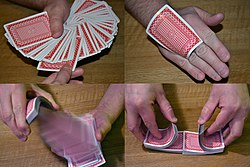
Card trick. Upper left: "Pick a card, any card". Upper right: Back-palming a card. Bottom left: A "spring" flourish. Bottom right: Mixing the cards (shuffling) allows for card trick preparation.

Card manipulation, commonly known as card magic, is the branch of magic that deals with creating effects using sleight of hand techniques involving playing cards. Card manipulation is often used in magical performances, especially in close-up, parlor, and street magic. Some of the most recognized names in this field include Dai Vernon,[1] Tony Slydini,[2] Ed Marlo, S.W. Erdnase, Richard Turner, John Scarne, Ricky Jay[3] and René Lavand.[4][5] Before becoming world-famous for his escapes, Houdini billed himself as "The King of Cards".[6] Among the more well-known card tricks relying on card manipulation are Ambitious Card, and Three-card Monte, a common street hustle also known as Find the Lady.

History

[edit]
Orson Welles performs a card trick for Carl Sandburg (August 1942)

Playing cards became popular with magicians in the 15th century[7] as they were props which were inexpensive, versatile, and easily accessible, plus sleight of hand with cards was already developed by card cheats.[8] Card magic has bloomed into one of the most popular branches of magic, accumulating thousands of techniques and ideas. These range from complex mathematics like those used by Persi Diaconis, the use of psychological techniques like those taught by Banachek, to extremely difficult sleight of hand like that of Ed Marlo and Dai Vernon.

Card magic, in one form or another, likely dates from the time playing cards became commonly known, towards the second half of the fourteenth century, but its history in this period is largely undocumented. Compared to sleight of hand magic in general and to cups and balls, it is a new form of magic.[9] However, due to its versatility as a prop it has become popular amongst modern magicians.

Martin Gardner called S.W. Erdnase's 1902 treatise on card manipulation Artifice, Ruse and Subterfuge at the Card Table: A Treatise on the Science and Art of Manipulating Cards[10] "the most famous, the most carefully studied book ever published on the art of manipulating cards at gaming tables".[11] This book influenced Dai Vernon to become a magician, who is considered to be the pioneer of modern day card magic.[12][13]

Technique

[edit]

Illusions performed with playing cards are constructed using basic card manipulation techniques (or sleights). It is the intention of the performer that such sleights are performed in a manner which is undetectable to the audience—however, that result takes practice and a thorough understanding of method.[14] Manipulation techniques include:

Lifts

[edit]

Lifts are techniques which extract one or more cards from a deck.[15] The produced card(s) are normally known to the audience, for example having previously been selected or identified as part of the illusion. In sleight of hand, a "double lift" can be made to extract two cards from the deck, but held together to appear as one card.

False deals

[edit]

Dealing cards (for example at the start of a traditional card game) is considered a fair means of distributing cards. False deals are techniques which appear to deliver cards fairly, when actually the cards delivered are predetermined or known to the performer. False dealing techniques include: second dealing, bottom dealing, Greek dealing (a variation of the bottom deal), center dealing (rarely used), and double dealing (the top and bottom cards of a small packet are dealt together).[16]

Side steal

[edit]

A technique invented by magician F. W. Conradi.[17] It is used to control a predetermined card to the top of a deck (most of the time) by utilizing the classic palm. There is also the diagonal palm shift, first published by S. W. Erdnase. Like the side steal, the diagonal palm shift utilizes the classic palm, but it is intended to control cards to the bottom of the deck, but it is commonly used to "teleport" a card to your pocket.

Passes

[edit]

The effect of the card pass is that an identified card is inserted somewhere into a deck. However, following rapid and concealed manipulation by the performer, it is secretly moved or displaced - usually to the top (or bottom) of the deck. A pass is achieved by swapping the portion of the deck from the identified card downwards, with the portion of the deck above the identified card (cutting the deck secretly to control a certain card). Pass techniques include: the classic pass, the Zingone Perfect Table pass, the flesh grip pass, the jog pass, the Braue pass, the Charlier pass, the finger palm pass,[18] the bluff pass and the Herrmann pass. Simply, a card pass is a secret cut of the deck (not to be confused with a coin pass which is a false transfer of a coin from one hand to the other).

Palming

[edit]

Palming is a technique for holding or concealing one or more cards in the palm of the hand. Cards palmed from a deck are typically held in reserve (unseen by the audience) until production is required for the illusion being performed. Palming techniques include: the Braue diagonal tip-up, the swing, the thumb-count, face card palm, the crosswise, new vertical, the gamblers' squaring, the gamblers' flat, the Hugard top palm, the flip-over, the Hofzinser bottom, the Braue bottom, the Tenkai palm, the lateral palm, and the Zingone bottom.[19]

False shuffles

[edit]

Shuffling cards is considered a fair means to randomize the cards contained in a deck. False shuffles are techniques which appear to fairly shuffle a deck, when actually the cards in the deck are maintained in an order appropriate to the illusion being performed. False shuffles can be performed that permit one or more cards to be positioned in a deck, or even for the entire deck to remain in an unshuffled state (for example the state the deck was in before the shuffle). False shuffle techniques include: the perfect riffle (also known as the faro shuffle), the strip-out, the Hindu shuffle, the gamblers', the Zarrow shuffle, the push through riffle shuffle, and various stock shuffling techniques (where the locations of one or more cards are controlled during the false shuffle).[20]

False cuts

[edit]

Cutting a deck of cards is a technique whereby the deck is split into two portions (the split point being randomly determined – often by a member of the audience), which are then swapped – the effect being to make sure that no one is sure of which card is on the top of the deck. False cuts are techniques whereby the performer appears to organize a fair cut, when actually a predetermined card (or cards) is organized to be located on the top of the deck. False cutting techniques include: the false running cut, and the gambler's false cut.[21]

Color change

[edit]

A color change is the effect of changing one card to another in front of the spectator's eyes. Usually the cards changed are of different colors, or a face card into a number card, in order to make the change more apparent. There are many different techniques to accomplish this effect, but among the most common are the classic color change and the snap change[clarification needed], as they are easier to master than others. Professional magicians usually perform other color changes such as the Cardini or Erdnase change[clarification needed]. Occasionally passes are used for color changes as well, mainly the classic pass.

Crimps

[edit]

Crimps are techniques whereby part of a card is intentionally physically marked, creased, or bent to facilitate identification during an illusion. Crimp techniques include: the regular crimp, the gamblers' crimp, the breather crimp and the peek crimp.[22]

Jogs

[edit]

A jog is one or more cards which protrude slightly from somewhere within a deck or stack of cards. The protrusion, although not noticeable to the audience, permits the performer to retain knowledge about the location of the card during other manipulations, like the overhand shuffle. While jogs are not always hidden from the audience, they are most often. Some varieties include "in jogs", "side jogs", and "out jogs".[23]

Reverses

[edit]

Card reverses are techniques whereby one or more cards in a deck are made to change their orientation, for example from face up to face down.[24] One common reverse is the half pass, which can reverse one or many cards hidden by the top of the deck.[25]

Forces

[edit]

Card forces are the sleight which involves forcing a spectator to choose a card that has been predetermined by the performer, while maintaining supposed free choice. Some forces include; the classic force, the riffle force, the dribble force, the slip force, and various forces incorporating card switches.

Switches

[edit]

Card switches are used to switch out one or many cards. Switches are commonly used in teleporting card tricks. Switches include double lifts, the top change, and various forms of card mucking.

False counts

[edit]

False counts are often used in magic tricks with a small amount of cards, most commonly 4 cards. False counts let you count a packet of cards while hiding cards, pretending there are more cards, or pretending there are less cards. The best known use of a false count is in Dai Vernon's twisting the aces, which uses Alex Elmsley's Elmsley count,[26] also known as the ghost count.[27] Another common false count is the Jordan count, which is very similar to the Elmsley count.

Important Figures

[edit]

Modern day

[edit]

Jason Ladanye is one of the most popular magicians performing the gambling subcategory of card magic[28][29] and has published multiple works teaching card tricks using advanced card manipulation.

Roberto Giobbi has had one the largest impacts on modern card manipulation with their book series Card College, an encyclopedic work taking magicians through all the fundamentals for card magic, from easy manipulations to difficult manipulations in 5 volumes.[30] Considered one of the best card manipulation fundamentals book.[31]

Dai Vernon, along with Ed Marlo, pioneered modern card manipulation in the context of magic.[12][13]

S. W. Erdnase created one of the most influential books for card manipulation, and helped pave way for much better manipulation books, letting just about anyone learn card manipulation.[32]

Early card manipulation

[edit]

Giovanni Giuseppi Pinetti is often accredited with the title of first card magician,[33] performing to notable figures such as King Louis XVI, and, from what records we have, started the trend of card magic. He, however, was not the first to perform or publish card magic or manipulation.

Misdirection

[edit]

Misdirection, though not entirely specific to card magic, is indeed very prominent in most card performances. In many cases, the ‘skill’ of a card illusionist is determined by how well they can switch the audiences attention from one part of the performance to the next, which becomes more difficult when dealing with hecklers. Magicians can use card techniques like flourishing, verbal misdirection and by cracking jokes, in order to mislead the audience, making concealment of important sleight of hand easier in the process.

See also

[edit]

References

[edit]
[edit]
Revisions and contributorsEdit on WikipediaRead on Wikipedia
from Grokipedia
Card manipulation is a specialized branch of magic that employs advanced techniques to produce, vanish, transform, and flourish playing cards, creating visually striking illusions such as cards appearing from thin air, color changes, and elaborate fans or spreads. This form of relies on dexterous finger movements, , and precise control to deceive the audience's perception, often performed in parlor, stage, or settings. Unlike broader card magic, which may incorporate mathematical principles or forces, card manipulation emphasizes physical mastery and aesthetic display, requiring extensive practice—often years—to achieve fluid execution. The origins of card manipulation trace back to the , when playing cards first appeared in , evolving from ancient Chinese paper games and initially used by gamblers to develop cheating techniques that later inspired magical effects. Early references to card sleights appear in 16th-century texts, such as Reginald Scot's (1584), which documented rudimentary manipulations, though these were often tied to exposing fraud rather than entertainment. By the 18th and 19th centuries, as public magic shows gained popularity, card manipulation transitioned into a theatrical art form, with performers like Giovanni Giuseppe Pinetti incorporating cards into elaborate stage routines in the 1790s. The 20th century saw its refinement as a standalone act, influenced by and the rise of specialized decks like cards in the early , making it accessible for professional magicians. Key techniques in card manipulation include back and front palming to conceal and produce cards, thumb fans for creating illusory multiples, and color changes like the Erdnase or Cardini change to transform card faces mid-air. Other foundational moves encompass vanishes through steals, location shifts via crimps or jogs, and rhythmic flourishes synchronized to music for enhanced dramatic effect. These methods demand not only technical proficiency but also misdirection and timing, with practitioners often dedicating 2–3 hours weekly to drills for consistency. Modern variations blend traditional sleights with contemporary elements, such as integrated illusions, expanding its appeal in and live performances. Notable performers have elevated card manipulation to an iconic status, including Cardini (Richard Pitchford, 1894–1973), whose elegant, glove-wearing act in the mid-20th century popularized single-handed fans and productions. Jeff McBride, a contemporary master, has authored instructional series like The Art of Card Manipulation (1990s), teaching generations through detailed breakdowns of and sequencing. Other influential figures include Richard Turner, a blind expert known for seamless manipulations that fooled , and , whose synchronized routines won the 2015 Fédération Internationale des Sociétés Magiques (FISM) World Championship in Close-Up Card Magic. These artists underscore the discipline's enduring legacy as a pinnacle of manual dexterity in magic.

Overview

Definition and principles

Card manipulation is a specialized discipline within the broader field of in , focusing on the dexterous control, concealment, or revelation of playing cards to produce illusory effects. This art form relies on precise manual skills to manipulate a standard deck in ways that appear impossible, creating moments of wonder for audiences in settings such as performances or larger illusions. At its core, card manipulation adheres to foundational principles that ensure deceptive naturalness and efficiency. Performers emphasize naturalness in movements, where every action mimics everyday card handling to avoid suspicion, as outlined in S.W. Erdnase's seminal 1902 treatise The Expert at the Card Table, which stresses that sleights must blend seamlessly with routine gestures. Economy of action is equally vital, minimizing superfluous motions to maintain speed and reduce the risk of exposure, allowing the magician to execute maneuvers fluidly without drawing attention. Erdnase further articulates principles of misdirection and cover, where subtle psychological direction diverts the spectator's gaze while physical barriers or natural hand positions obscure the sleight; these are executed ideally during the "off-beat"—a momentary lull in audience attention, such as after a surprising reveal or casual patter. Essential to all card manipulations are basic handling techniques, beginning with standardized grips that provide stability and versatility. The mechanic's grip (also called the dealer's grip) positions the deck resting on the curled fingers of the left hand, with the thumb along the left long edge and the second finger supporting the right long edge, enabling natural dealing and shuffles while keeping cards under control. The Biddle grip, or end grip, involves holding the deck by its short ends with the thumb on one end and fingers on the other, facilitating transfers, counts, and certain lifts without altering the deck's orientation. These grips, along with precise finger positioning—such as the index finger curled beneath for breaks or the pinky for leverage—form the mechanical foundation for advanced work, ensuring consistent pressure and alignment. Mastering card manipulation demands specific prerequisites to build the necessary proficiency and avoid common pitfalls. is crucial, as symmetric hand skills prevent telltale signs like awkward left-hand movements, allowing seamless execution from any angle and enhancing overall in performance. Beginners often start with practice using a (a tapered or deck with beveled edges), which simplifies controls and reveals without requiring full proficiency, helping develop timing, grip strength, and confidence before progressing to ungaffed cards. This preparatory approach fosters the dexterity needed for the discipline's demands.

Types and applications

Card manipulation in is broadly categorized by venue and scale, adapting techniques to suit the intimacy or spectacle of the setting. card manipulation, often performed in table-hopping environments, emphasizes sleight-of-hand with a full deck or small packets, allowing performers to engage audiences directly at close range, where subtle controls and create intimate illusions. Parlor card manipulation bridges this with small-stage presentations, using larger gestures and packet tricks—such as those involving four to ten cards—to maintain visibility for groups of 20 to 50 spectators, often incorporating elements for broader appeal. In contrast, stage card manipulation scales up for larger audiences, integrating full-deck flourishes with apparatus like giant cards or projections to amplify visual impact, distinguishing it from the precision-focused packet work in closer settings. These techniques underpin a variety of magical effects, enabling seamless integrations into routines that astonish through impossibility. Transpositions, where cards visibly swap positions across the deck or between performers' hands, rely on manipulations like double lifts to achieve fluid exchanges. Predictions involve controlling selections to fulfill foretold outcomes, often culminating in reveals that affirm the magician's foresight. The Any Card at Any Number (ACAAN) effect exemplifies advanced application, where a spectator names a card and number, and the deck is manipulated to place that card precisely at the specified position, blending control with psychological . A quintessential showcase is the Ambitious Card routine, in which a selected card repeatedly rises to the top of the deck despite being buried multiple times, demonstrating layered manipulations to build escalating wonder. Over time, card manipulation has evolved to support educational and thematic demonstrations, particularly in exposing cheats. Performers use authentic sleights—such as or second dealing—to simulate tactics, then reveal them to audiences, highlighting vulnerabilities in games like poker and educating on fair play. This extends to integrations, where manipulations facilitate "impossible" mind-reading, such as divining thoughts via key card placements, merging physical skill with psychological illusion for effects that blur reality and perception. Culturally, card manipulation exhibits international variations, with Japanese cardistry emerging as a prominent influence since the early , emphasizing aesthetic flourishes like intricate fans and aerial spins that prioritize visual artistry over , inspiring global practitioners through events and online communities.

History

Origins and early developments

Card manipulation emerged in alongside the introduction of playing cards, which originated in during the 14th century and spread to the continent via trade routes, with the earliest confirmed reference appearing in a 1377 by Swiss Johannes. By the late , these cards were integral to games, where manipulation techniques first developed primarily for purposes, as documented in municipal records from German cities like and in the 1490s, which described scams involving to alter game outcomes. Early examples included basic deceptions such as palming or switching cards during play, driven by the high stakes of wagering in taverns and fairs across , , and the . The 16th century saw the formalization of these practices through exposés and mathematical analyses, reflecting growing awareness of gambling frauds. Italian scholar referenced card-based recreations and potential cheats in his treatise De viribus quantitatis (circa 1498), framing them as intellectual puzzles that could be misused for deception. Girolamo Cardano's De subtilitate rerum (1550) further detailed probabilistic manipulations and sleights like false dealing in the context of games such as , emphasizing their role in outwitting opponents while warning of moral perils. These texts highlight how card manipulation transitioned from ad hoc scams to studied arts, often circulated among gamblers to counter rivals' tricks. Socio-cultural pressures, including church condemnations and secular bans on —such as repeated ordinances in German burgher books from 1400 onward—drove card sharps underground, fostering secretive guilds and itinerant practitioners who refined techniques away from public scrutiny. By the 17th and 18th centuries, card manipulation began shifting from predominantly fraudulent applications toward , influenced by the improvisational performances of Italian troupes, which integrated deceptive physical feats and sleight-of-hand elements into comedic routines across Europe. Street conjurors and fairground performers, such as England's Isaac Fawkes (active 1710s–1730s), popularized card effects like rapid productions and transformations for paying audiences, blending cheating sleights with theatrical flair to evade associations with . A key publication, Henry Dean's The Whole Art of Legerdemain, or Hocus Pocus in Perfection (1727), exposed common card cheats—including shifts and false shuffles—while adapting them for legitimate shows, marking the era's pivot from persecution-fueled secrecy to professionalized amusement. This evolution occurred amid ongoing legal crackdowns on sharps, with European courts prosecuting fraudsters for and moral corruption, compelling performers to reframe manipulation as harmless wonder.

19th and 20th century evolution

In the mid-19th century, contributed to the exposure of card manipulation techniques through his writings on card-sharping tricks, detailing methods used by cheats to gain unfair advantages at the card table. His 1862 publication Card-Sharpers, Their Tricks Exposed, or The Art of Always Winning provided practical descriptions of sleights such as false shuffles and controlled deals, aiming to educate the public against gambling frauds while elevating the legitimacy of stage conjuring. This work marked an early shift toward systematizing card techniques for broader audiences, bridging informal cheating practices with formalized magic literature. Building on this foundation, Professor Hoffmann's Modern Magic (1876) became a cornerstone text by codifying essential card sleights for performers, including the pass, , and palm, presented in an accessible manner for aspiring magicians. The book's dedicated chapter on general principles of sleight-of-hand applicable to card tricks emphasized precise execution and misdirection, influencing generations of practitioners by transforming scattered techniques into a structured . Hoffmann's encyclopedic approach, illustrated with over 300 drawings, democratized card manipulation, making it a staple in education and professional repertoires. The early 20th century saw S.W. Erdnase's The Expert at the Card Table (1902) emerge as a seminal treatise, offering in-depth analyses of advanced manipulations like bottom deals, second deals, and , framed through the lens of card cheating but adaptable to legitimate . Erdnase's detailed illustrations and philosophical insights into subtlety and naturalness profoundly shaped subsequent card work, with magicians such as Dai Vernon citing it as a lifelong influence on their handling and deceptive strategies. During the 1900s, T. Nelson Downs advanced card manipulation through innovative routines that integrated rapid fans, back palms, and transformations, often performed in settings to showcase dexterity alongside his renowned coin work. His The Art of Magic (1909), co-authored with John Northern Hilliard, included practical card effects like "Cards Up the Sleeve" and "The Flying Cards," emphasizing fluid transitions and audience engagement that refined the performative aspects of sleights. In the 1920s through 1940s, Dai Vernon further refined card techniques, developing subtler variations of classics such as the multiple lift and riffle force, drawing from Erdnase while prioritizing naturalness and psychological nuance in his presentations at venues like the Chicago Magic Circle. Vernon's innovations, honed through interactions in magic circles, elevated card manipulation from mechanical proficiency to an art form reliant on timing and conviction, influencing mid-century performers toward more deceptive, angle-proof methods. Parallel to these developments, institutional growth supported the evolution of card work, exemplified by the formation of The Magic Circle in in , which aimed to promote and advance the art of magic through education, performances, and ethical standards that encompassed sleight-of-hand disciplines like card manipulation. This society fostered a professional community where techniques were shared discreetly among members, contributing to the standardization and ethical refinement of card routines during the era.

Modern advancements

In the , card manipulation has seen a notable shift with the emergence of , a discipline centered on artistic flourishes and displays using playing cards without illusionary elements. Gaining traction around 2010 through online video-sharing platforms, cardistry fostered a global community that emphasized intricate packet cuts, fans, and aerials, thereby refining the precision required for magical sleights. This crossover has enriched traditional manipulation by promoting smoother, more visually dynamic handling, as seen in routines that blend flourishes with deceptive controls. Magicians like have exemplified this integration during the 2010s, incorporating cardistry's aesthetic into sophisticated close-up and stage acts. Lim's performances, which earned him the Fédération Internationale des Sociétés Magiques (FISM) gold medal for close-up card magic in 2015, showcase invisible deck productions and signed card transpositions that leverage fluid motions for heightened impact. His approach has influenced contemporary performers to prioritize seamless transitions between display and deception. Technological advancements have further transformed practice and presentation. Mobile applications such as VR Magic, released in the early , use to simulate interactive tutorials on , misdirection, and basic manipulations, allowing users to learn through virtual feedback without physical cards. These tools democratize access to training, reducing reliance on in-person mentorship. Global influences have diversified card manipulation post-2010, with Asian performers contributing innovative fusions. South Korean and broader East Asian artists have drawn from precision-based disciplines like speed stacking—adapted metaphorically to card handling in online tutorials—to enhance rapid packet work and fans. In , street magic evolutions since the early incorporate local rhythms and close-quarters adaptations, as demonstrated by performers like in urban New York settings blending flair with classic sleights. These regional styles have proliferated via digital sharing, expanding manipulative repertoires beyond Western traditions. Recent milestones underscore ongoing innovation. At the 2023 International Brotherhood of Magicians convention, Olivier Henning secured first place in the youth stage manipulation category, highlighting youthful advancements in aerial steals and productions. The COVID-19 pandemic accelerated virtual adaptations, with post-2020 performances on platforms like Zoom enabling remote card forces and revelations through screen-shared decks and audience-submitted selections, sustaining engagement during isolation. In July 2025, at the FISM World Championships of Magic in Turin, Italy, Francesco Della Bona (Italy) won the Grand Prix for stage manipulation, while card magic saw strong performances from competitors like Francesco Fontanelli (Italy, 2nd place), reflecting continued global innovation in the discipline as of November 2025.

Fundamental Concepts

Sleight of hand basics

Sleight of hand in card manipulation relies on developing precise physical dexterity and to execute subtle movements invisibly. This foundation involves repetitive drills that train the fingers to perform actions automatically, allowing performers to focus on without conscious effort. Key physical requirements include strengthening finger and coordination, achieved through targeted exercises that build and control over small muscle groups in the hands. Muscle memory is cultivated via structured drills emphasizing slow, deliberate repetition of fundamental actions, such as obtaining and holding a pinky break, where the subtly separates a portion of the deck. Practitioners often dedicate daily sessions to these, starting with 10 minutes of slow-motion practice to ensure accuracy before gradually increasing speed, repeating each motion numerous times per session, often hundreds of attempts daily to achieve clean executions. This approach prevents errors from rushed attempts and promotes natural fluidity, with experts recommending video recording to self-assess form and eliminate telltale tensions. Training tools like brand playing cards are preferred for their air-cushion finish, which provides optimal for smooth handling without clumping during shuffles or spreads, making them ideal for repetitive practice. For enhancing finger independence, exercises such as rolling s between fingers—adapted from manipulation routines—strengthen isolated digit control and can be transitioned to cards by practicing similar rolls with card edges. Additional dexterity drills include thumb-to-finger touches or exercises, where fingers alternately lift and tap in sequence, performed for 5-10 minutes daily to improve coordination without specialized equipment. Common challenges in building these skills include maintaining relaxed hand tension to avoid unnatural stiffness, which can telegraph movements, and managing viewing angles to conceal finger positions from spectators. Professionals address tension by consciously loosening grips during drills, aiming for executions that appear effortless, while angle management involves practicing under simulated perspectives, such as from multiple sides, to ensure . Seasoned performers often achieve speeds under one second through years of refinement, but beginners should prioritize precision over pace to overcome these hurdles. Progression typically begins with basic manipulations like card fans and simple riffle shuffles to establish comfortable handling, advancing to integrated sleights as dexterity improves. Consistent practice—such as 10-20 minutes twice daily—can lead to basic proficiency over several months, though mastery of complex routines may require thousands of hours over years. This gradual build ensures sustainable skill development, complementing psychological elements like misdirection without overlapping into specific deceptive tactics.

Misdirection and psychology

Misdirection forms the cornerstone of effective card manipulation, serving as a psychological tool to divert from the performer's secret actions. In card magic, it encompasses several distinct types that manipulate without relying on overt . Physical misdirection involves gestures or movements, such as directing the spectator's to one hand while the other executes a subtle maneuver with the deck. Psychological misdirection employs verbal or suggestive narratives to shape expectations, leading spectators to anticipate certain outcomes and overlook the method. Temporal misdirection leverages timing, executing sleights during "off-beat" moments when naturally wanes, such as immediately after a climactic reveal. These categories, as outlined in a comprehensive , enable performers to conceal manipulations seamlessly. Central to these techniques are established psychological principles that exploit cognitive limitations. , the failure to detect visual changes in a scene, allows magicians to swap or alter cards unnoticed by timing the action amid distractions, as demonstrated in studies where abrupt motion shifts mask card transformations. Dual-task interference occurs when spectators are engaged in a secondary activity, like counting cards aloud, which overloads and diminishes vigilance on the primary action. By forcing away from critical moments, these principles ensure sleights remain hidden, enhancing the illusion of impossibility. Dai Vernon's "natural touch" principle underscores the importance of fluid, unassuming handling in card manipulation, advocating for movements that mimic everyday actions to evade suspicion. This approach integrates psychological subtlety with physical execution, making manipulations appear effortless and reinforcing misdirection through apparent innocence. Ethically, misdirection in card manipulation distinguishes between consensual entertainment and exploitative deception. In performance magic, it fosters wonder within agreed-upon boundaries, but the same techniques can expose cheating in contexts, educating players on vulnerabilities like false shuffles to prevent fraud. This dual application highlights misdirection's role in both creating illusions and demystifying illicit practices. Ultimately, psychological misdirection amplifies the efficacy of sleights by addressing mental rather than just visual awareness, allowing performers to execute complex manipulations without physical exposure and deepening the audience's immersive experience.

Techniques

Lifts and controls

Lifts and controls are essential sleights in card manipulation that enable performers to secretly position selected cards to the top or bottom of the deck while maintaining the illusion of a fair shuffle or cut. These techniques rely on precise finger coordination and breaks to isolate cards without detection, allowing for controlled revelations in routines. The double lift is a foundational sleight where two cards are lifted and displayed as a single card, often to glimpse or show a card below the top without disturbing the deck's order. To execute it, the performer first establishes a pinky break below the top two cards by riffling the deck or using a jog from a previous control, holding the break with the left pinky in mechanic's grip. The left thumb then pushes over the top two cards squarely as one unit, grasped by the right hand's thumb and fingers, and turned over for display; the cards are replaced face down, realigning the break for subsequent actions. This mechanic ensures the bottom card of the lift—the actual selected card—remains hidden on top. Variations of the double lift adapt to different handling needs, such as the running lift, where the cards are pushed off progressively to reduce bevel and flash, mimicking a single card's movement more naturally. Angle considerations are critical, as the sleight is performed from the performer's perspective, requiring practice to avoid exposure to the left or front. For single card controls, the LePaul top control provides a subtle method to direct a selected card to the top via an overhand shuffle simulation. After the spectator replaces the card into the deck, the performer cuts at that point and drops the top half onto the bottom half at an angle, creating a natural jog that protrudes slightly for easy retention. The deck is then shuffled in overhand fashion, stripping out all but the jogged card to the top, with execution steps emphasizing relaxed wrist action to mask the jog's alignment. This control is angle-proof when performed close-up, as the jog is minimal and covered by hand positioning. The bottom palm control, conversely, facilitates placement to the bottom or outright removal of a card through . In execution, the deck is held in mechanic's grip with the left hand's fingers curled beneath; after the card is replaced near the bottom, the left fingers square and palm the target card by relaxing the hand and flexing the fingers to draw it into the palm's crotch, while the deck is lifted away. Angle considerations demand a natural hand position, often with the palm facing the body, to conceal the steal during subsequent cuts or shuffles. In routines, lifts and controls maintain card order amid apparent shuffles, enabling revelations such as a selected card rising to the top repeatedly, as in ambitious card effects where the double lift displays an indifferent card before the controlled selection appears. These applications preserve the deck's integrity for multi-phase tricks, ensuring the audience perceives randomness. Common errors in these sleights include flash exposure, where the second card's edge becomes visible during the double lift due to uneven beveling, remedied by a subtle turn to square the cards mid-motion. In controls like the LePaul, failing to retain the jog can misplace the card, addressed through consistent break maintenance and practice under varied lighting.

Passes and jogs

The pass is a core in card manipulation for secretly cutting the deck to reposition selected cards to the top, bottom, or desired location without detection, enabling invisible rearrangements during routines. The Hermann pass, as described in Jean Hugard and Frederick Braue's seminal Expert Card Technique (1940), employs a two-handed mechanic where the deck is held in the left hand's mechanic's grip with the maintaining a break below the cut point; the right hand lifts the upper packet slightly, pivoting it over the lower packet via a subtle , while the left thumb and fingers square the sides to mask the transposition and ensure inaudible execution through minimal card friction. This positioning—right hand fingers under the packet and thumb on top—provides natural cover, making it suitable for performance under direct gaze. Jogs and breaks serve as subtle positioning aids in card manipulation, marking card locations for precise control and setup without overt cuts. The side jog, outlined in Expert Card Technique (p. 102), involves the left thumb pushing a selected card approximately a quarter-inch outward from the deck's right long edge during insertion or overhand shuffling, creating an alignment step that the pinky can later detect for breaking and forcing; this mechanic facilitates quick deck division while maintaining a squared appearance. The Biddle count jog, from Elmer Biddle's Effective Card Magic (1947), integrates a rear jog during packet counting—holding cards in Biddle grip (thumb on top, fingers below) and transferring all but the bottom card forward in a reverse order, stealing the jogged selection underneath to set up forces like the classic Biddle trick where the named card vanishes from a dealt pile. These jogs enable reliable setup for forces by providing tactile breaks under the top few cards, essential for routines requiring exact positioning. Advanced variations expand jog utility for complex manipulations. Optical jogs rely on visual misalignment from the spectator's , where cards are squared but appear jogged due to slight fanning or lighting, allowing multiple-card control without physical displacement, as cataloged in Archive's jog techniques database. Riffle jogs, set during in-the-hands shuffles, involve thumb pressure to offset a block of cards sideways at the inner ends, preserving stacks for multi-card forces or revelations while simulating a genuine mix. Achieving silent execution under scrutiny demands disciplined practice: begin with slow-motion repetitions in front of a mirror to eliminate card rustles by perfecting pivot angles and finger , gradually increasing speed while timing the move during natural pauses or misdirection, as advised in discussions from Genii magazine forums on pass refinement. Video self-recording helps spot micro-movements, and incorporating the sleight into full routines under simulated audience builds reliability, ensuring the pass or jog blends seamlessly into handling.

False shuffles and cuts

False shuffles and cuts are essential techniques in card manipulation that simulate genuine mixing of the deck while preserving its original order or specific arrangements, such as stacks or key card positions. These methods allow performers to maintain control over the deck's sequence during routines that require apparent , enhancing the of fairness in effects like predictions or tricks. Developed over centuries, they rely on precise hand movements to mimic natural actions, often integrated with misdirection to evade detection. The overhand false shuffle, one of the earliest documented techniques, involves running small packets of cards from the top to the bottom in a controlled manner to retain the deck's order while appearing to shuffle haphazardly. Pioneered by S.W. Erdnase in his seminal 1902 work The Expert at the Card Table, this method uses "runs" of cards—deliberate groupings that keep the top and bottom stocks intact—executed through subtle thumb and finger control during the overhand action. It is particularly effective for in-the-hands shuffles, where the performer's grip conceals the retention of order, and can be adapted to cull unwanted cards or protect multiple stocks. For table-based shuffles, the Zarrow riffle shuffle provides a convincing alternative, interleaving the halves of the deck while secretly keeping the original order by undercutting and weaving packets without true mixing. Invented by magician Herb Zarrow and first detailed in The New Phoenix magazine in under the title "Full Deck Control," the mechanics involve lifting the inner ends of the bottom packet with the thumb during the riffle, then dropping the top packet beneath it to restore the sequence. This shuffle excels in visual naturalness, as the cards are pushed together slowly, mimicking a standard riffle, but requires practice to avoid flashing the break between packets. False cuts complement shuffles by simulating division and reassembly of the deck without altering its order. The Greek cut, a multi-packet table cut, divides the deck into three portions—top, middle, and bottom—then reassembles them in the original sequence under the guise of a thorough cut. Commonly taught in advanced card handling resources, it preserves the full stack by swapping the placement of the middle and bottom packets seamlessly. Similarly, the drop cut involves lifting a small top portion and dropping it onto the table before replacing the larger bottom packet on top, effectively a null cut that maintains order while appearing casual. Multi-way false cuts extend this principle, breaking the deck into four or more packets and reassembling via a series of lifts and drops to simulate extensive mixing, ideal for reinforcing the illusion after a false . These techniques are crucial for preserving arranged decks like the Si Stebbins system, a numerical and suit-based stack from the early that enables mathematical card revelations. In Si Stebbins routines, false shuffles such as the overhand run or Zarrow prevent disruption of the +3 value and CHaSeD suit progression, allowing the performer to execute predictions without resetting. The Mnemonica stack, devised by in his 2004 book Mnemonica: A Symphonic Drive-Through the 52 Cards, similarly benefits from tailored false cuts and shuffles, including drop variations and table riffles, to maintain its mnemonic order for memorized deck effects. Tamariz emphasizes 12 preservation strategies, such as fan spreads and running cuts, to integrate seamlessly into performances. Avoiding detection hinges on achieving sound and visual naturalness; performers must replicate the soft rustle of genuine shuffles and fluid packet handling to mask irregularities. For instance, in the Zarrow, muting the block slip sound with a slight hesitation ensures auditory deception, while consistent pacing in overhand runs prevents visual tells. These elements, when mastered, render the manipulations imperceptible even under scrutiny.

False deals

False deals are advanced sleight-of-hand techniques in card manipulation that allow the performer to deal cards from positions other than the top of the deck, creating the illusion of a fair deal while controlling the distribution of specific cards. These methods are essential for gambling demonstrations, cheating simulations, and structured magical effects where card order must be preserved or manipulated during the dealing process. Primarily executed from the mechanic's grip, false deals rely on precise finger control and rhythmic motion to mimic genuine dealing actions. The second deal involves dealing the second card from the top while retaining the top card in place. In the classic execution, the deck is held crosswise in the left hand with the thumb resting across the top; the left thumb pushes the top card slightly forward and downward to expose the second card, which is then seized by the right hand's first and second fingers while the thumb simultaneously retracts the top card. This thumb-push mechanic ensures the action occurs in a single fluid motion, with the hands swinging naturally together to conceal the displacement. A variation known as the Greek deal, which deals the second card from the bottom for added speed and deception in high-stakes scenarios, uses a modified pinky and ring finger pull to extract the card while the deck remains squared, allowing seamless integration into rapid dealing sequences. The bottom deal extracts the bottom card of the deck under the guise of a top deal, often employing the Erdnase-style method where the deck is gripped in the left hand with one corner against the second finger's first and the opposite corner against the palm below the thumb base, the third finger positioned midway along the side. The pinky or third finger pulls the bottom card inward and upward from the inner corner, concealed by the top card, while the right hand assists in releasing it; the thumb then draws back the top card as the hands separate in a swing. This pinky-pull execution emphasizes even pressure to avoid flashing edges. For applications involving marked cards, the belly deal variation adjusts the deck's or convex hold to facilitate smoother extraction of pre-identified bottom cards, enhancing control in scenarios requiring visual cues from markings. Acquitments are natural dealing gestures integrated into false deals to mask irregularities, such as squaring the deck with both hands after a push or turning the dealing hand palm-down to conceal any momentary flash of the retained card. These actions, like pausing to the edges or the deck on the table, simulate fair play and draw attention away from the sleight's execution. Mastering false deals demands rigorous practice, typically requiring over 500 hours to achieve fluent, undetectable performance under scrutiny, as the techniques involve micro-adjustments in grip tension and timing to withstand close examination. may serve as a brief to secure a misdealt card if needed.

Palming and steals

Palming refers to the sleight-of-hand technique in card magic where a card is concealed in the performer's hand, typically at the base of the fingers or , to facilitate secret transfers or revelations. This method allows for the controlled removal or addition of cards without detection, forming a of advanced card manipulation. The classic palm, one of the most fundamental variants, secures the card against the flesh at the base of the hand, enabling fluid integration with other sleights. The classic palm relies on a precise thumb and finger curl technique to grip the card securely yet invisibly. In the standard execution, the right hand's fingers curl inward while the presses against the card's edge, lodging it into the muscular hollow at the hand's base; this position maintains a natural hand posture, with the fingers slightly bent to avoid exposure. Jean Hugard describes the Hugard Top Palm, where the left swings under the top card(s) to initiate the curl, emphasizing relaxation to prevent telltale tension. Similarly, S. W. Erdnase outlines the first method of top palming, using the right fingers to curl and secure the card during a deck lift, ensuring the hand appears empty. For bottom palming, Johann Nepomuk Hofzinser's technique involves the fingers drawing the bottom card into the palm as the deck is squared, with the providing counterpressure. Substitutes for the classic palm include the back palm, which conceals the card along the back of the hand between the fingers, offering an alternative for situations requiring open-hand displays. The mechanics involve bending the fingers to slide the card behind the hand, where it is held by tension between the second and third fingers, allowing for vanishes or productions without frontal exposure. Arthur H. Buckley details a deep back palm variation, where the card is positioned farther up the forearm for added security during extended holds. This method serves as a practical substitute when the classic palm might cramp the hand or conflict with gesture timing. Steals extend palming by secretly extracting cards from the deck's interior. Edward Marlo's side steal, a seminal center extraction, employs a push-out mechanic where the left thumb riffles to a break above the target card, and the right fingers push it sideways into the left palm during a natural squaring gesture. Timing is synchronized with misdirective movements, such as turning the deck face-up or gesturing toward a spectator, to mask the steal; Marlo's standard side steal, for instance, uses the deck's edge as cover while the right hand approaches casually. Variations include the insertion steal, where the card is angled out from the center during a spread, and the left-hand side steal into Tenkai palm, which rotates the card for bottom placement. These methods, detailed across 36 variations, emphasize fluid integration with deck handling to avoid suspicion. Top and bottom steals often utilize Dai Vernon's transfer palm, a subtle hand-to-hand shift that relocates a palmed card without pausing the routine. In the Vernon transfer, a card palmed from the top or bottom—via a diagonal shift or bottom draw—is transferred to the opposite hand's palm under cover of a deck turnover or packet display, with fingers curling to receive it seamlessly. Vernon refined this for top steals by incorporating a gambling palm transfer, where the right hand palms the top card during a false cut, then shifts it leftward as the hands separate naturally. For bottom steals, the technique adapts Erdnase's bottom palm, transferring the card via a to maintain deck alignment. This sleight's elegance lies in its imperceptibility during continuous action, as seen in Vernon's applications for multiple card controls. Cover moves enhance palming by providing natural distractions or concealments during execution. In Jean Hugard and Frederick Braue's system, covers for related sleights like the side slip—such as Max Malini's two methods using a turnover or deck tilt—adapt to palming by timing the steal with a hand wash or squaring motion to divert attention from finger curls. For instance, the Braue Diagonal Tip-Up Palm employs a deck fan as cover, where the apparent adjustment hides the thumb's pressure on the card edge. While props like coins or wands can serve as secondary distractions in broader routines, the core covers rely on integrated deck gestures to simulate normal handling, ensuring the palmed card remains undetected.

Forces and switches

Forces and switches are essential techniques in card manipulation that allow performers to covertly control spectator selections or substitute cards, enabling predictions and revelations without overt deception. A compels a spectator to choose a specific card while maintaining the of free choice, often integrating seamlessly with controls from earlier stages of a routine. Switches, conversely, replace a visible card or packet with another under cover of natural actions, providing flexibility in effects like transformations or restorations. These methods prioritize subtlety and misdirection, drawing from established sleights refined over decades in professional literature. The classic exemplifies mechanical precision in compelling selections. In the riffle , the performer holds the deck in a mechanic's grip with the card at a predetermined position, typically near the bottom or middle, and establishes a break above it using the left or little finger. As the deck is riffled from the bottom up with the right hand, the spectator calls "stop," at which point the performer releases cards from above the break to ensure the card falls into their hand, appearing as a natural pause. This , detailed in Jean Hugard and Frederick Braue's The Royal Road to Card Magic (1948), relies on timing and a subtle pressure to maintain the break, making it suitable for performances where the deck's faces are partially visible. Variations, such as Dai Vernon's break method, emphasize a clean release to avoid flashing the card. Another mechanical approach is the Hindu shuffle force, executed during an overhand-style shuffle where small packets are drawn from the top of the deck held in the left hand into the right. The force card starts at the bottom of the left-hand portion; as the performer draws packets with the right hand's thumb and fingers, the left thumb secretly retains the force card until the spectator indicates a stopping point, at which it is released as the next packet. This technique, also covered in Hugard and Braue's The Royal Road to Card Magic, offers a rhythmic, informal action that disguises the control, and it can transition directly into a control if the card must return to a specific deck position. Roberto Giobbi expands on its applications in Card College (1995), noting its utility for settings due to minimal preparation. Switches enable post-selection substitutions, often for packets or single cards, building on palmed or held-out cards from prior manipulations. The optical switch, developed by Edward Marlo, involves holding two cards—say, a selection and duplicate—in the right hand's thumb crotch, with the selection facing the audience. Under cover of a gesture or turn, the right fingers pivot the bottom card (duplicate) to face out while the top card is palmed away, creating the illusion of an unchanged card through and motion blur. Described in Marlo's contributions to Great Tricks Revisited (1995), this is prized for its visual cleanliness in isolated card displays. The hand-to-hand switch transfers a palmed card from one hand to the other via a brief contact, such as during a deck square-up, where the receiving hand's fingers clip the card under the deck. Simon Lovell's Encyclopedia of Card Moves (2000) illustrates this as a foundational transfer for routines requiring covert loading without exposure. For packet work, the bubble switch adapts a break-created bulge to swap small groups of cards. Here, a packet is held with a thumb break forming a "bubble" at the inner end; as the left hand approaches to take it, the right fingers or push the bottom cards forward, allowing the force packet to be substituted while the original is angled out of view. This method, akin to variations in Marlo's packet interchanges, facilitates multi-card predictions by enabling silent replacements during counts or spreads. Psychological forces leverage spectator psychology over mechanics, reducing reliance on sleight. Equivoque, or the magician's choice, uses verbal framing to guide selections toward a predetermined outcome from multiple options, such as eliminating cards pairwise until one remains. Theodore Annemann outlined early applications in Practical Mental Magic (1944), while Eugene Burger refined it for propless mentalism in his seminars and Eugene Burger: Final Secrets (2021), emphasizing natural language to avoid suspicion. For instance, offering a spectator a choice between two piles but rephrasing refusals to imply acceptance narrows options subtly. Multiple outs complement this by preparing several revelation methods, allowing adaptation to unexpected choices; Dai Vernon's "The Trick That Cannot Be Explained" (from Ultimate Secrets of Card Magic, 1960) uses a five-card spread where equivoque funnels to one card, with outs like a duplicate or controlled revelation for deviations. These ensure robust predictions regardless of variance. In routine integration, forces and switches enable palm-free predictions by setting up selections early and revealing them through layered deceptions. A riffle force can place the card under control without , followed by a switch during a display to match a prewritten , as in Vernon's applications where multiple outs provide fail-safes. This approach maintains throughout, focusing on psychological reinforcement for impact.

Displays and changes

Displays and changes in card manipulation encompass a range of visual sleights that create striking transformations and revelations, serving as climactic elements in routines. These techniques emphasize apparent impossibilities, such as cards altering their identity or position in full view, often building on prior setups like steals to heighten dramatic impact. Color changes represent one of the most visually arresting displays, where a card's face transforms instantly into another. The Bertram Color Change, employing the Tenkai Palm, involves palming the target card in a reversed position across the palm while displaying an indifferent card at the fingertips; a subtle turnover and flash reveals the change as the palmed card replaces the original. This mechanic relies on precise finger positioning to maintain natural hand gestures, allowing the transformation to occur under direct scrutiny. For gimmick-assisted variations, the thumb tip change loads a duplicate card into a flesh-colored sheath worn on the thumb, which is then exchanged onto the face of the held card via a simple rubbing motion, creating the illusion of a spontaneous shift without advanced palming skills. Fan displays enhance the theatricality of revelations by spreading cards in an elegant arc, concealing discrepancies through false counts. In a false count fan, techniques like the Elmsley Count display four cards as four while hiding a fifth by using a slip-back on the first count and a block push-off on the third, enabling the performer to show a packet with hidden duplicates or orientations for subsequent changes. Similarly, the Jordan Count achieves the same effect by delaying the slip-back until the third count, allowing seamless integration into fan spreads where the extra card remains undetected amid the radial alignment. Glide reveals complement these by secretly retaining the bottom card of a fanned packet; after spreading, the performer squares the fan and glides the bottom card flush with the thumb, permitting a false bottom deal or reveal that exposes an alternate card while the selection stays controlled. Packet changes extend these principles to small assemblages, often culminating in routines like the Ambitious Card, where a signed selection repeatedly rises to the top through visual shifts. In one phase, a color change—such as the paintbrush method—transforms an indifferent card into the selection atop a three- or four-card packet, executed by brushing the face with the fingertips to load the signed card via a subtle steal. Another visual shift employs the Rubber Room Rise, encircling the packet with a rubber band before snapping it to cause the selection to visibly penetrate to the top, leveraging tension for a startling ascent. Lighting plays a crucial role in amplifying these effects, particularly backlighting, which casts silhouettes to obscure edges and facilitate illusions of floating or cards. By positioning the performer against a strong rear source, mask details, enhancing the perceived impossibility of transformations in fans or packets during low-angle viewing.

Auxiliary manipulations

Auxiliary manipulations include subtle techniques such as crimps, reverses, and false counts that enable performers to mark, locate, or reposition cards without relying on more overt . These methods are essential for maintaining control in routines where precision and invisibility are paramount, often integrating seamlessly with key card principles or retention. Crimps involve creating a small, deliberate bend in a card to allow its identification by touch during subsequent handling, such as riffles or cuts. The corner crimp bends one corner of the card downward, providing a tactile marker that facilitates locating a selection even after . Dai Vernon described the corner crimp as a versatile tool for card control, applicable in various routines to ensure a card remains traceable. The center crimp, by contrast, bends the card along its longitudinal midline, often used to control cards to the top or bottom of the deck by exploiting the irregularity during spreads or cuts. Removal of either crimp type typically occurs through firm squaring of the deck or subtle during natural manipulations, restoring the card to a normal state without drawing attention. Reverses are maneuvers that orient a card face up or down covertly, supporting repositioning for later revelations or controls. The cut reverse, also known as the Braue Reverse, reverses the bottom card to the top during an innocent-looking deck cut, executed by flipping the lower packet with the left thumb while the upper packet is lifted away. Developed by Frederick Braue in the mid-20th century, this technique enables hidden orientation changes ideal for marking positions without breaking the deck's apparent fairness. Variations like the Charlier cut reverse incorporate a one-handed flourish cut to achieve similar results, enhancing the deceptiveness in performance settings. False counts provide mechanics for displaying packets while concealing discrepancies in number or orientation, crucial for small-packet deceptions. The Elmsley count, invented by Alex Elmsley and first published in 1959, displays four cards as four but hides the face or identity of the bottom card by pulling the top two cards together as one during the initial display. Performed in a fingertip-to-fingertip grip, it maintains rhythm and fairness in appearance, transitioning smoothly into effects like card transpositions or color changes. This , originally called the "Ghost Count" by Elmsley, derives from earlier push-off counts and has become a foundational tool in packet magic due to its clean execution and adaptability. These auxiliary techniques serve utility roles in broader applications, such as key card location and bottom stocking. In key card location, a crimped card acts as a reliable locator, placed adjacent to a spectator's selection to enable the performer to cut directly to it by feel, even after multiple shuffles. Bottom stocking refers to retaining a specific group of cards at the deck's bottom during cuts or shuffles, often using a crimp or reverse on the stock's key card to maintain alignment and prevent displacement. As detailed in S.W. Erdnase's seminal work, this method preserves the integrity of stacked arrangements for gambling demonstrations or magical revelations.

Notable Performers

Early pioneers

One of the earliest notable figures in card manipulation was the Italian performer Chevalier Giuseppe Pinetti, active in the late , who brought sleight-of-hand card effects to public theaters across , marking a shift toward professional entertainment rather than secretive practices. Pinetti's demonstrations, including card revelations and transformations, emphasized theatrical presentation and mechanical aids, influencing the transition from clandestine card sharping to legitimate stage magic. In the mid-19th century, French magician advanced the field through his exposés of card cheating techniques, detailed in works like Card-Sharpers, Their Tricks Exposed (originally published in the 1850s and translated in 1861), where he described sleights such as false shuffles and to educate audiences and performers alike. Robert-Houdin's efforts helped legitimize card manipulation as an art form, separating it from fraud by focusing on ethical performance and innovation in routine construction. Professor Hoffmann (Angelo Lewis) further codified these techniques in his 1876 book Modern Magic, a comprehensive manual that systematically documented card sleights, forces, and routines, making advanced manipulations accessible to aspiring magicians for the first time. This work bridged 19th-century innovations with broader magical literature, emphasizing practical instruction over mere exposure. The pseudonymous contributed profoundly with The Expert at the Card Table in 1902, a seminal text on card sleights that introduced or refined techniques like the bottom deal, second deal, and jog shuffle, originally framed for gambling expertise but rapidly adopted by performers. Erdnase's detailed illustrations and theoretical insights elevated card manipulation's technical precision, influencing generations through its enduring status as a foundational reference. Lesser-known innovator Burling Hull, active from the early 1910s, popularized card tricks via mail-order catalogs, inventing accessible effects like the "Svengali Deck" variant and routines that democratized manipulation for amateur performers. Hull's commercial approach facilitated the spread of card magic beyond elite circles, emphasizing ingenuity in apparatus-assisted sleights. These pioneers' legacies lie primarily in their literary contributions, which shifted card manipulation from oral traditions among cheats to documented arts, laying the groundwork for modern performance without relying on live spectacles alone.

Mid-20th century masters

Dai Vernon, often called "The Professor," emerged as a pivotal figure in mid-20th century card manipulation, emphasizing naturalness and subtlety in sleight-of-hand during the through the . Born in 1894 in , , Vernon traveled extensively across the , studying card cheats and gamblers to refine his techniques, which revolutionized close-up card magic by prioritizing psychological misdirection over flashy mechanics. His influence extended to mentoring generations of performers at the in , where he served as resident magician from the 1960s onward. Vernon's seminal routine, "The Travelers," introduced in the , showcased four cards vanishing from and reappearing in a pocket, blending advanced controls and for an feel that became a cornerstone of modern card act repertoires. He pioneered approaches to effects like the Ambitious Card, focusing on fluid, deceptive handling that masked technical virtuosity. His mid-century insights were documented in the Inner Secrets of Card Magic series (1959–1961), co-authored with Jean Hugard, which detailed practical applications of psychological forces and false shuffles for professional performers. These works, along with his 1959–1961 manuscript later expanded into Revelations (2008 edition based on original materials), highlighted his deep analysis of S.W. Erdnase's techniques, adapting them for contemporary stage and settings. Tony Slydini, an Italian-born master of impromptu close-up magic active from the 1940s, elevated card manipulation through audience-driven performances in nightclubs and vaudeville circuits across New York and Boston. Arriving in the U.S. in 1930, Slydini (born Quintino Marucci in 1901) developed a style reliant on timing, psychology, and minimal props, allowing effects like coin vanishes and card transpositions to unfold spontaneously without pre-set routines. His work in the 1950s and 1960s, including appearances on television programs such as The Dick Cavett Show, popularized close-up artistry as a standalone art form, influencing nightclub acts where magicians like him adapted to real-time audience interactions. Slydini's emphasis on "misdirection through attention" made complex card steals and controls appear effortless, setting a standard for informal venues. Cardini (Richard Valentine Pitchford, 1894–1973) refined card manipulation in through a silent, elegant act that integrated fans and productions, performing in theaters and across the U.S. and . His signature "lace work"—intricate split fans and interlaced card displays—combined precision fanning with steals to produce cards fluidly from thin air, often transitioning into billiard ball routines for a seamless visual spectacle. Developed during his peak in and sustained through mid-century tours, this style influenced generation of manipulators by prioritizing aesthetic flow over verbal patter. Jeff McBride, born in 1954, emerged in the 1970s and became a master of card manipulation in the mid-20th century's later decades, known for his theatrical style blending sleight-of-hand with kabuki-inspired movements. Active through the 1980s and 1990s, McBride authored the instructional video series The Art of Card Manipulation (1989–1997), providing detailed breakdowns of , fans, and productions that trained generations of performers. His shows and workshops at the emphasized rhythmic sequencing and visual storytelling, solidifying his influence on stage card manipulation. In the , T.A. Waters advanced psychological forces in card magic, leveraging principles to create effects where spectators seemingly chose cards through subtle suggestion rather than mechanical sleights. His innovations, detailed in works like Mind, Myth & Magick (drawing from contributions), included routines using probability and verbal cues to "force" selections, blending card controls with mind-reading presentations for and TV audiences. Waters' methods, performed in intimate settings, highlighted the era's shift toward hybrid mental-card effects, as seen in broader mid-century television exposures like card routines on by performers such as Fred Kaps in the 1950s and .

Contemporary figures

Contemporary card manipulation has been elevated by performers who blend traditional sleight-of-hand with modern performance artistry and digital dissemination. (1948–2018), active from the 1980s until his death, was celebrated for his masterful sleight-of-hand with cards and his innovative integration of manipulation techniques into acting roles in films like and , where his expertise added authenticity to sleight-of-hand scenes. , emerging in the 2010s, revolutionized visual card changes through seamless, angle-proof effects that emphasize impossible transformations, earning him the FISM World Championship in Card Magic in 2018 and widespread acclaim for pushing the boundaries of close-up illusion. Dani DaOrtiz, prominent since the 2000s, has advanced the theoretical underpinnings of card magic by focusing on psychological forces and narrative-driven routines that exploit spectator cognition, as detailed in his instructional works like Shock Immersion. Richard Turner, born in 1954 and blind since childhood, has mastered card manipulation through touch alone, performing seamless sleights that have fooled experts like on their television show. Active since the with a career spanning into the 2020s, Turner's techniques include flawless , cuts, and deals demonstrated in settings and instructional DVDs like Richard's Encyclopedia of Card Secrets, emphasizing precision and misdirection without visual reliance. His work underscores the discipline's accessibility beyond sight. In the 2020s, digital platforms have propelled new talents into prominence, fusing cardistry's aesthetic flourishes with traditional magic. has popularized this hybrid through his YouTube channel, where videos blending intricate card flourishes and interactive tricks have amassed millions of views, democratizing advanced techniques for global audiences. Recent FISM competitions highlight this evolution; for instance, Francesco Fontanelli secured second place in Close-Up Card Magic at the 2025 FISM World Championship in , with a routine showcasing fluid manipulations and . Key contributions from these figures include the adaptation of routines for , where short-form videos on platforms like have popularized quick forces and reveals since 2020, expanding card magic's reach beyond live performances. Roberto Giobbi's Card College series, first published in the 1990s and updated through the 2020s, remains a foundational text, providing systematic instruction on manipulations from passes to for both novices and professionals. The field has also seen greater global diversity, with women gaining visibility in mentalism-infused card work. Anna DeGuzman, active in the 2020s, has impressed with interactive card routines on shows like : Fool Us in 2025, incorporating psychological elements to create memorable, audience-participatory effects that challenge gender norms in magic.

References

Add your contribution
Related Hubs
User Avatar
No comments yet.