


Community hub
Recent from talks
Contribute something
Nothing was collected or created yet.
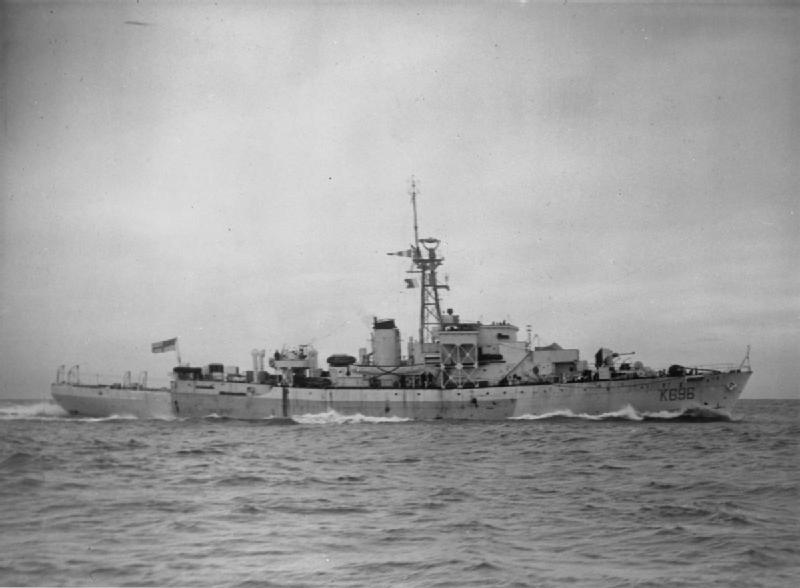
Castle-class corvette
View on Wikipedia
 | |
| Class overview | |
|---|---|
| Name | Castle class |
| Builders |
|
| Operators | |
| Preceded by | Flower class |
| Succeeded by | None |
| Planned | 95 |
| Completed | 44 |
| Canceled | 51 |
| Lost | 3 |
| Retired | 41 |
| General characteristics | |
| Type | Corvette |
| Displacement | 1,060 long tons (1,077 t) |
| Length | 252 ft (76.8 m) |
| Beam | 37 ft (11.3 m) |
| Draught | 10 ft (3.0 m) |
| Installed power |
|
| Propulsion | 1 screw; 1 triple-expansion steam engine |
| Speed | 16.5 knots (30.6 km/h; 19.0 mph) |
| Range | 9,500 nmi (17,600 km; 10,900 mi) at 10 knots (19 km/h; 12 mph) |
| Complement | 112 |
| Sensors & processing systems |
|
| Armament |
|


The Castle-class corvette was an ocean going convoy escort developed by the United Kingdom during the Second World War. It was the follow-on to the Flower-class corvette, and designed to be built in shipyards that were producing the Flowers. The Castle-class was a general improvement over the smaller Flowers which were designed for coastal rather than open ocean use.
The Castle-class corvettes started appearing in service during late 1943.
Background
[edit]In mid-1939, the Admiralty ordered 175 Flower-class corvettes for protecting shipping on the west coast of Britain as well as the Western Approaches. They were designed to be built in large numbers in small shipyards without propulsion and other components (mainly gearboxes, but also guns) then in short supply so not compete with other warships for construction. By the time the Flowers began entering service in late-1940, due to their long range they were required to undertake missions beyond coastal waters.[1][2] The Flowers were unsuited for open-ocean escort in the North Atlantic, especially in poor weather; they lacked speed, endurance, and habitability but became the mainstay of the Mid-Ocean Escort Force protecting convoys crossing the Atlantic.[2][3]
The Royal Navy recognized the limitations of the Flower and began designing an open-ocean escort in November 1940, which became the River-class frigate.[4][5] The larger Rivers were too expensive to produce at the required rate and needed larger slipways. The Loch-class frigate was developed in late-1942, which was derived from the River and designed for prefabricated construction.[6] The Castle was developed from a proposal by Smith's Dock Company – who had designed the Flower-class – for a stretched Flower.[7] The result was a smaller version of the Loch for shipyards that only built corvettes using mainly traditional methods.[8]
The design was approved in May 1943 and 96 Castles were ordered from yards in the UK and Canada.[7] Fifteen British and all 37 Canadian ships were later cancelled; Canada receiving twelve British-built ships instead.[8][7] The UK completed a further five as convoy rescue ships for its Merchant Navy. Four became weather ships after the war.[8]
Design
[edit]The Castle resembled later Flowers with an extended forecastle and mast behind the bridge, but was 135 tons heavier and 47 feet longer. The Admiralty Experiment Works at Haslar developed an improved hull form which, in combination with the increased length, made the Castle at least half a knot faster than the Flower despite using the same engine.[7] The Castle also had a single-screw.[9] A lattice mainmast was used instead of the pole version fitted to the Flowers.
Construction used mainly traditional methods with as much welding as possible. Scantling was based on the Flower, but lightened in some areas. The wireless office[7] (the same as on the Loch[8]), the radar office, and the lattice mast were installed as prefabricated units.[7]
The Castle was armed with a Squid anti-submarine mortar, directed by Type 145 and 147B ASDIC.[7] The Flower used the older Hedgehog mortar[4] and could not be fitted with Squid.[10] The first operational Type 147 and Squid were installed aboard HMS Hadleigh Castle in September 1943.[11][7]
In place of the BL 4-inch Mk IX main gun, the Castles had the new QF 4-inch Mk XIX gun on a High-Angle/Low-Angle mounting which could be used against aircraft as well as surface targets such as submarines.
In service
[edit]The Castle was criticized for being barely fast enough to fight German Type VII submarines and difficult to handle at low speed.[7]
Ships
[edit]Royal Canadian Navy
[edit]The following vessels were all originally built for the Royal Navy, but were transferred to the RCN on completion (for details of builders and construction dates see under Royal Navy below). All their pennant numbers (except Hedingham Castle, which was never completed), as well as their names, were changed when transferred.
- HMCS Arnprior (K494) (ex-HMS Rising Castle)
- HMCS Bowmanville (K493) (ex-HMS Nunney Castle), sold to Republic of China as cargo ship, but taken over by the Communist People's Liberation Army Navy after the end of the Chinese Civil War and rearmed with Soviet guns, entering PLAN service as Guangzhou.
- HMCS Copper Cliff (K495) (ex-HMS Hever Castle)
- HMCS Hespeler (K489) (ex-HMS Guildford Castle) (later SS Chilcotin)
- HMCS Humberstone (K497) (ex-HMS Norham Castle)
- HMCS Huntsville (K499) (ex-HMS Woolvesey Castle)
- HMCS Kincardine (K490) (ex-HMS Tamworth Castle)
- HMCS Leaside (K492) (ex-HMS Walmer Castle, later SS Coquitlam II)
- HMCS Orangeville (K491) (ex-HMS Hedingham Castle), sold to Republic of China as cargo ship, but taken over by the ROC Navy on 29 June 1950 and rearmed with US guns, entering ROCN service as De An (德安)
- HMCS Petrolia (K498) (ex-HMS Sherborne Castle)
- HMCS St. Thomas (K488) (ex-HMS Sandgate Castle, later SS Camosun III)
- HMCS Tillsonburg (K496) (ex-HMS Pembroke Castle), sold to Republic of China as cargo ship, but taken over by ROCN on 29 June 1950 and rearmed with US guns, entering ROCN service as Kao An (高安)
Royal Navy
[edit]The first of the Castle-class were the prototypes Hadleigh Castle and Kenilworth Castle, ordered on 9 December 1942; another 12 vessels were also ordered on 9 December, also under the 1942 War Programme. The remaining eighty-one ships were all ordered for the RN under the 1943 War Programme, of which thirty were completed. Fifty-one of these ships (15 from UK shipyards and 36 from Canadian shipyards) were cancelled late in 1943.
| Name | Pennant | Hull builder | Ordered | Laid down | Launched | Commissioned | Paid off | Fate |
|---|---|---|---|---|---|---|---|---|
| Hadleigh Castle | K355 | Smiths Dock Company | 9 Dec 1942 | 4 Apr 1943 | 21 Jun 1943 | 18 Sep 1943 | Aug 1946 | Scrapped, Jan 1959 |
| Kenilworth Castle | K420 | Smiths Dock Company | 9 Dec 1942 | 7 May 1943 | 17 Aug 1943 | 22 Nov 1943 | 1948 | Scrapped, 20 Jun 1959 |
| Allington Castle | K689 | Fleming & Ferguson | 9 Dec 1942 (a) |
22 Jul 1943 | 29 Feb 1944 | 19 June 1944 | 1947 | Scrapped 1958 |
| Bamborough Castle | K412 | John Lewis & Co. Ltd | 9 Dec 1942 | 1 Jul 1943 | 11 Jan 1944 | 30 May 1944 | 1950 | Scrapped 22 May 1959 |
| Caistor Castle | K690 | John Lewis & Co. Ltd | 9 Dec 1942 | 26 Aug 1943 | 22 May 1944 | 29 September 1944 | 1947 | Scrapped Mar 1956 |
| Denbigh Castle | K696 | John Lewis & Co. Ltd | 9 Dec 1942 | 30 Sep 1943 | 5 Aug 1944 | 30 December 1944 | Declared constructive total loss, 13 Feb 1945 | |
| Farnham Castle | K413 | John Crown & Sons Ltd | 9 Dec 1942 | 25 Jun 1943 | 25 Apr 1944 | 31 Jan 1945 | 1947 | Scrapped, 31 Oct 1960 |
| Hedingham Castle | K529 | John Crown & Sons Ltd | 9 Dec 1942 | 2 Nov 1943 | 30 Oct 1944 | 12 May 1945 | Aug 1945 | Scrapped, Apr 1958 |
| Lancaster Castle | K691 | Fleming & Ferguson | 9 Dec 1942 | 10 Sep 1943 | 14 Apr 1944 | 15 Sep 1944 | 1947 | Scrapped, 20 Jun 1959 |
| Maiden Castle | K443 | Fleming & Ferguson | 9 Dec 1942 | 1943 | 8 Jun 1944 | November 1944 | Became convoy rescue ship Empire Lifeguard before completion; Scrapped, 22 Jul 1955 | |
| Norham Castle (ex- |
K447 | A. & J. Inglis | 9 Dec 1942 | 30 Sep 1943 | 12 Apr 1944 | 6 Sep 1944 | Transferred to Canada as HMCS Humberstone 1944; Sold for mercantile service 1947 | |
| Oakham Castle | K530 | A. & J. Inglis | 9 Dec 1942 | 30 Sep 1943 | 20 Jul 1944 | 10 Dec 1944 | 1950 | Became the weather ship Weather Reporter 1957 |
| Pembroke Castle | K450 | Ferguson Shipbuilders | 9 Dec 1942 | 3 Jun 1943 | 12 Feb 1944 | 29 June 1944 | Transferred to Canada as HMCS Tillsonburg in 1944; Sold for mercantile service 1947; Sold to Republic of China as Kao An 1952 | |
| Rayleigh Castle | K695 | Ferguson Shipbuilders | 9 Dec 1942 | 1943 | 12 Jun 1944 | Oct 1944 | Completed as convoy rescue ship Empire Rest | |
| Alnwick Castle | K405 | George Brown & Co. | 19 Jan 1943 | 1943 | 3 Oct 1944 | 1957 | Broken up Dec 1958 | |
| Barnard Castle | K594 | George Brown & Co. | 1943 | 3 Oct 1944 | completed 1945 as convoy rescue ship Empire Shelter | |||
| Flint Castle | K383 | Henry Robb, at Leith | 20 Apr 1943 | 1 Sep 1943 | 31 Dec 1943 | Mar 1956 | Broken up 10 Jul 1958 | |
| Guildford Castle | K378 | Henry Robb, at Leith | 25 May 1943 | 13 Nov 1943 | 11 Mar 1944 | to Canada as HMCS Hespeler, 1944; Sold for mercantile service 1946 (later SS Chilcotin) | ||
| Hedingham Castle | K491 | Henry Robb, at Leith | 23 Jul 1943 | 26 Jan 1944 | 10 May 1944 | to Canada as HMCS Orangeville, 1944; Sold for mercantile service 1947; to Republic of China Navy 1951 as Te An | ||
| Knaresborough Castle | K389 | Blyth Dry Dock | 22 Apr 1943 | 1 Sep 1943 | 5 April 1944 | 1947 | Broken up 16 Mar 1956 | |
| Launceston Castle | K397 | Blyth Dry Dock | 27 May 1943 | 27 Nov 1943 | 20 June 1944 | 1947 | Broken up 3 Aug 1959 | |
| Sandgate Castle | K473 | Smiths Dock, at Middlesbrough | 23 Jun 1943 | 28 Dec 1943 | 18 May 1944 | 22 Nov 1945 | to Canada as HMCS St. Thomas, 1944; sold for mercantile service 1946 (later SS Camosun III) | |
| Tamworth Castle | K393 | Smiths Dock, at Middlesbrough | 25 Aug 1943 | 26 Jan 1944 | 3 Jul 1944 | 17 Feb 1946 | to Canada as HMCS Kincardine; sold for mercantile service 1946 | |
| Walmer Castle | K405 | Smiths Dock, at Middlesbrough | 23 Sep 1943 | 10 Mar 1944 | 5 Sep 1944 | 16 Nov 1945 | to Canada as HMCS Leaside; sold for mercantile service 1946 (later SS Coquitlam II) | |
| York Castle | Ferguson Brothers, Port Glasgow | 1944 | 20 Sep 1944 | completed Feb 1945 as convoy rescue ship SS Empire Comfort | ||||
| Hever Castle | Blyth Dry Dock | 29 June 1943 | 24 Feb 1944 | 15 Aug 1944 | to Canada as HMCS Copper Cliff, 1944; Sold for mercantile service 1947, then became Chinese (People's Liberation Army) 1949 | |||
| Leeds Castle | K384 | William Pickersgill & Sons | 23 Jan 1943 | 22 Apr 1943 | 12 Oct 1943 | 15 Feb 1944 | Nov 1956 | broken up 5 Jun 1958 |
| Morpeth Castle | K693 | William Pickersgill & Sons | 23 Jan 1943 | 23 Jun 1943 | 26 Nov 1943 | 13 Jul 1944 | 1946 | broken up 9 Aug 1960 |
| Nunney Castle | K446 | William Pickersgill & Sons | 23 Jan 1943 | 12 Aug 1943 | 26 Jan 1944 | 8 Oct 1944 | to Canada as HMCS Bowmanville, 1944; Sold for mercantile service 1946, then became Chinese (People's Liberation Army) Kuang Chou 1949 | |
| Oxford Castle | K692 | Harland and Wolff | 23 Jan 1943 | 21 Jun 1943 | 11 Dec 1943 | 10 Mar 1944 | 1946 | broken up 6 Sep 1960 |
| Pevensey Castle | K449 | Harland and Wolff | 23 Jan 1943 | 21 Jun 1943 | 11 Jan 1944 | 10 Jun 1944 | Feb 1946 | Became weather ship Weather Monitor in 1959 |
| Rising Castle | K398 | Harland and Wolff | 23 Jan 1943 | 21 Jun 1943 | 8 Feb 1944 | 26 Jun 1944 | 14 Mar 1946 | to Canada as HMCS Arnprior, 1944; transferred to Uruguay as Montevideo |
| Scarborough Castle | K536 | Fleming & Ferguson | 23 Jan 1943 | 1944 | 8 Sep 1944 | Jan 1945 | Completed as convoy rescue ship (Empire Peacemaker) | |
| Sherborne Castle | K453 | Harland and Wolff | 23 Jan 1943 | 21 June 1943 | 24 Feb 1944 | 14 Jul 1944 | 8 Mar 1946 | to Canada as HMCS Petrolia, 1944; Sold for mercantile service 1946 |
| Tintagel Castle | K399 | Ailsa Shipbuilding Company | 23 Jan 1943 | 29 April 1943 | 13 Dec 1943 | 7 Apr 1944 | Aug 1956 | Broken up Jun 1958 |
| Wolvesey Castle | K461 | Ailsa Shipbuilding Company | 23 Jan 1943 | 1 Jun 1943 | 24 Feb 1944 | 15 Jun 1944 | 15 Feb 1946 | to Canada as HMCS Huntsville, 1944; Sold for mercantile service 1947 |
| Amberley Castle | K386 | S P Austin & Son Ltd | 2 Feb 1943 | 31 May 1943 | 25 Nov 1943 | 24 Nov 1944 | 1947 | Became the weather ship Weather Adviser in 1960 |
| Berkeley Castle | K387 | Barclay Curle | 2 Feb 1943 | 23 Apr 1943 | 19 Aug 1943 | 18 Nov 1944 | 1946 | Scrapped 24 February 1956 |
| Carisbrooke Castle | K379 | Caledon Shipbuilding & Engineering Company | 2 Feb 1943 | 12 Mar 1943 | 31 Jul 1943 | 17 Nov 1943 | 1947 | Scrapped 14 June 1958 |
| Dumbarton Castle | K388 | Caledon Shipbuilding & Engineering Company | 2 Feb 1943 | 6 May 1943 | 28 Sep 1943 | 25 Feb 1944 | 1947 | Scrapped March 1961 |
| Hurst Castle | K416 | Caledon Shipbuilding & Engineering Company | 2 Feb 1943 | 6 August 1943 | 23 Feb 1944 | 9 Jun 1944 | Sunk by U-482 on 1 Sep 1944 | |
| Portchester Castle | K362 | Swan Hunter | 6 Feb 1943 | 17 March 1943 | 21 Jun 1943 | 8 Nov 1943 | 1947 | Scrapped 14 May 1958 |
| Rushen Castle | K372 | Swan Hunter | 6 Feb 1943 | 8 April 1943 | 16 Jul 1943 | 24 Feb 1944 | 1946 | Became the weather ship Weather Surveyor in 1960 |
| Shrewsbury Castle | K374 | Swan Hunter | 6 Feb 1943 | 5 May 1943 | 16 Aug 1943 | 24 Apr 1944 | Transferred to Norway on completion and renamed HNoMS Tunsberg Castle; Sunk by mine 12 Dec 1944 |
Notes: (a) from the previous order placed for a Modified Flower-class corvette named Amaryllis.
Two of those ordered 3 March 1943, three ordered 4 May 1943 and two ordered 10 July 1943 were all cancelled, as were all thirty-six ordered from Canadian shipyards on 15 March 1943.
Royal Norwegian Navy
[edit]- HNoMS Tunsberg Castle – HMS Shrewsbury Castle was loaned to the Royal Norwegian navy on 17 April 1944. On 12 December 1944, she hit a mine and sank.
Cancelled
[edit]Fifteen ships ordered for the Royal Navy from UK shipyards as part of the 1943 Programme were all cancelled on 31 October 1943:
- Caldecot Castle – ordered 19 January 1943 from John Brown & Company, Clydebank.
- Dover Castle – ordered 19 January 1943 from A. & J. Inglis, Glasgow.
- Dudley Castle – ordered 19 January 1943 from A. & J. Inglis, Glasgow.
- Bere Castle – ordered 23 January 1943 from John Brown & Company, Clydebank.
- Calshot Castle – ordered 23 January 1943 from John Brown & Company, Clydebank.
- Monmouth Castle (originally to have been Peel Castle) – ordered 23 January 1943 from John Lewis & Sons, Aberdeen.
- Rhuddlan Castle – ordered 23 January 1943 from John Crown & Sons, Sunderland.
- Thornbury Castle – ordered 23 January 1943 from Ferguson Brothers, Port Glasgow.
- Appleby Castle – ordered 3 March 1943 from Austin, at Sunderland.
- Tonbridge Castle – ordered 3 March 1943 from Austin, at Sunderland.
- Norwich Castle – ordered 4 May 1943 from John Brown & Company, Clydebank.
- Oswestry Castle – ordered 4 May 1943 from John Crown & Sons, Sunderland.
- Pendennis Castle – ordered 4 May 1943 from John Crown & Sons, Sunderland.
- Alton Castle – ordered 10 July 1943 from Fleming & Ferguson, Paisley.
- Warkworth Castle – ordered 10 July 1943 from Fleming & Ferguson, Paisley.
The following ships were ordered on 15 March 1943 for the Royal Navy from Canadian shipyards for completion between May 1944 and June 1945, but were all cancelled in December 1943:
- Aydon Castle
- Barnwell Castle
- Beeston Castle
- Bodiam Castle
- Bolton Castle
- Bowes Castle
- Bramber Castle
- Bridgnorth Castle
- Brough Castle
- Canterbury Castle
- Carew Castle
- Chepstow Castle
- Chester Castle
- Christchurch Castle
- Clare Castle
- Clavering Castle
- Clitheroe Castle
- Clun Castle
- Colchester Castle
- Corfe Castle
- Cornet Castle
- Cowes Castle
- Cowling Castle
- Criccieth Castle
- Cromer Castle
- Devizes Castle
- Dhyfe Castle
- Dunster Castle
- Egremont Castle
- Fotheringay Castle
- Helmsley Castle
- Malling Castle
- Malmesbury Castle
- Raby Castle
- Trematon Castle
- Tutbury Castle
- Wigmore Castle
Castles sunk or destroyed in action
[edit]- Hurst Castle was sunk by U-482 northwest of Ireland on 1 September 1944.
- HNoMS Tunsberg Castle was sunk by a mine near Båtsfjord, Norway on 12 December 1944.
- Denbigh Castle was hit by a torpedo from U-992 in the Barents Sea on 13 February 1945. She was towed by Bluebell to the Kola Inlet but later capsized.
U-boats sunk by Castles
[edit]- U-744 was sunk by Icarus, St. Catharines, Fennel, Chilliwack, Chaudiere, Gatineau and Kenilworth Castle on 6 March 1944
- U-484 was sunk in the north-west of Ireland by Portchester Castle and Helmsdale on 9 September 1944
- U-1200 was sunk south of Ireland by Pevensey Castle, Lancaster Castle, Portchester Castle and Kenilworth Castle on 11 November 1944
- U-387 was sunk in the Barents Sea by Bamborough Castle on 9 December 1944
- U-877 was sunk north-west of the Azores by St. Thomas on 27 December 1944
- U-425 was sunk in the Barents Sea by Lark and Alnwick Castle on 17 February 1945
- U-878 was sunk in the Bay of Biscay by Vanquisher and Tintagel Castle on 10 April 1945
Film appearance
[edit]The final third of the film The Cruel Sea is set on the Castle-class corvette Saltash Castle (portrayed by Portchester Castle).
Post-war conversions
[edit]Three were converted to passenger/cargo ships for the Union Steamship Company of British Columbia and were known as the White Boats.[12] They were operated from 1946 to 1958 but were heavy on fuel and had limited cargo capacity, for example they could not carry cars in the hold.
- SS Camosun III – ex-HMCS St. Thomas, HMS Sandgate Castle
- SS Chilcotin – ex-HMCS Hespeler, HMS Guildford Castle
- SS Coquitlam II – ex-HMCS Leaside, HMS Walmer Castle
References
[edit]Citations
[edit]- ^ Friedman (2006): page 134
- ^ a b Friedman (2006): page 135
- ^ Friedman (2006): page 136
- ^ a b Friedman (2006): page 139
- ^ Friedman (2006): page 140
- ^ Friedman (2006): page 149
- ^ a b c d e f g h i Brown (2007): chapter 7, "The origin of the Castles has been mentioned previously..."
- ^ a b c d Friedman (2006): page 156
- ^ Brown (2007): chapter 7, "It was thought that at least 200 new escorts..."
- ^ Friedman (2006): page 146
- ^ Brown (2007): chapter 7, "The first operational set was installed..."
- ^ Twigg
Sources
[edit]- Brown, David K. (2007). Atlantic Escorts : Ships, Weapons & Tactics in World War II. Barnsley, UK: Seaforth Publishing. ISBN 978-1-78346-901-7.
- Friedman, Norman (2008). British Destroyers & Frigates: The Second World War and After. Barnsley, UK: Seaforth Publishing. ISBN 978-1-84832-015-4.
- Lenton, H. T. (1998). British & Empire Warships of the Second World War. Annapolis, Maryland: Naval Institute Press. ISBN 1-55750-048-7.
- Twigg, Arthur M.: Union Steamships Remembered: 1920–1958 (1997) ISBN 1-55056-516-8.
External links
[edit]


Castle-class corvette
View on GrokipediaDevelopment and Design
Background and Origins
The Flower-class corvettes, while effective in early convoy escort roles during the Battle of the Atlantic, revealed significant strategic limitations as the campaign intensified, particularly their poor seaworthiness in heavy North Atlantic weather and limited operational range, which restricted their endurance for extended open-ocean anti-submarine warfare.[1][5] These shortcomings, exacerbated by the fall of France in 1940 that expanded U-boat operational areas, prompted the Admiralty to seek improved escorts capable of better sea-keeping and longer patrols to protect vital merchant shipping.[4][1] In response, the Admiralty approved the Castle-class design on May 7, 1943, as an enlarged and refined evolution of the Flower-class, drawing on operational experiences with modified versions of the earlier corvettes and the concurrent development of frigate classes such as the Loch and River to address the need for more robust long-range escorts.[4][1][5] Proposed by Smith's Dock Company, the design was developed by William Reed and emphasized simplicity for rapid production in civilian yards, with an estimated cost of £174,000 per ship excluding armament, prioritizing enhanced habitability and endurance over complex engineering.[4][5][6] The initial order placed in 1943 totaled 95 ships, with approximately 44 for United Kingdom yards and the remainder for Canadian builders, reflecting the Allied emphasis on mass production to bolster escort forces amid ongoing U-boat threats.[1] This allocation supported the broader World War II naval strategy of reinforcing mid-ocean convoy protection from 1943 to 1945, enabling the Mid-Ocean Escort Force to counter German submarine packs more effectively and contribute to the eventual Allied victory in the Atlantic theater.[1]Specifications and Armament
The Castle-class corvettes featured a lengthened forecastle hull design measuring 252 feet (77 m) overall, with a beam of 37 feet (11 m) and a draught of 13 feet 6 inches (4.1 m) at deep load, providing improved seaworthiness and stability in heavy weather compared to earlier convoy escorts.[7] Standard displacement was 1,010 long tons, increasing to approximately 1,590 long tons at full load.[2] Construction emphasized welded hulls for enhanced structural strength, though some elements retained traditional riveting to accommodate yard capabilities.[7] Propulsion was provided by two Admiralty three-drum boilers supplying steam to a single four-cylinder vertical triple-expansion reciprocating engine driving one shaft, delivering 2,750 indicated horsepower (2,050 kW) for a maximum speed of 16.5 knots.[2] Fuel capacity totaled 480 tons of oil, enabling an endurance of 9,500 nautical miles at 10 knots.[7] The design prioritized reliability and economy for extended ocean escort duties, with a typical crew complement of 120 officers and ratings.[2] Armament centered on anti-submarine warfare, with a single QF 4-inch (102 mm) Mk XIX naval gun mounted forward for surface and anti-aircraft defense.[2] Aft, the primary weapon was a Squid anti-submarine mortar consisting of three 12-inch (305 mm) tubes capable of launching up to 81 projectiles in salvos, supplemented by 15 depth charges delivered via two throwers and a stern rail; this configuration marked a significant upgrade from depth charge-only setups on predecessors.[7] Anti-aircraft protection included two twin and up to four single 20 mm Oerlikon cannons, with some vessels later fitted with a single 40 mm Bofors gun.[2] HMS Hadleigh Castle was the first to receive operational installation of the production Squid mortar in September 1943.[8] Sensors included Type 272 surface search radar for detecting surfaced submarines and surface vessels, along with HF/DF (high-frequency direction-finding) equipment for radio signal triangulation, and ASDIC Type 144Q or 147B sonar systems adapted for directing Squid fire, with the latter first integrated on HMS Hadleigh Castle.[1] These features, combined with a dedicated corvette bow sonar dome, enhanced detection ranges to about 1,300–2,500 yards for submerged targets.[4]| Category | Details |
|---|---|
| Dimensions | Length: 252 ft (77 m); Beam: 37 ft (11 m); Draught: 13 ft 6 in (4.1 m) |
| Displacement | 1,010 tons standard; 1,590 tons full load |
| Propulsion | 2 × Admiralty 3-drum boilers; 1 × 4-cyl. triple-expansion engine; 2,750 ihp; 1 shaft |
| Speed & Range | 16.5 knots max; 9,500 nmi at 10 knots |
| Armament | 1 × QF 4 in Mk XIX gun; 1 × Squid mortar (3 tubes); 15 × depth charges; 2 × twin + 4 × single 20 mm Oerlikon |
| Sensors | Type 272 radar; HF/DF; Type 144Q/147B ASDIC sonar |
| Crew | 120 |
Construction and Commissioning
Production and Builders
The production of the Castle-class corvettes began with orders placed between December 1942 and May 1943 under the British Admiralty's emergency shipbuilding programs, aimed at rapidly expanding the fleet of ocean-going escorts. The first keels were laid in June 1943, with initial completions occurring in late 1943, such as the launch of HMS Alnwick Castle in May 1944 marking early progress in the build cycle. By the end of 1945, 44 ships had been completed in United Kingdom yards for the Royal Navy, reflecting a focused effort to deliver vessels within 12 to 18 months from order to commissioning.[1] Construction emphasized the capabilities of smaller merchant shipyards, which were adapted for naval work to accelerate output without overburdening major warship facilities. This approach allowed for traditional building methods suited to the corvettes' design, prioritizing speed over complexity. Primary United Kingdom builders included Smith's Dock at Middlesbrough (8 ships), Fleming & Ferguson at Paisley (8 ships), Ailsa Shipbuilding at Troon (6 ships), Alexander Hall at Aberdeen, and Grangemouth Dockyard. In Canada, 37 orders were placed across multiple yards including Collingwood Shipyards, Midland Shipyards, Davie Shipbuilding, and Canadian Vickers, though all were among the 52 cancellations announced late in the war as priorities shifted.[1][9][10] The commissioning process involved rapid wartime adaptations, with 44 vessels entering Royal Navy service by 1945, of which 12 were transferred to the Royal Canadian Navy and 1 to the Royal Norwegian Navy. Production faced challenges including material shortages that delayed some builds and the need to reallocate labor from civilian merchant construction to naval priorities, yet the merchant yard focus enabled the completion of over 40 ships despite these constraints. Overall, 96 corvettes were ordered, but only 44 were realized, underscoring the program's efficiency in a resource-strained environment.[2][11][12]Ships by Navy
The Castle-class corvettes were primarily operated by the Royal Navy, with 44 ships completed for service during World War II. These vessels were built by various British shipyards, including Smiths Dock Company, Swan Hunter, and Harland & Wolff, and served mainly as convoy escorts in the Atlantic. Representative examples include HMS Alnwick Castle (K405), built by George Brown and Company and commissioned on 11 November 1944, which was placed in reserve post-war and scrapped in December 1958. Similarly, HMS Portchester Castle (K362), constructed by Swan Hunter and commissioned on 8 November 1943, was paid off in 1945 and scrapped at Troon in May 1958. Other notable Royal Navy ships were HMS Carisbrooke Castle (K379), built by Caledon Shipbuilding & Engineering Company and commissioned in late 1943, scrapped in June 1958, and HMS Lancaster Castle (K691), built by Fleming & Ferguson and commissioned in September 1944, which was scrapped in September 1960.| Ship Name | Pennant | Builder | Commissioning Date | Decommissioning/Fate |
|---|---|---|---|---|
| HMS Alnwick Castle | K405 | George Brown & Co. | 11 November 1944 | Paid off 1946; scrapped December 1958 |
| HMS Portchester Castle | K362 | Swan Hunter | 8 November 1943 | Paid off 1945; scrapped May 1958 |
| HMS Carisbrooke Castle | K379 | Caledon Shipbuilding | December 1943 | Paid off 1945; scrapped June 1958 |
| HMS Lancaster Castle | K691 | Fleming & Ferguson | September 1944 | Paid off 1946; scrapped September 1960 |
| Ship Name | Pennant | Ex-RN Name | Builder | Commissioning Date | Decommissioning Date |
|---|---|---|---|---|---|
| HMCS Arnprior | K494 | HMS Rising Castle | Harland & Wolff | 8 June 1944 | 14 March 1946 |
| HMCS Bowmanville | K493 | HMS Nunnery Castle | Pickersgill | 28 September 1944 | 15 February 1946 |
| HMCS Copper Cliff | K495 | HMS Hever Castle | Blyth Dry Dock | 25 July 1944 | 21 November 1945 |
| HMCS Hespeler | K489 | HMS Guildford Castle | Henry Robb | 28 February 1944 | 15 November 1945 |
| HMCS Humberstone | K497 | HMS Norham Castle | Harland & Wolff | 6 September 1944 | 17 November 1945 |
| HMCS Huntsville | K501 | HMS Tintagel Castle | William Denny & Brothers | 30 August 1944 | 7 May 1946 |
| HMCS Kincardine | K490 | HMS Tamworth Castle | Smiths Dock | 19 June 1944 | 27 February 1946 |
| HMCS Leaside | K531 | HMS Launceston Castle | Ailsa Shipbuilding | 16 December 1944 | 21 June 1946 |
| HMCS Orangeville | K491 | HMS Hedingham Castle | Henry Robb | 24 April 1944 | 12 April 1946 |
| HMCS Petrolia | K498 | HMS Sherborne Castle | Harland & Wolff | 29 June 1944 | 8 March 1946 |
| HMCS St. Thomas | K488 | HMS Sandgate Castle | Smiths Dock | 4 May 1944 | 18 October 1945 |
| HMCS Tillsonburg | K496 | HMS Pembroke Castle | Ferguson Bros. | 29 June 1944 | 15 February 1946 |