


Community hub
Recent from talks
Contribute something
Nothing was collected or created yet.
Banff-class sloop
View on Wikipedia
 HMS Walney | |
| Class overview | |
|---|---|
| Builders |
|
| Operators | |
| Preceded by |
|
| Succeeded by |
|
| Built | 1927–1932 |
| In commission | 1928–1954 |
| Completed | 10 |
| Lost | 3 |
| Scrapped | 7 |
| General characteristics (Banff-class sloop) | |
| Type | Sloop |
| Displacement | 1,546 long tons (1,571 t; 1,732 short tons) |
| Length | 250 ft (76.20 m) o/a |
| Beam | 42 ft (12.80 m) |
| Draught | 16 ft (4.88 m) |
| Propulsion |
|
| Speed | 16 knots (29.6 km/h) |
| Range | 7,542 nautical miles (13,968 km) at 12 knots (22.2 km/h) |
| Complement | 97 USCG – 200 RN |
| Armament |
|
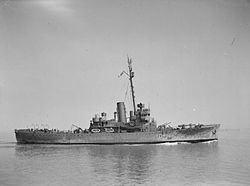
The Banff-class sloop was a group of ten warships of the Royal Navy. Built as United States Coast Guard Lake-class cutters, in 1941 these ships were loaned to the Royal Navy as antisubmarine warfare escort ships. The transfers took place at the Brooklyn Navy Yard; the sloops were manned for transport to Britain by personnel from the damaged battleship Malaya which was under repair there.
The sloops were initially part of Western Approaches command used to escort convoys such as SL convoys from Sierra Leone to Liverpool, and one, HMS Culver, was sunk by a German submarine in the Atlantic while so employed January 1942.
In 1943, the nine surviving sloops were assigned to Operation Torch—the Allied invasion of French North Africa. Two—Walney and Hartland—were destroyed in Operation Reservist in the assault to capture Oran harbor. The remaining seven escorted Mediterranean convoys in support of the North African invasion and saw varied employment in the Atlantic until assigned to the Kilindini Escort Force in late 1943 and early 1944. They stayed in the Indian Ocean for the remainder of the war escorting trade convoys in the Arabian Sea, and five served in the Bay of Bengal supporting Operation Dracula and Operation Zipper in the last months of conflict with Japan. Six were returned to the United States after the conclusion of hostilities; and one, disabled by mechanical failure, was scrapped overseas.
Ships
[edit]Lulworth (ex-Chelan)
[edit]Originally cutter #45, she was named for Lake Chelan,[3] built by Bethlehem Shipbuilding in Massachusetts,[2] and launched on 19 May 1928.[5] She became HMS Lulworth on 2 May 1941 and sailed to England with convoy SC 31.[6] After refit at Cardiff, Lulworth escorted convoys OS 4, SL 87, OS 10, and SL 93. While escorting convoy OS 10 on 31 October 1941, Lulworth attacked U-96. Lothar-Günther Buchheim, author of 1973 book Das Boot (later made into a film by the same name), was aboard U-96 at the time.[7] Following installation of HF/DF in December 1941, Lulworth escorted convoys OS 15, SL 98, OS 20, SL 103, OS 25, SL 109, OS 31, and SL 115. Lulworth was assigned to Operation Torch following repair of damage sustained while ramming and sinking the Italian submarine Pietro Calvi on 14 July 1942 while defending convoy SL 115.[8] Lulworth then escorted convoys KMS 8G, MKS 7, HX229A, ONS 3, SC 128, ONS 9, SC 132, ON 189, and HX 244 with the 40th Escort Group. After refit at Cardiff, Lulworth went to the Indian Ocean and unsuccessfully depth charged Japanese submarine I-37 on 16 March 1944 while escorting trade convoys with the Kilindini Escort Force. After refit at Durban, Lulworth escorted invasion convoys for Operation Dracula at Rangoon and Operation Zipper. Lulworth was returned to the United States on 12 February 1946, used for spare parts and scrapped in 1947.[9]
Hartland (ex-Pontchartrain)
[edit]Originally cutter #46, she was named for Lake Pontchartrain,[3] built by Bethlehem Shipbuilding in Quincy, Massachusetts,[2] and launched on 16 June 1928.[5] She became HMS Hartland on 30 April 1941.[6] Following installation of Type 271 Radar, Hartland escorted convoys OS 5, SL 88, OS 11, SL 94, OS 17, SL 99, OS 21, SL 104, OS 26, SL 110, OS 38, and SL 122. Hartland sailed with Operation Torch invasion convoy KMF 1. She was abandoned and sank on 8 November 1942 following a magazine explosion after sustaining heavy damage from coastal artillery and the French destroyer Typhon during the Operation Reservist attack on Oran harbour.[10]
Fishguard (ex-Tahoe)
[edit]Originally cutter #47, she was named for Lake Tahoe,[3] built by Bethlehem Shipbuilding in Massachusetts,[2] and launched on 12 June 1928. She became HMS Fishguard, named after the Welsh town of Fishguard, on 30 April 1941 and sailed to England with convoy HX 125.[6] After refit in London, Fishguard was assigned to the 44th Escort Group. Fishguard escorted convoys OS 3, SL 86, OS 9, SL 92, OS 14, and SL 97 before HF/DF was installed in early 1942, and then escorted convoys OS 19, SL 102, OS 24, SL 108, OS 30, SL 114, OS 36, and SL 120. Refit at Falmouth included installation of Type 271 Radar and replacement of the American 5-inch/51 caliber gun by a Royal Navy 4-inch gun. Fishguard continued service with the 44th Escort Group on convoys KMF 6, MKF 6, KMF 8, MKF 8, KMF 10A, MKF 10A, KMS 12G, MKS 11, ON 182, and HX 240. Fishguard was then assigned to the convoys for the invasion of Sicily Operation Husky followed by a trip to Chesapeake Bay with convoys GUS 10X and UT 1 prior to refit. Fishguard went to the Indian Ocean after refit at Cardiff, spent 1944 with the Kilindini Escort Force, and finished the war assigned to Operation Zipper after refit at Durban from November 1944 through March 1945. She was returned to the United States on 27 March 1946, used for spare parts, and scrapped in 1947.[11]
Sennen (ex-Champlain)
[edit]Originally cutter #48, she was named for Lake Champlain,[3] built by Bethlehem Shipbuilding in Massachusetts,[2] and launched on 11 October 1928.[5] She became HMS Sennen on 12 May 1941.[6] She sailed to England with convoy HX 128 and was assigned to the 42nd Escort Group after refit on the River Thames. She escorted convoys WS 11, SL 89, OS 12, SL 95, OS 17, SL 100, OS 22, and SL 106 prior to installation of Type 271 Radar during refit on the River Hull. Sennen escorted convoys OS 39 and SL 123 with the 45th Escort Group before assignment to Operation Torch. After the invasion of North Africa, Sennen escorted convoys OS 43 and SL 127 prior to assignment to the 1st Support Group during the battles for convoys ONS 4, ONS 5, and SC 130. Sennen was credited with sinking U-954 while defending the latter convoy on 19 May 1943.[2] Admiral Karl Dönitz's son Peter Dönitz was among those lost aboard U-954.[12] After refit at Grimsby, Sennen sailed with convoy KMS 26 to join the Indian Ocean Kilindini Escort Force from 26 October 1943 until refit at Durban in November 1944. Following completion of refit in March 1945, Sennen was assigned to Operation Zipper for the remainder of the war and returned to the United States on 27 March 1946. She was redesignated USCGC Champlain until scrapped in 1948.[13]
Culver (ex-Mendota)
[edit]Originally cutter #49, she was named for Lake Mendota,[3] built by Bethlehem Shipbuilding in Massachusetts,[2] and launched on 27 November 1928.[5] She became HMS Culver on 30 April 1941.[6] Culver sailed to England with convoy HX 125 and was assigned to the 40th Escort Group. She escorted convoys OB 346 and SL 83 prior to installation of HF/DF and Type 271 Radar during refit at Woolwich. Culver escorted convoys OS 10, SL 93, OS 15, and SL 98 after refit. While escorting the latter convoy, she was hit by two torpedoes fired by U-105 on 31 January 1942 and sank southwest of Ireland following a magazine explosion.[14][15] Only twelve of the crew survived.[16]
Gorleston (ex-Itasca)
[edit]Originally cutter #50, she was named for Lake Itasca,[3] built by General Engineering and Drydock at Oakland, California,[2] and launched on 16 November 1929.[5] On transfer to the RN she became HMS Gorleston after the East Anglian port of Gorleston on 30 May 1941.[6] She was uniquely armed with ten .50 caliber and two 20 mm machine guns in place of the 3"/50 and four 20 mm Oerlikon AA guns carried by the remainder of the class.[5] Her career was mostly spent on convoy escorts from West Africa and India. She was the escort leader for convoy SL 87,[17] and escorted convoy SL 118.[18] She was returned on 23 April 1946, redesignated USCGC Itasca and scrapped in 1950.
Walney (ex Sebago)
[edit]Originally cutter #51, she was named for Sebago Lake,[3] built by General Engineering and Drydock at Oakland, California,[2] and launched on 10 February 1930.[5] She destroyed more derelicts than other ships of the class. She transferred to the RN and became HMS Walney on 12 May 1941,[6] named after Walney Island. After service as a convoy escort she was prepared for Operation Reservist, an attack on Oran harbour that formed part of Operation Torch. After she was lost on 8 November 1942 in the assault, her captain was awarded the Victoria Cross for his part in pressing on.
Banff (ex-Saranac)
[edit]Originally cutter #52, she was named for the Saranac Lakes,[3] built by General Engineering and Drydock at Oakland, California,[2] and launched on 12 April 1930.[5] She became HMS Banff on 30 April 1941[6] and sailed to England with convoy HX 125. After refit on the River Thames, Banff escorted convoys OS 3, SL 86, OS 9, SL 92, OS 14, and SL 97 prior to installation of HF/DF. Banff then escorted convoys OS 19, SL102, OS 30, SL 114, OS 36, and SL 120 prior to assignment to Operation Torch. Hedgehog anti-submarine mortar was installed during refit at Immingham following escort of North African invasion convoys. Banff then escorted convoys ON 182 and HX 240 prior to return to the Mediterranean for Operation Husky. After a trip to Chesapeake Bay escorting convoys GUS 10X and UT 1, Banff completed refit at HMNB Devonport and joined the Kilindini Escort Force in November 1943. After spending the remainder of the war escorting Indian Ocean convoys, she was returned to the United States on 27 February 1946 and recommissioned as USCGC Tampa in 1947. She was decommissioned in 1954 and was scrapped in 1959.[19]
Landguard (ex-Shoshone)
[edit]Originally cutter #53, she was named for Shoshone Lake,[3] built by General Engineering and Drydock at Oakland, California,[2] and launched on 11 September 1930.[5] She performed Bering Sea patrols and reported more navigation law infractions than other ships of the class. She became HMS Landguard on 20 May 1941,[6] and was assigned to the 40th Escort Group. Landguard escorted convoys OB 346 and SL 83 prior to refit on the River Thames, and convoys OS 10, SL 93, OS 15, SL 98, OS 20, SL 103, OS 25, and SL 109 prior to refit at Grimsby. She then escorted convoys OS 37 and SL 121 prior to assignment to Operation Torch. After escorting North African invasion convoys to the Mediterranean, Landguard escorted convoys HX 229A, ONS 3, SC 128, and ON 192 with the 40th Escort Group prior to being damaged while patrolling the Bay of Biscay on 25 August 1943 by near misses during the first successful Henschel Hs 293 glide bomb attack by Dornier Do 217 bombers.[20] When the damage was repaired, Landguard sailed with convoy KMS 26 to join the Kilindini Escort Force in September 1943. She escorted Indian Ocean convoys until disabled by a machinery failure at Colombo in March 1945. She served as a depot ship at Colombo until February 1946 and was sold there by the United States government in 1947 to be scrapped in Manila in 1949.[21]
Totland (ex Cayuga)
[edit]Originally cutter #54, she was named for Cayuga Lake,[3] built by United Shipyards in Mariners Harbor, Staten Island,[2] and launched on 7 October 1931.[5] She became HMS Totland on 12 May 1941,[6] and sailed to England with convoy HX 128. After refit on the River Thames, Totland escorted convoys OS 4, SL 89, OS 12, SL 95, OS 17, SL 100, OS 22, SL 106, OS 28, SL 112, OS 40, and SL 124 with the 42nd Escort Group before being assigned to Operation Torch. After escorting convoys KMF 3, MKF 3, KMF 5, MKF 5, KMF 7, and MKF 7 in support of the North African invasion, Totland sank the German submarine U-522 on 23 February 1943 while escorting the tanker convoys UC 1 and CU 1.[22] Totland then escorted convoys between Freetown and Lagos via Sekondi-Takoradi until transferred to the Kilindini Escort Force in July 1944. Totland began a prolonged refit in October 1944 until the decision to retire her in May 1945. She was returned to the United States in May 1946, recommissioned as USCGC Mocoma in 1947, decommissioned in 1950, and scrapped in 1955.[23]
Notes
[edit]- ^ Fahey 1942 p.57
- ^ a b c d e f g h i j k l Kafka & Pepperburg 1946 p.694
- ^ a b c d e f g h i j k Fahey 1941 p.42
- ^ Fahey 1942 p.56
- ^ a b c d e f g h i j k Lenton & Colledge 1968 p.240
- ^ a b c d e f g h i j Blair 1996 p.744
- ^ Blair 1996 p.394
- ^ Blair 1996 pp.669–670
- ^ Mason, Geoffrey B (2005). "HMS Lulworth, cutter". Service Histories of Royal Navy Warships in World War 2. Archived from the original on 11 October 2011. Retrieved 31 August 2011 – via Naval-History.net.
- ^ Mason, Geoffrey B (2005), "HMS Hartland, cutter", Service Histories of Royal Navy Warships in World War 2, archived from the original on 11 October 2011, retrieved 31 August 2011 – via Naval-History.net
- ^ Mason, Geoffrey B (2005), "HMS Fishguard, cutter", Service Histories of Royal Navy Warships in World War 2, archived from the original on 11 October 2011, retrieved 31 August 2011 – via Naval-History.net
- ^ Blair 1998 pp.333–334
- ^ Mason, Geoffrey B (2005), "HMS Sennen, cutter", Service Histories of Royal Navy Warships in World War 2, archived from the original on 10 October 2011, retrieved 31 August 2011 – via Naval-History.net
- ^ Brown 1995 p.56
- ^ Blair 1996 p.497
- ^ Mason, Geoffrey B (2005), "HMS Culver, cutter", Service Histories of Royal Navy Warships in World War 2, archived from the original on 11 October 2011, retrieved 1 September 2011 – via Naval-History.net
- ^ Blair 1996 pp.381–383
- ^ Blair 1996 p.672
- ^ Mason, Geoffrey B (2005). "HMS Banff, cutter". Service Histories of Royal Navy Warships in World War 2. Archived from the original on 11 October 2011. Retrieved 1 September 2011 – via Naval-History.net.
- ^ Blair 1998 p.405
- ^ Mason, Geoffrey B (2005). "HMS Landguard, cutter". Service Histories of Royal Navy Warships in World War 2. Archived from the original on 11 August 2011. Retrieved 1 September 2011 – via Naval-History.net.
- ^ Blair 1998 p.197
- ^ Mason, Geoffrey B (2005). "HMS Totland (Y 88) - ex-US Coast Guard Cutter". Service Histories of Royal Navy Warships in World War 2. Archived from the original on 11 October 2011. Retrieved 1 September 2011 – via Naval-History.net.
References
[edit]- Blair, Clay (1996). Hitler's U-Boat War, The Hunters 1939–1942. Random House. ISBN 0-394-58839-8.
- Blair, Clay (1998). Hitler's U-Boat War, The Hunted 1942–1945. Random House. ISBN 0-679-45742-9.
- Brown, David (1995). Warship Losses of World War Two. Naval Institute Press. ISBN 1-55750-914-X.
- Fahey, James C. (1941). The Ships and Aircraft of the U.S. Fleet, Two-Ocean Fleet Edition. Ships and Aircraft.
- Fahey, James C. (1942). The Ships and Aircraft of the U.S. Fleet, War Edition. Ships and Aircraft.
- Kafka, Roger & Pepperburg, Roy L. (1946). Warships of the World. Cornell Maritime Press.
- Lenton, H. T. & Colledge, J. J. (1968). British and Dominion Warships of World War II. Doubleday and Company.
- Preston, Antony (1989). Jane's Fighting Ships of World War II. Random House. ISBN 0-517-67963-9.
External links
[edit]
 United States Navy United States Navy | |
|---|---|
 Royal Navy Royal NavyBanff-class sloops | |
| |
Banff-class sloop
View on GrokipediaDevelopment
Origins as Lake-class cutters
The Lake-class cutters were developed as part of the U.S. Coast Guard's significant fleet expansion in the 1920s, driven by the need to enforce Prohibition-era laws against rum-running and smuggling operations along U.S. coasts.[6] With the passage of the 18th Amendment in 1919 and the Volstead Act in 1920, the Coast Guard became the primary maritime enforcer, facing a surge in illicit alcohol imports via "Rum Row" mother ships stationed just beyond territorial waters.[6] Congress authorized substantial funding in 1924—approximately $13 million—to build new high-endurance vessels, including the 250-foot Lake-class cutters, which were commissioned between 1928 and 1931 to patrol ocean areas, interdict smuggling vessels, and support general law enforcement duties.[6][7] Designed in-house by the Coast Guard under Captain Q.B. Newman, the Lake-class represented a modernization of earlier 240-foot cutters, emphasizing versatility for multi-role operations such as search-and-rescue, icebreaking in northern waters, and coastal interdiction.[7][8] These ships featured improved seaworthiness with a flared stem and cruiser stern, enabling effective performance in rough seas and ice conditions, while their turbine-electric propulsion system provided reliable power for extended patrols.[7] Named after prominent North American lakes—such as Chelan (after Lake Chelan, Washington) and Pontchartrain (after Lake Pontchartrain, Louisiana)—the ten vessels in the class were intended for ocean patrol duties.[7] Each cost approximately $900,000 to build and was constructed at reputable shipyards like Bethlehem Shipbuilding Corporation in Quincy, Massachusetts.[7][8] In their initial U.S. Coast Guard service, the Lake-class cutters performed a range of peacetime missions, including the International Ice Patrol, Bering Sea Patrol for fur seal protection and ice navigation, and numerous search-and-rescue operations, such as the 1937 rescue of the crew from the Norwegian steamer SS Bjerkli.[7][8] Equipped for boarding operations against suspected smugglers, they carried a complement of 97 officers and enlisted personnel and light armament consisting of one 5-inch/51-caliber gun for defense, supplemented by small arms and, by 1929, additional weapons like one 3-inch/50-caliber gun and two 6-pounder guns.[7][8] This configuration allowed them to handle law enforcement intercepts while maintaining capabilities for humanitarian and environmental tasks in diverse operational theaters.[7]Transfer to Royal Navy
The Banff-class sloops originated as the ten vessels of the United States Coast Guard's Lake-class cutters, constructed between 1927 and 1931 for ocean patrol duties.[1] In early 1941, amid escalating World War II pressures on British naval resources, these cutters were loaned to the Royal Navy under the Anglo-American Lend-Lease Agreement, which facilitated the transfer of military equipment to support Allied efforts without immediate payment.[9] This arrangement followed the broader Destroyers for Bases deal of September 1940, where the United States provided 50 aging destroyers in exchange for British base rights, but the Lake-class transfers represented a distinct extension aimed at bolstering anti-submarine warfare capabilities.[1] The transfers occurred at the Brooklyn Navy Yard in New York, beginning in April 1941, with all ten vessels handed over by late May.[9] Each cutter was decommissioned from Coast Guard service, renamed with British place names prefixed by "HMS," and reclassified as escort sloops to fit Royal Navy nomenclature for convoy protection roles.[1] The ships were initially manned for their Atlantic crossing by volunteer crews drawn from the battleship HMS Malaya, which was undergoing repairs at the yard after torpedo damage sustained in convoy HX 112; this temporary staffing ensured the sloops could sail independently or in groups to British ports without delay.[10]| HMS Name | Pennant | Original USCGC Name | Commission Date (1941) |
|---|---|---|---|
| Banff | Y 43 | Saranac | 30 April |
| Culver | Y 87 | Mendota | 30 April |
| Fishguard | Y 59 | Tahoe | 30 April |
| Gorleston | Y 92 | Itasca | 30 May |
| Hartland | Y 00 | Pontchartrain | May |
| Landguard | Y 56 | Shoshone | May |
| Lulworth | Y 60 | Chelan | 3 April |
| Sennen | Y 21 | Champlain | 12 May |
| Totland | Y 88 | Cayuga | 12 May |
| Walney | Y 04 | Sebago | 12 May |
Design
Hull and general characteristics
The Banff-class sloops featured riveted steel hulls, a construction method typical for the era that provided structural integrity and longevity for extended maritime operations. Originally built as Lake-class cutters for the U.S. Coast Guard, these vessels were optimized for endurance cruising on long-range ocean patrols, particularly in challenging northern waters like the Bering Sea. The hull design included an ice-strengthened bow to withstand ice impacts, reflecting their initial role in ice-prone areas, while the overall architecture supported reliable performance in convoy escort duties after transfer to the Royal Navy.[7][11] Standard displacement measured 1,980 long tons (2,075 tons full load), with principal dimensions of 250 ft (76 m) in length overall, 42 ft (13 m) beam, and 13 ft (4.0 m) draught. These attributes provided a balanced profile for stability and maneuverability in varied sea states, with the deck layout configured for versatile cutter operations, including ample space for patrol gear and crew facilities. The hull's cruiser stern and flared bow further aided seaworthiness during prolonged voyages.[7][11][2] Crew accommodations originally supported a complement of 97 in U.S. Coast Guard service, consisting of officers and enlisted personnel suited to peacetime duties. Upon commissioning in the Royal Navy, internal quarters were modified and expanded to berth up to 200 personnel, incorporating additional facilities to meet the demands of wartime operations and larger crews for anti-submarine warfare roles.[7][12]Propulsion and performance
The Banff-class sloops employed a turbine-electric propulsion system, featuring two Babcock & Wilcox oil-fueled boilers that generated steam for a General Electric turbine generator, which in turn drove a single-shaft electric motor connected to a four-bladed propeller. This configuration delivered 3,350 shaft horsepower (shp), providing efficient power for extended maritime operations.[13][14] Performance characteristics included a maximum speed of 16 knots and a cruising range of 7,542 nautical miles at an economical speed of approximately 12 knots, facilitated by a fuel capacity of 300 tons of oil that supported long-duration patrols without frequent refueling.[14][13] The system's design emphasized endurance over rapid acceleration, aligning with the vessels' roles in anti-submarine warfare and convoy protection. Maneuverability was well-suited to convoy screening, with the stable hull and single-propeller setup enabling effective handling in formation maneuvers during escort duties. However, the top speed imposed limitations in high-speed pursuits, as it was comparable to the surfaced speed of approximately 17 knots achieved by German Type VII U-boats, often allowing submerged threats to evade capture once surfaced.[13][15]Armament and sensors
The Banff-class sloops, originally Lake-class cutters of the United States Coast Guard, entered Royal Navy service with their baseline armament adapted from peacetime patrol duties to wartime convoy escort requirements. In their USCG configuration, these vessels mounted a single 5-inch/51-caliber gun forward for primary surface fire support, a 3-inch/50-caliber gun aft, two 6-pounder (57 mm) saluting guns repurposed amidships for secondary armament, and machine guns in twin mounts (initially .30-caliber, later including .50-caliber) for light defense, with provisions for limited depth charges but no dedicated anti-submarine warfare (ASW) equipment.[14] Upon transfer to the Royal Navy under Lend-Lease in 1941, modifications emphasized enhanced anti-aircraft (AA) and ASW capabilities to counter U-boat and Luftwaffe threats in the Atlantic, with some variations between ships. The forward 5-inch gun was typically retained as the main battery, though some units like HMS Gorleston had it replaced with a British 4-inch QF Mk V gun for improved reliability; the aft 3-inch gun was often kept or exchanged for equivalent British ordnance. AA defenses were bolstered with a single quadruple 2-pounder "pom-pom" mount amidships and up to four 20 mm Oerlikon cannons in single mounts (or ten .50-caliber machine guns in some cases), replacing or augmenting the original machine guns, while the 6-pounders were sometimes removed to free space for additional throwers. For ASW, a Hedgehog forward-firing mortar was installed to deliver a 24-charge pattern ahead of the ship, complemented by four to eight depth charge throwers along the sides and stern rails holding up to 30 depth charges total, enabling patterned attacks on submerged targets.[1][16] Sensors were upgraded to align with Royal Navy standards for escort vessels, prioritizing submarine detection and convoy coordination. All ships received Type 144 or 144Q ASDIC (sonar) domes fitted in the forward hull for active underwater ranging, effective at the class's low convoy speeds of 16 knots. Surface search capabilities came via Type 271 centimetric radar in masts during 1942-1943 refits, providing early warning against surfaced U-boats or aircraft, while High Frequency Direction Finding (HF/DF) sets—such as FH3 or B28 models—allowed interception of German radio signals for directional plotting of enemy positions. These installations, leveraging limited hull space aft of the bridge, marked a shift from the USCG's basic navigational aids to integrated combat electronics.[17]Construction and commissioning
Builders and launch dates
The ten Lake-class cutters, later transferred to the Royal Navy and redesignated as the Banff-class sloops, were constructed to a standardized design developed by the U.S. Coast Guard for long-range patrol duties in northern waters.[8] These vessels were built by three primary American shipyards: the Bethlehem Shipbuilding Corporation's Fore River Shipyard in Quincy, Massachusetts, which handled the initial five units; the General Engineering & Dry Dock Company in Oakland, California, responsible for the next four; and the Staten Island Shipbuilding Company in Port Richmond, New York, which completed the final vessel.[13][11][8] Construction began in late 1927, with the first ships laid down at Fore River, and continued through 1931, reflecting a phased production approach to meet Coast Guard expansion needs following congressional authorization in the late 1920s.[13] Launches occurred primarily between 1928 and 1931, with commissioning into U.S. Coast Guard service spanning 1928 to 1932, allowing for outfitting and trials.[13][4] The design emphasized uniformity across builders, with only minor variations in fittings due to local materials or yard practices, such as slight differences in auxiliary equipment installation.[14]| Hull Number | Original Name | Builder | Laid Down | Launched | Commissioned |
|---|---|---|---|---|---|
| WPG-45 | Chelan | Fore River Shipyard, Quincy, MA | November 1927 | 19 May 1928 | 5 September 1928 |
| WPG-46 | Pontchartrain | Fore River Shipyard, Quincy, MA | November 1927 | 16 June 1928 | October 1928 |
| WPG-47 | Tahoe | Fore River Shipyard, Quincy, MA | December 1927 | 12 June 1928 | 17 November 1928 |
| WPG-48 | Champlain | Fore River Shipyard, Quincy, MA | May 1928 | 11 October 1928 | January 1929 |
| WPG-49 | Mendota | Fore River Shipyard, Quincy, MA | June 1928 | 27 November 1928 | March 1929 |
| WPG-50 | Itasca | General Engineering & Dry Dock Co., Oakland, CA | — | 16 November 1929 | 12 July 1930 |
| WPG-51 | Sebago | General Engineering & Dry Dock Co., Oakland, CA | — | 10 February 1930 | 2 September 1930 |
| WPG-52 | Saranac | General Engineering & Dry Dock Co., Oakland, CA | — | 12 April 1930 | 2 October 1930 |
| WPG-53 | Shoshone | General Engineering & Dry Dock Co., Oakland, CA | — | 11 September 1930 | January 1931 |
| WPG-54 | Cayuga | Staten Island Shipbuilding Co., Port Richmond, NY | — | 7 October 1931 | March 1932 |
Modifications upon transfer
Upon transfer to the Royal Navy under the Lend-Lease agreement in mid-1941, the ten Lake-class cutters originally built for the United States Coast Guard were subjected to refits in various UK dockyards to adapt them for anti-submarine warfare roles as Banff-class sloops. These modifications primarily occurred at commercial and naval facilities such as Pollock Dock in Belfast, the Thames shipyards, Cardiff, Newport, and Liverpool between 1941 and 1942, with initial work often commencing shortly after arrival to minimize downtime.[9][20][21] For instance, HMS Banff underwent initial alterations at a Thames commercial shipyard in July 1941, completing refit trials by early August, while HMS Lulworth was taken in hand at Cardiff in June 1941 before transfer to Newport for further work.[9][20] The key changes focused on integrating British systems and enhancing convoy defense capabilities without major structural alterations to the original 250-foot hulls. Essential modifications included rewiring for British electrical standards to accommodate Royal Navy equipment, the addition of ASDIC wells to facilitate sonar installation for submarine detection, and upgrades to anti-aircraft armament such as the addition of four single 20mm Oerlikon mountings (two forward and two aft) on vessels like HMS Gorleston. Some ships also replaced the original 3-inch gun with a British 12-pounder for improved high-angle fire, and all were painted in Admiralty disruptive camouflage patterns to reduce visibility during Atlantic operations. Early radar fittings, such as Type 286M air-warning sets on the mast and surface-warning sets on the bridge roof, were installed during these refits, as seen on HMS Gorleston at Liverpool in July 1941.[21] Most refits were completed within one to three months post-arrival, allowing rapid commissioning into escort duties, though delays affected some ships due to the urgent priorities of convoy protection amid the Battle of the Atlantic. For example, HMS Sennen was selected for refit upon reaching London in July 1941, with work extending into late summer owing to escort commitments.[22] The scope remained limited to essential ASW enhancements, preserving the hull integrity of the pre-war designs while prioritizing compatibility with British sensors and weaponry, at a cost constrained by wartime resource allocations. These adaptations enabled the sloops to contribute effectively to convoy escorts by late 1941.Operational history
Atlantic convoy escorts
Upon their transfer to the Royal Navy in 1941, the Banff-class sloops were integrated into Western Approaches Command, where they played a vital role in the Battle of the Atlantic by providing anti-submarine escorts for merchant convoys between the United Kingdom and West Africa.[12] These vessels, operating at speeds of around 16 knots, were among the larger sloops available for convoy protection, allowing them to maintain formation with slower merchant ships despite being marginally slower than surfaced U-boats.[1] Assigned primarily to groups such as the 40th and 41st Escort Groups, they focused on the SL (Sierra Leone to Liverpool) and OS (Outward Slow) convoy routes, departing from bases including Londonderry, Halifax, and Freetown.[23] For instance, HMS Walney joined the Londonderry Sloop Division in June 1941 and escorted convoys such as HX 128, OS 6, SL 88, SL 94, SL 99, and SL 122, often comprising 26 to 56 merchant vessels with no losses reported in several transits.[12] The sloops conducted routine patrols involving hydrophone sweeps and depth charge attacks on suspected U-boat contacts during these escorts, contributing to the defense of over a dozen SL and OS convoys collectively in 1941–1942.[23] While no confirmed U-boat sinkings were credited to the class during this phase, HMS Lulworth rammed and depth-charged the Italian submarine Pietro Calvi south of the Azores while escorting Convoy SL 115 in July 1942, marking an early anti-submarine success.[24] Their presence helped deter attacks and supported rescues, as seen when HMS Culver picked up survivors from the torpedoed SS Bennekom during the OS 10 convoy on 31 October 1941 after an assault by U-96.[5] The class earned the battle honour "Atlantic 1941–42" for their sustained efforts in protecting vital supply lines against German wolfpack tactics.[12] Post-Torch, in early 1943, HMS Totland sank U-522 by depth charges in the mid-Atlantic on 23 February while defending tanker convoy UC 1, rescuing over 100 survivors from torpedoed merchants Esso Baton Rouge and Empire Norseman in the process.[25] Similarly, HMS Sennen participated in the sinking of U-954 on 19 May 1943 using depth charges alongside HMS Jed while defending Convoy SC 130.[26] A notable tragedy occurred on 31 January 1942, when HMS Culver was sunk while escorting convoy SL 98 approximately 450 miles west-southwest of Cape Clear, Ireland.[5] Struck by two torpedoes from U-105 at 2331 hours, the sloop's magazine detonated, causing her to break in two and sink within one minute, resulting in 127 deaths and only 12 survivors rescued by HMS Lulworth.[23] This incident highlighted the persistent threats faced by the escorts amid coordinated U-boat operations. The Banff-class vessels endured harsh North Atlantic conditions, including severe weather that strained hulls and crews, while contending with the intensity of wolfpack ambushes that targeted stragglers and escorts alike.[12]Operation Torch
In late 1942, following their prior service in Atlantic convoy escorts, the nine surviving Banff-class sloops—after the earlier loss of HMS Culver—were reassigned to support Operation Torch, the Allied invasion of Vichy French North Africa. These vessels, including HMS Banff, HMS Fishguard, HMS Gorleston, HMS Hartland, HMS Landguard, HMS Lulworth, HMS Sennen, HMS Totland, and HMS Walney, provided offshore escort duties for the amphibious landings at Oran and Algiers on 8 November 1942, helping to screen the invasion force from potential threats.[12] A key element of the Oran operation was Operation Reservist, a daring raid to seize the harbor and prevent sabotage by Vichy French forces. On the night of 7-8 November, HMS Walney and her sister ship HMS Hartland, each carrying around 200 U.S. troops from the 6th Armored Infantry Division and a small U.S. Navy anti-sabotage team, attempted to force entry by ramming the harbor booms under cover of darkness. Starting at approximately 02:45, Walney led the assault but immediately came under intense fire from shore batteries, searchlights, and patrolling French warships, including the destroyers Tramontane and Typhoon. Despite heavy damage, Walney rammed both the outer and inner booms before being reduced to a burning wreck and sinking alongside the quay. Hartland, following closely, was also crippled by gunfire and ran aground south of the harbor entrance, where she was later declared a total loss after repeated hits.[27][28] The raid resulted in catastrophic casualties, underscoring the ferocity of Vichy resistance. HMS Walney lost 81 of her crew, with only 14 survivors, while HMS Hartland suffered 34 crew fatalities. Overall, Operation Reservist claimed 113 Royal Navy dead and 86 wounded across both ships, plus 5 U.S. Navy killed and 7 wounded, alongside heavy troop losses exceeding 189 dead from the embarked American forces. The remaining seven Banff-class sloops maintained their offshore escort roles during the Torch landings without incurring further class losses, contributing to the eventual Allied capture of Oran and Algiers by 11 November.[27][28][12]Mediterranean and Indian Ocean operations
Following Operation Torch in November 1942, seven surviving Banff-class sloops were redeployed to the Mediterranean Fleet for operations in 1943 and 1944, where they provided escort duties for vital supply convoys supporting Allied campaigns in North Africa and Italy. These vessels, including HMS Totland, participated in multiple KMF (UK to Mediterranean) and MKF (Mediterranean to UK) convoys, such as KMF 13 and MKF 13 in April 1943, ensuring the safe passage of troops and materiel to Algiers amid threats from Axis submarines and aircraft.[29] Similarly, they supported KMS (Gibraltar to Mediterranean) convoys like KMS 050 in May 1944, escorting shipments to ports including Malta and Alexandria to sustain the Allied advance, with HMS Totland and others conducting anti-submarine sweeps en route.[29] This role was critical in maintaining supply lines during the Sicilian and Italian invasions, though the sloops' limited speed of 16 knots restricted them to slower merchant vessels.[1] In 1944, five Banff-class sloops—HMS Banff, HMS Landguard, HMS Lulworth, HMS Sennen, and HMS Totland—were transferred to the East Indies Fleet to bolster convoy protection in the Indian Ocean amid escalating Japanese submarine activity, with HMS Gorleston joining later in the theater.[30][31][32] Arriving via routes through Aden and Kilindini, these ships escorted key convoys such as KR 8 and KR 9 from Kilindini to Colombo and Trincomalee in February-March 1944, safeguarding troop transports like the Khedive Ismail despite losses to Japanese submarine I-27.[24] By early 1945, they supported major Allied offensives, including Operation Dracula—the airborne and amphibious assault on Rangoon in May 1945—by providing anti-submarine screening for invasion convoys in the Bay of Bengal, and Operation Zipper, the reoccupation of Malaya in September 1945, where HMS Lulworth conducted patrols off the Arakan coast to protect landing forces.[20] HMS Banff, for instance, escorted a troopship from Kilindini to Aden in January 1945 as part of broader East Indies Escort Force duties.[30] By the war's end, the Banff-class sloops in these theaters conducted routine convoy escorts and patrols with minimal losses, transitioning to demobilization duties after VE Day on 8 May 1945 and continuing until VJ Day on 15 August 1945, after which they prepared for return to the United States.[33] Their contributions helped secure Allied sea lanes, with no combat sinkings recorded in the Mediterranean or Indian Ocean.[1]Ships
Class overview table
| Pennant | Name (RN / USCG) | Builder | Laid down / Launched / Commissioned (US / RN) | Fate |
|---|---|---|---|---|
| Y 43 | Banff / Saranac | General Engineering & Drydock Co., Oakland, CA | 1929 / 12 Apr 1930 / 2 Oct 1930 / 30 Apr 1941 | Returned to USCG 27 Feb 1946 as USCGC Tampa; sold 16 Feb 1959[34][4] |
| Y 87 | Culver / Mendota | Bethlehem Shipbuilding Corp., Quincy, MA | 20 Jun 1928 / 27 Nov 1928 / 23 Mar 1929 / 30 Apr 1941 | Sunk by U-105, 31 Jan 1942[5] |
| Y 59 | Fishguard / Tahoe | Bethlehem Shipbuilding Corp., Quincy, MA | 5 Dec 1927 / 12 Jun 1928 / 18 Nov 1928 / 30 Apr 1941 | Returned to USCG 27 Mar 1946 as USCGC Tahoe; sold 24 Oct 1947[35] |
| Y 21 | Sennen / Champlain | Defoe Shipbuilding Co., Bay City, MI | 23 May 1928 / 11 Oct 1928 / 24 Jan 1929 / 12 May 1941 | Returned to USCG 18 Feb 1946 as USCGC Champlain; sold 28 Jun 1948[26] |
| Y 60 | Lulworth / Chelan | Bethlehem Shipbuilding Corp., Quincy, MA | 14 Nov 1927 / 19 May 1928 / 5 Sep 1928 / 12 May 1941 | Returned to USCG 12 Feb 1946 as USCGC Chelan; scrapped 1947[24] |
| Y 92 | Gorleston / Itasca | General Engineering & Drydock Co., Oakland, CA | 9 Jan 1929 / 16 Nov 1929 / 12 Jul 1930 / 30 May 1941 | Returned to USCG 18 Feb 1946 as USCGC Itasca; scrapped Oct 1950 |
| Y 04 | Walney / Sebago | General Engineering & Drydock Co., Oakland, CA | 1929 / 10 Feb 1930 / 2 Sep 1930 / 12 May 1941 | Sunk during Operation Torch, 8 Nov 1942[27][14] |
| Y 56 | Landguard / Shoshone | General Engineering & Drydock Co., Oakland, CA | 1928 / 11 Sep 1930 / 10 Jan 1931 / 12 May 1941 | Returned to USCG 16 Mar 1946 as USCGC Shoshone; sold 23 Sep 1946 |
| Y 78 | Totland / Cayuga | Staten Island Shipbuilding, Port Richmond, NY | 1929 / 7 Oct 1931 / 22 Mar 1932 / 12 May 1941 | Returned to USCG 9 May 1946 as USCGC Mocoma; sold 23 Sep 1946[25] |
| Y 98 | Hartland / Pontchartrain | Defoe Shipbuilding Co., Bay City, MI | 27 Jan 1928 / 14 Jun 1928 / 8 Sep 1928 / 30 Apr 1941 | Sunk during Operation Torch, 8 Nov 1942 |