Hubbry Logo
CharalambosCharalambosMain
Open search
Charalambos
Community hub
Charalambos
logo
8 pages, 0 posts
0 subscribers
Be the first to start a discussion here.
Charalambos
Charalambos
from Wikipedia

Saint Charalambos or Haralambos (Ancient Greek: Ἅγιος Χαράλαμπος) was an early Christian priest in Magnesia on the Maeander, a city in Asia Minor, in the diocese of the same name. His name Χαράλαμπος means glowing with joy in Greek. He lived during the reign of Septimius Severus (193–211), when Lucian was Proconsul of Magnesia. According to one source, at the time of his martyrdom in 202, Charalambos was 113 years old.[1]

Key Information

Life and martyrdom

[edit]

Charalambos was Bishop of Magnesia and spread the Gospel in that region for many years. However, when news of his preaching reached the authorities of the area, the proconsul Lucian and military commander Lucius, the saint was arrested and brought to trial, where he confessed his faith in Christ and refused to offer sacrifice to idols.[2]

Despite his advanced age, he was tortured mercilessly. They lacerated his body with iron hooks, and scraped all the skin from his body.[2] The saint had only one thing to say to his tormentors: "Thank you, my brethren, for scraping off the old body and renewing my soul for new and eternal life."[1]

According to the saint's hagiography, upon witnessing Charalambos' endurance of these tortures, two soldiers, Porphyrius and Baptus, openly confessed their faith in Christ, for which they were immediately beheaded with a sword. Three women who were watching the sufferings of Charalambos also began to glorify Christ, and were martyred as well.[2]

The legend continues to say that Lucius, enraged, seized the instruments of torture and began to torture Charalambos himself, but suddenly his forearms were cut off as if by a sword. The governor Lucian then spat in the face of the saint, and immediately Lucian's head was turned around so that he faced backwards.[2] Apparently, Lucian and Lucius both prayed for mercy, and were healed by the saint, and became Christians.

More tortures, the legend says, were wrought upon the saint after he was brought to Septimius Severus himself. Condemned to death and led to the place of execution, Charalambos prayed that God grant that the place where his relics would repose would never suffer famine or disease.[3] After praying this, the saint gave up his soul to God even before the executioner had laid his sword to his neck. Tradition says that Severus' daughter Gallina[4] was so moved by his death, that she was converted and buried Charalambos herself.[1]

Veneration

[edit]

The skull of Saint Charalambos is kept at the Monastery of Saint Stephen at Meteora. Many miracles are traditionally attributed to the fragments of his relics, which are to be found in many places in Greece and elsewhere. The miracles have made this saint, considered the most aged of all the martyrs, especially dear to the people of Greece.[5] On some Greek islands, bulls are sacrificed on his feast day. "This festival is the most important popular activity of the village of Agia Paraskevi and it combines a variety of happenings that regard the ritual of the bull' s sacrifice. [An agricultural group] revived this ancient custom in 1774. It was established as a reverence to St Haralambos, the protector of [the] agricultural group that organises [the] festival".

The feast day of Saint Charalambos is normally commemorated on February 10,[6] the exception being when this date falls on the Saturday of Souls preceding Great Lent or on Clean Monday (the first day of Lent), in which case the feast is celebrated on 9 February.[5] He is also revered in Comitán, Chiapas, México (in Spanish: San Caralampio).

Iconography

[edit]

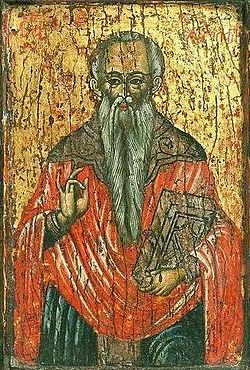
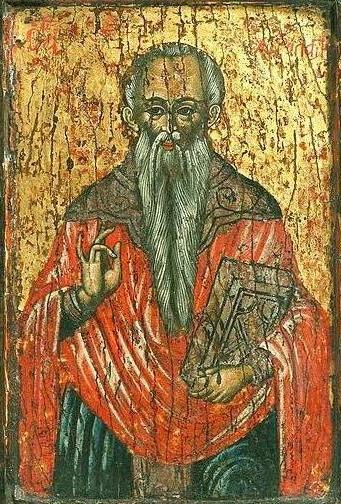
In Greek hagiography and iconography, Charalambos is regarded as a priest, while Russian sources seem to regard him as a bishop.[2]

Notes and references

[edit]
[edit]
Revisions and contributorsEdit on WikipediaRead on Wikipedia
from Grokipedia
Charalambos (Greek: Χαράλαμπος), also spelled Haralambos, is a Greek masculine derived from the elements chara () and lampein ("to shine"), meaning "shining with joy" or "radiant joy." It is most prominently associated with Saint Charalambos, a 2nd-century Christian and venerated in the Eastern Orthodox, Oriental Orthodox, and for his steadfast faith and miraculous intercessions, particularly against plagues and infectious diseases. His feast day is celebrated on 10. Saint Charalambos served as Bishop of Magnesia in Asia Minor (modern-day ), where he actively preached the Gospel and led many to Christian faith during a time of intense persecution. Born around 89 AD, he lived to the remarkable age of 113 before his arrest in 202 under , who demanded he sacrifice to pagan idols—a command he firmly refused. His martyrdom involved severe tortures, including having his skin flayed with iron hooks by soldiers, being dragged over hot coals, and enduring beatings, yet he remained unyielding, praising God throughout his ordeals. During his sufferings, Saint Charalambos performed several miracles that underscored his sanctity and converted onlookers to . He healed the wounds of his torturers, Porphyrius and Baptus, who subsequently confessed Christ and were martyred alongside him; three women witnesses also embraced the faith and shared their fate. He raised a young man from the dead, exorcised a from a man possessed for 35 years, and healed the governor , who oversaw his trial and converted. Notably, he converted Galina, the daughter of Emperor Severus, who destroyed idols in a pagan temple and ensured his honorable burial after he died peacefully in , reportedly having a vision of Christ. In hagiographic tradition, Saint Charalambos is revered as a protector against epidemics, with accounts of his halting outbreaks of , , and plague in various regions. His relics are said to have brought blessings of peace, prosperity, and freedom from and to the place of their enshrinement, as he himself prayed before his . While Greek sources often describe him as a , Slavic traditions emphasize his episcopal role, reflecting his enduring influence across Orthodox .

Historical Context

Roman Persecution of Christians

The reign of Septimius Severus (193–211 AD) marked a significant escalation in Roman policies toward Christianity, transitioning from sporadic local actions to more structured imperial measures. According to later sources such as the Historia Augusta, in approximately 202 AD, Severus issued an edict prohibiting conversions to Christianity (and Judaism), punishable by death, though the existence, precise nature, and empire-wide scope of this edict remain subjects of scholarly debate, with persecutions often interpreted as localized initiatives by provincial officials. This decree, while not mandating the extermination of existing Christians, triggered intensified persecutions in various provinces, particularly where Christianity had taken root, as local officials interpreted it broadly to suppress perceived threats to Roman religious unity. By the early third century, had spread extensively in Minor, the western region of modern-day , building on foundations laid by apostolic missions and urban communities in cities like and Smyrna. This proliferation alarmed Roman authorities, who viewed Christian refusal to participate in worship as disloyalty, prompting governors to enforce Severus' edict zealously. Provincial administrators, such as proconsuls in the senatorial province of and legates in imperial provinces like , bore primary responsibility for implementation, often initiating arrests and trials to demonstrate fidelity to . For instance, local bishops and leaders, like Charalambos in this era, became prime targets as symbols of resistance. Roman persecution methods emphasized coercion over outright annihilation, focusing on compelling to apostatize through and physical suffering. Arrests typically followed refusals to offer sacrifices to Roman gods or the , leading to and by magistrates. Common tortures included laceration with iron hooks or claws designed to tear flesh, alongside scourging and exposure to elements, intended to extract recantations while serving as deterrents. These practices were enforced variably by local officials, reflecting the decentralized nature of Roman justice. The geographical context of these persecutions in Asia Minor highlighted key Roman administrative centers, such as in the province of , a prosperous Ionian city under the oversight of the based in , where Christian communities faced scrutiny amid Hellenistic-Roman cultural blends. Similarly, , a Roman colony in the province of , served as a strategic hub governed by an imperial legate, where military presence facilitated swift enforcement of anti-Christian decrees against emerging faith groups.

Sources and Historicity

The primary textual sources for the life and martyrdom of Saint Charalambos are late medieval compilations, notably the brief hagiographical notice in the Synaxarion of Constantinople, a 10th-century liturgical collection of saints' commemorations edited by the Bollandist scholar Hippolyte Delehaye, and parallel entries in the Menologion of Basil II, an illuminated manuscript from around 1000 CE that expands on similar synaxarial traditions with short narratives for ecclesiastical reading. These sources provide the core narrative framework, attributing Charalambos' martyrdom to the reign of Emperor Septimius Severus (r. 193–211 CE), but they were composed centuries after the purported events, drawing on oral traditions and earlier passiones without direct eyewitness testimony. A significant chronological issue arises from the anachronistic mention in these hagiographies of Severus' "daughter Gallina" (or Galinia in some variants), who is said to have converted to upon witnessing the saint's endurance; however, no historical evidence supports the existence of such a , as Severus' known offspring included sons and Geta, with any daughters from prior marriages unattested beyond unreliable claims in the . This element exemplifies the legendary embellishments common in Byzantine , where familial details are invented to heighten dramatic conversion motifs. No contemporary Roman records, such as imperial edicts, provincial reports, or Eusebian histories, mention Charalambos or related events in Magnesia, nor does archaeological evidence from the region corroborate his existence or a specific martyrdom site. The persecutions under Severus, primarily local edicts against Christian rather than empire-wide campaigns, form the likely historical backdrop for such narratives, though they lack the systematic intensity later attributed to (r. 249–251 CE). Scholarly consensus views these accounts as a blend of and potential historical kernel, akin to other 3rd-century traditions like those of Saints Cyprian of Carthage or , where late compilations under ' edict of 250 CE imposed standardized persecution templates on disparate local figures to emphasize communal resilience. Delehaye and subsequent analysts caution that while a real priestly figure may underlie the —supported by early in Asia Minor—the absence of pre-Constantinian documentation renders verification improbable, prioritizing the texts' theological function over factual precision.

Life and Martyrdom

Early Life and Ministry

Saint Charalambos was born around 89 AD in , a city in Asia Minor (modern-day Tekin, ), during the era of the and while the Apostle John was still active nearby. He was ordained as a at an early age, committing himself to a life of and in service to the burgeoning in his homeland. His personal life was marked by abstinence, fervent prayer, kindness, and readiness to aid the needy, even sharing his last resources, which exemplified his humble and virtuous character. As a , Charalambos zealously preached against , actively converting locals and building a devoted following in Magnesia amid the gradual expansion of Christianity in Asia Minor. He later rose to the rank of , continuing his ministry with apostolic fervor and guiding many toward salvation through his teachings and example. Over his exceptionally long life, which extended to the age of 113, he remained steadfast in spreading the faith despite the broader challenges faced by Christians under Roman rule.

Arrest, Torture, and Execution

In 202 AD, during the reign of Emperor , Saint Charalambos, the 113-year-old bishop of Magnesia in Asia Minor, was arrested for his public preaching of and refusal to sacrifice to pagan idols. Local authorities, led by Governor , charged him with disrupting the peace by converting many to the faith, prompting his seizure and presentation before the . The persecution began with severe tortures ordered by , who commanded soldiers to lacerate Charalambos' body with iron hooks, flaying his flesh in an attempt to force renunciation of his . Miraculously, Charalambos endured without apparent pain, praising throughout the ordeal, which astonished onlookers and led to immediate conversions among the witnesses. Two soldiers, Porphyrius and Baptus, publicly confessed Christ upon seeing the saint's steadfastness and were promptly beheaded for their . Three women present at the scene also glorified Christ and were martyred shortly thereafter. Further enraged, the military commander personally seized the torture instruments to scourge the saint, but divine intervention caused his own forearms to be severed as if by an invisible sword. At Charalambos' prayer, Lucius was instantly healed, leading to his conversion along with numerous soldiers and citizens who witnessed the event. Transferred to Pisidian Antioch (modern Yalvaç, Turkey) for intensified persecution, Charalambos faced additional torments, including being dragged by his beard, having a nail driven into his body, and exposure to fire, yet he remained unharmed, performing further miracles such as raising a dead youth and exorcising a demon. In Antioch, Emperor Severus, with his daughter Galina, ordered Charalambos' final execution by beheading. Before the fell, the offered a , beholding a vision of Christ and beseeching divine protection for the world against famine, disease, and calamity, while granting peace, prosperity, and salvation to those who venerate his relics. Charalambos departed this life peacefully before the execution could be carried out, and Galina, converted by , buried his body honorably.

Veneration

Liturgical Commemoration

In the , the feast of Saint Charalambos is commemorated on February 10. Churches using the (aligned with the ) observe it on February 10 Gregorian, while those using the observe it on February 23 Gregorian; the feast is normally observed on this date, but if it falls on the preceding , it is transferred to February 9 or the following Sunday. His commemoration is recorded in traditional Eastern Orthodox liturgical books, including the Synaxarion and Menologion, where his life and martyrdom serve as the basis for themes of endurance and faith during the services. The feast is observed with the full cycle of services: Great Vespers on the eve, followed by (Orthros) and the of Saint John Chrysostom on the day itself. Key liturgical elements include the Apolytikion (Troparion) in Tone Four, which praises him as "an unshakable pillar of the Church" and "an ever-shining lamp of the " for his martyrdom, and the in Tone Four, which honors his relics as "a priceless treasure of the Church." Readings during the services draw from his passio, recounting his trials under Emperor , alongside scriptural lessons such as and Wisdom of Solomon 3:1-9 at , Luke 21:12-19 at , and II Timothy 2:1-10 with :17-16:2 at . Regional variations in observance occur in certain Greek islands, notably , where a associated with the includes the of a —symbolizing purification and protection against , attributed to the 's —typically held in summer (June or July) due to practical reasons, though originally linked to , followed by a communal meal and traditional dances to invoke his safeguarding of and health.

Relics and Associated Miracles

The primary relics of Saint Charalambos are preserved at the of in [Meteora](/page/Meteor a), , where the largest portion of his skull is housed in the dedicated to him. This relic, considered a priceless treasure, was gifted to the monastery by Prince Vladislav of in the 15th century (ca. 1412) and is venerated for its protective qualities against illness. His incorrupt right hand is kept at the Mega Spileo Monastery in , , and is regarded as wonderworking. Fragments of Saint Charalambos's relics are distributed across numerous Orthodox sites, including churches in such as the Church of Faneromeni in New Iraklitsa, (smaller portion of the skull), and the Kornofolias Monastery in Soufli (incorrupt right leg), as well as other locations in the Orthodox world. These relics play a central role in devotion, drawing pilgrims seeking . Miracles associated with Saint Charalambos's relics stem from traditions recorded in his . Prior to his execution, he prayed that the site of his relics' repose would be spared from and , a believed to have enduring effect, particularly at locations like where no such calamities have historically afflicted the area. Posthumously, his relics are credited with numerous healings, especially from skin ailments and pestilential diseases such as plagues, , and , making him a prominent intercessor in the and beyond. In the , reports of miracles linked to of his relics at the Monastery of include instances of protection during wartime and healings from severe illnesses, as documented in monastic publications and devotee testimonies. For example, in 1943, the saint is said to have appeared to avert destruction in Filiatra, , through the power of his relics' . These accounts underscore the ongoing role of his relics in contemporary Orthodox devotion.

Iconography

Traditional Depictions

In traditional Orthodox iconography, Saint Charalambos is commonly portrayed as an elderly or , dressed in liturgical vestments including a green sticharion, red , and draped over his shoulders. He holds a in his left hand while raising his right hand in a three-finger , emphasizing his role as a teacher and . His facial features typically include a long white and a serene expression, reflecting his advanced age at martyrdom—reputedly over 110 years—and his steadfast faith under persecution. These depictions draw from hagiographical traditions and iconographic manuals like the Hermeneia, which prescribe such standardized attributes to convey spiritual authority and endurance. Such representations appear in icons and frescoes from the Byzantine and post-Byzantine periods, often showing him standing alone against a gold background or accompanied by figures he converted, such as Porfirios and Baptos, fellow martyrs from his legend. In some icons, subtle references to his tortures—such as hooks or wounds on his body—appear, alluding to the iron nails and flesh-tearing implements used during his execution. Surviving examples include 18th-century frescoes in the Cemetery Church at , , where he is rendered in a hierarchical style typical of monastic art, and domestic icons from the , such as an 18th-century piece depicting him grasping a chained as a symbol of triumph over evil. These works, produced in workshops following established prototypes, served protective functions in homes and churches, invoking the saint's against sudden death and plague.

Symbolism and Variations

In icons of Saint Charalambos, the Gospel Book cradled in his left hand, often supported by a cloth of , symbolizes his episcopal role in teaching and proclaiming the Christian faith during . His raised right hand, extended in the traditional with three fingers joined, represents pastoral authority and divine protection, particularly against contagious diseases such as plague and infectious skin conditions. In some , a two-finger may appear, reflecting pre-reform traditions. These elements underscore his identity as a whose extends to bodily and spiritual healing. Depictions of Saint Charalambos vary across Orthodox traditions, with frequently emphasizing his bishopric through the inclusion of a and ornate vestments, alongside the standard blessing pose. In Greek hagiographical icons, narrative scenes of his —such as iron claws and burning—appear in borders or panels to highlight his endurance during martyrdom, a feature more common in folk-influenced art from the onward. Cultural adaptations in 19th- and 20th-century Greek prints often link his imagery to local feast traditions, where animals like bulls are led before his prior to ritual sacrifices on islands such as , evoking his role as protector of herds and against pestilence. In modern , his appears in online reproductions and printable formats, adapting traditional motifs for personal devotion and wider accessibility. Relics associated with Saint Charalambos are occasionally venerated alongside his icons in Orthodox practice.

References

Add your contribution
Related Hubs
User Avatar
No comments yet.